A GLOBALIZED WORLD
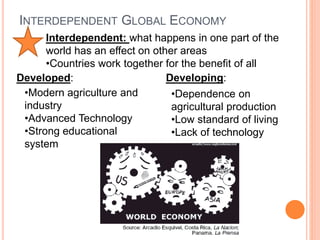
INTERDEPENDENT GLOBAL ECONOMY
Developed: Developing:
Interdependent: what happens in one part of the
world has an effect on other areas
•Countries work together for the benefit of all
•Dependence on
agricultural production
•Low standard of living
•Lack of technology
•Modern agriculture and
industry
•Advanced Technology
•Strong educational
system
ECONOMIC ORGANIZATIONS
European Union (EU) North Atlantic Free Trade
Agreement (NAFTA)
Organization of American States
(OAS)
Association of Southeast Asian
Nations (ASEAN)
Expanded free trade by
ending tariffs
25 member states
Euro is common currency
Free trade between Canada,
U.S. and Mexico (1990)
Lower trade barriers
Encourage foreign investment
Formed to strengthen
democracy, promote human
rights & confront problems
(poverty, terrorism, illegal drugs,
corruption)
Western Hemisphere (U.S.,
Canada)
Formed in 1967
Coordinates policies among
member nations (trade &
agriculture)
Example of regional cooperation
GLOBAL PROBLEMS: ENVIRONMENTAL ISSUES
 Pollution:
 contamination of the environment, including air,
water, and soil
 Acid Rain:
 rains falls through air that is contaminated by
pollution
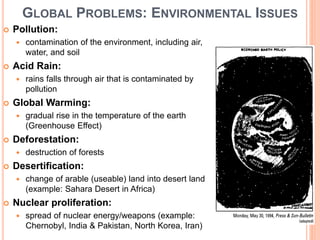
 Global Warming:
 gradual rise in the temperature of the earth
(Greenhouse Effect)
 Deforestation:
 destruction of forests
 Desertification:
 change of arable (useable) land into desert land
(example: Sahara Desert in Africa)
 Nuclear proliferation:
 spread of nuclear energy/weapons (example:
Chernobyl, India & Pakistan, North Korea, Iran)
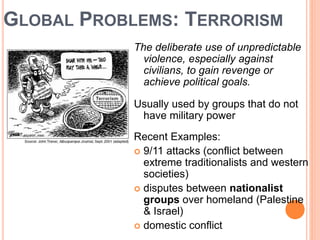
GLOBAL PROBLEMS: TERRORISM
The deliberate use of unpredictable
violence, especially against
civilians, to gain revenge or
achieve political goals.
Usually used by groups that do not
have military power
Recent Examples:
 9/11 attacks (conflict between
extreme traditionalists and western
societies)
 disputes between nationalist
groups over homeland (Palestine
& Israel)
 domestic conflict
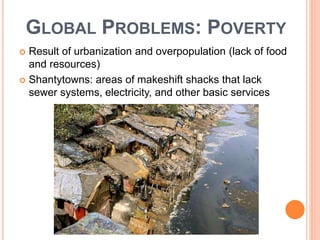
GLOBAL PROBLEMS: POVERTY
 Result of urbanization and overpopulation (lack of food
and resources)
 Shantytowns: areas of makeshift shacks that lack
sewer systems, electricity, and other basic services
GLOBAL PROBLEMS: HEALTH/MEDICINE
 People living longer: infant mortality rates , quality of
life
 Antibiotics
 Vaccines
 Transplants
 Laser surgery
 Challenges:
 Genetic Engineering
 New Epidemics: AIDS, SARS
 Rich countries have medical supplies, poor countries do not
MODERN GLOBAL REVOLUTIONS
Green Revolution
**INCREASING THE FOOD
SUPPLY**
Irrigation
Machinery
Fertilizer & Pesticides
New foods
Positive: food production;
develops new food products
Negative: depends on rainfall;
costly chemicals; small farmers
lose job
Computer Revolution
(Information revolution)
**GREAT INCREASE IN THE USE
OF COMPUTERS**
Internet; Social Media
Literacy
Positive: creates new jobs; links
people, businesses, nations;
makes more information available
Negative: expensive (only some
people can afford it); widens gap
between global North and South
AFRICA TODAY
 African countries gained independence after WWII
 Dependent on Europe for imports/manufactured goods
 Obstacles to progress:
 Population and poverty
 Political problems
 Economic dependence (on West)
 Land and climate
 Economic policies
 Ethnic tension & Nationalism
 Rwandan genocide, Darfur, Congo, Central African Republic
LATIN AMERICA TODAY
Cash-crop economies unstable; dependent
on West
Argentina – democracy
Nicaragua – Sandinistas & Contras
Mexico – gap between rich & poor, social
classes, population and poverty, urban
growth
OAS (Organization of American States)
NAFTA (North American Free Trade
Agreement)

10 A Globalized World

  • 1.
  • 2.
    INTERDEPENDENT GLOBAL ECONOMY Developed:Developing: Interdependent: what happens in one part of the world has an effect on other areas •Countries work together for the benefit of all •Dependence on agricultural production •Low standard of living •Lack of technology •Modern agriculture and industry •Advanced Technology •Strong educational system
  • 3.
    ECONOMIC ORGANIZATIONS European Union(EU) North Atlantic Free Trade Agreement (NAFTA) Organization of American States (OAS) Association of Southeast Asian Nations (ASEAN) Expanded free trade by ending tariffs 25 member states Euro is common currency Free trade between Canada, U.S. and Mexico (1990) Lower trade barriers Encourage foreign investment Formed to strengthen democracy, promote human rights & confront problems (poverty, terrorism, illegal drugs, corruption) Western Hemisphere (U.S., Canada) Formed in 1967 Coordinates policies among member nations (trade & agriculture) Example of regional cooperation
  • 4.
    GLOBAL PROBLEMS: ENVIRONMENTALISSUES  Pollution:  contamination of the environment, including air, water, and soil  Acid Rain:  rains falls through air that is contaminated by pollution  Global Warming:  gradual rise in the temperature of the earth (Greenhouse Effect)  Deforestation:  destruction of forests  Desertification:  change of arable (useable) land into desert land (example: Sahara Desert in Africa)  Nuclear proliferation:  spread of nuclear energy/weapons (example: Chernobyl, India & Pakistan, North Korea, Iran)
  • 5.
    GLOBAL PROBLEMS: TERRORISM Thedeliberate use of unpredictable violence, especially against civilians, to gain revenge or achieve political goals. Usually used by groups that do not have military power Recent Examples:  9/11 attacks (conflict between extreme traditionalists and western societies)  disputes between nationalist groups over homeland (Palestine & Israel)  domestic conflict
  • 6.
    GLOBAL PROBLEMS: POVERTY Result of urbanization and overpopulation (lack of food and resources)  Shantytowns: areas of makeshift shacks that lack sewer systems, electricity, and other basic services
  • 7.
    GLOBAL PROBLEMS: HEALTH/MEDICINE People living longer: infant mortality rates , quality of life  Antibiotics  Vaccines  Transplants  Laser surgery  Challenges:  Genetic Engineering  New Epidemics: AIDS, SARS  Rich countries have medical supplies, poor countries do not
  • 8.
    MODERN GLOBAL REVOLUTIONS GreenRevolution **INCREASING THE FOOD SUPPLY** Irrigation Machinery Fertilizer & Pesticides New foods Positive: food production; develops new food products Negative: depends on rainfall; costly chemicals; small farmers lose job Computer Revolution (Information revolution) **GREAT INCREASE IN THE USE OF COMPUTERS** Internet; Social Media Literacy Positive: creates new jobs; links people, businesses, nations; makes more information available Negative: expensive (only some people can afford it); widens gap between global North and South
  • 9.
    AFRICA TODAY  Africancountries gained independence after WWII  Dependent on Europe for imports/manufactured goods  Obstacles to progress:  Population and poverty  Political problems  Economic dependence (on West)  Land and climate  Economic policies  Ethnic tension & Nationalism  Rwandan genocide, Darfur, Congo, Central African Republic
  • 10.
    LATIN AMERICA TODAY Cash-cropeconomies unstable; dependent on West Argentina – democracy Nicaragua – Sandinistas & Contras Mexico – gap between rich & poor, social classes, population and poverty, urban growth OAS (Organization of American States) NAFTA (North American Free Trade Agreement)