GLOBAL I REVIEW #1
An Introduction to
Global History
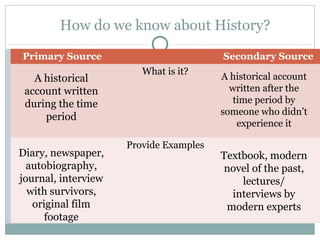
How do we know about History?
Primary Source Secondary Source
What is it?
Provide Examples
A historical
account written
during the time
period
A historical account
written after the
time period by
someone who didn’t
experience it
Diary, newspaper,
autobiography,
journal, interview
with survivors,
original film
footage
Textbook, modern
novel of the past,
lectures/
interviews by
modern experts
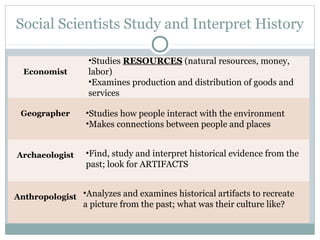
Social Scientists Study and Interpret History
Economist
Geographer
Archaeologist
Anthropologist
•Studies RESOURCES (natural resources, money,
labor)
•Examines production and distribution of goods and
services
•Studies how people interact with the environment
•Makes connections between people and places
•Find, study and interpret historical evidence from the
past; look for ARTIFACTS
•Analyzes and examines historical artifacts to recreate
a picture from the past; what was their culture like?
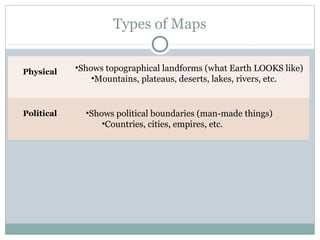
Types of Maps
Physical
Political
•Shows topographical landforms (what Earth LOOKS like)
•Mountains, plateaus, deserts, lakes, rivers, etc.
•Shows political boundaries (man-made things)
•Countries, cities, empires, etc.
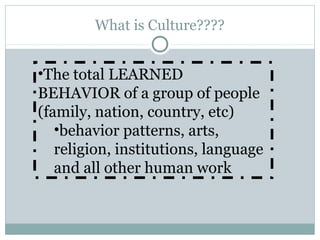
What is Culture????
•The total LEARNED
BEHAVIOR of a group of people
(family, nation, country, etc)
•behavior patterns, arts,
religion, institutions, language
and all other human work
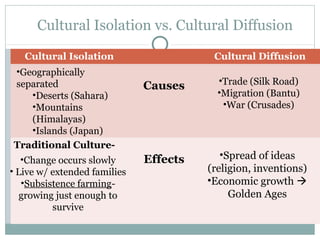
Cultural Isolation vs. Cultural Diffusion
Cultural Isolation Cultural Diffusion
Causes
Traditional Culture-
Effects
•Geographically
separated
•Deserts (Sahara)
•Mountains
(Himalayas)
•Islands (Japan)
•Trade (Silk Road)
•Migration (Bantu)
•War (Crusades)
•Change occurs slowly
• Live w/ extended families
•Subsistence farming-
growing just enough to
survive
•Spread of ideas
(religion, inventions)
•Economic growth 
Golden Ages
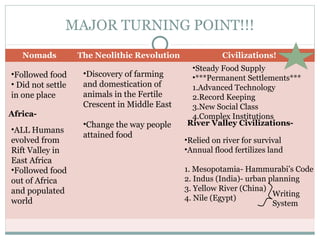
MAJOR TURNING POINT!!!
Nomads The Neolithic Revolution Civilizations!
Africa-
River Valley Civilizations-
•Followed food
• Did not settle
in one place
•ALL Humans
evolved from
Rift Valley in
East Africa
•Followed food
out of Africa
and populated
world
•Discovery of farming
and domestication of
animals in the Fertile
Crescent in Middle East
•Change the way people
attained food
•Steady Food Supply
•***Permanent Settlements***
1.Advanced Technology
2.Record Keeping
3.New Social Class
4.Complex Institutions
•Relied on river for survival
•Annual flood fertilizes land
1. Mesopotamia- Hammurabi’s Code
2. Indus (India)- urban planning
3. Yellow River (China)
4. Nile (Egypt)
Writing
System

1 intro to global

  • 1.
    GLOBAL I REVIEW#1 An Introduction to Global History
  • 2.
    How do weknow about History? Primary Source Secondary Source What is it? Provide Examples A historical account written during the time period A historical account written after the time period by someone who didn’t experience it Diary, newspaper, autobiography, journal, interview with survivors, original film footage Textbook, modern novel of the past, lectures/ interviews by modern experts
  • 3.
    Social Scientists Studyand Interpret History Economist Geographer Archaeologist Anthropologist •Studies RESOURCES (natural resources, money, labor) •Examines production and distribution of goods and services •Studies how people interact with the environment •Makes connections between people and places •Find, study and interpret historical evidence from the past; look for ARTIFACTS •Analyzes and examines historical artifacts to recreate a picture from the past; what was their culture like?
  • 4.
    Types of Maps Physical Political •Showstopographical landforms (what Earth LOOKS like) •Mountains, plateaus, deserts, lakes, rivers, etc. •Shows political boundaries (man-made things) •Countries, cities, empires, etc.
  • 5.
    What is Culture???? •Thetotal LEARNED BEHAVIOR of a group of people (family, nation, country, etc) •behavior patterns, arts, religion, institutions, language and all other human work
  • 6.
    Cultural Isolation vs.Cultural Diffusion Cultural Isolation Cultural Diffusion Causes Traditional Culture- Effects •Geographically separated •Deserts (Sahara) •Mountains (Himalayas) •Islands (Japan) •Trade (Silk Road) •Migration (Bantu) •War (Crusades) •Change occurs slowly • Live w/ extended families •Subsistence farming- growing just enough to survive •Spread of ideas (religion, inventions) •Economic growth  Golden Ages
  • 7.
    MAJOR TURNING POINT!!! NomadsThe Neolithic Revolution Civilizations! Africa- River Valley Civilizations- •Followed food • Did not settle in one place •ALL Humans evolved from Rift Valley in East Africa •Followed food out of Africa and populated world •Discovery of farming and domestication of animals in the Fertile Crescent in Middle East •Change the way people attained food •Steady Food Supply •***Permanent Settlements*** 1.Advanced Technology 2.Record Keeping 3.New Social Class 4.Complex Institutions •Relied on river for survival •Annual flood fertilizes land 1. Mesopotamia- Hammurabi’s Code 2. Indus (India)- urban planning 3. Yellow River (China) 4. Nile (Egypt) Writing System