 In European history, the Middle
Ages or Medieval period, lasted
from the 5th to the 15th century.
 It began with the collapse of
the Western Roman Empire, and was
followed by the Renaissance and
the Age of Discovery.
 It is called the Dark Age because
there were no significant discoveries
made or artworks produced, there
were no great leaders.
 The period is subdivided into the
Early, the High, and the Late Middle
Ages.
 In the 3rd century AD the Roman Empire was split into
Western Roman Empire and Eastern Roman Empire.
 Due to the constant barbaric invasions, the Western
Roman Empire fell.
 The province was split into small kingdoms as follows:
 Ostrogoths: Italian peninsula
 Visigoths: modern-day Spain
 Angles and Saxons: modern-day Britain
 Franks: central Europe
 The eastern roman empire sustained and was then called
the Byzantine empire.
 The capital of roman empire was shifted from Rome to
Constantinople
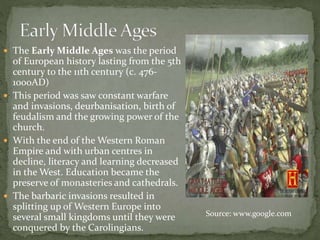
 The Early Middle Ages was the period
of European history lasting from the 5th
century to the 11th century (c. 476-
1000AD)
 This period was saw constant warfare
and invasions, deurbanisation, birth of
feudalism and the growing power of the
church.
 With the end of the Western Roman
Empire and with urban centres in
decline, literacy and learning decreased
in the West. Education became the
preserve of monasteries and cathedrals.
 The barbaric invasions resulted in
splitting up of Western Europe into
several small kingdoms until they were
conquered by the Carolingians.
Source: www.google.com
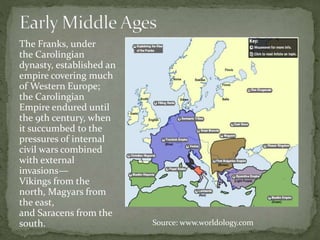
The Franks, under
the Carolingian
dynasty, established an
empire covering much
of Western Europe;
the Carolingian
Empire endured until
the 9th century, when
it succumbed to the
pressures of internal
civil wars combined
with external
invasions—
Vikings from the
north, Magyars from
the east,
and Saracens from the
south. Source: www.worldology.com
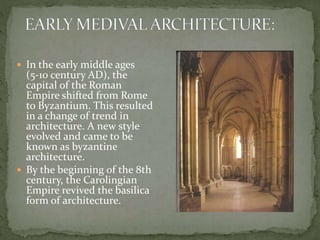
 In the early middle ages
(5-10 century AD), the
capital of the Roman
Empire shifted from Rome
to Byzantium. This resulted
in a change of trend in
architecture. A new style
evolved and came to be
known as byzantine
architecture.
 By the beginning of the 8th
century, the Carolingian
Empire revived the basilica
form of architecture.
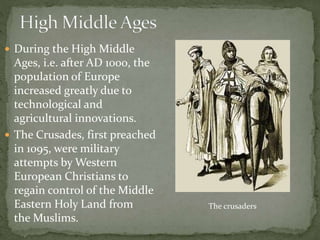
 During the High Middle
Ages, i.e. after AD 1000, the
population of Europe
increased greatly due to
technological and
agricultural innovations.
 The Crusades, first preached
in 1095, were military
attempts by Western
European Christians to
regain control of the Middle
Eastern Holy Land from
the Muslims.
The crusaders
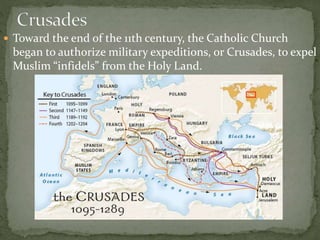
 Toward the end of the 11th century, the Catholic Church
began to authorize military expeditions, or Crusades, to expel
Muslim “infidels” from the Holy Land.
 The Crusades began in 1095 AD, when Pope Urban
summoned a Christian army to fight its way to
Jerusalem, and continued on and off until the end
of the 15th century.
 No one “won” the Crusades; in fact, many
thousands of people from both sides lost their lives.
 They made ordinary Catholics across Christendom
feel like they had a common purpose.
 They also exposed Crusaders to Islamic literature,
science and technology--exposure that would have
a lasting effect on European intellectual life.
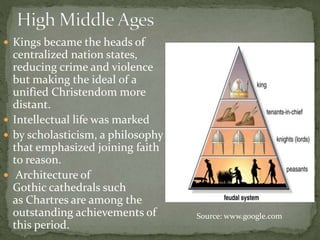
 Kings became the heads of
centralized nation states,
reducing crime and violence
but making the ideal of a
unified Christendom more
distant.
 Intellectual life was marked
 by scholasticism, a philosophy
that emphasized joining faith
to reason.
 Architecture of
Gothic cathedrals such
as Chartres are among the
outstanding achievements of
this period.
Source: www.google.com
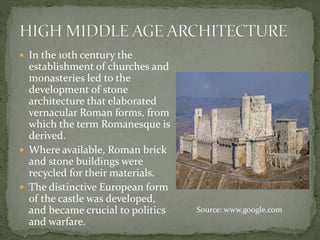
 In the 10th century the
establishment of churches and
monasteries led to the
development of stone
architecture that elaborated
vernacular Roman forms, from
which the term Romanesque is
derived.
 Where available, Roman brick
and stone buildings were
recycled for their materials.
 The distinctive European form
of the castle was developed,
and became crucial to politics
and warfare.
Source: www.google.com
 The Late Middle Ages was the period of European
history generally comprising the 14th to the 16th century (c.
1300–1500).
 A series of famines and plagues, such as the Great Famine of
1315–1317 and the Black Death, reduced the population to
around half of what it was before the calamities.
 Along with depopulation came social unrest and endemic
warfare.
 The unity of the Catholic Church was shattered by
the Western Schism.
 Printing press was discovered. Treaty of Magna Carta was the
first printed document.
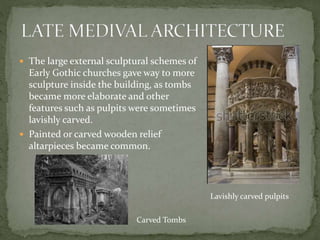
 The large external sculptural schemes of
Early Gothic churches gave way to more
sculpture inside the building, as tombs
became more elaborate and other
features such as pulpits were sometimes
lavishly carved.
 Painted or carved wooden relief
altarpieces became common.
Carved Tombs
Lavishly carved pulpits
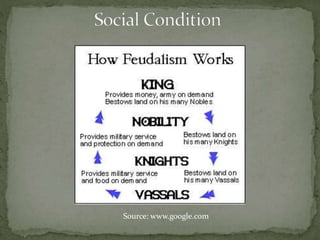
 In medieval Europe, rural life was governed by feudalism.
 A political, economic, and social system in which land
was allocated in exchange for services; roles and
obligations were clearly defined for all participants.
 Roles in the Feudal system:
1. Lord
2. Vassal
3. Fief
4. Manor
5. Serf
Source: www.google.com
 While Christianity was the dominant religion in
Medieval Europe, it was not the only one.
 In the early Middle Ages, there were some people who
still believed in the ancient Greek and Roman gods
which were popular during the time of the Roman
Empire.
 The Norse people of Scandinavia were also slow to
abandon their pagan gods and goddesses.
 Between 1000 and 1500 AD there were also a number of
people belonging to Judaism in western Europe.
 Aside from Christianity, the other major religion in
Europe during the Middle Ages (and still today), was
Islam.
Medieval Architecture
• The end of Roman Empire not only disturbed the
political, social and educational culture of Middle
Ages, but also, it influenced the architecture of the
Middle Ages in a significant manner.
• The essential aspect of this change was the
increasing influence of Christianity and Church in
political and cultural matters. The Church virtually
became the major power to manage the life style
of people of Middle Ages.
• Another significant reason that evolved various
innovative steps in architecture of the Middle Ages
was the tumultuous invasions by the barbarians
and the evolution of feudal system during the
Middle Ages.
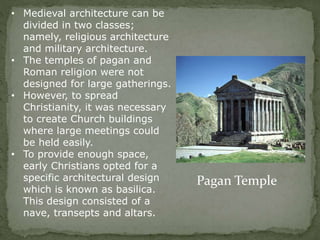
• Medieval architecture can be
divided in two classes;
namely, religious architecture
and military architecture.
• The temples of pagan and
Roman religion were not
designed for large gatherings.
• However, to spread
Christianity, it was necessary
to create Church buildings
where large meetings could
be held easily.
• To provide enough space,
early Christians opted for a
specific architectural design
which is known as basilica.
This design consisted of a
nave, transepts and altars.
Pagan Temple
Source: www.google.com
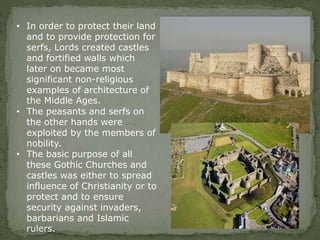
• In order to protect their land
and to provide protection for
serfs, Lords created castles
and fortified walls which
later on became most
significant non-religious
examples of architecture of
the Middle Ages.
• The peasants and serfs on
the other hands were
exploited by the members of
nobility.
• The basic purpose of all
these Gothic Churches and
castles was either to spread
influence of Christianity or to
protect and to ensure
security against invaders,
barbarians and Islamic
rulers.
• With changing influences of Church and
feudalism, architectural styles of Middle Ages
gradually changed from Romanesque architecture
to Gothic architecture.
• During the early Middle Ages, most of the
innovative architectural styles were influenced by
modernization as architectural works were
influenced by Italian, northern, Spanish, and
Byzantine inputs. These architectural styles also
showed the impact of religious and political
competition between kings and the clergy
 It is the architecture of the Byzantine or later
Roman Empire.
 Early Byzantine architecture was a
continuation of Roman architecture.
 Technological advancement and political and
territorial changes meant that a distinct style
gradually emerged which imbibed certain
influences from the Near East and used the
Greek cross plan in churches.
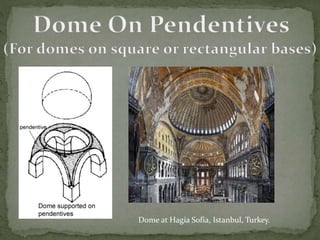
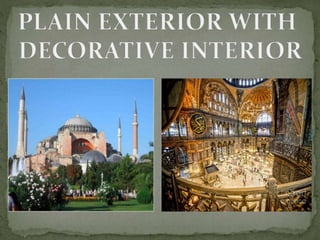
Dome at Hagia Sofia, Istanbul, Turkey.
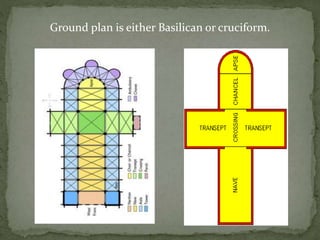
Ground plan is either Basilican or cruciform.
Principal building material was
brick arranged in decorative
patterns or covered in plaster.
Columns and capitals were classical
prototypes.
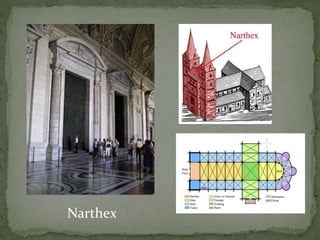
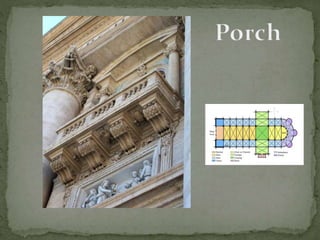
Narthex
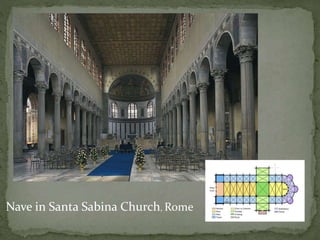
Nave in Santa Sabina Church, Rome
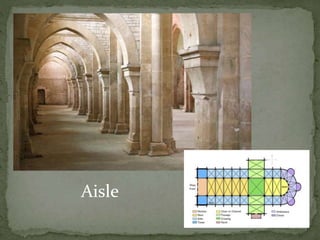
Aisle
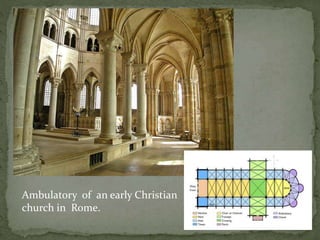
Ambulatory of an early Christian
church in Rome.
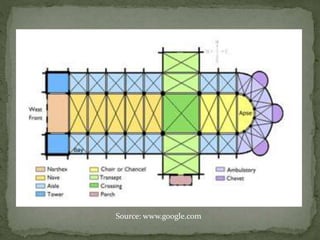
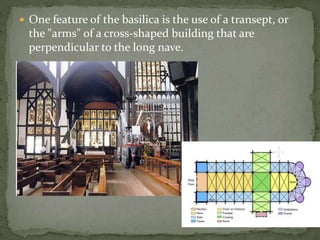
 One feature of the basilica is the use of a transept, or
the "arms" of a cross-shaped building that are
perpendicular to the long nave.
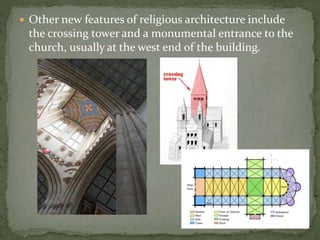
 Other new features of religious architecture include
the crossing tower and a monumental entrance to the
church, usually at the west end of the building.
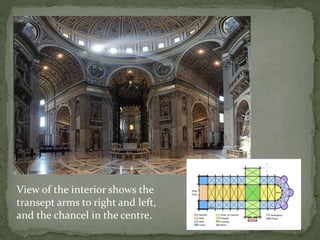
View of the interior shows the
transept arms to right and left,
and the chancel in the centre.
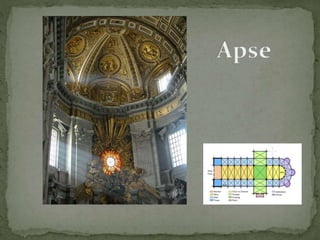
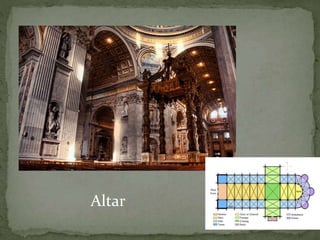
Altar
Piazza dei Miracoli, Italy
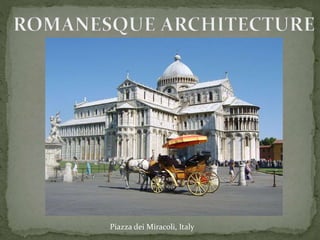
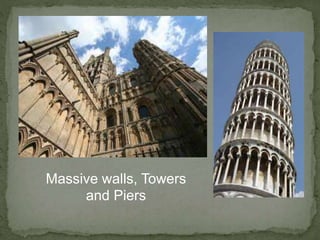
• Romanesque architectural style was influenced by Roman
architecture with significant modernizing techniques.
• This architectural style was used during 800-1100 A.D.
• Stone used in Romanesque architecture was cut with
precision
• The use of the Roman arch led to the stone being supported
in the middle by the arch construction.
• Buttresses were introduced as a means of support to the
basic design in Romanesque architecture in Medieval Times.
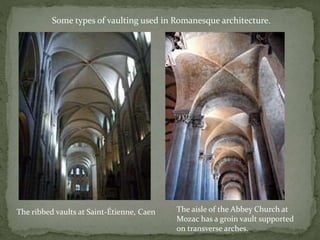
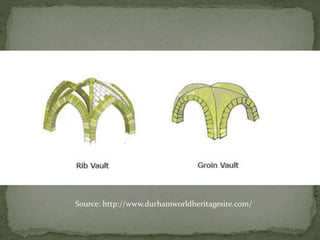
• The vault was developed to enable the construction of stone
roofs. Barrel or Tunnel Vaults - consisted of a continuous
surface of semicircular or pointed sections resembling a
barrel or tunnel which has been cut in half lengthwise. Groin
Vaults were produced by the intersection, at right angles of
two barrel vaults. The arches of groin vaults were either
pointed or round.
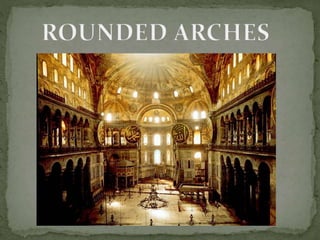
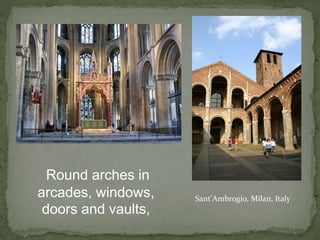
Round arches in
arcades, windows,
doors and vaults,
Sant'Ambrogio, Milan, Italy
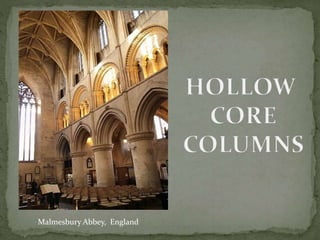
Malmesbury Abbey, England
Massive walls, Towers
and Piers
Some types of vaulting used in Romanesque architecture.
The ribbed vaults at Saint-Étienne, Caen The aisle of the Abbey Church at
Mozac has a groin vault supported
on transverse arches.
Source: http://www.durhamworldheritagesite.com/
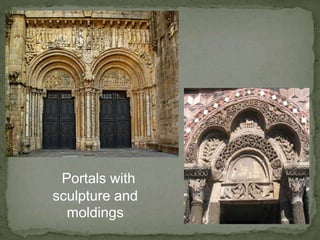
Portals with
sculpture and
moldings
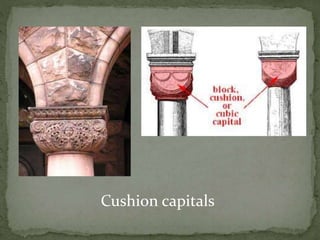
Cushion capitals
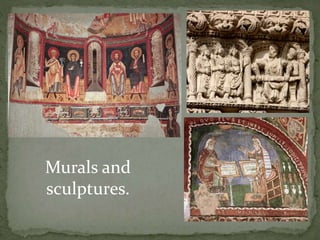
Murals and
sculptures.
• Gradually, architecture of the Middle Ages went
through a significant change and constructors
started to produce building with perpendicular
architecture which is also known as the Gothic
architecture.
• This building and construction style was used
during the period of 1200 – 1500 A. D. Gothic
arch structures were light and spacious and they
helped in creating airy structures that helped in
creating high structures with proper light.
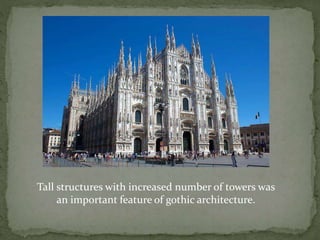
Tall structures with increased number of towers was
an important feature of gothic architecture.
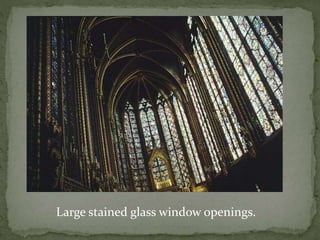
Large stained glass window openings.
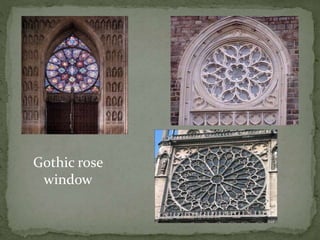
Gothic rose
window
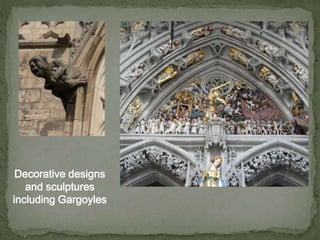
Decorative designs
and sculptures
including Gargoyles
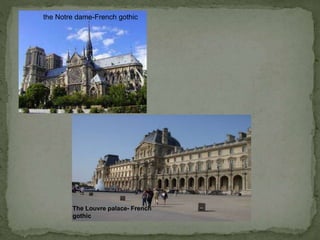
the Notre dame-French gothic
The Louvre palace- French
gothic
• Flying Buttresses
• Stained glass windows
• Pointed arch
• Rib vaults
• Pinnacles
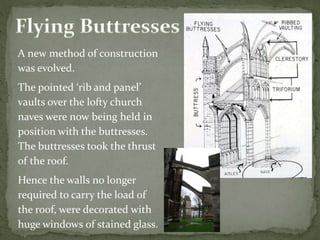
A new method of construction
was evolved.
The pointed ‘rib and panel’
vaults over the lofty church
naves were now being held in
position with the buttresses.
The buttresses took the thrust
of the roof.
Hence the walls no longer
required to carry the load of
the roof, were decorated with
huge windows of stained glass.
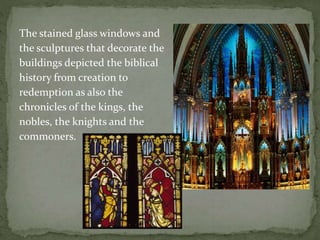
The stained glass windows and
the sculptures that decorate the
buildings depicted the biblical
history from creation to
redemption as also the
chronicles of the kings, the
nobles, the knights and the
commoners.
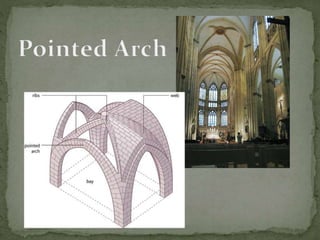
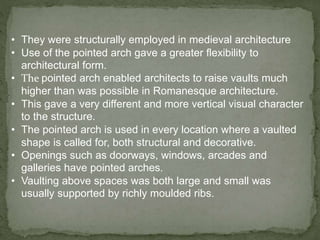
• They were structurally employed in medieval architecture
• Use of the pointed arch gave a greater flexibility to
architectural form.
• The pointed arch enabled architects to raise vaults much
higher than was possible in Romanesque architecture.
• This gave a very different and more vertical visual character
to the structure.
• The pointed arch is used in every location where a vaulted
shape is called for, both structural and decorative.
• Openings such as doorways, windows, arcades and
galleries have pointed arches.
• Vaulting above spaces was both large and small was
usually supported by richly moulded ribs.
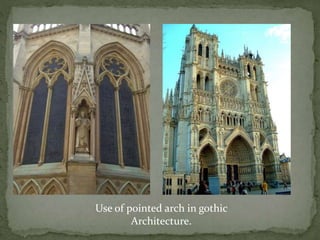
Use of pointed arch in gothic
Architecture.
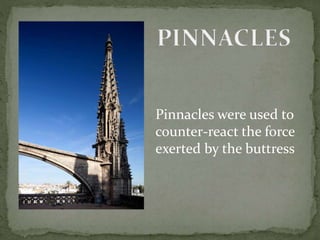
Pinnacles were used to
counter-react the force
exerted by the buttress
Summary
• In the early middle ages , the European kingdoms were in the state of constant
warfare.
• The end of the united roman empire disturbed the political ,social, cultural
stability.
• The art ,architecture, and science during the early medieval era, hence did not
have
• any innovations
• Although ,the byzantine empire sustained, and the capital of the Roman
Empire shifted from Rome to Byzantium. This resulted in a change of trend
in architecture. A new style evolved and came to be known as byzantine
architecture.
• Christianity was a new force in the medieval age. Christian faith was first
spread throughout the Roman Empire and then to the extremities of the
civilized world.
• The acceptance of Christianity as a state religion resulted in the construction
of churches in Rome.
• In the tenth, eleventh and twelfth centuries many churches,
cathedrals, monasteries, castles were erected.
• In the new nations of Europe, a new architectural style was seen
in the buildings. This style was an evolution from the late roman
architecture and hence came to be known as Romanesque
architecture.
• The religious enthusiasm that manifested in the crusades, led to
marvelous architectural developments during the high middle
ages.
• These were in turn evolved from the existing Romanesque style
and came to be known as gothic.
• The wealth and power of the clergy and the popular religious
fervor was responsible for the outburst of the construction of
churches during the late medieval europe.
THANKYOU
SHREEYA DATE 17
MINOTI DESAI 22
POONAM DODIA 26
DIVYA KACHA 43
CHAITALI KHUTALE 52
MANASI KORDE 55
MRUNAL KULKARNI 58
ANJALI MAKHELA 63

Medieval europe (1)

  • 2.
     In Europeanhistory, the Middle Ages or Medieval period, lasted from the 5th to the 15th century.  It began with the collapse of the Western Roman Empire, and was followed by the Renaissance and the Age of Discovery.  It is called the Dark Age because there were no significant discoveries made or artworks produced, there were no great leaders.  The period is subdivided into the Early, the High, and the Late Middle Ages.
  • 3.
     In the3rd century AD the Roman Empire was split into Western Roman Empire and Eastern Roman Empire.  Due to the constant barbaric invasions, the Western Roman Empire fell.  The province was split into small kingdoms as follows:  Ostrogoths: Italian peninsula  Visigoths: modern-day Spain  Angles and Saxons: modern-day Britain  Franks: central Europe  The eastern roman empire sustained and was then called the Byzantine empire.  The capital of roman empire was shifted from Rome to Constantinople
  • 4.
     The EarlyMiddle Ages was the period of European history lasting from the 5th century to the 11th century (c. 476- 1000AD)  This period was saw constant warfare and invasions, deurbanisation, birth of feudalism and the growing power of the church.  With the end of the Western Roman Empire and with urban centres in decline, literacy and learning decreased in the West. Education became the preserve of monasteries and cathedrals.  The barbaric invasions resulted in splitting up of Western Europe into several small kingdoms until they were conquered by the Carolingians. Source: www.google.com
  • 5.
    The Franks, under theCarolingian dynasty, established an empire covering much of Western Europe; the Carolingian Empire endured until the 9th century, when it succumbed to the pressures of internal civil wars combined with external invasions— Vikings from the north, Magyars from the east, and Saracens from the south. Source: www.worldology.com
  • 6.
     In theearly middle ages (5-10 century AD), the capital of the Roman Empire shifted from Rome to Byzantium. This resulted in a change of trend in architecture. A new style evolved and came to be known as byzantine architecture.  By the beginning of the 8th century, the Carolingian Empire revived the basilica form of architecture.
  • 7.
     During theHigh Middle Ages, i.e. after AD 1000, the population of Europe increased greatly due to technological and agricultural innovations.  The Crusades, first preached in 1095, were military attempts by Western European Christians to regain control of the Middle Eastern Holy Land from the Muslims. The crusaders
  • 8.
     Toward theend of the 11th century, the Catholic Church began to authorize military expeditions, or Crusades, to expel Muslim “infidels” from the Holy Land.
  • 9.
     The Crusadesbegan in 1095 AD, when Pope Urban summoned a Christian army to fight its way to Jerusalem, and continued on and off until the end of the 15th century.  No one “won” the Crusades; in fact, many thousands of people from both sides lost their lives.  They made ordinary Catholics across Christendom feel like they had a common purpose.  They also exposed Crusaders to Islamic literature, science and technology--exposure that would have a lasting effect on European intellectual life.
  • 10.
     Kings becamethe heads of centralized nation states, reducing crime and violence but making the ideal of a unified Christendom more distant.  Intellectual life was marked  by scholasticism, a philosophy that emphasized joining faith to reason.  Architecture of Gothic cathedrals such as Chartres are among the outstanding achievements of this period. Source: www.google.com
  • 11.
     In the10th century the establishment of churches and monasteries led to the development of stone architecture that elaborated vernacular Roman forms, from which the term Romanesque is derived.  Where available, Roman brick and stone buildings were recycled for their materials.  The distinctive European form of the castle was developed, and became crucial to politics and warfare. Source: www.google.com
  • 12.
     The LateMiddle Ages was the period of European history generally comprising the 14th to the 16th century (c. 1300–1500).  A series of famines and plagues, such as the Great Famine of 1315–1317 and the Black Death, reduced the population to around half of what it was before the calamities.  Along with depopulation came social unrest and endemic warfare.  The unity of the Catholic Church was shattered by the Western Schism.  Printing press was discovered. Treaty of Magna Carta was the first printed document.
  • 13.
     The largeexternal sculptural schemes of Early Gothic churches gave way to more sculpture inside the building, as tombs became more elaborate and other features such as pulpits were sometimes lavishly carved.  Painted or carved wooden relief altarpieces became common. Carved Tombs Lavishly carved pulpits
  • 14.
     In medievalEurope, rural life was governed by feudalism.  A political, economic, and social system in which land was allocated in exchange for services; roles and obligations were clearly defined for all participants.  Roles in the Feudal system: 1. Lord 2. Vassal 3. Fief 4. Manor 5. Serf
  • 15.
  • 16.
     While Christianitywas the dominant religion in Medieval Europe, it was not the only one.  In the early Middle Ages, there were some people who still believed in the ancient Greek and Roman gods which were popular during the time of the Roman Empire.  The Norse people of Scandinavia were also slow to abandon their pagan gods and goddesses.  Between 1000 and 1500 AD there were also a number of people belonging to Judaism in western Europe.  Aside from Christianity, the other major religion in Europe during the Middle Ages (and still today), was Islam.
  • 17.
    Medieval Architecture • Theend of Roman Empire not only disturbed the political, social and educational culture of Middle Ages, but also, it influenced the architecture of the Middle Ages in a significant manner. • The essential aspect of this change was the increasing influence of Christianity and Church in political and cultural matters. The Church virtually became the major power to manage the life style of people of Middle Ages. • Another significant reason that evolved various innovative steps in architecture of the Middle Ages was the tumultuous invasions by the barbarians and the evolution of feudal system during the Middle Ages.
  • 18.
    • Medieval architecturecan be divided in two classes; namely, religious architecture and military architecture. • The temples of pagan and Roman religion were not designed for large gatherings. • However, to spread Christianity, it was necessary to create Church buildings where large meetings could be held easily. • To provide enough space, early Christians opted for a specific architectural design which is known as basilica. This design consisted of a nave, transepts and altars. Pagan Temple
  • 19.
  • 20.
    • In orderto protect their land and to provide protection for serfs, Lords created castles and fortified walls which later on became most significant non-religious examples of architecture of the Middle Ages. • The peasants and serfs on the other hands were exploited by the members of nobility. • The basic purpose of all these Gothic Churches and castles was either to spread influence of Christianity or to protect and to ensure security against invaders, barbarians and Islamic rulers.
  • 21.
    • With changinginfluences of Church and feudalism, architectural styles of Middle Ages gradually changed from Romanesque architecture to Gothic architecture. • During the early Middle Ages, most of the innovative architectural styles were influenced by modernization as architectural works were influenced by Italian, northern, Spanish, and Byzantine inputs. These architectural styles also showed the impact of religious and political competition between kings and the clergy
  • 22.
     It isthe architecture of the Byzantine or later Roman Empire.  Early Byzantine architecture was a continuation of Roman architecture.  Technological advancement and political and territorial changes meant that a distinct style gradually emerged which imbibed certain influences from the Near East and used the Greek cross plan in churches.
  • 24.
    Dome at HagiaSofia, Istanbul, Turkey.
  • 28.
    Ground plan iseither Basilican or cruciform.
  • 29.
    Principal building materialwas brick arranged in decorative patterns or covered in plaster. Columns and capitals were classical prototypes.
  • 31.
  • 32.
    Nave in SantaSabina Church, Rome
  • 33.
  • 34.
    Ambulatory of anearly Christian church in Rome.
  • 35.
     One featureof the basilica is the use of a transept, or the "arms" of a cross-shaped building that are perpendicular to the long nave.
  • 36.
     Other newfeatures of religious architecture include the crossing tower and a monumental entrance to the church, usually at the west end of the building.
  • 37.
    View of theinterior shows the transept arms to right and left, and the chancel in the centre.
  • 38.
  • 41.
  • 42.
    • Romanesque architecturalstyle was influenced by Roman architecture with significant modernizing techniques. • This architectural style was used during 800-1100 A.D. • Stone used in Romanesque architecture was cut with precision • The use of the Roman arch led to the stone being supported in the middle by the arch construction. • Buttresses were introduced as a means of support to the basic design in Romanesque architecture in Medieval Times. • The vault was developed to enable the construction of stone roofs. Barrel or Tunnel Vaults - consisted of a continuous surface of semicircular or pointed sections resembling a barrel or tunnel which has been cut in half lengthwise. Groin Vaults were produced by the intersection, at right angles of two barrel vaults. The arches of groin vaults were either pointed or round.
  • 43.
    Round arches in arcades,windows, doors and vaults, Sant'Ambrogio, Milan, Italy
  • 44.
  • 45.
  • 46.
    Some types ofvaulting used in Romanesque architecture. The ribbed vaults at Saint-Étienne, Caen The aisle of the Abbey Church at Mozac has a groin vault supported on transverse arches.
  • 47.
  • 48.
  • 49.
  • 50.
  • 51.
    • Gradually, architectureof the Middle Ages went through a significant change and constructors started to produce building with perpendicular architecture which is also known as the Gothic architecture. • This building and construction style was used during the period of 1200 – 1500 A. D. Gothic arch structures were light and spacious and they helped in creating airy structures that helped in creating high structures with proper light.
  • 53.
    Tall structures withincreased number of towers was an important feature of gothic architecture.
  • 54.
    Large stained glasswindow openings.
  • 55.
  • 56.
  • 57.
    the Notre dame-Frenchgothic The Louvre palace- French gothic
  • 58.
    • Flying Buttresses •Stained glass windows • Pointed arch • Rib vaults • Pinnacles
  • 59.
    A new methodof construction was evolved. The pointed ‘rib and panel’ vaults over the lofty church naves were now being held in position with the buttresses. The buttresses took the thrust of the roof. Hence the walls no longer required to carry the load of the roof, were decorated with huge windows of stained glass.
  • 60.
    The stained glasswindows and the sculptures that decorate the buildings depicted the biblical history from creation to redemption as also the chronicles of the kings, the nobles, the knights and the commoners.
  • 62.
    • They werestructurally employed in medieval architecture • Use of the pointed arch gave a greater flexibility to architectural form. • The pointed arch enabled architects to raise vaults much higher than was possible in Romanesque architecture. • This gave a very different and more vertical visual character to the structure. • The pointed arch is used in every location where a vaulted shape is called for, both structural and decorative. • Openings such as doorways, windows, arcades and galleries have pointed arches. • Vaulting above spaces was both large and small was usually supported by richly moulded ribs.
  • 63.
    Use of pointedarch in gothic Architecture.
  • 65.
    Pinnacles were usedto counter-react the force exerted by the buttress
  • 66.
    Summary • In theearly middle ages , the European kingdoms were in the state of constant warfare. • The end of the united roman empire disturbed the political ,social, cultural stability. • The art ,architecture, and science during the early medieval era, hence did not have • any innovations • Although ,the byzantine empire sustained, and the capital of the Roman Empire shifted from Rome to Byzantium. This resulted in a change of trend in architecture. A new style evolved and came to be known as byzantine architecture. • Christianity was a new force in the medieval age. Christian faith was first spread throughout the Roman Empire and then to the extremities of the civilized world. • The acceptance of Christianity as a state religion resulted in the construction of churches in Rome.
  • 67.
    • In thetenth, eleventh and twelfth centuries many churches, cathedrals, monasteries, castles were erected. • In the new nations of Europe, a new architectural style was seen in the buildings. This style was an evolution from the late roman architecture and hence came to be known as Romanesque architecture. • The religious enthusiasm that manifested in the crusades, led to marvelous architectural developments during the high middle ages. • These were in turn evolved from the existing Romanesque style and came to be known as gothic. • The wealth and power of the clergy and the popular religious fervor was responsible for the outburst of the construction of churches during the late medieval europe.
  • 68.
    THANKYOU SHREEYA DATE 17 MINOTIDESAI 22 POONAM DODIA 26 DIVYA KACHA 43 CHAITALI KHUTALE 52 MANASI KORDE 55 MRUNAL KULKARNI 58 ANJALI MAKHELA 63

Editor's Notes

  • #7 Few large stone buildings were constructed between the Constantinian basilicas of the 4th century and the 8th century, although many smaller ones were built during the 6th and 7th centuries.
  • #9 Crusaders, who wore red crosses on their coats to advertise their status, believed that their service would guarantee the remission of their sins and ensure that they could spend all eternity in Heaven. They also received more worldly rewards, such as papal protection of their property and forgiveness of some kinds of loan payments.
  • #13 Schism-division into 2 groups because of different ideology.
  • #15 Grew out of Roman practices of clientage/patronage--Originally developed as a means of protection and defense— Lord—A landowner, usually a noble, although sometimes lords were bishops Vassal—A person (usually a soldier) given a piece of land by the lord Fief—The land itself that is given Manor (sometimes referred to in the context of the “manorial system”)—A basic unit of land, usually big enough for the supervision of a single noble or knight Serf—Though it technically translates as “slave,” the word “serf” (often used interchangeably with “peasant”) refers to a worker on the lord’s manor. Though not truly slaves, serfs had no legal rights and were compelled to work on their assigned land.
  • #25 A pendentive is a constructive device permitting the placing of a circular dome over a square room or an elliptical dome over a rectangular room. The pendentives, which are triangular segments of a sphere, taper to points at the bottom and spread at the top to establish the continuous circular or elliptical base needed for the dome. In masonry the pendentives thus receive the weight of the dome, concentrating it at the four corners where it can be received by the piers beneath.
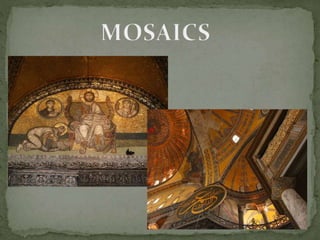
  • #27 Extensive use of glass mosaics The mosaics in Hagia Sophia were painted over by the Muslims after they took over Constantinople(Istanbul) because they showed graphic human figures and it went against their beliefs.
  • #29 Or hexagonal or circular
  • #30 No human figures in Byzantine decorations. Decorative features were scrolls, circles and other geometric forms depicting leaves and flowers.
  • #31 Basilican architecture was revived by Carolingian emporer Charlemagne in 8th century AD
  • #34 Walkway that merges into the ambulatory and forms a processional pathway around the church.
  • #35 ambulatory,  in architecture, continuation of the aisled spaces on either side of the nave (central part of the church) around the apse (semicircular projection at the east end of the church) or chancel (east end of the church where the main altar stands) to form a continuous processional way.
  • #36 It forms a crucifix with the nave as it is at right angles with it.
  • #37 It is the dark green area where the transept intersects with the nave of the church. It is intricately decorated
  • #39 Relics of the popes are buried below the altar
  • #41 Also called the portico. The porch is used by the pope for giving sermons to the crowds.
  • #48 Rib vaults have pointed arches and groin vaults have rounded arches
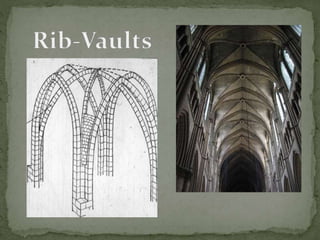
  • #65 Six interlocking arches form the ribs of the vault. This sturdy but light weight structure was filled up with stone slabs to complete the enclosure.