
“Christendom I”
Post Classical Western Europe
By: Janet Pareja for AP World History, 2015
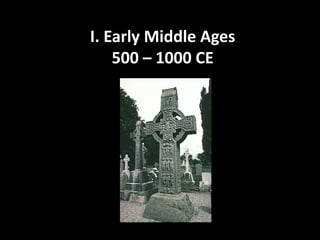
I. Early Middle Ages
500 – 1000 CE
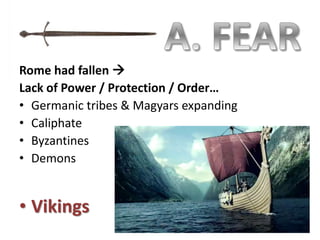
Rome had fallen 
Lack of Power / Protection / Order…
• Germanic tribes & Magyars expanding
• Caliphate
• Byzantines
• Demons
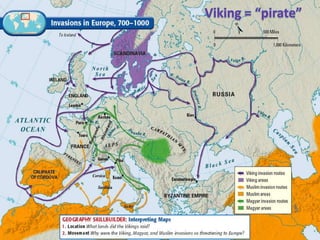
• Vikings
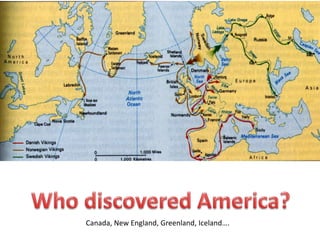
Canada, New England, Greenland, Iceland….
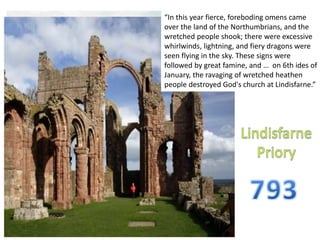
“In this year fierce, foreboding omens came
over the land of the Northumbrians, and the
wretched people shook; there were excessive
whirlwinds, lightning, and fiery dragons were
seen flying in the sky. These signs were
followed by great famine, and … on 6th ides of
January, the ravaging of wretched heathen
people destroyed God's church at Lindisfarne.”
16 mph
100 warriors
Silent under sail / oars
Wolfpacks
Sea-safe, estuaries, landing
Solarsteinn – “sunstone” to navigate /
presence of whales, birds.
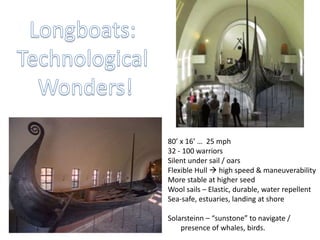
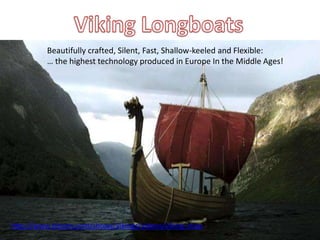
80’ x 16’ … 25 mph
32 - 100 warriors
Silent under sail / oars
Flexible Hull  high speed & maneuverability
More stable at higher seed
Wool sails – Elastic, durable, water repellent
Sea-safe, estuaries, landing at shore
Solarsteinn – “sunstone” to navigate /
presence of whales, birds.
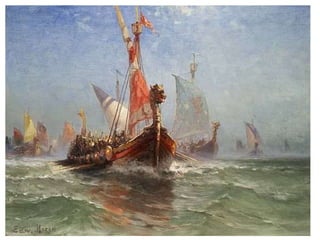
Beautifully crafted, Silent, Fast, Shallow-keeled and Flexible:
… the highest technology produced in Europe In the Middle Ages!
http://www.history.com/shows/vikings/videos/viking-ships
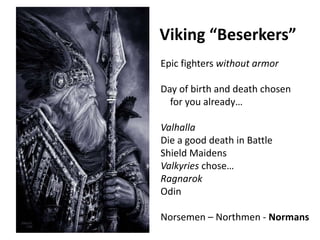
Viking “Beserkers”
Epic fighters without armor
Day of birth and death chosen
for you already…
Valhalla
Die a good death in Battle
Shield Maidens
Valkyries chose…
Ragnarok
Odin
Norsemen – Northmen - Normans
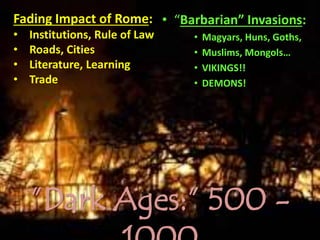
”Dark Ages:” 500 -
• “Barbarian” Invasions:
• Magyars, Huns, Goths,
• Muslims, Mongols…
• VIKINGS!!
• DEMONS!
Fading Impact of Rome:
• Institutions, Rule of Law
• Roads, Cities
• Literature, Learning
• Trade
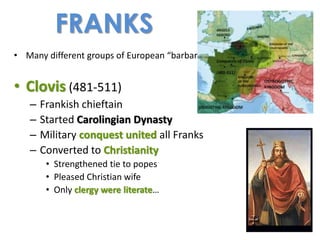
FRANKS
• Many different groups of European “barbarians”
• Clovis (481-511)
– Frankish chieftain
– Started Carolingian Dynasty
– Military conquest united all Franks
– Converted to Christianity
• Strengthened tie to popes
• Pleased Christian wife
• Only clergy were literate…
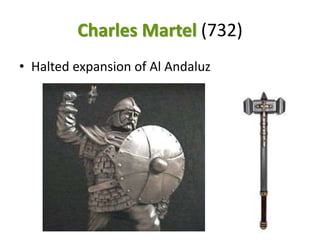
Charles Martel (732)
• Halted expansion of Al Andaluz
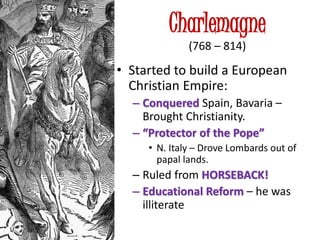
Charlemagne
(768 – 814)
• Started to build a European
Christian Empire:
– Conquered Spain, Bavaria –
Brought Christianity.
– “Protector of the Pope”
• N. Italy – Drove Lombards out of
papal lands.
– Ruled from HORSEBACK!
– Educational Reform – he was
illiterate
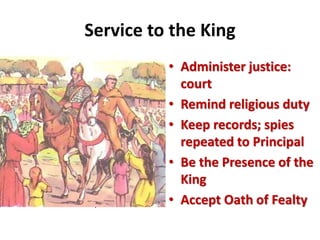
Service to the King
• Counts (comte) – Counties
– General in each county
• MISSI DOMENICI
– Envoys for the Ruler,
Hand chosen.
– 1 Year appointment
– Traveled in County in pairs
– Personal Character
– Isolated from local
interests so impartial
• Administer justice:
court
• Remind religious duty
• Keep records; spies
repeated to Principal
• Be the Presence of the
King
• Accept Oath of Fealty
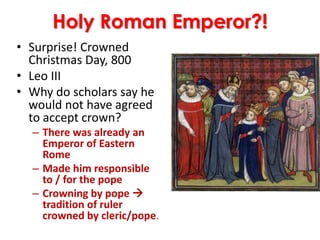
Holy Roman Emperor?!
• Surprise! Crowned
Christmas Day, 800
• Leo III
• Why do scholars say he
would not have agreed
to accept crown?
– There was already an
Emperor of Eastern
Rome
– Made him responsible
to / for the pope
– Crowning by pope 
tradition of ruler
crowned by cleric/pope.
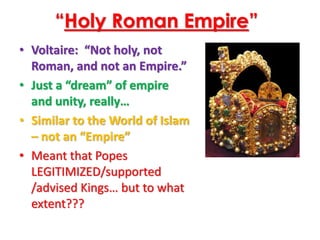
“Holy Roman Empire”
• Voltaire: “Not holy, not
Roman, and not an Empire.”
• Just a “dream” of empire
and unity, really…
• Similar to the World of Islam
– not an “Empire”
• Meant that Popes
LEGITIMIZED/supported
/advised Kings… but to what
extent???
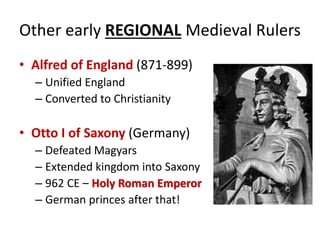
Other early REGIONAL Medieval Rulers
• Alfred of England (871-899)
– Unified England
– Converted to Christianity
• Otto I of Saxony (Germany)
– Defeated Magyars
– Extended kingdom into Saxony
– 962 CE – Holy Roman Emperor
– German princes after that!
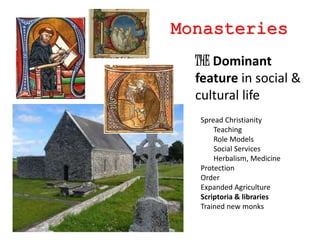
Monasteries
THE Dominant
feature in social &
cultural life
Spread Christianity
Teaching
Role Models
Social Services
Herbalism, Medicine
Protection
Order
Expanded Agriculture
Scriptoria & libraries
Trained new monks
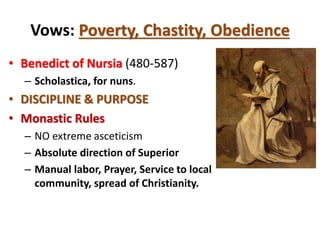
Vows: Poverty, Chastity, Obedience
• Benedict of Nursia (480-587)
– Scholastica, for nuns.
• DISCIPLINE & PURPOSE
• Monastic Rules
– NO extreme asceticism
– Absolute direction of Superior
– Manual labor, Prayer, Service to local
community, spread of Christianity.
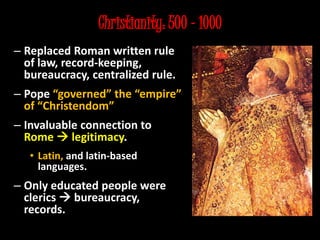
Christianity: 500 – 1000
– Replaced Roman written rule
of law, record-keeping,
bureaucracy, centralized rule.
– Pope “governed” the “empire”
of “Christendom”
– Invaluable connection to
Rome  legitimacy.
• Latin, and latin-based
languages.
– Only educated people were
clerics  bureaucracy,
records.
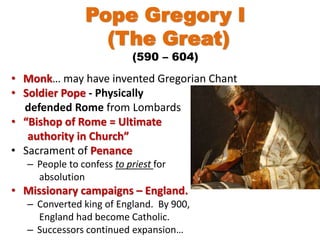
Pope Gregory I
(The Great)
(590 – 604)
• Monk… may have invented Gregorian Chant
• Soldier Pope - Physically
defended Rome from Lombards
• “Bishop of Rome = Ultimate
authority in Church”
• Sacrament of Penance
– People to confess to priest for
absolution
• Missionary campaigns – England.
– Converted king of England. By 900,
England had become Catholic.
– Successors continued expansion…
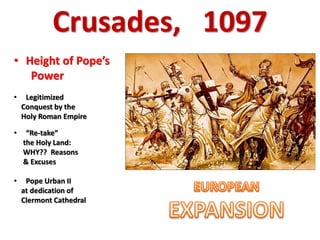
Crusades, 1097
• Height of Pope’s
Power
• Legitimized
Conquest by the
Holy Roman Empire
• “Re-take”
the Holy Land:
WHY?? Reasons
& Excuses
• Pope Urban II
at dedication of
Clermont Cathedral
4. Medieval Power and
Leadership resided in
BOTH
Church and Manor…
Political, Social and Religious
organization over lapped.
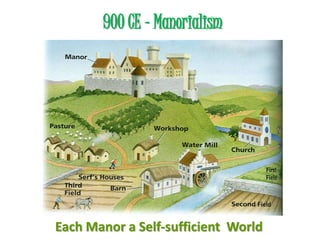
900 CE - Manorialism
• Manor
Each Manor a Self-sufficient World
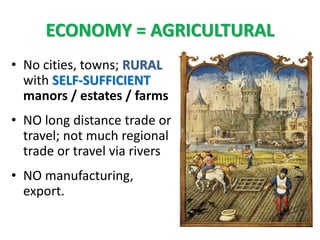
ECONOMY = AGRICULTURAL
• No cities, towns; RURAL
with SELF-SUFFICIENT
manors / estates / farms
• NO long distance trade or
travel; not much regional
trade or travel via rivers
• NO manufacturing,
export.
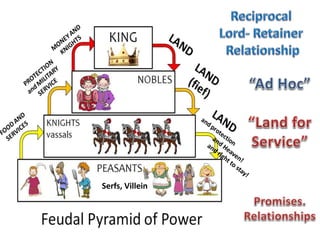
Serfs, Villein
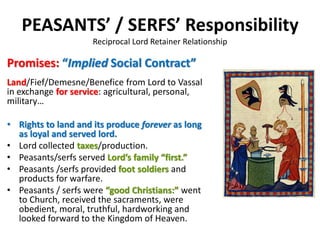
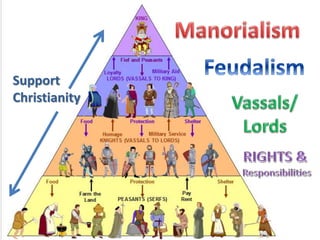
PEASANTS’ / SERFS’ Responsibility
Reciprocal Lord Retainer Relationship
Promises: “Implied Social Contract”
Land/Fief/Demesne/Benefice from Lord to Vassal
in exchange for service: agricultural, personal,
military…
• Rights to land and its produce forever as long
as loyal and served lord.
• Lord collected taxes/production.
• Peasants/serfs served Lord’s family “first.”
• Peasants /serfs provided foot soldiers and
products for warfare.
• Peasants / serfs were “good Christians:” went
to Church, received the sacraments, were
obedient, moral, truthful, hardworking and
looked forward to the Kingdom of Heaven.
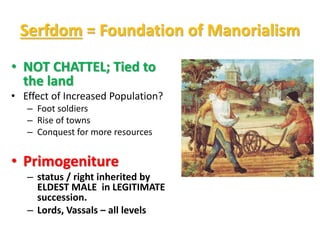
Serfdom = Foundation of Manorialism
• NOT CHATTEL; Tied to
the land
• Effect of Increased Population?
– Foot soldiers
– Rise of towns
– Conquest for more resources
• Primogeniture
– status / right inherited by
ELDEST MALE in LEGITIMATE
succession.
– Lords, Vassals – all levels
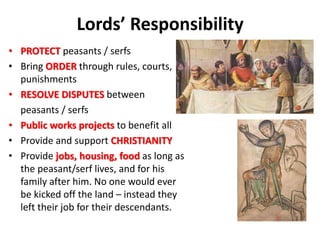
Lords’ Responsibility
• PROTECT peasants / serfs
• Bring ORDER through rules, courts,
punishments
• RESOLVE DISPUTES between
peasants / serfs
• Public works projects to benefit all
• Provide and support CHRISTIANITY
• Provide jobs, housing, food as long as
the peasant/serf lives, and for his
family after him. No one would ever
be kicked off the land – instead they
left their job for their descendants.
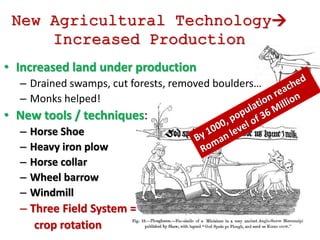
New Agricultural Technology
Increased Production
• Increased land under production
– Drained swamps, cut forests, removed boulders…
– Monks helped!
• New tools / techniques:
– Horse Shoe
– Heavy iron plow
– Horse collar
– Wheel barrow
– Windmill
– Three Field System =
crop rotation
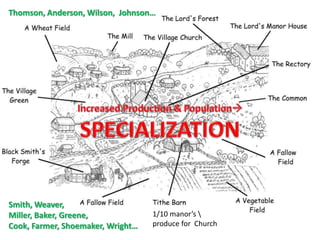
1/10 manor’s 
produce for Church
Smith, Weaver,
Miller, Baker, Greene,
Cook, Farmer, Shoemaker, Wright…
Thomson, Anderson, Wilson, Johnson…
Support
Christianity
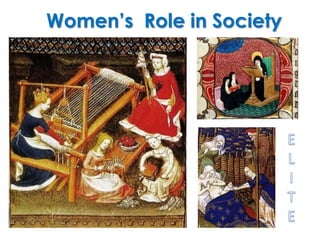
Women’s Role in Society
Intellectual Pursuits
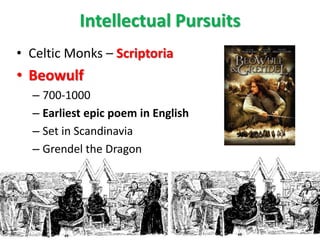
• Celtic Monks – Scriptoria
• Beowulf
– 700-1000
– Earliest epic poem in English
– Set in Scandinavia
– Grendel the Dragon
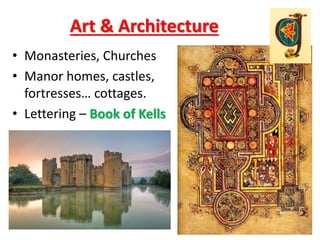
Art & Architecture
• Monasteries, Churches
• Manor homes, castles,
fortresses… cottages.
• Lettering – Book of Kells
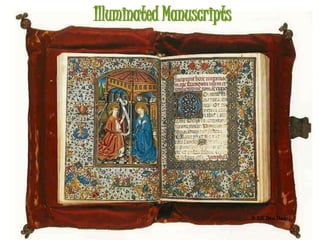
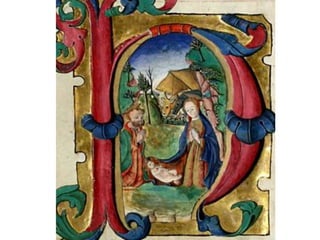
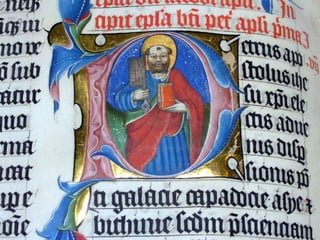
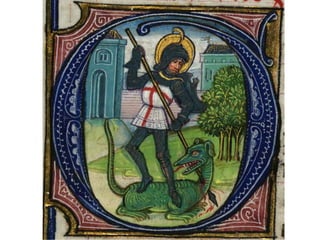
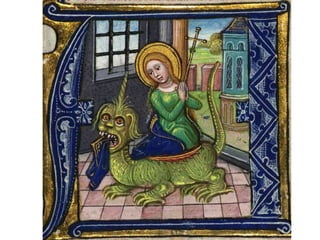
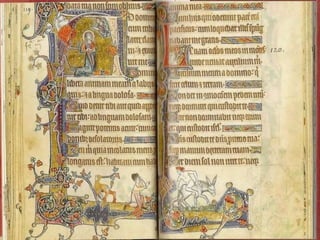
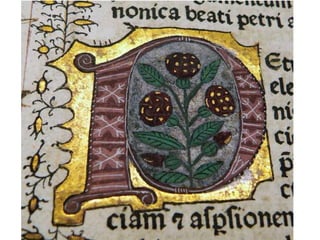
Illuminated Manuscripts
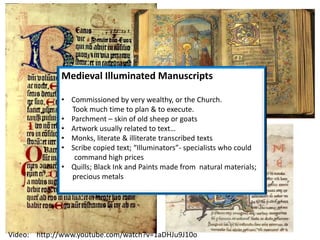
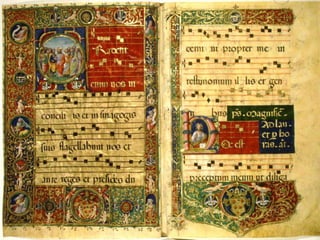
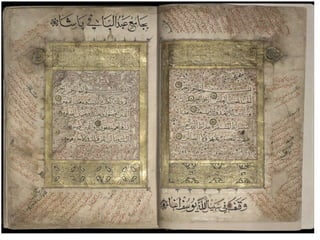
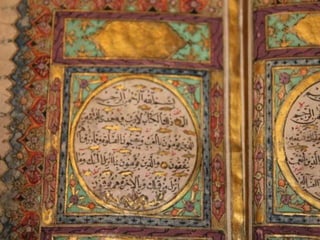
Medieval Illuminated Manuscripts
• Commissioned by very wealthy, or the Church.
Took much time to plan & to execute.
• Parchment – skin of old sheep or goats
• Artwork usually related to text…
• Monks, literate & illiterate transcribed texts
• Scribe copied text; “Illuminators”- specialists who could
command high prices
• Quills; Black Ink and Paints made from natural materials;
precious metals
Video: http://www.youtube.com/watch?v=1aDHJu9J10o
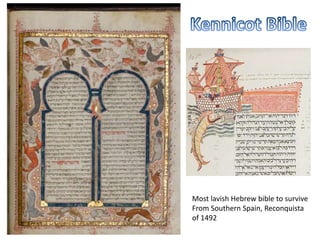
Most lavish Hebrew bible to survive
From Southern Spain, Reconquista
of 1492
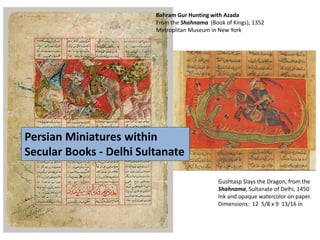
Bahram Gur Hunting with Azada
From the Shahnama (Book of Kings), 1352
Metroplitan Museum in New York
Gushtasp Slays the Dragon, from the
Shahnama, Sultanate of Delhi, 1450
Ink and opaque watercolor on paper.
Dimensions: 12 5/8 x 9 13/16 in
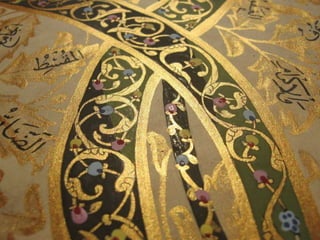
Persian Miniatures within
Secular Books - Delhi Sultanate
The Effect of Geography
and Environment on History
In the Early Post Classical World
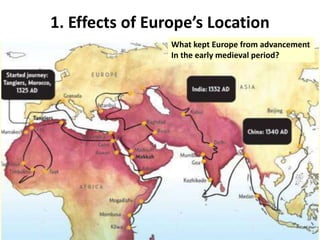
1. Effects of Europe’s Location
Location =
BARRIER to:
- Trade
- Conquest
- Profit
- Order
Technologies existed to
Mitigate Limitations:
- Agricultural Technologies
- Travel Technologies
- Industrial production for export
- Financial institutions
- Social Control through law,
culture, religion…
What kept Europe from advancement
In the early medieval period?
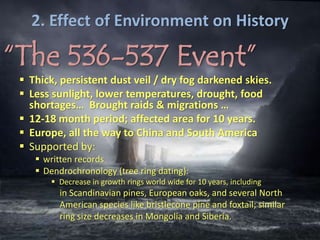
2. Effect of Environment on History
“The 536-537 Event”
 Thick, persistent dust veil / dry fog darkened skies.
 Less sunlight, lower temperatures, drought, food
shortages… Brought raids & migrations …
 12-18 month period; affected area for 10 years.
 Europe, all the way to China and South America
 Supported by:
 written records
 Dendrochronology (tree ring dating):
 Decrease in growth rings world wide for 10 years, including
in Scandinavian pines, European oaks, and several North
American species like bristlecone pine and foxtail; similar
ring size decreases in Mongolia and Siberia.
Effect of Environment on History
“…the sun became dark and its darkness lasted for one and a half years… Each day it
shone for about four hours and still this light was only a feeble shadow… the fruits did
not ripen and the wine tasted like sour grapes.”
- Michael the Syrian
“For the sun gave forth its light without brightness, like the moon, during this whole year,
and it seemed exceedingly like the sun in eclipse…
- John of Ephesos
“…the sun began to be darkened by day and the moon by night, while ocean was
tumultous with spray, from the 24th of March in this year till the 24th of June in the
following year…” - An anonymous Syrian chronicler
“First of all …a winter will come called Fimbulwinter. Then snow will drift from all directions.
There will then be great frosts and keen winds. The sun will do not good. There will be
three of these winters and no summer between. “
- From Snorri Sturluson’s Edda including this
reference to the “great” or “mighty” winter that is a forewarning of Ragnarok, the
destruction of the world and all of its inhabitants.
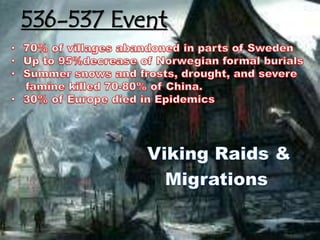
536-537 Event
To What Extent
Can we attribute Europe’s Slow
Political, Economic, and Cultural
Development
to Environmental Causes
during the Early Middle Ages?
A great idea for an Extended Essay ?

Christendom i

  • 1.
    “Christendom I” Post ClassicalWestern Europe By: Janet Pareja for AP World History, 2015
  • 2.
    I. Early MiddleAges 500 – 1000 CE
  • 3.
    Rome had fallen Lack of Power / Protection / Order… • Germanic tribes & Magyars expanding • Caliphate • Byzantines • Demons • Vikings
  • 5.
    Canada, New England,Greenland, Iceland….
  • 6.
    “In this yearfierce, foreboding omens came over the land of the Northumbrians, and the wretched people shook; there were excessive whirlwinds, lightning, and fiery dragons were seen flying in the sky. These signs were followed by great famine, and … on 6th ides of January, the ravaging of wretched heathen people destroyed God's church at Lindisfarne.”
  • 7.
    16 mph 100 warriors Silentunder sail / oars Wolfpacks Sea-safe, estuaries, landing Solarsteinn – “sunstone” to navigate / presence of whales, birds.
  • 8.
    80’ x 16’… 25 mph 32 - 100 warriors Silent under sail / oars Flexible Hull  high speed & maneuverability More stable at higher seed Wool sails – Elastic, durable, water repellent Sea-safe, estuaries, landing at shore Solarsteinn – “sunstone” to navigate / presence of whales, birds.
  • 9.
    Beautifully crafted, Silent,Fast, Shallow-keeled and Flexible: … the highest technology produced in Europe In the Middle Ages! http://www.history.com/shows/vikings/videos/viking-ships
  • 10.
    Viking “Beserkers” Epic fighterswithout armor Day of birth and death chosen for you already… Valhalla Die a good death in Battle Shield Maidens Valkyries chose… Ragnarok Odin Norsemen – Northmen - Normans
  • 11.
    ”Dark Ages:” 500- • “Barbarian” Invasions: • Magyars, Huns, Goths, • Muslims, Mongols… • VIKINGS!! • DEMONS! Fading Impact of Rome: • Institutions, Rule of Law • Roads, Cities • Literature, Learning • Trade
  • 13.
    FRANKS • Many differentgroups of European “barbarians” • Clovis (481-511) – Frankish chieftain – Started Carolingian Dynasty – Military conquest united all Franks – Converted to Christianity • Strengthened tie to popes • Pleased Christian wife • Only clergy were literate…
  • 14.
    Charles Martel (732) •Halted expansion of Al Andaluz
  • 15.
    Charlemagne (768 – 814) •Started to build a European Christian Empire: – Conquered Spain, Bavaria – Brought Christianity. – “Protector of the Pope” • N. Italy – Drove Lombards out of papal lands. – Ruled from HORSEBACK! – Educational Reform – he was illiterate
  • 16.
    Service to theKing • Counts (comte) – Counties – General in each county • MISSI DOMENICI – Envoys for the Ruler, Hand chosen. – 1 Year appointment – Traveled in County in pairs – Personal Character – Isolated from local interests so impartial • Administer justice: court • Remind religious duty • Keep records; spies repeated to Principal • Be the Presence of the King • Accept Oath of Fealty
  • 17.
    Holy Roman Emperor?! •Surprise! Crowned Christmas Day, 800 • Leo III • Why do scholars say he would not have agreed to accept crown? – There was already an Emperor of Eastern Rome – Made him responsible to / for the pope – Crowning by pope  tradition of ruler crowned by cleric/pope.
  • 18.
    “Holy Roman Empire” •Voltaire: “Not holy, not Roman, and not an Empire.” • Just a “dream” of empire and unity, really… • Similar to the World of Islam – not an “Empire” • Meant that Popes LEGITIMIZED/supported /advised Kings… but to what extent???
  • 19.
    Other early REGIONALMedieval Rulers • Alfred of England (871-899) – Unified England – Converted to Christianity • Otto I of Saxony (Germany) – Defeated Magyars – Extended kingdom into Saxony – 962 CE – Holy Roman Emperor – German princes after that!
  • 21.
    Monasteries THE Dominant feature insocial & cultural life Spread Christianity Teaching Role Models Social Services Herbalism, Medicine Protection Order Expanded Agriculture Scriptoria & libraries Trained new monks
  • 22.
    Vows: Poverty, Chastity,Obedience • Benedict of Nursia (480-587) – Scholastica, for nuns. • DISCIPLINE & PURPOSE • Monastic Rules – NO extreme asceticism – Absolute direction of Superior – Manual labor, Prayer, Service to local community, spread of Christianity.
  • 23.
    Christianity: 500 –1000 – Replaced Roman written rule of law, record-keeping, bureaucracy, centralized rule. – Pope “governed” the “empire” of “Christendom” – Invaluable connection to Rome  legitimacy. • Latin, and latin-based languages. – Only educated people were clerics  bureaucracy, records.
  • 24.
    Pope Gregory I (TheGreat) (590 – 604) • Monk… may have invented Gregorian Chant • Soldier Pope - Physically defended Rome from Lombards • “Bishop of Rome = Ultimate authority in Church” • Sacrament of Penance – People to confess to priest for absolution • Missionary campaigns – England. – Converted king of England. By 900, England had become Catholic. – Successors continued expansion…
  • 25.
    Crusades, 1097 • Heightof Pope’s Power • Legitimized Conquest by the Holy Roman Empire • “Re-take” the Holy Land: WHY?? Reasons & Excuses • Pope Urban II at dedication of Clermont Cathedral
  • 26.
    4. Medieval Powerand Leadership resided in BOTH Church and Manor… Political, Social and Religious organization over lapped.
  • 27.
    900 CE -Manorialism • Manor Each Manor a Self-sufficient World
  • 28.
    ECONOMY = AGRICULTURAL •No cities, towns; RURAL with SELF-SUFFICIENT manors / estates / farms • NO long distance trade or travel; not much regional trade or travel via rivers • NO manufacturing, export.
  • 29.
  • 30.
    PEASANTS’ / SERFS’Responsibility Reciprocal Lord Retainer Relationship Promises: “Implied Social Contract” Land/Fief/Demesne/Benefice from Lord to Vassal in exchange for service: agricultural, personal, military… • Rights to land and its produce forever as long as loyal and served lord. • Lord collected taxes/production. • Peasants/serfs served Lord’s family “first.” • Peasants /serfs provided foot soldiers and products for warfare. • Peasants / serfs were “good Christians:” went to Church, received the sacraments, were obedient, moral, truthful, hardworking and looked forward to the Kingdom of Heaven.
  • 31.
    Serfdom = Foundationof Manorialism • NOT CHATTEL; Tied to the land • Effect of Increased Population? – Foot soldiers – Rise of towns – Conquest for more resources • Primogeniture – status / right inherited by ELDEST MALE in LEGITIMATE succession. – Lords, Vassals – all levels
  • 32.
    Lords’ Responsibility • PROTECTpeasants / serfs • Bring ORDER through rules, courts, punishments • RESOLVE DISPUTES between peasants / serfs • Public works projects to benefit all • Provide and support CHRISTIANITY • Provide jobs, housing, food as long as the peasant/serf lives, and for his family after him. No one would ever be kicked off the land – instead they left their job for their descendants.
  • 33.
    New Agricultural Technology IncreasedProduction • Increased land under production – Drained swamps, cut forests, removed boulders… – Monks helped! • New tools / techniques: – Horse Shoe – Heavy iron plow – Horse collar – Wheel barrow – Windmill – Three Field System = crop rotation
  • 34.
    1/10 manor’s producefor Church Smith, Weaver, Miller, Baker, Greene, Cook, Farmer, Shoemaker, Wright… Thomson, Anderson, Wilson, Johnson…
  • 35.
  • 37.
  • 40.
    Intellectual Pursuits • CelticMonks – Scriptoria • Beowulf – 700-1000 – Earliest epic poem in English – Set in Scandinavia – Grendel the Dragon
  • 41.
    Art & Architecture •Monasteries, Churches • Manor homes, castles, fortresses… cottages. • Lettering – Book of Kells
  • 42.
  • 43.
    Medieval Illuminated Manuscripts •Commissioned by very wealthy, or the Church. Took much time to plan & to execute. • Parchment – skin of old sheep or goats • Artwork usually related to text… • Monks, literate & illiterate transcribed texts • Scribe copied text; “Illuminators”- specialists who could command high prices • Quills; Black Ink and Paints made from natural materials; precious metals Video: http://www.youtube.com/watch?v=1aDHJu9J10o
  • 51.
    Most lavish Hebrewbible to survive From Southern Spain, Reconquista of 1492
  • 55.
    Bahram Gur Huntingwith Azada From the Shahnama (Book of Kings), 1352 Metroplitan Museum in New York Gushtasp Slays the Dragon, from the Shahnama, Sultanate of Delhi, 1450 Ink and opaque watercolor on paper. Dimensions: 12 5/8 x 9 13/16 in Persian Miniatures within Secular Books - Delhi Sultanate
  • 56.
    The Effect ofGeography and Environment on History In the Early Post Classical World
  • 57.
    1. Effects ofEurope’s Location Location = BARRIER to: - Trade - Conquest - Profit - Order Technologies existed to Mitigate Limitations: - Agricultural Technologies - Travel Technologies - Industrial production for export - Financial institutions - Social Control through law, culture, religion… What kept Europe from advancement In the early medieval period?
  • 58.
    2. Effect ofEnvironment on History “The 536-537 Event”  Thick, persistent dust veil / dry fog darkened skies.  Less sunlight, lower temperatures, drought, food shortages… Brought raids & migrations …  12-18 month period; affected area for 10 years.  Europe, all the way to China and South America  Supported by:  written records  Dendrochronology (tree ring dating):  Decrease in growth rings world wide for 10 years, including in Scandinavian pines, European oaks, and several North American species like bristlecone pine and foxtail; similar ring size decreases in Mongolia and Siberia.
  • 59.
    Effect of Environmenton History “…the sun became dark and its darkness lasted for one and a half years… Each day it shone for about four hours and still this light was only a feeble shadow… the fruits did not ripen and the wine tasted like sour grapes.” - Michael the Syrian “For the sun gave forth its light without brightness, like the moon, during this whole year, and it seemed exceedingly like the sun in eclipse… - John of Ephesos “…the sun began to be darkened by day and the moon by night, while ocean was tumultous with spray, from the 24th of March in this year till the 24th of June in the following year…” - An anonymous Syrian chronicler “First of all …a winter will come called Fimbulwinter. Then snow will drift from all directions. There will then be great frosts and keen winds. The sun will do not good. There will be three of these winters and no summer between. “ - From Snorri Sturluson’s Edda including this reference to the “great” or “mighty” winter that is a forewarning of Ragnarok, the destruction of the world and all of its inhabitants.
  • 60.
  • 61.
    To What Extent Canwe attribute Europe’s Slow Political, Economic, and Cultural Development to Environmental Causes during the Early Middle Ages? A great idea for an Extended Essay ?

Editor's Notes

  • #4 Mongols of the Seas
  • #8 In the viking museum in Bygdøy, west of Oslo, Norway.
  • #9 In the viking museum in Bygdøy, west of Oslo, Norway, the Oseberg Ship.
  • #11 Shield maidens were women who chose to fight in battle. Valkyries -  "chooser of the slain") is one of a host of female figures who decide which soldiers die in battle and which live. Selecting among half of those who die in battle (the other half go to the goddess Freyja's afterlife field Fólkvangr), the valkyries bring their chosen to the afterlife hall of the slain, Valhalla, ruled over by the god Odin. There, the deceased warriors become einherjar. When the einherjar are not preparing for the events of Ragnarök, the valkyries bear them mead. Valkyries also appear as lovers of heroes and other mortals. Ragnarok - a series of future events, including a great battle foretold to ultimately result in the death of a number of major figures (including the gods Odin,Thor, Týr, Freyr, Heimdallr, and Loki), the occurrence of various natural disasters, and the subsequent submersion of the world in water. Afterward, the world will resurface anew and fertile, the surviving and returning gods will meet, and the world will be repopulated by two human survivors.
  • #14 Goths, Visigoths, Lombards, Angles, Saxons, Jutes…
  • #45 Bottom right at Lily Library at IU!!!
  • #54 Muslim illustrated manuscript
  • #59 Paraphrase: How does Geography affect history? Ie: spread of religion, conquest of kingdoms, trade …