PRESENTER – DR.SUMIT S. HADGAONKAR
 Expeditious closure wounds – one of the goals of
plastic surgery
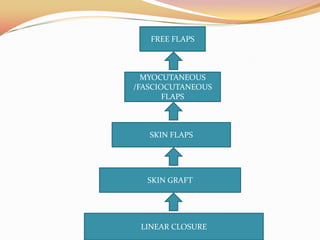
 Closure follows a reconstructive ladder
LINEAR CLOSURE
SKIN GRAFT
SKIN FLAPS
FREE FLAPS
MYOCUTANEOUS
/FASCIOCUTANEOUS
FLAPS
 Flaps – a partially or completely isolated segment of
tissue perfused with its own blood supply.
 A vascularized block of tissue mobilized from its donor
site and transferred to another location, adjacent or
remote for reconstructive purposes.
 May consist of skin, subcutaneous tissue, fascia,
muscle, bone or viscera (e.g.. Omentum)
 Reconstructive option of choice when padded and
durable cover needed
 Vary greatly in complexity…
from simple skin flap to microvascular free flap
History of Flaps
 Origin in India -2500-1500 BC
 Sushruta 800BC –forehead flap
 Charak Samhita
 Al-Zahrawi 10th century scholar
 Branca family of Italy
 Sir Harold Gillies – work on facial injuries, modern
plastic surgery
Flaps Uses
1. Replace tissue loss due to trauma or surgical excision
2. Provide skin coverage through which surgery can be
carried on latter
3. Provide padding over bony prominences
4. Bring in better blood supply to poorly vascularized
bed
5. Improve sensation to an area (sensate flap)
6. Bring in specialized tissue for reconstruction such
as bone or functioning muscle
Classification of Flaps
 Can be based on (five ‘C’ s)
1. Congruity
2. Configuration
3. Components
4. Circulation
5. Conditioning
Congruity
 Local – immediately adjacent to defect
 Regional – moved from adjacent region
 Distant – moved from remote anatomic area
 Pedicled – moved with intact tissue bridge for support
 Islanded – no intact skin but moved under the skin for
non contiguous defects.
Configuration
 By design and method of transfer
1. Advancement
2. Rotation
3. Transposition
4. Interpolation
5. Pedicled
Components
 Skin flaps
 Containing purely another component than skin e.g.
muscle ,fascia ,bone ,bowel ,omentum etc.
 Myocutaneous
 Fasciocutaneous
 Osteocutaneous
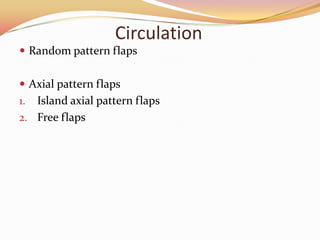
Circulation
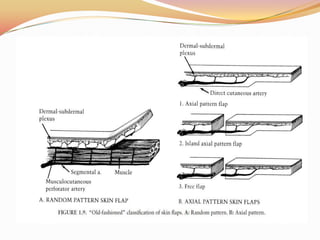
 Random pattern flaps
 Axial pattern flaps
1. Island axial pattern flaps
2. Free flaps
Conditioning
 Increasing flap safety – by enhancing its axiality
 Used in older days
 Invoking delay phenomenon
 Classically done by cutting down on either sides of flap to be
raised
 It opens up choke vessels
 Flap transferred 2-3 weeks later
 Particularly useful in higher risk patients
 e.g. Pedicled TRAM flap
SKIN FLAPS
 Use : 1.recipent bed with poor vascularity
2.coverage of vital structures ( to operate later )
3.reconstructing full thickness structures e.g.
eyelid ,cheek, nose, lip, ear etc.
4.padding bony prominences
 Disadvantage : it can’t sustain over contaminated
(infected ) bed.
 Types : 1.those rotating around a pivot point
a)rotation b) transposition c)interpolation
2.advancement flaps
a)single pedicled advancement b) V-Y
advancement c)bipedicled advancement
Muscle and Myocutaneous flaps
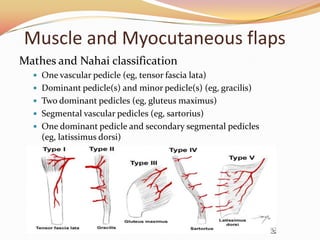
Mathes and Nahai classification
 One vascular pedicle (eg, tensor fascia lata)
 Dominant pedicle(s) and minor pedicle(s) (eg, gracilis)
 Two dominant pedicles (eg, gluteus maximus)
 Segmental vascular pedicles (eg, sartorius)
 One dominant pedicle and secondary segmental pedicles
(eg, latissimus dorsi)
According to mode of innervation (Taylor)
Type I – single unbranched nerve enters muscle.
Type II- Single nerve, branches prior to entering.
Type III – Multiple branches from same nerve trunk.
Type IV – Multiple branches from different nerve trunks.
Affects suitability for functioning muscle transfer
 Uses of muscle and myocutaneous flaps :
1. Functional muscle flap for motor reconstruction
2. Sensate Myocutaneous flap for sensate
reconstruction
3. Coverage of complex wounds
4. Chronic vascular insufficiency
5. Chronic radiation wounds
6. Exposed or infected prosthesis
Local Flaps
Local flaps
Advantages
 Best local cosmetic tissue match
 Often a simple procedure
 Local or regional anaesthesia option
Disadvantages
 Possible local tissue shortage
 Scarring may exacerbate the condition
 Surgeon may compromise local resection
Rotation Flap
 Movement is in the direction of an arc around a fixed
point and primarily in one plane.
 This is a semi-circular flap.
Transposition flap
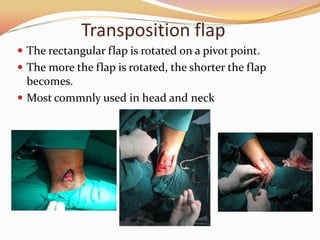
 The rectangular flap is rotated on a pivot point.
 The more the flap is rotated, the shorter the flap
becomes.
 Most commnly used in head and neck
Z plasty
 Creation of 2 triangular transposition flaps
 Length of both limbs must be same
 Angle may vary
 Uses :
1. Lengthning of scar
2. Changing direction of scar into more favorable one
3. Interrupt scar linearity
Rhombic flaps
 Specially designed transposition flaps for rhombic
shaped defects
 Defect must have 60 and 120 angles
Bilobed flaps
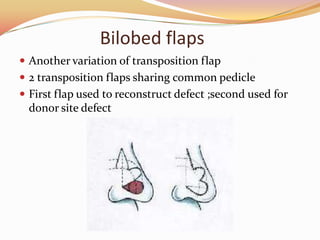
 Another variation of transposition flap
 2 transposition flaps sharing common pedicle
 First flap used to reconstruct defect ;second used for
donor site defect
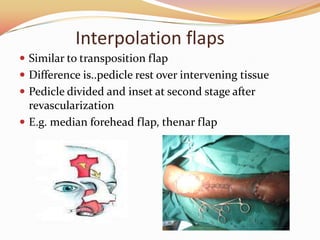
Interpolation flaps
 Similar to transposition flap
 Difference is..pedicle rest over intervening tissue
 Pedicle divided and inset at second stage after
revascularization
 E.g. median forehead flap, thenar flap
Advancement flaps
 Moved primarily in a straight line from the donor site
to the recipient site.
 No rotational or lateral movement is applied.
 E.g. rectangular advancement, V-Y advancement etc.
V-Y advancement flap
 Create a triangular-shaped flap with the base of the flap at
the cut edge of the skin where the amputation occurred. It
should be as wide as the greatest width of the amputation
 Skin incisions are made through the full thickness of the
skin.
 Advance the flap over the defected area and suture it to the
nail bed.
 Place corner stitches to avoid interference with the blood
supply to the corners. Convert the V-shaped defect into a
final Y-shaped wound
 The V-Y pedicle plasty technique allows most patients to
regain sensation and two-point discrimination in the
fingertip.
 The cosmetic results are usually excellent, with good
contour and fingertip padding is preserved
Combined local flaps
 In some circumstances, such as burn contracture
release, local flaps can usefully be combined to import
surplus tissue from a wide area adjacent to a scar or
defect that needs removal.
 Examples are the W-plasty and the multiple Y-to-V
plasty, which is a very versatile means of releasing an
isolated band scar contracture over a flexion crease
REGIONAL FLAPS
 As the distance of required flap transposition
increases, the incorporation of a defined blood supply
becomes critical.
 Classified as axial, however most flaps have random
pattern at their distal ends
 Utilized to cover large defects which require bulk
 Examples : 1. PMMF 2. DPF 3. Trapezius flap
Distant flaps
Pedicled flaps
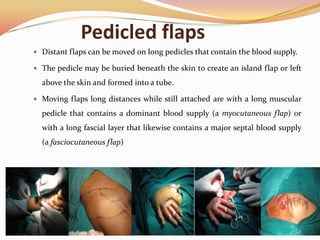
 Distant flaps can be moved on long pedicles that contain the blood supply.
 The pedicle may be buried beneath the skin to create an island flap or left
above the skin and formed into a tube.
 Moving flaps long distances while still attached are with a long muscular
pedicle that contains a dominant blood supply (a myocutaneous flap) or
with a long fascial layer that likewise contains a major septal blood supply
(a fasciocutaneous flap)
Free flaps
 With fine instruments and materials it has become commonplace to be
able to disconnect the blood supply of the flap from its donor site and
reconnect it in a distant place using the operating microscope.
 The free tissue transfer is now the best means of reconstructing major
composite loss of tissue in the face, jaws, lower limb and many other body
sites, as long as resources allow it.
 Free muscle transfers should be reanastomosed within 1–2 hours.
Advantages
 Being able to select exactly the best tissue to move
 Only takes what is necessary
 Minimises donor site morbidity
Disadvantages
 More complex surgical technique
 Failure involves total loss of all transferred tissue
 Usually takes more time unless the surgeon is
experienced
Free-tissue donor sites
Principles
of flap
surgery
Principle I:
Replace Like
With Like
Principle II:
Think of
Reconstructio
n in Terms of
Units
Principle III:
Always Have a
Pattern and a
Back-up Plan
Principle IV:
Steal From
Peter to Pay
Paul
Principle V:
Never Forget
the Donor
Area
Monitoring of the flap
Tissue colour
warmth and turgor
assess blanching
capillary refill time.
Complications
Causes of flap
failure
poor anatomical knowledge when raising the flap
(such that the blood supply is deficient from the
start)
flap inset with too much tension
local sepsis or a septicaemic patient
the dressing applied too tightly around the pedicle;
Thank you

Flaps in plastic surgery

  • 1.
  • 2.
     Expeditious closurewounds – one of the goals of plastic surgery  Closure follows a reconstructive ladder
  • 3.
    LINEAR CLOSURE SKIN GRAFT SKINFLAPS FREE FLAPS MYOCUTANEOUS /FASCIOCUTANEOUS FLAPS
  • 4.
     Flaps –a partially or completely isolated segment of tissue perfused with its own blood supply.  A vascularized block of tissue mobilized from its donor site and transferred to another location, adjacent or remote for reconstructive purposes.  May consist of skin, subcutaneous tissue, fascia, muscle, bone or viscera (e.g.. Omentum)  Reconstructive option of choice when padded and durable cover needed  Vary greatly in complexity… from simple skin flap to microvascular free flap
  • 5.
    History of Flaps Origin in India -2500-1500 BC  Sushruta 800BC –forehead flap  Charak Samhita  Al-Zahrawi 10th century scholar  Branca family of Italy  Sir Harold Gillies – work on facial injuries, modern plastic surgery
  • 11.
    Flaps Uses 1. Replacetissue loss due to trauma or surgical excision 2. Provide skin coverage through which surgery can be carried on latter 3. Provide padding over bony prominences 4. Bring in better blood supply to poorly vascularized bed 5. Improve sensation to an area (sensate flap) 6. Bring in specialized tissue for reconstruction such as bone or functioning muscle
  • 12.
    Classification of Flaps Can be based on (five ‘C’ s) 1. Congruity 2. Configuration 3. Components 4. Circulation 5. Conditioning
  • 13.
    Congruity  Local –immediately adjacent to defect  Regional – moved from adjacent region  Distant – moved from remote anatomic area  Pedicled – moved with intact tissue bridge for support  Islanded – no intact skin but moved under the skin for non contiguous defects.
  • 14.
    Configuration  By designand method of transfer 1. Advancement 2. Rotation 3. Transposition 4. Interpolation 5. Pedicled
  • 15.
    Components  Skin flaps Containing purely another component than skin e.g. muscle ,fascia ,bone ,bowel ,omentum etc.  Myocutaneous  Fasciocutaneous  Osteocutaneous
  • 16.
    Circulation  Random patternflaps  Axial pattern flaps 1. Island axial pattern flaps 2. Free flaps
  • 17.
    Conditioning  Increasing flapsafety – by enhancing its axiality  Used in older days  Invoking delay phenomenon  Classically done by cutting down on either sides of flap to be raised  It opens up choke vessels  Flap transferred 2-3 weeks later  Particularly useful in higher risk patients  e.g. Pedicled TRAM flap
  • 20.
    SKIN FLAPS  Use: 1.recipent bed with poor vascularity 2.coverage of vital structures ( to operate later ) 3.reconstructing full thickness structures e.g. eyelid ,cheek, nose, lip, ear etc. 4.padding bony prominences  Disadvantage : it can’t sustain over contaminated (infected ) bed.  Types : 1.those rotating around a pivot point a)rotation b) transposition c)interpolation 2.advancement flaps a)single pedicled advancement b) V-Y advancement c)bipedicled advancement
  • 22.
    Muscle and Myocutaneousflaps Mathes and Nahai classification  One vascular pedicle (eg, tensor fascia lata)  Dominant pedicle(s) and minor pedicle(s) (eg, gracilis)  Two dominant pedicles (eg, gluteus maximus)  Segmental vascular pedicles (eg, sartorius)  One dominant pedicle and secondary segmental pedicles (eg, latissimus dorsi)
  • 23.
    According to modeof innervation (Taylor) Type I – single unbranched nerve enters muscle. Type II- Single nerve, branches prior to entering. Type III – Multiple branches from same nerve trunk. Type IV – Multiple branches from different nerve trunks. Affects suitability for functioning muscle transfer
  • 24.
     Uses ofmuscle and myocutaneous flaps : 1. Functional muscle flap for motor reconstruction 2. Sensate Myocutaneous flap for sensate reconstruction 3. Coverage of complex wounds 4. Chronic vascular insufficiency 5. Chronic radiation wounds 6. Exposed or infected prosthesis
  • 25.
  • 27.
    Local flaps Advantages  Bestlocal cosmetic tissue match  Often a simple procedure  Local or regional anaesthesia option Disadvantages  Possible local tissue shortage  Scarring may exacerbate the condition  Surgeon may compromise local resection
  • 28.
    Rotation Flap  Movementis in the direction of an arc around a fixed point and primarily in one plane.  This is a semi-circular flap.
  • 29.
    Transposition flap  Therectangular flap is rotated on a pivot point.  The more the flap is rotated, the shorter the flap becomes.  Most commnly used in head and neck
  • 30.
    Z plasty  Creationof 2 triangular transposition flaps  Length of both limbs must be same  Angle may vary  Uses : 1. Lengthning of scar 2. Changing direction of scar into more favorable one 3. Interrupt scar linearity
  • 32.
    Rhombic flaps  Speciallydesigned transposition flaps for rhombic shaped defects  Defect must have 60 and 120 angles
  • 34.
    Bilobed flaps  Anothervariation of transposition flap  2 transposition flaps sharing common pedicle  First flap used to reconstruct defect ;second used for donor site defect
  • 35.
    Interpolation flaps  Similarto transposition flap  Difference is..pedicle rest over intervening tissue  Pedicle divided and inset at second stage after revascularization  E.g. median forehead flap, thenar flap
  • 36.
    Advancement flaps  Movedprimarily in a straight line from the donor site to the recipient site.  No rotational or lateral movement is applied.  E.g. rectangular advancement, V-Y advancement etc.
  • 38.
    V-Y advancement flap Create a triangular-shaped flap with the base of the flap at the cut edge of the skin where the amputation occurred. It should be as wide as the greatest width of the amputation  Skin incisions are made through the full thickness of the skin.  Advance the flap over the defected area and suture it to the nail bed.  Place corner stitches to avoid interference with the blood supply to the corners. Convert the V-shaped defect into a final Y-shaped wound  The V-Y pedicle plasty technique allows most patients to regain sensation and two-point discrimination in the fingertip.  The cosmetic results are usually excellent, with good contour and fingertip padding is preserved
  • 40.
    Combined local flaps In some circumstances, such as burn contracture release, local flaps can usefully be combined to import surplus tissue from a wide area adjacent to a scar or defect that needs removal.  Examples are the W-plasty and the multiple Y-to-V plasty, which is a very versatile means of releasing an isolated band scar contracture over a flexion crease
  • 41.
    REGIONAL FLAPS  Asthe distance of required flap transposition increases, the incorporation of a defined blood supply becomes critical.  Classified as axial, however most flaps have random pattern at their distal ends  Utilized to cover large defects which require bulk  Examples : 1. PMMF 2. DPF 3. Trapezius flap
  • 53.
  • 54.
    Pedicled flaps  Distantflaps can be moved on long pedicles that contain the blood supply.  The pedicle may be buried beneath the skin to create an island flap or left above the skin and formed into a tube.  Moving flaps long distances while still attached are with a long muscular pedicle that contains a dominant blood supply (a myocutaneous flap) or with a long fascial layer that likewise contains a major septal blood supply (a fasciocutaneous flap)
  • 55.
    Free flaps  Withfine instruments and materials it has become commonplace to be able to disconnect the blood supply of the flap from its donor site and reconnect it in a distant place using the operating microscope.  The free tissue transfer is now the best means of reconstructing major composite loss of tissue in the face, jaws, lower limb and many other body sites, as long as resources allow it.  Free muscle transfers should be reanastomosed within 1–2 hours.
  • 56.
    Advantages  Being ableto select exactly the best tissue to move  Only takes what is necessary  Minimises donor site morbidity Disadvantages  More complex surgical technique  Failure involves total loss of all transferred tissue  Usually takes more time unless the surgeon is experienced
  • 57.
  • 58.
    Principles of flap surgery Principle I: ReplaceLike With Like Principle II: Think of Reconstructio n in Terms of Units Principle III: Always Have a Pattern and a Back-up Plan Principle IV: Steal From Peter to Pay Paul Principle V: Never Forget the Donor Area
  • 59.
    Monitoring of theflap Tissue colour warmth and turgor assess blanching capillary refill time.
  • 60.
  • 61.
    Causes of flap failure pooranatomical knowledge when raising the flap (such that the blood supply is deficient from the start) flap inset with too much tension local sepsis or a septicaemic patient the dressing applied too tightly around the pedicle;
  • 63.