Parotid tumors and
parotidectomy
Dr Sumer Yadav
MBBS, MS, MCh
Plastic and reconstructive surgery
sumeryadav2004@gmail.com
Salivary gland neoplasm
1. Major salivary gland
a. Parotid gland
b. Submandibular gland
c. Sublingual gland
2. Minor salivary gland
600 – 1,000 minor salivary gland distributed throughout
the mucosa of the upper aerodigestive tract (more
common in the soft and hard palate).
sumeryadav2004@gmail.com
80% of salivary gland tumor occur in the parotid.
10 – 15% in the minor salivary gland.
5 – 10% in the submandibular gland.
80% of the parotid tumor are benign.
The most common is pleomorphic adenoma.
50% of the submandibular gland tumor are benign.
30% of the minor salivary gland are benign.
sumeryadav2004@gmail.com
Malignant disease of the parotid
Pathogenesis:
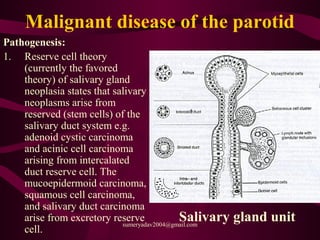
1. Reserve cell theory
(currently the favored
theory) of salivary gland
neoplasia states that salivary
neoplasms arise from
reserved (stem cells) of the
salivary duct system e.g.
adenoid cystic carcinoma
and acinic cell carcinoma
arising from intercalated
duct reserve cell. The
mucoepidermoid carcinoma,
squamous cell carcinoma,
and salivary duct carcinoma
arise from excretory reserve
cell.
Salivary gland unitsumeryadav2004@gmail.com
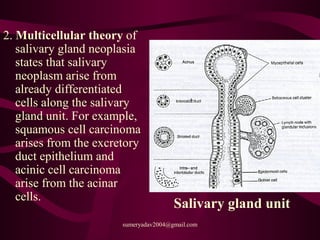
2. Multicellular theory of
salivary gland neoplasia
states that salivary
neoplasm arise from
already differentiated
cells along the salivary
gland unit. For example,
squamous cell carcinoma
arises from the excretory
duct epithelium and
acinic cell carcinoma
arise from the acinar
cells.
Salivary gland unit
sumeryadav2004@gmail.com
What are the most common benign
tumor of the parotid?
1. Pleomorphic adenoma (benign mixed tumor).
2. Warthin’s tumor (papillary cyst adenoma
lypmhomatosum).
3. Monomorphic adenoma
a. Basal cell adenoma
b. Canalicular adenomas
c. Oncocytoma
d. Myoepitheliomas
4. Granular cell tumor
5. Hemangioma
sumeryadav2004@gmail.com
What are the most common malignant neoplasm of
the parotid gland?
1. Mucoepidermoid carcinoma – 40%
It can high, intermediate, and low-grade base on the
clinical behavior and the tumor differentiation which is
related to the percentage of mucinous to epidermoid cell.
2. Adenoid cystic carcinoma – 10%
Adenoid cystic carcinoma are unique among the salivary
gland tumors because of their indolent and protracted
clinical course.
Characterized by perineural spread including skip lesions.
The disease thus specific survival continuous to declined
for more than 20 years after initial treatment.sumeryadav2004@gmail.com
3. Acinic cell carcinoma – 10 – 15 % of
It is considered a low-grade tumor.
4. Malignant mixed tumor - 7%
It is considered a high-grade malignancy.
5. Polymorphous low grade adenocarcinoma – 10%
It is a low-grade variant of adenocarcinoma.
6. Adeno carcinoma – 10%
It is a high-grade with poor prognosis.
7. Squamous cell carcinoma – 4%
It is high-grade, more common in elderly patients, and
can confused with high-grade mucoepidermoid
carcinoma. sumeryadav2004@gmail.com
The malignant parotid tumor can be classified
into:
1. High-grade: aggressive behavior, local invasion, and
lymph node metastasis.
- high grade mucoepidermoid carcinoma
- adenoid cystic carcinoma
- carcinoma ex phelomorphic adenoma
- adenocarcinoma
- aquamous cell carcinoma
- undifferentiated carcinoma
sumeryadav2004@gmail.com
2. Low-grade malignancy
- low grade mucoepidermoid carcinoma
- pholymorphous low grade adenocarcinoma
- acinic cell carcinoma
- low grade adenocarcinoma
- basal cell carcinoma
3. Intermediate grade
- intermediate grade mucoepidermoid carcinoma
- intermediate grade adenocarcinoma
- oncocytic carcinoma
sumeryadav2004@gmail.com
Evaluation of patients with a parotid mass
1. History
Important points in the history:
- Parotid mass (duration, rate of the growth,
presence of pain)
- Facial paralysis
- Cervical lymphadenopathies
- Eyes and joints symptoms
- History of exposure to radiation
sumeryadav2004@gmail.com
2. Examination
- Size of the mass
- Skin fixation
- Cervical adenopathies
- Facial nerve functions
- Raised ear lobule and retromandibular groove
obliteration
3. Investigation
C.T. and MRI are both effective modalities for imaging
the size, the local, and the regional extension of the
primary tumor and the neck metastasis.
C.T. saliography – it replaced now by high-resolution
contrasted C.T. and MRI.
sumeryadav2004@gmail.com
4. FNAB
- The accuracy is around 90% depend on the
techniques of aspirate and the
cytopathologist.
5. Superficial parotidectomy is considered as a
diagnostic and therapeutic for most benign
tumors.
sumeryadav2004@gmail.com
Treatment
Surgery -Parotid
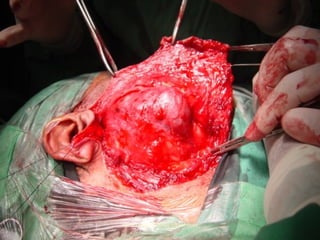
90%confined to superficial lobe - superficial parotidectomy
If adjacent to deep lobe - total parotidectomy
If invades adjacent soft tissue – radical parotidectomy
Never perform piecemeal excision in an attempt to preserve
facial nerve
Nerve grafting can be performed and RT can start3-4 wk
post op without adverse affects
syndrome – (gustatory sweating) due to redirection of
parasympathetic and sympathetic nerve fibers to the
dermal sweat glands sumeryadav2004@gmail.com
Indications of malignancy
Facial nerve involvement
Indurations / ulceration of skin , mucous membrane
Change in consistency
Fixity to muscles/ mandible
Lymph node metastasis
Rapid tumor growth
sumeryadav2004@gmail.com
Open biopsy
Contraindicated
Justified only in minor gland trs
Ulcerated lesions
sumeryadav2004@gmail.com
Benign tumors
Painless
Slow growing
No facial palsy
sumeryadav2004@gmail.com
Pleomorphic Adenoma
commonest benign tumor
Pseudocapsule
Pseudopodal extensions
Not multicentric
sumeryadav2004@gmail.com
Pleomorphic Adenoma
Mixed tumor
Consists of cartilage besides epithelial cells
Cartilage not of mesodermal origin
Derived from mucin secreted by epithelial cells
sumeryadav2004@gmail.com
Microscopy
Epithelial and myoepithelial components
Abundant matrix mucoid,myxoid or
chondroid supporting tissue
sumeryadav2004@gmail.com
Diagnosis
Lobulated , painless swelling
Long duration
Neither adherent to skin/ masseter muscle
Generally firm / variable consistency
sumeryadav2004@gmail.com
Malignant transformation
3–5%of cases
Pain
Rapid growth
Hard
sumeryadav2004@gmail.com
Treatment
Superficial parotidectmy
Total parotidectomy
sumeryadav2004@gmail.com
Adenolymphoma/Warthins tumor
Papillary cystadenoma lymphamatosum
5–15%of parotid tumors
Always at the lower pole of the parotid
Overlies the angle of mandible
sumeryadav2004@gmail.com
Warthins tumor
More in white races
Not seen in negroes
Encapsulated lesions
No malignant transformation
sumeryadav2004@gmail.com
Warthins tumor
Only salivary neoplasm more in males
Elderly males
Slow growing
painless
sumeryadav2004@gmail.com
Warthins tumor
Surface is smooth
Well defined
Distinct margins
Soft in consistency with fluctuation
Not tansilluminant
sumeryadav2004@gmail.com
Investigations
FNAC
Tc99 scan – hot spot
sumeryadav2004@gmail.com
Microscopy
Cystic / glandular spaces
Lined by columnar epithelium
Within abundant lymphoid tissue with
germinal centres
sumeryadav2004@gmail.com
Treatment
Superficial parotidectmy
Enuclation
sumeryadav2004@gmail.com
Mucoepidermoid carcinoma
MC- epithelial malignancy of gland
Parotid &minor glands
Hard in consistency
Infiltrate local tissue
Slow growing tumor
Recurs locally
sumeryadav2004@gmail.com
Mucoepidermoid carcinoma
LN mets in 30%
Lung, bone, brain -15%
Graded based on cellular content
sumeryadav2004@gmail.com
The post-operative complications:
1. Skin flap necrosis
2. Hematoma
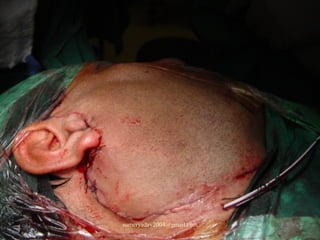
3. Salivary fistula and sialoseles – it presents as an
opening in the suture line below the lobule of the
ear.
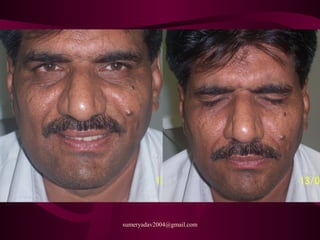
4. Facial nerve paralysis – which could be:
a. Temporarily: 5 – 10% of the patients.
b. Permanent: less than 2% of the cases.
5. Numbness of the ear due to injury of great auricular
nerve. sumeryadav2004@gmail.com
6. Xerostomia not common in the superficial
parotidectomy (30% of salivary producing tissue).
5. Frey’s syndrome (Gustatory sweating syndrome)
Incidence in 50% of the patients.
Etiology: post-operative growth of the interrupted
preganglionic parasympathetic nerve branches to
the parotid into the more superficial sweat glands.
The diagnosis is usually made from the history but
can be confirmed by the starch-iodine test.
sumeryadav2004@gmail.com
What is starch-iodine test?
Paint the affected skin with iodine, dust the
skin with the starch, feed the patient. The
appearance of bluish discoloration of the
overlying skin due to reaction of starch
and iodine in the presence of moisture
(sweat.
sumeryadav2004@gmail.com
How do you treat Frey’s syndrome?
Although frey’s syndrome is usually a minor problem, it
may require treatment which include:
1. Parasymphatholytic creams such as glycopyrrolate
lotion may also be applied to the skin or scopolamine
cream 3%.
2. Apply anti-perspirant to avoid sweating.
3. Jacobsen’s neurectomy via tympanotomy approach.
4. Elevating skin flap and placing tissue such as fascia,
dermis, or creating SCM muscle flap and if there is a
big defect you can use regional flap as a PMMF.
sumeryadav2004@gmail.com
Facial nerve paralysis
In parotid malignancy
a. Patient with clinically pre-op facial
nerve paralysis. What to do?
Intra-operative resection of the involved
part of the facial nerve and primary
grafting using greater auricular nerve or
sural nerve.
Post-operative radiotherapy (high-grade)
sumeryadav2004@gmail.com
b. Patient with a normal facial function
but intra-operative involvement of the
facial nerve. What to do?
Careful dissection of the tumor of the
facial nerve without sacrifying the facial
nerve and followed-up with radiotherapy
treatment.
sumeryadav2004@gmail.com
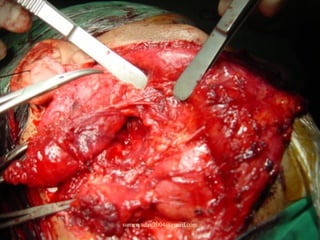
During an operation on the
parotid, where do you find
the facial nerve?
sumeryadav2004@gmail.com
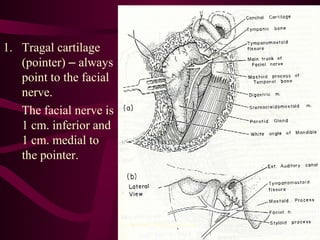
1. Tragal cartilage
(pointer) – always
point to the facial
nerve.
The facial nerve is
1 cm. inferior and
1 cm. medial to
the pointer.
sumeryadav2004@gmail.com
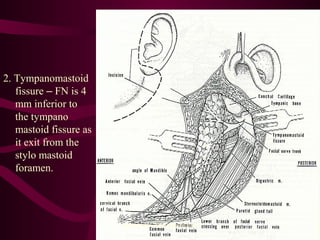
2. Tympanomastoid
fissure – FN is 4
mm inferior to
the tympano
mastoid fissure as
it exit from the
stylo mastoid
foramen.
sumeryadav2004@gmail.com
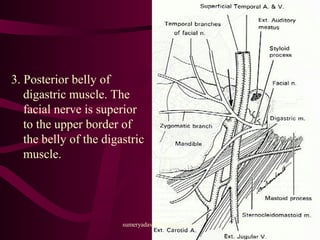
3. Posterior belly of
digastric muscle. The
facial nerve is superior
to the upper border of
the belly of the digastric
muscle.
sumeryadav2004@gmail.com
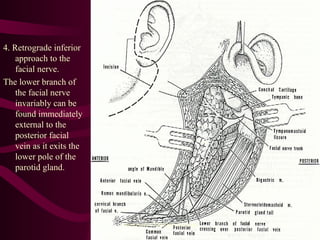
4. Retrograde inferior
approach to the
facial nerve.
The lower branch of
the facial nerve
invariably can be
found immediately
external to the
posterior facial
vein as it exits the
lower pole of the
parotid gland.
sumeryadav2004@gmail.com
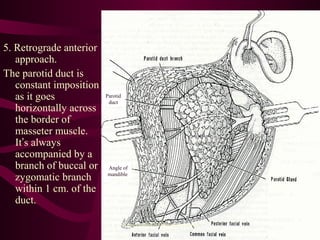
5. Retrograde anterior
approach.
The parotid duct is
constant imposition
as it goes
horizontally across
the border of
masseter muscle.
It’s always
accompanied by a
branch of buccal or
zygomatic branch
within 1 cm. of the
duct.
Angle of
mandible
Parotid
duct
sumeryadav2004@gmail.com
Does the grading make
difference in management
of the parotid malignancy?
sumeryadav2004@gmail.com
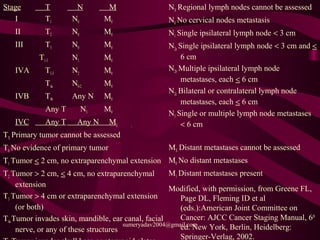
Stage T N M
I T1 N0 M0
II T2 N0 M0
III T3 N0 M0
T1-3 N1 M0
IVA T1-3 N2 M0
T4a N0-2 M0
IVB T4b Any N M0
Any T N3 M0
IVC Any T Any N M1
TX Primary tumor cannot be assessed
T0 No evidence of primary tumor
T1 Tumor < 2 cm, no extraparenchymal extension
T2 Tumor > 2 cm, < 4 cm, no extraparenchymal
extension
T3 Tumor > 4 cm or extraparenchymal extension
(or both)
T4aTumor invades skin, mandible, ear canal, facial
nerve, or any of these structures
NX Regional lymph nodes cannot be assessed
N0 No cervical nodes metastasis
N1 Single ipsilateral lymph node < 3 cm
N2a Single ipsilateral lymph node < 3 cm and <
6 cm
N2b Multiple ipsilateral lymph node
metastases, each < 6 cm
N2c Bilateral or contralateral lymph node
metastases, each < 6 cm
N3 Single or multiple lymph node metastases
< 6 cm
MX Distant metastases cannot be assessed
M0 No distant metastases
M1 Distant metastases present
Modified, with permission, from Greene FL,
Page DL, Fleming ID et al
(eds.):American Joint Committee on
Cancer: AJCC Cancer Staging Manual, 6th
ed. New York, Berlin, Heidelberg:
Springer-Verlag, 2002.
sumeryadav2004@gmail.com
Group 1: T1 and T2NO low-grade malignancy
Treatment is excision of the tumor with cuff of a
normal tissue.
Facial nerve is preserved.
Regional lymph node evaluated at the time of
surgery.
No post-op radio therapy unless the resection
margin is not clear.
sumeryadav2004@gmail.com
Group 2: T1 and T2NO high-grade malignancy
Treatment is total parotidectomy with excision of digastric
and submandibular nodes.
Facial nerve involvement:
a. patient with facial paralysis pre-operatively.
Resection of the facial nerve with primary grafting.
b. patient with normal facial function pre-op.
Resect the tumor of the facial and post-operative
wide field radiation.
sumeryadav2004@gmail.com
Group 3: T3NO or any N+ high-grade or
recurrent cancer.
Treatment is total parotidectomy
Modified radical neck dissection
Post-operative wide field radiotherapy
Facial nerve as in group 2
sumeryadav2004@gmail.com
Group 4: include all T4 tumor
Treatment is radical parotidectomy with modified
radical neck dissection and resection of
masseter muscle, part of the mandible or
mastoid or ear canal as required.
Resection of the facial nerve with the tumor and
primary grafting.
Followed by wide field post-operative
radiotheray. sumeryadav2004@gmail.com
Points to remember in parotid surgery:
1. Pre-op evaluation: general condition of the patient,
CBC, LFT and RFT, X RAYS , VIRAL
MARKERS, ECG
2. Consenting patients for possible facial weakness.
3. Operating in bloodless field by:
a. hypotensive technique
b. elevation of the head of the bed
c. delicate tissue handling
d. proper hemostasis
sumeryadav2004@gmail.com
4. Using facial nerve monitoring during
operation and at the end of operation.
5. Exposure of the eye and the operative side of
the face.
6. Lazy S incision.
7. Landmark for the facial nerve.
8. Fasciovenus pane of patey.- facial nerve and
retromandibular vein forms it b/w superficial
and deep lobe.
sumeryadav2004@gmail.com
Indications of post-operative
radiotherapy
1. High-grade tumor
2. Gross or microscopic residual disease
3. Tumor involving or close to the facial nerve
4. Recurrent disease
5. Documented lymph node metastasis
6. Extraparotid extension
7. Deep lobe cancers
8. All T3 and T4 cancers
sumeryadav2004@gmail.com
•Thanks
sumeryadav2004@gmail.com

salivary gland neoplasm

  • 1.
    Parotid tumors and parotidectomy DrSumer Yadav MBBS, MS, MCh Plastic and reconstructive surgery sumeryadav2004@gmail.com
  • 2.
  • 3.
  • 4.
  • 5.
  • 6.
  • 7.
  • 8.
    Salivary gland neoplasm 1.Major salivary gland a. Parotid gland b. Submandibular gland c. Sublingual gland 2. Minor salivary gland 600 – 1,000 minor salivary gland distributed throughout the mucosa of the upper aerodigestive tract (more common in the soft and hard palate). sumeryadav2004@gmail.com
  • 9.
    80% of salivarygland tumor occur in the parotid. 10 – 15% in the minor salivary gland. 5 – 10% in the submandibular gland. 80% of the parotid tumor are benign. The most common is pleomorphic adenoma. 50% of the submandibular gland tumor are benign. 30% of the minor salivary gland are benign. sumeryadav2004@gmail.com
  • 10.
    Malignant disease ofthe parotid Pathogenesis: 1. Reserve cell theory (currently the favored theory) of salivary gland neoplasia states that salivary neoplasms arise from reserved (stem cells) of the salivary duct system e.g. adenoid cystic carcinoma and acinic cell carcinoma arising from intercalated duct reserve cell. The mucoepidermoid carcinoma, squamous cell carcinoma, and salivary duct carcinoma arise from excretory reserve cell. Salivary gland unitsumeryadav2004@gmail.com
  • 11.
    2. Multicellular theoryof salivary gland neoplasia states that salivary neoplasm arise from already differentiated cells along the salivary gland unit. For example, squamous cell carcinoma arises from the excretory duct epithelium and acinic cell carcinoma arise from the acinar cells. Salivary gland unit sumeryadav2004@gmail.com
  • 12.
    What are themost common benign tumor of the parotid? 1. Pleomorphic adenoma (benign mixed tumor). 2. Warthin’s tumor (papillary cyst adenoma lypmhomatosum). 3. Monomorphic adenoma a. Basal cell adenoma b. Canalicular adenomas c. Oncocytoma d. Myoepitheliomas 4. Granular cell tumor 5. Hemangioma sumeryadav2004@gmail.com
  • 13.
    What are themost common malignant neoplasm of the parotid gland? 1. Mucoepidermoid carcinoma – 40% It can high, intermediate, and low-grade base on the clinical behavior and the tumor differentiation which is related to the percentage of mucinous to epidermoid cell. 2. Adenoid cystic carcinoma – 10% Adenoid cystic carcinoma are unique among the salivary gland tumors because of their indolent and protracted clinical course. Characterized by perineural spread including skip lesions. The disease thus specific survival continuous to declined for more than 20 years after initial treatment.sumeryadav2004@gmail.com
  • 14.
    3. Acinic cellcarcinoma – 10 – 15 % of It is considered a low-grade tumor. 4. Malignant mixed tumor - 7% It is considered a high-grade malignancy. 5. Polymorphous low grade adenocarcinoma – 10% It is a low-grade variant of adenocarcinoma. 6. Adeno carcinoma – 10% It is a high-grade with poor prognosis. 7. Squamous cell carcinoma – 4% It is high-grade, more common in elderly patients, and can confused with high-grade mucoepidermoid carcinoma. sumeryadav2004@gmail.com
  • 15.
    The malignant parotidtumor can be classified into: 1. High-grade: aggressive behavior, local invasion, and lymph node metastasis. - high grade mucoepidermoid carcinoma - adenoid cystic carcinoma - carcinoma ex phelomorphic adenoma - adenocarcinoma - aquamous cell carcinoma - undifferentiated carcinoma sumeryadav2004@gmail.com
  • 16.
    2. Low-grade malignancy -low grade mucoepidermoid carcinoma - pholymorphous low grade adenocarcinoma - acinic cell carcinoma - low grade adenocarcinoma - basal cell carcinoma 3. Intermediate grade - intermediate grade mucoepidermoid carcinoma - intermediate grade adenocarcinoma - oncocytic carcinoma sumeryadav2004@gmail.com
  • 17.
    Evaluation of patientswith a parotid mass 1. History Important points in the history: - Parotid mass (duration, rate of the growth, presence of pain) - Facial paralysis - Cervical lymphadenopathies - Eyes and joints symptoms - History of exposure to radiation sumeryadav2004@gmail.com
  • 18.
    2. Examination - Sizeof the mass - Skin fixation - Cervical adenopathies - Facial nerve functions - Raised ear lobule and retromandibular groove obliteration 3. Investigation C.T. and MRI are both effective modalities for imaging the size, the local, and the regional extension of the primary tumor and the neck metastasis. C.T. saliography – it replaced now by high-resolution contrasted C.T. and MRI. sumeryadav2004@gmail.com
  • 19.
    4. FNAB - Theaccuracy is around 90% depend on the techniques of aspirate and the cytopathologist. 5. Superficial parotidectomy is considered as a diagnostic and therapeutic for most benign tumors. sumeryadav2004@gmail.com
  • 20.
    Treatment Surgery -Parotid 90%confined tosuperficial lobe - superficial parotidectomy If adjacent to deep lobe - total parotidectomy If invades adjacent soft tissue – radical parotidectomy Never perform piecemeal excision in an attempt to preserve facial nerve Nerve grafting can be performed and RT can start3-4 wk post op without adverse affects syndrome – (gustatory sweating) due to redirection of parasympathetic and sympathetic nerve fibers to the dermal sweat glands sumeryadav2004@gmail.com
  • 21.
    Indications of malignancy Facialnerve involvement Indurations / ulceration of skin , mucous membrane Change in consistency Fixity to muscles/ mandible Lymph node metastasis Rapid tumor growth sumeryadav2004@gmail.com
  • 22.
    Open biopsy Contraindicated Justified onlyin minor gland trs Ulcerated lesions sumeryadav2004@gmail.com
  • 23.
    Benign tumors Painless Slow growing Nofacial palsy sumeryadav2004@gmail.com
  • 24.
    Pleomorphic Adenoma commonest benigntumor Pseudocapsule Pseudopodal extensions Not multicentric sumeryadav2004@gmail.com
  • 25.
    Pleomorphic Adenoma Mixed tumor Consistsof cartilage besides epithelial cells Cartilage not of mesodermal origin Derived from mucin secreted by epithelial cells sumeryadav2004@gmail.com
  • 26.
    Microscopy Epithelial and myoepithelialcomponents Abundant matrix mucoid,myxoid or chondroid supporting tissue sumeryadav2004@gmail.com
  • 27.
    Diagnosis Lobulated , painlessswelling Long duration Neither adherent to skin/ masseter muscle Generally firm / variable consistency sumeryadav2004@gmail.com
  • 28.
    Malignant transformation 3–5%of cases Pain Rapidgrowth Hard sumeryadav2004@gmail.com
  • 29.
  • 30.
    Adenolymphoma/Warthins tumor Papillary cystadenomalymphamatosum 5–15%of parotid tumors Always at the lower pole of the parotid Overlies the angle of mandible sumeryadav2004@gmail.com
  • 31.
    Warthins tumor More inwhite races Not seen in negroes Encapsulated lesions No malignant transformation sumeryadav2004@gmail.com
  • 32.
    Warthins tumor Only salivaryneoplasm more in males Elderly males Slow growing painless sumeryadav2004@gmail.com
  • 33.
    Warthins tumor Surface issmooth Well defined Distinct margins Soft in consistency with fluctuation Not tansilluminant sumeryadav2004@gmail.com
  • 34.
    Investigations FNAC Tc99 scan –hot spot sumeryadav2004@gmail.com
  • 35.
    Microscopy Cystic / glandularspaces Lined by columnar epithelium Within abundant lymphoid tissue with germinal centres sumeryadav2004@gmail.com
  • 36.
  • 37.
    Mucoepidermoid carcinoma MC- epithelialmalignancy of gland Parotid &minor glands Hard in consistency Infiltrate local tissue Slow growing tumor Recurs locally sumeryadav2004@gmail.com
  • 38.
    Mucoepidermoid carcinoma LN metsin 30% Lung, bone, brain -15% Graded based on cellular content sumeryadav2004@gmail.com
  • 39.
    The post-operative complications: 1.Skin flap necrosis 2. Hematoma 3. Salivary fistula and sialoseles – it presents as an opening in the suture line below the lobule of the ear. 4. Facial nerve paralysis – which could be: a. Temporarily: 5 – 10% of the patients. b. Permanent: less than 2% of the cases. 5. Numbness of the ear due to injury of great auricular nerve. sumeryadav2004@gmail.com
  • 40.
    6. Xerostomia notcommon in the superficial parotidectomy (30% of salivary producing tissue). 5. Frey’s syndrome (Gustatory sweating syndrome) Incidence in 50% of the patients. Etiology: post-operative growth of the interrupted preganglionic parasympathetic nerve branches to the parotid into the more superficial sweat glands. The diagnosis is usually made from the history but can be confirmed by the starch-iodine test. sumeryadav2004@gmail.com
  • 41.
    What is starch-iodinetest? Paint the affected skin with iodine, dust the skin with the starch, feed the patient. The appearance of bluish discoloration of the overlying skin due to reaction of starch and iodine in the presence of moisture (sweat. sumeryadav2004@gmail.com
  • 42.
    How do youtreat Frey’s syndrome? Although frey’s syndrome is usually a minor problem, it may require treatment which include: 1. Parasymphatholytic creams such as glycopyrrolate lotion may also be applied to the skin or scopolamine cream 3%. 2. Apply anti-perspirant to avoid sweating. 3. Jacobsen’s neurectomy via tympanotomy approach. 4. Elevating skin flap and placing tissue such as fascia, dermis, or creating SCM muscle flap and if there is a big defect you can use regional flap as a PMMF. sumeryadav2004@gmail.com
  • 43.
    Facial nerve paralysis Inparotid malignancy a. Patient with clinically pre-op facial nerve paralysis. What to do? Intra-operative resection of the involved part of the facial nerve and primary grafting using greater auricular nerve or sural nerve. Post-operative radiotherapy (high-grade) sumeryadav2004@gmail.com
  • 44.
    b. Patient witha normal facial function but intra-operative involvement of the facial nerve. What to do? Careful dissection of the tumor of the facial nerve without sacrifying the facial nerve and followed-up with radiotherapy treatment. sumeryadav2004@gmail.com
  • 45.
    During an operationon the parotid, where do you find the facial nerve? sumeryadav2004@gmail.com
  • 46.
    1. Tragal cartilage (pointer)– always point to the facial nerve. The facial nerve is 1 cm. inferior and 1 cm. medial to the pointer. sumeryadav2004@gmail.com
  • 47.
    2. Tympanomastoid fissure –FN is 4 mm inferior to the tympano mastoid fissure as it exit from the stylo mastoid foramen. sumeryadav2004@gmail.com
  • 48.
    3. Posterior bellyof digastric muscle. The facial nerve is superior to the upper border of the belly of the digastric muscle. sumeryadav2004@gmail.com
  • 49.
    4. Retrograde inferior approachto the facial nerve. The lower branch of the facial nerve invariably can be found immediately external to the posterior facial vein as it exits the lower pole of the parotid gland. sumeryadav2004@gmail.com
  • 50.
    5. Retrograde anterior approach. Theparotid duct is constant imposition as it goes horizontally across the border of masseter muscle. It’s always accompanied by a branch of buccal or zygomatic branch within 1 cm. of the duct. Angle of mandible Parotid duct sumeryadav2004@gmail.com
  • 51.
    Does the gradingmake difference in management of the parotid malignancy? sumeryadav2004@gmail.com
  • 52.
    Stage T NM I T1 N0 M0 II T2 N0 M0 III T3 N0 M0 T1-3 N1 M0 IVA T1-3 N2 M0 T4a N0-2 M0 IVB T4b Any N M0 Any T N3 M0 IVC Any T Any N M1 TX Primary tumor cannot be assessed T0 No evidence of primary tumor T1 Tumor < 2 cm, no extraparenchymal extension T2 Tumor > 2 cm, < 4 cm, no extraparenchymal extension T3 Tumor > 4 cm or extraparenchymal extension (or both) T4aTumor invades skin, mandible, ear canal, facial nerve, or any of these structures NX Regional lymph nodes cannot be assessed N0 No cervical nodes metastasis N1 Single ipsilateral lymph node < 3 cm N2a Single ipsilateral lymph node < 3 cm and < 6 cm N2b Multiple ipsilateral lymph node metastases, each < 6 cm N2c Bilateral or contralateral lymph node metastases, each < 6 cm N3 Single or multiple lymph node metastases < 6 cm MX Distant metastases cannot be assessed M0 No distant metastases M1 Distant metastases present Modified, with permission, from Greene FL, Page DL, Fleming ID et al (eds.):American Joint Committee on Cancer: AJCC Cancer Staging Manual, 6th ed. New York, Berlin, Heidelberg: Springer-Verlag, 2002. sumeryadav2004@gmail.com
  • 53.
    Group 1: T1and T2NO low-grade malignancy Treatment is excision of the tumor with cuff of a normal tissue. Facial nerve is preserved. Regional lymph node evaluated at the time of surgery. No post-op radio therapy unless the resection margin is not clear. sumeryadav2004@gmail.com
  • 54.
    Group 2: T1and T2NO high-grade malignancy Treatment is total parotidectomy with excision of digastric and submandibular nodes. Facial nerve involvement: a. patient with facial paralysis pre-operatively. Resection of the facial nerve with primary grafting. b. patient with normal facial function pre-op. Resect the tumor of the facial and post-operative wide field radiation. sumeryadav2004@gmail.com
  • 55.
    Group 3: T3NOor any N+ high-grade or recurrent cancer. Treatment is total parotidectomy Modified radical neck dissection Post-operative wide field radiotherapy Facial nerve as in group 2 sumeryadav2004@gmail.com
  • 56.
    Group 4: includeall T4 tumor Treatment is radical parotidectomy with modified radical neck dissection and resection of masseter muscle, part of the mandible or mastoid or ear canal as required. Resection of the facial nerve with the tumor and primary grafting. Followed by wide field post-operative radiotheray. sumeryadav2004@gmail.com
  • 57.
    Points to rememberin parotid surgery: 1. Pre-op evaluation: general condition of the patient, CBC, LFT and RFT, X RAYS , VIRAL MARKERS, ECG 2. Consenting patients for possible facial weakness. 3. Operating in bloodless field by: a. hypotensive technique b. elevation of the head of the bed c. delicate tissue handling d. proper hemostasis sumeryadav2004@gmail.com
  • 58.
    4. Using facialnerve monitoring during operation and at the end of operation. 5. Exposure of the eye and the operative side of the face. 6. Lazy S incision. 7. Landmark for the facial nerve. 8. Fasciovenus pane of patey.- facial nerve and retromandibular vein forms it b/w superficial and deep lobe. sumeryadav2004@gmail.com
  • 59.
    Indications of post-operative radiotherapy 1.High-grade tumor 2. Gross or microscopic residual disease 3. Tumor involving or close to the facial nerve 4. Recurrent disease 5. Documented lymph node metastasis 6. Extraparotid extension 7. Deep lobe cancers 8. All T3 and T4 cancers sumeryadav2004@gmail.com
  • 60.