By Santan &
Reyaz Ahmad Vali
 additive manufacturing (AM), a process of
joining materials to make objects from 3D
model data, usually layer upon layer, as
opposed to subtractive manufacturing
methodologies.
ASTM F2792 - 12a Standard Terminology for Additive Manufacturing Technologies
 Oxford Dictionaries:
 make (something) on a large scale using machinery
 make or produce (something abstract) in a merely mechanical way
 Online Etymology Dictionary:
 1560s, "something made by hand," from Middle French manufacture,
 from Latin manu "hand" + factura "a working,“
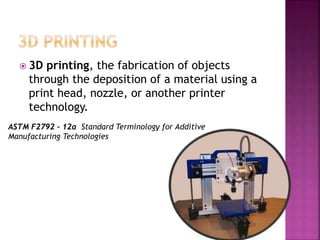
 3D printing, the fabrication of objects
through the deposition of a material using a
print head, nozzle, or another printer
technology.
ASTM F2792 - 12a Standard Terminology for Additive
Manufacturing Technologies
 Many processes that have the common
theme, controlled material removal, are
today collectively known as subtractive
manufacturing, in distinction from processes
of controlled material addition, which are
known as additive manufacturing
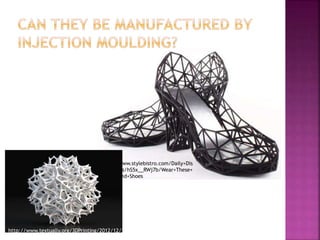
http://www.stylebistro.com/Daily+Dis
h/articles/hS5x__RWj7b/Wear+These+
3D+Printed+Shoes
http://www.textually.org/3DPrinting/2012/12/31/photo1032.jpeg
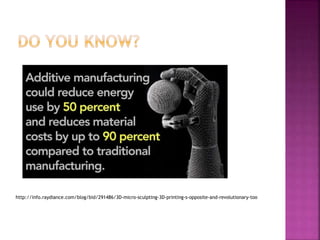
http://info.raydiance.com/blog/bid/291486/3D-micro-sculpting-3D-printing-s-opposite-and-revolutionary-too
 Free of complexity
 Variety is free
 No assembly required
 Little lead time
 Little skill manufacturing
 Few constraints
 Less waste
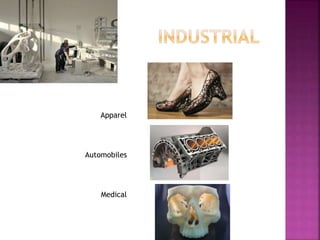
Apparel
Automobiles
Medical
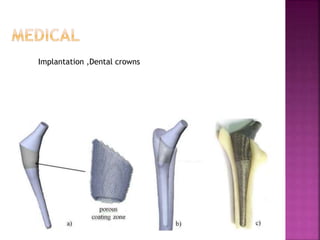
Implantation ,Dental crowns
• ART
• Education and research
3D printing polished nickel
steel
Additive manufacturing is latest technology making inroads into
classroom.
Plastic in 3D Printing
Currently, plastics are the most widely used materials in
additive manufacturing, and the important ones are listed
below:
ABS - acrylonitile butadiene styrene or 'lego' plastic – a
very common choice for 3D printing
PLA - polylactic acid – Is available in soft and hard grades,
is becoming very popular and may overtake ABS in the
near future
Metals
Some of the metals used in 3D printing include the following:
•Steel
•Stainless steel
•Titanium
•Gold
•Silver
Other
Bio-Ink - Bio-ink comprises stem cells and cells
from a patient, which can be laid down, layer by
layer to form a tissue. Human organs such as blood
vessels, bladders and kidney portions have been
replicated using this technology.
Bone material- Bone material comprises silicon,
calcium phosphate and zinc.
.
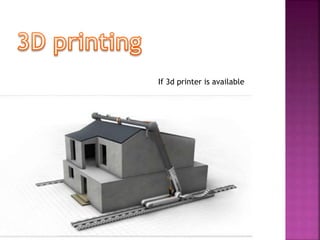
If 3d printer is available
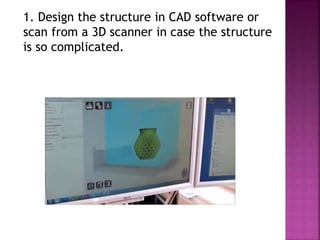
1. Design the structure in CAD software or
scan from a 3D scanner in case the structure
is so complicated.
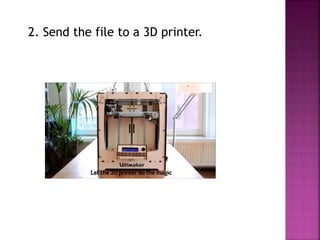
2. Send the file to a 3D printer.
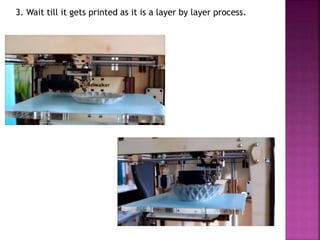
3. Wait till it gets printed as it is a layer by layer process.
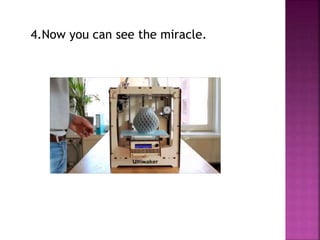
4.Now you can see the miracle.
additive manufacturing

additive manufacturing

  • 1.
  • 2.
     additive manufacturing(AM), a process of joining materials to make objects from 3D model data, usually layer upon layer, as opposed to subtractive manufacturing methodologies. ASTM F2792 - 12a Standard Terminology for Additive Manufacturing Technologies
  • 3.
     Oxford Dictionaries: make (something) on a large scale using machinery  make or produce (something abstract) in a merely mechanical way  Online Etymology Dictionary:  1560s, "something made by hand," from Middle French manufacture,  from Latin manu "hand" + factura "a working,“
  • 4.
     3D printing,the fabrication of objects through the deposition of a material using a print head, nozzle, or another printer technology. ASTM F2792 - 12a Standard Terminology for Additive Manufacturing Technologies
  • 5.
     Many processesthat have the common theme, controlled material removal, are today collectively known as subtractive manufacturing, in distinction from processes of controlled material addition, which are known as additive manufacturing
  • 7.
  • 9.
  • 11.
     Free ofcomplexity  Variety is free  No assembly required  Little lead time  Little skill manufacturing  Few constraints  Less waste
  • 13.
  • 14.
  • 15.
    • ART • Educationand research 3D printing polished nickel steel Additive manufacturing is latest technology making inroads into classroom.
  • 16.
    Plastic in 3DPrinting Currently, plastics are the most widely used materials in additive manufacturing, and the important ones are listed below: ABS - acrylonitile butadiene styrene or 'lego' plastic – a very common choice for 3D printing PLA - polylactic acid – Is available in soft and hard grades, is becoming very popular and may overtake ABS in the near future
  • 17.
    Metals Some of themetals used in 3D printing include the following: •Steel •Stainless steel •Titanium •Gold •Silver Other Bio-Ink - Bio-ink comprises stem cells and cells from a patient, which can be laid down, layer by layer to form a tissue. Human organs such as blood vessels, bladders and kidney portions have been replicated using this technology. Bone material- Bone material comprises silicon, calcium phosphate and zinc.
  • 18.
    . If 3d printeris available
  • 19.
    1. Design thestructure in CAD software or scan from a 3D scanner in case the structure is so complicated.
  • 20.
    2. Send thefile to a 3D printer.
  • 21.
    3. Wait tillit gets printed as it is a layer by layer process.
  • 22.
    4.Now you cansee the miracle.