3D Scanning Technology
Mr. G. Gopinath
Asst. Professor
Department of Mechanical Engineering
JB Institute of Engineering and Technology, Hyderabad
3D scanning
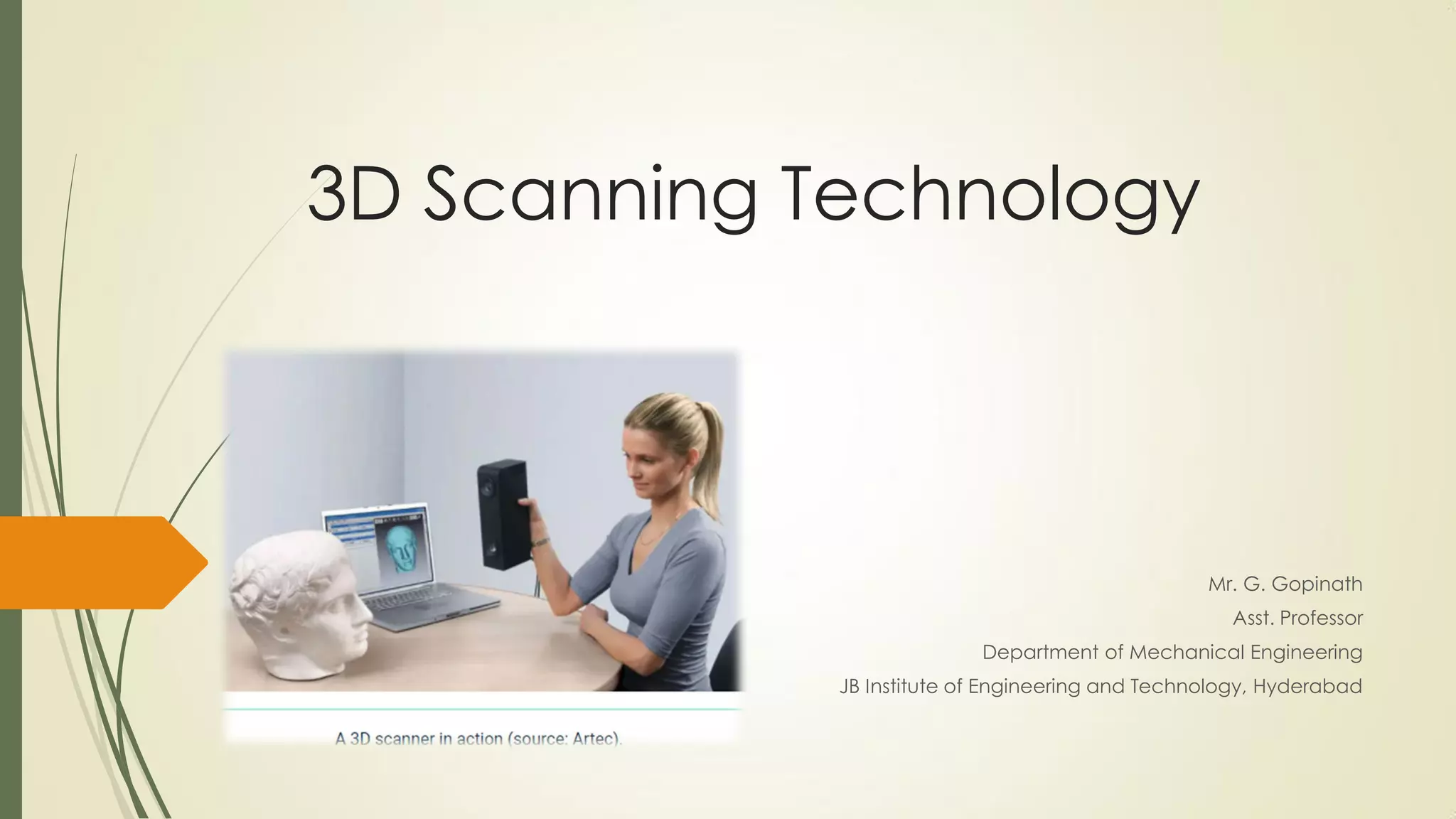
 3D scanning is a technique used to capture the shape of an object using a 3D
scanner. The result is a 3D file of the object which can be saved, edited, and
even 3D printed. Many different 3D scanning technologies exist to 3D scan
objects, environments, and people. Each 3D scanning technology comes with its
own limitations, advantages, and costs.
Bridging Physical and Digital world
 3D scanners are tri-dimensional measurement devices used to capture real-world objects or
environments so that they can be remodeled or analyzed in the digital world. The latest
generation of 3D scanners do not require contact with the physical object being captured.
Real Object 3D Model
3D scanners can be used to get complete or partial 3D measurements of any physical object.
The majority of these devices generate points or measures of extremely high density when
compared to traditional “point-by-point” measurement devices.
OBJECTS ARE USUALLY SCANNED IN 3D FOR 2 PURPOSES
 Extracting dimensions to reconstruct a CAD reference file for Reverse Engineering or Rapid Prototyping
 Measuring the object itself for analysis and documentation. This is done for applications such as computer –
Aided Inspection (CAI) and analysis (CAE)
Applications
3D scanners are powerful tools for professionals in several industries, such as
 automotive,
 aeronautics,
 dental,
 jewelry,
 video games,
 special effects,
 animation movies.
3D scanning technologies rely on different physical
principles and can be classified in categories:
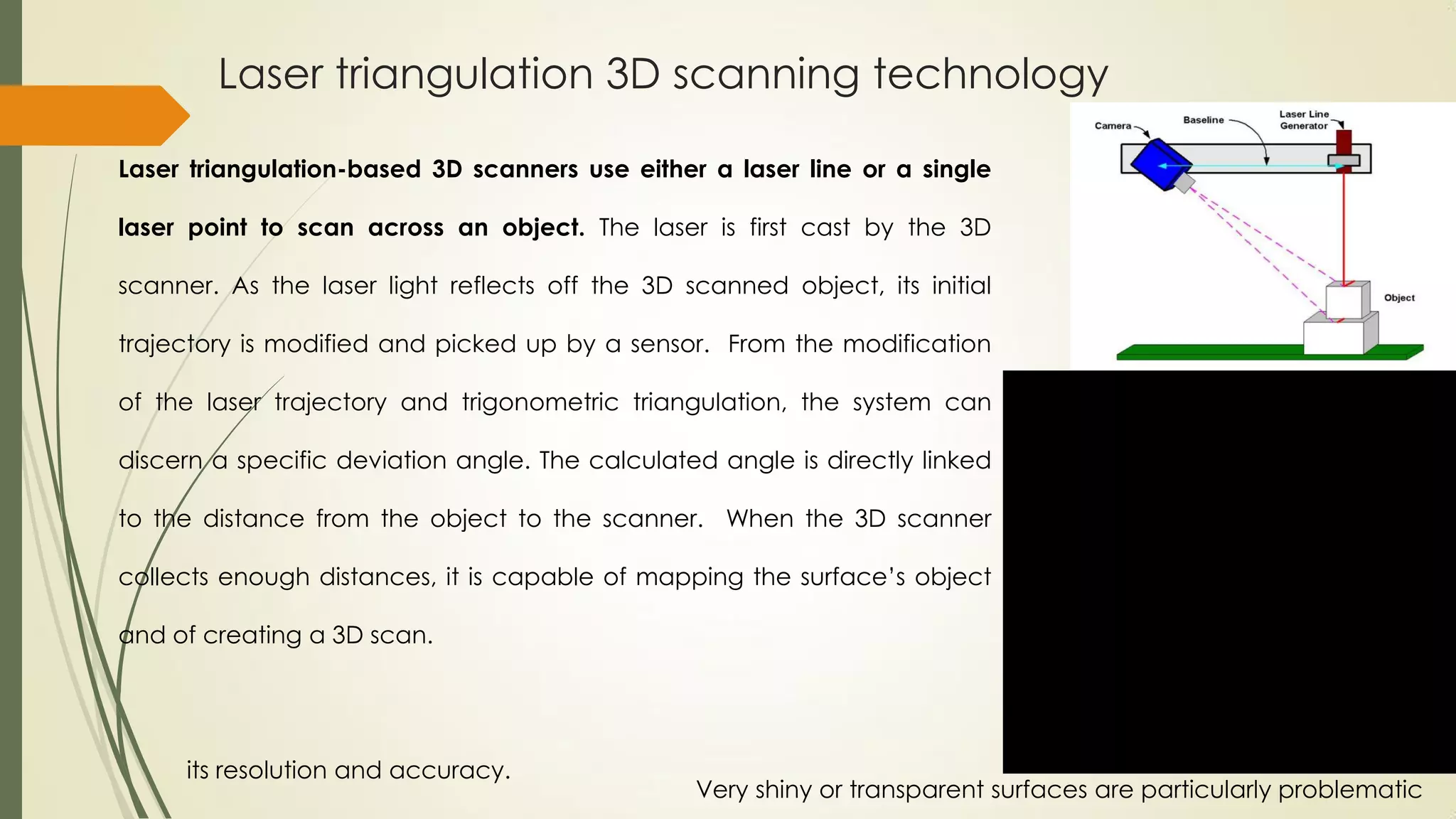
 Laser triangulation 3D scanning technology, as illustrated on the image, projects a laser
beam on a surface and measures the deformation of the laser ray.
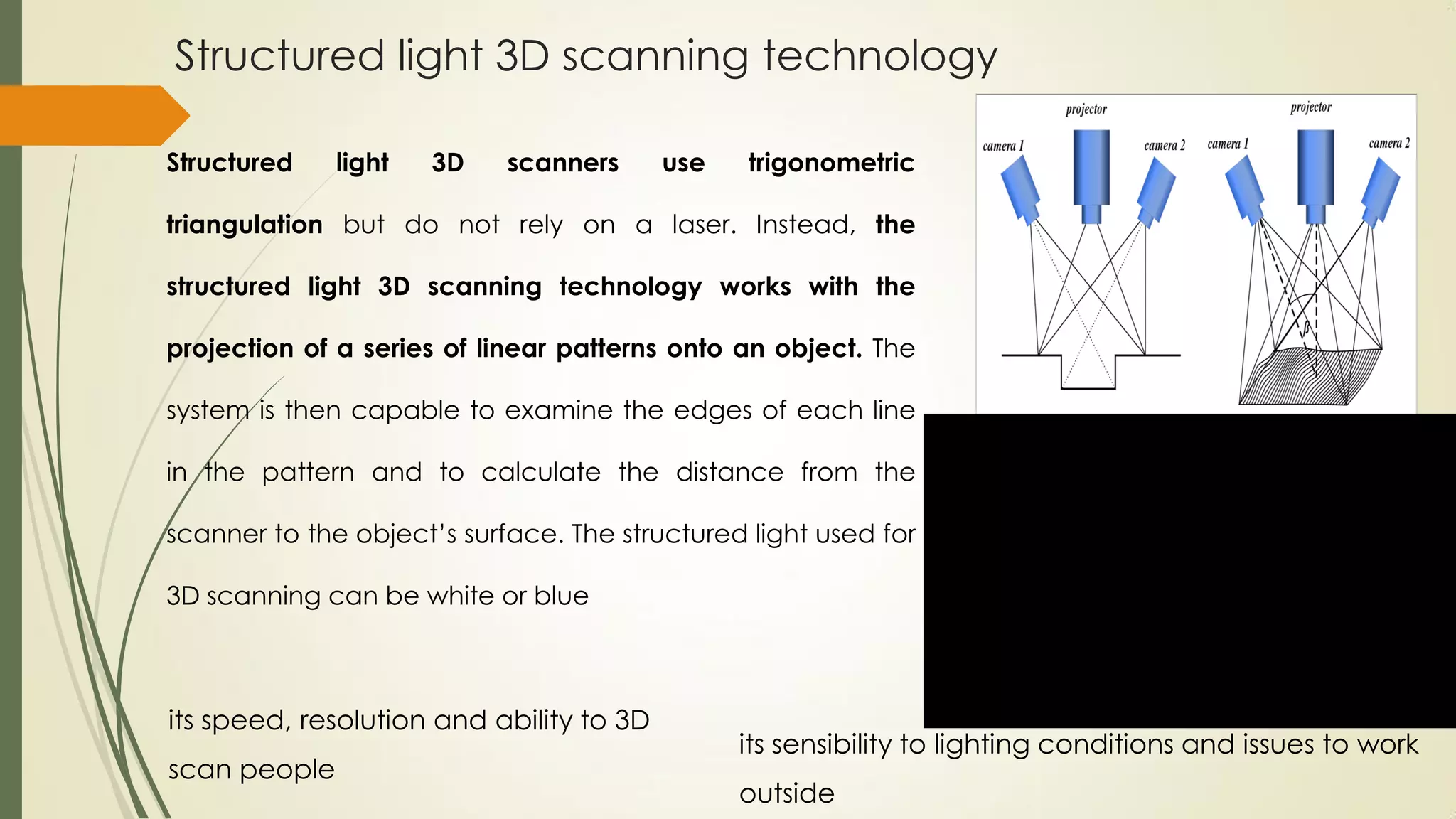
 Structured light 3D scanning technology measures the deformation of a light pattern on
a surface to 3D scan the shape of the surface.
 Photogrammetry, also called 3D scan from photographies, reconstructs in 3D a subject
from 2D captures with computer vision and computational geometry algorithms.
 Contact-based 3D scanning technology relies on the sampling of several points on a
surface, measured by the deformation of a probe.
Laser triangulation 3D scanning technology
Laser triangulation-based 3D scanners use either a laser line or a single
laser point to scan across an object. The laser is first cast by the 3D
scanner. As the laser light reflects off the 3D scanned object, its initial
trajectory is modified and picked up by a sensor. From the modification
of the laser trajectory and trigonometric triangulation, the system can
discern a specific deviation angle. The calculated angle is directly linked
to the distance from the object to the scanner. When the 3D scanner
collects enough distances, it is capable of mapping the surface’s object
and of creating a 3D scan.
its resolution and accuracy.
Very shiny or transparent surfaces are particularly problematic
Structured light 3D scanning technology
Structured light 3D scanners use trigonometric
triangulation but do not rely on a laser. Instead, the
structured light 3D scanning technology works with the
projection of a series of linear patterns onto an object. The
system is then capable to examine the edges of each line
in the pattern and to calculate the distance from the
scanner to the object’s surface. The structured light used for
3D scanning can be white or blue
its speed, resolution and ability to 3D
scan people
its sensibility to lighting conditions and issues to work
outside
Photogrammetry 3D scanning technology (photography)
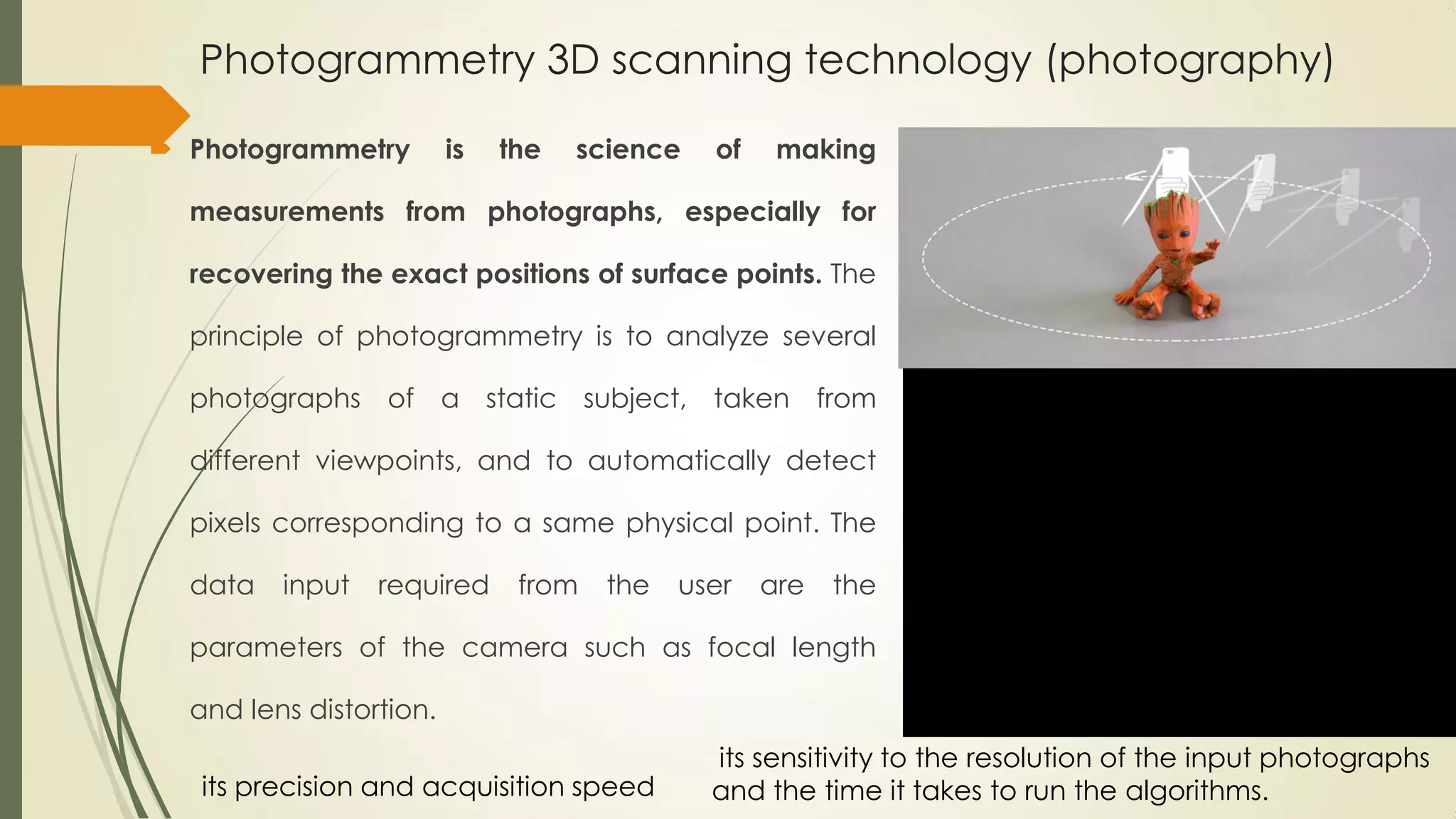
 Photogrammetry is the science of making
measurements from photographs, especially for
recovering the exact positions of surface points. The
principle of photogrammetry is to analyze several
photographs of a static subject, taken from
different viewpoints, and to automatically detect
pixels corresponding to a same physical point. The
data input required from the user are the
parameters of the camera such as focal length
and lens distortion.
its precision and acquisition speed
its sensitivity to the resolution of the input photographs
and the time it takes to run the algorithms.
Contact-based 3D scanning technology
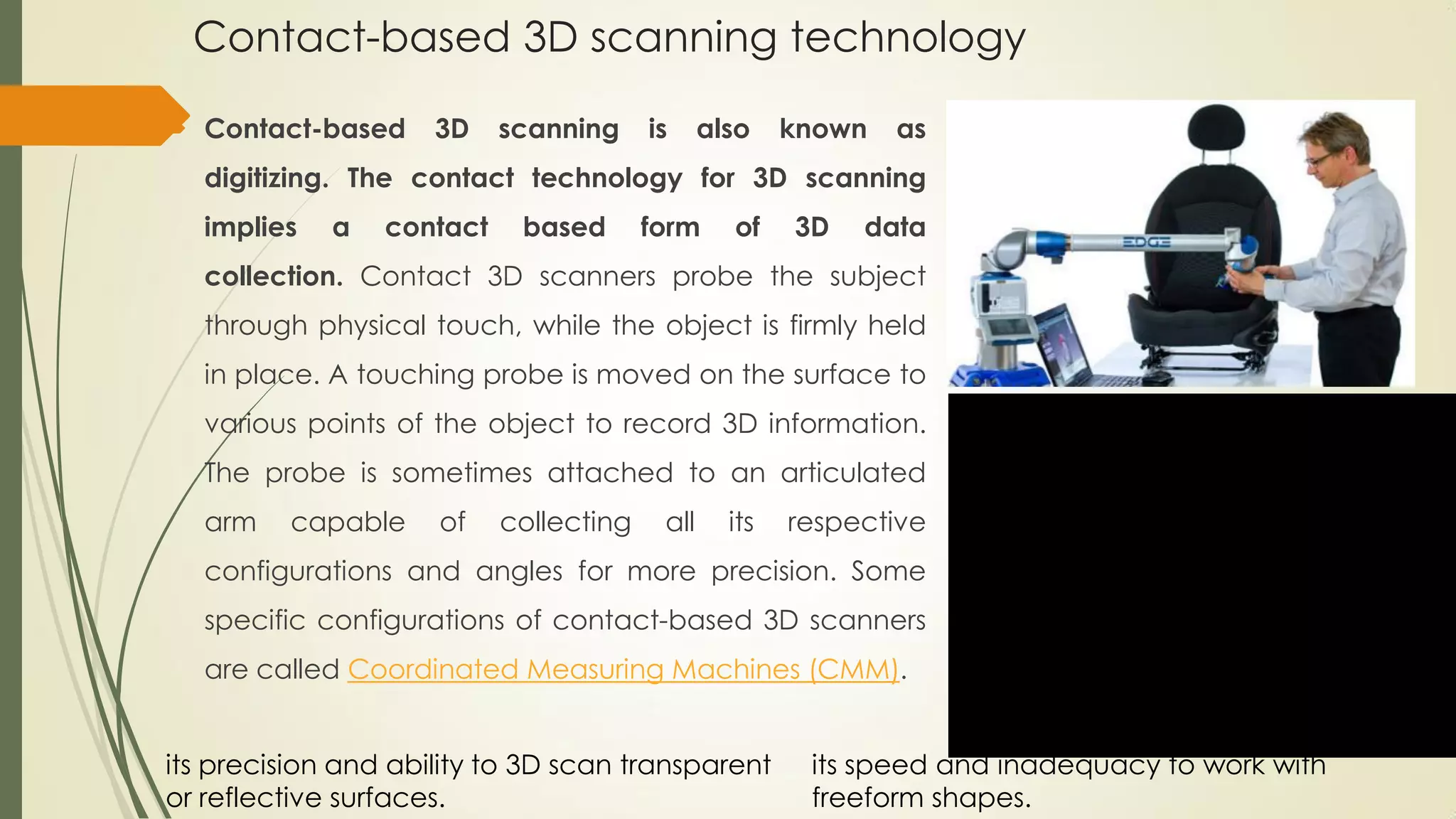
 Contact-based 3D scanning is also known as
digitizing. The contact technology for 3D scanning
implies a contact based form of 3D data
collection. Contact 3D scanners probe the subject
through physical touch, while the object is firmly held
in place. A touching probe is moved on the surface to
various points of the object to record 3D information.
The probe is sometimes attached to an articulated
arm capable of collecting all its respective
configurations and angles for more precision. Some
specific configurations of contact-based 3D scanners
are called Coordinated Measuring Machines (CMM).
its precision and ability to 3D scan transparent
or reflective surfaces.
its speed and inadequacy to work with
freeform shapes.
Thank you

3 d scanning technology

  • 1.
    3D Scanning Technology Mr.G. Gopinath Asst. Professor Department of Mechanical Engineering JB Institute of Engineering and Technology, Hyderabad
  • 2.
    3D scanning  3Dscanning is a technique used to capture the shape of an object using a 3D scanner. The result is a 3D file of the object which can be saved, edited, and even 3D printed. Many different 3D scanning technologies exist to 3D scan objects, environments, and people. Each 3D scanning technology comes with its own limitations, advantages, and costs.
  • 3.
    Bridging Physical andDigital world  3D scanners are tri-dimensional measurement devices used to capture real-world objects or environments so that they can be remodeled or analyzed in the digital world. The latest generation of 3D scanners do not require contact with the physical object being captured. Real Object 3D Model 3D scanners can be used to get complete or partial 3D measurements of any physical object. The majority of these devices generate points or measures of extremely high density when compared to traditional “point-by-point” measurement devices.
  • 4.
    OBJECTS ARE USUALLYSCANNED IN 3D FOR 2 PURPOSES  Extracting dimensions to reconstruct a CAD reference file for Reverse Engineering or Rapid Prototyping  Measuring the object itself for analysis and documentation. This is done for applications such as computer – Aided Inspection (CAI) and analysis (CAE)
  • 5.
    Applications 3D scanners arepowerful tools for professionals in several industries, such as  automotive,  aeronautics,  dental,  jewelry,  video games,  special effects,  animation movies.
  • 6.
    3D scanning technologiesrely on different physical principles and can be classified in categories:  Laser triangulation 3D scanning technology, as illustrated on the image, projects a laser beam on a surface and measures the deformation of the laser ray.  Structured light 3D scanning technology measures the deformation of a light pattern on a surface to 3D scan the shape of the surface.  Photogrammetry, also called 3D scan from photographies, reconstructs in 3D a subject from 2D captures with computer vision and computational geometry algorithms.  Contact-based 3D scanning technology relies on the sampling of several points on a surface, measured by the deformation of a probe.
  • 7.
    Laser triangulation 3Dscanning technology Laser triangulation-based 3D scanners use either a laser line or a single laser point to scan across an object. The laser is first cast by the 3D scanner. As the laser light reflects off the 3D scanned object, its initial trajectory is modified and picked up by a sensor. From the modification of the laser trajectory and trigonometric triangulation, the system can discern a specific deviation angle. The calculated angle is directly linked to the distance from the object to the scanner. When the 3D scanner collects enough distances, it is capable of mapping the surface’s object and of creating a 3D scan. its resolution and accuracy. Very shiny or transparent surfaces are particularly problematic
  • 8.
    Structured light 3Dscanning technology Structured light 3D scanners use trigonometric triangulation but do not rely on a laser. Instead, the structured light 3D scanning technology works with the projection of a series of linear patterns onto an object. The system is then capable to examine the edges of each line in the pattern and to calculate the distance from the scanner to the object’s surface. The structured light used for 3D scanning can be white or blue its speed, resolution and ability to 3D scan people its sensibility to lighting conditions and issues to work outside
  • 9.
    Photogrammetry 3D scanningtechnology (photography)  Photogrammetry is the science of making measurements from photographs, especially for recovering the exact positions of surface points. The principle of photogrammetry is to analyze several photographs of a static subject, taken from different viewpoints, and to automatically detect pixels corresponding to a same physical point. The data input required from the user are the parameters of the camera such as focal length and lens distortion. its precision and acquisition speed its sensitivity to the resolution of the input photographs and the time it takes to run the algorithms.
  • 10.
    Contact-based 3D scanningtechnology  Contact-based 3D scanning is also known as digitizing. The contact technology for 3D scanning implies a contact based form of 3D data collection. Contact 3D scanners probe the subject through physical touch, while the object is firmly held in place. A touching probe is moved on the surface to various points of the object to record 3D information. The probe is sometimes attached to an articulated arm capable of collecting all its respective configurations and angles for more precision. Some specific configurations of contact-based 3D scanners are called Coordinated Measuring Machines (CMM). its precision and ability to 3D scan transparent or reflective surfaces. its speed and inadequacy to work with freeform shapes.
  • 12.