Presented by
N.SUDHEER
M.TECH(MACHINE DESIGN)
16481D1509
GUDLAVALLERU ENGINEERING COLLEGE
Sheshadri Rao Knowledge Village, Gudlavalleru,PIN:521356.
A technical seminar on
Additive manufacturing??
Additive manufacturing or 3D printing is a process
of making three-dimensional solid objects from a
digital model.
 Subtractive manufacturing is a process by which 3D objects are
constructed by successively cutting material away from a solid block of
material. It is also known to us as “Conventional manufacturing”.
 Additive Manufacturing is a process by which 3D objects are
constructed by successively depositing material in layers such that it
becomes a predesigned shape.
Modern 3D printing has always been very useful for rapid prototype
development but it is starting to make its impact on the manufacturing
world as well.
A prototype is an early sample, model, or release of a
product built to test a concept or process to estimate the
behavior of original product under working conditions.
 Rapid prototyping(RP) is a group of techniques used to
quickly fabricate a scale model of a physical part or assembly
using three-dimensional computer aided design (CAD) data.
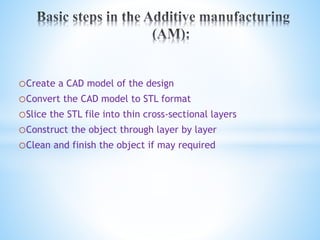
oCreate a CAD model of the design
oConvert the CAD model to STL format
oSlice the STL file into thin cross-sectional layers
oConstruct the object through layer by layer
oClean and finish the object if may required
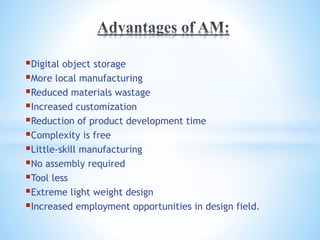
Digital object storage
More local manufacturing
Reduced materials wastage
Increased customization
Reduction of product development time
Complexity is free
Little-skill manufacturing
No assembly required
Tool less
Extreme light weight design
Increased employment opportunities in design field.
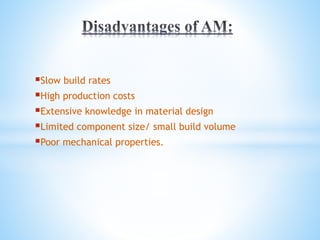
Slow build rates
High production costs
Extensive knowledge in material design
Limited component size/ small build volume
Poor mechanical properties.
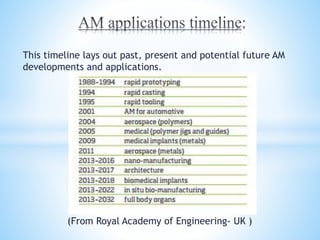
This timeline lays out past, present and potential future AM
developments and applications.
(From Royal Academy of Engineering- UK )
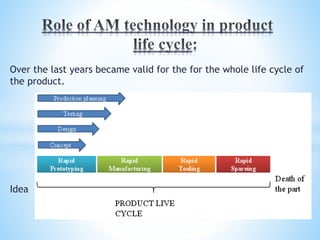
Over the last years became valid for the for the whole life cycle of
the product.
Idea
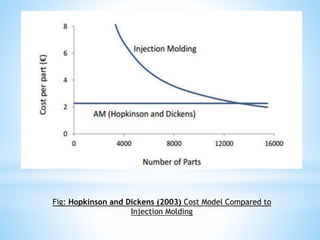
Fig: Hopkinson and Dickens (2003) Cost Model Compared to
Injection Molding
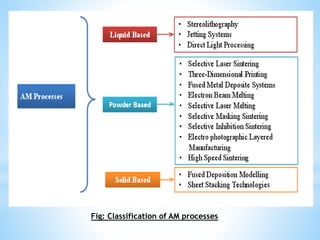
Fig: Classification of AM processes
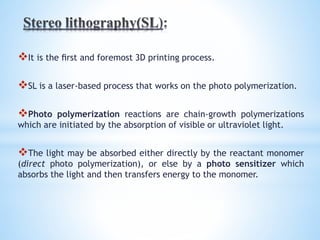
It is the first and foremost 3D printing process.
SL is a laser-based process that works on the photo polymerization.
Photo polymerization reactions are chain-growth polymerizations
which are initiated by the absorption of visible or ultraviolet light.
The light may be absorbed either directly by the reactant monomer
(direct photo polymerization), or else by a photo sensitizer which
absorbs the light and then transfers energy to the monomer.
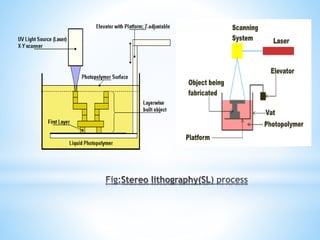
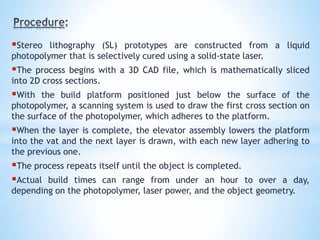
Stereo lithography (SL) prototypes are constructed from a liquid
photopolymer that is selectively cured using a solid-state laser.
The process begins with a 3D CAD file, which is mathematically sliced
into 2D cross sections.
With the build platform positioned just below the surface of the
photopolymer, a scanning system is used to draw the first cross section on
the surface of the photopolymer, which adheres to the platform.
When the layer is complete, the elevator assembly lowers the platform
into the vat and the next layer is drawn, with each new layer adhering to
the previous one.
The process repeats itself until the object is completed.
Actual build times can range from under an hour to over a day,
depending on the photopolymer, laser power, and the object geometry.
Prototypes for design, analysis, verification and functional
testing.
Parts for prototype tooling and low volume production tooling.
Patterns for investment casting, sand casting and molding.
Models for conceptualization and presentation.
Procedure:
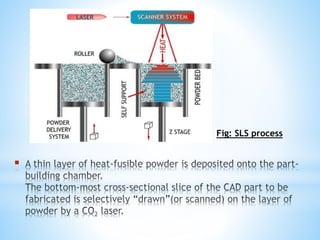
The SLS process creates 3D objects, layer by layer, from CAD-
data using powdered materials with heat generated by CO2 laser
within the sinteration system.
CAD data files in the .STL format are first transferred to the
sinteration systems where they are sliced.
From this point, the SLS process begins and operate as follows:

Fig: SLS process
The interaction of the laser beam with the powder elevates the
temperature to the point of melting, fusing the powder particles
to form a solid mass.
The intensity of laser beam is modulated to melt the powder
only in areas defined by the part’s geometry.
Surrounding powder remains a loose compact and serves as
natural supports.
When the cross-section is completely “drawn”, an additional
layer of powder is deposited via a roller mechanism on top of the
previously scanned layer.
This prepares the next layer for scanning.
By successive layers of powder deposition, the process is
repeated until the part is completed.
Concept models: Physical representation of designs used to
review design ideas, form and style.
Functional models and working prototypes: Parts that can
withstand limited functional testing, or fit and operate within an
assembly.
Polycarbonate patterns(rapid casting): These patterns are
used in investment casting process rather than wax patterns.
These patterns are durable and heat resistant.
Metal tools: direct rapid prototype of tools of molds for small
and short production runs.
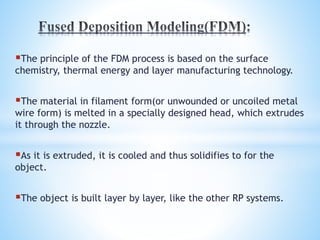
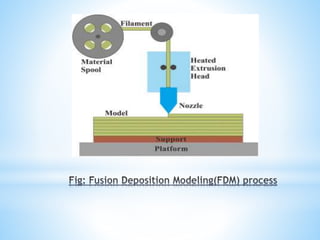
The principle of the FDM process is based on the surface
chemistry, thermal energy and layer manufacturing technology.
The material in filament form(or unwounded or uncoiled metal
wire form) is melted in a specially designed head, which extrudes
it through the nozzle.
As it is extruded, it is cooled and thus solidifies to for the
object.
The object is built layer by layer, like the other RP systems.
Aerospace
Prototyping
Automotive
Medical Instruments/ Surgical Implants
Research & Development
Dental
Art/Jewelry
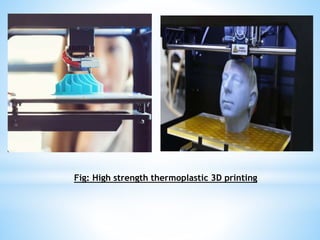
Fig: High strength thermoplastic 3D printing
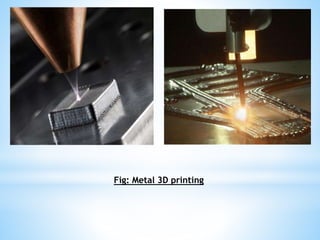
Fig: Metal 3D printing
1. Rapid Prototyping: principles and applications- Rafiq.I.Noorani(John Wiley&
sons publishers).
2. Rapid Prototyping: principles and applications- C.K.Chua, K.F.Leong &
C.S.Lim (Cambridge University press)-3rd edition.
3.Additive manufacturing- Amit Bandyopadhyay & Susmita Bose (CRC press).
4.3D printing: The Next Industrial Revolution-Christopher Barnatt (published by
“Explaining The Future.com”)-2nd edition.
5. https://www.3dsystems.com/
6. http://www.harbec.com/
7. http://www.raeng.org.uk/
8. http://www.nature.com/
9. https://www.creativemechanisms.com/
10. http://www.incodema3d.com/
11. http://additivemanufacturing.com/basics/
Thank you

ADDITIVE MANUFACTURING/ 3D PRINTING

  • 1.
    Presented by N.SUDHEER M.TECH(MACHINE DESIGN) 16481D1509 GUDLAVALLERUENGINEERING COLLEGE Sheshadri Rao Knowledge Village, Gudlavalleru,PIN:521356. A technical seminar on
  • 2.
    Additive manufacturing?? Additive manufacturingor 3D printing is a process of making three-dimensional solid objects from a digital model.
  • 3.
     Subtractive manufacturingis a process by which 3D objects are constructed by successively cutting material away from a solid block of material. It is also known to us as “Conventional manufacturing”.  Additive Manufacturing is a process by which 3D objects are constructed by successively depositing material in layers such that it becomes a predesigned shape. Modern 3D printing has always been very useful for rapid prototype development but it is starting to make its impact on the manufacturing world as well.
  • 4.
    A prototype isan early sample, model, or release of a product built to test a concept or process to estimate the behavior of original product under working conditions.  Rapid prototyping(RP) is a group of techniques used to quickly fabricate a scale model of a physical part or assembly using three-dimensional computer aided design (CAD) data.
  • 5.
    oCreate a CADmodel of the design oConvert the CAD model to STL format oSlice the STL file into thin cross-sectional layers oConstruct the object through layer by layer oClean and finish the object if may required
  • 6.
    Digital object storage Morelocal manufacturing Reduced materials wastage Increased customization Reduction of product development time Complexity is free Little-skill manufacturing No assembly required Tool less Extreme light weight design Increased employment opportunities in design field.
  • 7.
    Slow build rates Highproduction costs Extensive knowledge in material design Limited component size/ small build volume Poor mechanical properties.
  • 8.
    This timeline laysout past, present and potential future AM developments and applications. (From Royal Academy of Engineering- UK )
  • 9.
    Over the lastyears became valid for the for the whole life cycle of the product. Idea
  • 12.
    Fig: Hopkinson andDickens (2003) Cost Model Compared to Injection Molding
  • 13.
  • 14.
    It is thefirst and foremost 3D printing process. SL is a laser-based process that works on the photo polymerization. Photo polymerization reactions are chain-growth polymerizations which are initiated by the absorption of visible or ultraviolet light. The light may be absorbed either directly by the reactant monomer (direct photo polymerization), or else by a photo sensitizer which absorbs the light and then transfers energy to the monomer.
  • 16.
    Stereo lithography (SL)prototypes are constructed from a liquid photopolymer that is selectively cured using a solid-state laser. The process begins with a 3D CAD file, which is mathematically sliced into 2D cross sections. With the build platform positioned just below the surface of the photopolymer, a scanning system is used to draw the first cross section on the surface of the photopolymer, which adheres to the platform. When the layer is complete, the elevator assembly lowers the platform into the vat and the next layer is drawn, with each new layer adhering to the previous one. The process repeats itself until the object is completed. Actual build times can range from under an hour to over a day, depending on the photopolymer, laser power, and the object geometry.
  • 17.
    Prototypes for design,analysis, verification and functional testing. Parts for prototype tooling and low volume production tooling. Patterns for investment casting, sand casting and molding. Models for conceptualization and presentation.
  • 18.
    Procedure: The SLS processcreates 3D objects, layer by layer, from CAD- data using powdered materials with heat generated by CO2 laser within the sinteration system. CAD data files in the .STL format are first transferred to the sinteration systems where they are sliced. From this point, the SLS process begins and operate as follows:
  • 19.
  • 20.
    The interaction ofthe laser beam with the powder elevates the temperature to the point of melting, fusing the powder particles to form a solid mass. The intensity of laser beam is modulated to melt the powder only in areas defined by the part’s geometry. Surrounding powder remains a loose compact and serves as natural supports. When the cross-section is completely “drawn”, an additional layer of powder is deposited via a roller mechanism on top of the previously scanned layer. This prepares the next layer for scanning. By successive layers of powder deposition, the process is repeated until the part is completed.
  • 21.
    Concept models: Physicalrepresentation of designs used to review design ideas, form and style. Functional models and working prototypes: Parts that can withstand limited functional testing, or fit and operate within an assembly. Polycarbonate patterns(rapid casting): These patterns are used in investment casting process rather than wax patterns. These patterns are durable and heat resistant. Metal tools: direct rapid prototype of tools of molds for small and short production runs.
  • 22.
    The principle ofthe FDM process is based on the surface chemistry, thermal energy and layer manufacturing technology. The material in filament form(or unwounded or uncoiled metal wire form) is melted in a specially designed head, which extrudes it through the nozzle. As it is extruded, it is cooled and thus solidifies to for the object. The object is built layer by layer, like the other RP systems.
  • 24.
    Aerospace Prototyping Automotive Medical Instruments/ SurgicalImplants Research & Development Dental Art/Jewelry
  • 25.
    Fig: High strengththermoplastic 3D printing
  • 26.
    Fig: Metal 3Dprinting
  • 27.
    1. Rapid Prototyping:principles and applications- Rafiq.I.Noorani(John Wiley& sons publishers). 2. Rapid Prototyping: principles and applications- C.K.Chua, K.F.Leong & C.S.Lim (Cambridge University press)-3rd edition. 3.Additive manufacturing- Amit Bandyopadhyay & Susmita Bose (CRC press). 4.3D printing: The Next Industrial Revolution-Christopher Barnatt (published by “Explaining The Future.com”)-2nd edition. 5. https://www.3dsystems.com/ 6. http://www.harbec.com/ 7. http://www.raeng.org.uk/ 8. http://www.nature.com/ 9. https://www.creativemechanisms.com/ 10. http://www.incodema3d.com/ 11. http://additivemanufacturing.com/basics/
  • 28.