RETINOBLASTOMA
By
Dr.Jeetendra kancherla
Radiotherapy (JR-1)
Epidemiology
 Retinoblastoma(Rb) is the most common intraocular
malignancy in children, and affects 1 in 15,000 to 1 in
18,000 live births.
 It represents almost 4% of all pediatric malignancies.
 Approximately 250–300 children are newly
diagnosed with retinoblastoma each year in the
United States, and substantially higher rates occur in
developing countries.
 Studies from India show a two- to three-fold higher
incidence of tumors of the eye (majority of which
will be retinoblastoma in children <15 years of age).
Also, while over 95% children with retinoblastoma
survive in the developed world, only 50% children with
retinoblastoma survive worldwide.
This can be explained by a delay in presentation and,
consequently, a greater number of cases with
extraocular invasion seen in developing countries.
 It can present with unilateral disease (two-thirds of
cases), bilateral disease, or rarely with tumor in
both eyes and the pineal gland, which is called
trilateral disease.
Abramson DH, Schefler AC, Dunkel IJ, et al. “ Neoplasms of the eye. In: Cancer medicine. Hamilton,
Ontario: BC Decker; 2003:1165–1216.
Pathogenesis
 Mutational inactivation of both alleles of the
retinoblastoma (RB1) gene.
 On chromosome 13q14.
 Encodes a nuclear protein that acts as a tumor
suppressor and cell cycle regulator; checkpoint
between G1 & S-phase.
 Normal individual inherits two copies of this gene
one from each parent.
A "two-hit" model
Sporadic retinoblastoma:
First hit occurs after conception
in utero or in early childhood in
retinal cells.
All cells in body are not affected
as germ cells are not involved.
Second somatic mutation results
in loss of other normal allele.
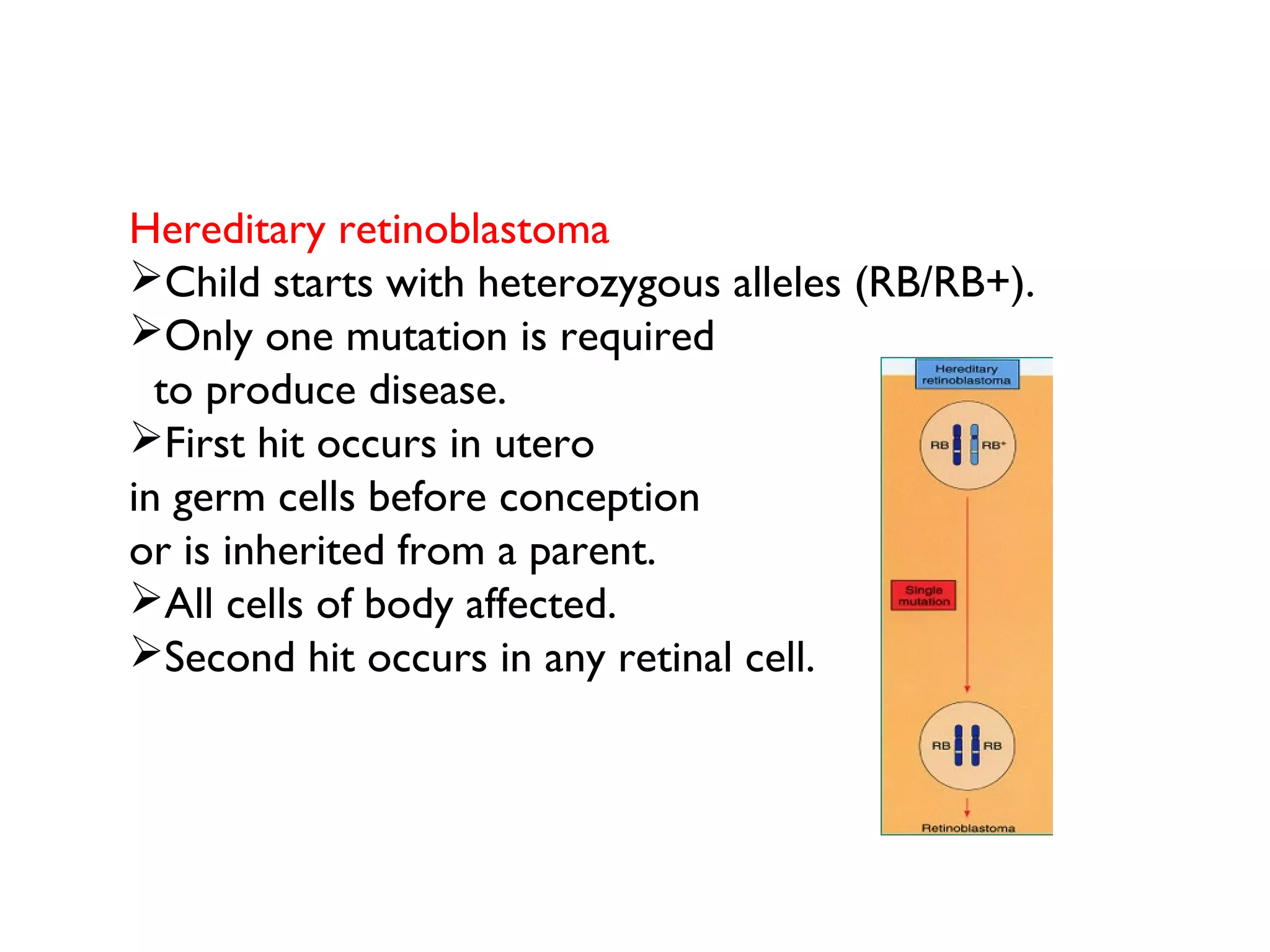
Hereditary retinoblastoma
Child starts with heterozygous alleles (RB/RB+).
Only one mutation is required
to produce disease.
First hit occurs in utero
in germ cells before conception
or is inherited from a parent.
All cells of body affected.
Second hit occurs in any retinal cell.
Clinical features
 leukokoria, a discoloration of the pupil.
 deterioration of vision.
 a red or irritated eye.
 faltering growth, or developmental delay.
“ Shields JA, Shields CL, Parsons HM. Differential diagnosis of retinoblastoma. Retina 1991;11:232–243.”
 Strabismus.
Shields JA, Augsburger JJ. Current approaches to the diagnosis and management of retinoblastoma. Surv
Ophthalmol 1981;25:347–372.
 In advanced disease in developing countries, eye
enlargement.
SPREAD
Local spread: anteriorly- seeding of vitreous & aqueous
posteriorly- sub retinal space and choroids
May spread through optic nerve
Along the central retinal vessels: tumor cells pass
through the lamina cribrosa and enter subarachnoid
space
Distant metastases: CNS, skull, bones, lymph nodes,
spinal cord, bone marrow
HISTOLOGY
 small basophilic cells (retinoblasts) with large
hyperchromatic nuclei and scanty cytoplasm.
 varying degrees of differentiation
Undifferentiated
Flexner–Wintersteiner rosettes
Homer–Wright rosettes (pseudorosettes)
Fleurettes -resembles a bouquet of flowers
Patterns of tumor growth
Intraretinal tumor - homogeneous, dome-shaped
white lesion , often with white flecks of calcification
Exophytic (into the subretinal space) causing retinal
detachment.
oAs the tumor grows, the retinal detachment may
become extensive, obscuring visualization of the tumor
Endophytic (into the vitreous)
with seeding of tumour cells throughout the eye
 Optic nerve invasion
 spread of tumour along the Sub Arachnoid Space.
 Diffuse infiltration of the retina, without exophytic
or endophytic growth.
 Metastatic spread
regional nodes
lung, brain and bone
DIAGNOSIS
 The diagnosis of retinoblastoma is based on
examination by an ophthalmologist and imaging
studies.
 Biopsy is generally not performed due to the
theoretical risk for extraocular dissemination, which
could convert an intraocular, curable tumor into
extraocular, metastatic disease.
 Detailed examination under anesthesia through
dilated pupils is performed.
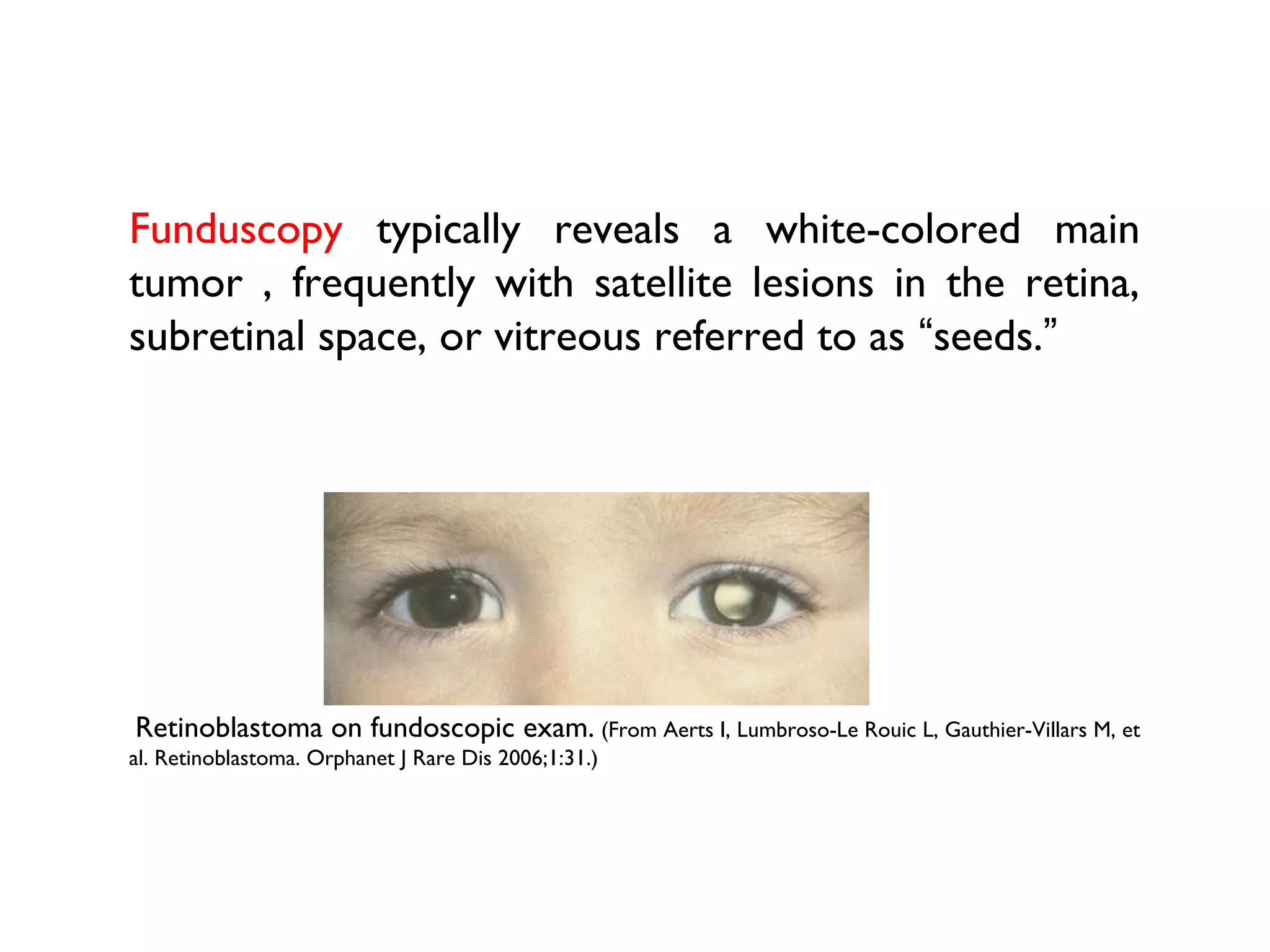
Funduscopy typically reveals a white-colored main
tumor , frequently with satellite lesions in the retina,
subretinal space, or vitreous referred to as “seeds.”
Retinoblastoma on fundoscopic exam. (From Aerts I, Lumbroso-Le Rouic L, Gauthier-Villars M, et
al. Retinoblastoma. Orphanet J Rare Dis 2006;1:31.)
Ultrasonography of the eyes is often performed to
evaluate the intraocular mass with attention to
heterogeneity and calcifications, which support a
diagnosis of Rb.
USG is not as sensitive as CT, which is the ideal imaging
format to detect intraocular calcifications.
MRI of the brain and spinal cord and cerebral spinal
fluid examination are indicated when there is gross
invasion of the optic nerve.
Magnetic resonance imaging (MRI) of the brain and
orbits is the most sensitive means of evaluating for
extraocular extension and also provides better
delineation of the optic nerve and the pineal area.
“Smith EV, Gragoudas ES, Kolodny NH et al. Magnetic resonance imaging: An emerging technique for the
diagnosis of ocular disorders. Int Ophthalmol 1990;14:119–124.”
A bone marrow examination and a bone scan are
indicated only in cases of an abnormal blood count or
clinical symptoms suggesting osseous metastases.
However bone marrow biopsy is a staging procedure
in locally advanced disease.
Screening for retinoblastoma
Parents and siblings of the affected child should be
screened for evidence of retinoblastoma in all cases of
retinoblastoma in order to identify the hereditary cases
of retinoblastoma.
Reese-Ellsworth Classification
(DD: disc diameter)
International Classification of Retinoblastoma
Treatment
 When the disease is contained with in the eye,
survival rates exceed 95% in the Western world.
 However, with extraocular spread, survival rates
decrease to under 50%.
 first goal must be preservation of life, then
preservation of the eye, and, finally, preservation of
vision
 Modalities - enucleation, chemotherapy,
photocoagulation, cryotherapy, EBRT, and plaque
brachytherapy.
Metastasis – chemotherapy, radiation, BMT
Enucleation
 definitive treatment
Indications
o the tumor involves > 50% of the globe
o orbital or optic nerve involvement
o anterior segment involvement
o neovascular glaucoma
o limited visual potential
 Enucleation is curative in >95% of patients with
unilateral disease.
 Involves removal of the eye leaving behind lids
and extraocular muscles but removing the longest
possible segment (10 to 15mm) of optic nerve in
continuity with the globe.
 Orbital implants are used at most treatment
centers, and by connecting them to orbital muscles,
excellent cosmesis can be achieved.
 Systemic adjuvant therapy has been used to prevent
the development of metastatic disease in certain
high risk factors assessed by pathologic review after
enucleation.
RADIOTHERAPY
 By virtue of its radiosensitive nature, Rb was
historically treated with first-line EBRT in a majority
of cases.
 However during the past 15 years, the trend has
been to move away from radiotherapy because of
radiation-induced growth deformities of the bony
orbit and mortality related to osteosarcoma
development.
Mortality from second tumors among long-term survivors of retinoblastoma. J Natl Cancer Inst
1993;85:1121–1128.
 EBRT still has a viable role in the management of
Rb, particularly as salvage, or perhaps more
accurately consolidative treatment in tumors that
are refractory to chemotherapy and other local
therapies.
 Other indications include lesions that are too large,
numerous, or close to the optic disc or fovea for
focal therapy out of concern for preserving central
vision. EBRT also has a special role in treating eyes
with vitreous seeds.
“Munier FL, Verwey J, Pica A, et al. New developments in external beam radiotherapy for retinoblastoma: from
lens to normal tissue-sparing techniques. Clin Experiment Ophthalmol 2008;36:78–89.”
Target volume: entire retina upto ora serrata and
atleast 10 mm of Optic N.
Technique
Lateral field technique
Started in 1930’s
D – shaped lateral field with
anterior border kept at bony orbit
Disadvantage: tumor recurrence
at or near ora serrata
Modified lateral beam technique
Two lateral opposed D-shaped fields are used
Direct anterior field [Hungerford et al ]
Whole eye is treated
Disadvantage:
Cataract formation
Dose exits through brain
Lacrimal gland irradiation-
impaired tear production
Advantages:
Simple, easy to setup
Reproducible
Anterior lens sparing technique [Abramson et al ]
Lateral D-shaped field: Day1-Day 4 by photons
Anterior electron beam field with central circular
contact lens as lens shaped shield: on Day 5
Unilateral disease:
one lateral field or
2 oblique portals
[superior and inferior]
Bilateral disease:
parallel opposed lateral fields
DOSE
Ideal:
40-45 Gy, 1.8-2 Gy per fraction, 5 days a week
For large tumor /vitreous seeding: 48-50 Gy
Palliative radiotherapy:
Extra-ocular involvement: 20-25 Gy
Metastatic disease: CNS, bones: 5 Gy/1#, 15 Gy/3#
 Chan et al. reported on 36 eyes that received EBRT
after incomplete response to primary chemotherapy
and focal therapies in bilateral Rb.
 Thirty-two received lens-sparing EBRT and the
remainder received whole-eye EBRT to a dose of 40
to 44 Gy in 20 to 22 fractions.
 The rate of eye preservation was 83%, and 67%
required no further treatment after EBRT.
 McCormick et al. reported local failure in two-thirds
of cases when lens-sparing lateral technique was
used. McCormick B, Ellsworth R, Abramson D, et al. Radiation therapy for retinoblastoma:
comparison of results with lens-sparing versus lateral beam techniques. Int J Radiat Oncol Biol Phys
1988;15:567.
 Based on these concerns, more sophisticated
techniques were developed, modified lateral field
techniques using oblique angles, anterior treatment
techniques using electrons, and multiple
noncoplanar arcs.
 Conformal or IMRT is well suited for the treatment
of small tumors such as Rb.
 Krasin et al. performed a planning study that favored
the use of IMRT over conformal for the treatment
of the entire globe. IMRT resulted in the greatest
sparing of the surrounding bony orbit and other
normal tissues.
“Krasin MJ, Crawford BT, Zhu Y, et al. Intensity-modulated radiation therapy for children with intraocular
retinoblastoma: potential sparing of the bony orbit. Clin Oncol (R Coll Radiol) 2004;16:215–222.”
 Patients with hereditary disease who received EBRT
have a cumulative incidence of second cancers of
35%, compared with 6% for those who did not
receive EBRT, and the risk is even higher if
treatment takes place before 1 year of age.“Roarty JD,
McLean IW, Zimmerman LE. Incidence of second neoplasms in patients with bilateral retinoblastoma.
Ophthalmology 1988;95:1583–1587.”
 Cataracts, optic nerve damage, total retinal vascular
occlusion, vitreous hemorrhage, and facial and
temporal bone hypoplasia are other complications
associated with EBRT therapy.
“ Imhof SM, Mourits MP, Hofman P, et al. Quantification of orbital and midfacial growth retardation after
megavoltage external beam irradiation in children with retinoblastoma. Ophthalmology 1996;103:263–
268.”
Brachytherapy
 Brachytherapy with either iodine-125, gold, and
more recently ruthenium have been used in selected
cases of Rb.“Schueler AO, Fluhs D, Anastassiou G, et al. Beta-ray brachytherapy of
retinoblastoma: feasibility of a new small-sized ruthenium-106 plaque. Ophthalmic Res 2006;38:8–12.”
 The intention is to deliver a dose of 40 to 45 Gy
transclerally to the apex of the tumor over a period
of 2 to 4 days.
 This treatment is limited to tumors that are <16
mm in base and 8 mm in thickness, and can be used
as the primary treatment or, more frequently, in
patients who had failed initial therapy, including
previous EBRT.
Chemotherapy
 Chemotherapy is used to reduce the size of the
tumor(Chemoreduction) to allow local therapies,
including cryotherapy and laser photocoagulation, or
thermotherapy, to eradicate the remaining disease.
 Numerous studies have been published that show
that chemotherapy is very effective in eliminating the
need for EBRT or enucleation in R-E group I to III
eyes, while proving to be significantly less successful
in eyes with group IV or V disease.
“Kingston JE, Hungerford JL, Madreperla SA, et al. Results of combined chemotherapy and radiotherapy for
advanced intraocular retinoblastoma. Arch Ophthalmol 1996;114:1339–1343.
Greenwald MJ, Strauss LC. Treatment of intraocular retinoblastoma with carboplatin and etoposide
chemotherapy. Ophthalmology 1996;103:1989–1997.
Gunduz K, Shields CL, Shields JA, et al. The outcome of chemoreduction treatment in patients with Reese-
Ellsworth group V retinoblastoma. Arch Ophthalmol 1998;116:1613–1617.”
 Carboplatin, vincristine, and etoposide are generally
used along with subtenon carboplatin for more
advanced eyes.
 Eyes with diffuse vitreous seeding rarely respond to
chemotherapy alone
 Novel therapies for patient with vitreous or
subretinal seeding include intra-arterial
chemotherapy (IAC) with selective catheterization
of the ophthalmic artery.
“Gobin YP, Dunkel IJ, Marr BP, et al. Intra-arterial chemotherapy for the management of retinoblastoma: four-
year experience. Arch Ophthalmol” 2011;129:732–737.
 Gobin et.al described 78 patients (95 eyes) treated
with IAC with melphelan with or without
topotecan.
 The procedure succeeded in 98.5% of cases and the
ocular event-free survival rates at 2 years were 70%
for all eyes, 82% for eyes that received IAC as
primary treatment, and 58% for eyes that had prior
treatment with chemotherapy or EBRT, and there
were no permanent complications.
Cryotherapy
 Cryotherapy induces tumor tissue to freeze rapidly,
resulting in damage to the vascular endothelium with
secondary thrombosis and infarction of the tumor tissue.
 It may be used as primary therapy for small peripheral
tumors.
 Ninety percent of tumors <3 mm in diameter are cured
permanently, and complications are few and rarely
serious.
“Abramson DH, Ellsworth RM, Rozakis GW. Cryotherapy for retinoblastoma. Arch Ophthalmol
1982;100:1253–1256.”
Thermotherapy
 Thermotherapy involves the application of heat
directly to the tumor with infrared radiation. A
temperature between 45°C and 60°C is reached,
which is below the coagulative threshold and
therefore spares the retinal vessels from
coagulation.
Shields CL, Shields JA, Cater J, et al. Plaque radiotherapy for retinoblastoma: Long-term tumor control and
treatment complications in 208 tumors. Ophthalmology 2001;108:2116–2121.
Murphree AL, Villablanca JG, Deegan WF 3rd, et al. Chemotherapy plus local treatment in the management
of intraocular retinoblastoma. Arch Ophthalmol 1996;114:1348–1356.
 In a study of 91 tumors, 92% of the tumors that
were <1.5 mm in diameter were controlled with
thermotherapy alone.
chemothermotherapy
 Larger tumors or tumors with subretinal seeds are
usually treated with a combination of
thermotherapy and chemotherapy
(chemothermotherapy), usually delivered within
hours of each other.
 In one study of 188 retinoblastomas, tumor control
was achieved in 86% of cases.
“Shields CL, Santos MC, Diniz W, et al. Thermotherapy for retinoblastoma. Arch Ophthalmol 1999;117:885–
893”
 Complications included focal iris atrophy, paraxial
lens opacity, sector optic disk atrophy, retinal
traction, optic disk edema, retinal vascular
occlusion, retinal detachment, and corneal edema.
Laser photocoagulation
 Laser photocoagulation is recommended only for
small posterior tumors with the goal of coagulating
the tumors blood supply.
“Shields JA, Shields CL, Parsons H, et al. The role of photocoagulation in the management of retinoblastoma.
Arch Ophthalmol 1990;108:205–208.”
 Effective therapy usually requires two or three
sessions at monthly intervals. Complications of this
treatment include retinal detachment, retinal
vascular occlusion, retinal traction, and preretinal
fibrosis.
Follow-up
Recurrence usually occurs with in 3 years.
The risk period for extraocular spread after
successful treatment is 12 to 18 months.
Long-term survivors should also be followed for
the development of second malignancies.
Opthalmoscopic Examination :
First year : every 2-3 months
Second year : every 3-4 months.
3-5 years: every 6 months
>5 years: every one year
THANK YOU

Retinoblastoma

  • 1.
  • 2.
    Epidemiology  Retinoblastoma(Rb) isthe most common intraocular malignancy in children, and affects 1 in 15,000 to 1 in 18,000 live births.  It represents almost 4% of all pediatric malignancies.  Approximately 250–300 children are newly diagnosed with retinoblastoma each year in the United States, and substantially higher rates occur in developing countries.  Studies from India show a two- to three-fold higher incidence of tumors of the eye (majority of which will be retinoblastoma in children <15 years of age).
  • 3.
    Also, while over95% children with retinoblastoma survive in the developed world, only 50% children with retinoblastoma survive worldwide. This can be explained by a delay in presentation and, consequently, a greater number of cases with extraocular invasion seen in developing countries.
  • 5.
     It canpresent with unilateral disease (two-thirds of cases), bilateral disease, or rarely with tumor in both eyes and the pineal gland, which is called trilateral disease. Abramson DH, Schefler AC, Dunkel IJ, et al. “ Neoplasms of the eye. In: Cancer medicine. Hamilton, Ontario: BC Decker; 2003:1165–1216.
  • 6.
    Pathogenesis  Mutational inactivationof both alleles of the retinoblastoma (RB1) gene.  On chromosome 13q14.  Encodes a nuclear protein that acts as a tumor suppressor and cell cycle regulator; checkpoint between G1 & S-phase.  Normal individual inherits two copies of this gene one from each parent.
  • 8.
    A "two-hit" model Sporadicretinoblastoma: First hit occurs after conception in utero or in early childhood in retinal cells. All cells in body are not affected as germ cells are not involved. Second somatic mutation results in loss of other normal allele.
  • 9.
    Hereditary retinoblastoma Child startswith heterozygous alleles (RB/RB+). Only one mutation is required to produce disease. First hit occurs in utero in germ cells before conception or is inherited from a parent. All cells of body affected. Second hit occurs in any retinal cell.
  • 10.
    Clinical features  leukokoria,a discoloration of the pupil.  deterioration of vision.  a red or irritated eye.  faltering growth, or developmental delay. “ Shields JA, Shields CL, Parsons HM. Differential diagnosis of retinoblastoma. Retina 1991;11:232–243.”  Strabismus. Shields JA, Augsburger JJ. Current approaches to the diagnosis and management of retinoblastoma. Surv Ophthalmol 1981;25:347–372.  In advanced disease in developing countries, eye enlargement.
  • 12.
    SPREAD Local spread: anteriorly-seeding of vitreous & aqueous posteriorly- sub retinal space and choroids May spread through optic nerve Along the central retinal vessels: tumor cells pass through the lamina cribrosa and enter subarachnoid space Distant metastases: CNS, skull, bones, lymph nodes, spinal cord, bone marrow
  • 13.
    HISTOLOGY  small basophiliccells (retinoblasts) with large hyperchromatic nuclei and scanty cytoplasm.  varying degrees of differentiation Undifferentiated Flexner–Wintersteiner rosettes Homer–Wright rosettes (pseudorosettes) Fleurettes -resembles a bouquet of flowers
  • 14.
    Patterns of tumorgrowth Intraretinal tumor - homogeneous, dome-shaped white lesion , often with white flecks of calcification Exophytic (into the subretinal space) causing retinal detachment. oAs the tumor grows, the retinal detachment may become extensive, obscuring visualization of the tumor Endophytic (into the vitreous) with seeding of tumour cells throughout the eye
  • 15.
     Optic nerveinvasion  spread of tumour along the Sub Arachnoid Space.  Diffuse infiltration of the retina, without exophytic or endophytic growth.  Metastatic spread regional nodes lung, brain and bone
  • 16.
    DIAGNOSIS  The diagnosisof retinoblastoma is based on examination by an ophthalmologist and imaging studies.  Biopsy is generally not performed due to the theoretical risk for extraocular dissemination, which could convert an intraocular, curable tumor into extraocular, metastatic disease.  Detailed examination under anesthesia through dilated pupils is performed.
  • 17.
    Funduscopy typically revealsa white-colored main tumor , frequently with satellite lesions in the retina, subretinal space, or vitreous referred to as “seeds.” Retinoblastoma on fundoscopic exam. (From Aerts I, Lumbroso-Le Rouic L, Gauthier-Villars M, et al. Retinoblastoma. Orphanet J Rare Dis 2006;1:31.)
  • 18.
    Ultrasonography of theeyes is often performed to evaluate the intraocular mass with attention to heterogeneity and calcifications, which support a diagnosis of Rb. USG is not as sensitive as CT, which is the ideal imaging format to detect intraocular calcifications. MRI of the brain and spinal cord and cerebral spinal fluid examination are indicated when there is gross invasion of the optic nerve.
  • 19.
    Magnetic resonance imaging(MRI) of the brain and orbits is the most sensitive means of evaluating for extraocular extension and also provides better delineation of the optic nerve and the pineal area. “Smith EV, Gragoudas ES, Kolodny NH et al. Magnetic resonance imaging: An emerging technique for the diagnosis of ocular disorders. Int Ophthalmol 1990;14:119–124.” A bone marrow examination and a bone scan are indicated only in cases of an abnormal blood count or clinical symptoms suggesting osseous metastases. However bone marrow biopsy is a staging procedure in locally advanced disease.
  • 20.
    Screening for retinoblastoma Parentsand siblings of the affected child should be screened for evidence of retinoblastoma in all cases of retinoblastoma in order to identify the hereditary cases of retinoblastoma.
  • 21.
  • 22.
  • 23.
    Treatment  When thedisease is contained with in the eye, survival rates exceed 95% in the Western world.  However, with extraocular spread, survival rates decrease to under 50%.  first goal must be preservation of life, then preservation of the eye, and, finally, preservation of vision  Modalities - enucleation, chemotherapy, photocoagulation, cryotherapy, EBRT, and plaque brachytherapy. Metastasis – chemotherapy, radiation, BMT
  • 24.
    Enucleation  definitive treatment Indications othe tumor involves > 50% of the globe o orbital or optic nerve involvement o anterior segment involvement o neovascular glaucoma o limited visual potential  Enucleation is curative in >95% of patients with unilateral disease.
  • 25.
     Involves removalof the eye leaving behind lids and extraocular muscles but removing the longest possible segment (10 to 15mm) of optic nerve in continuity with the globe.  Orbital implants are used at most treatment centers, and by connecting them to orbital muscles, excellent cosmesis can be achieved.  Systemic adjuvant therapy has been used to prevent the development of metastatic disease in certain high risk factors assessed by pathologic review after enucleation.
  • 26.
    RADIOTHERAPY  By virtueof its radiosensitive nature, Rb was historically treated with first-line EBRT in a majority of cases.  However during the past 15 years, the trend has been to move away from radiotherapy because of radiation-induced growth deformities of the bony orbit and mortality related to osteosarcoma development. Mortality from second tumors among long-term survivors of retinoblastoma. J Natl Cancer Inst 1993;85:1121–1128.  EBRT still has a viable role in the management of Rb, particularly as salvage, or perhaps more accurately consolidative treatment in tumors that are refractory to chemotherapy and other local therapies.
  • 27.
     Other indicationsinclude lesions that are too large, numerous, or close to the optic disc or fovea for focal therapy out of concern for preserving central vision. EBRT also has a special role in treating eyes with vitreous seeds. “Munier FL, Verwey J, Pica A, et al. New developments in external beam radiotherapy for retinoblastoma: from lens to normal tissue-sparing techniques. Clin Experiment Ophthalmol 2008;36:78–89.” Target volume: entire retina upto ora serrata and atleast 10 mm of Optic N.
  • 28.
    Technique Lateral field technique Startedin 1930’s D – shaped lateral field with anterior border kept at bony orbit Disadvantage: tumor recurrence at or near ora serrata Modified lateral beam technique Two lateral opposed D-shaped fields are used
  • 29.
    Direct anterior field[Hungerford et al ] Whole eye is treated Disadvantage: Cataract formation Dose exits through brain Lacrimal gland irradiation- impaired tear production Advantages: Simple, easy to setup Reproducible
  • 30.
    Anterior lens sparingtechnique [Abramson et al ] Lateral D-shaped field: Day1-Day 4 by photons Anterior electron beam field with central circular contact lens as lens shaped shield: on Day 5 Unilateral disease: one lateral field or 2 oblique portals [superior and inferior] Bilateral disease: parallel opposed lateral fields
  • 31.
    DOSE Ideal: 40-45 Gy, 1.8-2Gy per fraction, 5 days a week For large tumor /vitreous seeding: 48-50 Gy Palliative radiotherapy: Extra-ocular involvement: 20-25 Gy Metastatic disease: CNS, bones: 5 Gy/1#, 15 Gy/3#
  • 32.
     Chan etal. reported on 36 eyes that received EBRT after incomplete response to primary chemotherapy and focal therapies in bilateral Rb.  Thirty-two received lens-sparing EBRT and the remainder received whole-eye EBRT to a dose of 40 to 44 Gy in 20 to 22 fractions.  The rate of eye preservation was 83%, and 67% required no further treatment after EBRT.
  • 33.
     McCormick etal. reported local failure in two-thirds of cases when lens-sparing lateral technique was used. McCormick B, Ellsworth R, Abramson D, et al. Radiation therapy for retinoblastoma: comparison of results with lens-sparing versus lateral beam techniques. Int J Radiat Oncol Biol Phys 1988;15:567.  Based on these concerns, more sophisticated techniques were developed, modified lateral field techniques using oblique angles, anterior treatment techniques using electrons, and multiple noncoplanar arcs.
  • 34.
     Conformal orIMRT is well suited for the treatment of small tumors such as Rb.  Krasin et al. performed a planning study that favored the use of IMRT over conformal for the treatment of the entire globe. IMRT resulted in the greatest sparing of the surrounding bony orbit and other normal tissues. “Krasin MJ, Crawford BT, Zhu Y, et al. Intensity-modulated radiation therapy for children with intraocular retinoblastoma: potential sparing of the bony orbit. Clin Oncol (R Coll Radiol) 2004;16:215–222.”
  • 35.
     Patients withhereditary disease who received EBRT have a cumulative incidence of second cancers of 35%, compared with 6% for those who did not receive EBRT, and the risk is even higher if treatment takes place before 1 year of age.“Roarty JD, McLean IW, Zimmerman LE. Incidence of second neoplasms in patients with bilateral retinoblastoma. Ophthalmology 1988;95:1583–1587.”  Cataracts, optic nerve damage, total retinal vascular occlusion, vitreous hemorrhage, and facial and temporal bone hypoplasia are other complications associated with EBRT therapy. “ Imhof SM, Mourits MP, Hofman P, et al. Quantification of orbital and midfacial growth retardation after megavoltage external beam irradiation in children with retinoblastoma. Ophthalmology 1996;103:263– 268.”
  • 36.
    Brachytherapy  Brachytherapy witheither iodine-125, gold, and more recently ruthenium have been used in selected cases of Rb.“Schueler AO, Fluhs D, Anastassiou G, et al. Beta-ray brachytherapy of retinoblastoma: feasibility of a new small-sized ruthenium-106 plaque. Ophthalmic Res 2006;38:8–12.”  The intention is to deliver a dose of 40 to 45 Gy transclerally to the apex of the tumor over a period of 2 to 4 days.
  • 37.
     This treatmentis limited to tumors that are <16 mm in base and 8 mm in thickness, and can be used as the primary treatment or, more frequently, in patients who had failed initial therapy, including previous EBRT.
  • 38.
    Chemotherapy  Chemotherapy isused to reduce the size of the tumor(Chemoreduction) to allow local therapies, including cryotherapy and laser photocoagulation, or thermotherapy, to eradicate the remaining disease.  Numerous studies have been published that show that chemotherapy is very effective in eliminating the need for EBRT or enucleation in R-E group I to III eyes, while proving to be significantly less successful in eyes with group IV or V disease. “Kingston JE, Hungerford JL, Madreperla SA, et al. Results of combined chemotherapy and radiotherapy for advanced intraocular retinoblastoma. Arch Ophthalmol 1996;114:1339–1343. Greenwald MJ, Strauss LC. Treatment of intraocular retinoblastoma with carboplatin and etoposide chemotherapy. Ophthalmology 1996;103:1989–1997. Gunduz K, Shields CL, Shields JA, et al. The outcome of chemoreduction treatment in patients with Reese- Ellsworth group V retinoblastoma. Arch Ophthalmol 1998;116:1613–1617.”
  • 39.
     Carboplatin, vincristine,and etoposide are generally used along with subtenon carboplatin for more advanced eyes.  Eyes with diffuse vitreous seeding rarely respond to chemotherapy alone  Novel therapies for patient with vitreous or subretinal seeding include intra-arterial chemotherapy (IAC) with selective catheterization of the ophthalmic artery. “Gobin YP, Dunkel IJ, Marr BP, et al. Intra-arterial chemotherapy for the management of retinoblastoma: four- year experience. Arch Ophthalmol” 2011;129:732–737.
  • 40.
     Gobin et.aldescribed 78 patients (95 eyes) treated with IAC with melphelan with or without topotecan.  The procedure succeeded in 98.5% of cases and the ocular event-free survival rates at 2 years were 70% for all eyes, 82% for eyes that received IAC as primary treatment, and 58% for eyes that had prior treatment with chemotherapy or EBRT, and there were no permanent complications.
  • 41.
    Cryotherapy  Cryotherapy inducestumor tissue to freeze rapidly, resulting in damage to the vascular endothelium with secondary thrombosis and infarction of the tumor tissue.  It may be used as primary therapy for small peripheral tumors.  Ninety percent of tumors <3 mm in diameter are cured permanently, and complications are few and rarely serious. “Abramson DH, Ellsworth RM, Rozakis GW. Cryotherapy for retinoblastoma. Arch Ophthalmol 1982;100:1253–1256.”
  • 42.
    Thermotherapy  Thermotherapy involvesthe application of heat directly to the tumor with infrared radiation. A temperature between 45°C and 60°C is reached, which is below the coagulative threshold and therefore spares the retinal vessels from coagulation. Shields CL, Shields JA, Cater J, et al. Plaque radiotherapy for retinoblastoma: Long-term tumor control and treatment complications in 208 tumors. Ophthalmology 2001;108:2116–2121. Murphree AL, Villablanca JG, Deegan WF 3rd, et al. Chemotherapy plus local treatment in the management of intraocular retinoblastoma. Arch Ophthalmol 1996;114:1348–1356.  In a study of 91 tumors, 92% of the tumors that were <1.5 mm in diameter were controlled with thermotherapy alone.
  • 43.
    chemothermotherapy  Larger tumorsor tumors with subretinal seeds are usually treated with a combination of thermotherapy and chemotherapy (chemothermotherapy), usually delivered within hours of each other.  In one study of 188 retinoblastomas, tumor control was achieved in 86% of cases. “Shields CL, Santos MC, Diniz W, et al. Thermotherapy for retinoblastoma. Arch Ophthalmol 1999;117:885– 893”  Complications included focal iris atrophy, paraxial lens opacity, sector optic disk atrophy, retinal traction, optic disk edema, retinal vascular occlusion, retinal detachment, and corneal edema.
  • 44.
    Laser photocoagulation  Laserphotocoagulation is recommended only for small posterior tumors with the goal of coagulating the tumors blood supply. “Shields JA, Shields CL, Parsons H, et al. The role of photocoagulation in the management of retinoblastoma. Arch Ophthalmol 1990;108:205–208.”  Effective therapy usually requires two or three sessions at monthly intervals. Complications of this treatment include retinal detachment, retinal vascular occlusion, retinal traction, and preretinal fibrosis.
  • 45.
    Follow-up Recurrence usually occurswith in 3 years. The risk period for extraocular spread after successful treatment is 12 to 18 months. Long-term survivors should also be followed for the development of second malignancies. Opthalmoscopic Examination : First year : every 2-3 months Second year : every 3-4 months. 3-5 years: every 6 months >5 years: every one year
  • 46.