Anatomy of Retina &
Retinoblastoma
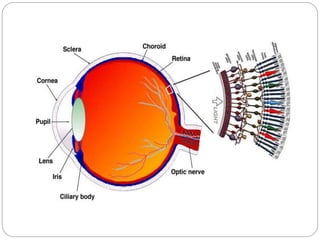
What is the retina?
 Innermost coat of the eyeball.
 Thin, delicate, transparent membrane.
 Externally related to the choroid & sclera.
 Thickness
 Near optic disc – 0.56 mm
 Equator – 0.18 to 0.2 mm
 Ora-serrata – 0.1 mm
 Thinnest at Fovea.
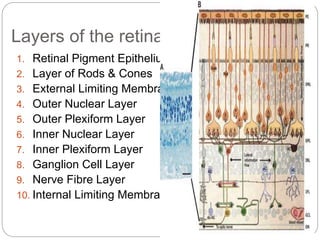
Layers of the retina
1. Retinal Pigment Epithelium
2. Layer of Rods & Cones
3. External Limiting Membrane
4. Outer Nuclear Layer
5. Outer Plexiform Layer
6. Inner Nuclear Layer
7. Inner Plexiform Layer
8. Ganglion Cell Layer
9. Nerve Fibre Layer
10. Internal Limiting Membrane
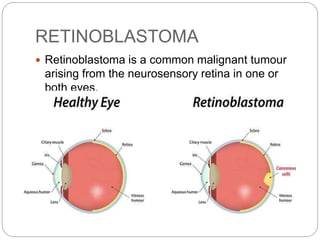
RETINOBLASTOMA
 Retinoblastoma is a common malignant tumour
arising from the neurosensory retina in one or
both eyes.
Epidemiology
 The most common primary intraocular
malignancy of childhood ( 1 and 2 years of age )
 3% of all childhood cancers
 The second most common malignant intraocular
tumour
 1 in 18,000 live births
 No sex predisposition
 25-30% cases are bilateral but asymmetrical
 Survival rates are over 95% in specialized centers
but are much lower in the developing world.
Genetics & Histopathology
 RB1 is the tumour suppressor gene on 13q14 in
which mutations/deletion predisposes to
retinoblastoma.
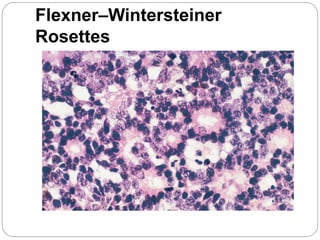
 Tumours are composed of small basophilic cells
(retinoblasts) with large hyperchromatic nuclei
and scanty cytoplasm.
 Characterized by the formation of structures
known as rosettes
 Flexner–Wintersteiner,
 Homer–Wright and fleurettes
Flexner–Wintersteiner
Rosettes
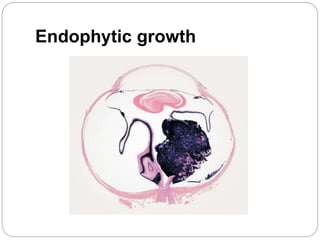
 Growth may be endophytic (into the vitreous)
with seeding of tumour cells throughout the eye,
or
 Exophytic (into the subretinal space) leading to
retinal detachment, or mixed, or the retina may be
diffusely infiltrated.
Endophytic growth
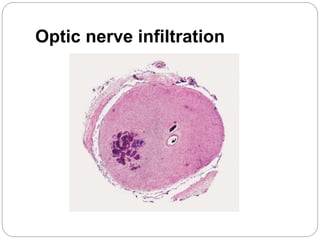
 Optic nerve invasion may occur, with spread of
tumour along the subarachnoid space to the
brain.
 Metastatic spread is to regional nodes, lung, brain
and bone.
Optic nerve infiltration
Types of retinoblastoma
1. Heritable (hereditary, germline) retinoblastoma
accounts for 40%.
 One of the pair of alleles of RB1 is mutated in all the cells
in the body.
 When a further mutagenic event (‘second hit’ according to
the ‘two-hit’ hypothesis proposed by Knudson) affects the
second allele, the cell may then undergo malignant
transformation.
 Because of the presence of the mutation in all
cells, a large majority of these children develop
bilateral and multifocal tumours.
 Pinealoblastoma (‘trilateral retinoblastoma’, which
occurs in up to 10%, usually before the age of 5),
 Osteosarcomas,
 Soft tissue sarcomas and melanomas
 The risk of a second malignancy is about 6%
 Increases five-fold if external beam
irradiation has been used to treat the original
tumour,
 The second tumour tends to arise within the
irradiated field.
2. Non-heritable (non-hereditary, somatic)
retinoblastoma.
 60% Cases
 The tumour is unilateral,
 Non transmissible and
 Does not predispose the patient to second non-ocular
cancers.
 If a patient has a solitary retinoblastoma and no
positive family history, Its very likely that
 Non-heritable
 The risk in each sibling and the patient’s offspring
is about 1%.
 Screening of at-risk family members.
 Siblings at risk of retinoblastoma should be
screened by
 Prenatal ultrasonography,
 Ophthalmoscopy soon after birth and
 Then regularly until the age of 4 or 5 years.
 Early diagnosis correlates with a higher chance of
preserving vision, salvaging the eye and
preserving life.
 If a child has heritable retinoblastoma, the risk to
siblings is 2% if the parents are healthy, and 40%
if a parent is affected.
 Parents should also be screened
Clinical features
 Bilateral cases present with in 1 yr of age
 Unilateral cases present up to 2 yrs of age
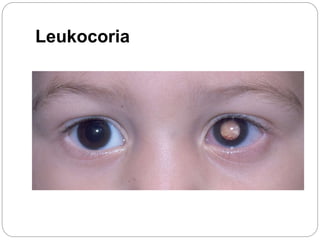
 Leukocoria (white pupillary reflex) is the
commonest presentation (60%) and may first be
noticed in family photographs.
Leukocoria
 Strabismus is the second most common (20%);
fundus examination is therefore mandatory in all
cases of childhood squint.
 Painful red eye with secondary glaucoma
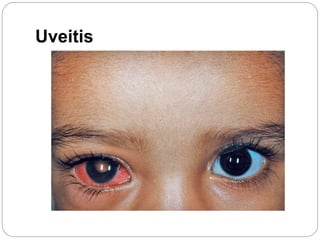
 Painful red eye with uveitis
 Poor vision.
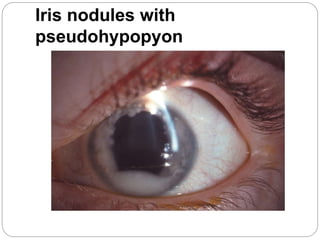
 Inflammation or pseudoinflammation
 Nystagmus
Uveitis
Iris nodules with
pseudohypopyon
Clinical features
 Routine examination of a patient known to be at
risk.
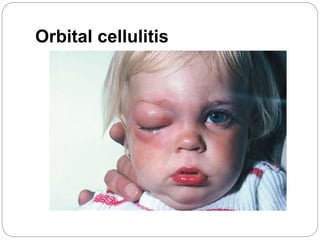
 Orbital inflammation mimicking orbital or
preseptal
cellulitis may occur with necrotic tumours
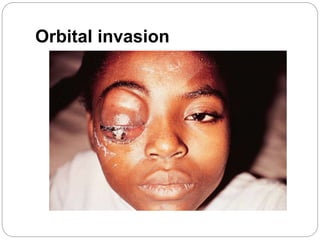
 Orbital invasion or visible extraocular growth
 Metastatic disease involving regional lymph
nodes
and brain before the detection of ocular
involvement is
Orbital cellulitis
Orbital invasion
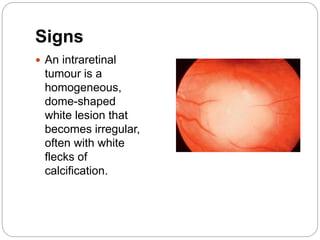
Signs
 An intraretinal
tumour is a
homogeneous,
dome-shaped
white lesion that
becomes irregular,
often with white
flecks of
calcification.
Signs
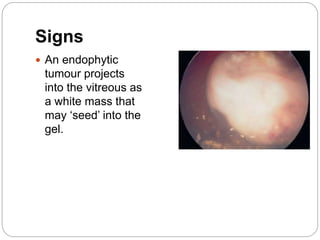
 An endophytic
tumour projects
into the vitreous as
a white mass that
may ‘seed’ into the
gel.
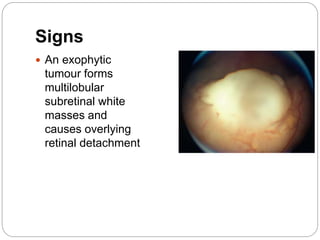
Signs
 An exophytic
tumour forms
multilobular
subretinal white
masses and
causes overlying
retinal detachment
Clinical Stages
 I. Quiescent stage.
 II. Glaucomatous stage.
 III. Stage of extraocular extension.
 IV. Stage of distant metastasis.
Clinical Stages
 I. Quiescent stage.
 Lasts for about 6 months to1year.
 Leukocoria
 Nystagmus
 Strabismus
 Diminution of vision
 Retinal detachment
Clinical Stages
 II. Glaucomatous
stage.
 Pain, redness, watering.
 Eyeball is enlarged
leading to proptosis.
 Conjunctival congesion.
 Corneal haze.
 Increased intraocular
pressure.
 Rarely acute iridocyclitis.
Clinical Stages
 III. Stage of
extraocular
extension.
 Fungation and
involvement of
extraocular tissues
resulting in marked
proptosis
Clinical Stages
 IV. Stage of distant metastasis.
 1. Lymphatic spread to preauricular and
neighbouring lymph nodes.
 2. Direct extension by continuity to the optic nerve
and brain is common.
 3. Metastasis by blood stream involves cranial
and other bones.
Investigations
 Red reflex testing with a distant direct ophthalmoscope
 Examination under anaesthesia
 General examination
 Tonometry.
 Measurement of the corneal diameter
 Anterior chamber examination
 Ophthalmoscopy,
 Cycloplegic refraction.
Investigations
 Ultrasonography
 Aqueous LDH levels
 Wide field photography
 CT scan
 MRI for optic nerve evaluation
 Bone scans and bone marrow aspiration
 Genetic study
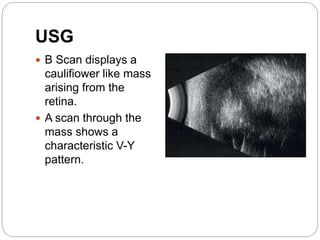
USG
 B Scan displays a
caulifiower like mass
arising from the
retina.
 A scan through the
mass shows a
characteristic V-Y
pattern.
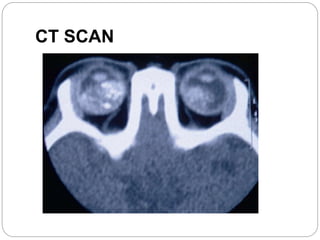
CT SCAN
Differential diagnosis
 Persistent anterior fetal vasculature (persistent
hyperplastic primary vitreous)
 Coats disease
 Retinopathy of prematurity
 Toxocariasis
 Uveitis
 Vitreoretinal dysplasia
 Endophthalmitis
Treatment
 1. Tumour destructive therapy.
 When tumour is involving less than half of retina
and optic nerve is not involved
 Chemoreduction followed by local therapy
(Cryotherapy, thermochemotherapy or
brachytherapy) for large tumours (>12mm in
diameter)
 Tumour <12 mm in diameter and <8mm in
thickness Radiotherapy (external beam
radiotherapy or brachytherapy) combined with
chemotherapy is recommended for medium size.
 Cryotherapy is indicated for a small tumour (<4.5
mm indiameter and <2.5 mm in thickness) located
anterior to equator.
 Laser photocoagulation is used for a small
tumour located posterior to equator <3 mm from
fovea.
 Thermotherapy with diode laser is used for a
small tumour located posterior to equator away
from macula
 2. Enucleation
 Tumour involves more than half of the retina.
 Optic nerve is involved.
 Glaucoma is present and anterior chamber is
involved.
 Followed by radiotherapy and chemotherapy if
optic nerve is involved.
 Intravenous carboplatin, etoposide and vincristine
(CEV) are given in three to six cycles according to
the grade of retinoblastoma.
 Careful review at frequent intervals is generally
required following treatment, in order to detect
recurrence or the development of a new tumour,
particularly in heritable disease.
 Palliative therapy
 Retinoblastoma with orbital extension,
 Retinoblastoma with intracranial extension, and
 Retinoblastoma with distant metastasis.
 Chemotherapy,
 Surgical debulking of the orbit or orbital
exentration, and
 External beam radiotherapy
Prognosis
 If untreated the prognosis is almost always bad
and the patient invariably dies.
 Rarely, spontaneous regression with resultant
cure and
shrinkage of the eyeball may occur due to
necrosis followed by calcification
 Prognosis is fair (survival rate 70-85%) if the
eyeball is enucleated before the occurrence of
extraocular extension.
Thank
You

retinoblastoma 2.pptx

  • 1.
    Anatomy of Retina& Retinoblastoma
  • 2.
    What is theretina?  Innermost coat of the eyeball.  Thin, delicate, transparent membrane.  Externally related to the choroid & sclera.  Thickness  Near optic disc – 0.56 mm  Equator – 0.18 to 0.2 mm  Ora-serrata – 0.1 mm  Thinnest at Fovea.
  • 5.
    Layers of theretina 1. Retinal Pigment Epithelium 2. Layer of Rods & Cones 3. External Limiting Membrane 4. Outer Nuclear Layer 5. Outer Plexiform Layer 6. Inner Nuclear Layer 7. Inner Plexiform Layer 8. Ganglion Cell Layer 9. Nerve Fibre Layer 10. Internal Limiting Membrane
  • 6.
    RETINOBLASTOMA  Retinoblastoma isa common malignant tumour arising from the neurosensory retina in one or both eyes.
  • 7.
    Epidemiology  The mostcommon primary intraocular malignancy of childhood ( 1 and 2 years of age )  3% of all childhood cancers  The second most common malignant intraocular tumour  1 in 18,000 live births  No sex predisposition  25-30% cases are bilateral but asymmetrical  Survival rates are over 95% in specialized centers but are much lower in the developing world.
  • 8.
    Genetics & Histopathology RB1 is the tumour suppressor gene on 13q14 in which mutations/deletion predisposes to retinoblastoma.  Tumours are composed of small basophilic cells (retinoblasts) with large hyperchromatic nuclei and scanty cytoplasm.  Characterized by the formation of structures known as rosettes  Flexner–Wintersteiner,  Homer–Wright and fleurettes
  • 9.
  • 10.
     Growth maybe endophytic (into the vitreous) with seeding of tumour cells throughout the eye, or  Exophytic (into the subretinal space) leading to retinal detachment, or mixed, or the retina may be diffusely infiltrated.
  • 11.
  • 12.
     Optic nerveinvasion may occur, with spread of tumour along the subarachnoid space to the brain.  Metastatic spread is to regional nodes, lung, brain and bone.
  • 13.
  • 14.
    Types of retinoblastoma 1.Heritable (hereditary, germline) retinoblastoma accounts for 40%.  One of the pair of alleles of RB1 is mutated in all the cells in the body.  When a further mutagenic event (‘second hit’ according to the ‘two-hit’ hypothesis proposed by Knudson) affects the second allele, the cell may then undergo malignant transformation.
  • 15.
     Because ofthe presence of the mutation in all cells, a large majority of these children develop bilateral and multifocal tumours.  Pinealoblastoma (‘trilateral retinoblastoma’, which occurs in up to 10%, usually before the age of 5),  Osteosarcomas,  Soft tissue sarcomas and melanomas
  • 16.
     The riskof a second malignancy is about 6%  Increases five-fold if external beam irradiation has been used to treat the original tumour,  The second tumour tends to arise within the irradiated field.
  • 17.
    2. Non-heritable (non-hereditary,somatic) retinoblastoma.  60% Cases  The tumour is unilateral,  Non transmissible and  Does not predispose the patient to second non-ocular cancers.
  • 18.
     If apatient has a solitary retinoblastoma and no positive family history, Its very likely that  Non-heritable  The risk in each sibling and the patient’s offspring is about 1%.
  • 19.
     Screening ofat-risk family members.  Siblings at risk of retinoblastoma should be screened by  Prenatal ultrasonography,  Ophthalmoscopy soon after birth and  Then regularly until the age of 4 or 5 years.
  • 20.
     Early diagnosiscorrelates with a higher chance of preserving vision, salvaging the eye and preserving life.  If a child has heritable retinoblastoma, the risk to siblings is 2% if the parents are healthy, and 40% if a parent is affected.  Parents should also be screened
  • 21.
    Clinical features  Bilateralcases present with in 1 yr of age  Unilateral cases present up to 2 yrs of age  Leukocoria (white pupillary reflex) is the commonest presentation (60%) and may first be noticed in family photographs.
  • 22.
  • 23.
     Strabismus isthe second most common (20%); fundus examination is therefore mandatory in all cases of childhood squint.  Painful red eye with secondary glaucoma  Painful red eye with uveitis  Poor vision.  Inflammation or pseudoinflammation  Nystagmus
  • 24.
  • 25.
  • 26.
    Clinical features  Routineexamination of a patient known to be at risk.  Orbital inflammation mimicking orbital or preseptal cellulitis may occur with necrotic tumours  Orbital invasion or visible extraocular growth  Metastatic disease involving regional lymph nodes and brain before the detection of ocular involvement is
  • 27.
  • 28.
  • 29.
    Signs  An intraretinal tumouris a homogeneous, dome-shaped white lesion that becomes irregular, often with white flecks of calcification.
  • 30.
    Signs  An endophytic tumourprojects into the vitreous as a white mass that may ‘seed’ into the gel.
  • 31.
    Signs  An exophytic tumourforms multilobular subretinal white masses and causes overlying retinal detachment
  • 32.
    Clinical Stages  I.Quiescent stage.  II. Glaucomatous stage.  III. Stage of extraocular extension.  IV. Stage of distant metastasis.
  • 33.
    Clinical Stages  I.Quiescent stage.  Lasts for about 6 months to1year.  Leukocoria  Nystagmus  Strabismus  Diminution of vision  Retinal detachment
  • 34.
    Clinical Stages  II.Glaucomatous stage.  Pain, redness, watering.  Eyeball is enlarged leading to proptosis.  Conjunctival congesion.  Corneal haze.  Increased intraocular pressure.  Rarely acute iridocyclitis.
  • 37.
    Clinical Stages  III.Stage of extraocular extension.  Fungation and involvement of extraocular tissues resulting in marked proptosis
  • 38.
    Clinical Stages  IV.Stage of distant metastasis.  1. Lymphatic spread to preauricular and neighbouring lymph nodes.  2. Direct extension by continuity to the optic nerve and brain is common.  3. Metastasis by blood stream involves cranial and other bones.
  • 39.
    Investigations  Red reflextesting with a distant direct ophthalmoscope  Examination under anaesthesia  General examination  Tonometry.  Measurement of the corneal diameter  Anterior chamber examination  Ophthalmoscopy,  Cycloplegic refraction.
  • 40.
    Investigations  Ultrasonography  AqueousLDH levels  Wide field photography  CT scan  MRI for optic nerve evaluation  Bone scans and bone marrow aspiration  Genetic study
  • 41.
    USG  B Scandisplays a caulifiower like mass arising from the retina.  A scan through the mass shows a characteristic V-Y pattern.
  • 42.
  • 43.
    Differential diagnosis  Persistentanterior fetal vasculature (persistent hyperplastic primary vitreous)  Coats disease  Retinopathy of prematurity  Toxocariasis  Uveitis  Vitreoretinal dysplasia  Endophthalmitis
  • 44.
    Treatment  1. Tumourdestructive therapy.  When tumour is involving less than half of retina and optic nerve is not involved  Chemoreduction followed by local therapy (Cryotherapy, thermochemotherapy or brachytherapy) for large tumours (>12mm in diameter)
  • 45.
     Tumour <12mm in diameter and <8mm in thickness Radiotherapy (external beam radiotherapy or brachytherapy) combined with chemotherapy is recommended for medium size.  Cryotherapy is indicated for a small tumour (<4.5 mm indiameter and <2.5 mm in thickness) located anterior to equator.
  • 46.
     Laser photocoagulationis used for a small tumour located posterior to equator <3 mm from fovea.  Thermotherapy with diode laser is used for a small tumour located posterior to equator away from macula
  • 47.
     2. Enucleation Tumour involves more than half of the retina.  Optic nerve is involved.  Glaucoma is present and anterior chamber is involved.  Followed by radiotherapy and chemotherapy if optic nerve is involved.  Intravenous carboplatin, etoposide and vincristine (CEV) are given in three to six cycles according to the grade of retinoblastoma.
  • 48.
     Careful reviewat frequent intervals is generally required following treatment, in order to detect recurrence or the development of a new tumour, particularly in heritable disease.
  • 49.
     Palliative therapy Retinoblastoma with orbital extension,  Retinoblastoma with intracranial extension, and  Retinoblastoma with distant metastasis.  Chemotherapy,  Surgical debulking of the orbit or orbital exentration, and  External beam radiotherapy
  • 50.
    Prognosis  If untreatedthe prognosis is almost always bad and the patient invariably dies.  Rarely, spontaneous regression with resultant cure and shrinkage of the eyeball may occur due to necrosis followed by calcification  Prognosis is fair (survival rate 70-85%) if the eyeball is enucleated before the occurrence of extraocular extension.
  • 51.