Blepharospasm
“WHEN YOUR EYES CAN’T STOP BLINKING”
Ade Wijaya, MD
August 2017
Outline
• Introduction
• Epidemiology and Genetics
• Risk factors
• Etiology
• Patophysiology
• Clinical manifestation
• Complication
• Rating scare
• Management
- Botulinum toxin injection
Introduction
Focal dystonia
Excessive eyes blinking
Benign essential blepharospasm vs secondary blepharospasm
Epidemiology & Genetics
12 / 1.000.000 in Japan – 133 / 1.000.000 in South Italy
Female : Male = 2,3 : 1
Autosomal dominant; familial ?
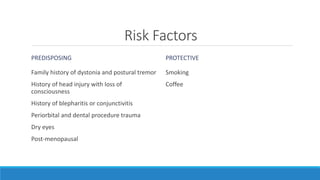
Risk Factors
PREDISPOSING
Family history of dystonia and postural tremor
History of head injury with loss of
consciousness
History of blepharitis or conjunctivitis
Periorbital and dental procedure trauma
Dry eyes
Post-menopausal
PROTECTIVE
Smoking
Coffee
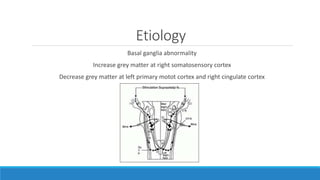
Etiology
Basal ganglia abnormality
Increase grey matter at right somatosensory cortex
Decrease grey matter at left primary motot cortex and right cingulate cortex
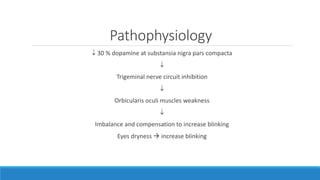
Pathophysiology
 30 % dopamine at substansia nigra pars compacta

Trigeminal nerve circuit inhibition

Orbicularis oculi muscles weakness

Imbalance and compensation to increase blinking
Eyes dryness  increase blinking
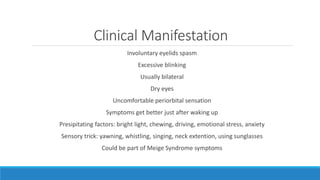
Clinical Manifestation
Involuntary eyelids spasm
Excessive blinking
Usually bilateral
Dry eyes
Uncomfortable periorbital sensation
Symptoms get better just after waking up
Presipitating factors: bright light, chewing, driving, emotional stress, anxiety
Sensory trick: yawning, whistling, singing, neck extention, using sunglasses
Could be part of Meige Syndrome symptoms
Complication
Impaired daily functional activities such as reading, writing, driving
Decrease quality of life
Functional blindness in 32 from 1.000.000
Anxiety & depression
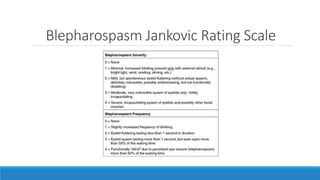
Blepharospasm Jankovic Rating Scale
Management
Botulinum Toxin
For refractory cases:
Deep Brain Stimulation
Surgery
In trial:
Transcranial Magnetic Stimulation
Not satisfactory:
Medications: anticholinergics, benzodiazepines, bromocriptin, dopamine
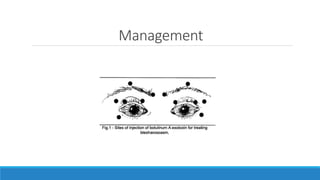
Management
Botulinum Toxin  blocking presynaptic cholinergic receptors thus, inhibiting acethylcholine
release
Type A Botulinum Toxin: Introduced by Scott at 1980, FDA approved for blepharospasm at 1989
Only short-term temporary effect (12 weeks – 1 year), long term use can reduce efficacy, probably
due to antibody formation
Dose: 30-200 unit / eyes, higher dose  higher efficacy but also higher side effects/complications
Management
(Botulinum toxin side effects/complications)
• local bruise
• ecchymosis
• ptosis
• keratopathy
• diplopia
• lagophtalmus
• dry eyes
• midfacial weakness
• nasopharyngitis
• respiratory tract infection
• visual disturbance
• dyspnea
Management
Summary
1. Blepharospasm is a focal dystonia
2. Main symptoms: excessive eye blinking, involuntary eyelids spasm
3. Decrease QOL, and functional ability leading to depression and anxiety
4. Drug of choice: botulinum toxin injection
References:
1. Hallett, M. (2002). Blepharospasm recent advances. Neurology, 59(9), 1306-1312.
2. Hallett, M., Evinger, C., Jankovic, J., & Stacy, M. (2008). Update on blepharospasm Report from the BEBRF International Workshop. Neurology,71(16), 1275-1282.
3. Horovitz, S. G., Ford, A., Najee-Ullah, M. A., Ostuni, J. L., & Hallett, M. (2012). Anatomical correlates of blepharospasm. Transl Neurodegener, 1(1), 12.
4. Defazio, G., Martino, D., Aniello, M. S., Masi, G., Abbruzzese, G., Lamberti, S., ... & Berardelli, A. (2006). A family study on primary blepharospasm.Journal of Neurology, Neurosurgery & Psychiatry, 77(2), 252-254.
5. Peckham, E. L., Lopez, G., Shamim, E. A., Richardson, S. P., Sanku, S., Malkani, R., ... & Hallett, M. (2011). Clinical features of patients with blepharospasm: a report of 240 patients. European Journal of
Neurology, 18(3), 382-386.
6. Hall, T. A., McGwin, G., Searcey, K., Xie, A., Hupp, S. L., Owsley, C., & Kline, L. B. (2006). Health-related quality of life and psychosocial characteristics of patients with benign essential blepharospasm. Archives of
ophthalmology,124(1), 116-119.
7. Yoon, J. S., Kim, J. C., & Lee, S. Y. (2009). Double-Blind, Randomized, Comparative Study of Meditoxin® Versus Botox® in the Treatment of Essential Blepharospasm. Korean Journal of Ophthalmology, 23(3), 137-
141.
8. Cillino, S. A. L. V. A. T. O. R. E., Raimondi, G., Guepratte, N., Damiani, S., Cillino, M., Di Pace, F., & Casuccio, A. (2010). Long-term efficacy of botulinum toxin A for treatment of blepharospasm, hemifacial spasm,
and spastic entropion: a multicentre study using two drug-dose escalation indexes. eye,24(4), 600-607.
9. Tsai, C. P., Chiu, M. C., Yen, D. J., Guo, Y. C., Yuan, C. L., & Lee, T. C. (2005). Quantitative assessment of efficacy of dysport (botulinum toxin type A) in the treatment of idiopathic blepharospasm and hemifacial
spasm. Acta Neurol Taiwan, 14(2), 61-68.
10. Truong, D. D., Gollomp, S. M., Jankovic, J., LeWitt, P. A., Marx, M., Hanschmann, A., ... & Xeomin US Blepharospasm Study Group. (2013). Sustained efficacy and safety of repeated incobotulinumtoxinA (Xeomin®)
injections in blepharospasm. Journal of Neural Transmission, 120(9), 1345-1353.
11. Kranz, G., Shamim, E. A., Lin, P. T., Kranz, G. S., & Hallett, M. (2010). Transcranial magnetic brain stimulation modulates blepharospasm A randomized controlled study. Neurology, 75(16), 1465-1471.
12. Kranz, G., Shamim, E. A., Lin, P. T., Kranz, G. S., Voller, B., & Hallett, M. (2009). Blepharospasm and the modulation of cortical excitability in primary and secondary motor areas. Neurology, 73(23), 2031-2036.
THANK YOU

Blepharospasm

  • 1.
    Blepharospasm “WHEN YOUR EYESCAN’T STOP BLINKING” Ade Wijaya, MD August 2017
  • 2.
    Outline • Introduction • Epidemiologyand Genetics • Risk factors • Etiology • Patophysiology • Clinical manifestation • Complication • Rating scare • Management - Botulinum toxin injection
  • 3.
    Introduction Focal dystonia Excessive eyesblinking Benign essential blepharospasm vs secondary blepharospasm
  • 4.
    Epidemiology & Genetics 12/ 1.000.000 in Japan – 133 / 1.000.000 in South Italy Female : Male = 2,3 : 1 Autosomal dominant; familial ?
  • 5.
    Risk Factors PREDISPOSING Family historyof dystonia and postural tremor History of head injury with loss of consciousness History of blepharitis or conjunctivitis Periorbital and dental procedure trauma Dry eyes Post-menopausal PROTECTIVE Smoking Coffee
  • 6.
    Etiology Basal ganglia abnormality Increasegrey matter at right somatosensory cortex Decrease grey matter at left primary motot cortex and right cingulate cortex
  • 7.
    Pathophysiology  30 %dopamine at substansia nigra pars compacta  Trigeminal nerve circuit inhibition  Orbicularis oculi muscles weakness  Imbalance and compensation to increase blinking Eyes dryness  increase blinking
  • 8.
    Clinical Manifestation Involuntary eyelidsspasm Excessive blinking Usually bilateral Dry eyes Uncomfortable periorbital sensation Symptoms get better just after waking up Presipitating factors: bright light, chewing, driving, emotional stress, anxiety Sensory trick: yawning, whistling, singing, neck extention, using sunglasses Could be part of Meige Syndrome symptoms
  • 9.
    Complication Impaired daily functionalactivities such as reading, writing, driving Decrease quality of life Functional blindness in 32 from 1.000.000 Anxiety & depression
  • 10.
  • 11.
    Management Botulinum Toxin For refractorycases: Deep Brain Stimulation Surgery In trial: Transcranial Magnetic Stimulation Not satisfactory: Medications: anticholinergics, benzodiazepines, bromocriptin, dopamine
  • 12.
    Management Botulinum Toxin blocking presynaptic cholinergic receptors thus, inhibiting acethylcholine release Type A Botulinum Toxin: Introduced by Scott at 1980, FDA approved for blepharospasm at 1989 Only short-term temporary effect (12 weeks – 1 year), long term use can reduce efficacy, probably due to antibody formation Dose: 30-200 unit / eyes, higher dose  higher efficacy but also higher side effects/complications
  • 13.
    Management (Botulinum toxin sideeffects/complications) • local bruise • ecchymosis • ptosis • keratopathy • diplopia • lagophtalmus • dry eyes • midfacial weakness • nasopharyngitis • respiratory tract infection • visual disturbance • dyspnea
  • 14.
  • 15.
    Summary 1. Blepharospasm isa focal dystonia 2. Main symptoms: excessive eye blinking, involuntary eyelids spasm 3. Decrease QOL, and functional ability leading to depression and anxiety 4. Drug of choice: botulinum toxin injection
  • 16.
    References: 1. Hallett, M.(2002). Blepharospasm recent advances. Neurology, 59(9), 1306-1312. 2. Hallett, M., Evinger, C., Jankovic, J., & Stacy, M. (2008). Update on blepharospasm Report from the BEBRF International Workshop. Neurology,71(16), 1275-1282. 3. Horovitz, S. G., Ford, A., Najee-Ullah, M. A., Ostuni, J. L., & Hallett, M. (2012). Anatomical correlates of blepharospasm. Transl Neurodegener, 1(1), 12. 4. Defazio, G., Martino, D., Aniello, M. S., Masi, G., Abbruzzese, G., Lamberti, S., ... & Berardelli, A. (2006). A family study on primary blepharospasm.Journal of Neurology, Neurosurgery & Psychiatry, 77(2), 252-254. 5. Peckham, E. L., Lopez, G., Shamim, E. A., Richardson, S. P., Sanku, S., Malkani, R., ... & Hallett, M. (2011). Clinical features of patients with blepharospasm: a report of 240 patients. European Journal of Neurology, 18(3), 382-386. 6. Hall, T. A., McGwin, G., Searcey, K., Xie, A., Hupp, S. L., Owsley, C., & Kline, L. B. (2006). Health-related quality of life and psychosocial characteristics of patients with benign essential blepharospasm. Archives of ophthalmology,124(1), 116-119. 7. Yoon, J. S., Kim, J. C., & Lee, S. Y. (2009). Double-Blind, Randomized, Comparative Study of Meditoxin® Versus Botox® in the Treatment of Essential Blepharospasm. Korean Journal of Ophthalmology, 23(3), 137- 141. 8. Cillino, S. A. L. V. A. T. O. R. E., Raimondi, G., Guepratte, N., Damiani, S., Cillino, M., Di Pace, F., & Casuccio, A. (2010). Long-term efficacy of botulinum toxin A for treatment of blepharospasm, hemifacial spasm, and spastic entropion: a multicentre study using two drug-dose escalation indexes. eye,24(4), 600-607. 9. Tsai, C. P., Chiu, M. C., Yen, D. J., Guo, Y. C., Yuan, C. L., & Lee, T. C. (2005). Quantitative assessment of efficacy of dysport (botulinum toxin type A) in the treatment of idiopathic blepharospasm and hemifacial spasm. Acta Neurol Taiwan, 14(2), 61-68. 10. Truong, D. D., Gollomp, S. M., Jankovic, J., LeWitt, P. A., Marx, M., Hanschmann, A., ... & Xeomin US Blepharospasm Study Group. (2013). Sustained efficacy and safety of repeated incobotulinumtoxinA (Xeomin®) injections in blepharospasm. Journal of Neural Transmission, 120(9), 1345-1353. 11. Kranz, G., Shamim, E. A., Lin, P. T., Kranz, G. S., & Hallett, M. (2010). Transcranial magnetic brain stimulation modulates blepharospasm A randomized controlled study. Neurology, 75(16), 1465-1471. 12. Kranz, G., Shamim, E. A., Lin, P. T., Kranz, G. S., Voller, B., & Hallett, M. (2009). Blepharospasm and the modulation of cortical excitability in primary and secondary motor areas. Neurology, 73(23), 2031-2036.
  • 17.