Solving
Retail
Problems
Lean Retail Management-Desktop
Research
Topics
What is Lean Thinking?

What is Lean Retail?

Why Lean Retail?

What does customer value

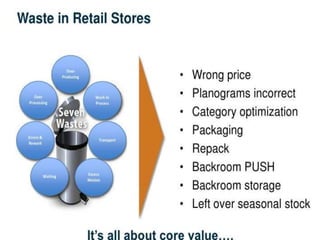
Waist in retail store

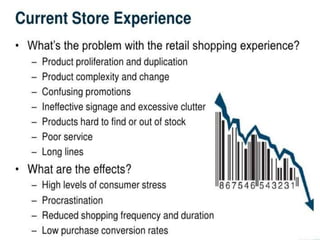
Customer store experience

Benefits of Lean Retail

Implementing Lean Retail

Principles of Lean Retail Execution

Retail Scenario-SAP
Warehouse and DC Management (Lean WM)

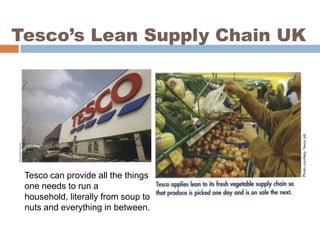
Tesco’s Lean Supply Chain UK

Tesco can provide all the things
one needs to run a
household, literally from soup to
nuts and everything in between.
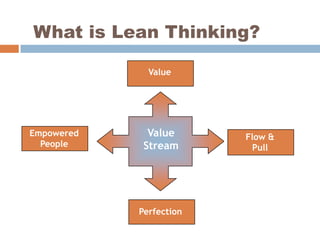
What is Lean Thinking?
Value

Empowered
People

Value
Stream

Perfection

Flow &
Pull
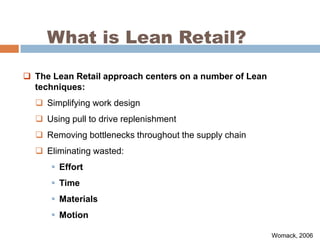
What is Lean Retail?
 The Lean Retail approach centers on a number of Lean
techniques:

 Simplifying work design
 Using pull to drive replenishment
 Removing bottlenecks throughout the supply chain
 Eliminating wasted:
 Effort
 Time
 Materials
 Motion
Womack, 2006
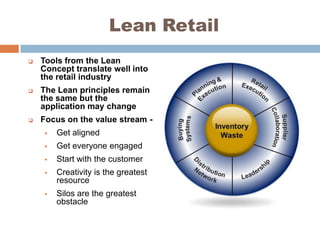
Lean Retail


Tools from the Lean
Concept translate well into
the retail industry



The Lean principles remain
the same but the
application may change



Focus on the value stream 

Get aligned



Get everyone engaged



Start with the customer



Creativity is the greatest
resource



Silos are the greatest
obstacle
Contents From :Lean_Retail_sample.ppt - Lean

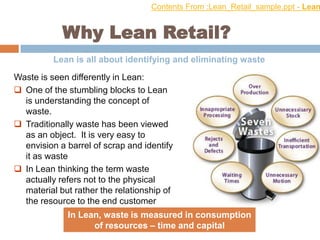
Why Lean Retail?
Lean is all about identifying and eliminating waste

Waste is seen differently in Lean:
 One of the stumbling blocks to Lean
is understanding the concept of
waste.
 Traditionally waste has been viewed
as an object. It is very easy to
envision a barrel of scrap and identify
it as waste
 In Lean thinking the term waste
actually refers not to the physical
material but rather the relationship of
the resource to the end customer
In Lean, waste is measured in consumption
of resources – time and capital
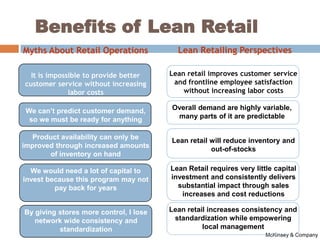
Benefits of Lean Retail
Myths About Retail Operations

Lean Retailing Perspectives

It is impossible to provide better
customer service without increasing
labor costs

Lean retail improves customer service
and frontline employee satisfaction
without increasing labor costs

We can’t predict customer demand,
so we must be ready for anything

Overall demand are highly variable,
many parts of it are predictable

Product availability can only be
improved through increased amounts
of inventory on hand

Lean retail will reduce inventory and
out-of-stocks

We would need a lot of capital to
invest because this program may not
pay back for years

Lean Retail requires very little capital
investment and consistently delivers
substantial impact through sales
increases and cost reductions

By giving stores more control, I lose
network wide consistency and
standardization

Lean retail increases consistency and
standardization while empowering
local management
McKinsey & Company
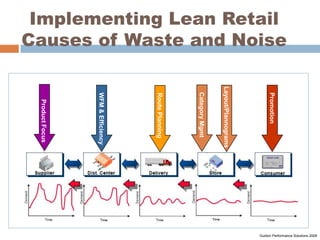
Implementing Lean Retail
Causes of Waste and Noise
Promotion

Layout/Plannograms

Category Mgmt

Route Planning

WFM & Efficiency

Product Focus

Guidon Performance Solutions 2009
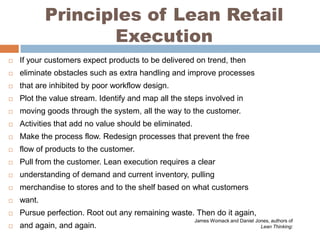
Principles of Lean Retail
Execution


If your customers expect products to be delivered on trend, then



eliminate obstacles such as extra handling and improve processes



that are inhibited by poor workflow design.



Plot the value stream. Identify and map all the steps involved in



moving goods through the system, all the way to the customer.



Activities that add no value should be eliminated.



Make the process flow. Redesign processes that prevent the free



flow of products to the customer.



Pull from the customer. Lean execution requires a clear



understanding of demand and current inventory, pulling



merchandise to stores and to the shelf based on what customers



want.



Pursue perfection. Root out any remaining waste. Then do it again,



and again, and again.

James Womack and Daniel Jones, authors of
Lean Thinking:
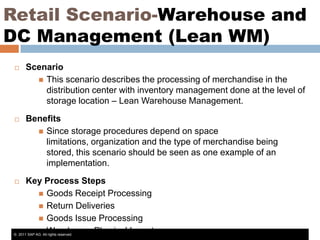
Retail Scenario-Warehouse and
DC Management (Lean WM)


Scenario
 This scenario describes the processing of merchandise in the
distribution center with inventory management done at the level of
storage location – Lean Warehouse Management.



Benefits
 Since storage procedures depend on space
limitations, organization and the type of merchandise being
stored, this scenario should be seen as one example of an
implementation.

Key Process Steps
 Goods Receipt Processing
 Return Deliveries
 Goods Issue Processing
 Warehouse Physical Inventory
© 2011 SAP AG. All rights reserved.

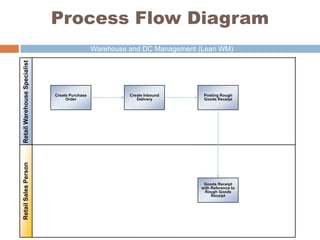
Process Flow Diagram

Retail Sales Person

Retail Warehouse Specialist

Warehouse and DC Management (Lean WM)

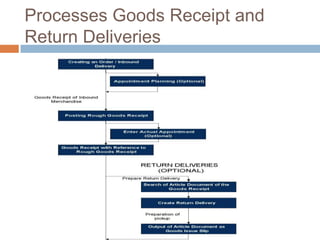
Create Purchase
Order

Create Inbound
Delivery

Posting Rough
Goods Receipt

Goods Receipt
with Reference to
Rough Goods
Receipt
Process Flow Diagram

Retail Warehouse Specialist

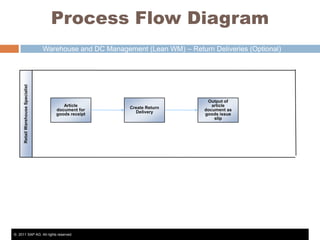
Warehouse and DC Management (Lean WM) – Return Deliveries (Optional)

Article
document for
goods receipt

© 2011 SAP AG. All rights reserved.

Create Return
Delivery

Output of
article
document as
goods issue
slip
Process Flow Diagram

Retail Warehouse Specialist

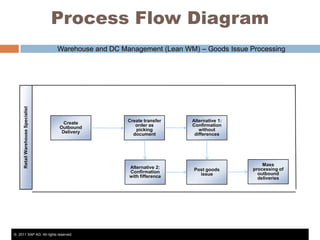
Warehouse and DC Management (Lean WM) – Goods Issue Processing

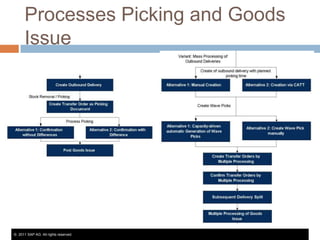
Create
Outbound
Delivery

© 2011 SAP AG. All rights reserved.

Create transfer
order as
picking
document

Alternative 1:
Confirmation
without
differences

Alternative 2:
Confirmation
with fifference

Post goods
issue

Mass
processing of
outbound
deliveries
Process Flow Diagram

Retail Warehouse Specialist

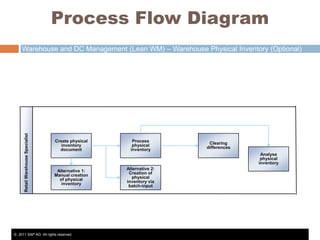
Warehouse and DC Management (Lean WM) – Warehouse Physical Inventory (Optional)

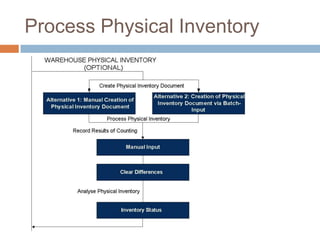
Create physical
inventory
document

Process
physical
inventory

Clearing
differences
Analyse
physical
inventory

Alternative 1:
Manual creation
of physical
inventory

© 2011 SAP AG. All rights reserved.

Alternative 2:
Creation of
physical
inventory via
batch-input
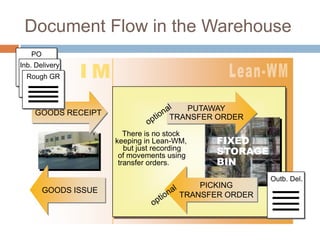
Document Flow in the Warehouse
PO
Inb. Delivery
Rough GR

GOODS RECEIPT

PUTAWAY
TRANSFER ORDER
There is no stock
keeping in Lean-WM,
but just recording
of movements using
transfer orders.

GOODS ISSUE

FIXED
STORAGE
BIN

PICKING
TRANSFER ORDER

Outb. Del.
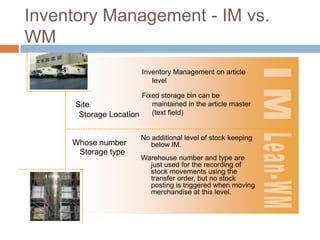
Inventory Management - IM vs.
WM
Inventory Management on article
level
Fixed storage bin can be
maintained in the article master
Site
(text field)
Storage Location

Whose number
Storage type

No additional level of stock keeping
below IM.

Warehouse number and type are
just used for the recording of
stock movements using the
transfer order, but no stock
posting is triggered when moving
merchandise at this level.
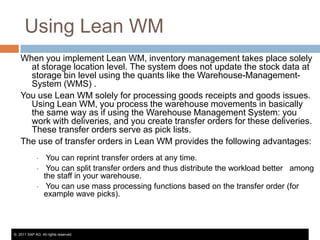
Using Lean WM
When you implement Lean WM, inventory management takes place solely
at storage location level. The system does not update the stock data at
storage bin level using the quants like the Warehouse-ManagementSystem (WMS) .
You use Lean WM solely for processing goods receipts and goods issues.
Using Lean WM, you process the warehouse movements in basically
the same way as if using the Warehouse Management System: you
work with deliveries, and you create transfer orders for these deliveries.
These transfer orders serve as pick lists.
The use of transfer orders in Lean WM provides the following advantages:
•
•
•

You can reprint transfer orders at any time.
You can split transfer orders and thus distribute the workload better among
the staff in your warehouse.
You can use mass processing functions based on the transfer order (for
example wave picks).

© 2011 SAP AG. All rights reserved.
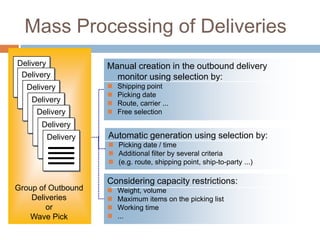
Mass Processing of Deliveries
Delivery
Delivery
Delivery
Delivery

Delivery

Manual creation in the outbound delivery
monitor using selection by:





Shipping point
Picking date
Route, carrier ...
Free selection

Delivery
Delivery

Group of Outbound
Deliveries
or
Wave Pick

Automatic generation using selection by:
 Picking date / time
 Additional filter by several criteria
 (e.g. route, shipping point, ship-to-party ...)

Considering capacity restrictions:





Weight, volume
Maximum items on the picking list
Working time
...
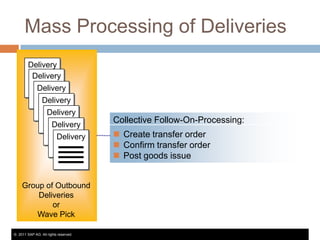
Mass Processing of Deliveries
Delivery
Delivery
Delivery
Delivery
Delivery
Delivery
Delivery

Group of Outbound
Deliveries
or
Wave Pick
© 2011 SAP AG. All rights reserved.

Collective Follow-On-Processing:

 Create transfer order
 Confirm transfer order
 Post goods issue
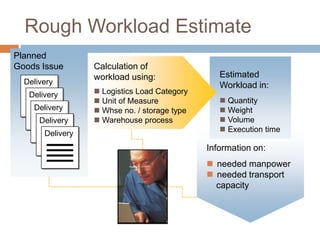
Rough Workload Estimate
Planned
Goods Issue
Delivery
Delivery
Delivery
Delivery
Delivery

Calculation of
workload using:
 Logistics Load Category
 Unit of Measure
 Whse no. / storage type
 Warehouse process

Estimated
Workload in:
 Quantity
 Weight
 Volume
 Execution time

Information on:
 needed manpower
 needed transport
capacity
Processes Goods Receipt and
Return Deliveries
Processes Picking and Goods
Issue

© 2011 SAP AG. All rights reserved.
Process Physical Inventory
References





SAP
CISCO
Lean Manufacturing in World
Other Internet Reports and searches on Lean
Reatil
Email
IM

amitkgarg22@gmail.com
Phone 09880641822
amitkgarg22 (Skype)

Amit Garg
Sr. Retail Functional Consultant
Overall 11 years experience in Retail Domain In Procurement ,Sourcing,
Supply Chain Management Buying ,Merchandising, Category Management ,
Supplier/Vendor Management ,Retail IT, Process Consulting and Business
Analysis. Depth knowledge of Retail & CPG Business Processes and its
dependencies

Retail Lean Management -Desktop Research

  • 1.
  • 2.
    Topics What is LeanThinking?  What is Lean Retail?  Why Lean Retail?  What does customer value  Waist in retail store  Customer store experience  Benefits of Lean Retail  Implementing Lean Retail  Principles of Lean Retail Execution  Retail Scenario-SAP Warehouse and DC Management (Lean WM) 
  • 3.
    Tesco’s Lean SupplyChain UK Tesco can provide all the things one needs to run a household, literally from soup to nuts and everything in between.
  • 4.
    What is LeanThinking? Value Empowered People Value Stream Perfection Flow & Pull
  • 5.
    What is LeanRetail?  The Lean Retail approach centers on a number of Lean techniques:  Simplifying work design  Using pull to drive replenishment  Removing bottlenecks throughout the supply chain  Eliminating wasted:  Effort  Time  Materials  Motion Womack, 2006
  • 6.
    Lean Retail  Tools fromthe Lean Concept translate well into the retail industry  The Lean principles remain the same but the application may change  Focus on the value stream  Get aligned  Get everyone engaged  Start with the customer  Creativity is the greatest resource  Silos are the greatest obstacle
  • 8.
    Contents From :Lean_Retail_sample.ppt- Lean Why Lean Retail? Lean is all about identifying and eliminating waste Waste is seen differently in Lean:  One of the stumbling blocks to Lean is understanding the concept of waste.  Traditionally waste has been viewed as an object. It is very easy to envision a barrel of scrap and identify it as waste  In Lean thinking the term waste actually refers not to the physical material but rather the relationship of the resource to the end customer In Lean, waste is measured in consumption of resources – time and capital
  • 16.
    Benefits of LeanRetail Myths About Retail Operations Lean Retailing Perspectives It is impossible to provide better customer service without increasing labor costs Lean retail improves customer service and frontline employee satisfaction without increasing labor costs We can’t predict customer demand, so we must be ready for anything Overall demand are highly variable, many parts of it are predictable Product availability can only be improved through increased amounts of inventory on hand Lean retail will reduce inventory and out-of-stocks We would need a lot of capital to invest because this program may not pay back for years Lean Retail requires very little capital investment and consistently delivers substantial impact through sales increases and cost reductions By giving stores more control, I lose network wide consistency and standardization Lean retail increases consistency and standardization while empowering local management McKinsey & Company
  • 17.
    Implementing Lean Retail Causesof Waste and Noise Promotion Layout/Plannograms Category Mgmt Route Planning WFM & Efficiency Product Focus Guidon Performance Solutions 2009
  • 18.
    Principles of LeanRetail Execution  If your customers expect products to be delivered on trend, then  eliminate obstacles such as extra handling and improve processes  that are inhibited by poor workflow design.  Plot the value stream. Identify and map all the steps involved in  moving goods through the system, all the way to the customer.  Activities that add no value should be eliminated.  Make the process flow. Redesign processes that prevent the free  flow of products to the customer.  Pull from the customer. Lean execution requires a clear  understanding of demand and current inventory, pulling  merchandise to stores and to the shelf based on what customers  want.  Pursue perfection. Root out any remaining waste. Then do it again,  and again, and again. James Womack and Daniel Jones, authors of Lean Thinking:
  • 19.
    Retail Scenario-Warehouse and DCManagement (Lean WM)  Scenario  This scenario describes the processing of merchandise in the distribution center with inventory management done at the level of storage location – Lean Warehouse Management.  Benefits  Since storage procedures depend on space limitations, organization and the type of merchandise being stored, this scenario should be seen as one example of an implementation. Key Process Steps  Goods Receipt Processing  Return Deliveries  Goods Issue Processing  Warehouse Physical Inventory © 2011 SAP AG. All rights reserved. 
  • 20.
    Process Flow Diagram RetailSales Person Retail Warehouse Specialist Warehouse and DC Management (Lean WM) Create Purchase Order Create Inbound Delivery Posting Rough Goods Receipt Goods Receipt with Reference to Rough Goods Receipt
  • 21.
    Process Flow Diagram RetailWarehouse Specialist Warehouse and DC Management (Lean WM) – Return Deliveries (Optional) Article document for goods receipt © 2011 SAP AG. All rights reserved. Create Return Delivery Output of article document as goods issue slip
  • 22.
    Process Flow Diagram RetailWarehouse Specialist Warehouse and DC Management (Lean WM) – Goods Issue Processing Create Outbound Delivery © 2011 SAP AG. All rights reserved. Create transfer order as picking document Alternative 1: Confirmation without differences Alternative 2: Confirmation with fifference Post goods issue Mass processing of outbound deliveries
  • 23.
    Process Flow Diagram RetailWarehouse Specialist Warehouse and DC Management (Lean WM) – Warehouse Physical Inventory (Optional) Create physical inventory document Process physical inventory Clearing differences Analyse physical inventory Alternative 1: Manual creation of physical inventory © 2011 SAP AG. All rights reserved. Alternative 2: Creation of physical inventory via batch-input
  • 24.
    Document Flow inthe Warehouse PO Inb. Delivery Rough GR GOODS RECEIPT PUTAWAY TRANSFER ORDER There is no stock keeping in Lean-WM, but just recording of movements using transfer orders. GOODS ISSUE FIXED STORAGE BIN PICKING TRANSFER ORDER Outb. Del.
  • 25.
    Inventory Management -IM vs. WM Inventory Management on article level Fixed storage bin can be maintained in the article master Site (text field) Storage Location Whose number Storage type No additional level of stock keeping below IM. Warehouse number and type are just used for the recording of stock movements using the transfer order, but no stock posting is triggered when moving merchandise at this level.
  • 26.
    Using Lean WM Whenyou implement Lean WM, inventory management takes place solely at storage location level. The system does not update the stock data at storage bin level using the quants like the Warehouse-ManagementSystem (WMS) . You use Lean WM solely for processing goods receipts and goods issues. Using Lean WM, you process the warehouse movements in basically the same way as if using the Warehouse Management System: you work with deliveries, and you create transfer orders for these deliveries. These transfer orders serve as pick lists. The use of transfer orders in Lean WM provides the following advantages: • • • You can reprint transfer orders at any time. You can split transfer orders and thus distribute the workload better among the staff in your warehouse. You can use mass processing functions based on the transfer order (for example wave picks). © 2011 SAP AG. All rights reserved.
  • 27.
    Mass Processing ofDeliveries Delivery Delivery Delivery Delivery Delivery Manual creation in the outbound delivery monitor using selection by:     Shipping point Picking date Route, carrier ... Free selection Delivery Delivery Group of Outbound Deliveries or Wave Pick Automatic generation using selection by:  Picking date / time  Additional filter by several criteria  (e.g. route, shipping point, ship-to-party ...) Considering capacity restrictions:     Weight, volume Maximum items on the picking list Working time ...
  • 28.
    Mass Processing ofDeliveries Delivery Delivery Delivery Delivery Delivery Delivery Delivery Group of Outbound Deliveries or Wave Pick © 2011 SAP AG. All rights reserved. Collective Follow-On-Processing:  Create transfer order  Confirm transfer order  Post goods issue
  • 29.
    Rough Workload Estimate Planned GoodsIssue Delivery Delivery Delivery Delivery Delivery Calculation of workload using:  Logistics Load Category  Unit of Measure  Whse no. / storage type  Warehouse process Estimated Workload in:  Quantity  Weight  Volume  Execution time Information on:  needed manpower  needed transport capacity
  • 30.
    Processes Goods Receiptand Return Deliveries
  • 31.
    Processes Picking andGoods Issue © 2011 SAP AG. All rights reserved.
  • 32.
  • 33.
    References     SAP CISCO Lean Manufacturing inWorld Other Internet Reports and searches on Lean Reatil
  • 34.
    Email IM amitkgarg22@gmail.com Phone 09880641822 amitkgarg22 (Skype) AmitGarg Sr. Retail Functional Consultant Overall 11 years experience in Retail Domain In Procurement ,Sourcing, Supply Chain Management Buying ,Merchandising, Category Management , Supplier/Vendor Management ,Retail IT, Process Consulting and Business Analysis. Depth knowledge of Retail & CPG Business Processes and its dependencies