


Logistics Collaboration Solutions 
Shipper, Carrier, Retailer & Consumer 
Research Done By : Amit Garg
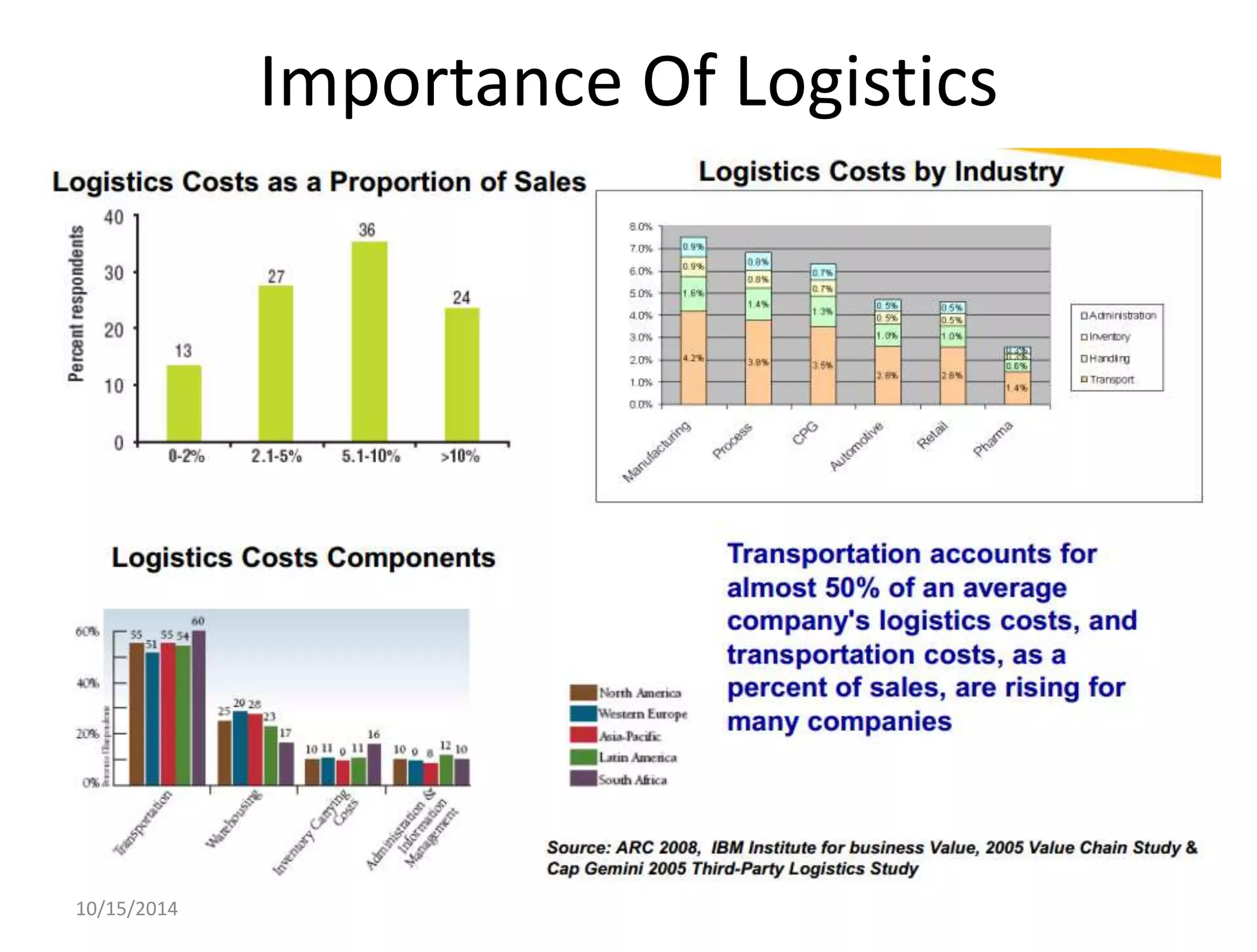
Importance Of Logistics 
10/15/2014
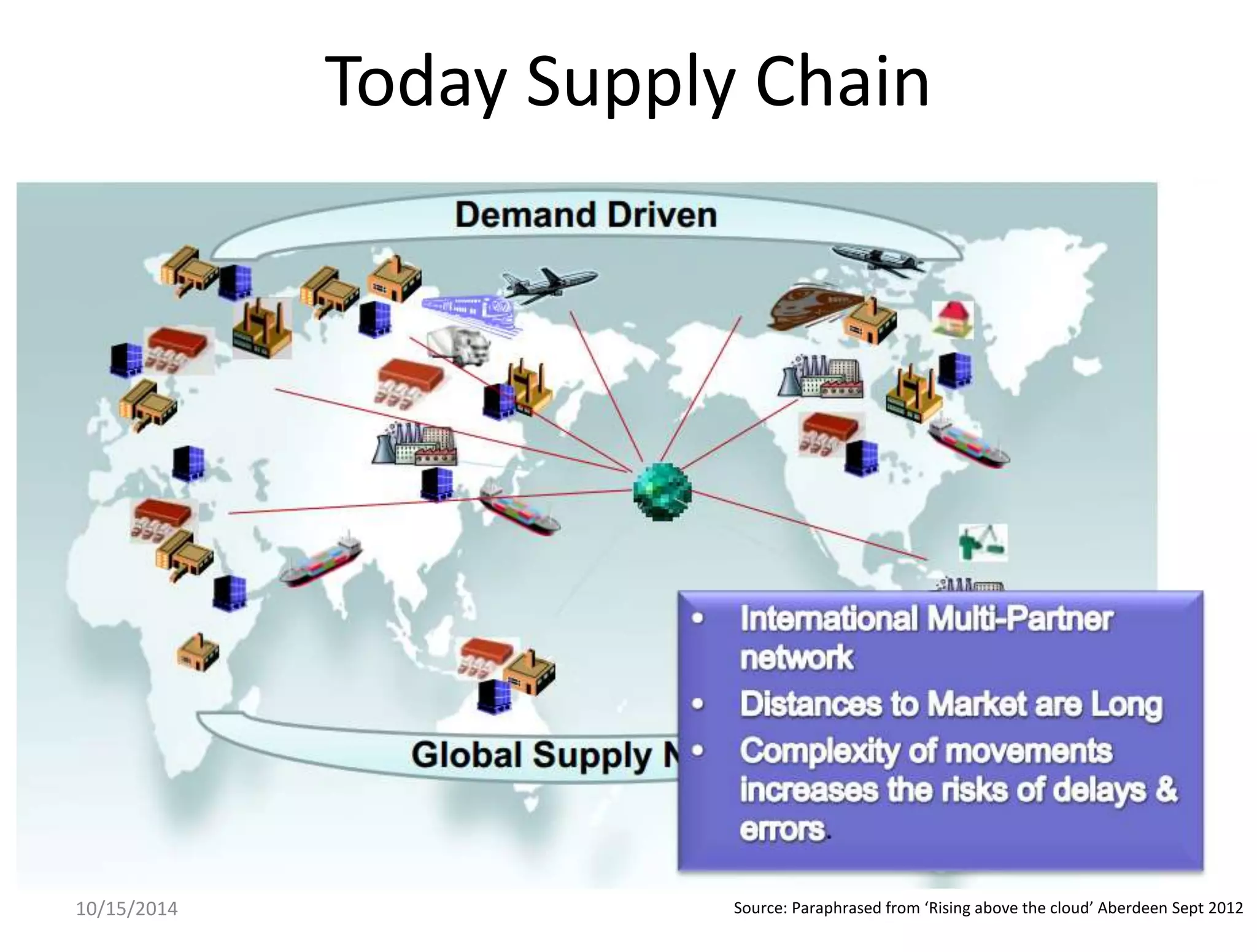
Today Supply Chain 
10/15/2014 Source: Paraphrased from ‘Rising above the cloud’ Aberdeen Sept 2012
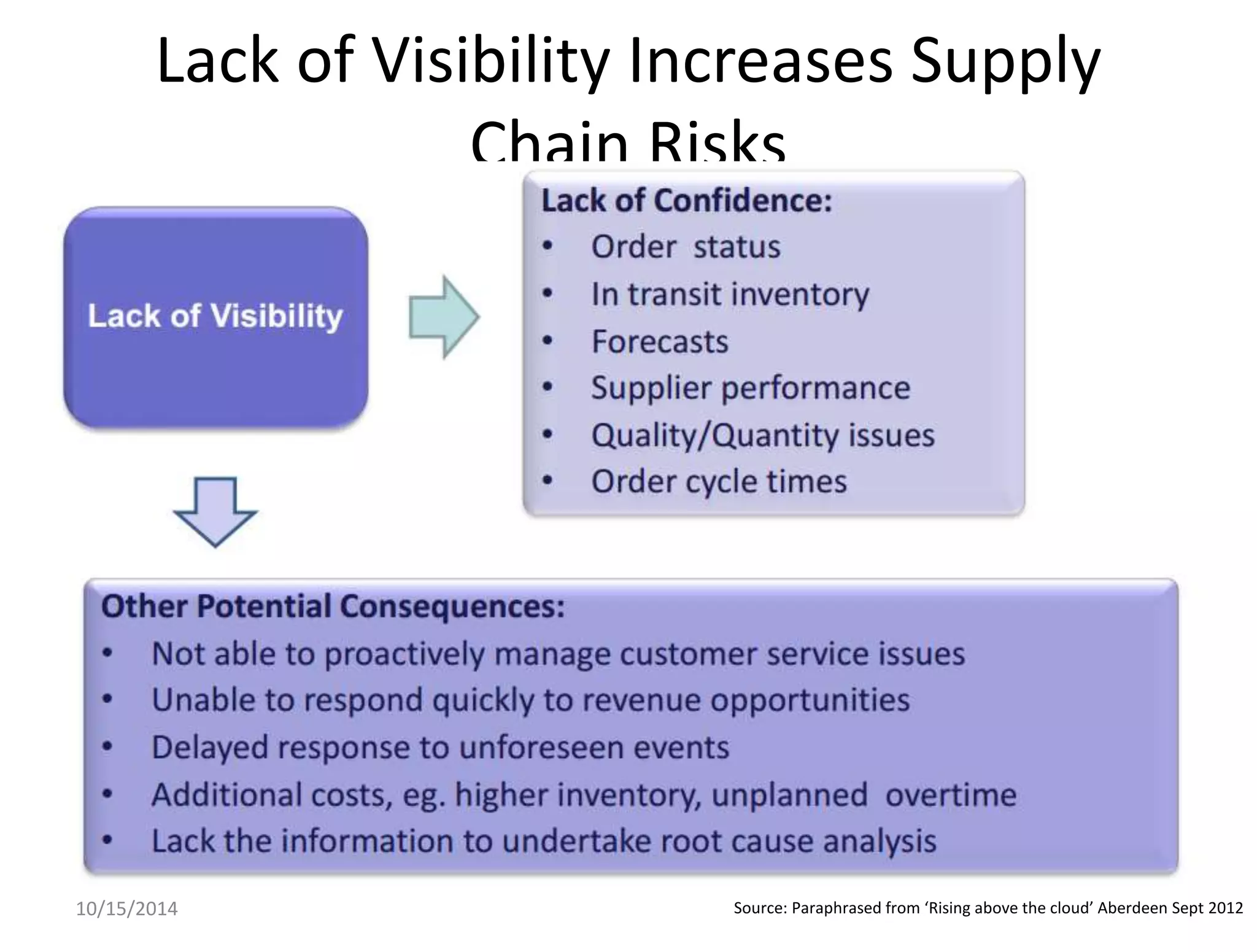
Lack of Visibility Increases Supply 
Chain Risks 
10/15/2014 Source: Paraphrased from ‘Rising above the cloud’ Aberdeen Sept 2012
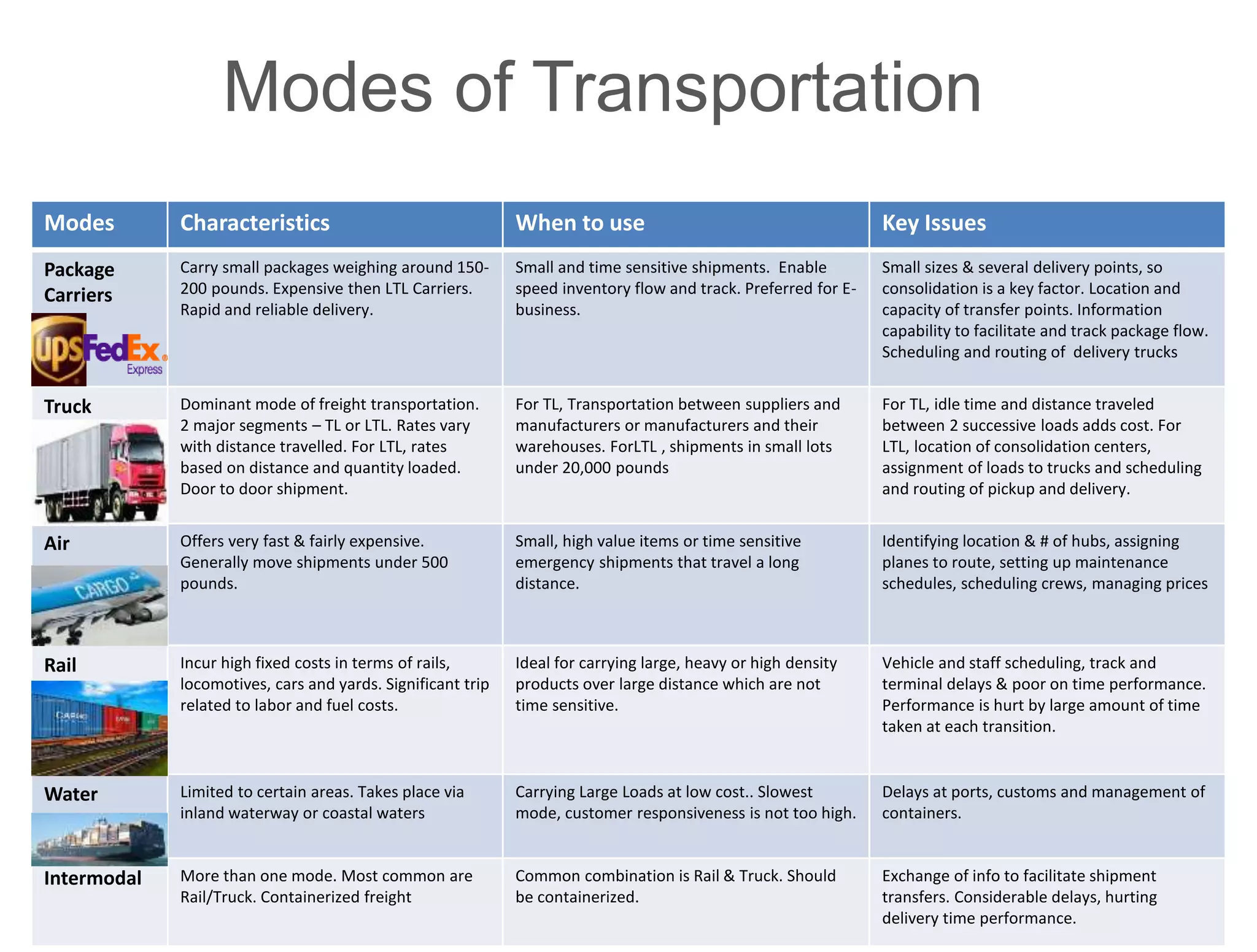
Modes of Transportation 
Modes Characteristics When to use Key Issues 
Package 
Carriers 
Carry small packages weighing around 150- 
200 pounds. Expensive then LTL Carriers. 
Rapid and reliable delivery. 
Small and time sensitive shipments. Enable 
speed inventory flow and track. Preferred for E-business. 
Small sizes & several delivery points, so 
consolidation is a key factor. Location and 
capacity of transfer points. Information 
capability to facilitate and track package flow. 
Scheduling and routing of delivery trucks 
Truck Dominant mode of freight transportation. 
2 major segments – TL or LTL. Rates vary 
with distance travelled. For LTL, rates 
based on distance and quantity loaded. 
Door to door shipment. 
For TL, Transportation between suppliers and 
manufacturers or manufacturers and their 
warehouses. ForLTL , shipments in small lots 
under 20,000 pounds 
For TL, idle time and distance traveled 
between 2 successive loads adds cost. For 
LTL, location of consolidation centers, 
assignment of loads to trucks and scheduling 
and routing of pickup and delivery. 
Air Offers very fast & fairly expensive. 
Generally move shipments under 500 
pounds. 
Small, high value items or time sensitive 
emergency shipments that travel a long 
distance. 
Identifying location & # of hubs, assigning 
planes to route, setting up maintenance 
schedules, scheduling crews, managing prices 
Rail Incur high fixed costs in terms of rails, 
locomotives, cars and yards. Significant trip 
related to labor and fuel costs. 
Ideal for carrying large, heavy or high density 
products over large distance which are not 
time sensitive. 
Vehicle and staff scheduling, track and 
terminal delays & poor on time performance. 
Performance is hurt by large amount of time 
taken at each transition. 
Water Limited to certain areas. Takes place via 
inland waterway or coastal waters 
Carrying Large Loads at low cost.. Slowest 
mode, customer responsiveness is not too high. 
Delays at ports, customs and management of 
containers. 
Intermodal More than one mode. Most common are 
Rail/Truck. Containerized freight 
Common combination is Rail & Truck. Should 
be containerized. 
Exchange of info to facilitate shipment 
transfers. Considerable delays, hurting 
delivery time performance.
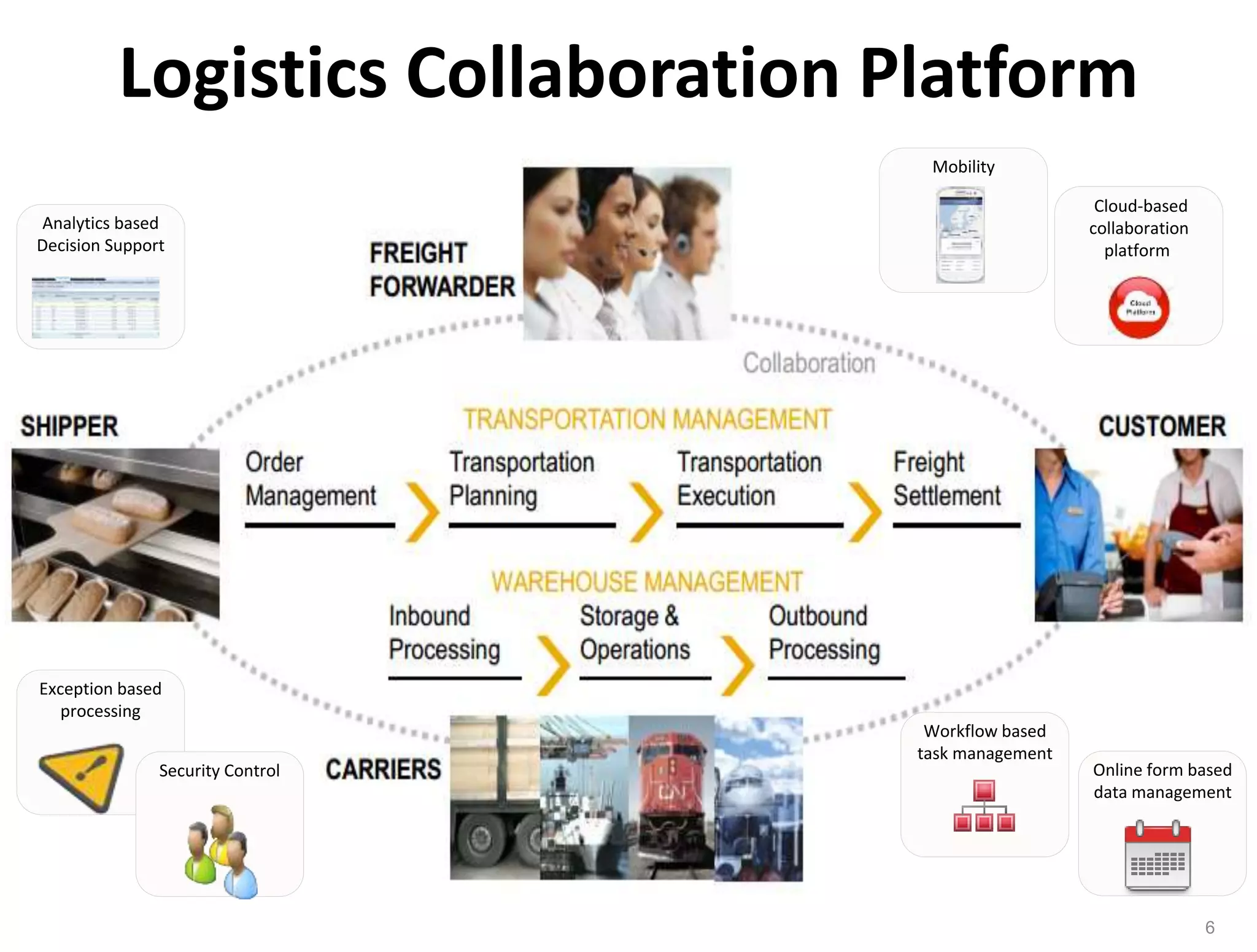
Logistics Collaboration Platform 
Cloud-based 
collaboration 
platform 
Workflow based 
task management 
Online form based 
data management 
6 
Mobility 
Analytics based 
Decision Support 
Exception based 
processing 
Security Control
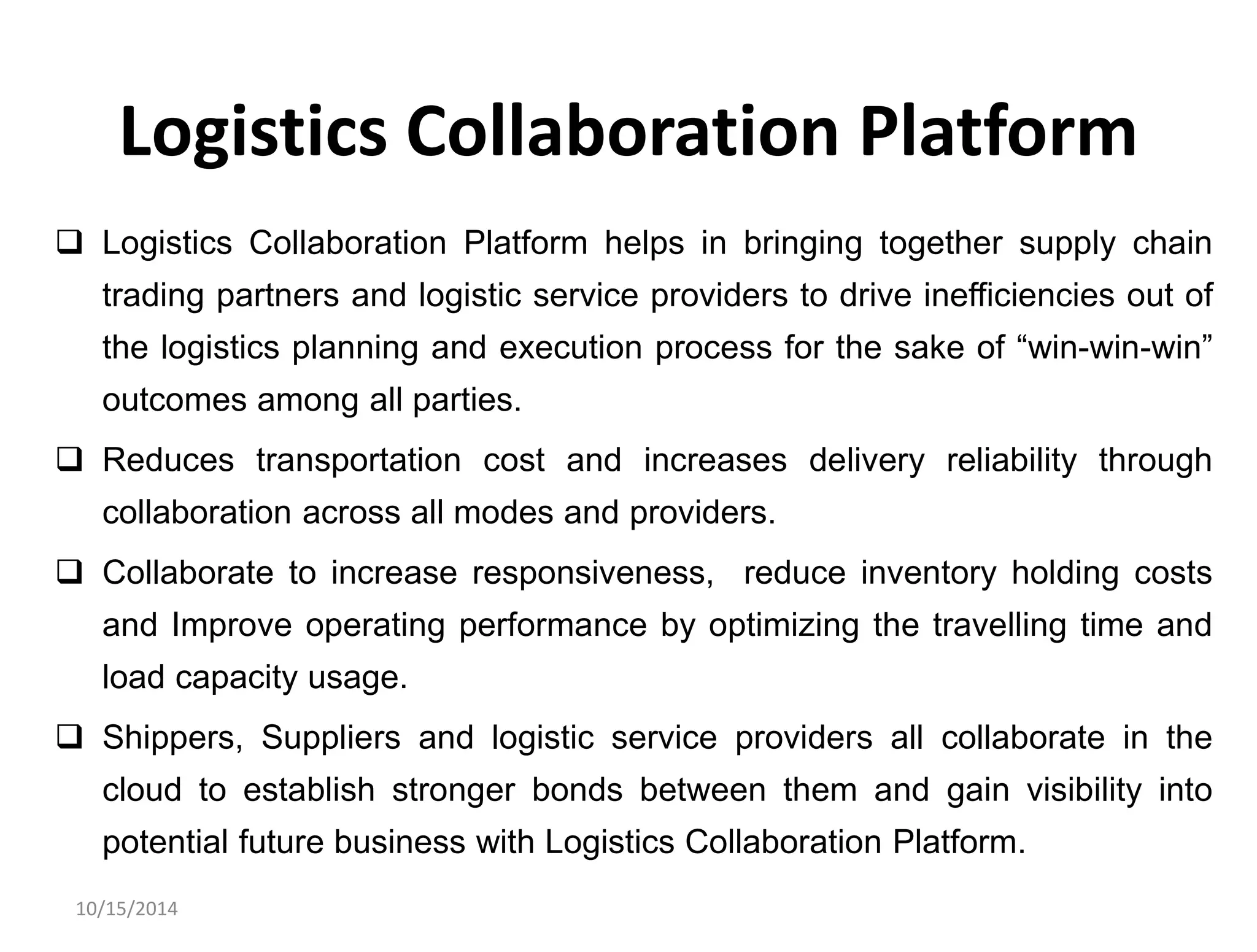
Logistics Collaboration Platform 
 Logistics Collaboration Platform helps in bringing together supply chain 
trading partners and logistic service providers to drive inefficiencies out of 
the logistics planning and execution process for the sake of “win-win-win” 
outcomes among all parties. 
 Reduces transportation cost and increases delivery reliability through 
collaboration across all modes and providers. 
 Collaborate to increase responsiveness, reduce inventory holding costs 
and Improve operating performance by optimizing the travelling time and 
load capacity usage. 
 Shippers, Suppliers and logistic service providers all collaborate in the 
cloud to establish stronger bonds between them and gain visibility into 
potential future business with Logistics Collaboration Platform. 
10/15/2014
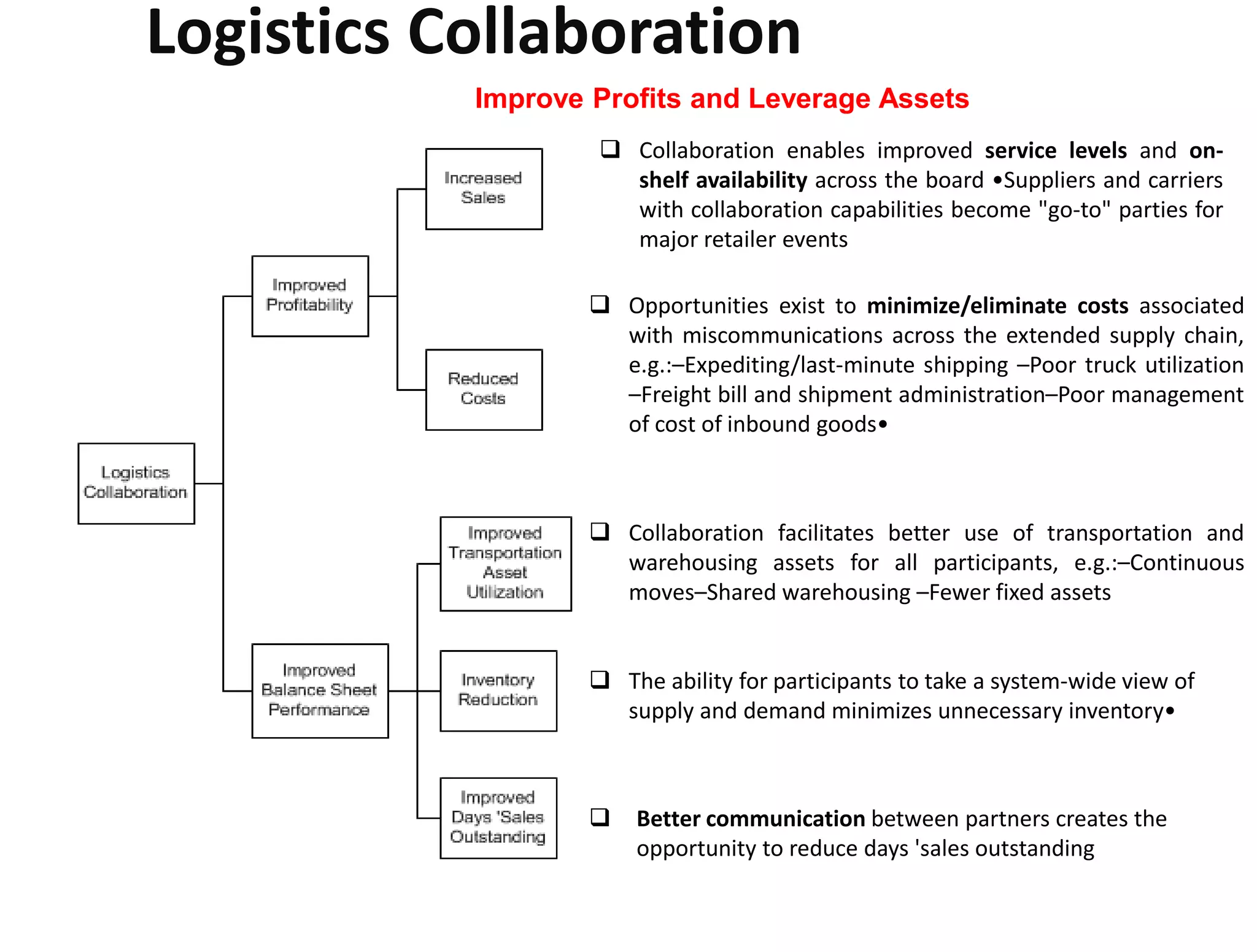
Logistics Collaboration 
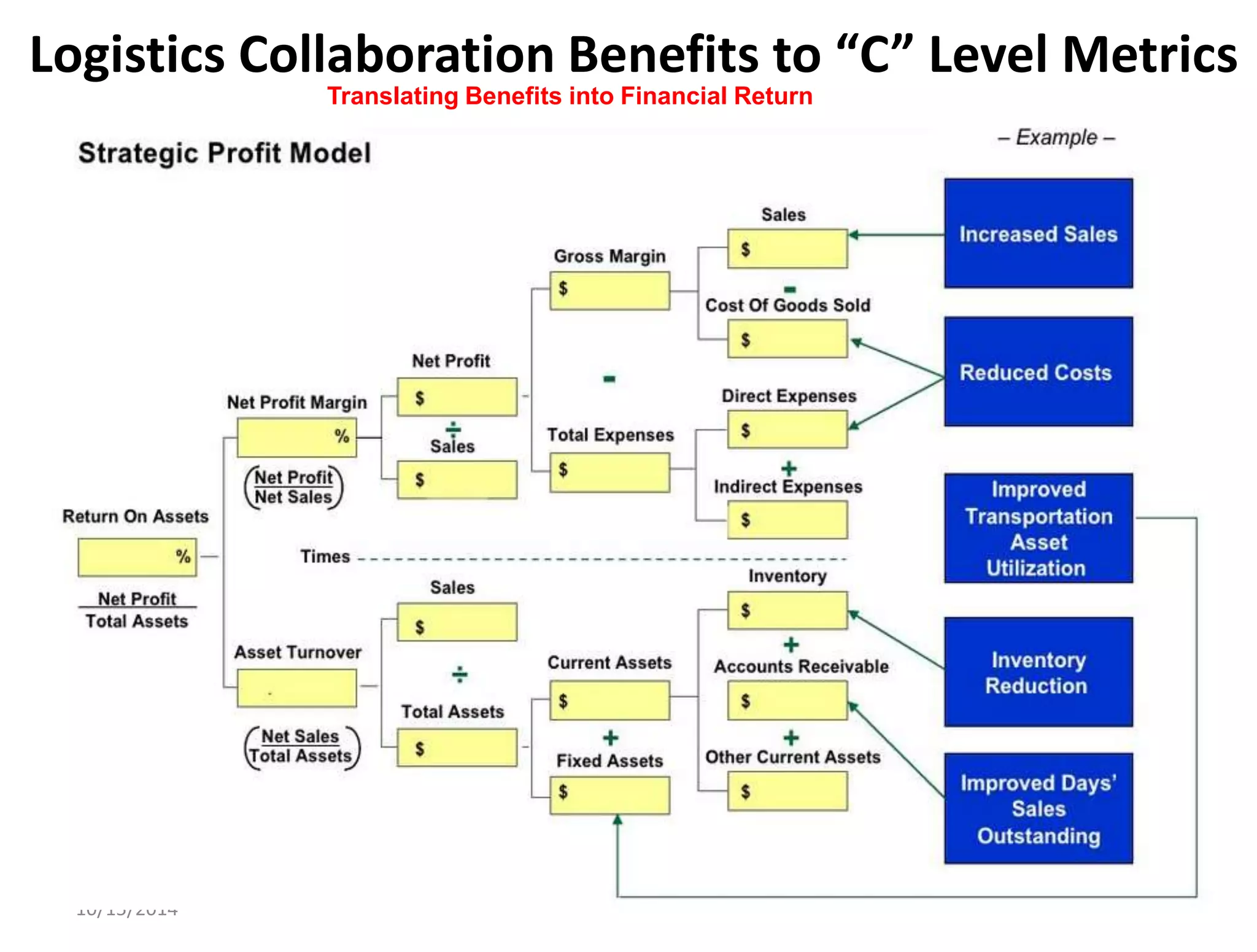
Improve Profits and Leverage Assets 
 Collaboration enables improved service levels and on-shelf 
availability across the board •Suppliers and carriers 
with collaboration capabilities become "go-to" parties for 
major retailer events 
 Opportunities exist to minimize/eliminate costs associated 
with miscommunications across the extended supply chain, 
e.g.:–Expediting/last-minute shipping –Poor truck utilization 
–Freight bill and shipment administration–Poor management 
of cost of inbound goods• 
 Collaboration facilitates better use of transportation and 
warehousing assets for all participants, e.g.:–Continuous 
moves–Shared warehousing –Fewer fixed assets 
 The ability for participants to take a system-wide view of 
supply and demand minimizes unnecessary inventory• 
 Better communication between partners creates the 
opportunity to reduce days 'sales outstanding
Logistics Collaboration Benefits to “C” Level Metrics 
10/15/2014 
Translating Benefits into Financial Return
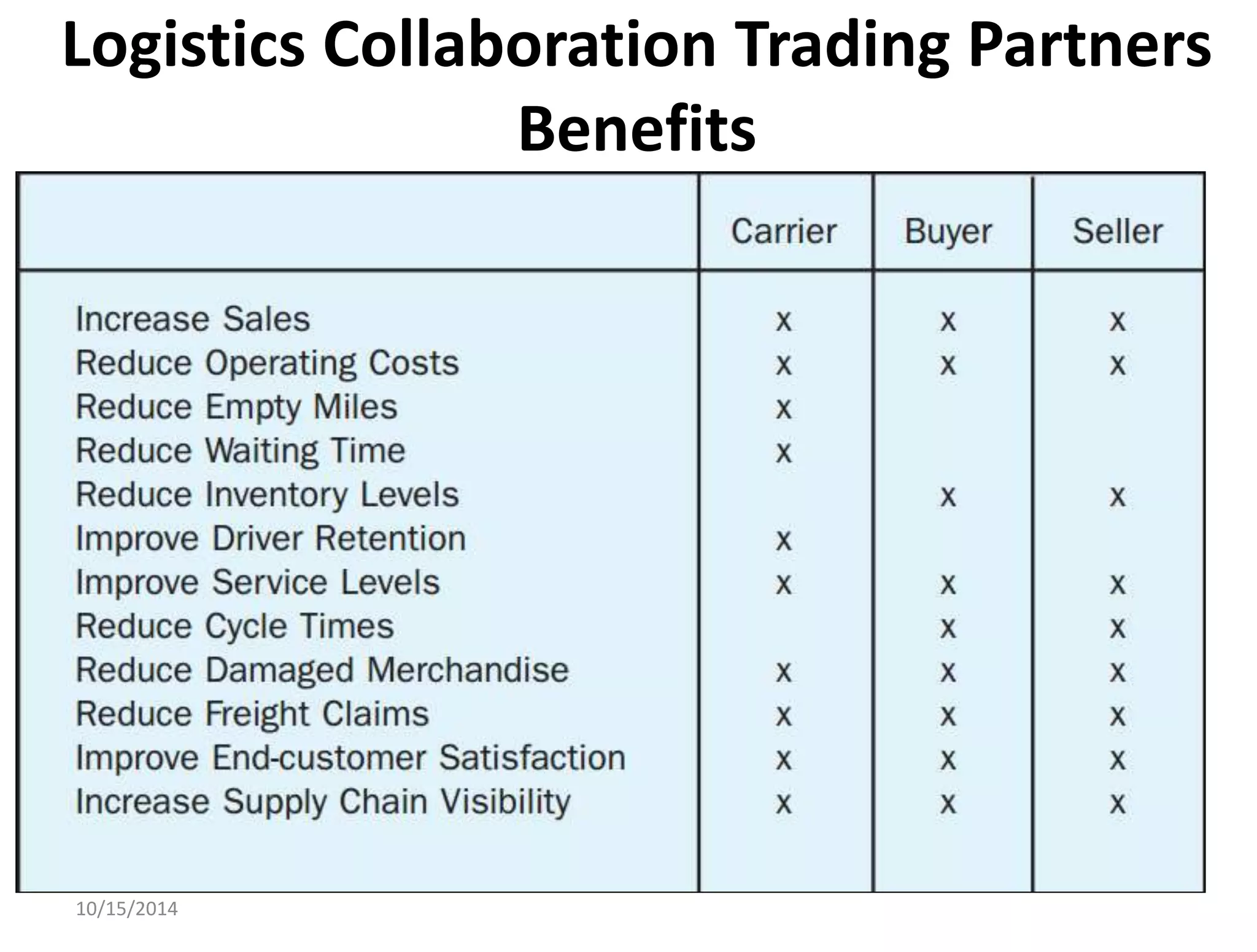
Logistics Collaboration Trading Partners 
Benefits 
10/15/2014
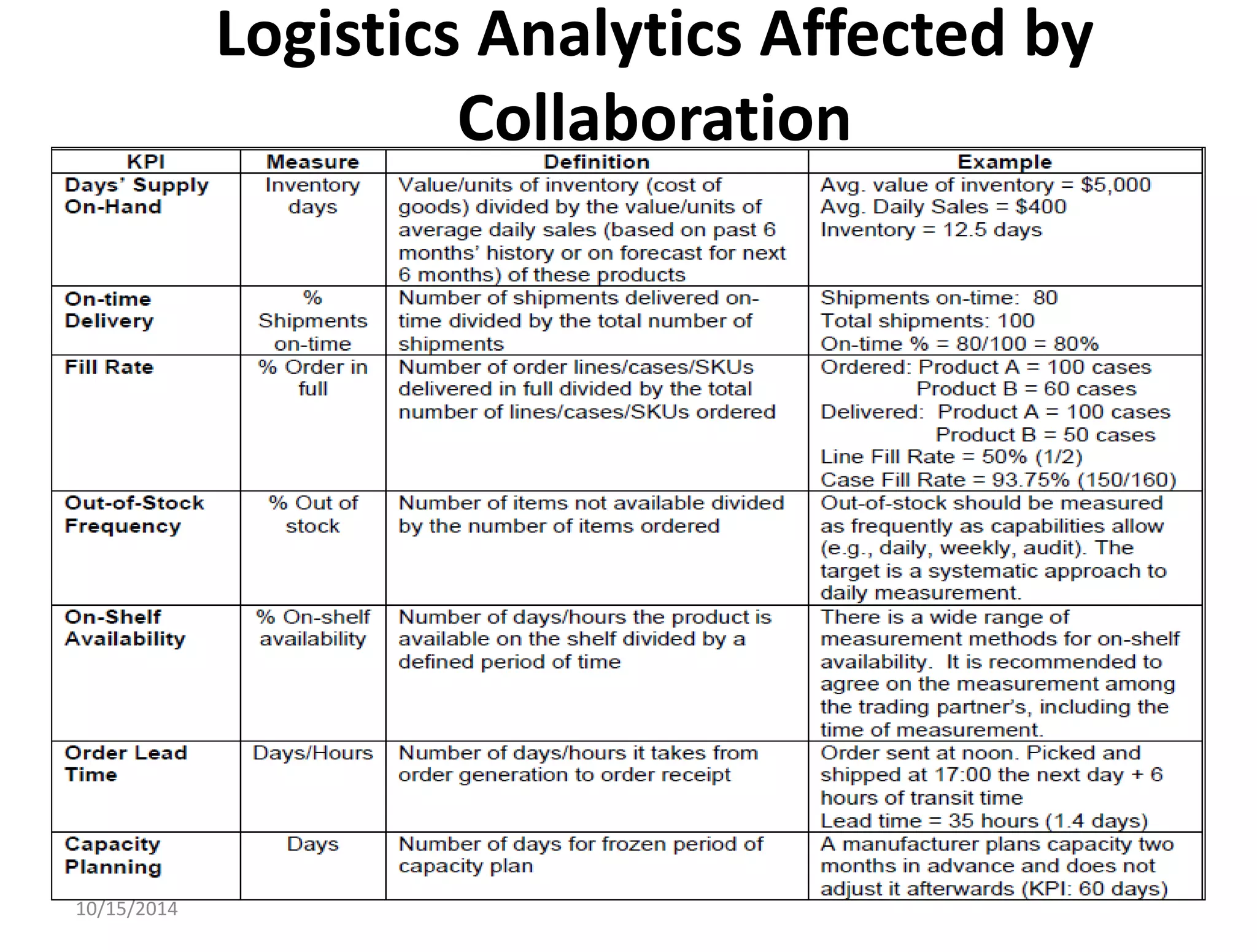
Logistics Analytics Affected by 
Collaboration 
10/15/2014
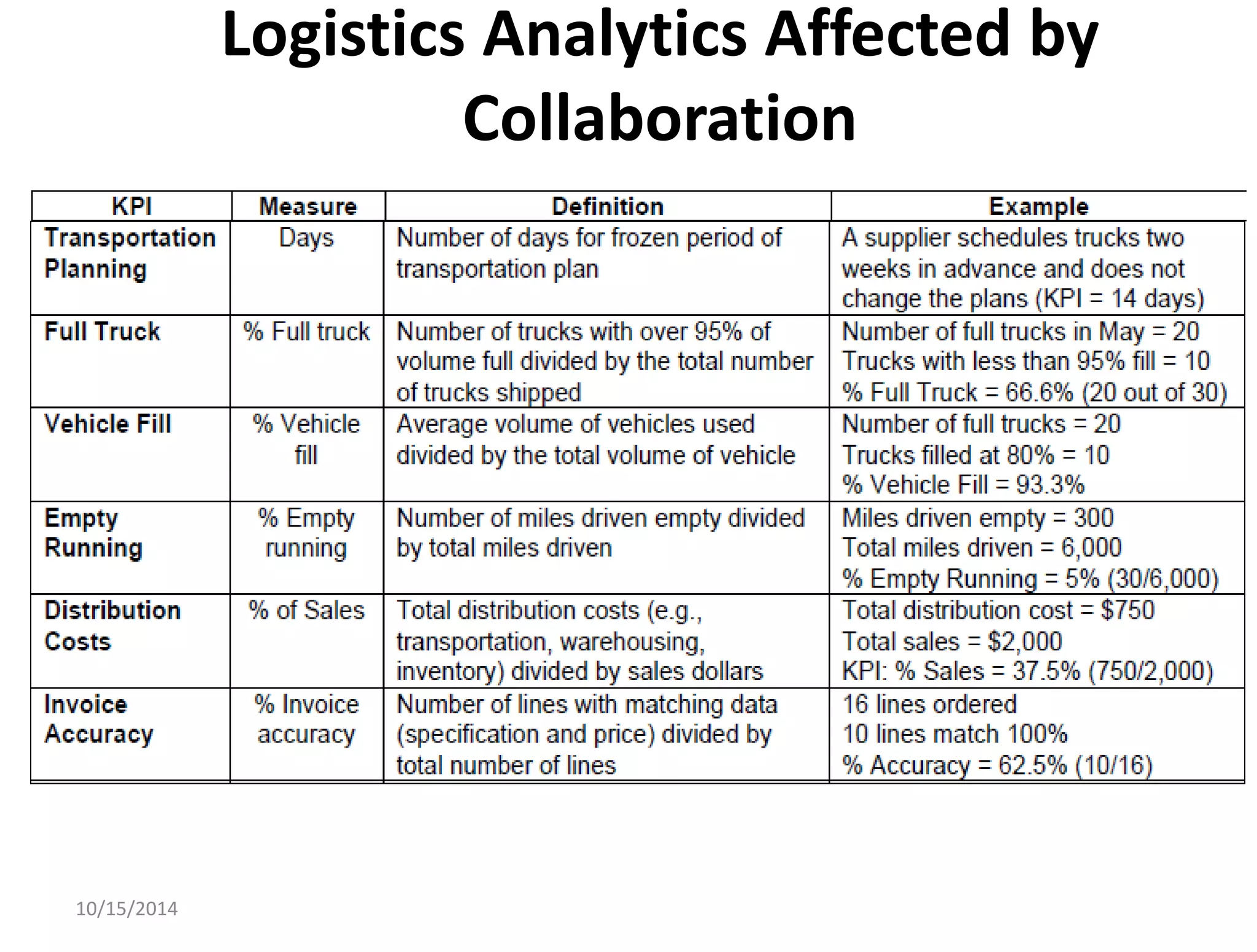
Logistics Analytics Affected by 
Collaboration 
10/15/2014
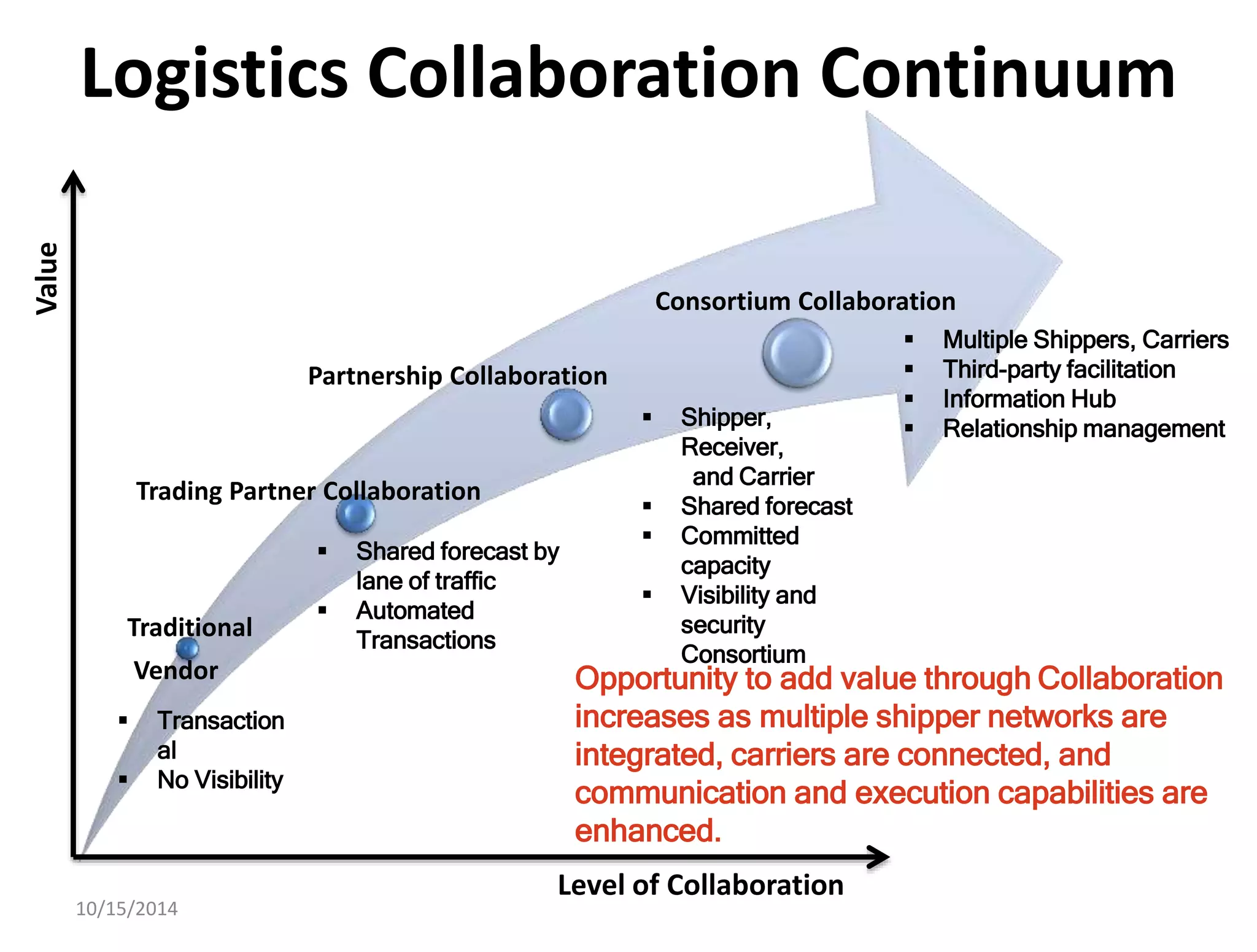
Logistics Collaboration Continuum 
Trading Partner Collaboration 
Traditional 
Vendor 
10/15/2014 
Partnership Collaboration 
Consortium Collaboration 
Level of Collaboration 
Value 
 Multiple Shippers, Carriers 
 Third-party facilitation 
 Information Hub 
 Relationship management 
 Shipper, 
Receiver, 
and Carrier 
 Shared forecast 
 Committed 
capacity 
 Visibility and 
security 
Consortium 
 Shared forecast by 
lane of traffic 
 Automated 
Transactions 
 Transaction 
al 
 No Visibility 
Opportunity to add value through Collaboration 
increases as multiple shipper networks are 
integrated, carriers are connected, and 
communication and execution capabilities are 
enhanced.
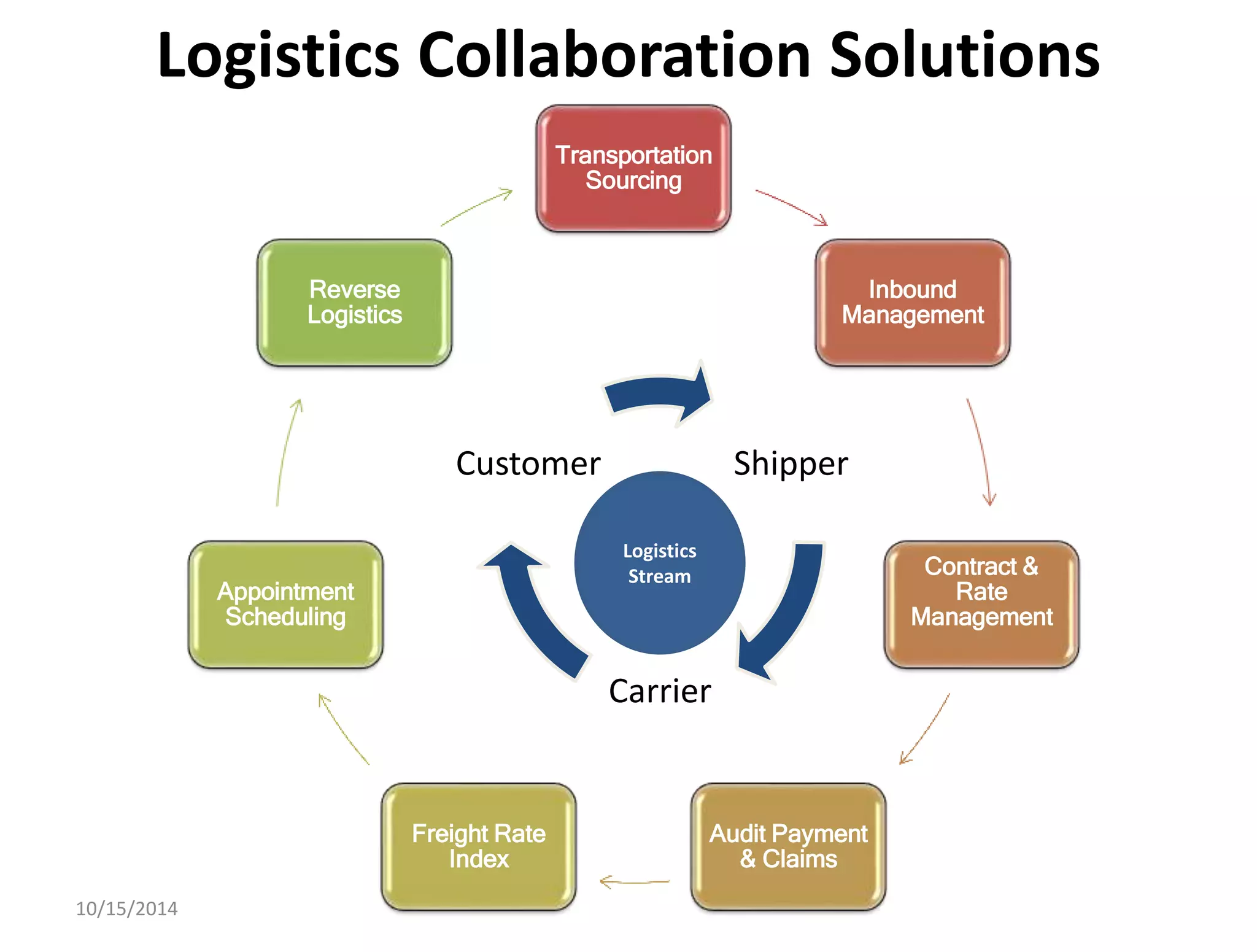
Logistics Collaboration Solutions 
10/15/2014 
Transportation 
Sourcing 
Inbound 
Management 
Contract & 
Rate 
Management 
Audit Payment 
& Claims 
Freight Rate 
Index 
Reverse 
Logistics 
Appointment 
Scheduling 
Logistics 
Stream 
Shipper 
Carrier 
Customer
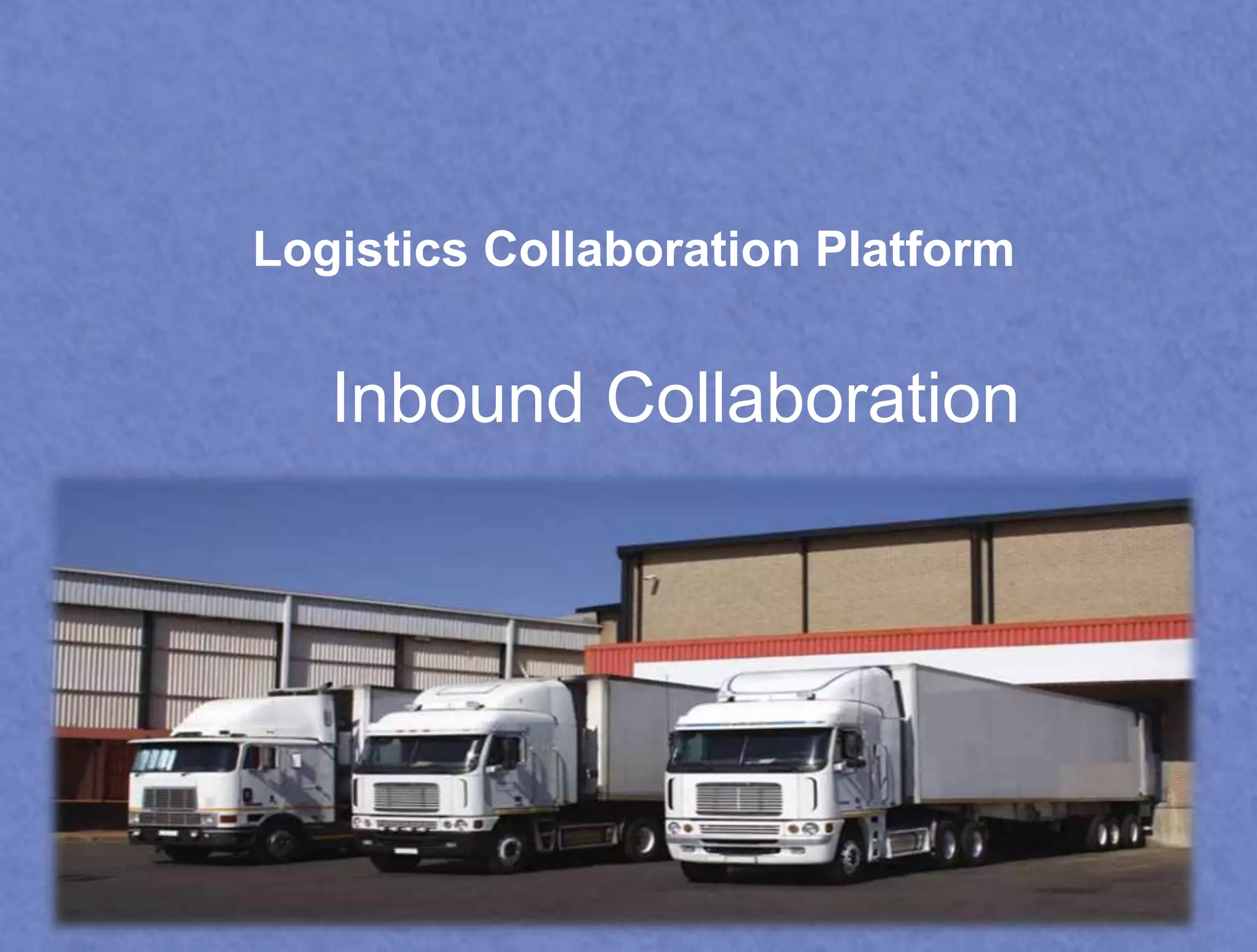
Logistics Collaboration Platform 
Inbound Collaboration
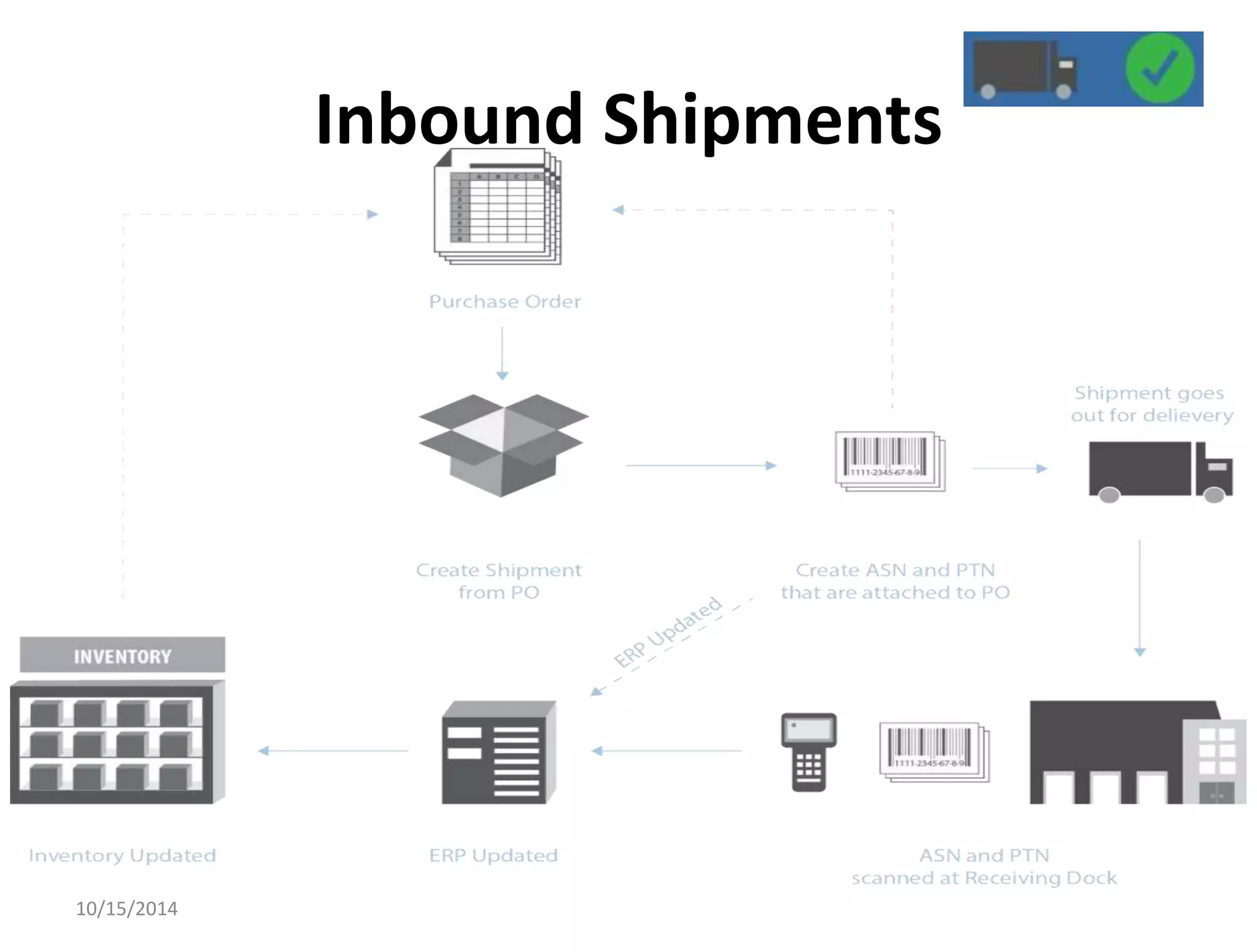
Inbound Shipments 
10/15/2014
Inbound Collaboration 
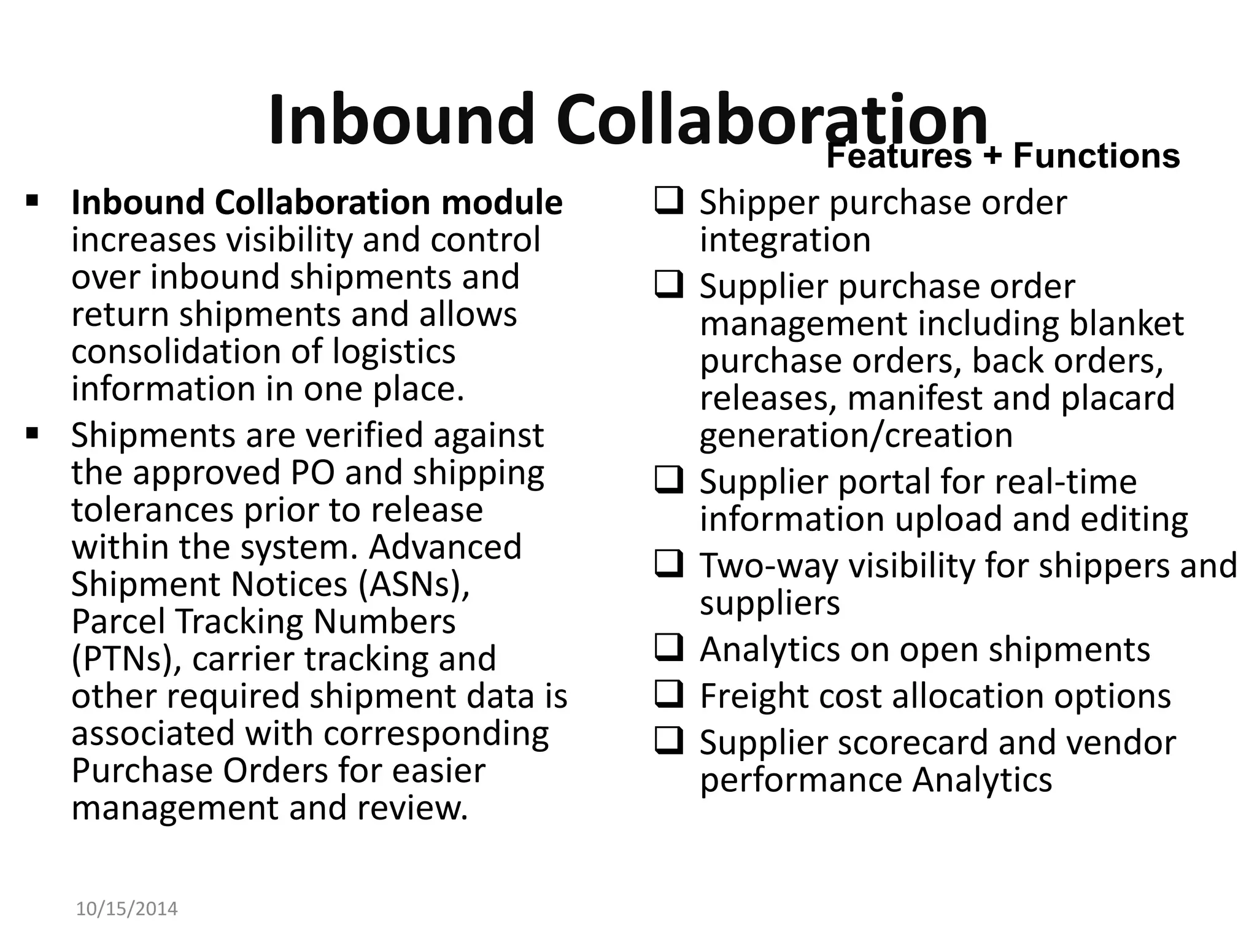
 Inbound Collaboration module 
increases visibility and control 
over inbound shipments and 
return shipments and allows 
consolidation of logistics 
information in one place. 
 Shipments are verified against 
the approved PO and shipping 
tolerances prior to release 
within the system. Advanced 
Shipment Notices (ASNs), 
Parcel Tracking Numbers 
(PTNs), carrier tracking and 
other required shipment data is 
associated with corresponding 
Purchase Orders for easier 
management and review. 
 Shipper purchase order 
integration 
 Supplier purchase order 
management including blanket 
purchase orders, back orders, 
releases, manifest and placard 
generation/creation 
 Supplier portal for real-time 
information upload and editing 
 Two-way visibility for shippers and 
suppliers 
 Analytics on open shipments 
 Freight cost allocation options 
 Supplier scorecard and vendor 
performance Analytics 
10/15/2014 
Features + Functions
Inbound Collaboration 
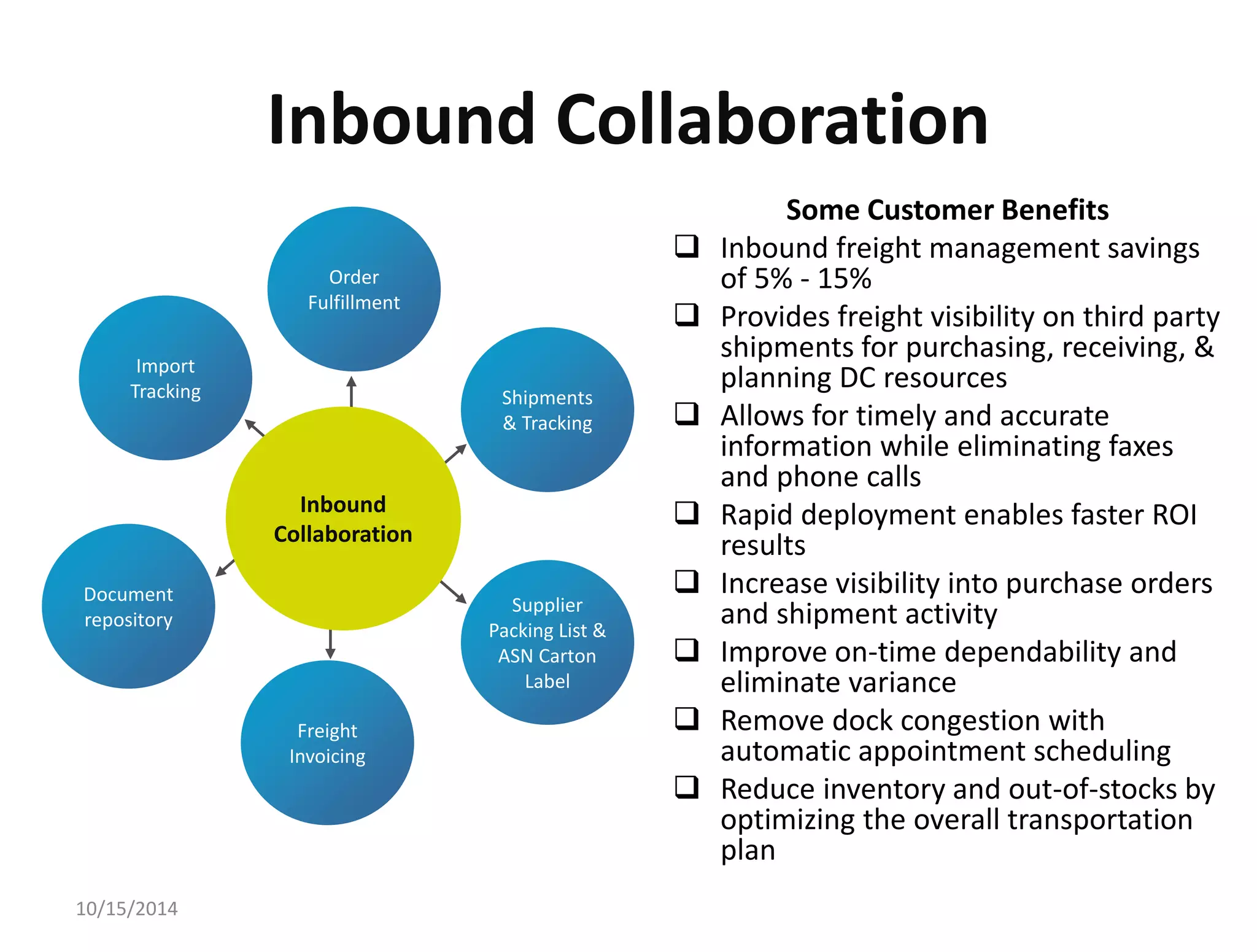
Some Customer Benefits 
 Inbound freight management savings 
of 5% - 15% 
 Provides freight visibility on third party 
shipments for purchasing, receiving, & 
planning DC resources 
 Allows for timely and accurate 
information while eliminating faxes 
and phone calls 
 Rapid deployment enables faster ROI 
results 
 Increase visibility into purchase orders 
and shipment activity 
 Improve on-time dependability and 
eliminate variance 
 Remove dock congestion with 
automatic appointment scheduling 
 Reduce inventory and out-of-stocks by 
optimizing the overall transportation 
plan 
Import 
Tracking Shipments 
10/15/2014 
Order 
Fulfillment 
Supplier 
Packing List & 
ASN Carton 
Label 
Freight 
Invoicing 
Document 
repository 
& Tracking 
Inbound 
Collaboration
Transportation Sourcing Collaboration
Transportation Sourcing Collaboration 
 Seamless collaboration with carriers 
during the procurement cycle. 
 Reduce transportation costs by 
optimizing bid execution and carrier 
negotiation 
 Save time and money with every RFP 
 Quickly solicit and contract rates, 
capacity and lanes 
 Centralized bid data and carrier 
performance histories for comparisons 
of price, quality, service and capacity 
10/15/2014 
Features + Functions 
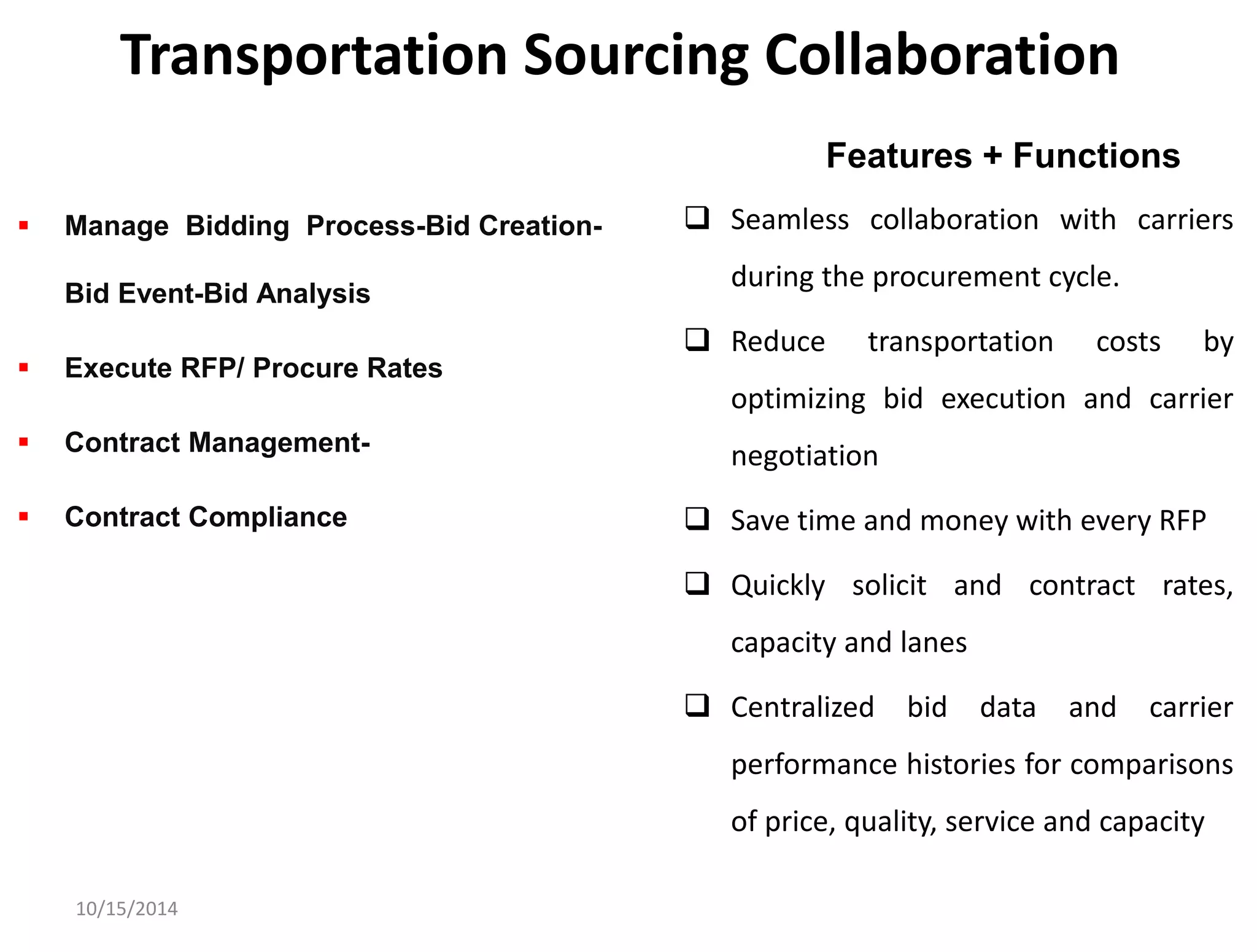
 Manage Bidding Process-Bid Creation- 
Bid Event-Bid Analysis 
 Execute RFP/ Procure Rates 
 Contract Management- 
 Contract Compliance
Contract & Rate Management 
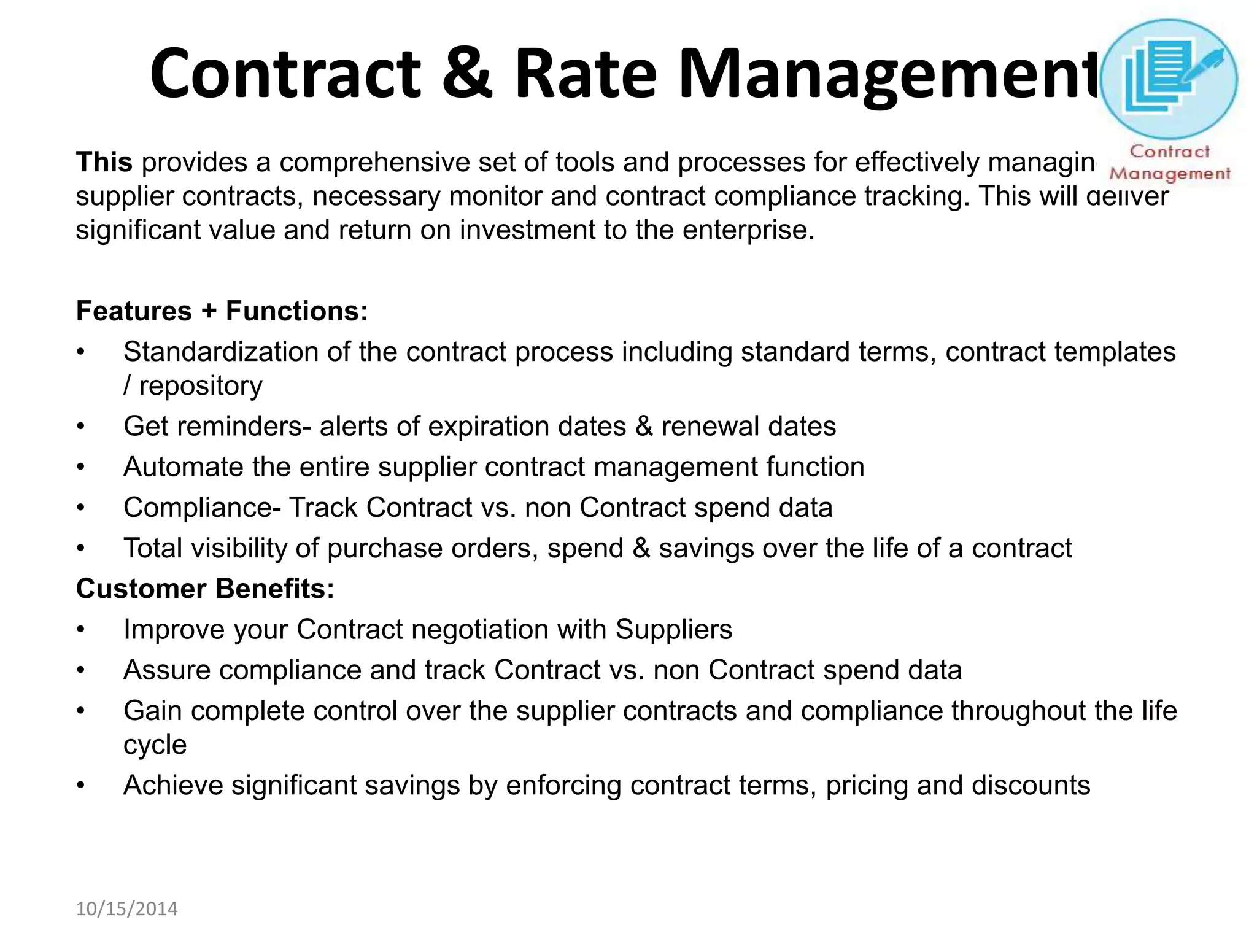
This provides a comprehensive set of tools and processes for effectively managing the 
supplier contracts, necessary monitor and contract compliance tracking. This will deliver 
significant value and return on investment to the enterprise. 
Features + Functions: 
• Standardization of the contract process including standard terms, contract templates 
/ repository 
• Get reminders- alerts of expiration dates & renewal dates 
• Automate the entire supplier contract management function 
• Compliance- Track Contract vs. non Contract spend data 
• Total visibility of purchase orders, spend & savings over the life of a contract 
Customer Benefits: 
• Improve your Contract negotiation with Suppliers 
• Assure compliance and track Contract vs. non Contract spend data 
• Gain complete control over the supplier contracts and compliance throughout the life 
cycle 
• Achieve significant savings by enforcing contract terms, pricing and discounts 
10/15/2014
Audit Payments & Claim
Audit Payments & Claim 
 Carrier Invoicing 
 Invoice Matching 
 Freight Bill Audit 
 Payments 
• User can easily receive freight bills 
electronically, standardize the data 
and format, and audit against the 
contracted rate and shipment activity. 
• Resolve discrepancies through a 
collaborative dispute workflow with 
transportation providers. Payment 
vouchers are triggered following bill 
approval. 
 Allow match or auto payment to 
carriers 
 Support audit on accessorial and 
line-haul charges 
 Enable payment or interfaces to 
financial systems to pay within 
defined tolerances 
 Manage invoicing and reconciliation 
through carrier portal or electronic 
communication (EDI, XML) 
 Support claims management and 
settlement 
 Allocate freight costs to the SKU 
level 
 Set tolerances for the amount of 
deviation allowed for certain rates 
and surcharges 
10/15/2014 
Features + Functions
Audit Payments & Claim Customer 
Benefits 
• Simplify billing and reduce freight payment errors 
• Dispute cost discrepancies 
• Generate motor carrier claims and support cargo 
claims 
• Prevent overpayments and identify past overcharges 
• Manage detention claims 
• Interface with financial systems 
• Provide motor carriers with a consistent system for 
resolving freight billing issues 
• Execute detailed audits of freight invoices (including 
accessorial and fuel surcharges) 
10/15/2014
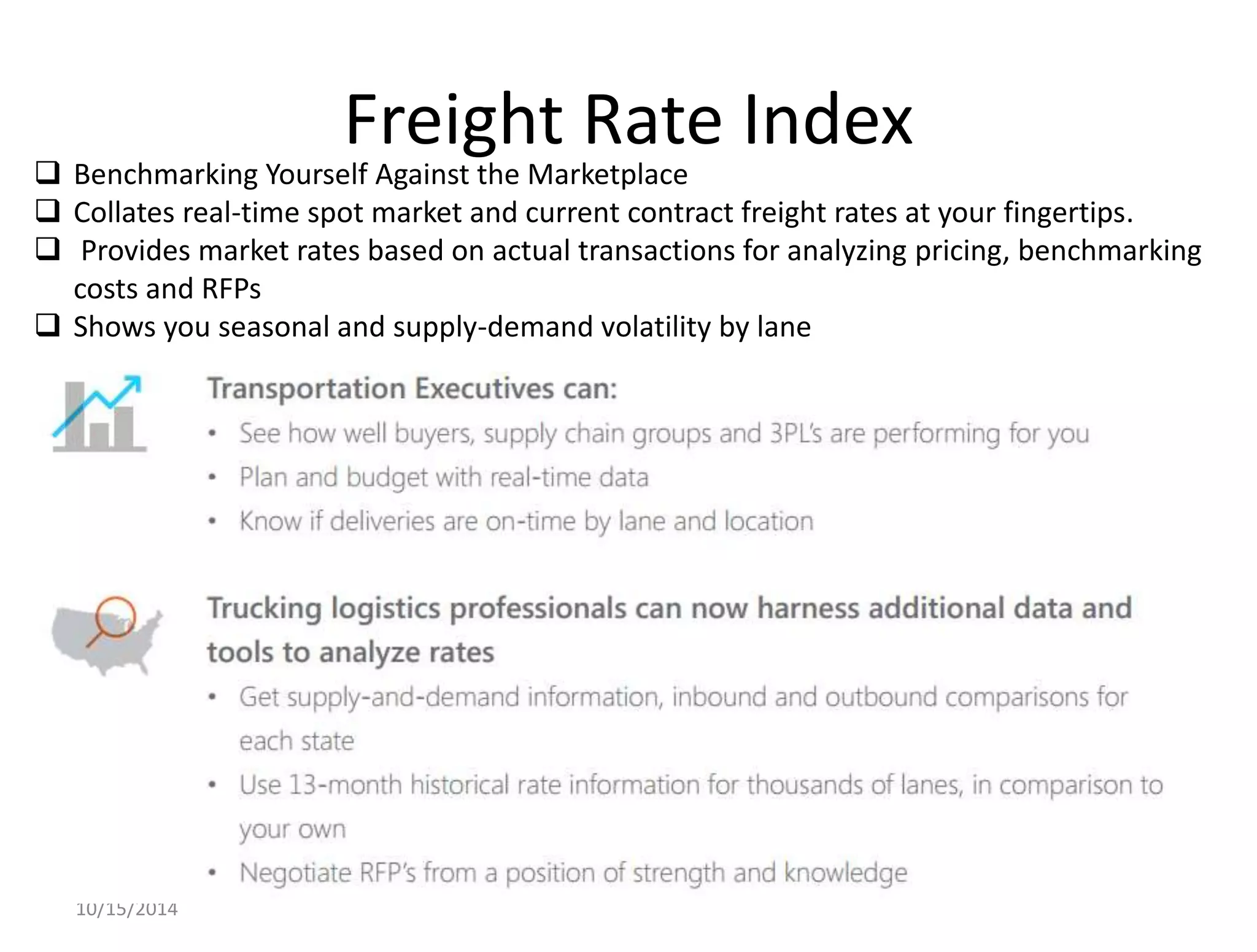
Freight Rate Index
Freight Rate Index 
 Benchmarking Yourself Against the Marketplace 
 Collates real-time spot market and current contract freight rates at your fingertips. 
 Provides market rates based on actual transactions for analyzing pricing, benchmarking 
costs and RFPs 
 Shows you seasonal and supply-demand volatility by lane 
10/15/2014
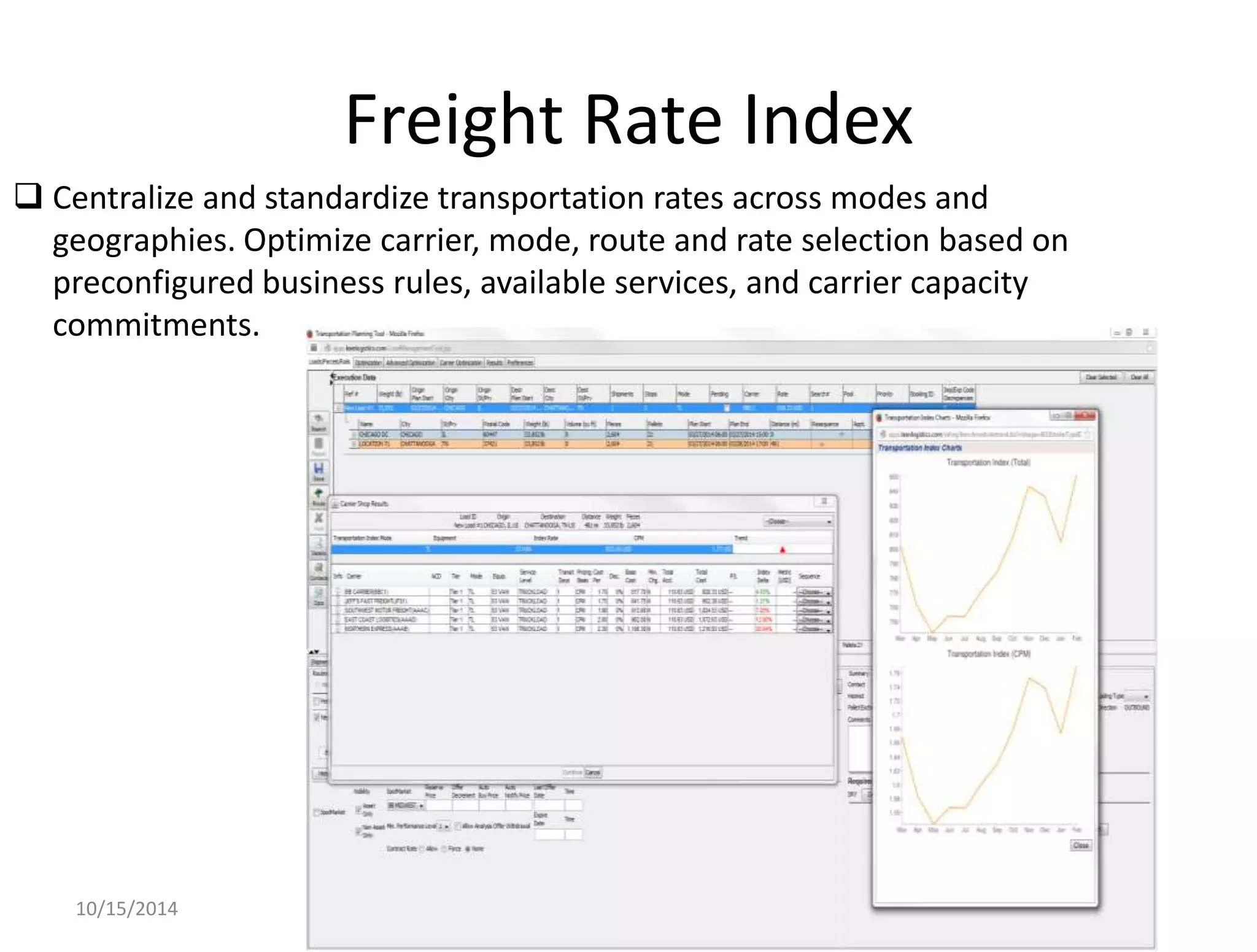
Freight Rate Index 
 Centralize and standardize transportation rates across modes and 
geographies. Optimize carrier, mode, route and rate selection based on 
preconfigured business rules, available services, and carrier capacity 
commitments. 
10/15/2014
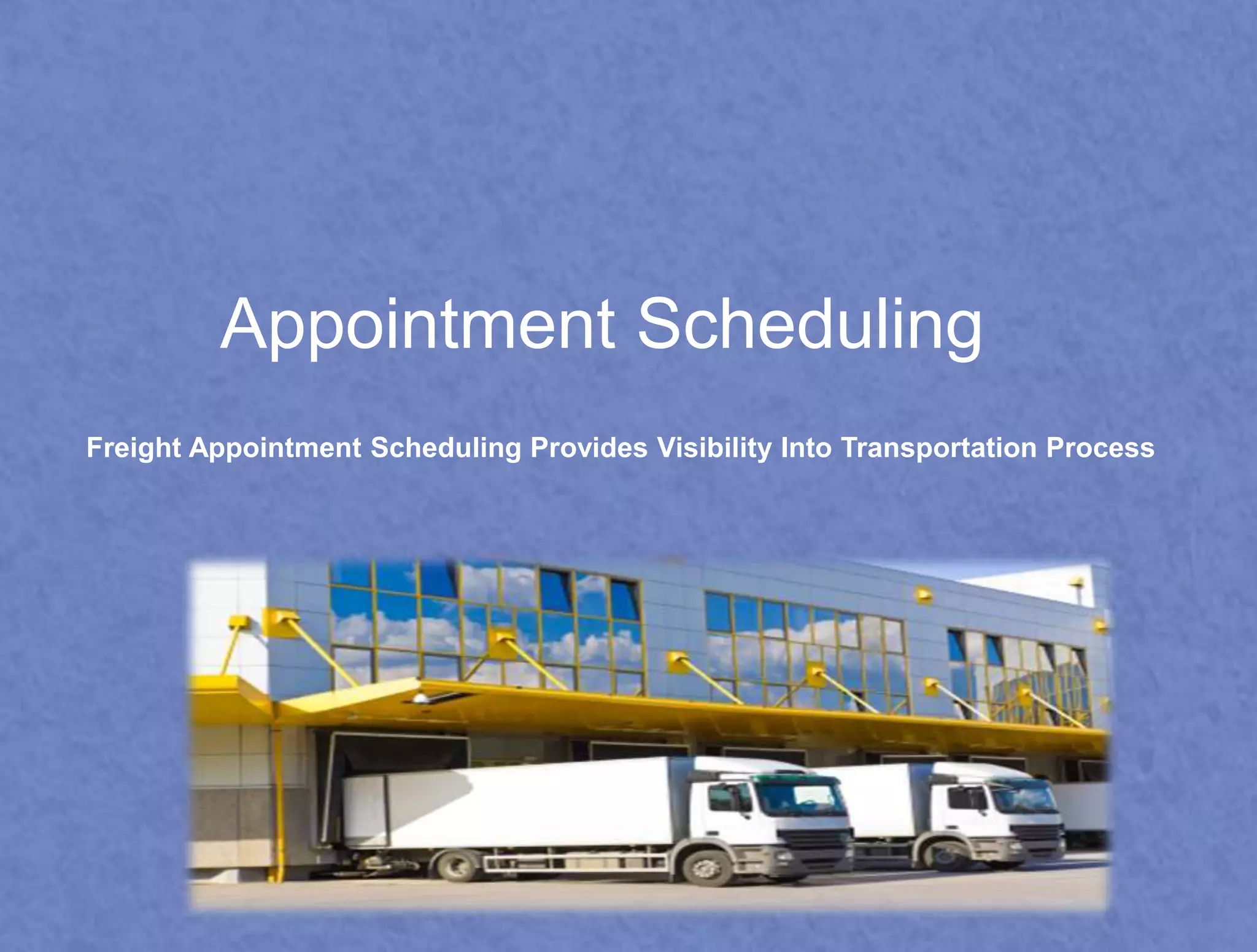
Appointment Scheduling 
Freight Appointment Scheduling Provides Visibility Into Transportation Process
Appointment Scheduling 
• Carrier appointment scheduling tool 
that allows motor carriers and 
suppliers to easily “self-schedule” 
their warehouse delivery and labor 
needs. 
• Helps to increase productivity and 
levels workload, stay on schedule, 
and keep in compliance with 
business hours of Service and other 
government regulations. 
• Save money by reducing direct 
transportation costs and labor 
• Satisfy customers with on-time and 
accurate delivery 
• Reduce detention fees as shipment 
dates and times become more 
visible 
 Support system-recommended times 
to drive appointment setting and dock 
resources allocation at the DC 
 Access to carrier information, routes 
and pricing 
 Availability alerts and filters to ensure 
schedules are not overbooked 
 Managed, non-managed and un-appointed 
shipment metrics per dock 
 Real time dock status reports 
 Priority settings, flags and tools to 
highlight special or urgent delivery 
appointments 
 Appointment grid profile to visualize 
dock capacity management 
10/15/2014 
Features + Functions
Reverse Logistics Collaboration
Reverse Logistics Collaboration 
• Gatekeeping (Warranty) 
• Return Material Authorization (RMA) 
• Return Price Rationalization 
10/15/2014
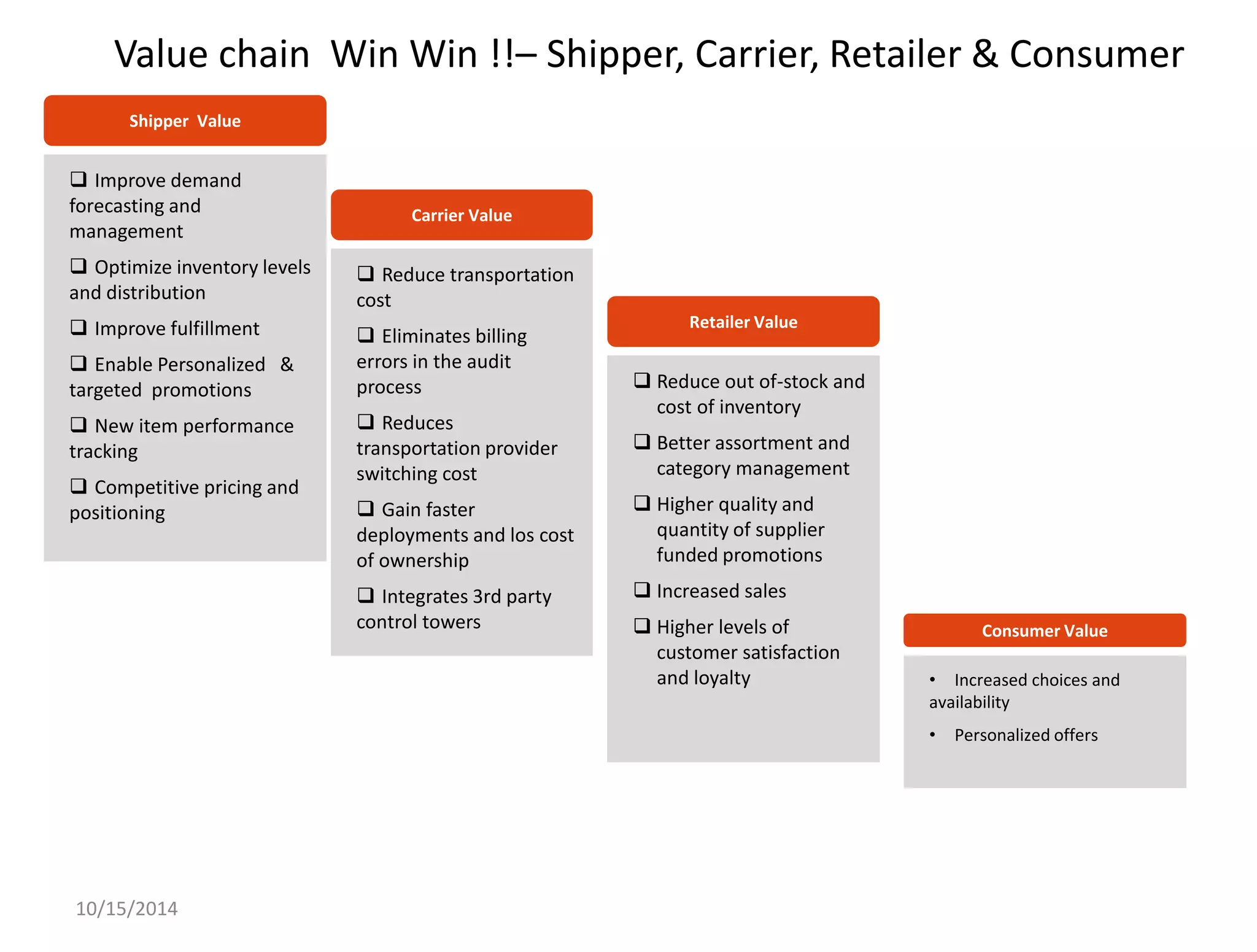
Value chain Win Win !!– Shipper, Carrier, Retailer & Consumer 
Shipper Value 
10/15/2014 
Carrier Value 
 Reduce transportation 
cost 
 Eliminates billing 
errors in the audit 
process 
 Reduces 
transportation provider 
switching cost 
 Gain faster 
deployments and los cost 
of ownership 
 Integrates 3rd party 
control towers 
 Improve demand 
forecasting and 
management 
 Optimize inventory levels 
and distribution 
 Improve fulfillment 
 Enable Personalized & 
targeted promotions 
 New item performance 
tracking 
 Competitive pricing and 
positioning 
Consumer Value 
• Increased choices and 
availability 
• Personalized offers 
Retailer Value 
 Reduce out of-stock and 
cost of inventory 
 Better assortment and 
category management 
 Higher quality and 
quantity of supplier 
funded promotions 
 Increased sales 
 Higher levels of 
customer satisfaction 
and loyalty
Thank You!

Logistics Collaboration Solutions-Research

  • 1.
    Logistics Collaboration Solutions Shipper, Carrier, Retailer & Consumer Research Done By : Amit Garg
  • 2.
  • 3.
    Today Supply Chain 10/15/2014 Source: Paraphrased from ‘Rising above the cloud’ Aberdeen Sept 2012
  • 4.
    Lack of VisibilityIncreases Supply Chain Risks 10/15/2014 Source: Paraphrased from ‘Rising above the cloud’ Aberdeen Sept 2012
  • 5.
    Modes of Transportation Modes Characteristics When to use Key Issues Package Carriers Carry small packages weighing around 150- 200 pounds. Expensive then LTL Carriers. Rapid and reliable delivery. Small and time sensitive shipments. Enable speed inventory flow and track. Preferred for E-business. Small sizes & several delivery points, so consolidation is a key factor. Location and capacity of transfer points. Information capability to facilitate and track package flow. Scheduling and routing of delivery trucks Truck Dominant mode of freight transportation. 2 major segments – TL or LTL. Rates vary with distance travelled. For LTL, rates based on distance and quantity loaded. Door to door shipment. For TL, Transportation between suppliers and manufacturers or manufacturers and their warehouses. ForLTL , shipments in small lots under 20,000 pounds For TL, idle time and distance traveled between 2 successive loads adds cost. For LTL, location of consolidation centers, assignment of loads to trucks and scheduling and routing of pickup and delivery. Air Offers very fast & fairly expensive. Generally move shipments under 500 pounds. Small, high value items or time sensitive emergency shipments that travel a long distance. Identifying location & # of hubs, assigning planes to route, setting up maintenance schedules, scheduling crews, managing prices Rail Incur high fixed costs in terms of rails, locomotives, cars and yards. Significant trip related to labor and fuel costs. Ideal for carrying large, heavy or high density products over large distance which are not time sensitive. Vehicle and staff scheduling, track and terminal delays & poor on time performance. Performance is hurt by large amount of time taken at each transition. Water Limited to certain areas. Takes place via inland waterway or coastal waters Carrying Large Loads at low cost.. Slowest mode, customer responsiveness is not too high. Delays at ports, customs and management of containers. Intermodal More than one mode. Most common are Rail/Truck. Containerized freight Common combination is Rail & Truck. Should be containerized. Exchange of info to facilitate shipment transfers. Considerable delays, hurting delivery time performance.
  • 6.
    Logistics Collaboration Platform Cloud-based collaboration platform Workflow based task management Online form based data management 6 Mobility Analytics based Decision Support Exception based processing Security Control
  • 7.
    Logistics Collaboration Platform  Logistics Collaboration Platform helps in bringing together supply chain trading partners and logistic service providers to drive inefficiencies out of the logistics planning and execution process for the sake of “win-win-win” outcomes among all parties.  Reduces transportation cost and increases delivery reliability through collaboration across all modes and providers.  Collaborate to increase responsiveness, reduce inventory holding costs and Improve operating performance by optimizing the travelling time and load capacity usage.  Shippers, Suppliers and logistic service providers all collaborate in the cloud to establish stronger bonds between them and gain visibility into potential future business with Logistics Collaboration Platform. 10/15/2014
  • 8.
    Logistics Collaboration ImproveProfits and Leverage Assets  Collaboration enables improved service levels and on-shelf availability across the board •Suppliers and carriers with collaboration capabilities become "go-to" parties for major retailer events  Opportunities exist to minimize/eliminate costs associated with miscommunications across the extended supply chain, e.g.:–Expediting/last-minute shipping –Poor truck utilization –Freight bill and shipment administration–Poor management of cost of inbound goods•  Collaboration facilitates better use of transportation and warehousing assets for all participants, e.g.:–Continuous moves–Shared warehousing –Fewer fixed assets  The ability for participants to take a system-wide view of supply and demand minimizes unnecessary inventory•  Better communication between partners creates the opportunity to reduce days 'sales outstanding
  • 9.
    Logistics Collaboration Benefitsto “C” Level Metrics 10/15/2014 Translating Benefits into Financial Return
  • 10.
    Logistics Collaboration TradingPartners Benefits 10/15/2014
  • 11.
    Logistics Analytics Affectedby Collaboration 10/15/2014
  • 12.
    Logistics Analytics Affectedby Collaboration 10/15/2014
  • 13.
    Logistics Collaboration Continuum Trading Partner Collaboration Traditional Vendor 10/15/2014 Partnership Collaboration Consortium Collaboration Level of Collaboration Value  Multiple Shippers, Carriers  Third-party facilitation  Information Hub  Relationship management  Shipper, Receiver, and Carrier  Shared forecast  Committed capacity  Visibility and security Consortium  Shared forecast by lane of traffic  Automated Transactions  Transaction al  No Visibility Opportunity to add value through Collaboration increases as multiple shipper networks are integrated, carriers are connected, and communication and execution capabilities are enhanced.
  • 14.
    Logistics Collaboration Solutions 10/15/2014 Transportation Sourcing Inbound Management Contract & Rate Management Audit Payment & Claims Freight Rate Index Reverse Logistics Appointment Scheduling Logistics Stream Shipper Carrier Customer
  • 15.
    Logistics Collaboration Platform Inbound Collaboration
  • 16.
  • 17.
    Inbound Collaboration Inbound Collaboration module increases visibility and control over inbound shipments and return shipments and allows consolidation of logistics information in one place.  Shipments are verified against the approved PO and shipping tolerances prior to release within the system. Advanced Shipment Notices (ASNs), Parcel Tracking Numbers (PTNs), carrier tracking and other required shipment data is associated with corresponding Purchase Orders for easier management and review.  Shipper purchase order integration  Supplier purchase order management including blanket purchase orders, back orders, releases, manifest and placard generation/creation  Supplier portal for real-time information upload and editing  Two-way visibility for shippers and suppliers  Analytics on open shipments  Freight cost allocation options  Supplier scorecard and vendor performance Analytics 10/15/2014 Features + Functions
  • 18.
    Inbound Collaboration SomeCustomer Benefits  Inbound freight management savings of 5% - 15%  Provides freight visibility on third party shipments for purchasing, receiving, & planning DC resources  Allows for timely and accurate information while eliminating faxes and phone calls  Rapid deployment enables faster ROI results  Increase visibility into purchase orders and shipment activity  Improve on-time dependability and eliminate variance  Remove dock congestion with automatic appointment scheduling  Reduce inventory and out-of-stocks by optimizing the overall transportation plan Import Tracking Shipments 10/15/2014 Order Fulfillment Supplier Packing List & ASN Carton Label Freight Invoicing Document repository & Tracking Inbound Collaboration
  • 19.
  • 20.
    Transportation Sourcing Collaboration  Seamless collaboration with carriers during the procurement cycle.  Reduce transportation costs by optimizing bid execution and carrier negotiation  Save time and money with every RFP  Quickly solicit and contract rates, capacity and lanes  Centralized bid data and carrier performance histories for comparisons of price, quality, service and capacity 10/15/2014 Features + Functions  Manage Bidding Process-Bid Creation- Bid Event-Bid Analysis  Execute RFP/ Procure Rates  Contract Management-  Contract Compliance
  • 21.
    Contract & RateManagement This provides a comprehensive set of tools and processes for effectively managing the supplier contracts, necessary monitor and contract compliance tracking. This will deliver significant value and return on investment to the enterprise. Features + Functions: • Standardization of the contract process including standard terms, contract templates / repository • Get reminders- alerts of expiration dates & renewal dates • Automate the entire supplier contract management function • Compliance- Track Contract vs. non Contract spend data • Total visibility of purchase orders, spend & savings over the life of a contract Customer Benefits: • Improve your Contract negotiation with Suppliers • Assure compliance and track Contract vs. non Contract spend data • Gain complete control over the supplier contracts and compliance throughout the life cycle • Achieve significant savings by enforcing contract terms, pricing and discounts 10/15/2014
  • 22.
  • 23.
    Audit Payments &Claim  Carrier Invoicing  Invoice Matching  Freight Bill Audit  Payments • User can easily receive freight bills electronically, standardize the data and format, and audit against the contracted rate and shipment activity. • Resolve discrepancies through a collaborative dispute workflow with transportation providers. Payment vouchers are triggered following bill approval.  Allow match or auto payment to carriers  Support audit on accessorial and line-haul charges  Enable payment or interfaces to financial systems to pay within defined tolerances  Manage invoicing and reconciliation through carrier portal or electronic communication (EDI, XML)  Support claims management and settlement  Allocate freight costs to the SKU level  Set tolerances for the amount of deviation allowed for certain rates and surcharges 10/15/2014 Features + Functions
  • 24.
    Audit Payments &Claim Customer Benefits • Simplify billing and reduce freight payment errors • Dispute cost discrepancies • Generate motor carrier claims and support cargo claims • Prevent overpayments and identify past overcharges • Manage detention claims • Interface with financial systems • Provide motor carriers with a consistent system for resolving freight billing issues • Execute detailed audits of freight invoices (including accessorial and fuel surcharges) 10/15/2014
  • 25.
  • 26.
    Freight Rate Index  Benchmarking Yourself Against the Marketplace  Collates real-time spot market and current contract freight rates at your fingertips.  Provides market rates based on actual transactions for analyzing pricing, benchmarking costs and RFPs  Shows you seasonal and supply-demand volatility by lane 10/15/2014
  • 27.
    Freight Rate Index  Centralize and standardize transportation rates across modes and geographies. Optimize carrier, mode, route and rate selection based on preconfigured business rules, available services, and carrier capacity commitments. 10/15/2014
  • 28.
    Appointment Scheduling FreightAppointment Scheduling Provides Visibility Into Transportation Process
  • 29.
    Appointment Scheduling •Carrier appointment scheduling tool that allows motor carriers and suppliers to easily “self-schedule” their warehouse delivery and labor needs. • Helps to increase productivity and levels workload, stay on schedule, and keep in compliance with business hours of Service and other government regulations. • Save money by reducing direct transportation costs and labor • Satisfy customers with on-time and accurate delivery • Reduce detention fees as shipment dates and times become more visible  Support system-recommended times to drive appointment setting and dock resources allocation at the DC  Access to carrier information, routes and pricing  Availability alerts and filters to ensure schedules are not overbooked  Managed, non-managed and un-appointed shipment metrics per dock  Real time dock status reports  Priority settings, flags and tools to highlight special or urgent delivery appointments  Appointment grid profile to visualize dock capacity management 10/15/2014 Features + Functions
  • 30.
  • 31.
    Reverse Logistics Collaboration • Gatekeeping (Warranty) • Return Material Authorization (RMA) • Return Price Rationalization 10/15/2014
  • 32.
    Value chain WinWin !!– Shipper, Carrier, Retailer & Consumer Shipper Value 10/15/2014 Carrier Value  Reduce transportation cost  Eliminates billing errors in the audit process  Reduces transportation provider switching cost  Gain faster deployments and los cost of ownership  Integrates 3rd party control towers  Improve demand forecasting and management  Optimize inventory levels and distribution  Improve fulfillment  Enable Personalized & targeted promotions  New item performance tracking  Competitive pricing and positioning Consumer Value • Increased choices and availability • Personalized offers Retailer Value  Reduce out of-stock and cost of inventory  Better assortment and category management  Higher quality and quantity of supplier funded promotions  Increased sales  Higher levels of customer satisfaction and loyalty
  • 33.