Supply Chain Management in Retail Submitted By: Uday Mishra GSBA G. Noida [email_address] 9891683518
CONTENTS SCM- Concept Cyclic View of SCM Objective of SCM in Retail Need of SCM in Retail Integrated Supply Chain Management & its Benefits Process View of SCM Evolution of SCM Innovation in SCM Functions of Retail Supply Chain Retail Logistics  & its Benefits Emerging Concepts of Retail Logistics Food and Grocery Supply Chain Bibliography
Concept of SCM Those activities  associates with moving goods from the  raw materials stage though to the end user. It not only includes the manufacturer and suppliers but also transport, warehouse, retailers and customer also. These all activities are monitor by the information system.
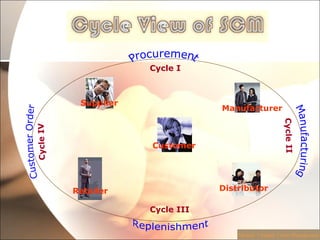
Module 1:Supply Chain Management Cycle I Cycle II Cycle III Cycle IV Customer Distributor Manufacturer Supplier Retailer Procurement Customer Order Manufacturing Replenishment
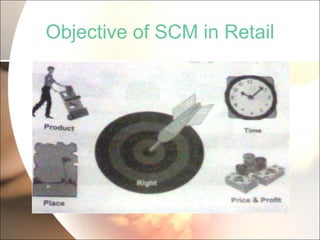
Objective of SCM in Retail
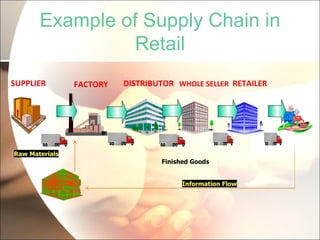
Example of Supply Chain in Retail Information Flow Raw Materials RETAILER FACTORY DISTRIBUTOR WHOLE SELLER SUPPLIER Finished   Goods
Need of SCM in Retail Cost Cutting Time Saving Customer Satisfaction Increase Profit Margins
Need of SCM in Retail Physical Flows Information Flows Financial Flows
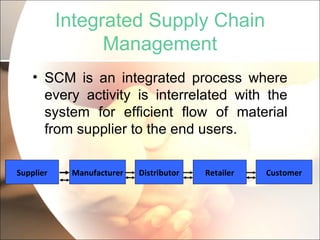
Integrated Supply Chain Management SCM is an integrated process where every activity is interrelated with the system for efficient flow of material from supplier to the end users. Supplier Manufacturer Distributor Retailer Customer
Benefits of Integrated Supply Chain Achieving the best delivery performance. Reduction in inventory Lower supply chain cost Improvement in overall productivity Accuracy in forecast
Module 1:Supply Chain Management Concept of supply chain could be thought of as a loop   SCM starts with the customer and ends with the customer Customer could be an internal customer or an external customer
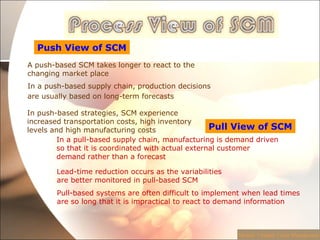
Module 1:Supply Chain Management A push-based SCM takes longer to react to the changing market place  In a push-based supply chain, production decisions are usually based on long-term forecasts   In push-based strategies, SCM experience increased transportation costs, high inventory levels and high manufacturing costs   In a pull-based supply chain, manufacturing is demand driven so that it is coordinated with actual external customer demand rather than a forecast  Push View of SCM Pull View of SCM Lead-time reduction occurs as the variabilities  are better monitored  in pull-based SCM Pull-based systems are often difficult to implement when lead times are so long that it is impractical to react to demand information
Conventional Approach Modern Approach Module 1:Supply Chain Management
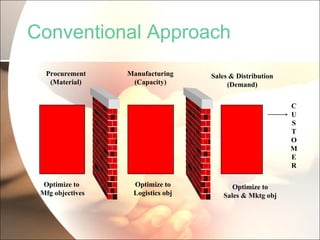
Conventional   Approach Sales & Distribution (Demand) Manufacturing (Capacity) Procurement (Material) C U S T O M E R Optimize to  Mfg objectives Optimize to Logistics obj Optimize to Sales & Mktg obj
Modern Approach Just In Time (JIT) Inventory Management Model Total Quality Management (TQM) Model Efficient Consumer Response (Ecr) Working Group.
Innovation in SCM Vendor managed inventory Collaborative planning  forecasting and replenishment. Cross docking
Functions of Retail Supply Chain Physically movement of goods from one outlet to another. Stocking the good at the outlets where needed. Management of the entire process.
Retail Logistics Retail logistics is the organized process of managing the flow of merchandise from the source of supply to customer. The main objective of logistics management is to reduce the inventory – holding cost and improve profits
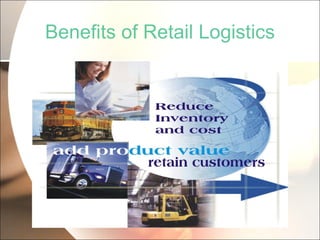
Benefits of Retail Logistics
New Emerging Concepts of Logistics Third party logistics  Supply of logistics related operations b/w traders by an independent organizations. ex- Federal Express, DHL, Maersk Logistics.
Contd…. Fourth Party Logistics It refers to the evolution in logistics from suppliers focused  on ware housing and transportation to suppliers offering a more integrated solution
Contd… Reverse Logistics  Process of moving goods from their typical final destination, for the purpose of capturing the  value or proper disposal . Stands for all operations related to the re use of products & materials
 
Video Example Fresh-O-Mart Supply Chain
Conclusion A supply chain is a network of facilities and distribution options that performs the functions of procurement of materials, transformation of these materials into intermediate and finished products and the distribution of these products to the customers.
Bibliography Reference Books : Swapna Pradhan Levy & Weitz Gibson G. Vedamani Gilbert  Magazines : The Franchising World   Mastermind Internet : i2solutions.net Google.com Wikipedia.com
 

Scm In Retail by Uday mishra

  • 1.
    Supply Chain Managementin Retail Submitted By: Uday Mishra GSBA G. Noida [email_address] 9891683518
  • 2.
    CONTENTS SCM- ConceptCyclic View of SCM Objective of SCM in Retail Need of SCM in Retail Integrated Supply Chain Management & its Benefits Process View of SCM Evolution of SCM Innovation in SCM Functions of Retail Supply Chain Retail Logistics & its Benefits Emerging Concepts of Retail Logistics Food and Grocery Supply Chain Bibliography
  • 3.
    Concept of SCMThose activities associates with moving goods from the raw materials stage though to the end user. It not only includes the manufacturer and suppliers but also transport, warehouse, retailers and customer also. These all activities are monitor by the information system.
  • 4.
    Module 1:Supply ChainManagement Cycle I Cycle II Cycle III Cycle IV Customer Distributor Manufacturer Supplier Retailer Procurement Customer Order Manufacturing Replenishment
  • 5.
  • 6.
    Example of SupplyChain in Retail Information Flow Raw Materials RETAILER FACTORY DISTRIBUTOR WHOLE SELLER SUPPLIER Finished Goods
  • 7.
    Need of SCMin Retail Cost Cutting Time Saving Customer Satisfaction Increase Profit Margins
  • 8.
    Need of SCMin Retail Physical Flows Information Flows Financial Flows
  • 9.
    Integrated Supply ChainManagement SCM is an integrated process where every activity is interrelated with the system for efficient flow of material from supplier to the end users. Supplier Manufacturer Distributor Retailer Customer
  • 10.
    Benefits of IntegratedSupply Chain Achieving the best delivery performance. Reduction in inventory Lower supply chain cost Improvement in overall productivity Accuracy in forecast
  • 11.
    Module 1:Supply ChainManagement Concept of supply chain could be thought of as a loop SCM starts with the customer and ends with the customer Customer could be an internal customer or an external customer
  • 12.
    Module 1:Supply ChainManagement A push-based SCM takes longer to react to the changing market place In a push-based supply chain, production decisions are usually based on long-term forecasts In push-based strategies, SCM experience increased transportation costs, high inventory levels and high manufacturing costs In a pull-based supply chain, manufacturing is demand driven so that it is coordinated with actual external customer demand rather than a forecast Push View of SCM Pull View of SCM Lead-time reduction occurs as the variabilities are better monitored in pull-based SCM Pull-based systems are often difficult to implement when lead times are so long that it is impractical to react to demand information
  • 13.
    Conventional Approach ModernApproach Module 1:Supply Chain Management
  • 14.
    Conventional Approach Sales & Distribution (Demand) Manufacturing (Capacity) Procurement (Material) C U S T O M E R Optimize to Mfg objectives Optimize to Logistics obj Optimize to Sales & Mktg obj
  • 15.
    Modern Approach JustIn Time (JIT) Inventory Management Model Total Quality Management (TQM) Model Efficient Consumer Response (Ecr) Working Group.
  • 16.
    Innovation in SCMVendor managed inventory Collaborative planning forecasting and replenishment. Cross docking
  • 17.
    Functions of RetailSupply Chain Physically movement of goods from one outlet to another. Stocking the good at the outlets where needed. Management of the entire process.
  • 18.
    Retail Logistics Retaillogistics is the organized process of managing the flow of merchandise from the source of supply to customer. The main objective of logistics management is to reduce the inventory – holding cost and improve profits
  • 19.
  • 20.
    New Emerging Conceptsof Logistics Third party logistics Supply of logistics related operations b/w traders by an independent organizations. ex- Federal Express, DHL, Maersk Logistics.
  • 21.
    Contd…. Fourth PartyLogistics It refers to the evolution in logistics from suppliers focused on ware housing and transportation to suppliers offering a more integrated solution
  • 22.
    Contd… Reverse Logistics Process of moving goods from their typical final destination, for the purpose of capturing the value or proper disposal . Stands for all operations related to the re use of products & materials
  • 23.
  • 24.
  • 25.
    Conclusion A supplychain is a network of facilities and distribution options that performs the functions of procurement of materials, transformation of these materials into intermediate and finished products and the distribution of these products to the customers.
  • 26.
    Bibliography Reference Books: Swapna Pradhan Levy & Weitz Gibson G. Vedamani Gilbert Magazines : The Franchising World Mastermind Internet : i2solutions.net Google.com Wikipedia.com
  • 27.

Editor's Notes