1
1
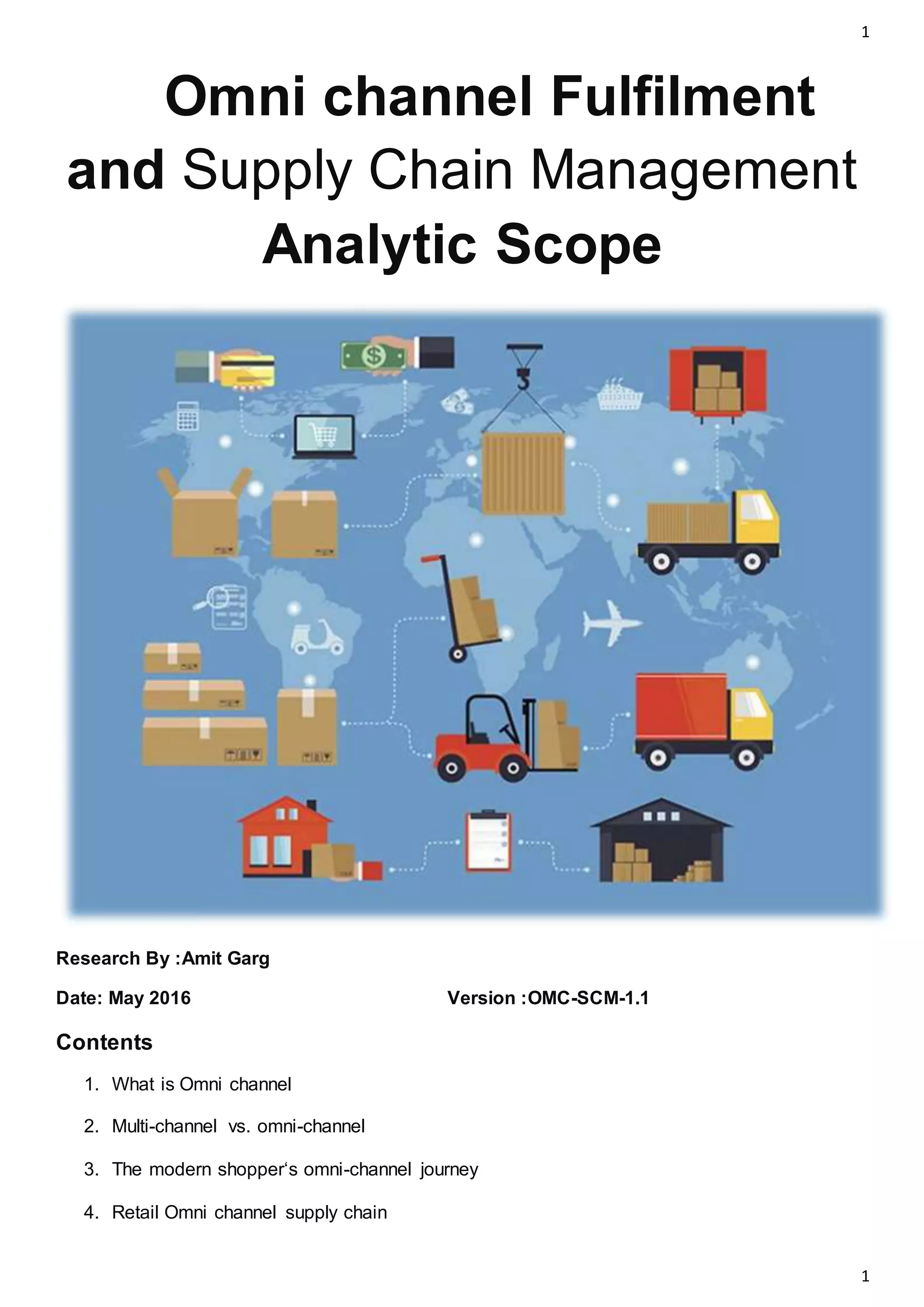
Omni channel Fulfilment
and Supply Chain Management
Analytic Scope
Research By :Amit Garg
Date: May 2016 Version :OMC-SCM-1.1
Contents
1. What is Omni channel
2. Multi-channel vs. omni-channel
3. The modern shopper‘s omni-channel journey
4. Retail Omni channel supply chain
2
2
5. Key business stake holder
6. Key business Challenges
7. Supply Chain Analytics Progression
8. Key analysis area
3
3
Omni channel retailing
Omnichannel retailing is a business model that implies using of a variety of channels in a
customer's shopping experience including research before a purchase. Such channels include
retail stores, online stores, mobile stores, mobile app stores, telephone sales, catalogue, TV
shopping networks, vending machines and any other method of transacting with a customer.
Transacting includes browsing, buying, returning as well as pre-sale and after-sale service.
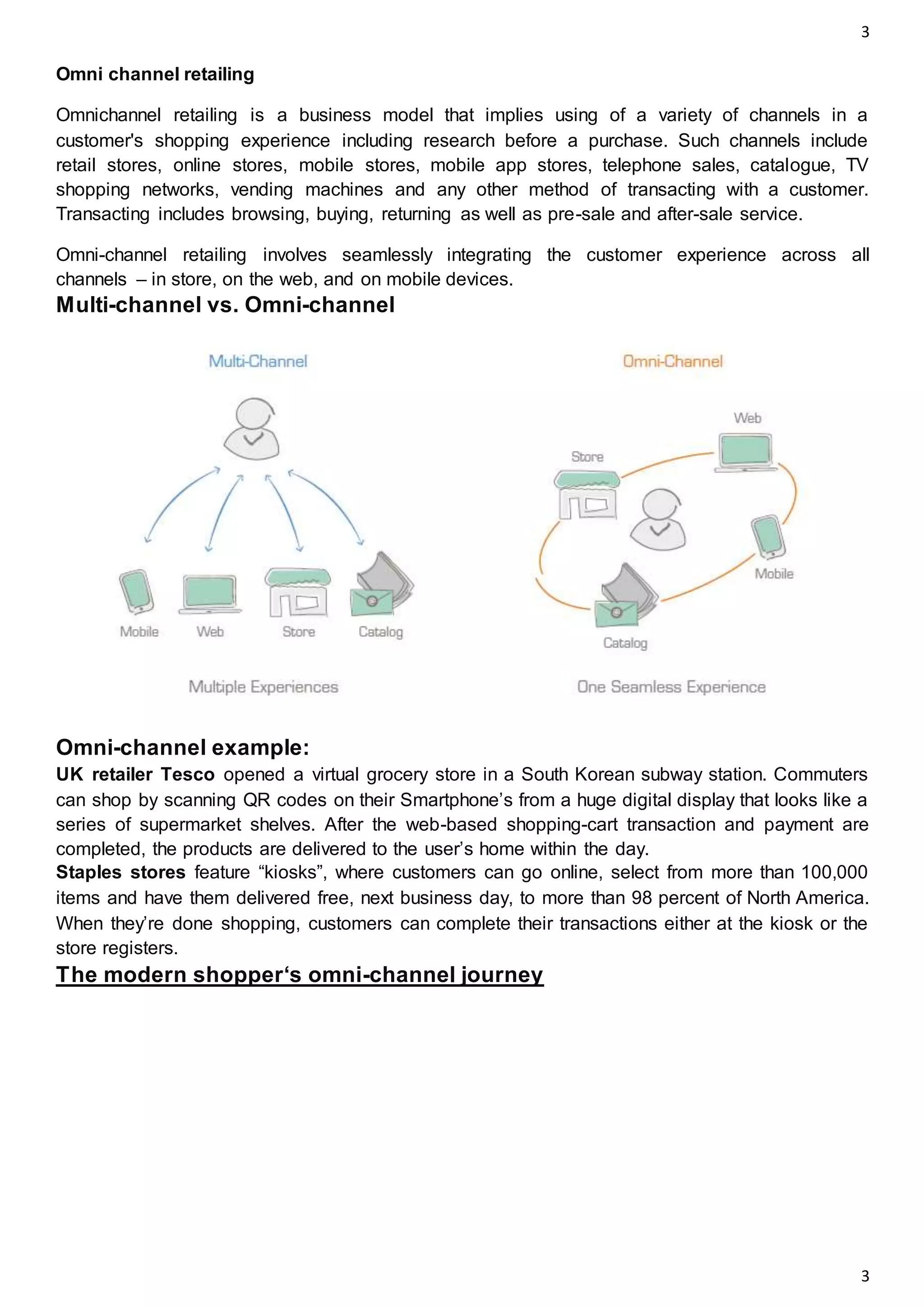
Omni-channel retailing involves seamlessly integrating the customer experience across all
channels – in store, on the web, and on mobile devices.
Multi-channel vs. Omni-channel
Omni-channel example:
UK retailer Tesco opened a virtual grocery store in a South Korean subway station. Commuters
can shop by scanning QR codes on their Smartphone’s from a huge digital display that looks like a
series of supermarket shelves. After the web-based shopping-cart transaction and payment are
completed, the products are delivered to the user’s home within the day.
Staples stores feature “kiosks”, where customers can go online, select from more than 100,000
items and have them delivered free, next business day, to more than 98 percent of North America.
When they’re done shopping, customers can complete their transactions either at the kiosk or the
store registers.
The modern shopper‘s omni-channel journey
4
4
5
5
Omni-channel supply chain in retail
Key business stake holder:
1. Buying and Vendor Management
2. Merchandising-Category Management
3. Store Operations
4. Omni Channel operation
5. Supply chain
a. Warehouse/DC
b. Logistics - In-house/ 3 PL
6. Customer service
6
6
Omni-channel retailing –Merchanding and supply chain key challenges
1. Harmonizing of product assortment across channels, the breadth and depth of assortment
mix for each channel.
2. Web ready products; Key product information, attributes and images are not always
accurate, standardized or readily available for retailers or their trading partners.
3. Strategic Pricing and tactical promotions are not used to induce product category take-
offs in desired channels, to manage demand across channels and optimize the supply
chain.
4. Reducing cycle time for cross channel fulfilment and improving customer experience and
expectations.
5. Non sustainable speedy delivery due to unreliable order fulfilment process.
6. Optimization of returns management through physical and online channels, product return
polices and lack of sound reverse logistics for returns management
7. Lack of robust order management systems and process.
8. Real time tracking and lack of order, shipments and inventory visibility.
9. Challenges in real time demand forecasting for responsive distribution networks.
10. Evaluating new and alternative delivery options and distribution business models like drop
shipping ,click and collect, reverse and collect ,dark stores ,delivery lockers and same day
delivery.
11. Synchronization of distribution centres with all ordering channels (online, in-store,call
center, catalog and mobile)
12. Segmented Supply Chain Processes- many distribution centres, managed by different in-
house and outsourced operators, running on different systems.
13. Warehouse capability like automated replenishments, dedicated facilities or zones for item
level picking and packing.
14. Less effective and inefficient transportation solution for multi delivery options which in
impacts cost and margin of delivered products.
15. Non dynamic route scheduling to deliver to hundreds of thousands of delivery points as
opposed to hundreds of stores, based on short lead times of often less than a day.
16. Combine customer, product and stock information to optimise cross channel CRM
opportunities.
7
7
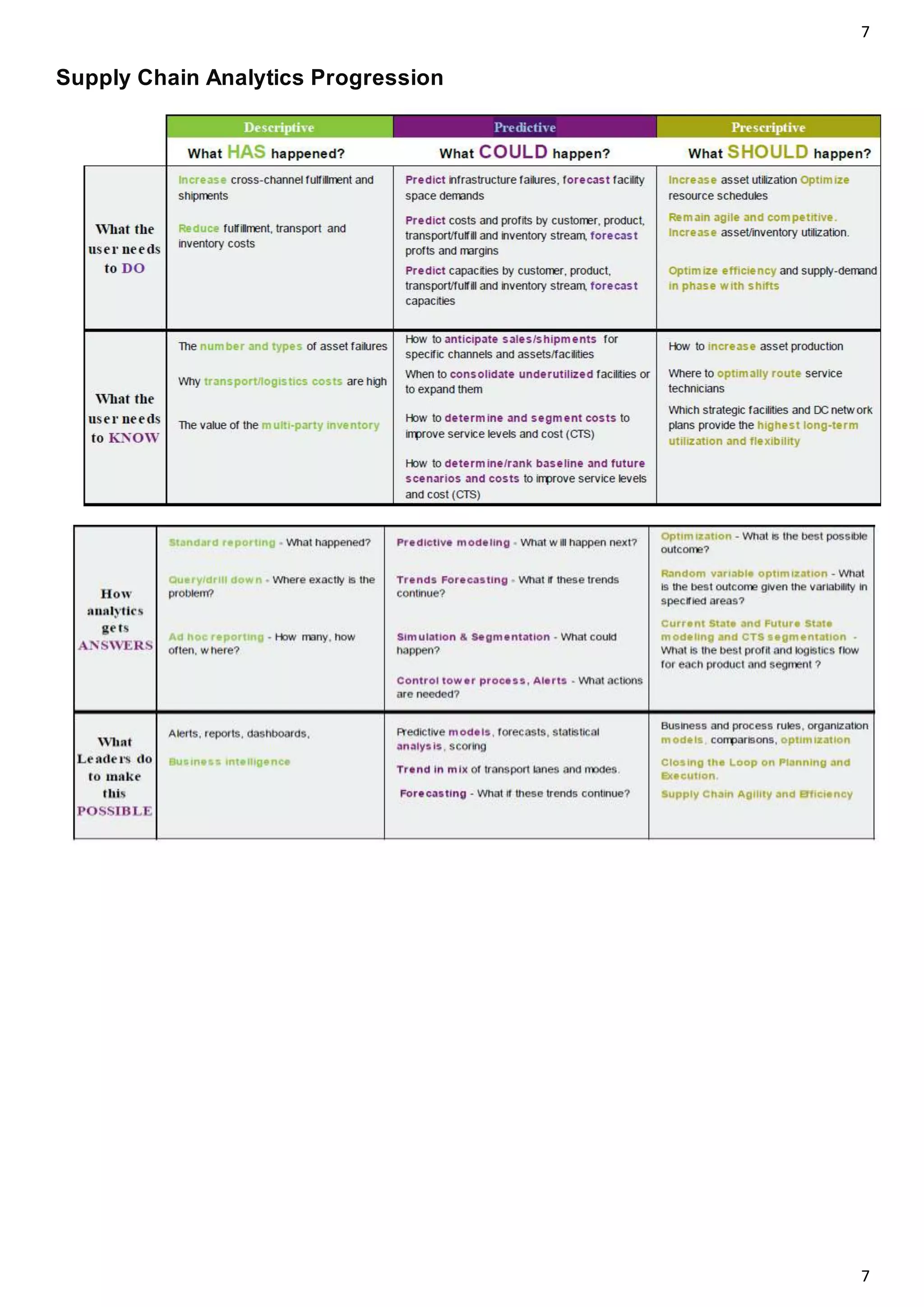
Supply Chain Analytics Progression
8
8
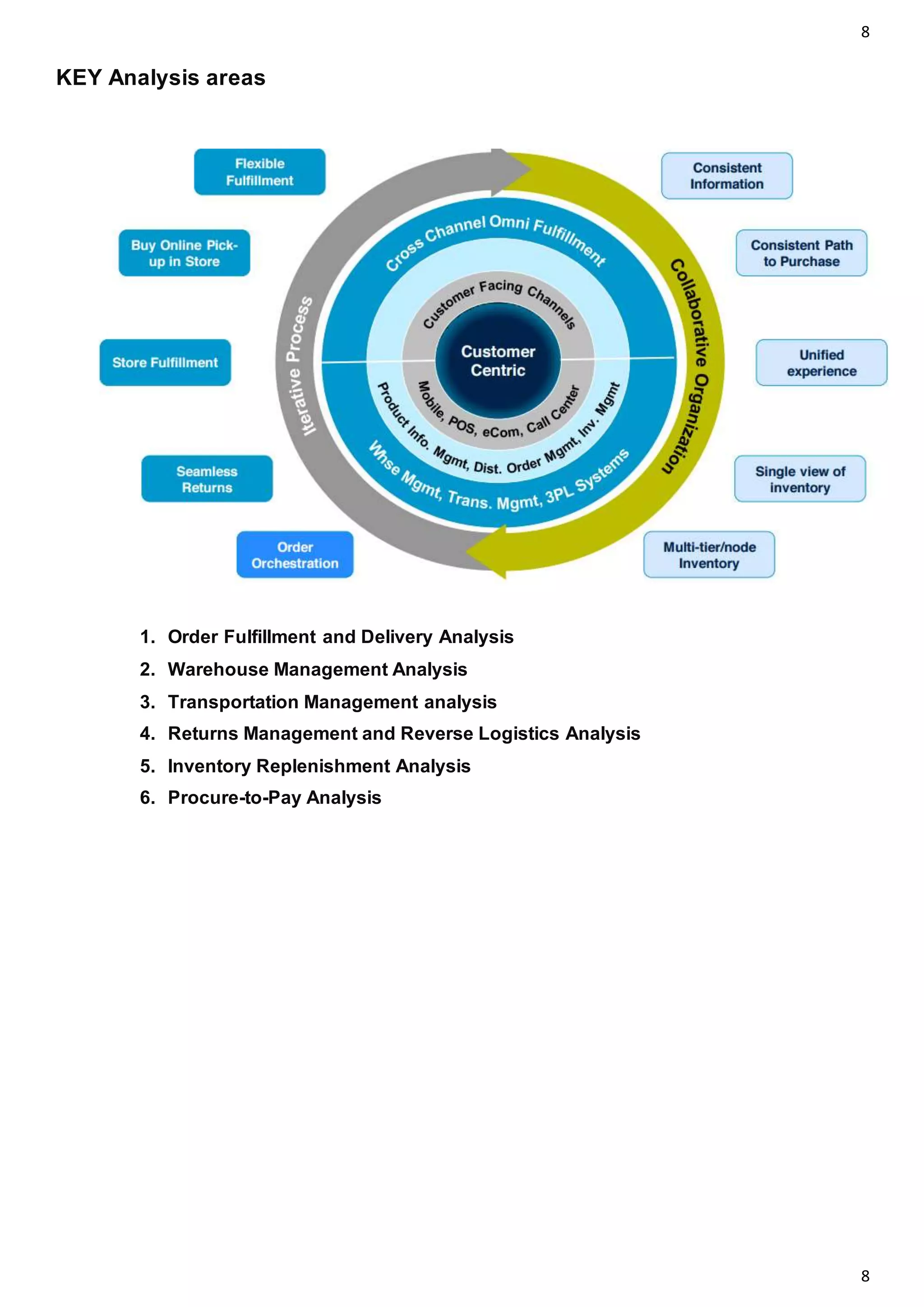
KEY Analysis areas
1. Order Fulfillment and Delivery Analysis
2. Warehouse Management Analysis
3. Transportation Management analysis
4. Returns Management and Reverse Logistics Analysis
5. Inventory Replenishment Analysis
6. Procure-to-Pay Analysis
9
9
Order Fulfillment and Delivery Analysis
Some of the key matrix:
 Order to booking close rates
 % Order discounts
 Average order size
 % Revenue Lag
 Order Gross profit
 Top 10 orders
 Orders not fulfilled
 Top 10 products with high fulfillment lag
 Shipping performance trends
 Backlog trends
 Current customer overdue analysis
10
10
Warehouse Management Analysis
Warehouse Operations analysis
 InBound Vs OutBound Analysis
 Inbound Ordercycle Time
 Inbound CycleTime Trend
 Outbound Order Fulfillment Efficiency
 OutBound Cycle time Trend
 Daily Picking Efficiency
 Top Vendors by Service
 Units Shipped by Order Type
 Lines Received by Vendor
 Fill Rate by Product Group
11
11
 Vendor Performance Infractions by Code and Vendor
Warehouse Performance analysis
 Logistics Cost Analysis
 DC Cost Analysis
 Labor Cost per Order Analysis
 Expense Analysis
 Order Accuracy Measurement
 DC Performance Ranking
 DC Fixture Analysis
 Fixture to Inventory Space Index
 DC Cost Vs Space Utilization
12
12
Transportation Management analysis
Some of the key matrix:
 Number of Shipments by Mode
 Budgeted Cost by Merchandising Department
 On-Time Pickup Performance by Carrier
 Tenders (Accepted, Rejected, Recalled) by Service Level
 Total Cost by Mode
 Average Stop Duration
 Average Handling Time by Protection Level & Facility
 Number of On-Time Arrivals by Carrier
 Total Trip Distance by Carrier
 Facility Activity Delays by Carrier
 Transit Time Index
 MOM Transit Time Trend
 Driver Performance Index
 Cost per Mile Analysis
 Vehicle Performance Index
 Transporter Performance Trend
 Empty Miles Analysis
13
13
 Fleet Utilization Index
 FTL / LTL Shipment Trend
 Frieght Cost Analysis
Returns Management and Reverse Logistics Analysis
Some of the key matrix:
 Returns Route Analyisis
 Returns Cost Analyisis
 Returns Cause Analysis
 Returns Action Analysis
 Return to Vendor/customer by Reason
 RTV Transactions
 Customer Returns By Vendor
 Customer Returns By Vendor Trends
Inventory Replenishment Analysis
This analysis enables agile supply chain inventory deployment actions by providing focused,
action-oriented insights into potential stock-out situations across the entire
supply chain.
Some of the key matrix:
 Replenishment Analysis
 Replenishment Arrival Analysis
 Auto Replenishment SKUs
 Safety Stock Analysis
 Inventory Carrying Costs
 Purchase Price Variance
Inventory Performance
 Inventory Efficiency Analysis
 Inventory Quality Ratio Trend
 DIFOT Service Levels
 Carrying Cost of Avg Invty Stay
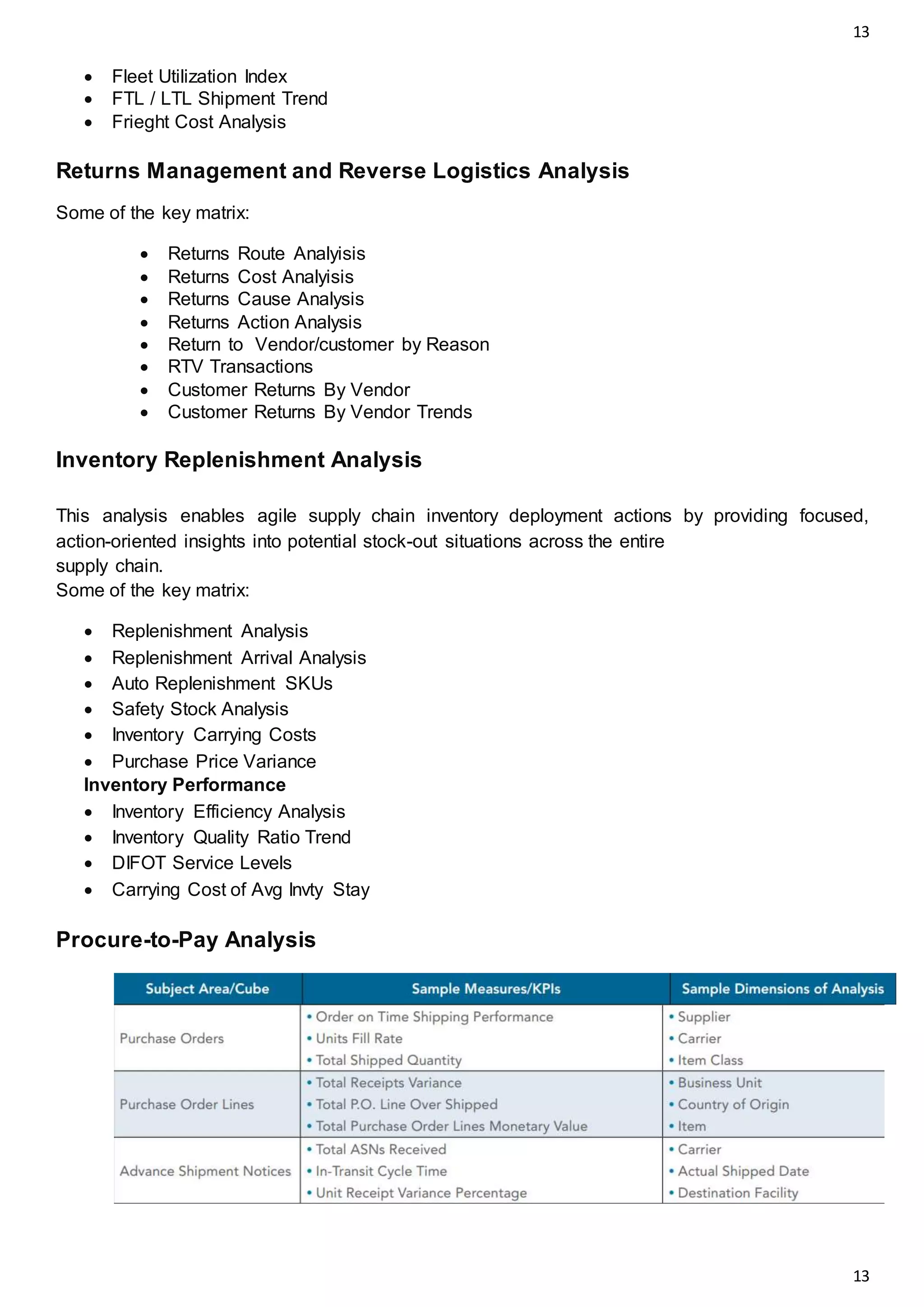
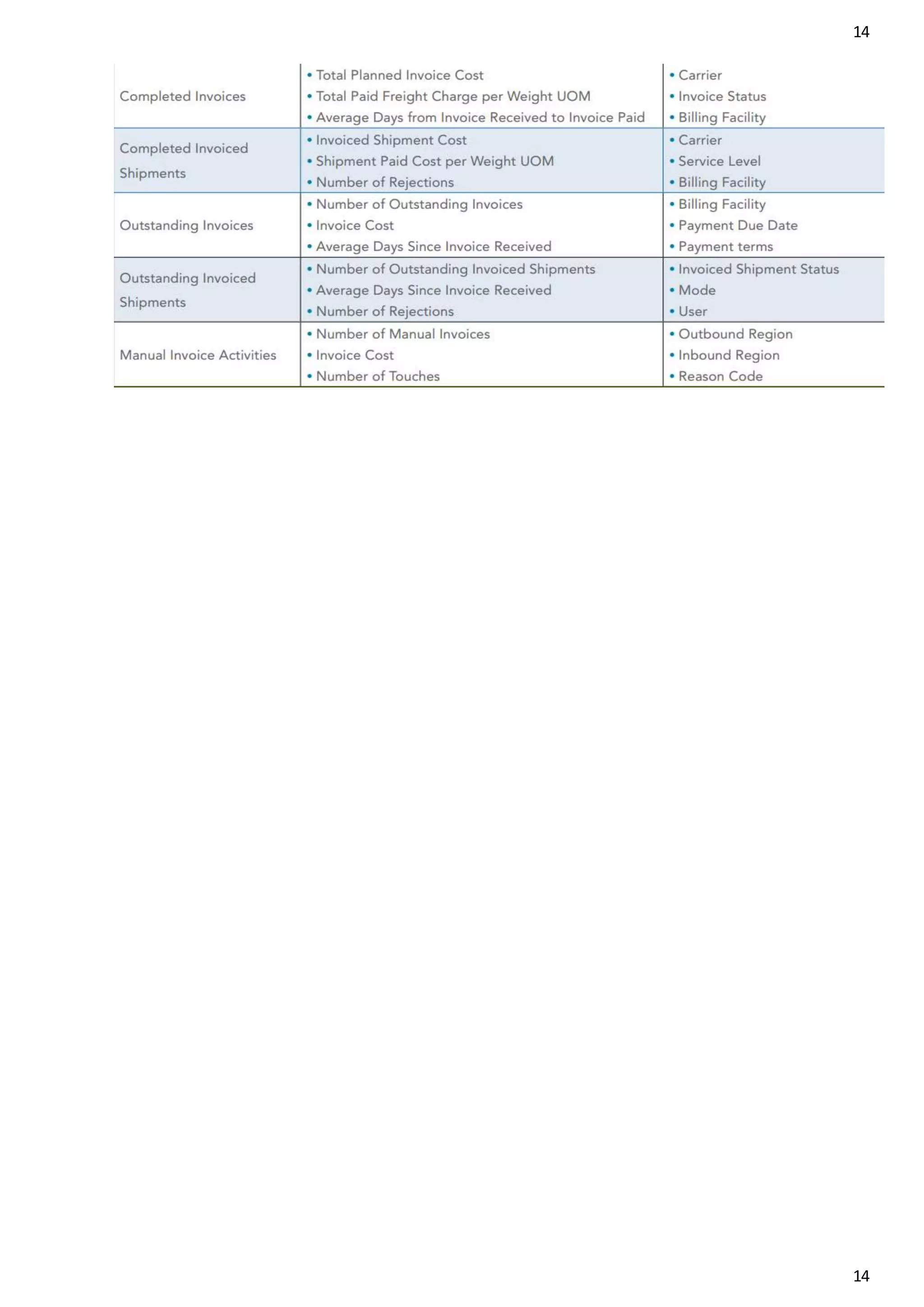
Procure-to-Pay Analysis
14
14

Omni channel fulfilment and supply chain management analytic

  • 1.
    1 1 Omni channel Fulfilment andSupply Chain Management Analytic Scope Research By :Amit Garg Date: May 2016 Version :OMC-SCM-1.1 Contents 1. What is Omni channel 2. Multi-channel vs. omni-channel 3. The modern shopper‘s omni-channel journey 4. Retail Omni channel supply chain
  • 2.
    2 2 5. Key businessstake holder 6. Key business Challenges 7. Supply Chain Analytics Progression 8. Key analysis area
  • 3.
    3 3 Omni channel retailing Omnichannelretailing is a business model that implies using of a variety of channels in a customer's shopping experience including research before a purchase. Such channels include retail stores, online stores, mobile stores, mobile app stores, telephone sales, catalogue, TV shopping networks, vending machines and any other method of transacting with a customer. Transacting includes browsing, buying, returning as well as pre-sale and after-sale service. Omni-channel retailing involves seamlessly integrating the customer experience across all channels – in store, on the web, and on mobile devices. Multi-channel vs. Omni-channel Omni-channel example: UK retailer Tesco opened a virtual grocery store in a South Korean subway station. Commuters can shop by scanning QR codes on their Smartphone’s from a huge digital display that looks like a series of supermarket shelves. After the web-based shopping-cart transaction and payment are completed, the products are delivered to the user’s home within the day. Staples stores feature “kiosks”, where customers can go online, select from more than 100,000 items and have them delivered free, next business day, to more than 98 percent of North America. When they’re done shopping, customers can complete their transactions either at the kiosk or the store registers. The modern shopper‘s omni-channel journey
  • 4.
  • 5.
    5 5 Omni-channel supply chainin retail Key business stake holder: 1. Buying and Vendor Management 2. Merchandising-Category Management 3. Store Operations 4. Omni Channel operation 5. Supply chain a. Warehouse/DC b. Logistics - In-house/ 3 PL 6. Customer service
  • 6.
    6 6 Omni-channel retailing –Merchandingand supply chain key challenges 1. Harmonizing of product assortment across channels, the breadth and depth of assortment mix for each channel. 2. Web ready products; Key product information, attributes and images are not always accurate, standardized or readily available for retailers or their trading partners. 3. Strategic Pricing and tactical promotions are not used to induce product category take- offs in desired channels, to manage demand across channels and optimize the supply chain. 4. Reducing cycle time for cross channel fulfilment and improving customer experience and expectations. 5. Non sustainable speedy delivery due to unreliable order fulfilment process. 6. Optimization of returns management through physical and online channels, product return polices and lack of sound reverse logistics for returns management 7. Lack of robust order management systems and process. 8. Real time tracking and lack of order, shipments and inventory visibility. 9. Challenges in real time demand forecasting for responsive distribution networks. 10. Evaluating new and alternative delivery options and distribution business models like drop shipping ,click and collect, reverse and collect ,dark stores ,delivery lockers and same day delivery. 11. Synchronization of distribution centres with all ordering channels (online, in-store,call center, catalog and mobile) 12. Segmented Supply Chain Processes- many distribution centres, managed by different in- house and outsourced operators, running on different systems. 13. Warehouse capability like automated replenishments, dedicated facilities or zones for item level picking and packing. 14. Less effective and inefficient transportation solution for multi delivery options which in impacts cost and margin of delivered products. 15. Non dynamic route scheduling to deliver to hundreds of thousands of delivery points as opposed to hundreds of stores, based on short lead times of often less than a day. 16. Combine customer, product and stock information to optimise cross channel CRM opportunities.
  • 7.
  • 8.
    8 8 KEY Analysis areas 1.Order Fulfillment and Delivery Analysis 2. Warehouse Management Analysis 3. Transportation Management analysis 4. Returns Management and Reverse Logistics Analysis 5. Inventory Replenishment Analysis 6. Procure-to-Pay Analysis
  • 9.
    9 9 Order Fulfillment andDelivery Analysis Some of the key matrix:  Order to booking close rates  % Order discounts  Average order size  % Revenue Lag  Order Gross profit  Top 10 orders  Orders not fulfilled  Top 10 products with high fulfillment lag  Shipping performance trends  Backlog trends  Current customer overdue analysis
  • 10.
    10 10 Warehouse Management Analysis WarehouseOperations analysis  InBound Vs OutBound Analysis  Inbound Ordercycle Time  Inbound CycleTime Trend  Outbound Order Fulfillment Efficiency  OutBound Cycle time Trend  Daily Picking Efficiency  Top Vendors by Service  Units Shipped by Order Type  Lines Received by Vendor  Fill Rate by Product Group
  • 11.
    11 11  Vendor PerformanceInfractions by Code and Vendor Warehouse Performance analysis  Logistics Cost Analysis  DC Cost Analysis  Labor Cost per Order Analysis  Expense Analysis  Order Accuracy Measurement  DC Performance Ranking  DC Fixture Analysis  Fixture to Inventory Space Index  DC Cost Vs Space Utilization
  • 12.
    12 12 Transportation Management analysis Someof the key matrix:  Number of Shipments by Mode  Budgeted Cost by Merchandising Department  On-Time Pickup Performance by Carrier  Tenders (Accepted, Rejected, Recalled) by Service Level  Total Cost by Mode  Average Stop Duration  Average Handling Time by Protection Level & Facility  Number of On-Time Arrivals by Carrier  Total Trip Distance by Carrier  Facility Activity Delays by Carrier  Transit Time Index  MOM Transit Time Trend  Driver Performance Index  Cost per Mile Analysis  Vehicle Performance Index  Transporter Performance Trend  Empty Miles Analysis
  • 13.
    13 13  Fleet UtilizationIndex  FTL / LTL Shipment Trend  Frieght Cost Analysis Returns Management and Reverse Logistics Analysis Some of the key matrix:  Returns Route Analyisis  Returns Cost Analyisis  Returns Cause Analysis  Returns Action Analysis  Return to Vendor/customer by Reason  RTV Transactions  Customer Returns By Vendor  Customer Returns By Vendor Trends Inventory Replenishment Analysis This analysis enables agile supply chain inventory deployment actions by providing focused, action-oriented insights into potential stock-out situations across the entire supply chain. Some of the key matrix:  Replenishment Analysis  Replenishment Arrival Analysis  Auto Replenishment SKUs  Safety Stock Analysis  Inventory Carrying Costs  Purchase Price Variance Inventory Performance  Inventory Efficiency Analysis  Inventory Quality Ratio Trend  DIFOT Service Levels  Carrying Cost of Avg Invty Stay Procure-to-Pay Analysis
  • 14.