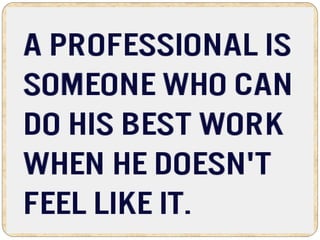
- Mausham Banerjee
EVERY SALE HAS FIVE BASIC
OBSTACLES : NO NEED , NO MONEY ,
NO HURRY , NO DESIRE
NO TRUST
- Zig Ziglar
PART I
 Qualities of a Professional
PART II
 Know your Customer
 About yourself
PART III
 AIDA model to selling
 How to make telephone calls
 Answers to common objections
 Handling Objections
INDEX
SALES TECHNIQUES
PART – I
Qualities of a Professional
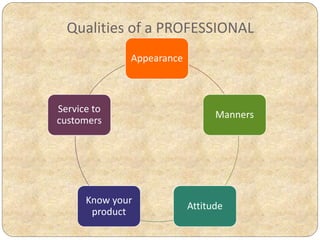
Qualities of a PROFESSIONAL
Appearance
Manners
Attitude
Know your
product
Service to
customers
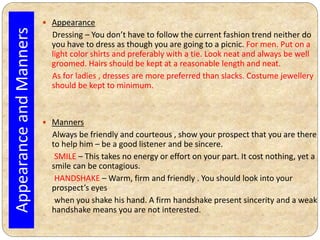
 Appearance
Dressing – You don’t have to follow the current fashion trend neither do
you have to dress as though you are going to a picnic. For men. Put on a
light color shirts and preferably with a tie. Look neat and always be well
groomed. Hairs should be kept at a reasonable length and neat.
As for ladies , dresses are more preferred than slacks. Costume jewellery
should be kept to minimum.
 Manners
Always be friendly and courteous , show your prospect that you are there
to help him – be a good listener and be sincere.
SMILE – This takes no energy or effort on your part. It cost nothing, yet a
smile can be contagious.
HANDSHAKE – Warm, firm and friendly . You should look into your
prospect’s eyes
when you shake his hand. A firm handshake present sincerity and a weak
handshake means you are not interested.
AppearanceandManners
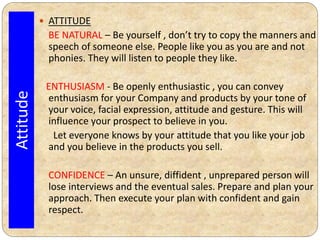
 ATTITUDE
BE NATURAL – Be yourself , don’t try to copy the manners and
speech of someone else. People like you as you are and not
phonies. They will listen to people they like.
ENTHUSIASM - Be openly enthusiastic , you can convey
enthusiasm for your Company and products by your tone of
your voice, facial expression, attitude and gesture. This will
influence your prospect to believe in you.
Let everyone knows by your attitude that you like your job
and you believe in the products you sell.
CONFIDENCE – An unsure, diffident , unprepared person will
lose interviews and the eventual sales. Prepare and plan your
approach. Then execute your plan with confident and gain
respect.
Attitude
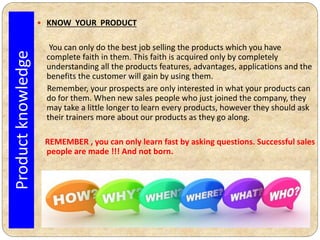
 KNOW YOUR PRODUCT
You can only do the best job selling the products which you have
complete faith in them. This faith is acquired only by completely
understanding all the products features, advantages, applications and the
benefits the customer will gain by using them.
Remember, your prospects are only interested in what your products can
do for them. When new sales people who just joined the company, they
may take a little longer to learn every products, however they should ask
their trainers more about our products as they go along.
REMEMBER , you can only learn fast by asking questions. Successful sales
people are made !!! And not born.
Productknowledge
 YOUR SERVICE TO CUSTOMERS
Repeat orders are assured by good services.
We do not only sell products alone, we sell
products together with solutions with
services. Once you are selling on service basis ,
you will have the customers for life because all
customers like to be served and they will
appreciate the help you can offer that nobody
from your competitors can.
Servicetocustomers
PART – II
Know your Customer
About yourself
KNOW YOUR CUSTOMERS
We can only sell our products to customers that like us. Therefore in
order for them to like us, we must be aware that most customers
wants the followings things :-
 He likes compliments – so give him freely
 He wants respect – show him openly
 He wants ways to make his job easier – give him good service
 He like to talk about things that interest him – find out and talk about
it
 Find out about his hobbies – talk about his hobbies
 Find out about his family – take note
 Find out his birthday and anniversary – send him cards
 Find out what motivates him to buy – do that every time you service
him
 He only buys from sales people he likes – make him like you
Knowyourcustomers
ABOUT YOURSELF
The last attribute is a desire to earn as much as you can and
a
Willingness to work hard to earn it.
REMEMBER – There is not short-cut to success.
This plus a strong faith in your ability , will provide the
incentive you
Need to be classified as A PROFESSIONAL SALES PERSON.
Aboutyourself
PART – III
AIDA model to selling
How to make telephone calls
Answers to common objections
Handling Objections
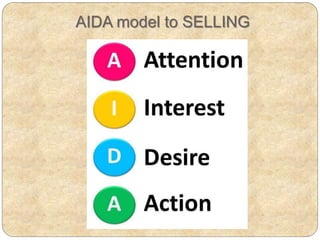
AIDA model to SELLING
Attention is the 1st phase that will spark the interest
of a consumer. What sparks attention is usually by its
unique design, pricing, and marketing policy and
other factors that divert our attention towards this
product.
Unless the salesperson involves the prospect’s mind
in the presentation, his total effort may go unnoticed
or unregistered.
ATTENTION
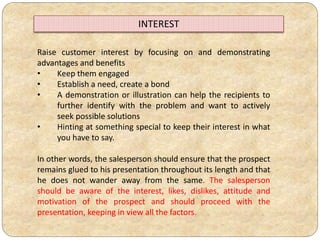
Raise customer interest by focusing on and demonstrating
advantages and benefits
• Keep them engaged
• Establish a need, create a bond
• A demonstration or illustration can help the recipients to
further identify with the problem and want to actively
seek possible solutions
• Hinting at something special to keep their interest in what
you have to say.
In other words, the salesperson should ensure that the prospect
remains glued to his presentation throughout its length and that
he does not wander away from the same. The salesperson
should be aware of the interest, likes, dislikes, attitude and
motivation of the prospect and should proceed with the
presentation, keeping in view all the factors.
INTEREST
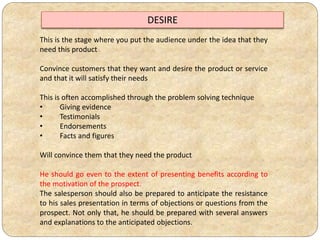
This is the stage where you put the audience under the idea that they
need this product
Convince customers that they want and desire the product or service
and that it will satisfy their needs
This is often accomplished through the problem solving technique
• Giving evidence
• Testimonials
• Endorsements
• Facts and figures
Will convince them that they need the product
He should go even to the extent of presenting benefits according to
the motivation of the prospect.
The salesperson should also be prepared to anticipate the resistance
to his sales presentation in terms of objections or questions from the
prospect. Not only that, he should be prepared with several answers
and explanations to the anticipated objections.
DESIRE
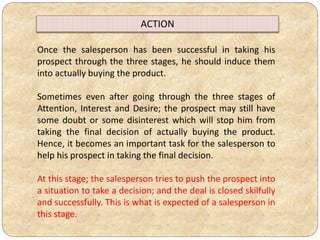
Once the salesperson has been successful in taking his
prospect through the three stages, he should induce them
into actually buying the product.
Sometimes even after going through the three stages of
Attention, Interest and Desire; the prospect may still have
some doubt or some disinterest which will stop him from
taking the final decision of actually buying the product.
Hence, it becomes an important task for the salesperson to
help his prospect in taking the final decision.
At this stage; the salesperson tries to push the prospect into
a situation to take a decision; and the deal is closed skilfully
and successfully. This is what is expected of a salesperson in
this stage.
ACTION
TELEPHONE PLAN
HERE’S HOW TO MAKE YOUR PHONE CALLS FOR NEW ACCOUNTS
When the switchboard Operator Greets You , Say :
 “Hello, my name is ( Your name ) and I am calling from ……….. ( Company
Name )
 “How are you today ? Good !! “
 “I wonder if you can help me ? Could you tell me if your company does
their own maintenance ? “
 “Who is in charge of your Plant Maintenance ?”
 “You say Mr. Verma is your maintenance Supervisor ?”
 “That’s fine. I wonder if I could talk to him. Thank you very much .”
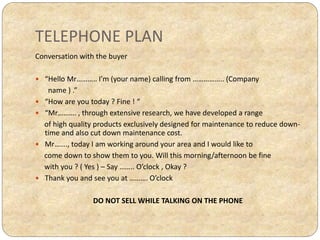
TELEPHONE PLAN
Conversation with the buyer
 “Hello Mr……….. I’m (your name) calling from …………….. (Company
name ) .”
 “How are you today ? Fine ! “
 “Mr………. , through extensive research, we have developed a range
of high quality products exclusively designed for maintenance to reduce down-
time and also cut down maintenance cost.
 Mr……., today I am working around your area and I would like to
come down to show them to you. Will this morning/afternoon be fine
with you ? ( Yes ) – Say …….. O’clock , Okay ?
 Thank you and see you at ………. O’clock
DO NOT SELL WHILE TALKING ON THE PHONE
HANDLING OBJECTIONS
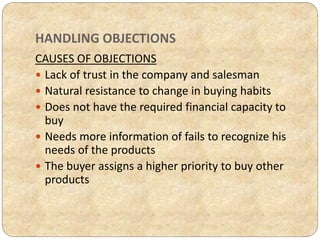
CAUSES OF OBJECTIONS
 Lack of trust in the company and salesman
 Natural resistance to change in buying habits
 Does not have the required financial capacity to
buy
 Needs more information of fails to recognize his
needs of the products
 The buyer assigns a higher priority to buy other
products
HANDLING OBJECTIONS
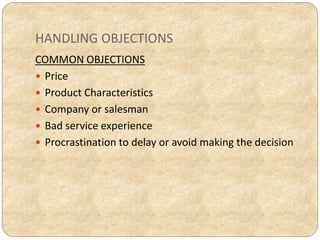
COMMON OBJECTIONS
 Price
 Product Characteristics
 Company or salesman
 Bad service experience
 Procrastination to delay or avoid making the decision
HANDLING OBJECTIONS
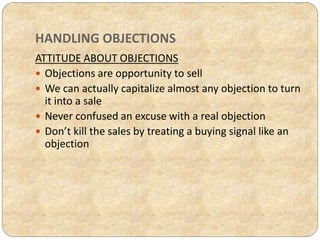
ATTITUDE ABOUT OBJECTIONS
 Objections are opportunity to sell
 We can actually capitalize almost any objection to turn
it into a sale
 Never confused an excuse with a real objection
 Don’t kill the sales by treating a buying signal like an
objection
HANDLING OBJECTIONS
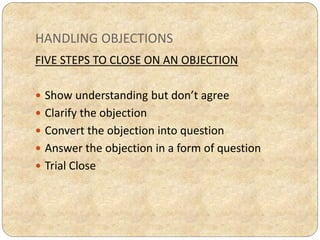
FIVE STEPS TO CLOSE ON AN OBJECTION
 Show understanding but don’t agree
 Clarify the objection
 Convert the objection into question
 Answer the objection in a form of question
 Trial Close
HANDLING OBJECTIONS
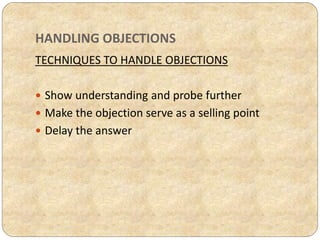
TECHNIQUES TO HANDLE OBJECTIONS
 Show understanding and probe further
 Make the objection serve as a selling point
 Delay the answer
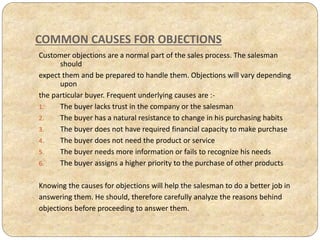
COMMON CAUSES FOR OBJECTIONS
Customer objections are a normal part of the sales process. The salesman
should
expect them and be prepared to handle them. Objections will vary depending
upon
the particular buyer. Frequent underlying causes are :-
1. The buyer lacks trust in the company or the salesman
2. The buyer has a natural resistance to change in his purchasing habits
3. The buyer does not have required financial capacity to make purchase
4. The buyer does not need the product or service
5. The buyer needs more information or fails to recognize his needs
6. The buyer assigns a higher priority to the purchase of other products
Knowing the causes for objections will help the salesman to do a better job in
answering them. He should, therefore carefully analyze the reasons behind
objections before proceeding to answer them.
Thank you !!

Sales training

  • 1.
  • 2.
    EVERY SALE HASFIVE BASIC OBSTACLES : NO NEED , NO MONEY , NO HURRY , NO DESIRE NO TRUST - Zig Ziglar
  • 3.
    PART I  Qualitiesof a Professional PART II  Know your Customer  About yourself PART III  AIDA model to selling  How to make telephone calls  Answers to common objections  Handling Objections INDEX SALES TECHNIQUES
  • 4.
    PART – I Qualitiesof a Professional
  • 6.
    Qualities of aPROFESSIONAL Appearance Manners Attitude Know your product Service to customers
  • 7.
     Appearance Dressing –You don’t have to follow the current fashion trend neither do you have to dress as though you are going to a picnic. For men. Put on a light color shirts and preferably with a tie. Look neat and always be well groomed. Hairs should be kept at a reasonable length and neat. As for ladies , dresses are more preferred than slacks. Costume jewellery should be kept to minimum.  Manners Always be friendly and courteous , show your prospect that you are there to help him – be a good listener and be sincere. SMILE – This takes no energy or effort on your part. It cost nothing, yet a smile can be contagious. HANDSHAKE – Warm, firm and friendly . You should look into your prospect’s eyes when you shake his hand. A firm handshake present sincerity and a weak handshake means you are not interested. AppearanceandManners
  • 8.
     ATTITUDE BE NATURAL– Be yourself , don’t try to copy the manners and speech of someone else. People like you as you are and not phonies. They will listen to people they like. ENTHUSIASM - Be openly enthusiastic , you can convey enthusiasm for your Company and products by your tone of your voice, facial expression, attitude and gesture. This will influence your prospect to believe in you. Let everyone knows by your attitude that you like your job and you believe in the products you sell. CONFIDENCE – An unsure, diffident , unprepared person will lose interviews and the eventual sales. Prepare and plan your approach. Then execute your plan with confident and gain respect. Attitude
  • 9.
     KNOW YOURPRODUCT You can only do the best job selling the products which you have complete faith in them. This faith is acquired only by completely understanding all the products features, advantages, applications and the benefits the customer will gain by using them. Remember, your prospects are only interested in what your products can do for them. When new sales people who just joined the company, they may take a little longer to learn every products, however they should ask their trainers more about our products as they go along. REMEMBER , you can only learn fast by asking questions. Successful sales people are made !!! And not born. Productknowledge
  • 10.
     YOUR SERVICETO CUSTOMERS Repeat orders are assured by good services. We do not only sell products alone, we sell products together with solutions with services. Once you are selling on service basis , you will have the customers for life because all customers like to be served and they will appreciate the help you can offer that nobody from your competitors can. Servicetocustomers
  • 11.
    PART – II Knowyour Customer About yourself
  • 12.
    KNOW YOUR CUSTOMERS Wecan only sell our products to customers that like us. Therefore in order for them to like us, we must be aware that most customers wants the followings things :-  He likes compliments – so give him freely  He wants respect – show him openly  He wants ways to make his job easier – give him good service  He like to talk about things that interest him – find out and talk about it  Find out about his hobbies – talk about his hobbies  Find out about his family – take note  Find out his birthday and anniversary – send him cards  Find out what motivates him to buy – do that every time you service him  He only buys from sales people he likes – make him like you Knowyourcustomers
  • 13.
    ABOUT YOURSELF The lastattribute is a desire to earn as much as you can and a Willingness to work hard to earn it. REMEMBER – There is not short-cut to success. This plus a strong faith in your ability , will provide the incentive you Need to be classified as A PROFESSIONAL SALES PERSON. Aboutyourself
  • 14.
    PART – III AIDAmodel to selling How to make telephone calls Answers to common objections Handling Objections
  • 15.
  • 16.
    Attention is the1st phase that will spark the interest of a consumer. What sparks attention is usually by its unique design, pricing, and marketing policy and other factors that divert our attention towards this product. Unless the salesperson involves the prospect’s mind in the presentation, his total effort may go unnoticed or unregistered. ATTENTION
  • 17.
    Raise customer interestby focusing on and demonstrating advantages and benefits • Keep them engaged • Establish a need, create a bond • A demonstration or illustration can help the recipients to further identify with the problem and want to actively seek possible solutions • Hinting at something special to keep their interest in what you have to say. In other words, the salesperson should ensure that the prospect remains glued to his presentation throughout its length and that he does not wander away from the same. The salesperson should be aware of the interest, likes, dislikes, attitude and motivation of the prospect and should proceed with the presentation, keeping in view all the factors. INTEREST
  • 18.
    This is thestage where you put the audience under the idea that they need this product Convince customers that they want and desire the product or service and that it will satisfy their needs This is often accomplished through the problem solving technique • Giving evidence • Testimonials • Endorsements • Facts and figures Will convince them that they need the product He should go even to the extent of presenting benefits according to the motivation of the prospect. The salesperson should also be prepared to anticipate the resistance to his sales presentation in terms of objections or questions from the prospect. Not only that, he should be prepared with several answers and explanations to the anticipated objections. DESIRE
  • 19.
    Once the salespersonhas been successful in taking his prospect through the three stages, he should induce them into actually buying the product. Sometimes even after going through the three stages of Attention, Interest and Desire; the prospect may still have some doubt or some disinterest which will stop him from taking the final decision of actually buying the product. Hence, it becomes an important task for the salesperson to help his prospect in taking the final decision. At this stage; the salesperson tries to push the prospect into a situation to take a decision; and the deal is closed skilfully and successfully. This is what is expected of a salesperson in this stage. ACTION
  • 21.
    TELEPHONE PLAN HERE’S HOWTO MAKE YOUR PHONE CALLS FOR NEW ACCOUNTS When the switchboard Operator Greets You , Say :  “Hello, my name is ( Your name ) and I am calling from ……….. ( Company Name )  “How are you today ? Good !! “  “I wonder if you can help me ? Could you tell me if your company does their own maintenance ? “  “Who is in charge of your Plant Maintenance ?”  “You say Mr. Verma is your maintenance Supervisor ?”  “That’s fine. I wonder if I could talk to him. Thank you very much .”
  • 22.
    TELEPHONE PLAN Conversation withthe buyer  “Hello Mr……….. I’m (your name) calling from …………….. (Company name ) .”  “How are you today ? Fine ! “  “Mr………. , through extensive research, we have developed a range of high quality products exclusively designed for maintenance to reduce down- time and also cut down maintenance cost.  Mr……., today I am working around your area and I would like to come down to show them to you. Will this morning/afternoon be fine with you ? ( Yes ) – Say …….. O’clock , Okay ?  Thank you and see you at ………. O’clock DO NOT SELL WHILE TALKING ON THE PHONE
  • 24.
    HANDLING OBJECTIONS CAUSES OFOBJECTIONS  Lack of trust in the company and salesman  Natural resistance to change in buying habits  Does not have the required financial capacity to buy  Needs more information of fails to recognize his needs of the products  The buyer assigns a higher priority to buy other products
  • 25.
    HANDLING OBJECTIONS COMMON OBJECTIONS Price  Product Characteristics  Company or salesman  Bad service experience  Procrastination to delay or avoid making the decision
  • 26.
    HANDLING OBJECTIONS ATTITUDE ABOUTOBJECTIONS  Objections are opportunity to sell  We can actually capitalize almost any objection to turn it into a sale  Never confused an excuse with a real objection  Don’t kill the sales by treating a buying signal like an objection
  • 27.
    HANDLING OBJECTIONS FIVE STEPSTO CLOSE ON AN OBJECTION  Show understanding but don’t agree  Clarify the objection  Convert the objection into question  Answer the objection in a form of question  Trial Close
  • 28.
    HANDLING OBJECTIONS TECHNIQUES TOHANDLE OBJECTIONS  Show understanding and probe further  Make the objection serve as a selling point  Delay the answer
  • 29.
    COMMON CAUSES FOROBJECTIONS Customer objections are a normal part of the sales process. The salesman should expect them and be prepared to handle them. Objections will vary depending upon the particular buyer. Frequent underlying causes are :- 1. The buyer lacks trust in the company or the salesman 2. The buyer has a natural resistance to change in his purchasing habits 3. The buyer does not have required financial capacity to make purchase 4. The buyer does not need the product or service 5. The buyer needs more information or fails to recognize his needs 6. The buyer assigns a higher priority to the purchase of other products Knowing the causes for objections will help the salesman to do a better job in answering them. He should, therefore carefully analyze the reasons behind objections before proceeding to answer them.
  • 30.