RESPONSIVE NEUROSTIMULATION (RNS)
FOR INTRACTABLE EPILEPSY
James R. White, MD
RESPONSIVE NEUROSTIMULATION
(RNS)
MINNESOTA EPILEPSY GROUP
SEIZURE CARE FOR ALL AGES
Patient Selection
• The RNS System is indicated for patients who:
• Have failed 2 medications
• Have partial onset seizures that are localized to 1 or 2 foci
• Other considerations:
• Patients who are not resective surgery candidates
• Temporal lobectomy patients can have a 70% chance of seizure freedom
• Patients at risk of neurological/cognitive deficits with resection
• For example, seizure onset over language cortex
• Equally effective across variety of patients:
– Treated and not treated with VNS
– Treated and not treated with epilepsy surgery
4
WHAT HAPPENS TO PATIENTS
WITH NEW ONSET EPILEPSY?
• % of patients controlled
with:
• First AED:
• 47%
• Second AED:
• 13%
• Third AED/combination
therapy
• 4%
• Total controlled: 64%
• Total not controlled: 36%
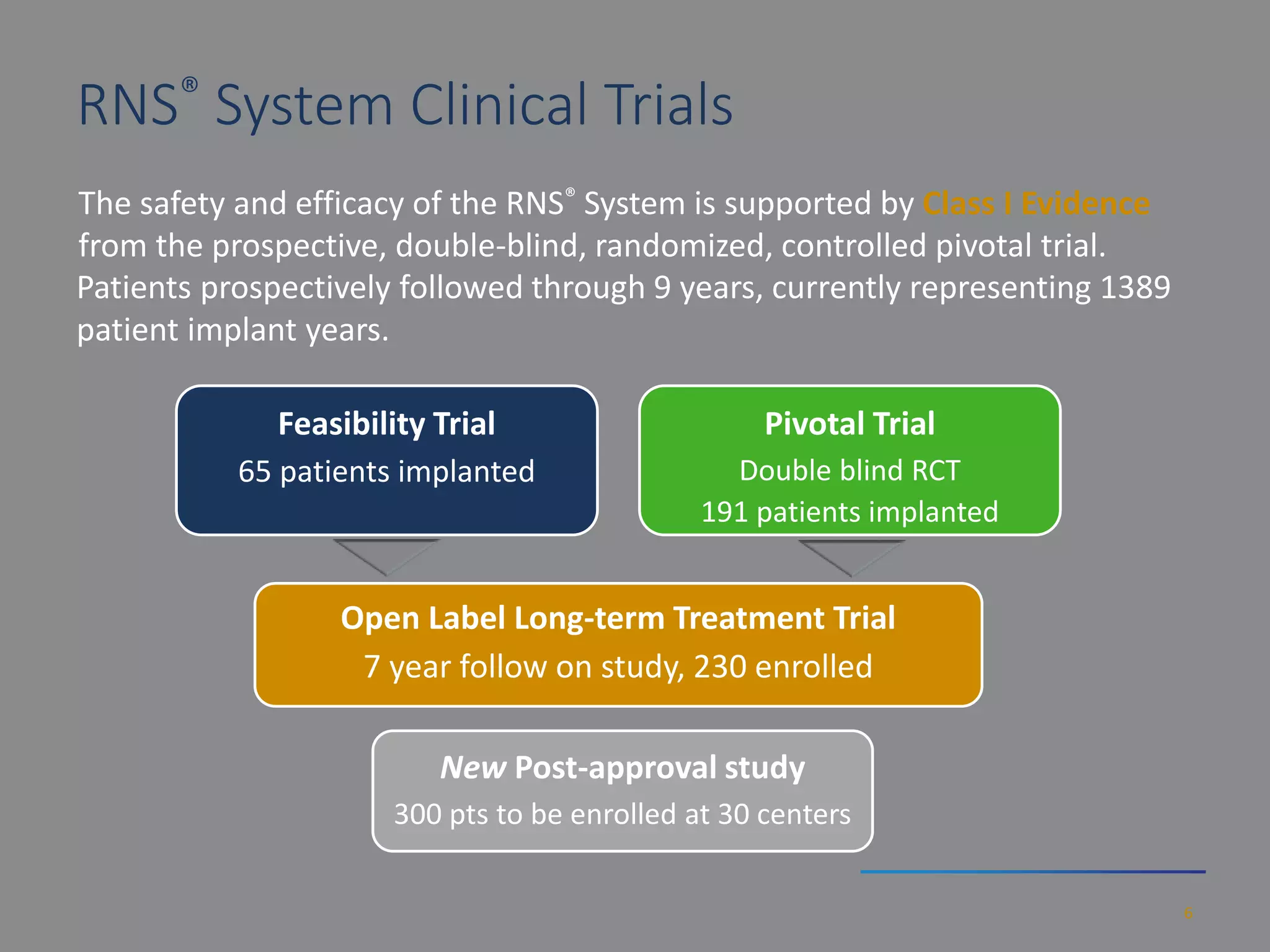
RNSÂŽ System Clinical Trials
6
Feasibility Trial
65 patients implanted
Pivotal Trial
Double blind RCT
191 patients implanted
Open Label Long-term Treatment Trial
7 year follow on study, 230 enrolled
New Post-approval study
300 pts to be enrolled at 30 centers
The safety and efficacy of the RNSÂŽ System is supported by Class I Evidence
from the prospective, double-blind, randomized, controlled pivotal trial.
Patients prospectively followed through 9 years, currently representing 1389
patient implant years.
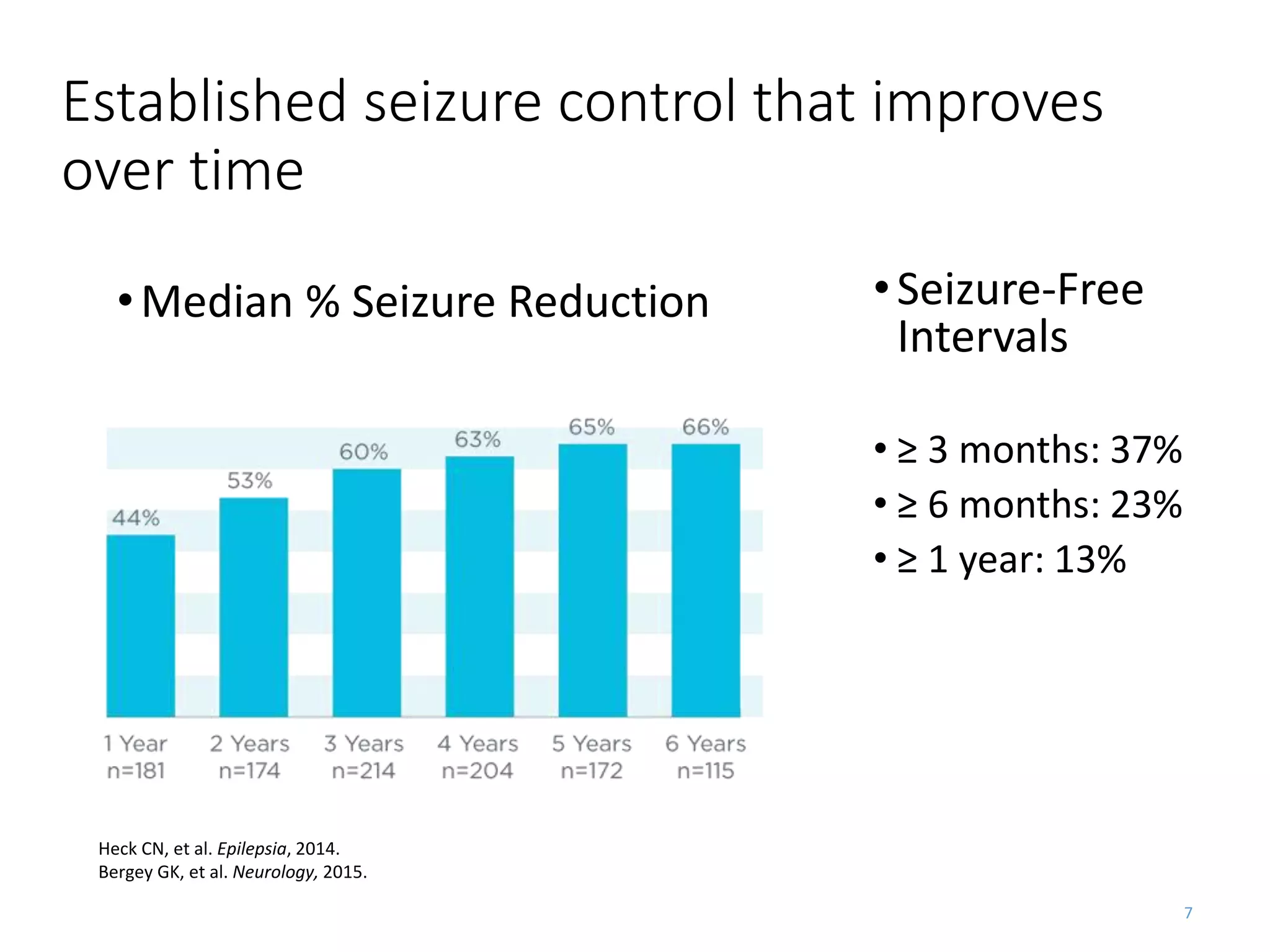
Established seizure control that improves
over time
•Median % Seizure Reduction •Seizure-Free
Intervals
• ≥ 3 months: 37%
• ≥ 6 months: 23%
• ≥ 1 year: 13%
7
Heck CN, et al. Epilepsia, 2014.
Bergey GK, et al. Neurology, 2015.
Patient’s seizures are not
completely controlled.
• Most patients have a significant improvement in
seizures, but are not “cured”.
• 12.9% had at least 1 seizure-free period of 1 year
or longer.
• No participants were seizure-free over the entire
follow-up.
MINNESOTA EPILEPSY GROUP
SEIZURE CARE FOR ALL AGES
PLACEBO EFFECT DURING PIVOTAL TRIALS
• The treatment group was compared to the sham control group:
• Treatment group: Device is fully functioning, stimulating when seizure
activity detected.
• Sham group: Has device implanted, but device is not stimulating.
• During blinded evaluation period, sham group was noted to
have seizure reduction:
• First month: 25.2% seizure reduction
• Third month: 9.4% seizure reduction
• Treatment group still significantly better than sham group
• This placebo effect is interesting and seen in other device
studies.
• Makes it more of a challenge to show that the device works!
• Shows how important it is have a control!
RNSÂŽ System is effective for both mesial
temporal and neocortical seizure onsets
10
Mesial temporal lobe onset (n=106)
• 70% median reduction in seizures1 (LOCF*)
• 66% responder rate1 (95% CI 57%–74%)
• Improvements in memory for mesial temporal
onset seizures2 (p<0.005)
Neocortical onset (n=122)
• 58% median reduction in seizures3 (LOCF*)
• 55% responder rate3 (95% CI 46–63%)
• Improvements in naming for neocortical onset
seizures2 (p<0.001)
*Last observation carried forward analysis, last 3 months
1 Van Ness, P, et al, American Epilepsy Society abstract, 2015
2 Loring DW, et al, Epilepsia, 2015
3 Jobst B, et al, American Epilepsy Society abstract, 2015
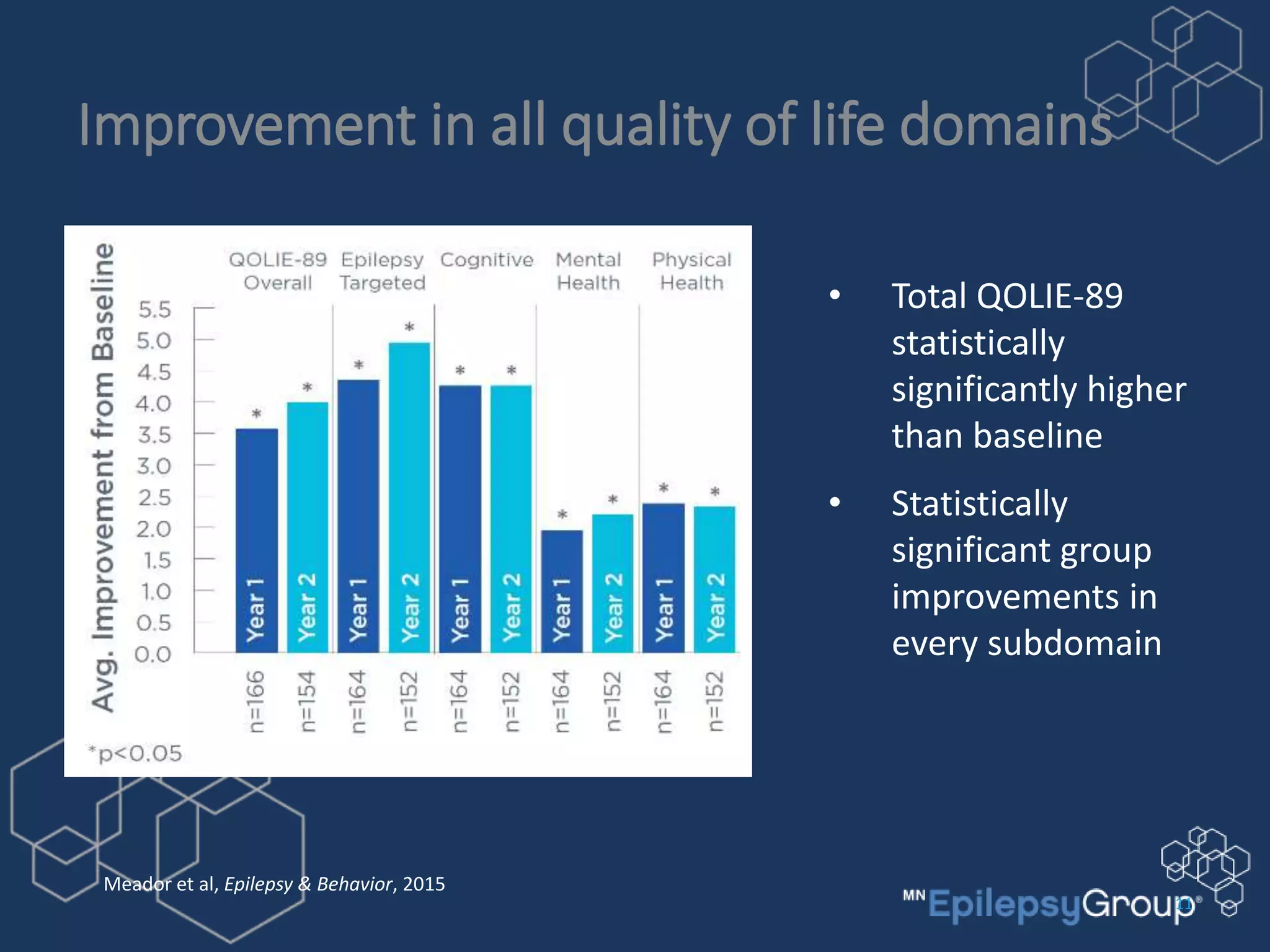
Improvement in all quality of life domains
Meador et al, Epilepsy & Behavior, 2015
• Total QOLIE-89
statistically
significantly higher
than baseline
• Statistically
significant group
improvements in
every subdomain
11
Long-term Safety
• Rate of serious adverse events similar to that of deep
brain stimulation for movement disorders
• Infection risk 3.5% per neurostimulator procedure1
• All reported infections were soft tissue
• No chronic neurologic or medical consequences
• Implant related hemorrhage 2.7%2
• No persistent, clinically significant neurologic sequelae
12
1 Based on device related SAEs
2 Not seizure related
Bergey et al., Neurology, 2015
Morrell et al., Neurology, 2011
MINNESOTA EPILEPSY GROUP
SEIZURE CARE FOR ALL AGES
Procedure Overview
14
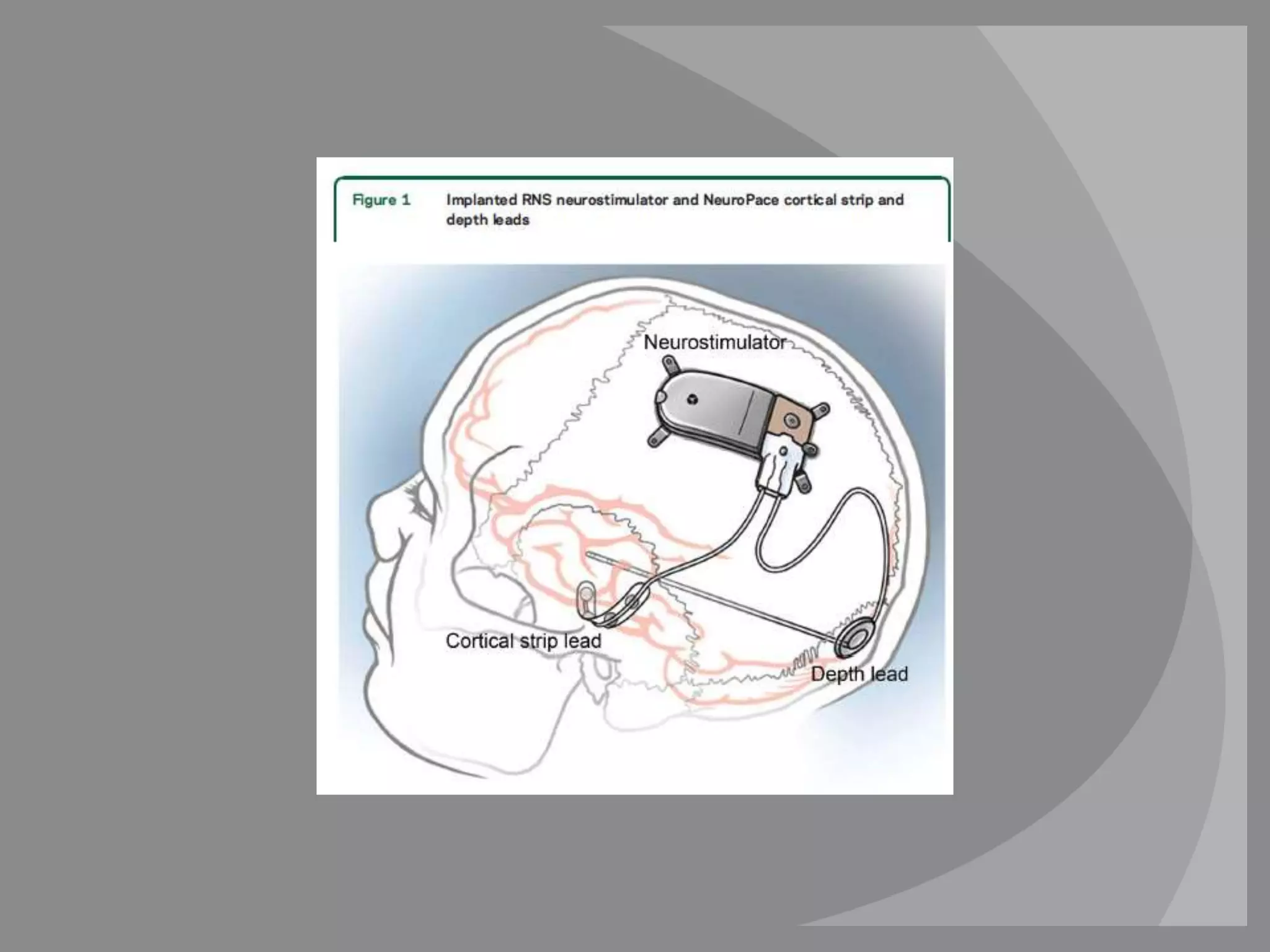
• Leads are placed at the seizure focus
– up to 2 leads are connected to the neurostimulator at once
– up to 4 leads can be implanted
• Neurostimulator is implanted into skull, underneath scalp
– Device conforms to skull, invisible underneath hair
• Standard stereotactic neurosurgical techniques and equipment
MINNESOTA EPILEPSY GROUP
SEIZURE CARE FOR ALL AGES
Step 1: Personalized Detection
17
LHip
RHip
LHip
RHip
Physician determines which patterns will be detected
Detection and Responsive Stimulation
(Hippocampal Epileptiform Discharge)
18
RNS Neuropsych Outcomes
• Loring et al, Epilepsia, 2015
• Neuropsychological data was collected during the
open –label arm of the RCT of RNS.
• Primary Cognitive tests:
• Boston naming
• RAVLT
• Tests were performed at baseline, year 1 and year
2.
• 191 patients implanted in the Pivotal Trial.
• 175 patients had baseline neuropsych and year 1, year
2 or both.
MINNESOTA EPILEPSY GROUP
SEIZURE CARE FOR ALL AGES
RNS Neuropsych Outcomes
• No significant cognitive declines noted through 2
years.
• Naming:
• All patients: significant improvement (p<0.0001)
• Neocortical group: significant improvement (p<0.001)
• Mesial temporal lobe group: no significant change
• Verbal learning:
• All patients: significant improvement (p<0.03)
• Neocortical group: no significant change
• Mesial temporal lobe group: significant improvement
(p<0.005
MINNESOTA EPILEPSY GROUP
SEIZURE CARE FOR ALL AGES
CONCLUSIONS
• The RNS is another weapon in our arsenal to try to
improve seizure control/quality of life in our
patients with intractable epilepsy.
• Careful selection of optimal patients is important:
• Good seizure localization
• Patient is not a resective surgery candidate
• RNS appears relatively safe from a memory
standpoint.
THANK YOU!

Responsive Neurostimulation (RNS) for Intractable Epilepsy

  • 1.
    RESPONSIVE NEUROSTIMULATION (RNS) FORINTRACTABLE EPILEPSY James R. White, MD
  • 2.
  • 4.
    Patient Selection • TheRNS System is indicated for patients who: • Have failed 2 medications • Have partial onset seizures that are localized to 1 or 2 foci • Other considerations: • Patients who are not resective surgery candidates • Temporal lobectomy patients can have a 70% chance of seizure freedom • Patients at risk of neurological/cognitive deficits with resection • For example, seizure onset over language cortex • Equally effective across variety of patients: – Treated and not treated with VNS – Treated and not treated with epilepsy surgery 4
  • 5.
    WHAT HAPPENS TOPATIENTS WITH NEW ONSET EPILEPSY? • % of patients controlled with: • First AED: • 47% • Second AED: • 13% • Third AED/combination therapy • 4% • Total controlled: 64% • Total not controlled: 36%
  • 6.
    RNSÂŽ System ClinicalTrials 6 Feasibility Trial 65 patients implanted Pivotal Trial Double blind RCT 191 patients implanted Open Label Long-term Treatment Trial 7 year follow on study, 230 enrolled New Post-approval study 300 pts to be enrolled at 30 centers The safety and efficacy of the RNSÂŽ System is supported by Class I Evidence from the prospective, double-blind, randomized, controlled pivotal trial. Patients prospectively followed through 9 years, currently representing 1389 patient implant years.
  • 7.
    Established seizure controlthat improves over time •Median % Seizure Reduction •Seizure-Free Intervals • ≥ 3 months: 37% • ≥ 6 months: 23% • ≥ 1 year: 13% 7 Heck CN, et al. Epilepsia, 2014. Bergey GK, et al. Neurology, 2015.
  • 8.
    Patient’s seizures arenot completely controlled. • Most patients have a significant improvement in seizures, but are not “cured”. • 12.9% had at least 1 seizure-free period of 1 year or longer. • No participants were seizure-free over the entire follow-up. MINNESOTA EPILEPSY GROUP SEIZURE CARE FOR ALL AGES
  • 9.
    PLACEBO EFFECT DURINGPIVOTAL TRIALS • The treatment group was compared to the sham control group: • Treatment group: Device is fully functioning, stimulating when seizure activity detected. • Sham group: Has device implanted, but device is not stimulating. • During blinded evaluation period, sham group was noted to have seizure reduction: • First month: 25.2% seizure reduction • Third month: 9.4% seizure reduction • Treatment group still significantly better than sham group • This placebo effect is interesting and seen in other device studies. • Makes it more of a challenge to show that the device works! • Shows how important it is have a control!
  • 10.
    RNS® System iseffective for both mesial temporal and neocortical seizure onsets 10 Mesial temporal lobe onset (n=106) • 70% median reduction in seizures1 (LOCF*) • 66% responder rate1 (95% CI 57%–74%) • Improvements in memory for mesial temporal onset seizures2 (p<0.005) Neocortical onset (n=122) • 58% median reduction in seizures3 (LOCF*) • 55% responder rate3 (95% CI 46–63%) • Improvements in naming for neocortical onset seizures2 (p<0.001) *Last observation carried forward analysis, last 3 months 1 Van Ness, P, et al, American Epilepsy Society abstract, 2015 2 Loring DW, et al, Epilepsia, 2015 3 Jobst B, et al, American Epilepsy Society abstract, 2015
  • 11.
    Improvement in allquality of life domains Meador et al, Epilepsy & Behavior, 2015 • Total QOLIE-89 statistically significantly higher than baseline • Statistically significant group improvements in every subdomain 11
  • 12.
    Long-term Safety • Rateof serious adverse events similar to that of deep brain stimulation for movement disorders • Infection risk 3.5% per neurostimulator procedure1 • All reported infections were soft tissue • No chronic neurologic or medical consequences • Implant related hemorrhage 2.7%2 • No persistent, clinically significant neurologic sequelae 12 1 Based on device related SAEs 2 Not seizure related Bergey et al., Neurology, 2015 Morrell et al., Neurology, 2011
  • 13.
  • 14.
    Procedure Overview 14 • Leadsare placed at the seizure focus – up to 2 leads are connected to the neurostimulator at once – up to 4 leads can be implanted • Neurostimulator is implanted into skull, underneath scalp – Device conforms to skull, invisible underneath hair • Standard stereotactic neurosurgical techniques and equipment
  • 16.
  • 17.
    Step 1: PersonalizedDetection 17 LHip RHip LHip RHip Physician determines which patterns will be detected
  • 18.
    Detection and ResponsiveStimulation (Hippocampal Epileptiform Discharge) 18
  • 19.
    RNS Neuropsych Outcomes •Loring et al, Epilepsia, 2015 • Neuropsychological data was collected during the open –label arm of the RCT of RNS. • Primary Cognitive tests: • Boston naming • RAVLT • Tests were performed at baseline, year 1 and year 2. • 191 patients implanted in the Pivotal Trial. • 175 patients had baseline neuropsych and year 1, year 2 or both. MINNESOTA EPILEPSY GROUP SEIZURE CARE FOR ALL AGES
  • 20.
    RNS Neuropsych Outcomes •No significant cognitive declines noted through 2 years. • Naming: • All patients: significant improvement (p<0.0001) • Neocortical group: significant improvement (p<0.001) • Mesial temporal lobe group: no significant change • Verbal learning: • All patients: significant improvement (p<0.03) • Neocortical group: no significant change • Mesial temporal lobe group: significant improvement (p<0.005 MINNESOTA EPILEPSY GROUP SEIZURE CARE FOR ALL AGES
  • 21.
    CONCLUSIONS • The RNSis another weapon in our arsenal to try to improve seizure control/quality of life in our patients with intractable epilepsy. • Careful selection of optimal patients is important: • Good seizure localization • Patient is not a resective surgery candidate • RNS appears relatively safe from a memory standpoint.
  • 22.

Editor's Notes