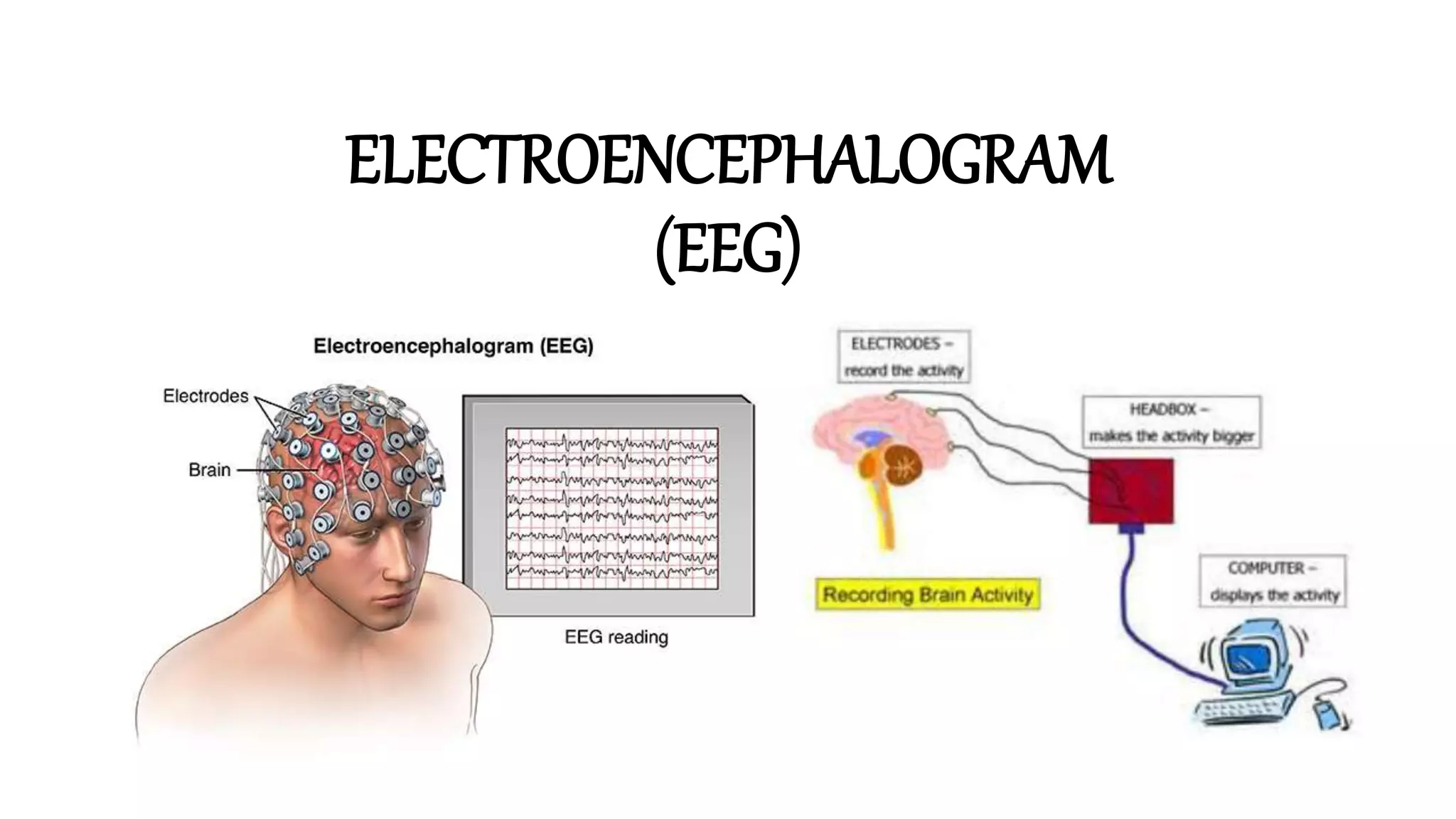
ELECTROENCEPHALOGRAM
(EEG)
The Source of EEG
• The generator source is WITHIN the cerebral
cortex by pyramidal cells. EEG is a measure of
cerebral electrical activity
• Electrical activity recorded is produced by
extracellular current flow associated with
summated excitatory and inhibitory
postsynaptic potential.
• EEG does not record individual action potentials.
The Synaptic Potentials
•Synaptic potentials have lower voltage value than
the action potentials, but the resultant current has
larger distribution
•Post-synaptic potentials:
•Longer duration
•Larger amount of membrane surface areas
EPSPs/IPSPs
(Excitatory/Inhibitory Post-synaptic Potentials)
•EPSP – produces a change in membrane
permeability within a select portion of the cell
membrane resulting in a net influx of +ve ions that
depolarizes the cell
•IPSP – selective activation of either Cl- or K+
channels resulting in a net outward ionic current
with hyperpolarization of the cell
WHAT DOES AN EEG REFLECT?
Spontaneous EEG activity occurs when currents flow
across charged neuronal membranes. An EEG waveforms
reflects the summation of PSPs
Rhythmic and Arrhythmic EEG activity
•When EEG waves are rhythmical, most of the cells
within the given neuronal pool are behaving
similarly.
With arrhythmic activity, there is less correlation with
individual cell behavior
FACTORS AFFECTING EEG WAVEFORMS
• Voltage of cortical discharge
• Area involved in synchronous activity
• Degree of synchrony
• Location of the dipole generators in relation to the convolutions of
the cortical mantle
EEG vs SEIZURES
• This test is particularly useful for recording uncontrollable, abnormal
brain wave activity associated with epileptic seizures.
• Doctors refer to some specific EEG patterns as ‘epileptiform
abnormalities’ or ‘epilepsy waves’.
• These EEG wave patterns consist of Spikes, Sharp Waves, and Spike-
and-Wave discharges, Slow Waves etc.
• They help to assist classification of a seizure disorder type.
EEG WAVEFORMS
• NORMAL / ABNORMAL?
• ABNORMAL – SPECIFIC/NON-SPECIFIC?
• NON-SPECIFIC – seen under conditions like trauma, stroke, brain tumor.
Example: slowing
• SPECIFIC – indicate tendency towards seizures.
a.k.a EPILEPSY WAVES
• Spikes
• Sharp
• Spike-and-waves
• Polyspike
• Polyspike-wave
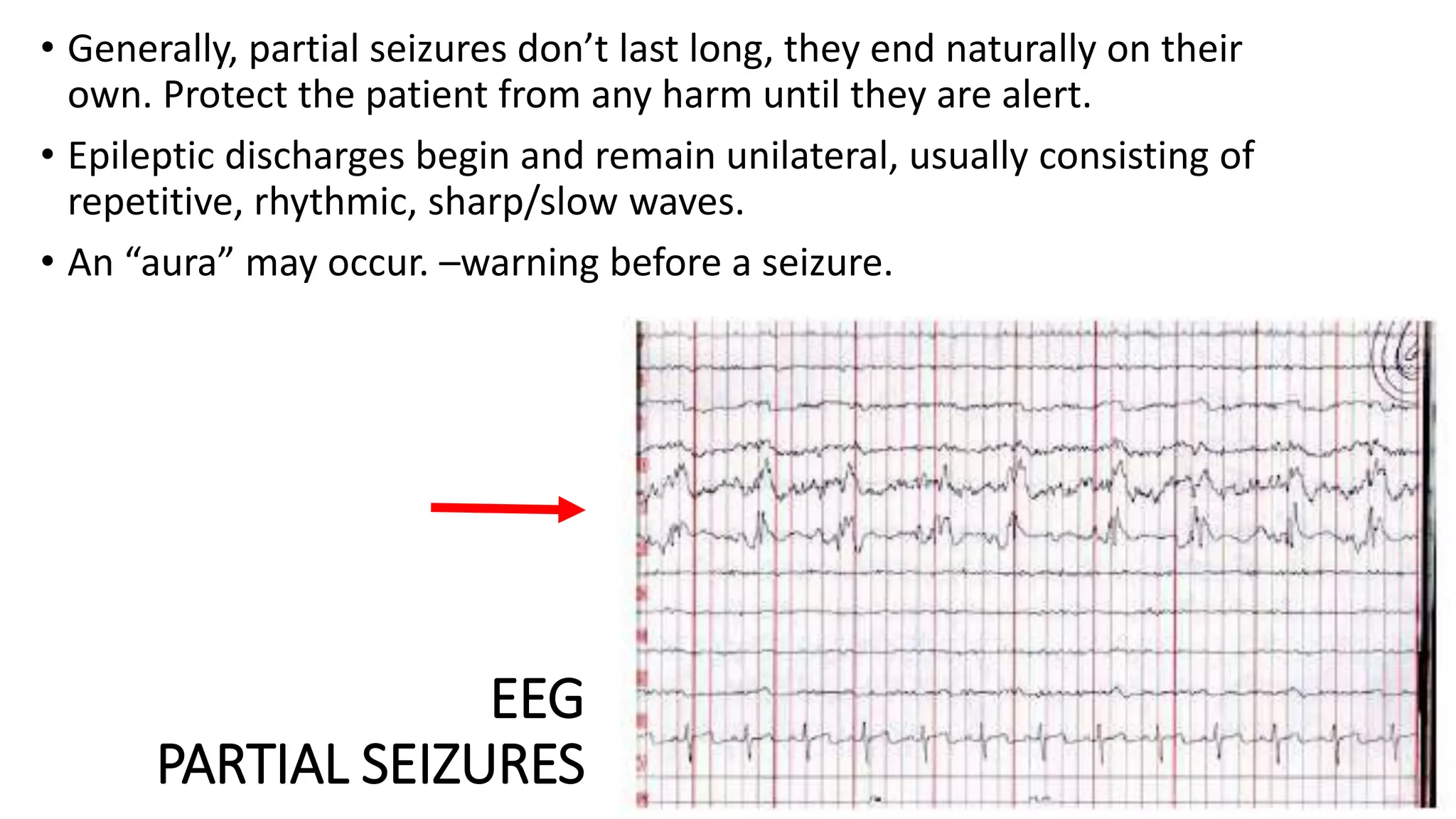
EEG
PARTIAL SEIZURES
• Generally, partial seizures don’t last long, they end naturally on their
own. Protect the patient from any harm until they are alert.
• Epileptic discharges begin and remain unilateral, usually consisting of
repetitive, rhythmic, sharp/slow waves.
• An “aura” may occur. –warning before a seizure.
GENERALISED
SEIZURES
Absence seizures – Petit-mal seizures
• Start and end abruptly, usually lasts <30s
• Staring, unresponsive, frequent eye
blinking, lip smacking
Voltage often max in F-C regions
Sudden onset of generalized spike-and-wave complexes
Irregular slow spike-and-wave complexes
No characteristic location
TONIC-CLONIC
• Tonic-clonic
• Tonic – sudden stiffness of limb, lose balance and fall
Lasts < 20s ; EEG: Rapid, high amplitude spikes
• Clonic – Repetitive jerks of muscles
Lasts longer ; EEG: rhythmic spike-wave matching the f of jerks
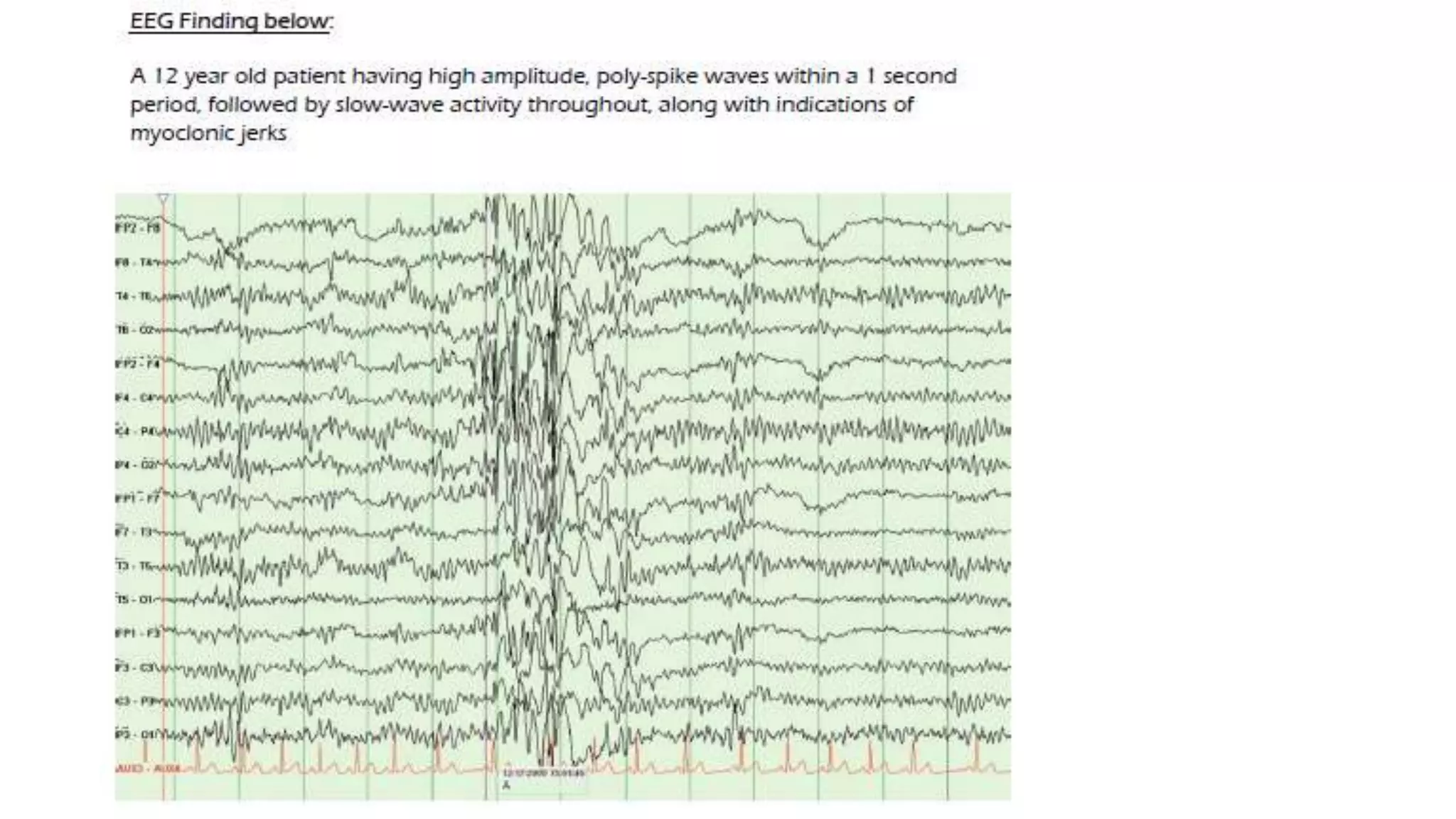
Myoclonic
• – Single jerks/ quick series of jerks (upper shoulders)
EEG: High vol poly-spikes, last <1s, followed by slow-waves
Can be rhythmic or non-rhythmic
*Refer PBL EEG given*
• Atonic – sudden loss of muscle tone
• Eye drooping, head nodding, shoulders slumping
• Severe form “drop attack”, last < 15s
• EEG: irregular mixed waveforms. Intermittent desynchronized
flattening/polyspikes
EEG Epilepsy

EEG Epilepsy

  • 1.
  • 2.
    The Source ofEEG • The generator source is WITHIN the cerebral cortex by pyramidal cells. EEG is a measure of cerebral electrical activity • Electrical activity recorded is produced by extracellular current flow associated with summated excitatory and inhibitory postsynaptic potential. • EEG does not record individual action potentials.
  • 3.
    The Synaptic Potentials •Synapticpotentials have lower voltage value than the action potentials, but the resultant current has larger distribution •Post-synaptic potentials: •Longer duration •Larger amount of membrane surface areas
  • 4.
    EPSPs/IPSPs (Excitatory/Inhibitory Post-synaptic Potentials) •EPSP– produces a change in membrane permeability within a select portion of the cell membrane resulting in a net influx of +ve ions that depolarizes the cell •IPSP – selective activation of either Cl- or K+ channels resulting in a net outward ionic current with hyperpolarization of the cell
  • 5.
    WHAT DOES ANEEG REFLECT? Spontaneous EEG activity occurs when currents flow across charged neuronal membranes. An EEG waveforms reflects the summation of PSPs Rhythmic and Arrhythmic EEG activity •When EEG waves are rhythmical, most of the cells within the given neuronal pool are behaving similarly. With arrhythmic activity, there is less correlation with individual cell behavior
  • 6.
    FACTORS AFFECTING EEGWAVEFORMS • Voltage of cortical discharge • Area involved in synchronous activity • Degree of synchrony • Location of the dipole generators in relation to the convolutions of the cortical mantle
  • 8.
    EEG vs SEIZURES •This test is particularly useful for recording uncontrollable, abnormal brain wave activity associated with epileptic seizures. • Doctors refer to some specific EEG patterns as ‘epileptiform abnormalities’ or ‘epilepsy waves’. • These EEG wave patterns consist of Spikes, Sharp Waves, and Spike- and-Wave discharges, Slow Waves etc. • They help to assist classification of a seizure disorder type.
  • 10.
    EEG WAVEFORMS • NORMAL/ ABNORMAL? • ABNORMAL – SPECIFIC/NON-SPECIFIC? • NON-SPECIFIC – seen under conditions like trauma, stroke, brain tumor. Example: slowing • SPECIFIC – indicate tendency towards seizures. a.k.a EPILEPSY WAVES • Spikes • Sharp • Spike-and-waves • Polyspike • Polyspike-wave
  • 12.
    EEG PARTIAL SEIZURES • Generally,partial seizures don’t last long, they end naturally on their own. Protect the patient from any harm until they are alert. • Epileptic discharges begin and remain unilateral, usually consisting of repetitive, rhythmic, sharp/slow waves. • An “aura” may occur. –warning before a seizure.
  • 15.
    GENERALISED SEIZURES Absence seizures –Petit-mal seizures • Start and end abruptly, usually lasts <30s • Staring, unresponsive, frequent eye blinking, lip smacking Voltage often max in F-C regions Sudden onset of generalized spike-and-wave complexes Irregular slow spike-and-wave complexes No characteristic location
  • 16.
    TONIC-CLONIC • Tonic-clonic • Tonic– sudden stiffness of limb, lose balance and fall Lasts < 20s ; EEG: Rapid, high amplitude spikes • Clonic – Repetitive jerks of muscles Lasts longer ; EEG: rhythmic spike-wave matching the f of jerks
  • 18.
    Myoclonic • – Singlejerks/ quick series of jerks (upper shoulders) EEG: High vol poly-spikes, last <1s, followed by slow-waves Can be rhythmic or non-rhythmic *Refer PBL EEG given*
  • 20.
    • Atonic –sudden loss of muscle tone • Eye drooping, head nodding, shoulders slumping • Severe form “drop attack”, last < 15s • EEG: irregular mixed waveforms. Intermittent desynchronized flattening/polyspikes