Fetal Surgery
2016 Innovation Summit
David Lynch-Salamon, MD
Medical Director
Midwest Fetal Care Center
• 1. Accurate diagnosis and staging possible, with exclusion of associated
anomalies.
• 2. Natural history of the disease is documented, and prognosis is established.
• 3. Currently no effective postnatal therapy.
• 4. In utero surgery proven feasible in animal models, reversing deleterious
effects of the condition.
• 5. Interventions performed in specialized multidisciplinary fetal treatment
centers within strict protocols and approval of the local Ethics Committee with
informed consent of the mother or parents.
Criteria for Fetal Surgery
Harrison et al, NEJM, 1982
Fetal Therapy
• Transplacental
• Needle based
• Fetoscopic
• Open
• Betamethasone
• Antiarrhythmic drugs
• Thyroid medication
Transplacental
• Cordocentesis for transfusion or medication administration
• Shunt placement
• Ablation of vascular connections
Needle Based
• Disorders of monochorionic placentation
− TTTS
− TAPS
− sIUGR
− TRAP
• Amniotic band sequence
• FETO
• Spina bifida repair
• Lower urinary tract obstruction (LUTO)
Fetoscopic
• Spina bifida
• LUTO
• Congenital pulmonary airway malformations (CPAM)
• Sacrococcygeal teratoma
• Other masses
Open Repairs
Fetal MMC Repair
• Prospective and randomized
• Prenatl vs postnatal repair
• NEJM 2011
• Less need for VP shunt in first year (44% vs 84%)
• Improved mental/motor composite score at 30 months
• Less need for intermittent catheterization (38% vs 51%)
• Durable
MOMS Trial
• Prospective and randomized
• Laser vs amnioreduction
• Stopped early due to significant benefit in laser group
• NEJM 2004
• Better survival of at least one twin at 28 days (76% vs 56%)
• More likely to be free of neurologic complications (52% vs 31%)
Laser for TTTS
Laryngeal Atresia
9 mm
Sagittal US at 25 3/7 weeks
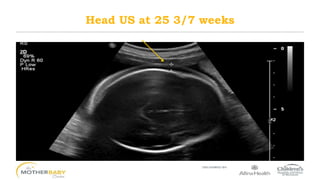
Head US at 25 3/7 weeks
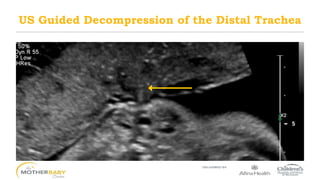
US Guided Decompression of the Distal Trachea
Immediate Post Procedure
Sagittal US
Head US at 29 Weeks
2015 2016 YTD
Peds Cards Echos 747 672
Laser 15 20
Bladder Shunt 2 Patients
4 Procedures
2 Patients
4 Procedures
PUBS 4 Patients
6 Procedures
2 Patients
8 Procedures
Complicated Mono 1 2
Thoracentesis 0 2
Tracheocentesis 0 1
MMC 0 3
MWFCC Procedures

Fetal Surgery

  • 1.
    Fetal Surgery 2016 InnovationSummit David Lynch-Salamon, MD Medical Director Midwest Fetal Care Center
  • 2.
    • 1. Accuratediagnosis and staging possible, with exclusion of associated anomalies. • 2. Natural history of the disease is documented, and prognosis is established. • 3. Currently no effective postnatal therapy. • 4. In utero surgery proven feasible in animal models, reversing deleterious effects of the condition. • 5. Interventions performed in specialized multidisciplinary fetal treatment centers within strict protocols and approval of the local Ethics Committee with informed consent of the mother or parents. Criteria for Fetal Surgery Harrison et al, NEJM, 1982
  • 3.
    Fetal Therapy • Transplacental •Needle based • Fetoscopic • Open
  • 4.
    • Betamethasone • Antiarrhythmicdrugs • Thyroid medication Transplacental
  • 5.
    • Cordocentesis fortransfusion or medication administration • Shunt placement • Ablation of vascular connections Needle Based
  • 6.
    • Disorders ofmonochorionic placentation − TTTS − TAPS − sIUGR − TRAP • Amniotic band sequence • FETO • Spina bifida repair • Lower urinary tract obstruction (LUTO) Fetoscopic
  • 7.
    • Spina bifida •LUTO • Congenital pulmonary airway malformations (CPAM) • Sacrococcygeal teratoma • Other masses Open Repairs
  • 8.
  • 9.
    • Prospective andrandomized • Prenatl vs postnatal repair • NEJM 2011 • Less need for VP shunt in first year (44% vs 84%) • Improved mental/motor composite score at 30 months • Less need for intermittent catheterization (38% vs 51%) • Durable MOMS Trial
  • 11.
    • Prospective andrandomized • Laser vs amnioreduction • Stopped early due to significant benefit in laser group • NEJM 2004 • Better survival of at least one twin at 28 days (76% vs 56%) • More likely to be free of neurologic complications (52% vs 31%) Laser for TTTS
  • 12.
  • 13.
    Sagittal US at25 3/7 weeks
  • 14.
    Head US at25 3/7 weeks
  • 15.
    US Guided Decompressionof the Distal Trachea
  • 16.
    US Guided Decompressionof the Distal Trachea
  • 17.
    US Guided Decompressionof the Distal Trachea
  • 18.
  • 19.
    Head US at29 Weeks
  • 20.
    2015 2016 YTD PedsCards Echos 747 672 Laser 15 20 Bladder Shunt 2 Patients 4 Procedures 2 Patients 4 Procedures PUBS 4 Patients 6 Procedures 2 Patients 8 Procedures Complicated Mono 1 2 Thoracentesis 0 2 Tracheocentesis 0 1 MMC 0 3 MWFCC Procedures