Critical Care Research:
Connection to Practice
Abbott Northwestern Hospital Innovation Summit
November 5, 2016
Roman Melamed, MD, FCCP
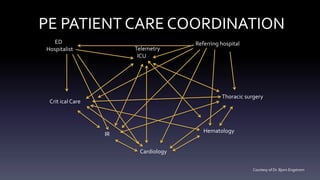
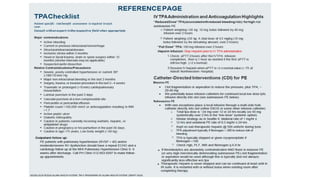
PE PATIENT CARE COORDINATION
Referring hospital
Telemetry
ICU
ED
Hospitalist
Crit ical Care
IR
Cardiology
Hematology
Thoracic surgery
Courtesy of Dr. Bjorn Engstrom
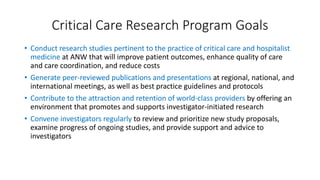
Critical Care Research Program Goals
• Conduct research studies pertinent to the practice of critical care and hospitalist
medicine at ANW that will improve patient outcomes, enhance quality of care
and care coordination, and reduce costs
• Generate peer-reviewed publications and presentations at regional, national, and
international meetings, as well as best practice guidelines and protocols
• Contribute to the attraction and retention of world-class providers by offering an
environment that promotes and supports investigator-initiated research
• Convene investigators regularly to review and prioritize new study proposals,
examine progress of ongoing studies, and provide support and advice to
investigators
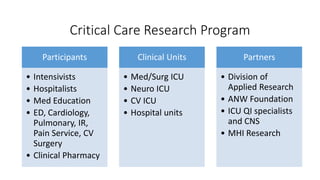
Critical Care Research Program
Participants
• Intensivists
• Hospitalists
• Med Education
• ED, Cardiology,
Pulmonary, IR,
Pain Service, CV
Surgery
• Clinical Pharmacy
Clinical Units
• Med/Surg ICU
• Neuro ICU
• CV ICU
• Hospital units
Partners
• Division of
Applied Research
• ANW Foundation
• ICU QI specialists
and CNS
• MHI Research
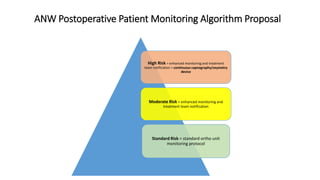
High Risk = enhanced monitoring and treatment
team notification + continuous capnography/oxymetry
device
Moderate Risk = enhanced monitoring and
treatment team notification
Standard Risk = standard ortho unit
monitoring protocol
ANW Postoperative Patient Monitoring Algorithm Proposal
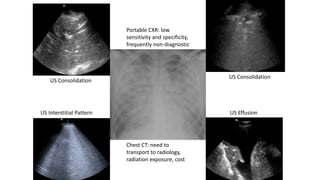
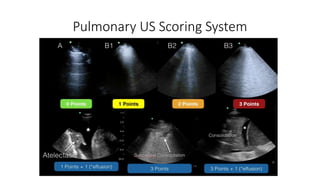
Portable CXR: low
sensitivity and specificity,
frequently non-diagnostic
Chest CT: need to
transport to radiology,
radiation exposure, cost
US Consolidation
US Effusion
US Consolidation
US Interstitial Pattern
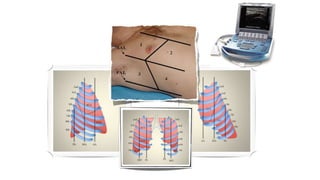
Pulmonary US Scoring System
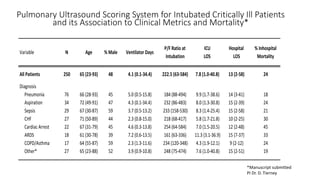
Variable N Age % Male Ventilator Days
P/F Ratio at
Intubation
ICU
LOS
Hospital
LOS
% Inhospital
Mortality
All Patients 250 65 (23-93) 48 4.1 (0.1-34.4) 222.5 (63-584) 7.8 (1.0-40.8) 13 (2-58) 24
Diagnosis
Pneumonia 76 66 (28-93) 45 5.0 (0.5-15.8) 184 (88-494) 9.9 (1.7-38.6) 14 (3-41) 18
Aspiration 34 72 (49-91) 47 4.3 (0.1-34.4) 232 (86-483) 8.0 (1.3-30.8) 15 (2-39) 24
Sepsis 29 67 (30-87) 59 3.7 (0.5-13.2) 233 (158-530) 8.3 (1.4-25.4) 15 (2-58) 21
CHF 27 71 (50-89) 44 2.3 (0.8-15.0) 218 (68-417) 5.8 (1.7-21.8) 10 (2-25) 30
Cardiac Arrest 22 67 (31-79) 45 4.6 (0.3-13.8) 254 (64-584) 7.0 (1.5-20.5) 12 (2-48) 45
ARDS 18 61 (30-78) 39 7.2 (0.6-13.5) 161 (63-336) 11.3 (3.1-36.9) 15 (7-37) 33
COPD/Asthma 17 64 (55-87) 59 2.3 (1.3-11.6) 234 (120-348) 4.3 (1.9-12.1) 9 (2-12) 24
Other* 27 65 (23-88) 52 3.9 (0.9-10.8) 248 (75-474) 7.6 (1.0-40.8) 15 (2-51) 19
Pulmonary Ultrasound Scoring System for Intubated Critically Ill Patients
and its Association to Clinical Metrics and Mortality*
*Manuscript submitted
PI Dr. D. Tierney
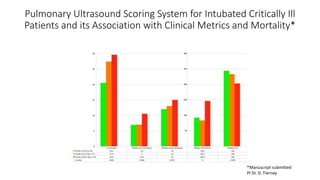
Pulmonary Ultrasound Scoring System for Intubated Critically Ill
Patients and its Association with Clinical Metrics and Mortality*
*Manuscript submitted
PI Dr. D. Tierney
Annual Cardiovascular-Thoracic Critical Care Conference,
Washington DC, September 2016
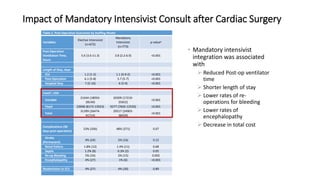
• Mandatory intensivist
integration was associated
with
 Reduced Post-op ventilator
time
 Shorter length of stay
 Lower rates of re-
operations for bleeding
 Lower rates of
encephalopathy
 Decrease in total cost
Impact of Mandatory Intensivist Consult after Cardiac Surgery
Table 2. Post-Operative Outcomes by Staffing Model
Variables
Elective Intensivist
(n=672)
Mandatory
Intensivist
(n=773)
p-valuea
Post-Operation
Ventilation Time,
hours
5.6 (3.6-11.3) 3.8 (2.2-6.9) <0.001
Length of Stay, days
ICU 1.2 (1-2) 1.1 (0.9-2) <0.001
Post-Operation 6.1 (5-8) 5.7 (5-7) <0.001
Hospital Stay 7 (5-10) 6 (5-9) <0.001
Costsb, USD
Variable
21644 (18050-
28140)
20309 (17210-
25652)
<0.001
Fixed 10048 (8173-13923) 9277 (7602-12550) <0.001
Total
31399 (26474-
41714)
29517 (24903-
38429)
<0.001
Complications (30
days post-operation)
53% (356) 48% (371) 0.07
Stroke
(Permanent)
4% (24) 2% (16) 0.12
Renal Failure 1.8% (12) 1.4% (11) 0.68
Sepsis 1.2% (8) 0.3% (2) 0.05
Re-op Bleeding 5% (33) 2% (15) 0.002
Encephalopathy 4% (27) 1% (6) <0.001
Readmission to ICU 4% (27) 4% (30) 0.89
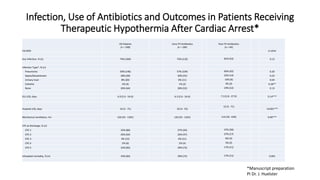
Infection, Use of Antibiotics and Outcomes in Patients Receiving
Therapeutic Hypothermia After Cardiac Arrest*
*Manuscript preparation
PI Dr. J. Huelster
Variable
All Patients
(n = 248)
Intra-TH Antibiotics
(n = 184)
Post-TH Antibiotics
(n = 64)
p value
Any infection, % (n) 74% (184) 72% (132) 81% (52) 0.13
Infection Type*, % (n)
Pneumonia 59% (146) 57% (104) 66% (42) 0.20
Sepsis/bloodstream 28% (69) 30% (55) 22% (14) 0.22
Urinary tract 8% (20) 6% (11) 14% (9) 0.04
Cellulitis 2% (4) 1% (2) 3% (2) 0.28**
None 26% (64) 28% (52) 19% (12) 0.13
ICU LOS, days 6.9 (2.6 - 54.6) 6.3 (2.6 - 54.6) 7.3 (2.8 - 27.9) 0.14***
Hospital LOS, days 10 (3 - 71) 10 (3 - 55)
12 (3 - 71)
<0.001***
Mechanical ventilation, hrs 120 (34 - 1301) 120 (34 - 1301) 119 (39 - 639) 0.90***
CPC at discharge, % (n)
CPC 1 32% (80) 27% (50) 47% (30)
CPC 2 26% (64) 26% (47) 27% (17)
CPC 3 6% (15) 6% (11) 6% (4)
CPC 4 2% (6) 2% (4) 3% (2)
CPC 5 33% (83) 39% (72) 17% (11)
Inhospital mortality, % (n) 33% (83) 39% (72) 17% (11) 0.001
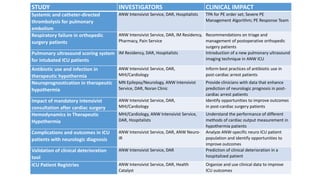
STUDY INVESTIGATORS CLINICAL IMPACT
Systemic and catheter-directed
thrombolysis for pulmonary
embolism
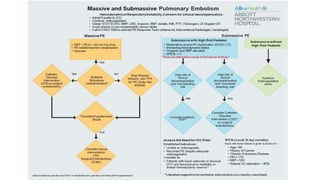
ANW Intensivist Service, DAR, Hospitalists TPA for PE order set; Severe PE
Management Algorithm; PE Response Team
Respiratory failure in orthopedic
surgery patients
ANW Intensivist Service, DAR, IM Residency,
Pharmacy, Pain Service
Recommendations on triage and
management of postoperative orthopedic
surgery patients
Pulmonary ultrasound scoring system
for intubated ICU patients
IM Residency, DAR, Hospitalists Introduction of a new pulmonary ultrasound
imaging technique in ANW ICU
Antibiotic use and infection in
therapeutic hypothermia
ANW Intensivist Service, DAR,
MHI/Cardiology
Inform best practices of antibiotic use in
post-cardiac arrest patients
Neuroprognostication in therapeutic
hypothermia
MN Epilepsy/Neurology, ANW Intensivist
Service, DAR, Noran Clinic
Provide clinicians with data that enhance
prediction of neurologic prognosis in post-
cardiac arrest patients
Impact of mandatory intensivist
consultation after cardiac surgery
ANW Intensivist Service, DAR,
MHI/Cardiology
Identify opportunities to improve outcomes
in post-cardiac surgery patients
Hemodynamics in Therapeutic
Hypothermia
MHI/Cardiology, ANW Intensivist Service,
DAR, Hospitalists
Understand the performance of different
methods of cardiac output measurement in
hypothermia patients
Complications and outcomes in ICU
patients with neurologic diagnosis
ANW Intensivist Service, DAR, ANW Neuro-
IR
Analyze ANW-specific neuro ICU patient
population and identify opportunities to
improve outcomes
Validation of clinical deterioration
tool
ANW Intensivist Service, DAR Prediction of clinical deterioration in a
hospitalized patient
ICU Patient Registries ANW Intensivist Service, DAR, Health
Catalyst
Organize and use clinical data to improve
ICU outcomes
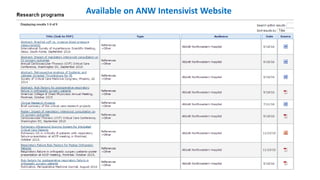
Available on ANW Intensivist Website
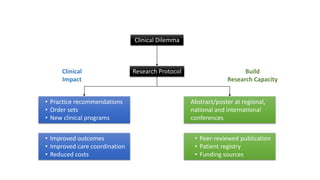
Clinical Dilemma
Research Protocol
• Practice recommendations
• Order sets
• New clinical programs
Abstract/poster at regional,
national and international
conferences
• Improved outcomes
• Improved care coordination
• Reduced costs
• Peer-reviewed publication
• Patient registry
• Funding sources
Clinical
Impact
Build
Research Capacity
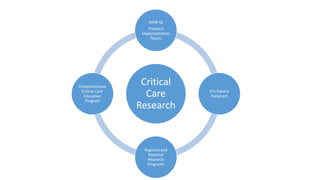
Critical
Care
Research
ANW QI
Protocol
Implementation
Teams
ICU Patient
Datamart
Regional and
National
Research
Programs
Comprehensive
Critical Care
Education
Program

Critical Care Research: Connection to Practice

  • 1.
    Critical Care Research: Connectionto Practice Abbott Northwestern Hospital Innovation Summit November 5, 2016 Roman Melamed, MD, FCCP
  • 2.
    PE PATIENT CARECOORDINATION Referring hospital Telemetry ICU ED Hospitalist Crit ical Care IR Cardiology Hematology Thoracic surgery Courtesy of Dr. Bjorn Engstrom
  • 6.
    Critical Care ResearchProgram Goals • Conduct research studies pertinent to the practice of critical care and hospitalist medicine at ANW that will improve patient outcomes, enhance quality of care and care coordination, and reduce costs • Generate peer-reviewed publications and presentations at regional, national, and international meetings, as well as best practice guidelines and protocols • Contribute to the attraction and retention of world-class providers by offering an environment that promotes and supports investigator-initiated research • Convene investigators regularly to review and prioritize new study proposals, examine progress of ongoing studies, and provide support and advice to investigators
  • 7.
    Critical Care ResearchProgram Participants • Intensivists • Hospitalists • Med Education • ED, Cardiology, Pulmonary, IR, Pain Service, CV Surgery • Clinical Pharmacy Clinical Units • Med/Surg ICU • Neuro ICU • CV ICU • Hospital units Partners • Division of Applied Research • ANW Foundation • ICU QI specialists and CNS • MHI Research
  • 10.
    High Risk =enhanced monitoring and treatment team notification + continuous capnography/oxymetry device Moderate Risk = enhanced monitoring and treatment team notification Standard Risk = standard ortho unit monitoring protocol ANW Postoperative Patient Monitoring Algorithm Proposal
  • 11.
    Portable CXR: low sensitivityand specificity, frequently non-diagnostic Chest CT: need to transport to radiology, radiation exposure, cost US Consolidation US Effusion US Consolidation US Interstitial Pattern
  • 13.
  • 14.
    Variable N Age% Male Ventilator Days P/F Ratio at Intubation ICU LOS Hospital LOS % Inhospital Mortality All Patients 250 65 (23-93) 48 4.1 (0.1-34.4) 222.5 (63-584) 7.8 (1.0-40.8) 13 (2-58) 24 Diagnosis Pneumonia 76 66 (28-93) 45 5.0 (0.5-15.8) 184 (88-494) 9.9 (1.7-38.6) 14 (3-41) 18 Aspiration 34 72 (49-91) 47 4.3 (0.1-34.4) 232 (86-483) 8.0 (1.3-30.8) 15 (2-39) 24 Sepsis 29 67 (30-87) 59 3.7 (0.5-13.2) 233 (158-530) 8.3 (1.4-25.4) 15 (2-58) 21 CHF 27 71 (50-89) 44 2.3 (0.8-15.0) 218 (68-417) 5.8 (1.7-21.8) 10 (2-25) 30 Cardiac Arrest 22 67 (31-79) 45 4.6 (0.3-13.8) 254 (64-584) 7.0 (1.5-20.5) 12 (2-48) 45 ARDS 18 61 (30-78) 39 7.2 (0.6-13.5) 161 (63-336) 11.3 (3.1-36.9) 15 (7-37) 33 COPD/Asthma 17 64 (55-87) 59 2.3 (1.3-11.6) 234 (120-348) 4.3 (1.9-12.1) 9 (2-12) 24 Other* 27 65 (23-88) 52 3.9 (0.9-10.8) 248 (75-474) 7.6 (1.0-40.8) 15 (2-51) 19 Pulmonary Ultrasound Scoring System for Intubated Critically Ill Patients and its Association to Clinical Metrics and Mortality* *Manuscript submitted PI Dr. D. Tierney
  • 15.
    Pulmonary Ultrasound ScoringSystem for Intubated Critically Ill Patients and its Association with Clinical Metrics and Mortality* *Manuscript submitted PI Dr. D. Tierney
  • 17.
    Annual Cardiovascular-Thoracic CriticalCare Conference, Washington DC, September 2016
  • 18.
    • Mandatory intensivist integrationwas associated with  Reduced Post-op ventilator time  Shorter length of stay  Lower rates of re- operations for bleeding  Lower rates of encephalopathy  Decrease in total cost Impact of Mandatory Intensivist Consult after Cardiac Surgery Table 2. Post-Operative Outcomes by Staffing Model Variables Elective Intensivist (n=672) Mandatory Intensivist (n=773) p-valuea Post-Operation Ventilation Time, hours 5.6 (3.6-11.3) 3.8 (2.2-6.9) <0.001 Length of Stay, days ICU 1.2 (1-2) 1.1 (0.9-2) <0.001 Post-Operation 6.1 (5-8) 5.7 (5-7) <0.001 Hospital Stay 7 (5-10) 6 (5-9) <0.001 Costsb, USD Variable 21644 (18050- 28140) 20309 (17210- 25652) <0.001 Fixed 10048 (8173-13923) 9277 (7602-12550) <0.001 Total 31399 (26474- 41714) 29517 (24903- 38429) <0.001 Complications (30 days post-operation) 53% (356) 48% (371) 0.07 Stroke (Permanent) 4% (24) 2% (16) 0.12 Renal Failure 1.8% (12) 1.4% (11) 0.68 Sepsis 1.2% (8) 0.3% (2) 0.05 Re-op Bleeding 5% (33) 2% (15) 0.002 Encephalopathy 4% (27) 1% (6) <0.001 Readmission to ICU 4% (27) 4% (30) 0.89
  • 19.
    Infection, Use ofAntibiotics and Outcomes in Patients Receiving Therapeutic Hypothermia After Cardiac Arrest* *Manuscript preparation PI Dr. J. Huelster Variable All Patients (n = 248) Intra-TH Antibiotics (n = 184) Post-TH Antibiotics (n = 64) p value Any infection, % (n) 74% (184) 72% (132) 81% (52) 0.13 Infection Type*, % (n) Pneumonia 59% (146) 57% (104) 66% (42) 0.20 Sepsis/bloodstream 28% (69) 30% (55) 22% (14) 0.22 Urinary tract 8% (20) 6% (11) 14% (9) 0.04 Cellulitis 2% (4) 1% (2) 3% (2) 0.28** None 26% (64) 28% (52) 19% (12) 0.13 ICU LOS, days 6.9 (2.6 - 54.6) 6.3 (2.6 - 54.6) 7.3 (2.8 - 27.9) 0.14*** Hospital LOS, days 10 (3 - 71) 10 (3 - 55) 12 (3 - 71) <0.001*** Mechanical ventilation, hrs 120 (34 - 1301) 120 (34 - 1301) 119 (39 - 639) 0.90*** CPC at discharge, % (n) CPC 1 32% (80) 27% (50) 47% (30) CPC 2 26% (64) 26% (47) 27% (17) CPC 3 6% (15) 6% (11) 6% (4) CPC 4 2% (6) 2% (4) 3% (2) CPC 5 33% (83) 39% (72) 17% (11) Inhospital mortality, % (n) 33% (83) 39% (72) 17% (11) 0.001
  • 20.
    STUDY INVESTIGATORS CLINICALIMPACT Systemic and catheter-directed thrombolysis for pulmonary embolism ANW Intensivist Service, DAR, Hospitalists TPA for PE order set; Severe PE Management Algorithm; PE Response Team Respiratory failure in orthopedic surgery patients ANW Intensivist Service, DAR, IM Residency, Pharmacy, Pain Service Recommendations on triage and management of postoperative orthopedic surgery patients Pulmonary ultrasound scoring system for intubated ICU patients IM Residency, DAR, Hospitalists Introduction of a new pulmonary ultrasound imaging technique in ANW ICU Antibiotic use and infection in therapeutic hypothermia ANW Intensivist Service, DAR, MHI/Cardiology Inform best practices of antibiotic use in post-cardiac arrest patients Neuroprognostication in therapeutic hypothermia MN Epilepsy/Neurology, ANW Intensivist Service, DAR, Noran Clinic Provide clinicians with data that enhance prediction of neurologic prognosis in post- cardiac arrest patients Impact of mandatory intensivist consultation after cardiac surgery ANW Intensivist Service, DAR, MHI/Cardiology Identify opportunities to improve outcomes in post-cardiac surgery patients Hemodynamics in Therapeutic Hypothermia MHI/Cardiology, ANW Intensivist Service, DAR, Hospitalists Understand the performance of different methods of cardiac output measurement in hypothermia patients Complications and outcomes in ICU patients with neurologic diagnosis ANW Intensivist Service, DAR, ANW Neuro- IR Analyze ANW-specific neuro ICU patient population and identify opportunities to improve outcomes Validation of clinical deterioration tool ANW Intensivist Service, DAR Prediction of clinical deterioration in a hospitalized patient ICU Patient Registries ANW Intensivist Service, DAR, Health Catalyst Organize and use clinical data to improve ICU outcomes
  • 21.
    Available on ANWIntensivist Website
  • 22.
    Clinical Dilemma Research Protocol •Practice recommendations • Order sets • New clinical programs Abstract/poster at regional, national and international conferences • Improved outcomes • Improved care coordination • Reduced costs • Peer-reviewed publication • Patient registry • Funding sources Clinical Impact Build Research Capacity
  • 23.
    Critical Care Research ANW QI Protocol Implementation Teams ICU Patient Datamart Regionaland National Research Programs Comprehensive Critical Care Education Program