
DR.SRIRAMA.ANJANEYULU
                MD;DM
         NEUROLOGIST
               GUNTUR
Terminology

 “Treatment nonresponder”
 “Refractory”
 “Intractable”
 “Drug resistant”
CONSEQUENCES OF RE
 Bodily injuries - hospitalization.
 Shortened life spans-risk of sudden unexpected death.
 Significant neuropsychological, psychiatric, and social
  impairments.
 Limited employment, reduce marriage rates, and
  decrease quality of life.
PROGNOSTIC GROUPS IN EPILEPSY
 (1) Spontaneous remission (20–30%) - benign epilepsy
 with centrotemporal spikes or childhood absences.

 (2) Remission on AEDs (20–30%) - most focal epilepsy
 and myoclonic juvenile epilepsy syndromes;.

 (3) Persistent seizures under AEDs (30–40%) .
DEFINITION
 (1) Absence of response to 2 AEDs tolerated at
  reasonable doses.

 (2) Minimum frequency of seizures (e.g. 1 seizure per
  month) to be considered refractory or the duration of
  minimum remission (e.g. 6– 12 months) to be qualified
  as non refractory.

 (3) Duration of 1 year to 1 decade of non controlled
  epilepsy.
EPIDEMIOLOGY
 (i) No unifying definition of RE.
 (ii) Same pt might be refractory at one time, but treatment
  responsive at another.
 (iii) Response to medication is assessed without a
  pretreatment baseline, as most pts are treated rapidly after
  diagnosis.
  It is unclear whether or not so-called refractory pts have
  had a substantial response to treatment.
 (iv) There is evidence from trials that pts defined as
  refractory will respond readily, although not completely to
  therapy.
EPI…………
 Epilepsy - prevalence ~ 5/1000
 Incidence ~ 50/100,000/year.
 Assuming that 20% of patients with active epilepsy
  would be resistant to AED treatment
 One bn population of India,
 There would be about one mn people with medically
  refractory epilepsy.
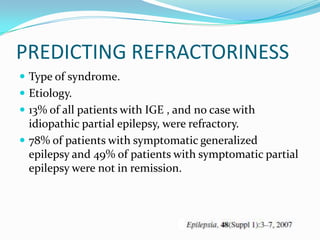
PREDICTING REFRACTORINESS
 Type of syndrome.
 Etiology.
 13% of all patients with IGE , and no case with
  idiopathic partial epilepsy, were refractory.
 78% of patients with symptomatic generalized
  epilepsy and 49% of patients with symptomatic partial
  epilepsy were not in remission.
 Younger age.
 High sz frequency.
 Presentation with SE.
 Abnormal NE.
 Mixed seizure types with dev.delay.
 Multiple sz types prior to treatment and after
  treatment.
 Quantity of interictal spikes.
 Human factors-
 Wrong drug,
 Dose,
 Frequency,
 Compliance.


 Environmental –trauma ,drug exposure.


 Genetic -
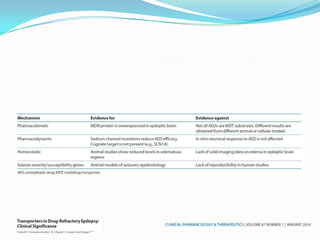
Mechanisms of Refractoriness
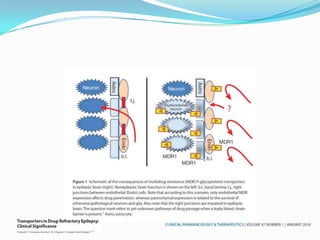
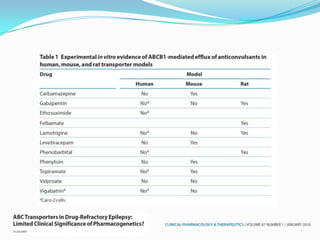
 Drug transporter hypothesis
 Target hypothesis
 Intrinsic disease severity
REFRACTRORINESS
 Drug fails to reach the neuronal target
  (pharmacokinetic hypothesis).
 Drug fails to act at the neuronal target
  (pharmacodynamic hypothesis).
 Seizure phenotype and history of seizures determine
  the “level of refractoriness” (the inherent disease
  severity hypothesis).
 Pathobiosis- process whereby malfunctioning cells are
 allowed to survive in an otherwise hostile
 environment; this phenomenon would in turn
 promote survival of defective glia.
Diagnosis of Refractory Epilepsy
Exclude false refractoriness related to -
 Nonepileptic seizures. (20%)
 Inadequate AEDs.
 Noncompliance .
 Seizure-precipitating factors.
Confirm refractoriness
 Inadequate control of seizures despite at least 2
  potentially effective AEDs (mono- or polytherapy)
  taken in tolerable doses.
 Occurrence of an average of one sz per month for 18
  months or more.
 Not more than 3 month sz free hiatus during this
  period of 18 months.
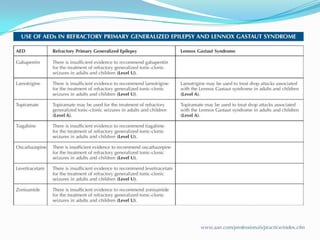
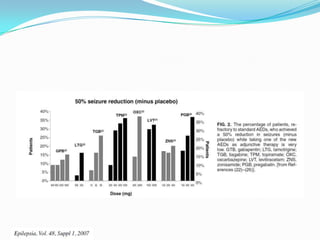
AED FOR RE
FIRST LINE DRUGS
 Partial epilepsies-CBZ
 Generalized epilepsies-VPA

ADD ON DRUGS
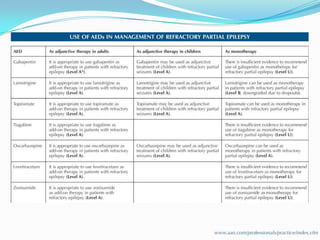
 Partial-PHB,CLB;/LEV,TPM
 Generalized-ZNS,LEV,LTG

 VPA+TPM=hyper ammonaemia
 LEV+ZNS=SZ++++.
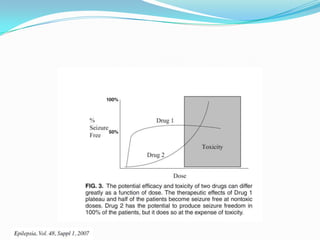
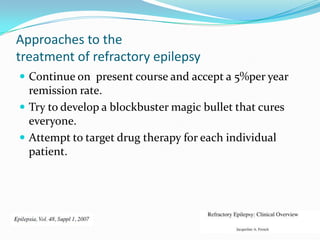
Approaches to the
treatment of refractory epilepsy
 Continue on present course and accept a 5%per year
  remission rate.
 Try to develop a blockbuster magic bullet that cures
  everyone.
 Attempt to target drug therapy for each individual
  patient.
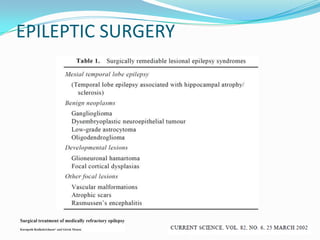
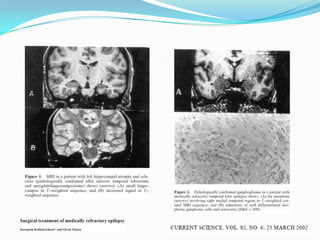
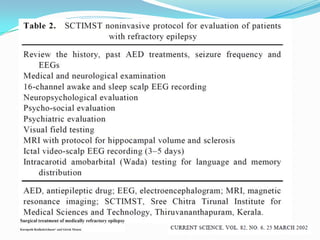
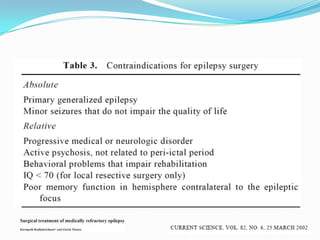
EPILEPTIC SURGERY
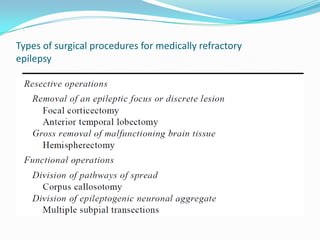
Types of surgical procedures for medically refractory
epilepsy
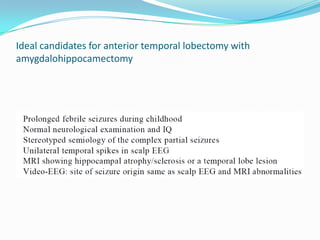
Ideal candidates for anterior temporal lobectomy with
amygdalohippocamectomy
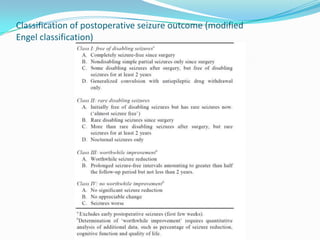
Classification of postoperative seizure outcome (modified
Engel classification)
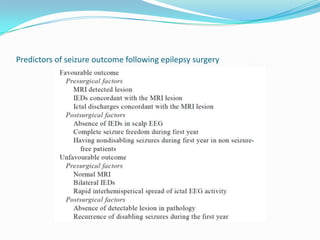
Predictors of seizure outcome following epilepsy surgery
 KD-chronic ketosis,GABA synthesis
  increase,hyperpolarize neurons and glia.
 VNS
Treatments under Investigation
 Polymers
 Electrical brain stimulation
 Prediction of seizures
POLYMERS
 Polymers containing AEDs - 2- to 3-mm microspheres ,
    placed near the epileptogenic zone.
   (1) new AEDs could be used which do not cross the BBB or
    show systemic toxicity.
   (2) useful when the epileptogenic zone is near eloquent
    cortex.
   (3) prevent noncompliance .
   Implanting wafers impregnated with chemotherapeutic
    agents into the resection cavity results in prolongation of
    survival without an increased incidence of adverse events .
   Studies in animals have been promising as the application
    of polymers containing phenytoin to the epileptogenic
    zone in mice has reduced epileptogenic indexes .
ELECTRICAL STIMULATION
 Still not accepted as a routine treatment for epilepsy-
  no consensus regarding the better region to stimulate
  and in what type of seizure it is most effective.
 The epileptogenic zone and the centromedian or
  anterior nuclei of the thalamus seem to be the most
  effective targets for electrical stimulation .
 The efficacy similar to vagal nerve stimulation which
  has a lower risk and less comorbidity .
FUTURE…..
 Seizure detector coupled with a trigger AED infusion
  pump has been developed with success in the mouse .
 Research has also been done in predicting seizures .
 Device may predict seizures and automatically
  administer AEDs to prevent them from occurring.
Thank you

Refractory epilepsy

  • 1.
    DR.SRIRAMA.ANJANEYULU MD;DM NEUROLOGIST GUNTUR
  • 2.
    Terminology  “Treatment nonresponder” “Refractory”  “Intractable”  “Drug resistant”
  • 3.
    CONSEQUENCES OF RE Bodily injuries - hospitalization.  Shortened life spans-risk of sudden unexpected death.  Significant neuropsychological, psychiatric, and social impairments.  Limited employment, reduce marriage rates, and decrease quality of life.
  • 4.
    PROGNOSTIC GROUPS INEPILEPSY  (1) Spontaneous remission (20–30%) - benign epilepsy with centrotemporal spikes or childhood absences.  (2) Remission on AEDs (20–30%) - most focal epilepsy and myoclonic juvenile epilepsy syndromes;.  (3) Persistent seizures under AEDs (30–40%) .
  • 5.
    DEFINITION  (1) Absenceof response to 2 AEDs tolerated at reasonable doses.  (2) Minimum frequency of seizures (e.g. 1 seizure per month) to be considered refractory or the duration of minimum remission (e.g. 6– 12 months) to be qualified as non refractory.  (3) Duration of 1 year to 1 decade of non controlled epilepsy.
  • 6.
    EPIDEMIOLOGY  (i) Nounifying definition of RE.  (ii) Same pt might be refractory at one time, but treatment responsive at another.  (iii) Response to medication is assessed without a pretreatment baseline, as most pts are treated rapidly after diagnosis. It is unclear whether or not so-called refractory pts have had a substantial response to treatment.  (iv) There is evidence from trials that pts defined as refractory will respond readily, although not completely to therapy.
  • 7.
    EPI…………  Epilepsy -prevalence ~ 5/1000  Incidence ~ 50/100,000/year.  Assuming that 20% of patients with active epilepsy would be resistant to AED treatment  One bn population of India,  There would be about one mn people with medically refractory epilepsy.
  • 11.
    PREDICTING REFRACTORINESS  Typeof syndrome.  Etiology.  13% of all patients with IGE , and no case with idiopathic partial epilepsy, were refractory.  78% of patients with symptomatic generalized epilepsy and 49% of patients with symptomatic partial epilepsy were not in remission.
  • 12.
     Younger age. High sz frequency.  Presentation with SE.  Abnormal NE.  Mixed seizure types with dev.delay.  Multiple sz types prior to treatment and after treatment.  Quantity of interictal spikes.
  • 13.
     Human factors- Wrong drug,  Dose,  Frequency,  Compliance.  Environmental –trauma ,drug exposure.  Genetic -
  • 14.
    Mechanisms of Refractoriness Drug transporter hypothesis  Target hypothesis  Intrinsic disease severity
  • 15.
    REFRACTRORINESS  Drug failsto reach the neuronal target (pharmacokinetic hypothesis).  Drug fails to act at the neuronal target (pharmacodynamic hypothesis).  Seizure phenotype and history of seizures determine the “level of refractoriness” (the inherent disease severity hypothesis).
  • 17.
     Pathobiosis- processwhereby malfunctioning cells are allowed to survive in an otherwise hostile environment; this phenomenon would in turn promote survival of defective glia.
  • 20.
    Diagnosis of RefractoryEpilepsy Exclude false refractoriness related to -  Nonepileptic seizures. (20%)  Inadequate AEDs.  Noncompliance .  Seizure-precipitating factors.
  • 21.
    Confirm refractoriness  Inadequatecontrol of seizures despite at least 2 potentially effective AEDs (mono- or polytherapy) taken in tolerable doses.  Occurrence of an average of one sz per month for 18 months or more.  Not more than 3 month sz free hiatus during this period of 18 months.
  • 22.
    AED FOR RE FIRSTLINE DRUGS  Partial epilepsies-CBZ  Generalized epilepsies-VPA ADD ON DRUGS  Partial-PHB,CLB;/LEV,TPM  Generalized-ZNS,LEV,LTG  VPA+TPM=hyper ammonaemia  LEV+ZNS=SZ++++.
  • 27.
    Approaches to the treatmentof refractory epilepsy  Continue on present course and accept a 5%per year remission rate.  Try to develop a blockbuster magic bullet that cures everyone.  Attempt to target drug therapy for each individual patient.
  • 28.
  • 32.
    Types of surgicalprocedures for medically refractory epilepsy
  • 33.
    Ideal candidates foranterior temporal lobectomy with amygdalohippocamectomy
  • 34.
    Classification of postoperativeseizure outcome (modified Engel classification)
  • 35.
    Predictors of seizureoutcome following epilepsy surgery
  • 36.
     KD-chronic ketosis,GABAsynthesis increase,hyperpolarize neurons and glia.  VNS
  • 37.
    Treatments under Investigation Polymers  Electrical brain stimulation  Prediction of seizures
  • 38.
    POLYMERS  Polymers containingAEDs - 2- to 3-mm microspheres , placed near the epileptogenic zone.  (1) new AEDs could be used which do not cross the BBB or show systemic toxicity.  (2) useful when the epileptogenic zone is near eloquent cortex.  (3) prevent noncompliance .  Implanting wafers impregnated with chemotherapeutic agents into the resection cavity results in prolongation of survival without an increased incidence of adverse events .  Studies in animals have been promising as the application of polymers containing phenytoin to the epileptogenic zone in mice has reduced epileptogenic indexes .
  • 39.
    ELECTRICAL STIMULATION  Stillnot accepted as a routine treatment for epilepsy- no consensus regarding the better region to stimulate and in what type of seizure it is most effective.  The epileptogenic zone and the centromedian or anterior nuclei of the thalamus seem to be the most effective targets for electrical stimulation .  The efficacy similar to vagal nerve stimulation which has a lower risk and less comorbidity .
  • 40.
    FUTURE…..  Seizure detectorcoupled with a trigger AED infusion pump has been developed with success in the mouse .  Research has also been done in predicting seizures .  Device may predict seizures and automatically administer AEDs to prevent them from occurring.
  • 41.