New Treatment Devices
and Clinical Trials in
Epilepsy
Kate Davis, MD, MTR
Assistant Professor of Neurology, University of Pennsylvania
Medical Director of Penn’s Epilepsy Monitoring Unit and Epilepsy
Surgical Program
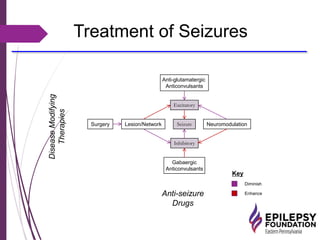
Treatment of Seizures
Anti-seizure
Drugs
DiseaseModifying
Therapies
Diminish
Enhance
Key
Excitatory
Inhibitory
Gabaergic
Anticonvulsants
Anti-glutamatergic
Anticonvulsants
Seizure NeuromodulationLesion/NetworkSurgery
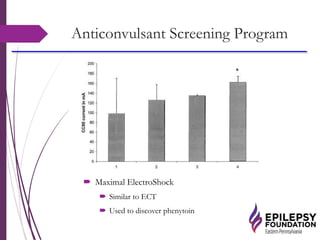
Anticonvulsant Screening Program
 Maximal ElectroShock
 Similar to ECT
 Used to discover phenytoin
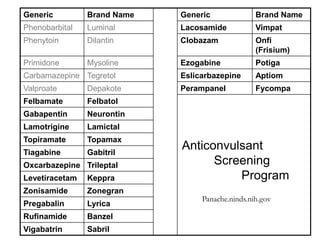
Generic Brand Name Generic Brand Name
Phenobarbital Luminal Lacosamide Vimpat
Phenytoin Dilantin Clobazam Onfi
(Frisium)
Primidone Mysoline Ezogabine Potiga
Carbamazepine Tegretol Eslicarbazepine Aptiom
Valproate Depakote Perampanel Fycompa
Felbamate Felbatol
Gabapentin Neurontin
Lamotrigine Lamictal
Topiramate Topamax
Tiagabine Gabitril
Oxcarbazepine Trileptal
Levetiracetam Keppra
Zonisamide Zonegran
Pregabalin Lyrica
Rufinamide Banzel
Vigabatrin Sabril
Anticonvulsant
Screening
Program
Panache.ninds.nih.gov
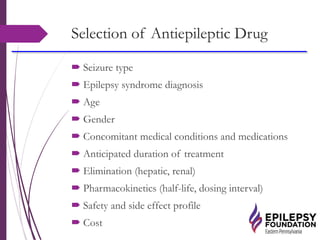
Selection of Antiepileptic Drug
 Seizure type
 Epilepsy syndrome diagnosis
 Age
 Gender
 Concomitant medical conditions and medications
 Anticipated duration of treatment
 Elimination (hepatic, renal)
 Pharmacokinetics (half-life, dosing interval)
 Safety and side effect profile
 Cost
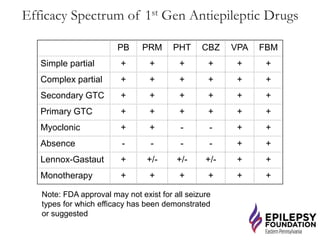
Efficacy Spectrum of 1st Gen Antiepileptic Drugs
PB PRM PHT CBZ VPA FBM
Simple partial + + + + + +
Complex partial + + + + + +
Secondary GTC + + + + + +
Primary GTC + + + + + +
Myoclonic + + - - + +
Absence - - - - + +
Lennox-Gastaut + +/- +/- +/- + +
Monotherapy + + + + + +
Note: FDA approval may not exist for all seizure
types for which efficacy has been demonstrated
or suggested
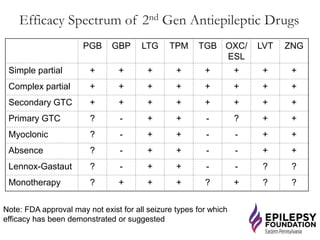
Efficacy Spectrum of 2nd Gen Antiepileptic Drugs
PGB GBP LTG TPM TGB OXC/
ESL
LVT ZNG
Simple partial + + + + + + + +
Complex partial + + + + + + + +
Secondary GTC + + + + + + + +
Primary GTC ? - + + - ? + +
Myoclonic ? - + + - - + +
Absence ? - + + - - + +
Lennox-Gastaut ? - + + - - ? ?
Monotherapy ? + + + ? + ? ?
Note: FDA approval may not exist for all seizure types for which
efficacy has been demonstrated or suggested
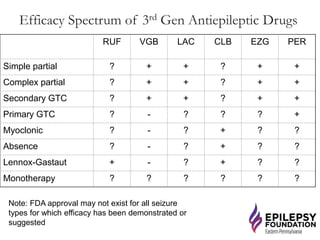
Efficacy Spectrum of 3rd Gen Antiepileptic Drugs
RUF VGB LAC CLB EZG PER
Simple partial ? + + ? + +
Complex partial ? + + ? + +
Secondary GTC ? + + ? + +
Primary GTC ? - ? ? ? +
Myoclonic ? - ? + ? ?
Absence ? - ? + ? ?
Lennox-Gastaut + - ? + ? ?
Monotherapy ? ? ? ? ? ?
Note: FDA approval may not exist for all seizure
types for which efficacy has been demonstrated or
suggested
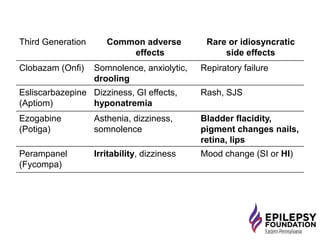
Third Generation Common adverse
effects
Rare or idiosyncratic
side effects
Clobazam (Onfi) Somnolence, anxiolytic,
drooling
Repiratory failure
Esliscarbazepine
(Aptiom)
Dizziness, GI effects,
hyponatremia
Rash, SJS
Ezogabine
(Potiga)
Asthenia, dizziness,
somnolence
Bladder flacidity,
pigment changes nails,
retina, lips
Perampanel
(Fycompa)
Irritability, dizziness Mood change (SI or HI)
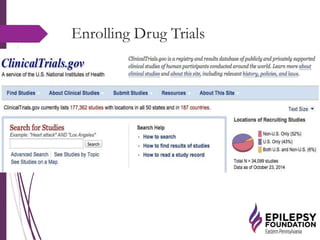
Enrolling Drug Trials
A Randomized, Double-Blind, Placebo-
Controlled Study of the Safety and Efficacy
of Intranasal Midazolam (USL261) in the
Outpatient Treatment of Subjects with
Seizure Clusters (P261-401)
A Randomized, Double-Blind, Placebo-Controlled
Study of the Safety and Efficacy of Intranasal
Midazolam (USL261) in the Outpatient Treatment
of Subjects with Seizure Clusters (P261-401)
Enrolling Drug Trials
A Multicenter, Double-Blind, Randomized,
Placebo-Controlled, Dose-Response Trial
of YKP3089 as Adjunctive Therapy in
Subjects with Partial Onset Seizures with
Optional Open-Label Extension (YKP3089
C017)
The purpose of this study is to determine the
effective dose range of YKP3089.
Enrolling Seizure Detection Study
A Pivotal Phase III Trial of Detecting
Generalized Tonic-Clonic Seizures with a
Seizure Detection and Warning System in
Epilepsy Patients (Brain Sentinel)
The purpose of this non-interventional device
study is to learn whether the experimental
seizure detection device being studied (the
Night WatchTM, an electromyography recorder
and analyzer) is able to detect GTC seizures
and alert caregivers when they start.
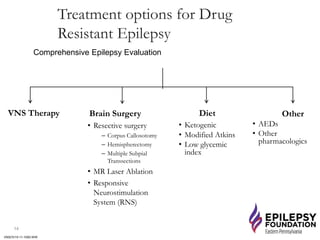
Treatment options for Drug
Resistant Epilepsy
14
Comprehensive Epilepsy Evaluation
VNS Therapy Diet
• Ketogenic
• Modified Atkins
• Low glycemic
index
Other
• AEDs
• Other
pharmacologics
Brain Surgery
• Resective surgery
– Corpus Callosotomy
– Hemispherectomy
– Multiple Subpial
Transsections
• MR Laser Ablation
• Responsive
Neurostimulation
System (RNS)
VNSOV15-11-1000-WW
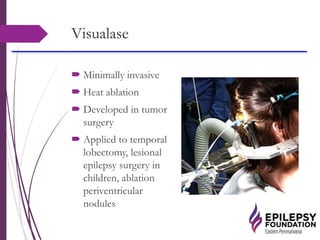
Visualase
 Minimally invasive
 Heat ablation
 Developed in tumor
surgery
 Applied to temporal
lobectomy, lesional
epilepsy surgery in
children, ablation
periventricular
nodules
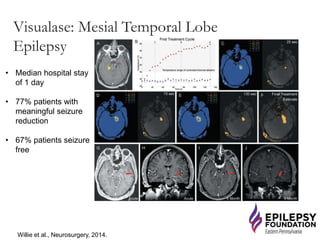
Visualase: Mesial Temporal Lobe
Epilepsy
• Median hospital stay
of 1 day
• 77% patients with
meaningful seizure
reduction
• 67% patients seizure
free
Willie et al., Neurosurgery, 2014.
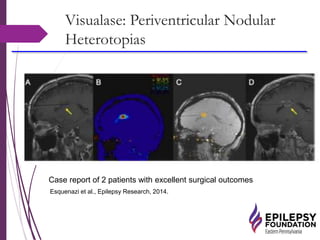
Visualase: Periventricular Nodular
Heterotopias
Case report of 2 patients with excellent surgical outcomes
Esquenazi et al., Epilepsy Research, 2014.
Transorbital endoscopic
amygdalohippocampectomy
 Minimally invasive
 Advantage is that cortex
spared
 Procedure offered only
at Penn by Dr. Lucas
Transorbital endoscopic
amygdalohippocampectomy: a feasibility
investigation. Source:
Journal of neurosurgery [0022-3085] Chen, H I
yr:2014 vol:120 iss:6 pg:1428 -1436
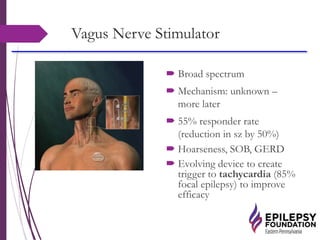
Vagus Nerve Stimulator
 Broad spectrum
 Mechanism: unknown –
more later
 55% responder rate
(reduction in sz by 50%)
 Hoarseness, SOB, GERD
 Evolving device to create
trigger to tachycardia (85%
focal epilepsy) to improve
efficacy
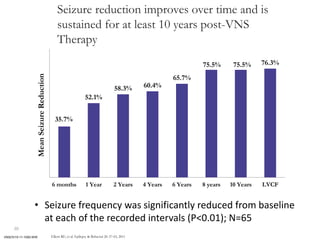
Seizure reduction improves over time and is
sustained for at least 10 years post-VNS
Therapy
20
35.7%
52.1%
58.3% 60.4%
65.7%
75.5% 75.5% 76.3%
6 months 1 Year 2 Years 4 Years 6 Years 8 years 10 Years LVCF
MeanSeizureReduction
• Seizure frequency was significantly reduced from baseline
at each of the recorded intervals (P<0.01); N=65
Elliott RE, et al. Epilepsy & Behavior 20: 57-63, 2011VNSOV15-11-1000-WW
NeuroPace® RNS® System Treatment
for Epilepsy
Indication for Use
The RNS® System is an adjunctive therapy in reducing the
frequency of seizures in individuals 18 years of age or older with
partial onset seizures who have undergone diagnostic testing that
localized no more than 2 epileptogenic foci, are refractory to two or
more antiepileptic medications, and currently have frequent and
disabling seizures (motor partial seizures, complex partial seizures
and/or secondarily generalized seizures). The RNS® System has
demonstrated safety and effectiveness in patients who average 3 or
more disabling seizures per month over the three most recent
months (with no month with fewer than two seizures), and has not
been evaluated in patients with less frequent seizures.
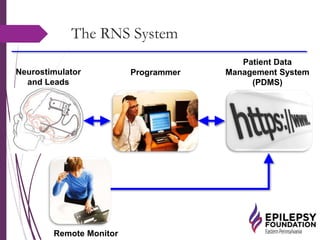
The RNS System
Neurostimulator
and Leads
Patient Data
Management System
(PDMS)
Programmer
Remote Monitor
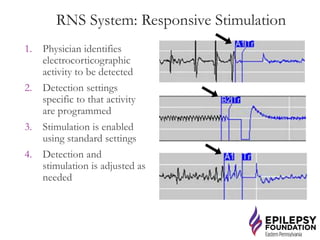
RNS System: Responsive Stimulation
1. Physician identifies
electrocorticographic
activity to be detected
2. Detection settings
specific to that activity
are programmed
3. Stimulation is enabled
using standard settings
4. Detection and
stimulation is adjusted as
needed
RNS Clinical Trials
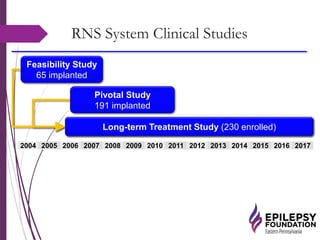
2004 2005 2006 2007 2008 2009 2010 2011 2012 2013 2014 2015 2016 2017
RNS System Clinical Studies
Feasibility Study
65 implanted
Pivotal Study
191 implanted
Long-term Treatment Study (230 enrolled)Long-term Treatment Study (230 enrolled)
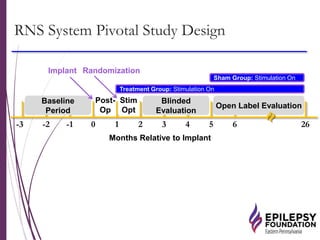
-3 -2 -1 0 1 2 3 4 5 6 26
RNS System Pivotal Study Design
Post-
Op
Stim
Opt
Months Relative to Implant
Implant Randomization
Sham Group: Stimulation On
Treatment Group: Stimulation On
Baseline
Period
Open Label Evaluation
Blinded
Evaluation
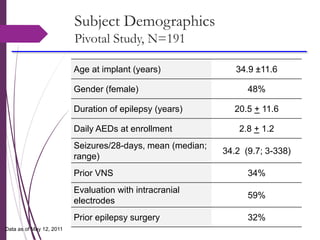
Subject Demographics
Pivotal Study, N=191
Age at implant (years) 34.9 ±11.6
Gender (female) 48%
Duration of epilepsy (years) 20.5 + 11.6
Daily AEDs at enrollment 2.8 + 1.2
Seizures/28-days, mean (median;
range)
34.2 (9.7; 3-338)
Prior VNS 34%
Evaluation with intracranial
electrodes
59%
Prior epilepsy surgery 32%
28
Data as of May 12, 2011
Primary Effectiveness Endpoint
Post-op Month of Blinded Evaluation PeriodEntire Blinded
Evaluation
Period
Month
4
Treatment
53 4 53
Sham
Treatment Sham
%
Change in
Seizure
Frequency
(GEE)
p = 0.012
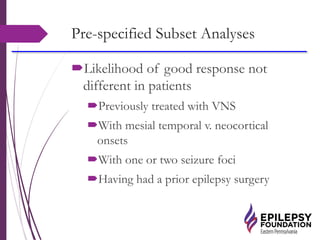
Pre-specified Subset Analyses
Likelihood of good response not
different in patients
Previously treated with VNS
With mesial temporal v. neocortical
onsets
With one or two seizure foci
Having had a prior epilepsy surgery
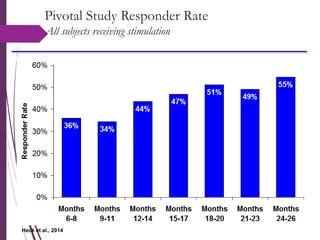
Pivotal Study Responder Rate
All subjects receiving stimulation
Sham
Treatment
Heck et al., 2014
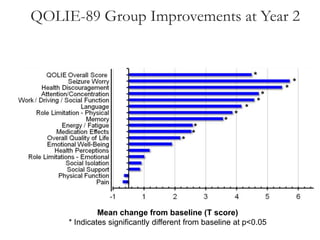
QOLIE-89 Group Improvements at Year 2
Mean change from baseline (T score)
* Indicates significantly different from baseline at p<0.05
*
*
*
*
*
*
*
*
*
*
*
Pivotal Study:
SAEs First Post-Op Month (N=191)
Most common SAEs
Implant site infection: 2.6% (5 subjects)
Extradural hematoma: 1.0% (2 subjects)
Hydrocephalus: 1.0% (2 subjects)
Procedural headache: 1.0% (2 subjects)
Neuropsychological and Mood Assessments
14 neuropsychological domains and 3 mood
inventories
Testing at baseline, end of Blinded Evaluation
Period and at 1 and 2 years post-implant
No difference between Treatment and Sham at end of
Blinded Evaluation Period
No deterioration in group scores at any time point
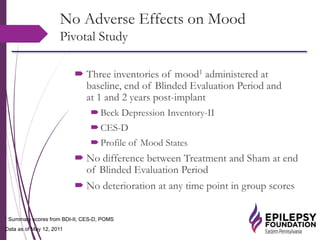
No Adverse Effects on Mood
Pivotal Study
 Three inventories of mood1 administered at
baseline, end of Blinded Evaluation Period and
at 1 and 2 years post-implant
Beck Depression Inventory-II
CES-D
Profile of Mood States
 No difference between Treatment and Sham at end
of Blinded Evaluation Period
 No deterioration at any time point in group scores
1 Summary scores from BDI-II, CES-D, POMS
Data as of May 12, 2011
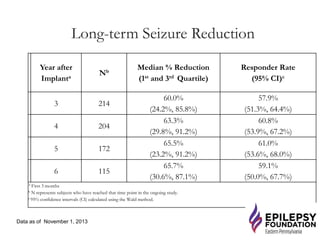
Year after
Implanta
Nb
Median % Reduction
(1st and 3rd Quartile)
Responder Rate
(95% CI)c
3 214
60.0%
(24.2%, 85.8%)
57.9%
(51.3%, 64.4%)
4 204
63.3%
(29.8%, 91.2%)
60.8%
(53.9%, 67.2%)
5 172
65.5%
(23.2%, 91.2%)
61.0%
(53.6%, 68.0%)
6 115
65.7%
(30.6%, 87.1%)
59.1%
(50.0%, 67.7%)
A First 3 months
b N represents subjects who have reached that time point in the ongoing study.
c 95% confidence intervals (CI) calculated using the Wald method.
Data as of November 1, 2013
Long-term Seizure Reduction
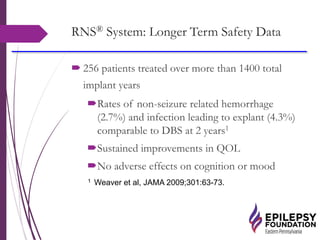
RNS® System: Longer Term Safety Data
 256 patients treated over more than 1400 total
implant years
Rates of non-seizure related hemorrhage
(2.7%) and infection leading to explant (4.3%)
comparable to DBS at 2 years1
Sustained improvements in QOL
No adverse effects on cognition or mood
1 Weaver et al, JAMA 2009;301:63-73.
The RNS System is a new type of adjunctive treatment
for with intractable partial seizures
 The RNS System is proven effective and safe in
some patients who have failed medications
 Patients who have been treated with the VNS or
epilepsy surgery may respond to the RNS System
 The RNS System provides an opportunity for
improved seizure control with good tolerability
and acceptable risk

New Treatment Devices and Clinical Trials

  • 1.
    New Treatment Devices andClinical Trials in Epilepsy Kate Davis, MD, MTR Assistant Professor of Neurology, University of Pennsylvania Medical Director of Penn’s Epilepsy Monitoring Unit and Epilepsy Surgical Program
  • 2.
  • 3.
    Anticonvulsant Screening Program Maximal ElectroShock  Similar to ECT  Used to discover phenytoin
  • 4.
    Generic Brand NameGeneric Brand Name Phenobarbital Luminal Lacosamide Vimpat Phenytoin Dilantin Clobazam Onfi (Frisium) Primidone Mysoline Ezogabine Potiga Carbamazepine Tegretol Eslicarbazepine Aptiom Valproate Depakote Perampanel Fycompa Felbamate Felbatol Gabapentin Neurontin Lamotrigine Lamictal Topiramate Topamax Tiagabine Gabitril Oxcarbazepine Trileptal Levetiracetam Keppra Zonisamide Zonegran Pregabalin Lyrica Rufinamide Banzel Vigabatrin Sabril Anticonvulsant Screening Program Panache.ninds.nih.gov
  • 5.
    Selection of AntiepilepticDrug  Seizure type  Epilepsy syndrome diagnosis  Age  Gender  Concomitant medical conditions and medications  Anticipated duration of treatment  Elimination (hepatic, renal)  Pharmacokinetics (half-life, dosing interval)  Safety and side effect profile  Cost
  • 6.
    Efficacy Spectrum of1st Gen Antiepileptic Drugs PB PRM PHT CBZ VPA FBM Simple partial + + + + + + Complex partial + + + + + + Secondary GTC + + + + + + Primary GTC + + + + + + Myoclonic + + - - + + Absence - - - - + + Lennox-Gastaut + +/- +/- +/- + + Monotherapy + + + + + + Note: FDA approval may not exist for all seizure types for which efficacy has been demonstrated or suggested
  • 7.
    Efficacy Spectrum of2nd Gen Antiepileptic Drugs PGB GBP LTG TPM TGB OXC/ ESL LVT ZNG Simple partial + + + + + + + + Complex partial + + + + + + + + Secondary GTC + + + + + + + + Primary GTC ? - + + - ? + + Myoclonic ? - + + - - + + Absence ? - + + - - + + Lennox-Gastaut ? - + + - - ? ? Monotherapy ? + + + ? + ? ? Note: FDA approval may not exist for all seizure types for which efficacy has been demonstrated or suggested
  • 8.
    Efficacy Spectrum of3rd Gen Antiepileptic Drugs RUF VGB LAC CLB EZG PER Simple partial ? + + ? + + Complex partial ? + + ? + + Secondary GTC ? + + ? + + Primary GTC ? - ? ? ? + Myoclonic ? - ? + ? ? Absence ? - ? + ? ? Lennox-Gastaut + - ? + ? ? Monotherapy ? ? ? ? ? ? Note: FDA approval may not exist for all seizure types for which efficacy has been demonstrated or suggested
  • 9.
    Third Generation Commonadverse effects Rare or idiosyncratic side effects Clobazam (Onfi) Somnolence, anxiolytic, drooling Repiratory failure Esliscarbazepine (Aptiom) Dizziness, GI effects, hyponatremia Rash, SJS Ezogabine (Potiga) Asthenia, dizziness, somnolence Bladder flacidity, pigment changes nails, retina, lips Perampanel (Fycompa) Irritability, dizziness Mood change (SI or HI)
  • 10.
  • 11.
    Enrolling Drug Trials ARandomized, Double-Blind, Placebo- Controlled Study of the Safety and Efficacy of Intranasal Midazolam (USL261) in the Outpatient Treatment of Subjects with Seizure Clusters (P261-401) A Randomized, Double-Blind, Placebo-Controlled Study of the Safety and Efficacy of Intranasal Midazolam (USL261) in the Outpatient Treatment of Subjects with Seizure Clusters (P261-401)
  • 12.
    Enrolling Drug Trials AMulticenter, Double-Blind, Randomized, Placebo-Controlled, Dose-Response Trial of YKP3089 as Adjunctive Therapy in Subjects with Partial Onset Seizures with Optional Open-Label Extension (YKP3089 C017) The purpose of this study is to determine the effective dose range of YKP3089.
  • 13.
    Enrolling Seizure DetectionStudy A Pivotal Phase III Trial of Detecting Generalized Tonic-Clonic Seizures with a Seizure Detection and Warning System in Epilepsy Patients (Brain Sentinel) The purpose of this non-interventional device study is to learn whether the experimental seizure detection device being studied (the Night WatchTM, an electromyography recorder and analyzer) is able to detect GTC seizures and alert caregivers when they start.
  • 14.
    Treatment options forDrug Resistant Epilepsy 14 Comprehensive Epilepsy Evaluation VNS Therapy Diet • Ketogenic • Modified Atkins • Low glycemic index Other • AEDs • Other pharmacologics Brain Surgery • Resective surgery – Corpus Callosotomy – Hemispherectomy – Multiple Subpial Transsections • MR Laser Ablation • Responsive Neurostimulation System (RNS) VNSOV15-11-1000-WW
  • 15.
    Visualase  Minimally invasive Heat ablation  Developed in tumor surgery  Applied to temporal lobectomy, lesional epilepsy surgery in children, ablation periventricular nodules
  • 16.
    Visualase: Mesial TemporalLobe Epilepsy • Median hospital stay of 1 day • 77% patients with meaningful seizure reduction • 67% patients seizure free Willie et al., Neurosurgery, 2014.
  • 17.
    Visualase: Periventricular Nodular Heterotopias Casereport of 2 patients with excellent surgical outcomes Esquenazi et al., Epilepsy Research, 2014.
  • 18.
    Transorbital endoscopic amygdalohippocampectomy  Minimallyinvasive  Advantage is that cortex spared  Procedure offered only at Penn by Dr. Lucas Transorbital endoscopic amygdalohippocampectomy: a feasibility investigation. Source: Journal of neurosurgery [0022-3085] Chen, H I yr:2014 vol:120 iss:6 pg:1428 -1436
  • 19.
    Vagus Nerve Stimulator Broad spectrum  Mechanism: unknown – more later  55% responder rate (reduction in sz by 50%)  Hoarseness, SOB, GERD  Evolving device to create trigger to tachycardia (85% focal epilepsy) to improve efficacy
  • 20.
    Seizure reduction improvesover time and is sustained for at least 10 years post-VNS Therapy 20 35.7% 52.1% 58.3% 60.4% 65.7% 75.5% 75.5% 76.3% 6 months 1 Year 2 Years 4 Years 6 Years 8 years 10 Years LVCF MeanSeizureReduction • Seizure frequency was significantly reduced from baseline at each of the recorded intervals (P<0.01); N=65 Elliott RE, et al. Epilepsy & Behavior 20: 57-63, 2011VNSOV15-11-1000-WW
  • 21.
    NeuroPace® RNS® SystemTreatment for Epilepsy
  • 22.
    Indication for Use TheRNS® System is an adjunctive therapy in reducing the frequency of seizures in individuals 18 years of age or older with partial onset seizures who have undergone diagnostic testing that localized no more than 2 epileptogenic foci, are refractory to two or more antiepileptic medications, and currently have frequent and disabling seizures (motor partial seizures, complex partial seizures and/or secondarily generalized seizures). The RNS® System has demonstrated safety and effectiveness in patients who average 3 or more disabling seizures per month over the three most recent months (with no month with fewer than two seizures), and has not been evaluated in patients with less frequent seizures.
  • 23.
    The RNS System Neurostimulator andLeads Patient Data Management System (PDMS) Programmer Remote Monitor
  • 24.
    RNS System: ResponsiveStimulation 1. Physician identifies electrocorticographic activity to be detected 2. Detection settings specific to that activity are programmed 3. Stimulation is enabled using standard settings 4. Detection and stimulation is adjusted as needed
  • 25.
  • 26.
    2004 2005 20062007 2008 2009 2010 2011 2012 2013 2014 2015 2016 2017 RNS System Clinical Studies Feasibility Study 65 implanted Pivotal Study 191 implanted Long-term Treatment Study (230 enrolled)Long-term Treatment Study (230 enrolled)
  • 27.
    -3 -2 -10 1 2 3 4 5 6 26 RNS System Pivotal Study Design Post- Op Stim Opt Months Relative to Implant Implant Randomization Sham Group: Stimulation On Treatment Group: Stimulation On Baseline Period Open Label Evaluation Blinded Evaluation
  • 28.
    Subject Demographics Pivotal Study,N=191 Age at implant (years) 34.9 ±11.6 Gender (female) 48% Duration of epilepsy (years) 20.5 + 11.6 Daily AEDs at enrollment 2.8 + 1.2 Seizures/28-days, mean (median; range) 34.2 (9.7; 3-338) Prior VNS 34% Evaluation with intracranial electrodes 59% Prior epilepsy surgery 32% 28 Data as of May 12, 2011
  • 29.
    Primary Effectiveness Endpoint Post-opMonth of Blinded Evaluation PeriodEntire Blinded Evaluation Period Month 4 Treatment 53 4 53 Sham Treatment Sham % Change in Seizure Frequency (GEE) p = 0.012
  • 30.
    Pre-specified Subset Analyses Likelihoodof good response not different in patients Previously treated with VNS With mesial temporal v. neocortical onsets With one or two seizure foci Having had a prior epilepsy surgery
  • 31.
    Pivotal Study ResponderRate All subjects receiving stimulation Sham Treatment Heck et al., 2014
  • 32.
    QOLIE-89 Group Improvementsat Year 2 Mean change from baseline (T score) * Indicates significantly different from baseline at p<0.05 * * * * * * * * * * *
  • 33.
    Pivotal Study: SAEs FirstPost-Op Month (N=191) Most common SAEs Implant site infection: 2.6% (5 subjects) Extradural hematoma: 1.0% (2 subjects) Hydrocephalus: 1.0% (2 subjects) Procedural headache: 1.0% (2 subjects)
  • 34.
    Neuropsychological and MoodAssessments 14 neuropsychological domains and 3 mood inventories Testing at baseline, end of Blinded Evaluation Period and at 1 and 2 years post-implant No difference between Treatment and Sham at end of Blinded Evaluation Period No deterioration in group scores at any time point
  • 35.
    No Adverse Effectson Mood Pivotal Study  Three inventories of mood1 administered at baseline, end of Blinded Evaluation Period and at 1 and 2 years post-implant Beck Depression Inventory-II CES-D Profile of Mood States  No difference between Treatment and Sham at end of Blinded Evaluation Period  No deterioration at any time point in group scores 1 Summary scores from BDI-II, CES-D, POMS Data as of May 12, 2011
  • 36.
    Year after Implanta Nb Median %Reduction (1st and 3rd Quartile) Responder Rate (95% CI)c 3 214 60.0% (24.2%, 85.8%) 57.9% (51.3%, 64.4%) 4 204 63.3% (29.8%, 91.2%) 60.8% (53.9%, 67.2%) 5 172 65.5% (23.2%, 91.2%) 61.0% (53.6%, 68.0%) 6 115 65.7% (30.6%, 87.1%) 59.1% (50.0%, 67.7%) A First 3 months b N represents subjects who have reached that time point in the ongoing study. c 95% confidence intervals (CI) calculated using the Wald method. Data as of November 1, 2013 Long-term Seizure Reduction
  • 37.
    RNS® System: LongerTerm Safety Data  256 patients treated over more than 1400 total implant years Rates of non-seizure related hemorrhage (2.7%) and infection leading to explant (4.3%) comparable to DBS at 2 years1 Sustained improvements in QOL No adverse effects on cognition or mood 1 Weaver et al, JAMA 2009;301:63-73.
  • 38.
    The RNS Systemis a new type of adjunctive treatment for with intractable partial seizures  The RNS System is proven effective and safe in some patients who have failed medications  Patients who have been treated with the VNS or epilepsy surgery may respond to the RNS System  The RNS System provides an opportunity for improved seizure control with good tolerability and acceptable risk