A SEMINAR PRESENTATION ON -
RESPIRATORY SYSTEM
OF CRUSTACEA
Presented by-
Avijit Pramanik
AAH-MA-09-02
B.F.Sc, W.B.U.A.F.S.
M.F.Sc, CIFE, Mumbai
About Crustacea
Ø Crustaceans form a large, diverse arthropod taxon which includes such animals as crabs,
lobsters, crayfish, shrimps, prawns, krill, woodlice, and barnacles.
Ø The name "custacea" comes from the Latin word meaning "crusted forms".
Ø Crustaceans are primarily aquatic arthropod.
Ø They have five pairs of jointed legs, and in some species, the front pair of legs are
modified to form strong pincers.
Ø Crustaceans have compound eyes (made up of lots of lenses) on stalks and two pairs of
antennae, which help them to sense predators.
Respiration
Ø Respiration strategy obviously varies with the type of environment the organism lives in.
Ø The goal of respiration is to bring oxygen into the body and expel waste gases out of the
body.
Ø Very small aquatic crustaceans exchange gases through the process of diffusion directly
across the body surface called the integument.
Ø The blood is close enough to the surface to directly exchange gases at the surface.
Ø This is feasible mainly because the oxygen requirement of tiny organisms is relatively low,
and because the small organisms have a great deal of surface area compared to body
mass (meaning more gas can be exchanged relative to body size).
Respiration
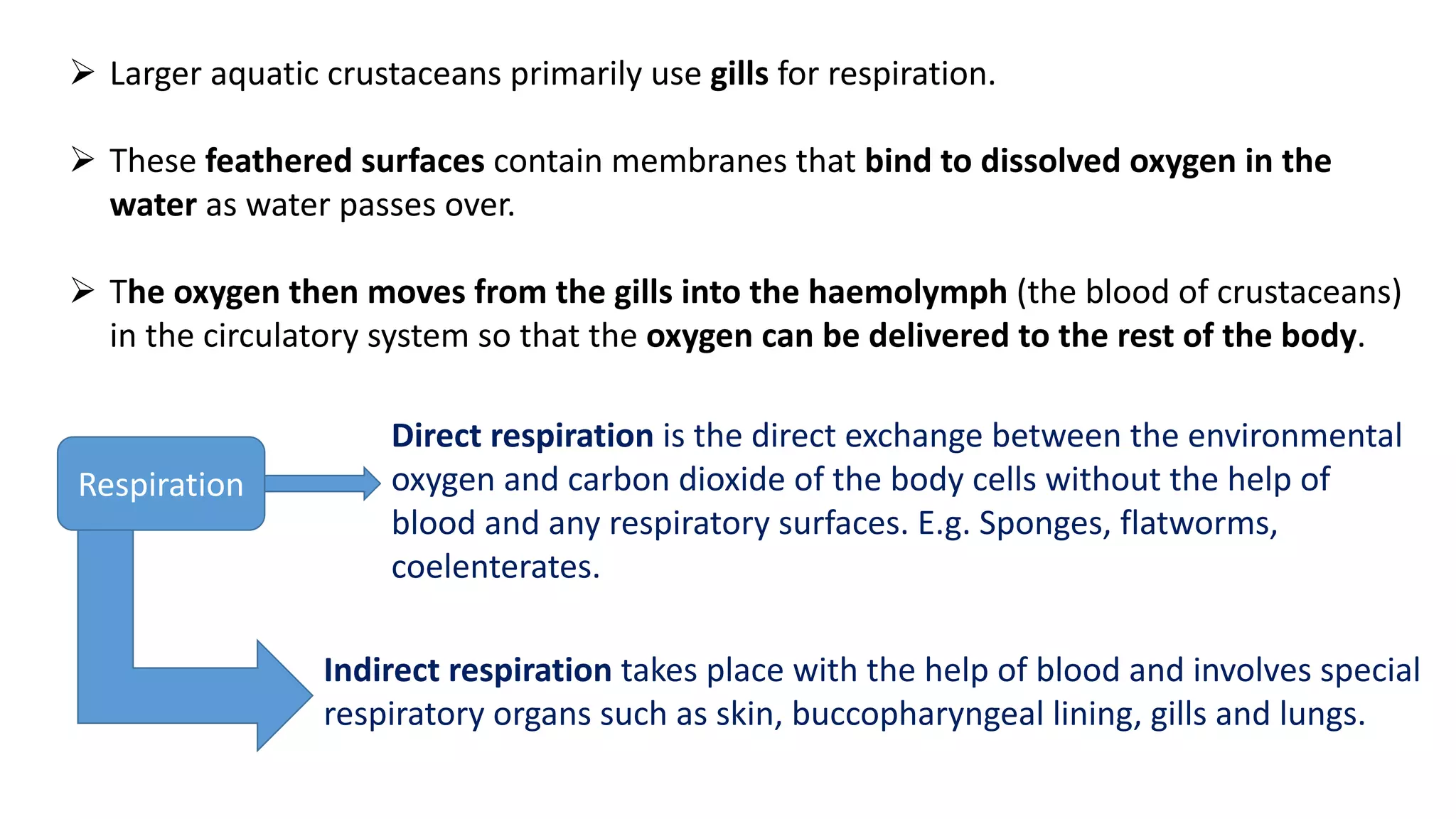
Direct respiration is the direct exchange between the environmental
oxygen and carbon dioxide of the body cells without the help of
blood and any respiratory surfaces. E.g. Sponges, flatworms,
coelenterates.
Indirect respiration takes place with the help of blood and involves special
respiratory organs such as skin, buccopharyngeal lining, gills and lungs.
Ø Larger aquatic crustaceans primarily use gills for respiration.
Ø These feathered surfaces contain membranes that bind to dissolved oxygen in the
water as water passes over.
Ø The oxygen then moves from the gills into the haemolymph (the blood of crustaceans)
in the circulatory system so that the oxygen can be delivered to the rest of the body.
Different types of respiratory system in crustaceans
1) Many of the smaller crustaceans, such as the copepods, have no special respiratory
organs.
§ Gas exchange takes place through the entire thin integument.
§ The inner wall of the carapace, facing the trunk, is often rich with blood vessels and
may in many groups be the only respiratory organ.
2) For those who have gills, are formed by modifications of parts of appendages, most
often the epipodites.
§ These thin-walled, lamellate structures are present on some or all of the thoracic
appendages in cephalocarids, fairy shrimps, and many malacostracans.
3) In mantis shrimps (order Stomatopoda), for example, gills are found on the
exopodites of the pleopods.
Cont..
4) In euphausiids the single series of branched epipodial gills are fully exposed.
5) In decapods the gills, protected by the overhanging carapace, are arranged in three
series at or near the limb bases.
6) As an adaptation to aerial respiration, the branchial chambers are greatly enlarged in
certain land crabs and serve as lungs, the inner membrane being richly supplied with
blood vessels.
7) In isopods the respiratory function has been taken over by the abdominal appendages;
either both rami or the endopodite become thin and flattened.
8) Most sow bugs and pill bugs have, in addition, trachea-like infoldings in some of the
exopodites.
Respiratory System of Prawn:
Ø Prawn respires in the aquatic medium and it carries three sets of organs for the
purpose -
A. lining of the branchiostegite
B. epipodites and
C. gills
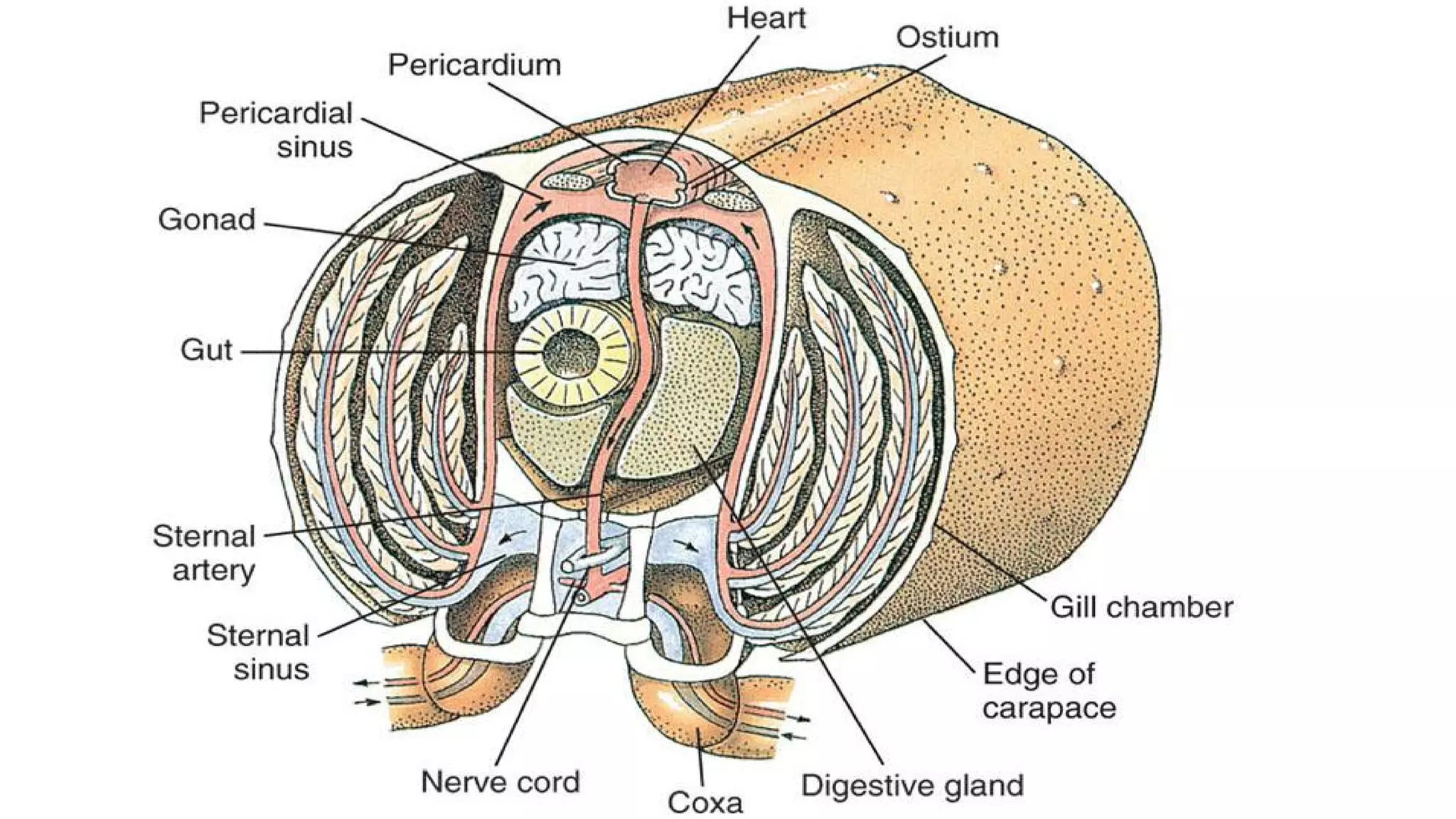
Ø All these organs are enclosed within a special chamber on each side of the
cephalothorax, which is called gill-chamber.
Ø The gill-chamber is covered by the lateral extension of carapace, called gill- cover or
branchiostegite.
Ø Each gill-chamber is thus open ventrally, anteriorly and posteriorly.
A. Lining of the branchiostegite:
The richly vascularised membrane of the branchiostegite serves as respiratory surface,
through which gaseous exchange takes place.
B. Epipodites:
q These are - small highly vascularised leaf-like membranous structures
- one on the coxal segment of each maxilliped
q These epipodites being present in the anterior part of the gill-chamber carry out
respiratory functions.
C. Gills:
Ø The gills are regarded as primary respiratory organs.
Ø On each lateral side of the cephalothorax and beneath the branchiostegites, there
are eight gills (Fig. 18.10),
- each attached with the thoracic wall by a gill-root.
Ø 7 of these 8 gills are serially arranged , while the 8th gill remains concealed under the
2nd gill.
Ø The gills are crescent-shaped and their sizes increase gradually from anterior to
posterior direction .
Ø Each gill consists of a slender axis or base on which double rows of rhomboidal leaf-
like gill-plates are arranged like the pages of a book.
Location of gills:
q A crustacean's gills are found in either the thoracic cavity (chest cavity) or on
appendages.
q If they are on appendages they might be visible.
q They will look like feathered areas at the end of legs or at the junction between legs and
body shells.
q The feathered effect is due to the structure of gills, which need as much surface area as
possible to be able to get the most oxygen from water flowing over them.
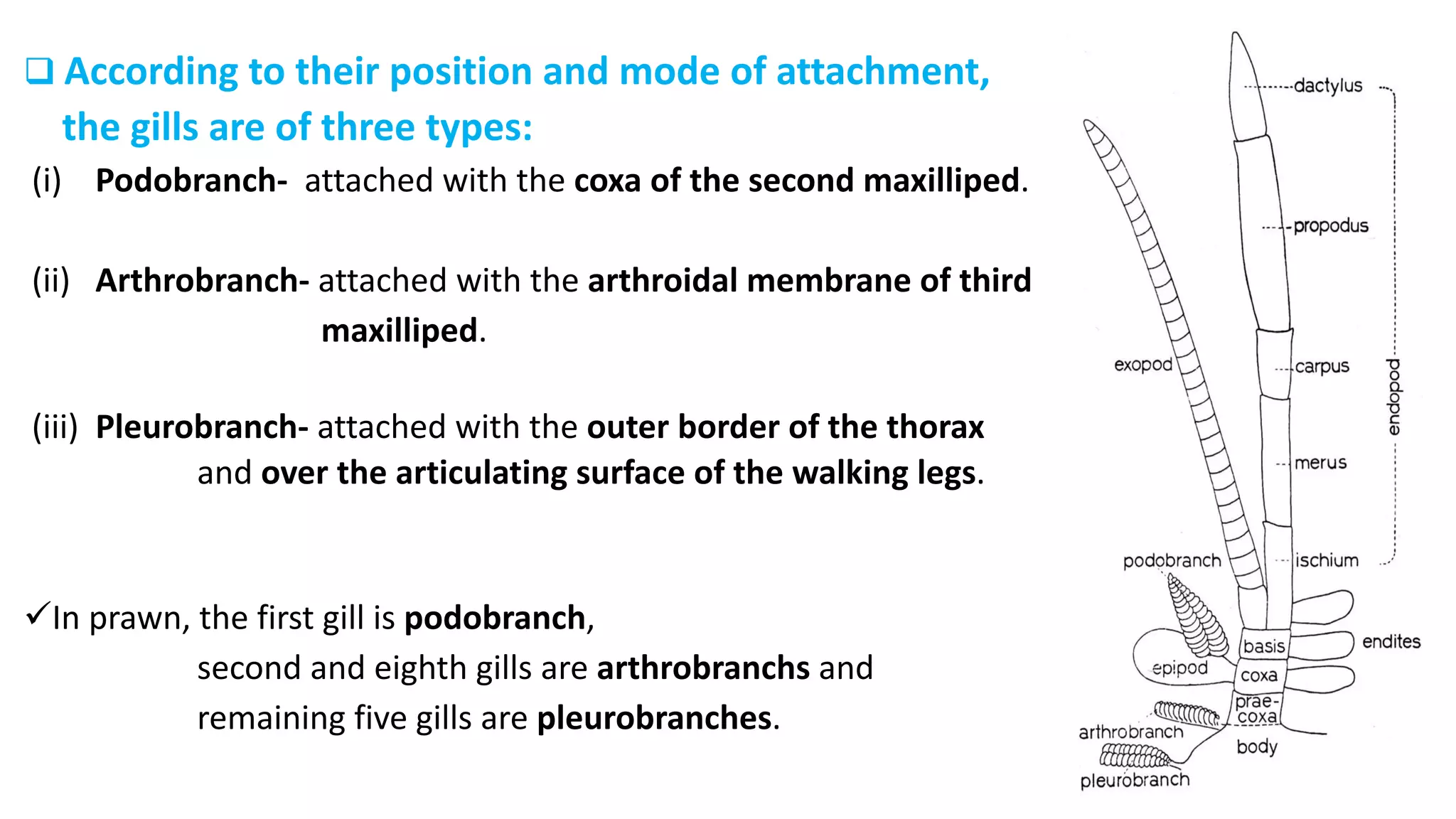
q According to their position and mode of attachment,
the gills are of three types:
(i) Podobranch- attached with the coxa of the second maxilliped.
(ii) Arthrobranch- attached with the arthroidal membrane of third
maxilliped.
(iii) Pleurobranch- attached with the outer border of the thorax
and over the articulating surface of the walking legs.
üIn prawn, the first gill is podobranch,
second and eighth gills are arthrobranchs and
remaining five gills are pleurobranches.
Histology:
Ø Histological structure of the gill shows that gill base has following layers—
1) the outermost cuticle,
2) inner epidermis and
3) innermost connective tissue mass.
Ø Each gill- plate is formed by monolayer of cells, sand-witched between two layers of
cuticle.
Ø The cellular layer includes two alternately arranged cell types—pigmented and
transparent.
Ø These gills are generally associated with the appendages.
Ø They are also involved in excretory function.
Gill types of the Decapoda in SEM.
A: Dendrobranchiate gills of Penaeus setiferus. X50.
B: Close-up of dendrobranchiate gill lamellae of
Penaeus setiferus. x 125.
C: Trichobranchiate gills of Stenopus hispidus. x 50.
D: Close-up of trichobranchiate gill lamellae of
Nephrops sp. x 220.
E: Phyllobranchiate gills of Ranilia sp. X15.
F: Close-up of phyllobranchiate gills of Lysmala
wurdemanni. x200.
Mechanism of Respiration:
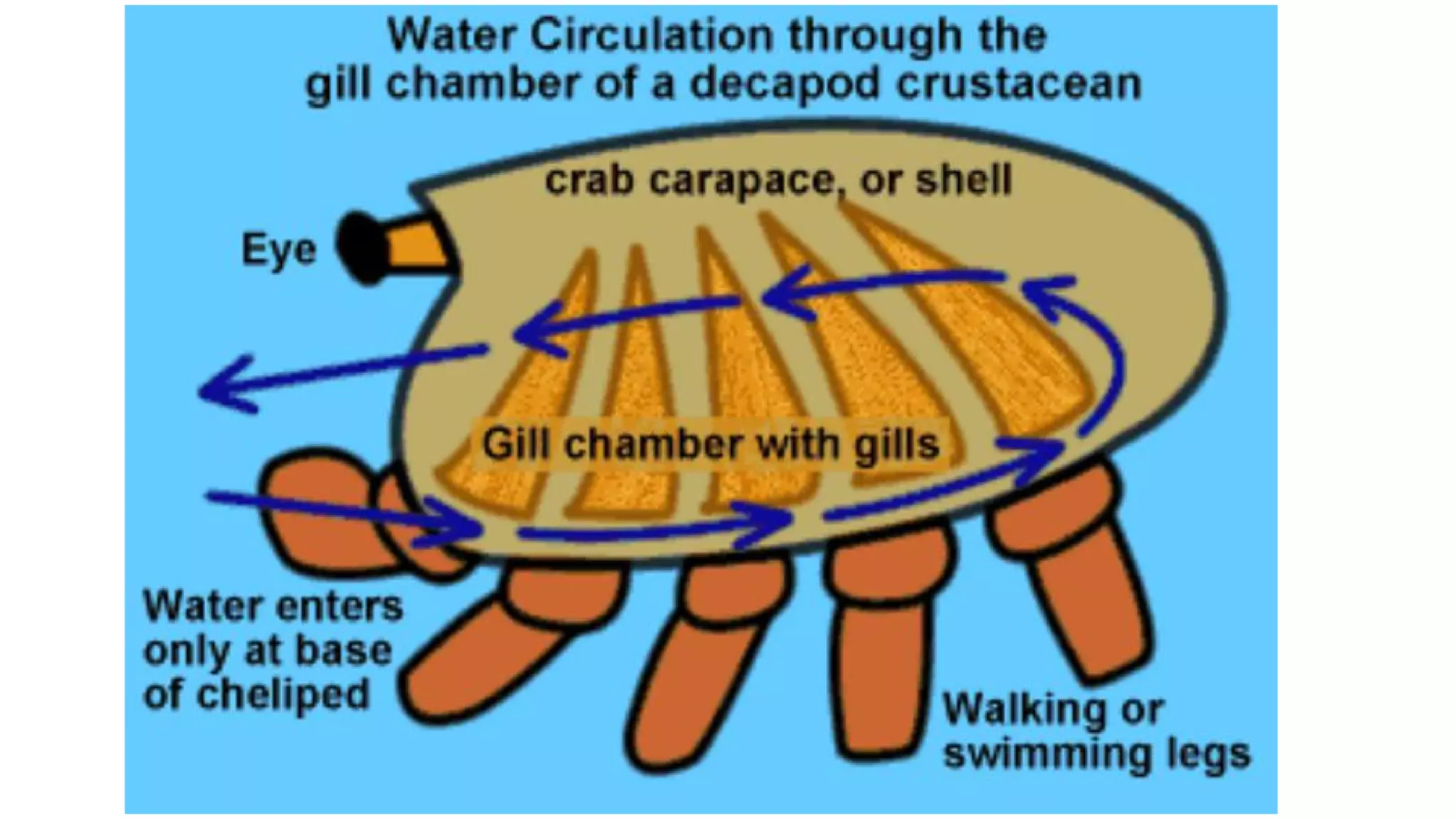
Ø The scaphognathites of maxillae and exopodites of maxillipeds are responsible for
forcing the water to rush inside the gill- chamber through posterior and lateral sides.
Ø Oxygen is taken up from the circulating water across the Gill surface.
Ø Water current are facilitated by beating of appendages.
Ø The oxygen binds with the respiratory pigment Haemocyanin.
Ø Haemocyanin helps in further distribution of oxygen throughout the body.
Ø During the flow of water the vascularised surface of the branchiostegites, gills and
epipodites are bathed and gaseous exchange occurs through these areas when
dissolved oxygen is taken in and carbon dioxide, ammonia passes from the body to
the exterior.
Gills of crayfish under carapage
Exchanging of gases
Different function of Gills
q The crustacean gill is a multi-functional organ, and it is the site of a number of
physiological processes, including:
1) Gas exchange (described earlier)
2) ion transport, which is the basis for hemolymph osmoregulation
3) acid-base balance
4) ammonia excretion
2) Ion exchange/ osmoregulation:
ü Gills are the major site of active NaCl absorption in hyper-osmoregulating of crustacea.
ü Chloride cells are highly reduced or absent in anterior gills.
3) Acid-Base balance:
Ø Respiratory CO2 diffuses into the hemolymph where it is hydrated to form carbonic
acid.
Ø CO2 has equal solubility in air and water while O2 solubility in water is approximately
28 times lower than in air.
Ø High volumes of water must be pumped over the gills in order to extract enough
O2 to support metabolism.
4) Ammonia excretion:
Ø Ammonia is the natural waste product of crustaceans protein metabolism.
Ø Ammonia is excreted as their primary nitrogenous waste product.
Ø Main sites of ammonia excretion are usually organs gills, pleopods, and other well
ventilated appendages.
Conclusion
Ø Respiration is very important for survival of all organism on earth.
Ø Gills are very similar to lungs in the way that they function.
Ø The crustaceans are small organism with simple organs but are able to utilize it in the
most effective way as they are able to survive in harsh environments.
Ø The rapid flow of water past the gills also creates unfavorable conditions for the
settlement and growth of microfouling organisms.
Ø As a result, most decapods show adaptations for keeping gills free of fouling.
References
ØLocomotion and Energetics in Arthropods (eBook) by Clyde F. HerreidIICharles R.
Fourtner, Respiratory and Circulatory Coordination in Decapod Crustaceans, pg - 277-298
ØCrustacean Respiratory System from Study.com
ØBruce E. Felgenhauer, Internal Anatomy of the Decapoda: An Overview. Pg - 14-19
ØRaymond T. Bauer.1999, Gill-Cleaning Mechanisms of a Dendrobranchiate Shrimp,
Rimapenaeus similis (Decapoda, Penaeidae): Description and Experimental Testing of
Function . Journal of Morphology ; 2-12 and 125-139.
ØRaymond P. Henry., Cedomil Lucu.,Horst Onken and Dirk Weihrauch, Multiple functions
of the crustacean gill: osmotic/ionic regulation, acid-base balance, ammonia excretion,
and bioaccumulation of toxic metals.
THANK YOU

Respiratory system of crustacea

  • 1.
    A SEMINAR PRESENTATIONON - RESPIRATORY SYSTEM OF CRUSTACEA Presented by- Avijit Pramanik AAH-MA-09-02 B.F.Sc, W.B.U.A.F.S. M.F.Sc, CIFE, Mumbai
  • 2.
    About Crustacea Ø Crustaceansform a large, diverse arthropod taxon which includes such animals as crabs, lobsters, crayfish, shrimps, prawns, krill, woodlice, and barnacles. Ø The name "custacea" comes from the Latin word meaning "crusted forms". Ø Crustaceans are primarily aquatic arthropod. Ø They have five pairs of jointed legs, and in some species, the front pair of legs are modified to form strong pincers. Ø Crustaceans have compound eyes (made up of lots of lenses) on stalks and two pairs of antennae, which help them to sense predators.
  • 3.
    Respiration Ø Respiration strategyobviously varies with the type of environment the organism lives in. Ø The goal of respiration is to bring oxygen into the body and expel waste gases out of the body. Ø Very small aquatic crustaceans exchange gases through the process of diffusion directly across the body surface called the integument. Ø The blood is close enough to the surface to directly exchange gases at the surface. Ø This is feasible mainly because the oxygen requirement of tiny organisms is relatively low, and because the small organisms have a great deal of surface area compared to body mass (meaning more gas can be exchanged relative to body size).
  • 4.
    Respiration Direct respiration isthe direct exchange between the environmental oxygen and carbon dioxide of the body cells without the help of blood and any respiratory surfaces. E.g. Sponges, flatworms, coelenterates. Indirect respiration takes place with the help of blood and involves special respiratory organs such as skin, buccopharyngeal lining, gills and lungs. Ø Larger aquatic crustaceans primarily use gills for respiration. Ø These feathered surfaces contain membranes that bind to dissolved oxygen in the water as water passes over. Ø The oxygen then moves from the gills into the haemolymph (the blood of crustaceans) in the circulatory system so that the oxygen can be delivered to the rest of the body.
  • 5.
    Different types ofrespiratory system in crustaceans 1) Many of the smaller crustaceans, such as the copepods, have no special respiratory organs. § Gas exchange takes place through the entire thin integument. § The inner wall of the carapace, facing the trunk, is often rich with blood vessels and may in many groups be the only respiratory organ. 2) For those who have gills, are formed by modifications of parts of appendages, most often the epipodites. § These thin-walled, lamellate structures are present on some or all of the thoracic appendages in cephalocarids, fairy shrimps, and many malacostracans. 3) In mantis shrimps (order Stomatopoda), for example, gills are found on the exopodites of the pleopods.
  • 6.
    Cont.. 4) In euphausiidsthe single series of branched epipodial gills are fully exposed. 5) In decapods the gills, protected by the overhanging carapace, are arranged in three series at or near the limb bases. 6) As an adaptation to aerial respiration, the branchial chambers are greatly enlarged in certain land crabs and serve as lungs, the inner membrane being richly supplied with blood vessels. 7) In isopods the respiratory function has been taken over by the abdominal appendages; either both rami or the endopodite become thin and flattened. 8) Most sow bugs and pill bugs have, in addition, trachea-like infoldings in some of the exopodites.
  • 7.
    Respiratory System ofPrawn: Ø Prawn respires in the aquatic medium and it carries three sets of organs for the purpose - A. lining of the branchiostegite B. epipodites and C. gills Ø All these organs are enclosed within a special chamber on each side of the cephalothorax, which is called gill-chamber. Ø The gill-chamber is covered by the lateral extension of carapace, called gill- cover or branchiostegite. Ø Each gill-chamber is thus open ventrally, anteriorly and posteriorly.
  • 8.
    A. Lining ofthe branchiostegite: The richly vascularised membrane of the branchiostegite serves as respiratory surface, through which gaseous exchange takes place.
  • 9.
    B. Epipodites: q Theseare - small highly vascularised leaf-like membranous structures - one on the coxal segment of each maxilliped q These epipodites being present in the anterior part of the gill-chamber carry out respiratory functions.
  • 10.
    C. Gills: Ø Thegills are regarded as primary respiratory organs. Ø On each lateral side of the cephalothorax and beneath the branchiostegites, there are eight gills (Fig. 18.10), - each attached with the thoracic wall by a gill-root. Ø 7 of these 8 gills are serially arranged , while the 8th gill remains concealed under the 2nd gill. Ø The gills are crescent-shaped and their sizes increase gradually from anterior to posterior direction . Ø Each gill consists of a slender axis or base on which double rows of rhomboidal leaf- like gill-plates are arranged like the pages of a book.
  • 13.
    Location of gills: qA crustacean's gills are found in either the thoracic cavity (chest cavity) or on appendages. q If they are on appendages they might be visible. q They will look like feathered areas at the end of legs or at the junction between legs and body shells. q The feathered effect is due to the structure of gills, which need as much surface area as possible to be able to get the most oxygen from water flowing over them.
  • 14.
    q According totheir position and mode of attachment, the gills are of three types: (i) Podobranch- attached with the coxa of the second maxilliped. (ii) Arthrobranch- attached with the arthroidal membrane of third maxilliped. (iii) Pleurobranch- attached with the outer border of the thorax and over the articulating surface of the walking legs. üIn prawn, the first gill is podobranch, second and eighth gills are arthrobranchs and remaining five gills are pleurobranches.
  • 15.
    Histology: Ø Histological structureof the gill shows that gill base has following layers— 1) the outermost cuticle, 2) inner epidermis and 3) innermost connective tissue mass. Ø Each gill- plate is formed by monolayer of cells, sand-witched between two layers of cuticle. Ø The cellular layer includes two alternately arranged cell types—pigmented and transparent. Ø These gills are generally associated with the appendages. Ø They are also involved in excretory function.
  • 16.
    Gill types ofthe Decapoda in SEM. A: Dendrobranchiate gills of Penaeus setiferus. X50. B: Close-up of dendrobranchiate gill lamellae of Penaeus setiferus. x 125. C: Trichobranchiate gills of Stenopus hispidus. x 50. D: Close-up of trichobranchiate gill lamellae of Nephrops sp. x 220. E: Phyllobranchiate gills of Ranilia sp. X15. F: Close-up of phyllobranchiate gills of Lysmala wurdemanni. x200.
  • 17.
    Mechanism of Respiration: ØThe scaphognathites of maxillae and exopodites of maxillipeds are responsible for forcing the water to rush inside the gill- chamber through posterior and lateral sides. Ø Oxygen is taken up from the circulating water across the Gill surface. Ø Water current are facilitated by beating of appendages. Ø The oxygen binds with the respiratory pigment Haemocyanin. Ø Haemocyanin helps in further distribution of oxygen throughout the body. Ø During the flow of water the vascularised surface of the branchiostegites, gills and epipodites are bathed and gaseous exchange occurs through these areas when dissolved oxygen is taken in and carbon dioxide, ammonia passes from the body to the exterior.
  • 19.
    Gills of crayfishunder carapage Exchanging of gases
  • 20.
    Different function ofGills q The crustacean gill is a multi-functional organ, and it is the site of a number of physiological processes, including: 1) Gas exchange (described earlier) 2) ion transport, which is the basis for hemolymph osmoregulation 3) acid-base balance 4) ammonia excretion 2) Ion exchange/ osmoregulation: ü Gills are the major site of active NaCl absorption in hyper-osmoregulating of crustacea. ü Chloride cells are highly reduced or absent in anterior gills.
  • 21.
    3) Acid-Base balance: ØRespiratory CO2 diffuses into the hemolymph where it is hydrated to form carbonic acid. Ø CO2 has equal solubility in air and water while O2 solubility in water is approximately 28 times lower than in air. Ø High volumes of water must be pumped over the gills in order to extract enough O2 to support metabolism. 4) Ammonia excretion: Ø Ammonia is the natural waste product of crustaceans protein metabolism. Ø Ammonia is excreted as their primary nitrogenous waste product. Ø Main sites of ammonia excretion are usually organs gills, pleopods, and other well ventilated appendages.
  • 22.
    Conclusion Ø Respiration isvery important for survival of all organism on earth. Ø Gills are very similar to lungs in the way that they function. Ø The crustaceans are small organism with simple organs but are able to utilize it in the most effective way as they are able to survive in harsh environments. Ø The rapid flow of water past the gills also creates unfavorable conditions for the settlement and growth of microfouling organisms. Ø As a result, most decapods show adaptations for keeping gills free of fouling.
  • 23.
    References ØLocomotion and Energeticsin Arthropods (eBook) by Clyde F. HerreidIICharles R. Fourtner, Respiratory and Circulatory Coordination in Decapod Crustaceans, pg - 277-298 ØCrustacean Respiratory System from Study.com ØBruce E. Felgenhauer, Internal Anatomy of the Decapoda: An Overview. Pg - 14-19 ØRaymond T. Bauer.1999, Gill-Cleaning Mechanisms of a Dendrobranchiate Shrimp, Rimapenaeus similis (Decapoda, Penaeidae): Description and Experimental Testing of Function . Journal of Morphology ; 2-12 and 125-139. ØRaymond P. Henry., Cedomil Lucu.,Horst Onken and Dirk Weihrauch, Multiple functions of the crustacean gill: osmotic/ionic regulation, acid-base balance, ammonia excretion, and bioaccumulation of toxic metals.
  • 24.