Arnab Basu
    II nd semester
S.I.F.;C.U.S.A.T.
GENERAL INFORMATION:-
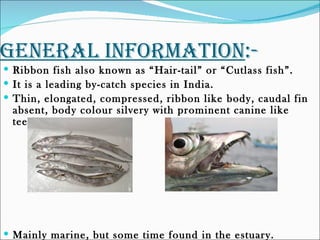
 Ribbon fish also known as “Hair-tail” or “Cutlass fish”.
 It is a leading by-catch species in India.
 Thin, elongated, compressed, ribbon like body, caudal fin
 absent, body colour silvery with prominent canine like
 teeth.


 Mainly marine, but some time found in the estuary.
TAxONOMIc cLAssIFIcATION:-
 Phylum- Chordata
 Subphylum- Vertebrata
 Class- Actinopterygii
 Super-order- Acanthopterygii
 Order - Perciformes
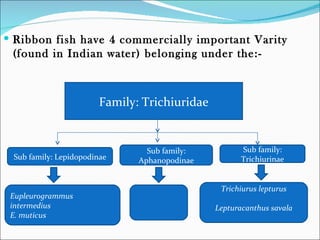
 Ribbon fish have 4 commercially important Varity
 (found in Indian water) belonging under the:-


                        Family: Trichiuridae


                                 Sub family:          Sub family:
 Sub family: Lepidopodinae     Aphanopodinae          Trichiurinae


                                                Trichiurus lepturus
 Eupleurogrammus
 intermedius                                   Lepturacanthus savala
 E. muticus
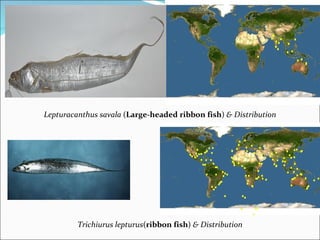
Lepturacanthus savala (Large-headed ribbon fish) & Distribution


         Trichiurus lepturus(ribbon fish) & Distribution
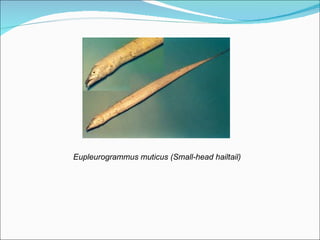
Eupleurogrammus muticus (Small-head hailtail)
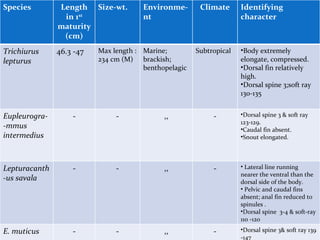
Species        Length Size-wt.         Environme-       Climate      Identifying
                in 1st                 nt                            character
               maturity
                (cm)
Trichiurus     46.3 -47   Max length : Marine;         Subtropical   •Body extremely
lepturus                  234 cm (M) brackish;                       elongate, compressed.
                                       benthopelagic                 •Dorsal fin relatively
                                                                     high.
                                                                     •Dorsal spine 3;soft ray
                                                                     130-135


Eupleurogra-       -           -             ,,             -        •Dorsal spine 3 & soft ray
                                                                     123-129.
-mmus                                                                •Caudal fin absent.
intermedius                                                          •Snout elongated.


Lepturacanth       -           -             ,,             -        • Lateral line running
                                                                     nearer the ventral than the
-us savala                                                           dorsal side of the body.
                                                                     • Pelvic and caudal fins
                                                                     absent; anal fin reduced to
                                                                     spinules .
                                                                     •Dorsal spine 3-4 & soft-ray
                                                                     110 -120

E. muticus         -           -             ,,             -        •Dorsal spine 3& soft ray 139
                                                                     -147
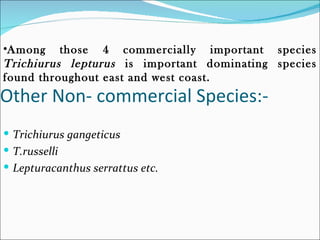
•Among those 4 commercially important species
Trichiurus lepturus is important dominating species
found throughout east and west coast.
Other Non- commercial Species:-
 Trichiurus gangeticus
 T.russelli
 Lepturacanthus serrattus etc.
FOOd & FEEdING HAbIT
•Ribbon fish are predacious, carnivorous and some time shows cannibalistic
behavior and selective feeding behavior.
•Feeding both during day and night.
•Intensity of feeding is not related to the spawning activity.


                Stage                                     Food
       Post-larvae and juveniles       larvae and Small juvenile (anchovy,
                                       clupeoids, carangidae),
                                       cephalopods larvae, calanoid copepods, post
                                       larvae & larvae of penaeid prawns &
                                       shrimps, crabs, acetes etc
                Adults                 Commercially important fish and other
                                       organisms i.e. Stolephorus spp. Kowala
                                       coval, Sardinella spp., Leioggnathus spp.,
                                       Dussumieria spp., polynemids, Carnax spp.,
                                       Acetes*, Penaeus & metapenaeus prawns,
                                       octopus, squilla*,crab larvae, isopods, Sepia
                                       spp., megalopa larvae etc.
REPROdUcTIVE bIOLOGY
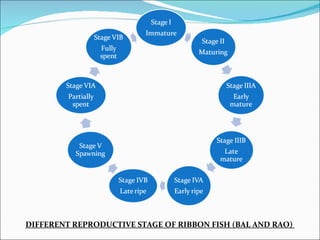
DIFFERENT REPRODUCTIVE STAGE OF RIBBON FISH (BAL AND RAO)
sPAWNING sEAsON
 On west coast, peak spawning season April- June. But
  in east coast it is February to June , peak in May.
 Another is November - December.
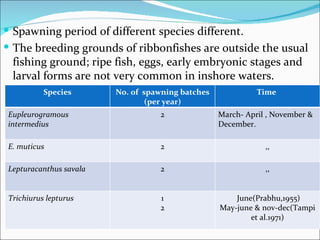
 Spawning period of different species different.
 The breeding grounds of ribbonfishes are outside the usual
 fishing ground; ripe fish, eggs, early embryonic stages and
 larval forms are not very common in inshore waters.
          Species       No. of spawning batches             Time
                                (per year)
Eupleurogramous                    2              March- April , November &
intermedius                                       December.

E. muticus                         2                          ,,

Lepturacanthus savala              2                          ,,


Trichiurus lepturus                1                  June(Prabhu,1955)
                                   2              May-june & nov-dec(Tampi
                                                          et al.1971)
FEcUNdITY
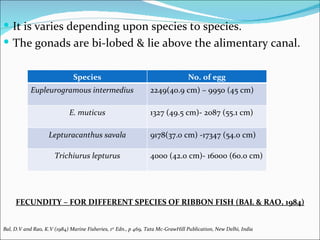
 It is varies depending upon species to species.
 The gonads are bi-lobed & lie above the alimentary canal.


                              Species                                            No. of egg
            Eupleurogramous intermedius                         2249(40.9 cm) – 9950 (45 cm)

                             E. muticus                         1327 (49.5 cm)- 2087 (55.1 cm)

                    Lepturacanthus savala                       9178(37.0 cm) -17347 (54.0 cm)

                      Trichiurus lepturus                       4000 (42.0 cm)- 16000 (60.0 cm)


     FECUNDITY – FOR DIFFERENT SPECIES OF RIBBON FISH (BAL & RAO, 1984)


Bal, D.V and Rao, K.V (1984) Marine Fisheries, 1st Edn., p 469, Tata Mc-GrawHill Publication, New Delhi, India
sEx RATIO
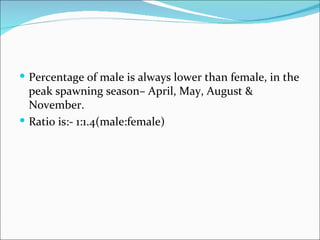
 Percentage of male is always lower than female, in the
  peak spawning season– April, May, August &
  November.
 Ratio is:- 1:1.4(male:female)
AGE ANd GROWTH
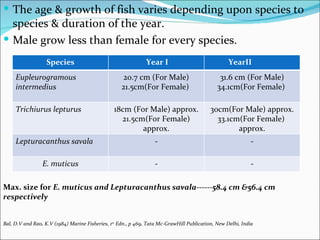
 The age & growth of fish varies depending upon species to
  species & duration of the year.
 Male grow less than female for every species.

                   Species                                    Year I                               YearII
     Eupleurogramous                                20.7 cm (For Male)                         31.6 cm (For Male)
     intermedius                                    21.5cm(For Female)                        34.1cm(For Female)

     Trichiurus lepturus                        18cm (For Male) approx.                    30cm(For Male) approx.
                                                  21.5cm(For Female)                         33.1cm(For Female)
                                                        approx.                                    approx.
     Lepturacanthus savala                                        -                                          -

                 E. muticus                                       -                                          -

Max. size for E. muticus and Lepturacanthus savala------58.4 cm &56.4 cm
respectively


Bal, D.V and Rao, K.V (1984) Marine Fisheries, 1st Edn., p 469, Tata Mc-GrawHill Publication, New Delhi, India
dIsTRIbUTION
 Major and abundant fishery resource among the marine
  pelagic fin fishes of the Indian seas.
 Distribution in the Atlantic and Indo-Pacific regions and in
  India they are distributed all along the coast with
  abundance in the northwest and central east coasts.
 In India T. lepturus found both east & west coast---
  dominating species. Contributed about 92 -95%.
 Gujarat, Andhrapradesh, West-bengal, northern
  Maharastra, south-east cost of Tamilnadu, karnataka, Kerala
  etc are important landing centre.
FIsH & FIsHERY
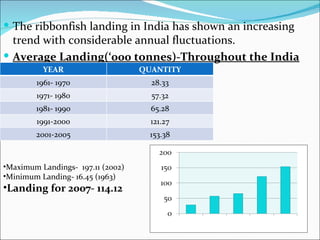
 The ribbonfish landing in India has shown an increasing
  trend with considerable annual fluctuations.
 Average Landing(‘000 tonnes)-Throughout the India
          YEAR                     QUANTITY
        1961- 1970                   28.33
        1971- 1980                   57.32
        1981- 1990                   65.28
        1991-2000                    121.27
        2001-2005                    153.38


•Maximum Landings- 197.11 (2002)
•Minimum Landing- 16.45 (1963)
•Landing for 2007- 114.12
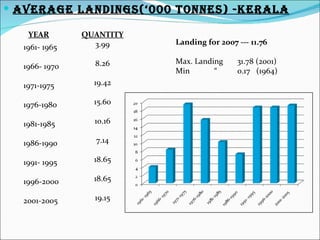
 AVERAGE LANdINGs(‘000 TONNEs) -kERALA

   YEAR        QUANTITY
                 3.99     Landing for 2007 --- 11.76
  1961- 1965

                 8.26     Max. Landing     31.78 (2001)
  1966- 1970
                          Min       “      0.17 (1964)
  1971-1975      19.42

  1976-1980      15.60

  1981-1985      10.16

  1986-1990      7.14

  1991- 1995     18.65

  1996-2000      18.65

  2001-2005      19.15
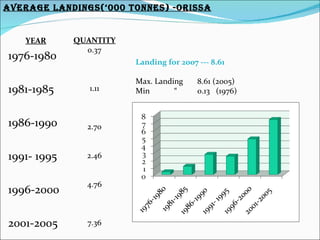
AVERAGE LANdINGs(‘000 TONNEs) -ORIssA


   YEAR      QUANTITY
               0.37
1976-1980               Landing for 2007 --- 8.61

                        Max. Landing     8.61 (2005)
1981-1985       1.11    Min       “      0.13 (1976)


1986-1990      2.70


1991- 1995     2.46


               4.76
1996-2000

2001-2005      7.36
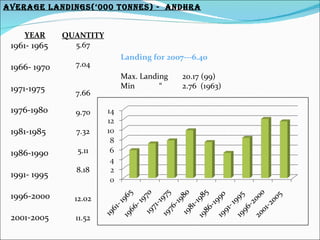
AVERAGE LANdINGs(‘000 TONNEs) - ANdHRA


    YEAR      QUANTITY
 1961- 1965     5.67
                         Landing for 2007---6.40
 1966- 1970     7.04
                         Max. Landing    20.17 (99)
 1971-1975               Min       “     2.76 (1963)
                7.66

 1976-1980      9.70

 1981-1985      7.32

 1986-1990      5.11

                8.18
 1991- 1995

 1996-2000      12.02

 2001-2005      11.52
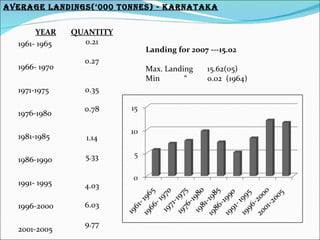
AVERAGE LANdINGs(‘000 TONNEs) - kARNATAkA


       YEAR    QUANTITY
  1961- 1965     0.21
                           Landing for 2007 ---15.02
                 0.27
  1966- 1970               Max. Landing    15.62(05)
                           Min       “     0.02 (1964)
  1971-1975      0.35

                 0.78
  1976-1980

  1981-1985      1.14

  1986-1990      5.33


  1991- 1995     4.03

  1996-2000      6.03

                 9.77
  2001-2005
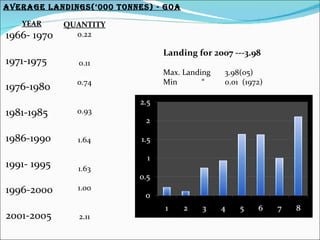
AVERAGE LANdINGs(‘000 TONNEs) - GOA

   YEAR      QUANTITY
1966- 1970     0.22

                               Landing for 2007 ---3.98
1971-1975      0.11
                               Max. Landing   3.98(05)
               0.74            Min       “    0.01 (1972)
1976-1980

1981-1985      0.93


1986-1990      1.64


1991- 1995     1.63

1996-2000      1.00


2001-2005      2.11
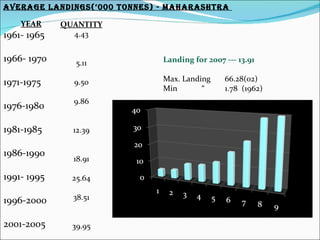
AVERAGE LANdINGs(‘000 TONNEs) - MAHARAsHTRA

    YEAR     QUANTITY
1961- 1965     4.43


1966- 1970      5.11          Landing for 2007 --- 13.91

1971-1975      9.50           Max. Landing     66.28(02)
                              Min       “      1.78 (1962)
               9.86
1976-1980

1981-1985      12.39

1986-1990
               18.91

1991- 1995     25.64

1996-2000      38.51


2001-2005      39.95
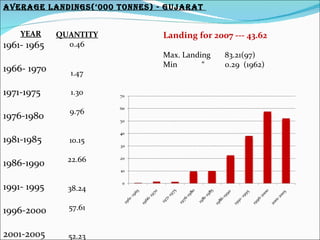
AVERAGE LANdINGs(‘000 TONNEs) - GUjARAT


    YEAR     QUANTITY          Landing for 2007 --- 43.62
1961- 1965     0.46
                               Max. Landing   83.21(97)
                               Min       “    0.29 (1962)
1966- 1970     1.47

1971-1975      1.30

               9.76
1976-1980

1981-1985      10.15

               22.66
1986-1990

1991- 1995     38.24

1996-2000      57.61


2001-2005      52.23
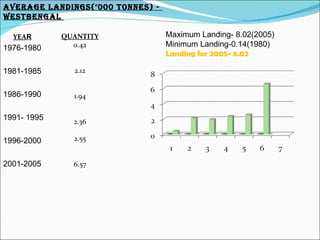
AVERAGE LANdINGs(‘000 TONNEs) -
WEsTbENGAL

  YEAR       QUANTITY             Maximum Landing- 8.02(2005)
1976-1980      0.42               Minimum Landing-0.14(1980)
                                  Landing for 2005- 8.02

1981-1985      2.12


1986-1990      1.94


1991- 1995     2.36

1996-2000      2.55


2001-2005      6.57
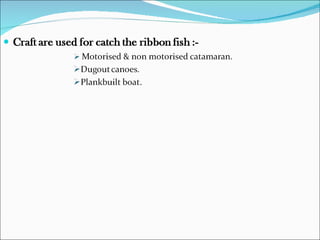
cRAFT ANd GEAR
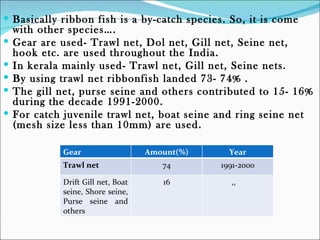
 Basically ribbon fish is a by-catch species. So, it is come
    with other species….
   Gear are used- Trawl net, Dol net, Gill net, Seine net,
    hook etc. are used throughout the India.
   In kerala mainly used- Trawl net, Gill net, Seine nets.
   By using trawl net ribbonfish landed 73- 74% .
   The gill net, purse seine and others contributed to 15- 16%
    during the decade 1991-2000.
   For catch juvenile trawl net, boat seine and ring seine net
    (mesh size less than 10mm) are used.

             Gear                   Amount(%)     Year
             Trawl net                 74       1991-2000

             Drift Gill net, Boat      16         ,,
             seine, Shore seine,
             Purse seine and
             others
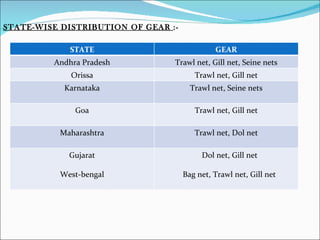
STATE-WISE DISTRIBUTION OF GEAR :-

             STATE                            GEAR
         Andhra Pradesh          Trawl net, Gill net, Seine nets
             Orissa                     Trawl net, Gill net
            Karnataka                  Trawl net, Seine nets

              Goa                       Trawl net, Gill net

           Maharashtra                  Trawl net, Dol net

             Gujarat                      Dol net, Gill net

           West-bengal               Bag net, Trawl net, Gill net
MANAGEMENT:-
 Ribbon fish is very important species as a by-catch, so for
  save this species many management options like effort
  regulation, closed season, closed area, gear regulation, mesh
  regulation.
 Intensive approach also seen for ensure good brood stock,
  for fishery industry.
OTHER FAcTOR:-
 It has low price in the market, so acceptable for
  poor people as a food- used as a cheap protein.
 Dried ribbon fish also use as fish product.
 Pearl essence formed from the guanine(present
  in the skin)
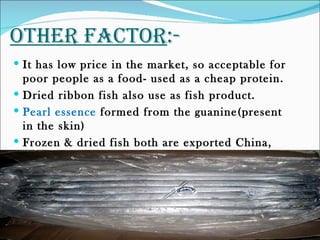
 Frozen & dried fish both are exported China,
  Japan and other southeast Asian countries.
THANK YOU

Ribbon fish

  • 1.
    Arnab Basu II nd semester S.I.F.;C.U.S.A.T.
  • 2.
    GENERAL INFORMATION:-  Ribbonfish also known as “Hair-tail” or “Cutlass fish”.  It is a leading by-catch species in India.  Thin, elongated, compressed, ribbon like body, caudal fin absent, body colour silvery with prominent canine like teeth.  Mainly marine, but some time found in the estuary.
  • 3.
    TAxONOMIc cLAssIFIcATION:-  Phylum-Chordata  Subphylum- Vertebrata  Class- Actinopterygii  Super-order- Acanthopterygii  Order - Perciformes
  • 4.
     Ribbon fishhave 4 commercially important Varity (found in Indian water) belonging under the:- Family: Trichiuridae Sub family: Sub family: Sub family: Lepidopodinae Aphanopodinae Trichiurinae Trichiurus lepturus Eupleurogrammus intermedius Lepturacanthus savala E. muticus
  • 5.
    Lepturacanthus savala (Large-headedribbon fish) & Distribution Trichiurus lepturus(ribbon fish) & Distribution
  • 6.
  • 7.
    Species Length Size-wt. Environme- Climate Identifying in 1st nt character maturity (cm) Trichiurus 46.3 -47 Max length : Marine; Subtropical •Body extremely lepturus 234 cm (M) brackish; elongate, compressed. benthopelagic •Dorsal fin relatively high. •Dorsal spine 3;soft ray 130-135 Eupleurogra- - - ,, - •Dorsal spine 3 & soft ray 123-129. -mmus •Caudal fin absent. intermedius •Snout elongated. Lepturacanth - - ,, - • Lateral line running nearer the ventral than the -us savala dorsal side of the body. • Pelvic and caudal fins absent; anal fin reduced to spinules . •Dorsal spine 3-4 & soft-ray 110 -120 E. muticus - - ,, - •Dorsal spine 3& soft ray 139 -147
  • 8.
    •Among those 4commercially important species Trichiurus lepturus is important dominating species found throughout east and west coast. Other Non- commercial Species:-  Trichiurus gangeticus  T.russelli  Lepturacanthus serrattus etc.
  • 9.
  • 10.
    •Ribbon fish arepredacious, carnivorous and some time shows cannibalistic behavior and selective feeding behavior. •Feeding both during day and night. •Intensity of feeding is not related to the spawning activity. Stage Food Post-larvae and juveniles larvae and Small juvenile (anchovy, clupeoids, carangidae), cephalopods larvae, calanoid copepods, post larvae & larvae of penaeid prawns & shrimps, crabs, acetes etc Adults Commercially important fish and other organisms i.e. Stolephorus spp. Kowala coval, Sardinella spp., Leioggnathus spp., Dussumieria spp., polynemids, Carnax spp., Acetes*, Penaeus & metapenaeus prawns, octopus, squilla*,crab larvae, isopods, Sepia spp., megalopa larvae etc.
  • 11.
  • 12.
    DIFFERENT REPRODUCTIVE STAGEOF RIBBON FISH (BAL AND RAO)
  • 13.
  • 14.
     On westcoast, peak spawning season April- June. But in east coast it is February to June , peak in May.  Another is November - December.
  • 15.
     Spawning periodof different species different.  The breeding grounds of ribbonfishes are outside the usual fishing ground; ripe fish, eggs, early embryonic stages and larval forms are not very common in inshore waters. Species No. of spawning batches Time (per year) Eupleurogramous 2 March- April , November & intermedius December. E. muticus 2 ,, Lepturacanthus savala 2 ,, Trichiurus lepturus 1 June(Prabhu,1955) 2 May-june & nov-dec(Tampi et al.1971)
  • 16.
  • 17.
     It isvaries depending upon species to species.  The gonads are bi-lobed & lie above the alimentary canal. Species No. of egg Eupleurogramous intermedius 2249(40.9 cm) – 9950 (45 cm) E. muticus 1327 (49.5 cm)- 2087 (55.1 cm) Lepturacanthus savala 9178(37.0 cm) -17347 (54.0 cm) Trichiurus lepturus 4000 (42.0 cm)- 16000 (60.0 cm) FECUNDITY – FOR DIFFERENT SPECIES OF RIBBON FISH (BAL & RAO, 1984) Bal, D.V and Rao, K.V (1984) Marine Fisheries, 1st Edn., p 469, Tata Mc-GrawHill Publication, New Delhi, India
  • 18.
  • 19.
     Percentage ofmale is always lower than female, in the peak spawning season– April, May, August & November.  Ratio is:- 1:1.4(male:female)
  • 20.
  • 21.
     The age& growth of fish varies depending upon species to species & duration of the year.  Male grow less than female for every species. Species Year I YearII Eupleurogramous 20.7 cm (For Male) 31.6 cm (For Male) intermedius 21.5cm(For Female) 34.1cm(For Female) Trichiurus lepturus 18cm (For Male) approx. 30cm(For Male) approx. 21.5cm(For Female) 33.1cm(For Female) approx. approx. Lepturacanthus savala - - E. muticus - - Max. size for E. muticus and Lepturacanthus savala------58.4 cm &56.4 cm respectively Bal, D.V and Rao, K.V (1984) Marine Fisheries, 1st Edn., p 469, Tata Mc-GrawHill Publication, New Delhi, India
  • 22.
  • 23.
     Major andabundant fishery resource among the marine pelagic fin fishes of the Indian seas.  Distribution in the Atlantic and Indo-Pacific regions and in India they are distributed all along the coast with abundance in the northwest and central east coasts.  In India T. lepturus found both east & west coast--- dominating species. Contributed about 92 -95%.  Gujarat, Andhrapradesh, West-bengal, northern Maharastra, south-east cost of Tamilnadu, karnataka, Kerala etc are important landing centre.
  • 24.
  • 25.
     The ribbonfishlanding in India has shown an increasing trend with considerable annual fluctuations.  Average Landing(‘000 tonnes)-Throughout the India YEAR QUANTITY 1961- 1970 28.33 1971- 1980 57.32 1981- 1990 65.28 1991-2000 121.27 2001-2005 153.38 •Maximum Landings- 197.11 (2002) •Minimum Landing- 16.45 (1963) •Landing for 2007- 114.12
  • 26.
     AVERAGE LANdINGs(‘000TONNEs) -kERALA YEAR QUANTITY 3.99 Landing for 2007 --- 11.76 1961- 1965 8.26 Max. Landing 31.78 (2001) 1966- 1970 Min “ 0.17 (1964) 1971-1975 19.42 1976-1980 15.60 1981-1985 10.16 1986-1990 7.14 1991- 1995 18.65 1996-2000 18.65 2001-2005 19.15
  • 27.
    AVERAGE LANdINGs(‘000 TONNEs)-ORIssA YEAR QUANTITY 0.37 1976-1980 Landing for 2007 --- 8.61 Max. Landing 8.61 (2005) 1981-1985 1.11 Min “ 0.13 (1976) 1986-1990 2.70 1991- 1995 2.46 4.76 1996-2000 2001-2005 7.36
  • 28.
    AVERAGE LANdINGs(‘000 TONNEs)- ANdHRA YEAR QUANTITY 1961- 1965 5.67 Landing for 2007---6.40 1966- 1970 7.04 Max. Landing 20.17 (99) 1971-1975 Min “ 2.76 (1963) 7.66 1976-1980 9.70 1981-1985 7.32 1986-1990 5.11 8.18 1991- 1995 1996-2000 12.02 2001-2005 11.52
  • 29.
    AVERAGE LANdINGs(‘000 TONNEs)- kARNATAkA YEAR QUANTITY 1961- 1965 0.21 Landing for 2007 ---15.02 0.27 1966- 1970 Max. Landing 15.62(05) Min “ 0.02 (1964) 1971-1975 0.35 0.78 1976-1980 1981-1985 1.14 1986-1990 5.33 1991- 1995 4.03 1996-2000 6.03 9.77 2001-2005
  • 30.
    AVERAGE LANdINGs(‘000 TONNEs)- GOA YEAR QUANTITY 1966- 1970 0.22 Landing for 2007 ---3.98 1971-1975 0.11 Max. Landing 3.98(05) 0.74 Min “ 0.01 (1972) 1976-1980 1981-1985 0.93 1986-1990 1.64 1991- 1995 1.63 1996-2000 1.00 2001-2005 2.11
  • 31.
    AVERAGE LANdINGs(‘000 TONNEs)- MAHARAsHTRA YEAR QUANTITY 1961- 1965 4.43 1966- 1970 5.11 Landing for 2007 --- 13.91 1971-1975 9.50 Max. Landing 66.28(02) Min “ 1.78 (1962) 9.86 1976-1980 1981-1985 12.39 1986-1990 18.91 1991- 1995 25.64 1996-2000 38.51 2001-2005 39.95
  • 32.
    AVERAGE LANdINGs(‘000 TONNEs)- GUjARAT YEAR QUANTITY Landing for 2007 --- 43.62 1961- 1965 0.46 Max. Landing 83.21(97) Min “ 0.29 (1962) 1966- 1970 1.47 1971-1975 1.30 9.76 1976-1980 1981-1985 10.15 22.66 1986-1990 1991- 1995 38.24 1996-2000 57.61 2001-2005 52.23
  • 33.
    AVERAGE LANdINGs(‘000 TONNEs)- WEsTbENGAL YEAR QUANTITY Maximum Landing- 8.02(2005) 1976-1980 0.42 Minimum Landing-0.14(1980) Landing for 2005- 8.02 1981-1985 2.12 1986-1990 1.94 1991- 1995 2.36 1996-2000 2.55 2001-2005 6.57
  • 34.
  • 35.
     Basically ribbonfish is a by-catch species. So, it is come with other species….  Gear are used- Trawl net, Dol net, Gill net, Seine net, hook etc. are used throughout the India.  In kerala mainly used- Trawl net, Gill net, Seine nets.  By using trawl net ribbonfish landed 73- 74% .  The gill net, purse seine and others contributed to 15- 16% during the decade 1991-2000.  For catch juvenile trawl net, boat seine and ring seine net (mesh size less than 10mm) are used. Gear Amount(%) Year Trawl net 74 1991-2000 Drift Gill net, Boat 16 ,, seine, Shore seine, Purse seine and others
  • 36.
    STATE-WISE DISTRIBUTION OFGEAR :- STATE GEAR Andhra Pradesh Trawl net, Gill net, Seine nets Orissa Trawl net, Gill net Karnataka Trawl net, Seine nets Goa Trawl net, Gill net Maharashtra Trawl net, Dol net Gujarat Dol net, Gill net West-bengal Bag net, Trawl net, Gill net
  • 38.
    MANAGEMENT:-  Ribbon fishis very important species as a by-catch, so for save this species many management options like effort regulation, closed season, closed area, gear regulation, mesh regulation.  Intensive approach also seen for ensure good brood stock, for fishery industry.
  • 39.
    OTHER FAcTOR:-  Ithas low price in the market, so acceptable for poor people as a food- used as a cheap protein.  Dried ribbon fish also use as fish product.  Pearl essence formed from the guanine(present in the skin)  Frozen & dried fish both are exported China, Japan and other southeast Asian countries.
  • 40.