Topic: Diseases of Fish
Dr. Ramkumar Lodhi
Conservation Biology Lab
synopsis
Introduction.
Dropsy.
Tail Rot or Fin Rot.
Eye diseases.
Furunculoris.
Costiasis.
White spot (Itch).
Fungal diseases.
Swimming bladder diseases.
Conclusion.
Reference.
INTRODUCTION
Large no of diseases occurs in all aquatic animals including fish.Due to
nutritional deficiency or unhygienic condition of water or attack of
parasites.
All species of fishes becomes infested with pathogenic bacteria.
A sick fish generally is unable to maintain balance in the water,usually
lie on the side either at the bottom are floating at the surface.
The gills becomes pale,body covered with grey slime and there is
normal colour.
A sick fish is sluggish skinness of the fish in the pond may be due to
the change in the physico – chemical of water and due to shortage of
food.
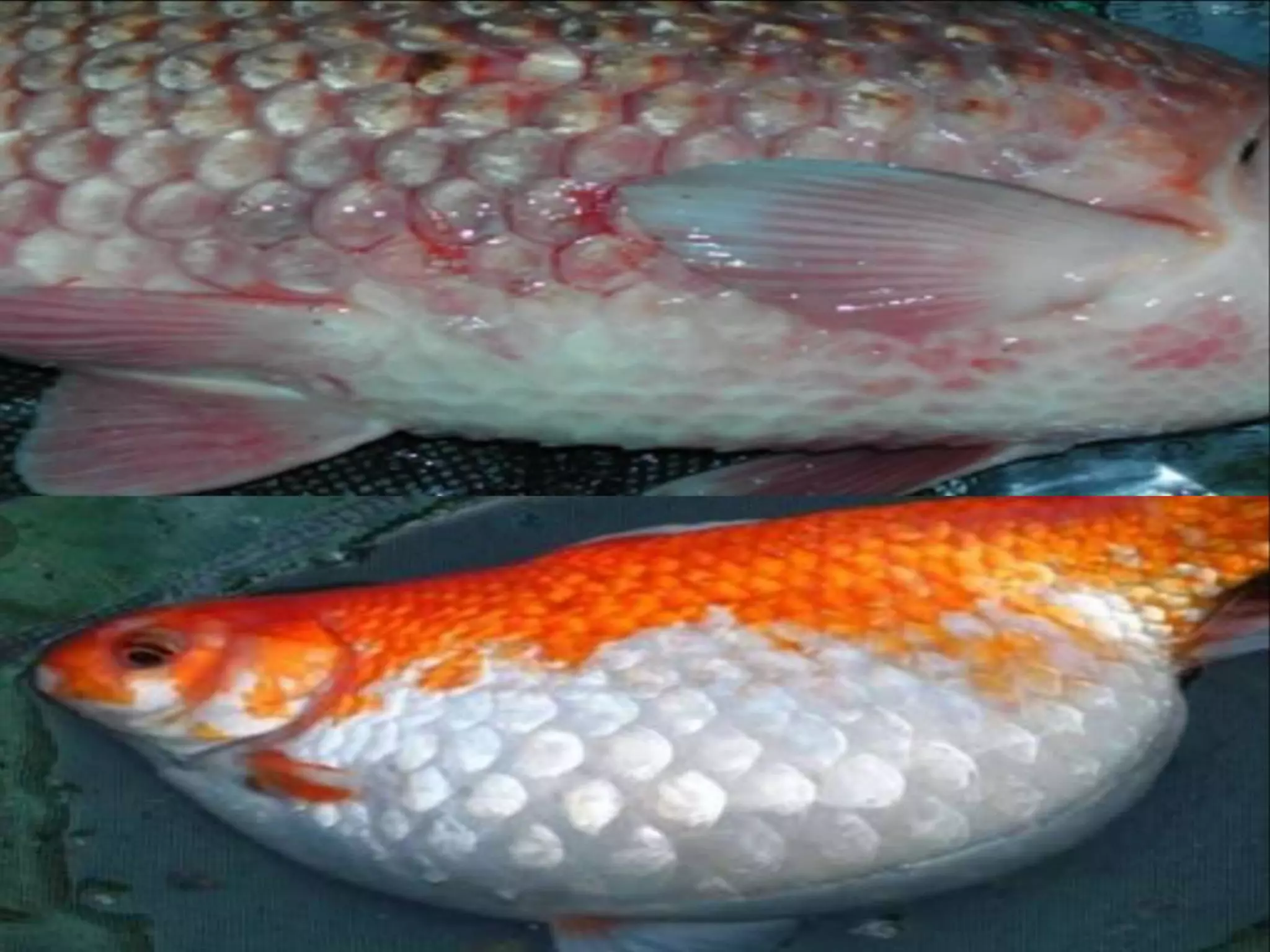
DROPSY
 In this diseases there is accumulation of fluid in the internal
organs causing swellings.Intestine,liver and kidney are
badely effected.
 It is caused by bacteria called psedomonas puntata and
Aeromonas hydrophilla.
 Most fishes with this problem can survive only 2-3 weeks
but sometimes as many months.
 Dropsy is mainly found in carps like Catla and Rohu.
Control measure
 Dropsy is mainly treated with chloralphenicol antibiotics
added in water. The fishes kept in the solution for 3-7 days.
TAIL ROT OR FIN ROT
 Tail rot is basically erosion and disintegration of fin and tail.
 In earlier stage white line appears on fin which may leads to fin lost.
 Tail rot is caused by Pseudomonas Floresence.
 It occurs due to poor quality of water.
 If fin rot is noticed in the early stages and treated then fish may be
survive. If tail rot remains untreated then entire tail is lost and fish
die.
 Control measures
 The diseases may be cured by dipping in the copper sulphate
solution for 1-2.
 If heavy infection,the affected portion of tail should be removed and
then wash by 1% silvar nitrate.
 The fish kept in a diluted sol of potassium dichoromate for healing of
wounds which may require 7-10 days
EYE DISEASE
 This disease is caused by bacteria streptoccus iniae, as well
as Lactococcus,entrococ-cusrococcus.
 The most common symptom of these bacteria will show as
cloudy eye and bulges outwards from eye cavity ,thus
called pop eye diseases.
 The conory becomes vascularised leading to opacity eye
becomes whitish and loss of balanace in the body of fish.
 It is observed in Rohu catla and silvar fish.
 Control measures
 The diseased fish may be treated by chloromycetin in the
early stage of this diseases,then fish kept in 1% of KMnO4
for 3 minutes
FURUNCULOSIS
 Mostly observed in salmon,trout and goldfish.
 It is caused by bacteria Aeromonas salmonicida.
 The infected fish develops swellings on the sides of the
body which may leads to ulcer.
 The swelling contains pus like substance formed by
necrosis of muscle cells.
 Control measure
 Cured by antibiotics oxytetracycline and sulfamerazine.
 This disease is caused by ectoparasite costia which is a flagellate that
attacks skin and gills, destroys epidermal cells and feed them.
 As a result excessive secretion of mucus.
 The body of the fish becomes covered with bluish or grey film of
mucus.
 Loss of appetite, and becomes weak and dies after sometime.
 Another protozoan ciliate chilodon also attacks skin and gills.
 Control Measures
 Both the protozoan are controlled by treating the fish with 1% acetic
acid solution or solution of formalin.
 Solutions of methylene blue, KMnO4, CuSO4 can also be used to kill
the parasite.
COSTIASIS
WHITE SPOT
 This disease caused by ciliated protozoan Ichthyophthirius species.
 The parasite attacks the skin of fresh water fish, rest in between epidermis and
dermis .
 Infection results in the appearance of several white spots on the skin
and fin due to rapid proliferation of epidermal cells ,which forms a covering
over the parasite.
 The entire body of the fish are covered by nodules trophonts.
CONTROL MEASURES
 The fish kept in the 3% salt solution or 1% solution of formaline and then
methylene (2 minutes).
 The parasite also killed by rising up the temperature above 24 degree celicious.
FUNGAL DISEASE
 The fungal disease is mainly caused by seprolegnia and are
characterised by the appearance of wool (tufts) on the skin.
 Root like hyphae or filaments grows in to the subcutaneous parts,
causing death of the fish.
 Gills are also affected causing gill rot .Gill first becomes pale then latter
yellow-brown and destroyed.
 The infection spread quickly when the fish is already injured and
weak.Healthy eggs also affected if dead eggs are not removed from the
water.
CONTOL MEASURE
 The fish is taken out from the water and the affected part washed with
iodine solution,then the fish kept under 1% potassium dichromate for a
week.
 We could also kept the fish under 3% solution of salt as well as 1%
solution of phenoxethol also kills the fungi.
SWIM BLADDER DISEASE
 Swim bladder disease refers to a condition when the
swim bladder donot work normally due to diseases
or environmental factors.
 Affected fish will exhibit problems with buoyancy
that is ,they will have difficulty controlling their
ability to flout or sink.
 Fish have swollen belly, mainly observed in gold fish.
 Affected fish may eat normally or have no appetite at
all.This disorder is some times caused by
compression of swim bladder,which may involve a
distended stomach from rapid eating or overeating
or gulping air.
CON….
 Gestrointestinal tract enlargement puts pressure on the swim
bladder or other abdominal may enlarge and affect the swim
blader (kidney and liver)
 Due to swim bladder disease, fishes don’t maintain normal
position in the water.
CONTROL MEASURE
 If the fishes have SBD, the first course of action is not to feed
fish for three days.At the same increasing water
temperature(80 degree celicious).
 Adding small amount of salt in the tank.Reducing the water
level to make it easier for fish movement around the
tank.Hand feeding is necessary.
CONCLUSION
 The disease is harmful for both wild and cultured
fishes of our country.
 Disease in fishes may cause a heavy loss for
commercially cultured fishes. So we should be
know about the signs and symptoms of disease,
that we can easily find out the proper treatment .
 Fisheries is an important tool of self-employment
because fish is an important source of nutrients
and have have great economic value.
REFERENCE
• S.S. KHANA and H R SING. Fish biology and
fisheries.
• Biology of fishs ;3rd edition by RICHARD
MOORE AND QUENTIN BONE.
Diseases of fish

Diseases of fish

  • 1.
    Topic: Diseases ofFish Dr. Ramkumar Lodhi Conservation Biology Lab
  • 2.
    synopsis Introduction. Dropsy. Tail Rot orFin Rot. Eye diseases. Furunculoris. Costiasis. White spot (Itch). Fungal diseases. Swimming bladder diseases. Conclusion. Reference.
  • 3.
    INTRODUCTION Large no ofdiseases occurs in all aquatic animals including fish.Due to nutritional deficiency or unhygienic condition of water or attack of parasites. All species of fishes becomes infested with pathogenic bacteria. A sick fish generally is unable to maintain balance in the water,usually lie on the side either at the bottom are floating at the surface. The gills becomes pale,body covered with grey slime and there is normal colour. A sick fish is sluggish skinness of the fish in the pond may be due to the change in the physico – chemical of water and due to shortage of food.
  • 4.
    DROPSY  In thisdiseases there is accumulation of fluid in the internal organs causing swellings.Intestine,liver and kidney are badely effected.  It is caused by bacteria called psedomonas puntata and Aeromonas hydrophilla.  Most fishes with this problem can survive only 2-3 weeks but sometimes as many months.  Dropsy is mainly found in carps like Catla and Rohu. Control measure  Dropsy is mainly treated with chloralphenicol antibiotics added in water. The fishes kept in the solution for 3-7 days.
  • 6.
    TAIL ROT ORFIN ROT  Tail rot is basically erosion and disintegration of fin and tail.  In earlier stage white line appears on fin which may leads to fin lost.  Tail rot is caused by Pseudomonas Floresence.  It occurs due to poor quality of water.  If fin rot is noticed in the early stages and treated then fish may be survive. If tail rot remains untreated then entire tail is lost and fish die.  Control measures  The diseases may be cured by dipping in the copper sulphate solution for 1-2.  If heavy infection,the affected portion of tail should be removed and then wash by 1% silvar nitrate.  The fish kept in a diluted sol of potassium dichoromate for healing of wounds which may require 7-10 days
  • 8.
    EYE DISEASE  Thisdisease is caused by bacteria streptoccus iniae, as well as Lactococcus,entrococ-cusrococcus.  The most common symptom of these bacteria will show as cloudy eye and bulges outwards from eye cavity ,thus called pop eye diseases.  The conory becomes vascularised leading to opacity eye becomes whitish and loss of balanace in the body of fish.  It is observed in Rohu catla and silvar fish.  Control measures  The diseased fish may be treated by chloromycetin in the early stage of this diseases,then fish kept in 1% of KMnO4 for 3 minutes
  • 10.
    FURUNCULOSIS  Mostly observedin salmon,trout and goldfish.  It is caused by bacteria Aeromonas salmonicida.  The infected fish develops swellings on the sides of the body which may leads to ulcer.  The swelling contains pus like substance formed by necrosis of muscle cells.  Control measure  Cured by antibiotics oxytetracycline and sulfamerazine.
  • 12.
     This diseaseis caused by ectoparasite costia which is a flagellate that attacks skin and gills, destroys epidermal cells and feed them.  As a result excessive secretion of mucus.  The body of the fish becomes covered with bluish or grey film of mucus.  Loss of appetite, and becomes weak and dies after sometime.  Another protozoan ciliate chilodon also attacks skin and gills.  Control Measures  Both the protozoan are controlled by treating the fish with 1% acetic acid solution or solution of formalin.  Solutions of methylene blue, KMnO4, CuSO4 can also be used to kill the parasite. COSTIASIS
  • 14.
    WHITE SPOT  Thisdisease caused by ciliated protozoan Ichthyophthirius species.  The parasite attacks the skin of fresh water fish, rest in between epidermis and dermis .  Infection results in the appearance of several white spots on the skin and fin due to rapid proliferation of epidermal cells ,which forms a covering over the parasite.  The entire body of the fish are covered by nodules trophonts. CONTROL MEASURES  The fish kept in the 3% salt solution or 1% solution of formaline and then methylene (2 minutes).  The parasite also killed by rising up the temperature above 24 degree celicious.
  • 16.
    FUNGAL DISEASE  Thefungal disease is mainly caused by seprolegnia and are characterised by the appearance of wool (tufts) on the skin.  Root like hyphae or filaments grows in to the subcutaneous parts, causing death of the fish.  Gills are also affected causing gill rot .Gill first becomes pale then latter yellow-brown and destroyed.  The infection spread quickly when the fish is already injured and weak.Healthy eggs also affected if dead eggs are not removed from the water. CONTOL MEASURE  The fish is taken out from the water and the affected part washed with iodine solution,then the fish kept under 1% potassium dichromate for a week.  We could also kept the fish under 3% solution of salt as well as 1% solution of phenoxethol also kills the fungi.
  • 18.
    SWIM BLADDER DISEASE Swim bladder disease refers to a condition when the swim bladder donot work normally due to diseases or environmental factors.  Affected fish will exhibit problems with buoyancy that is ,they will have difficulty controlling their ability to flout or sink.  Fish have swollen belly, mainly observed in gold fish.  Affected fish may eat normally or have no appetite at all.This disorder is some times caused by compression of swim bladder,which may involve a distended stomach from rapid eating or overeating or gulping air.
  • 19.
    CON….  Gestrointestinal tractenlargement puts pressure on the swim bladder or other abdominal may enlarge and affect the swim blader (kidney and liver)  Due to swim bladder disease, fishes don’t maintain normal position in the water. CONTROL MEASURE  If the fishes have SBD, the first course of action is not to feed fish for three days.At the same increasing water temperature(80 degree celicious).  Adding small amount of salt in the tank.Reducing the water level to make it easier for fish movement around the tank.Hand feeding is necessary.
  • 21.
    CONCLUSION  The diseaseis harmful for both wild and cultured fishes of our country.  Disease in fishes may cause a heavy loss for commercially cultured fishes. So we should be know about the signs and symptoms of disease, that we can easily find out the proper treatment .  Fisheries is an important tool of self-employment because fish is an important source of nutrients and have have great economic value.
  • 22.
    REFERENCE • S.S. KHANAand H R SING. Fish biology and fisheries. • Biology of fishs ;3rd edition by RICHARD MOORE AND QUENTIN BONE.