Respiration
Structure of Gills and Lungs
Dr. D. S. Kulkarni
Associate Professor and Head
Department of Zoology
Bharatiya Mahavidyalaya, Amravati
• Why do we breathe?
• Think of all the reasons why
we need a respiratory system.
W
O
R
K
T
O
G
E
T
H
E
R
W
O
R
K
T
O
G
E
T
H
E
R
Warning: terminology!
“Respiration” is used several different ways:
–Cellular respiration is the aerobic
breakdown of glucose in the mitochondria
to make ATP.
–Respiratory systems are the organs in
animals that exchange gases with the
environment.
–“Respiration” is an everyday term that is
often used to mean “breathing.”
Respiration
• Respiration is the process by which
animals take in oxygen and exchange it
for carbon dioxide and water as waste
products.
• Every cell in an animal requires oxygen
to perform cellular respiration.
Respiratory system function
• Respiratory systems allow animals to
move oxygen (needed for cellular
respiration) into body tissues and remove
carbon dioxide (waste product of cellular
respiration) from cells.
Respiration
• Exchange of oxygen and carbon dioxide in
an organism takes place at two locations:-
Internal respiration
Blood ↔ Cell
External respiration
Blood ↔ External Environment
Respiration
The mechanisms, processes, and organs
used for respiration depend on the
medium, size, and complexity
of the organism.
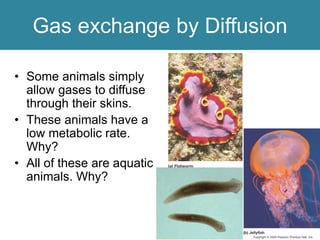
Gas exchange by Diffusion
• Some animals simply
allow gases to diffuse
through their skins.
• These animals have a
low metabolic rate.
Why?
• All of these are aquatic
animals. Why?
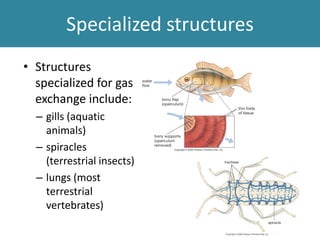
Specialized structures
• Structures
specialized for gas
exchange include:
– gills (aquatic
animals)
– spiracles
(terrestrial insects)
– lungs (most
terrestrial
vertebrates)
Respiration
• The body structures which are needed
for gaseous exchange between the
blood and the surrounding medium are
known as respiratory organs.
• The system designed for exchange of
gases (O2 and CO2) between the
organism and its environment is termed
the respiratory system.
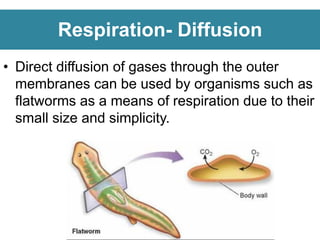
Respiration- Diffusion
• Direct diffusion of gases through the outer
membranes can be used by organisms such as
flatworms as a means of respiration due to their
small size and simplicity.
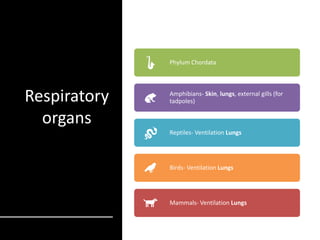
Respiratory
organs
Respiration can occur using a variety of
respiratory organs in different animals,
including skin, gills, and tracheal systems.
Phylum Chordata
Amphibians- Skin, lungs, external gills (for
tadpoles)
Reptiles- Ventilation Lungs
Birds- Ventilation Lungs
Mammals- Ventilation Lungs
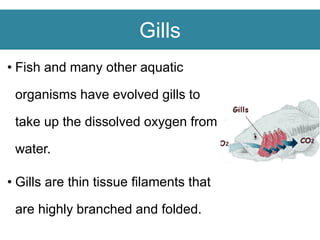
Gills
• Fish and many other aquatic
organisms have evolved gills to
take up the dissolved oxygen from
water.
• Gills are thin tissue filaments that
are highly branched and folded.
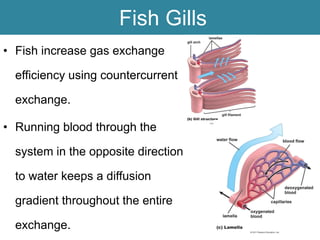
Fish Gills
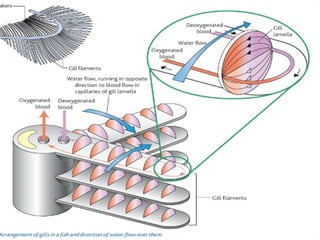
• Fish increase gas exchange
efficiency using countercurrent
exchange.
• Running blood through the
system in the opposite direction
to water keeps a diffusion
gradient throughout the entire
exchange.
Countercurrent Exchange
• In a concurrent or parallel
system, exchange is
inefficient. Equilibrium is
reached at one end.
• In a countercurrent
system, equilibrium is not
reached, so gas
exchange continues,
increasing efficiency.
Types of Gills
• Based on their location, gills are of two
types- internal gills and external gills.
• Internal gills or true gills
• External Gills or Larval Gills
• In some animals both internal and
external gills are present.
Internal gills or true gills:
• In chordate embryo the pharyngeal cavity is
connected to the outside by a series of lateral
openings called, gill slits or pharyngeal clefts.
• The number of gill slits varies in different
chordates- 140 pairs in Amphioxus, 6-14 pairs
in cyclostomes, 5 pairs in most elasmobranchs
and bony fishes, and 4 pairs in teleosts.
Structure of a true gill:
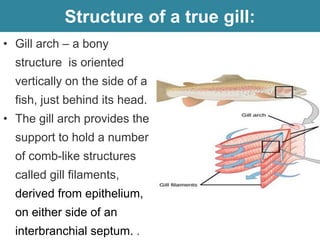
• Gill arch – a bony
structure is oriented
vertically on the side of a
fish, just behind its head.
• The gill arch provides the
support to hold a number
of comb-like structures
called gill filaments,
derived from epithelium,
on either side of an
interbranchial septum. .
Structure of a true gill:
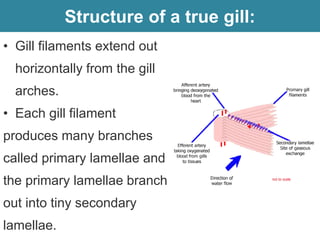
• Gill filaments extend out
horizontally from the gill
arches.
• Each gill filament
produces many branches
called primary lamellae and
the primary lamellae branch
out into tiny secondary
lamellae.
Structure of a true gill:
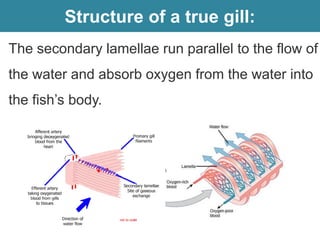
The secondary lamellae run parallel to the flow of
the water and absorb oxygen from the water into
the fish’s body.
Structure of Gill
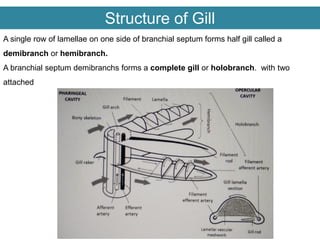
A single row of lamellae on one side of branchial septum forms half gill called a
demibranch or hemibranch.
A branchial septum demibranchs forms a complete gill or holobranch. with two
attached
Mechanism Of Gill Respiration
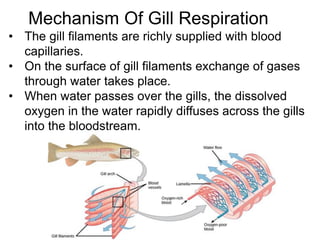
• The gill filaments are richly supplied with blood
capillaries.
• On the surface of gill filaments exchange of gases
through water takes place.
• When water passes over the gills, the dissolved
oxygen in the water rapidly diffuses across the gills
into the bloodstream.
Mechanism Of
Gill Respiration
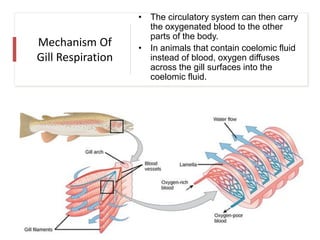
• The circulatory system can then carry
the oxygenated blood to the other
parts of the body.
• In animals that contain coelomic fluid
instead of blood, oxygen diffuses
across the gill surfaces into the
coelomic fluid.
External or larval gills:
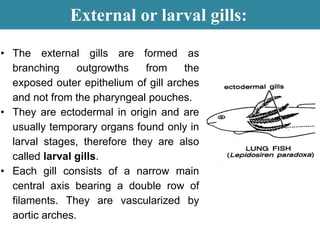
• The external gills are formed as
branching outgrowths from the
exposed outer epithelium of gill arches
and not from the pharyngeal pouches.
• They are ectodermal in origin and are
usually temporary organs found only in
larval stages, therefore they are also
called larval gills.
• Each gill consists of a narrow main
central axis bearing a double row of
filaments. They are vascularized by
aortic arches.
External or larval gills
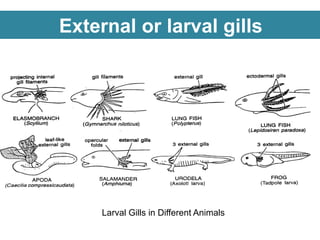
• External gills occur in the larvae of Lampreys, a few
bony fishes, lung fishes and all amphibians.
• In amphibians, larval gills are absorbed at the time
of metamorphosis.
• In some urodels both external gills and gill slits
persist during adult life.
• In Amphiuma gills are absorbed but gill slits persist.
• Gills assume different shapes: pectinate, bipinnate,
dendritic, leaf like, etc.
External or larval gills
Larval Gills in Different Animals
Summery
• The folded surfaces of the gills provide a
large surface area to ensure that fish obtain
sufficient oxygen.
• Blood with a low concentration of oxygen
molecules circulates through the gills.
• As a result, oxygen molecules diffuse from
water (high concentration) to blood (low
concentration).
• Similarly, carbon dioxide molecules diffuse
from the blood (high concentration) to water
(low concentration).
• Why are gills so widely seen in aquatic
animals but not in land animals?
• One group of land animals that have gills
is the Isopods (“pill bugs” and “sow
bugs”). How can these organisms
survive on land with gills?
W
O
R
K
T
O
G
E
T
H
E
R
W
O
R
K
T
O
G
E
T
H
E
R

Structure of respiratory organs

  • 1.
    Respiration Structure of Gillsand Lungs Dr. D. S. Kulkarni Associate Professor and Head Department of Zoology Bharatiya Mahavidyalaya, Amravati
  • 2.
    • Why dowe breathe? • Think of all the reasons why we need a respiratory system. W O R K T O G E T H E R W O R K T O G E T H E R
  • 3.
    Warning: terminology! “Respiration” isused several different ways: –Cellular respiration is the aerobic breakdown of glucose in the mitochondria to make ATP. –Respiratory systems are the organs in animals that exchange gases with the environment. –“Respiration” is an everyday term that is often used to mean “breathing.”
  • 4.
    Respiration • Respiration isthe process by which animals take in oxygen and exchange it for carbon dioxide and water as waste products. • Every cell in an animal requires oxygen to perform cellular respiration.
  • 5.
    Respiratory system function •Respiratory systems allow animals to move oxygen (needed for cellular respiration) into body tissues and remove carbon dioxide (waste product of cellular respiration) from cells.
  • 6.
    Respiration • Exchange ofoxygen and carbon dioxide in an organism takes place at two locations:- Internal respiration Blood ↔ Cell External respiration Blood ↔ External Environment
  • 7.
    Respiration The mechanisms, processes,and organs used for respiration depend on the medium, size, and complexity of the organism.
  • 8.
    Gas exchange byDiffusion • Some animals simply allow gases to diffuse through their skins. • These animals have a low metabolic rate. Why? • All of these are aquatic animals. Why?
  • 9.
    Specialized structures • Structures specializedfor gas exchange include: – gills (aquatic animals) – spiracles (terrestrial insects) – lungs (most terrestrial vertebrates)
  • 10.
    Respiration • The bodystructures which are needed for gaseous exchange between the blood and the surrounding medium are known as respiratory organs. • The system designed for exchange of gases (O2 and CO2) between the organism and its environment is termed the respiratory system.
  • 11.
    Respiration- Diffusion • Directdiffusion of gases through the outer membranes can be used by organisms such as flatworms as a means of respiration due to their small size and simplicity.
  • 12.
    Respiratory organs Respiration can occurusing a variety of respiratory organs in different animals, including skin, gills, and tracheal systems. Phylum Chordata Amphibians- Skin, lungs, external gills (for tadpoles) Reptiles- Ventilation Lungs Birds- Ventilation Lungs Mammals- Ventilation Lungs
  • 13.
    Gills • Fish andmany other aquatic organisms have evolved gills to take up the dissolved oxygen from water. • Gills are thin tissue filaments that are highly branched and folded.
  • 14.
    Fish Gills • Fishincrease gas exchange efficiency using countercurrent exchange. • Running blood through the system in the opposite direction to water keeps a diffusion gradient throughout the entire exchange.
  • 15.
    Countercurrent Exchange • Ina concurrent or parallel system, exchange is inefficient. Equilibrium is reached at one end. • In a countercurrent system, equilibrium is not reached, so gas exchange continues, increasing efficiency.
  • 16.
    Types of Gills •Based on their location, gills are of two types- internal gills and external gills. • Internal gills or true gills • External Gills or Larval Gills • In some animals both internal and external gills are present.
  • 17.
    Internal gills ortrue gills: • In chordate embryo the pharyngeal cavity is connected to the outside by a series of lateral openings called, gill slits or pharyngeal clefts. • The number of gill slits varies in different chordates- 140 pairs in Amphioxus, 6-14 pairs in cyclostomes, 5 pairs in most elasmobranchs and bony fishes, and 4 pairs in teleosts.
  • 18.
    Structure of atrue gill: • Gill arch – a bony structure is oriented vertically on the side of a fish, just behind its head. • The gill arch provides the support to hold a number of comb-like structures called gill filaments, derived from epithelium, on either side of an interbranchial septum. .
  • 19.
    Structure of atrue gill: • Gill filaments extend out horizontally from the gill arches. • Each gill filament produces many branches called primary lamellae and the primary lamellae branch out into tiny secondary lamellae.
  • 20.
    Structure of atrue gill: The secondary lamellae run parallel to the flow of the water and absorb oxygen from the water into the fish’s body.
  • 21.
    Structure of Gill Asingle row of lamellae on one side of branchial septum forms half gill called a demibranch or hemibranch. A branchial septum demibranchs forms a complete gill or holobranch. with two attached
  • 22.
    Mechanism Of GillRespiration • The gill filaments are richly supplied with blood capillaries. • On the surface of gill filaments exchange of gases through water takes place. • When water passes over the gills, the dissolved oxygen in the water rapidly diffuses across the gills into the bloodstream.
  • 24.
    Mechanism Of Gill Respiration •The circulatory system can then carry the oxygenated blood to the other parts of the body. • In animals that contain coelomic fluid instead of blood, oxygen diffuses across the gill surfaces into the coelomic fluid.
  • 25.
    External or larvalgills: • The external gills are formed as branching outgrowths from the exposed outer epithelium of gill arches and not from the pharyngeal pouches. • They are ectodermal in origin and are usually temporary organs found only in larval stages, therefore they are also called larval gills. • Each gill consists of a narrow main central axis bearing a double row of filaments. They are vascularized by aortic arches.
  • 26.
    External or larvalgills • External gills occur in the larvae of Lampreys, a few bony fishes, lung fishes and all amphibians. • In amphibians, larval gills are absorbed at the time of metamorphosis. • In some urodels both external gills and gill slits persist during adult life. • In Amphiuma gills are absorbed but gill slits persist. • Gills assume different shapes: pectinate, bipinnate, dendritic, leaf like, etc.
  • 27.
    External or larvalgills Larval Gills in Different Animals
  • 28.
    Summery • The foldedsurfaces of the gills provide a large surface area to ensure that fish obtain sufficient oxygen. • Blood with a low concentration of oxygen molecules circulates through the gills. • As a result, oxygen molecules diffuse from water (high concentration) to blood (low concentration). • Similarly, carbon dioxide molecules diffuse from the blood (high concentration) to water (low concentration).
  • 29.
    • Why aregills so widely seen in aquatic animals but not in land animals? • One group of land animals that have gills is the Isopods (“pill bugs” and “sow bugs”). How can these organisms survive on land with gills? W O R K T O G E T H E R W O R K T O G E T H E R