I. DEFINITION
II. COMPONENTS OF AEROSOL PACKAGE
III. TYPES OF SYSTEM
IV. MANUFACTURING OF PHARMACEUTICAL
AEROSOLS
V. QUALITY CONTROL FOR PHARMACEUTICAL
AEROSOLS
VI. EVALUATION TESTS
VII. LABELLING
DEFINITION –
A system that depends on the power of a compressed or
liquefied gas to expel the contents from the container
Development of pharmaceutical aerosols is occurred in
1950s
These aerosol products were intended for burns , minor
cuts and bruises , infections and various dermatologic
conditions
Aerosol products intended for local activity in the
respiratory tract appeared in 1955 , when Epinephrine
was made available in a pressurized package
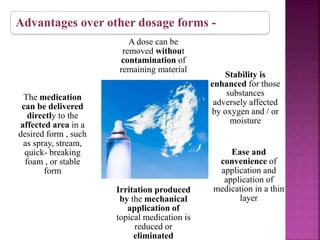
Advantages over other dosage forms -
A dose can be
removed without
contamination of
remaining material
Stability is
enhanced for those
substances
adversely affected
by oxygen and / or
moisture
The medication
can be delivered
directly to the
affected area in a
desired form , such
as spray, stream,
quick- breaking
foam , or stable
form
Irritation produced
by the mechanical
application of
topical medication is
reduced or
eliminated
Ease and
convenience of
application and
application of
medication in a thin
layer
 Costly
 Difficulty in disposal
 Difficulty in formulation
 Quality control testing is complicated
 Cannot be subjected to heat
An aerosol
product
consist of
following
component
parts :
Propellant
Container
Valve and actuator
Product
concentrate
The propellant is responsible for developing the
proper pressure within the container
It expels the product when the valve is opened
It aids in atomization or foam production of the
product
Various types are -
Fluorinated hydrocarbons such as
trichloromonofluoromethane (propellant 11) ,
dichlorodifluoromethane (propellant 12) and
dichlorotetrafluoroethane (propellant 114) have widespread
use in most aerosols for oral and inhalation use
Topical pharmaceutical aerosols utilize hydrocarbons
(propane, butane and isobutane ) and compressed gases such
as nitrogen , carbon dioxide and nitrous oxide
Blends of various fluorocarbon propellants are generally
used for pharmaceutical aerosols. Blending is done on the
basis of desired final pressure
 The vapor pressure of a mixture consisting of two
individual propellants is equal to the sum of the mole
fraction of each component present multiplied by the vapor
pressure of each pure propellant at the desired temperature
.
 This relationship can be shown mathematically :
p a = n a pA
0
= NA pA
0 (1)
n a + nb
where ,
 p a = Partial vapor pressure of propellant A
 pA
0 = Vapor pressure of pure propellant A
 n a = Moles of propellant A
 nb = Moles of propellant B
 NA = Mole fraction of component A
 To calculate the partial vapor pressure of propellant B
p b = n b pB
0
= N B p B
0 (2)
n b + na
 The total vapor pressure of the system is then obtained
from – P = p a + p b
 where P is the total vapor pressure of the system.
 It must withstand pressures as high as 140 to
180 psig at 1300 F
Various
materials
used are
A . Metal –
• 1.Tinplated steel
• A . Side – seam (three
– piece )
• B . Two – piece or
drawn
• C .Tin – free steel
• 2. Aluminum
• a. Two – piece
• b.One – piece (extruded
or drawn)
• 3. Stainless steel
B. Glass
• a. Uncoated
glass
• b.Plastic –
coated glass
A . METAL –
I .Tinplated containers –
They consists of a sheet of steel plate that has been
electroplated on both sides with tin
The thickness of the tin coating is described in terms of
its weight , e.g.-#25,#50 and #100
Tinplated steel is obtained in thin sheets, and when
required , it is coated with an organic material
These sheets are lithographed at this point
Then the sheet is cut into sizes to make a body, a top and
a bottom , each piece is fabricated into the desired shape
The body is shaped into a cylinder and seamed via a
flanging and soldering operation
The top and bottom are attached to the body , and a side
seam stripe is added to the inside seam area when
required
A recent development in metal tinplate containers is the
welded side
II. Aluminum containers
Aluminum is used to manufacture extruded (seamless)
aerosol containers
Many pharmaceuticals are packed in this because of –
a. Lessened danger of incompatibility (Due to seamless
nature.)
b. Greater resistance to corrosion
Disadvantages-
a. Corroded by pure water and pure ethanol
b.Combination with ethanol and propellant 11 shown to
produce hydrogen , acetyl chloride, aluminum chloride
III. Stainless Steel Containers -
They are extremely strong and resistant to most
materials
These containers are limited to the smaller sizes
,owing to production problems as well as cost
Stainless steal containers have been used for
inhalation aerosols
In most cases , no internal organic coating is
required
B. GLASS CONTAINERS -
They are used for a large number of aerosol
pharmaceuticals
Glass containers are available with or without plastic
coatings
Corrosion problems are eliminated and allows a greater
degree of freedom in design of the container
Defined as a device that is used to seal the aerosol
container and to permit controlled discharge of the
contents
Valves - continuous spray or metered
A. CONTINUOUS SPAY VALVES
They are two –way valves -
Permits either the addition of product into container , as
in pressure filling of propellant , or the withdrawal of
product during use of aerosol package
Continuous –spray valves are used for liquids ,
emulsions , powders, paints , and food product
Valve
Components
 The normal aerosol valve has 7 basic parts
I. Mounting cup with associated steel jacket
II. Stem
III. Stem gasket
IV. Spring
V. Body or housing
VI. Dip tube
VII. Actuator
 Used to attach the valve proper to the container
 Is made from Tin plate steel , Aluminum or Brass
 Ferrule is attached either by rolling the end under the
lip of the bottle or by clinching the metal under the lip
VALVE BODY OR HOUSING
 Manufactured from Nylon or Delrin
 Opening at the point of the attachment of the dip tube
range from 0.013 inch to 0.080 inch
 It is made from Nylon or Delrin ( brass & stainless
steel can also utilized )
 One or more orifices are set into the stem
 They range from one orifice of about 0.013 inch to
0.030 inch , to 3 orifices of 0.040 inch each
GASKET
 Buta – N and Neoprene rubber are commonly used
SPRING
 Hold the gasket in place
 It returns valve to its closed position
 Stainless steel is used
 Made from Polyethylene or Polypropylene.
 Inside diameter of
• Commonly used Dip tube is about 0.120 inch to 0.125
inch
• Capillary dip tubes are about 0.050 inch
• Dip tube of highly viscous products may be as large as
0.195 inch
ACTUATORS
 It is integral part of aerosol package
 It serves to aid in producing the required type of
product discharge
 Allows easy opening and closing of the valve
 Different types actuators are
1) Spray
2) Foam
3) Solid stream
4) Special applications
 SPRAY ACTUATORS
 Capable of dispersing the stream of product
concentrate and propellant into relatively small
particles
 The combination of propellant vaporization and
actuator orifice and internal channels can deliver the
spray in the desired particle size range
 Used with pharmaceuticals intended for topical use
such as
 Spray on bandages , antiseptics , local anesthetics,
and foot preparations
FOAM ACTUATORS
 Consist of relatively large orifices ranging from
approximately 0.070 inch to 0.125 inch and greater
 The orifices allow for passage of the product into a
relatively large chamber , where it can expand and
dispensed
 These are for dispensing of semisolid products as
ointments
 Large openings allow for passage of the product
through the valve stem and into the actuator
 SPECIAL ACTUATORS
 Used for pharmaceutical and medical aerosol require a
specially designed actuator
 They are designed to deliver the medication to the
appropriate site of action – throat , nose , eye or
vaginal tract
 Metered dose inhaler
 To increased interest in modifying metered dose
inhalers (MDIs) to minimize the number of
administration error and to improve the drug delivery
of aerosols particles into the drug delivery system of
the nasal passageways and respiratory tract
 Formulation of pharmaceutical aerosols
 Contains two essential components
 Product concentrate
 Propellant
 Product concentrate
 Product concentrate contains ingredients or mixture of
active ingredients and other such as solvents,
antioxidants and surfactants.
 Propellant
May be single or blend of various propellants
 Blends of propellant used in a pharmaceutical
formulation to achieve desired solubility characteristics
or various surfactants are mixed to give the proper
HLB value for emulsion system
 To give the desired vapor pressure, solubility &
particle size
 Parameters consideration
 Physical, chemical and pharmaceutical properties of
active ingredients
 Site of application
 Solution system
 Water based system
 Suspension or Dispersion systems
 Foam systems
 1. Aqueous stable foams
 2. Non aqueous stable foams
 3. Quick-breaking foams
 4. Thermal foams
 Intranasal aerosols
 Contains both vapor & liquid phase.
 Drug soluble in propellant – no other solvent is
required .
 Propellant 12 or A – 70 – single or mixture
 In mixture – propellant with vapor pressure less than
propellant 12 , vapor pressure reduction, bigger sized
aerosol particles.
 E.g. propellant 12/11(30:70), propellant 12/114(45:55).
 General formulation :
 Aerosol intended for treatment of Asthma
Weight %
Active ingredients To 10 -15
Propellant To 100
Weight %
Isoproterenol HCL 0.25
Ascorbic acid 0.10
Ethanol 35.75
Propellant 12 63.90
 Large amounts of water can be used to replace all or
part of non – aqueous solvents
 The products are emitted as a spray or foam
 Contains water phase, vapor phase and the propellant.
 Water immiscible with propellant – solubility increased
by adding,
 Co – solvent (ethanol)
 Surfactants (0.5% - 2.0%) – non polar ( esters
of oleic acid, palmitic acid, stearic acid)
 Using suspending agent.
 Oral inhalation aerosols.
 Active ingredients dispersed in propellant or mixture
 Physical stability by,
- Control of moisture content
- Active ingredients with minimum solubility in propellant.
- Initial particle size < 5 microns
- Propellant density
- Suspending agents
 Oral inhalation aerosol
 Eg:
Weight %
Epinephrine bitartrate
(within 1 to 5 microns)
0.50
Sorbitan trioleate 0.50
Propellant 114 49.50
Propellant 12 49.50
 Consists of aq. or non aq. vehicles, propellant &
surfactants.
 Four types ,
 Aqueous stable foams
 Non aqueous stable forms
 Quick breaking forms
 Thermal forms
 Aqueous stable foams
- Propellant content usually is about 8 to 10%
v/v or 3 or 5 % w/w
- As amount of propellant increases a stiffer and
dryer foam is produced
- Lower concentration yield wetter foams
- Steroidal antibiotics
%w/w
Active ingredients 95.0 -96.5
Oil – waxes ”
o/w surfactant ”
Water ”
Hydrocarbon
propellant
3.5 – 5.0
 Non aqueous stable foams
- Formulated through the various glycols such as
polyethylene glycol
% w/w
Glycol 91.0
Emulsifying agent 4.0
Hydrocarbon
propellant
3.5 – 5.0
 Quick breaking foams
- Propellant – external phase
- Topical application
- Cationic, anionic, non ionic surfactant
 Can be formulated as follows
% w/w
Ethyl alcohol 46.0 - 66.0
Surfactant 0.5 - 5.0
Water 28.0 – 42.0
Hydrocarbon propellant 3.0 – 15.0
 Thermal foams
 Used to produce warm foam for shaving
 They are not readily accepted and they are
soon discontinued owing to inconvenience of
use , expense ,lack of effectiveness
 Intended for the deposition of medication into the nasal
passage ways
 Drugs intended to produce local or systemic effect can
be used
 A new alternative is pressurized metered nasal aerosols
 Advantages
 Delivery of measured dose of drug
 Excellent depth of penetration
 Reduced droplet or particle size
 Lower dose and maintenance of sterility
 Decreased mucosal irritability
 Formula
Active ingredients upto 1.0 % weight
Dispensing agent,
additives, solvents etc
upto 1.0 % weight
Propellant 12/11
(60:40)
upto 98.0 % weight
Apparatus
I . Cold filling apparatus
II . Pressure filling apparatus
III .Compressed gas filling apparatus
Method A
 Product concentrate chilled to -30 to -40o F.
 Chilled product added to chilled container.
 Chilled propellant added through inlet valve.
Method B
 Product concentrate and propellant chilled to -30 to -
40o F.
 Mixture added to chilled container.
 The valves are set in place.
 Filled containers passed through water bath
(contents heated to 130o F).
 Containers dried, capped and labeled.
Advantage
 Easy process
Disadvantage
 Aqueous products, emulsions cannot be filled.
 For non aqueous systems, moisture appears in final
product.
 Consists of metering burette – measures the
amount of propellant to be filled.
Method
 Product concentrate is filled through the burette at
room temperature.
 Propellant is added through the inlet valve.
 Flow of propellant stops when pressure of filling
propellant become equal to the pressure within the
container.
 Preferred for solutions, emulsions & suspensions.
 Less contamination.
 Less propellant is lost.
 No refrigeration.
 Propellant – compressed gas
 Pressure reduced by pressure reducing valve
 Pressure used – 150 psig
METHOD
 Product concentrate placed in container
 Valve crimped in its place
 Air evacuated by vacuum pump
 Filling head inserted into valve opening, valve
depressed & gas allowed to flow into container.
 Container shaken during and after filling by
mechanical shakers
It Includes
 Propellants
 Valves, Actuator and Dip Tubes
 Containers
 Weight Checking
 Leak Testing
 Spray Testing
 Vapor pressure is determined and compared to
Specifications
 The density is also determined
PARAMETER TESTED BY
Identification
(of propellant and when
a blend of propellant is
used , to determine its
composition)
Gas Chromatography
Purity and acceptability Moisture, Halogen,
Non-Volatile Residue
Determinations
 Testing procedure
 Take 25 valves and placed on containers
 Filled with specific test solution
 Actuator with 0.020 inch orifice is attached.
( containers placed at temp. 25±10 C)
 Valve is actuated to fullest extent for 2 sec.
 Repeat for total of 2 individual delivery from each
25 test units.
 Valve delivery per actuation in µL =
Individual delivery wt in mg
Specific gravity of test solution
 Valve Acceptance
 The test procedure applies to two categories of metered
aerosol valves having the following limits
For valves Delivering The limits are
54µL or less ± 15%
55 to 200 µL ± 10%
Of 50 individual deliveries
(1) If four or more are outside limits : the valves are
rejected
(2) If three individual deliveries are outside limits :
another 25 valves are sampled and the test is
repeated
Lot is rejected if more than one delivery is outside the
specification
(3) If two deliveries from 1 valve are beyond limits :
another 25 valves are tested
Lot is rejected if more than one delivery is outside the
specification
 Both uncoated and coated metal Containers are
examined for defects in lining
 Quality control aspects include specifications for the
degree of conductivity of an electric current as a
measure of exposed metal
 Glass containers examined for Flaws
WEIGHT CHECKING
 Add tared empty aerosol container to filling lines
which after filling with concentrate are removed
and then weighed
 Same procedure is used for checking weight of
Propellants
 The finished container is weighed to check the
accuracy of filling
 For metal containers done by measuring the Crimp
dimensions and ensure that they meet
specifications
 Final testing of the valve closure is done by
passing filled containers through water bath
 Periodic checks are made of the temperature of the
water bath
SPRAY TESTING
 It is done
»To clear the dip tube of pure propellant and
concentrate
»To check for defects in the valve and spray pattern
A. Flammability & combustibility
1.Flash point
2.Flame Extension / Projection
B. Physicochemical characteristics
1.Vapour pressure
2.Density
3.Moisture content
4.Identification of Propellants
5.Concentrate – propellant ratio
C. Performance
1. Aerosol valve discharge rate
2. Spray pattern
3. Dosage with metered valves
4. Net contents
5. Foam stability
6. Particle size determination
7. Leakage
D. Biological testing
1.Therapeutic activity
2.Toxicity studies
 Flash point
Apparatus : Tag Open Cup Apparatus
 The aerosol product is chilled to a temperature of
about -250 F and transferred to the test apparatus
 Test liquids temperature is allowed to increase slowly
and the temperature at which vapors ignite is taken as
Flash Point
Flame Projection
 This test indicates the effect of an aerosol
formulation on the extension of an open Flame
 Product is sprayed for 4 sec into a flame & exact
length is measured with ruler
Property Method
1. Vapor pressure Can Puncturing Device
2. Density Hydrometer
 Pycnometer
3. Moisture  Karl Fischer Method,
 Gas Chromatography
4. Identification Gas Chromatography,
IR Spectroscopy
1. Aerosol valve discharge rate
 Aerosol product of known weight is taken and
discharged for a given period of time
 By reweighing the container after time limit, the
change in weight per time dispensed is the discharge
rate (g/sec)
 The method is based on the impingement of spray on
piece of paper that has treated with Dye-Talc mixture
 The particle that strike the paper cause the dye to go
solution and to be absorbed onto the paper
 This gives a record of the spray can be used for
comparison purposes
Reproducibility of dosage determined by
»Assay Techniques
Where one or two doses are dispensed into a solvent
or onto a material that absorbs the active ingredients
These solutions can then be assayed , and the amount
of active ingredients determined
 4. Net contents
 Several methods can be used
 Tared cans have been placed onto the filling
lines are reweighed and the difference in
weight is equal to the net content
Methods :
Visual Evaluation
Time for given mass to penetrate the foam
Time for given rod that is inserted into the
foam to fall
Rotational Viscometer
6.Partical size determination
Methods : Cascade Impactor
Light Scatter Decay
a) Cascade Impactor
 Stream of particles projected through a series
of nozzles and glass slides at high velocity
 The larger particle impacted first on the lower
velocity stages
 And smaller particles pass on and are collected
higher velocity stage
b) Light Scatter Decay
 As aerosol settles under turbulent conditions, the
changes in light intensity of a Tyndall beam is
measured
1.Therapeutic Activity
» For Inhalation Aerosols : Depends on the particle
size distribution
» For Topical Aerosols : Is applied to test areas
and absorption of therapeutic ingredients can be
determined
2.Toxicity
» For Inhalation Aerosols : Exposing test animals to
vapor sprayed from aerosol container
» For Topical Aerosols : Irritation & chilling effects
are determined
 Degree of chilling depends on the type and amount of
propellant present
 Thermistor probes attached to recording thermometers
used to indicate the change in skin temperature
 Medicinal aerosols should contain at least the following
 Avoid inhaling. Avoid spraying into eyes or onto other
mucous membranes
 Contents under pressure . Do not puncture or incinerate
container
 Do not expose to heat or store at temperature above 120o F
 Use only as directed
 Lachman, L., Lieberman, HA., 2009. The theory and practice of
industrial pharmacy, special Indian ed. CBS publishers and
distributors PVT. LTD, New Delhi , 589-618 .
 Sciarra, JJ., Stoller, L., 1998. The science and technology of
aerosol packaging . A Wiley – interscience publication , Newyork,
247- 255.

Aerosols

  • 2.
    I. DEFINITION II. COMPONENTSOF AEROSOL PACKAGE III. TYPES OF SYSTEM IV. MANUFACTURING OF PHARMACEUTICAL AEROSOLS V. QUALITY CONTROL FOR PHARMACEUTICAL AEROSOLS VI. EVALUATION TESTS VII. LABELLING
  • 3.
    DEFINITION – A systemthat depends on the power of a compressed or liquefied gas to expel the contents from the container Development of pharmaceutical aerosols is occurred in 1950s These aerosol products were intended for burns , minor cuts and bruises , infections and various dermatologic conditions Aerosol products intended for local activity in the respiratory tract appeared in 1955 , when Epinephrine was made available in a pressurized package
  • 4.
    Advantages over otherdosage forms - A dose can be removed without contamination of remaining material Stability is enhanced for those substances adversely affected by oxygen and / or moisture The medication can be delivered directly to the affected area in a desired form , such as spray, stream, quick- breaking foam , or stable form Irritation produced by the mechanical application of topical medication is reduced or eliminated Ease and convenience of application and application of medication in a thin layer
  • 5.
     Costly  Difficultyin disposal  Difficulty in formulation  Quality control testing is complicated  Cannot be subjected to heat
  • 6.
    An aerosol product consist of following component parts: Propellant Container Valve and actuator Product concentrate
  • 7.
    The propellant isresponsible for developing the proper pressure within the container It expels the product when the valve is opened It aids in atomization or foam production of the product
  • 8.
    Various types are- Fluorinated hydrocarbons such as trichloromonofluoromethane (propellant 11) , dichlorodifluoromethane (propellant 12) and dichlorotetrafluoroethane (propellant 114) have widespread use in most aerosols for oral and inhalation use Topical pharmaceutical aerosols utilize hydrocarbons (propane, butane and isobutane ) and compressed gases such as nitrogen , carbon dioxide and nitrous oxide Blends of various fluorocarbon propellants are generally used for pharmaceutical aerosols. Blending is done on the basis of desired final pressure
  • 9.
     The vaporpressure of a mixture consisting of two individual propellants is equal to the sum of the mole fraction of each component present multiplied by the vapor pressure of each pure propellant at the desired temperature .  This relationship can be shown mathematically : p a = n a pA 0 = NA pA 0 (1) n a + nb where ,  p a = Partial vapor pressure of propellant A  pA 0 = Vapor pressure of pure propellant A  n a = Moles of propellant A  nb = Moles of propellant B  NA = Mole fraction of component A
  • 10.
     To calculatethe partial vapor pressure of propellant B p b = n b pB 0 = N B p B 0 (2) n b + na  The total vapor pressure of the system is then obtained from – P = p a + p b  where P is the total vapor pressure of the system.
  • 11.
     It mustwithstand pressures as high as 140 to 180 psig at 1300 F
  • 12.
    Various materials used are A .Metal – • 1.Tinplated steel • A . Side – seam (three – piece ) • B . Two – piece or drawn • C .Tin – free steel • 2. Aluminum • a. Two – piece • b.One – piece (extruded or drawn) • 3. Stainless steel B. Glass • a. Uncoated glass • b.Plastic – coated glass
  • 13.
    A . METAL– I .Tinplated containers – They consists of a sheet of steel plate that has been electroplated on both sides with tin The thickness of the tin coating is described in terms of its weight , e.g.-#25,#50 and #100 Tinplated steel is obtained in thin sheets, and when required , it is coated with an organic material These sheets are lithographed at this point
  • 14.
    Then the sheetis cut into sizes to make a body, a top and a bottom , each piece is fabricated into the desired shape The body is shaped into a cylinder and seamed via a flanging and soldering operation The top and bottom are attached to the body , and a side seam stripe is added to the inside seam area when required A recent development in metal tinplate containers is the welded side
  • 15.
    II. Aluminum containers Aluminumis used to manufacture extruded (seamless) aerosol containers Many pharmaceuticals are packed in this because of – a. Lessened danger of incompatibility (Due to seamless nature.) b. Greater resistance to corrosion Disadvantages- a. Corroded by pure water and pure ethanol b.Combination with ethanol and propellant 11 shown to produce hydrogen , acetyl chloride, aluminum chloride
  • 16.
    III. Stainless SteelContainers - They are extremely strong and resistant to most materials These containers are limited to the smaller sizes ,owing to production problems as well as cost Stainless steal containers have been used for inhalation aerosols In most cases , no internal organic coating is required
  • 17.
    B. GLASS CONTAINERS- They are used for a large number of aerosol pharmaceuticals Glass containers are available with or without plastic coatings Corrosion problems are eliminated and allows a greater degree of freedom in design of the container
  • 18.
    Defined as adevice that is used to seal the aerosol container and to permit controlled discharge of the contents Valves - continuous spray or metered A. CONTINUOUS SPAY VALVES They are two –way valves - Permits either the addition of product into container , as in pressure filling of propellant , or the withdrawal of product during use of aerosol package Continuous –spray valves are used for liquids , emulsions , powders, paints , and food product
  • 19.
    Valve Components  The normalaerosol valve has 7 basic parts I. Mounting cup with associated steel jacket II. Stem III. Stem gasket IV. Spring V. Body or housing VI. Dip tube VII. Actuator
  • 20.
     Used toattach the valve proper to the container  Is made from Tin plate steel , Aluminum or Brass  Ferrule is attached either by rolling the end under the lip of the bottle or by clinching the metal under the lip VALVE BODY OR HOUSING  Manufactured from Nylon or Delrin  Opening at the point of the attachment of the dip tube range from 0.013 inch to 0.080 inch
  • 21.
     It ismade from Nylon or Delrin ( brass & stainless steel can also utilized )  One or more orifices are set into the stem  They range from one orifice of about 0.013 inch to 0.030 inch , to 3 orifices of 0.040 inch each GASKET  Buta – N and Neoprene rubber are commonly used SPRING  Hold the gasket in place  It returns valve to its closed position  Stainless steel is used
  • 22.
     Made fromPolyethylene or Polypropylene.  Inside diameter of • Commonly used Dip tube is about 0.120 inch to 0.125 inch • Capillary dip tubes are about 0.050 inch • Dip tube of highly viscous products may be as large as 0.195 inch ACTUATORS  It is integral part of aerosol package  It serves to aid in producing the required type of product discharge  Allows easy opening and closing of the valve
  • 23.
     Different typesactuators are 1) Spray 2) Foam 3) Solid stream 4) Special applications  SPRAY ACTUATORS  Capable of dispersing the stream of product concentrate and propellant into relatively small particles  The combination of propellant vaporization and actuator orifice and internal channels can deliver the spray in the desired particle size range
  • 24.
     Used withpharmaceuticals intended for topical use such as  Spray on bandages , antiseptics , local anesthetics, and foot preparations FOAM ACTUATORS  Consist of relatively large orifices ranging from approximately 0.070 inch to 0.125 inch and greater  The orifices allow for passage of the product into a relatively large chamber , where it can expand and dispensed
  • 25.
     These arefor dispensing of semisolid products as ointments  Large openings allow for passage of the product through the valve stem and into the actuator  SPECIAL ACTUATORS  Used for pharmaceutical and medical aerosol require a specially designed actuator  They are designed to deliver the medication to the appropriate site of action – throat , nose , eye or vaginal tract
  • 26.
     Metered doseinhaler  To increased interest in modifying metered dose inhalers (MDIs) to minimize the number of administration error and to improve the drug delivery of aerosols particles into the drug delivery system of the nasal passageways and respiratory tract
  • 27.
     Formulation ofpharmaceutical aerosols  Contains two essential components  Product concentrate  Propellant  Product concentrate  Product concentrate contains ingredients or mixture of active ingredients and other such as solvents, antioxidants and surfactants.  Propellant May be single or blend of various propellants
  • 28.
     Blends ofpropellant used in a pharmaceutical formulation to achieve desired solubility characteristics or various surfactants are mixed to give the proper HLB value for emulsion system  To give the desired vapor pressure, solubility & particle size  Parameters consideration  Physical, chemical and pharmaceutical properties of active ingredients  Site of application
  • 29.
     Solution system Water based system  Suspension or Dispersion systems  Foam systems  1. Aqueous stable foams  2. Non aqueous stable foams  3. Quick-breaking foams  4. Thermal foams  Intranasal aerosols
  • 30.
     Contains bothvapor & liquid phase.  Drug soluble in propellant – no other solvent is required .  Propellant 12 or A – 70 – single or mixture  In mixture – propellant with vapor pressure less than propellant 12 , vapor pressure reduction, bigger sized aerosol particles.  E.g. propellant 12/11(30:70), propellant 12/114(45:55).
  • 31.
     General formulation:  Aerosol intended for treatment of Asthma Weight % Active ingredients To 10 -15 Propellant To 100 Weight % Isoproterenol HCL 0.25 Ascorbic acid 0.10 Ethanol 35.75 Propellant 12 63.90
  • 32.
     Large amountsof water can be used to replace all or part of non – aqueous solvents  The products are emitted as a spray or foam  Contains water phase, vapor phase and the propellant.  Water immiscible with propellant – solubility increased by adding,  Co – solvent (ethanol)  Surfactants (0.5% - 2.0%) – non polar ( esters of oleic acid, palmitic acid, stearic acid)
  • 33.
     Using suspendingagent.  Oral inhalation aerosols.  Active ingredients dispersed in propellant or mixture  Physical stability by, - Control of moisture content - Active ingredients with minimum solubility in propellant. - Initial particle size < 5 microns - Propellant density - Suspending agents
  • 34.
     Oral inhalationaerosol  Eg: Weight % Epinephrine bitartrate (within 1 to 5 microns) 0.50 Sorbitan trioleate 0.50 Propellant 114 49.50 Propellant 12 49.50
  • 35.
     Consists ofaq. or non aq. vehicles, propellant & surfactants.  Four types ,  Aqueous stable foams  Non aqueous stable forms  Quick breaking forms  Thermal forms
  • 36.
     Aqueous stablefoams - Propellant content usually is about 8 to 10% v/v or 3 or 5 % w/w - As amount of propellant increases a stiffer and dryer foam is produced - Lower concentration yield wetter foams - Steroidal antibiotics %w/w Active ingredients 95.0 -96.5 Oil – waxes ” o/w surfactant ” Water ” Hydrocarbon propellant 3.5 – 5.0
  • 37.
     Non aqueousstable foams - Formulated through the various glycols such as polyethylene glycol % w/w Glycol 91.0 Emulsifying agent 4.0 Hydrocarbon propellant 3.5 – 5.0
  • 38.
     Quick breakingfoams - Propellant – external phase - Topical application - Cationic, anionic, non ionic surfactant  Can be formulated as follows % w/w Ethyl alcohol 46.0 - 66.0 Surfactant 0.5 - 5.0 Water 28.0 – 42.0 Hydrocarbon propellant 3.0 – 15.0
  • 39.
     Thermal foams Used to produce warm foam for shaving  They are not readily accepted and they are soon discontinued owing to inconvenience of use , expense ,lack of effectiveness
  • 40.
     Intended forthe deposition of medication into the nasal passage ways  Drugs intended to produce local or systemic effect can be used  A new alternative is pressurized metered nasal aerosols  Advantages  Delivery of measured dose of drug  Excellent depth of penetration  Reduced droplet or particle size  Lower dose and maintenance of sterility  Decreased mucosal irritability
  • 41.
     Formula Active ingredientsupto 1.0 % weight Dispensing agent, additives, solvents etc upto 1.0 % weight Propellant 12/11 (60:40) upto 98.0 % weight
  • 42.
    Apparatus I . Coldfilling apparatus II . Pressure filling apparatus III .Compressed gas filling apparatus
  • 44.
    Method A  Productconcentrate chilled to -30 to -40o F.  Chilled product added to chilled container.  Chilled propellant added through inlet valve. Method B  Product concentrate and propellant chilled to -30 to - 40o F.  Mixture added to chilled container.
  • 45.
     The valvesare set in place.  Filled containers passed through water bath (contents heated to 130o F).  Containers dried, capped and labeled. Advantage  Easy process Disadvantage  Aqueous products, emulsions cannot be filled.  For non aqueous systems, moisture appears in final product.
  • 47.
     Consists ofmetering burette – measures the amount of propellant to be filled. Method  Product concentrate is filled through the burette at room temperature.  Propellant is added through the inlet valve.  Flow of propellant stops when pressure of filling propellant become equal to the pressure within the container.
  • 48.
     Preferred forsolutions, emulsions & suspensions.  Less contamination.  Less propellant is lost.  No refrigeration.
  • 49.
     Propellant –compressed gas  Pressure reduced by pressure reducing valve  Pressure used – 150 psig METHOD  Product concentrate placed in container  Valve crimped in its place  Air evacuated by vacuum pump  Filling head inserted into valve opening, valve depressed & gas allowed to flow into container.  Container shaken during and after filling by mechanical shakers
  • 50.
    It Includes  Propellants Valves, Actuator and Dip Tubes  Containers  Weight Checking  Leak Testing  Spray Testing
  • 51.
     Vapor pressureis determined and compared to Specifications  The density is also determined PARAMETER TESTED BY Identification (of propellant and when a blend of propellant is used , to determine its composition) Gas Chromatography Purity and acceptability Moisture, Halogen, Non-Volatile Residue Determinations
  • 52.
     Testing procedure Take 25 valves and placed on containers  Filled with specific test solution  Actuator with 0.020 inch orifice is attached. ( containers placed at temp. 25±10 C)  Valve is actuated to fullest extent for 2 sec.  Repeat for total of 2 individual delivery from each 25 test units.
  • 53.
     Valve deliveryper actuation in µL = Individual delivery wt in mg Specific gravity of test solution  Valve Acceptance  The test procedure applies to two categories of metered aerosol valves having the following limits For valves Delivering The limits are 54µL or less ± 15% 55 to 200 µL ± 10%
  • 54.
    Of 50 individualdeliveries (1) If four or more are outside limits : the valves are rejected (2) If three individual deliveries are outside limits : another 25 valves are sampled and the test is repeated Lot is rejected if more than one delivery is outside the specification (3) If two deliveries from 1 valve are beyond limits : another 25 valves are tested Lot is rejected if more than one delivery is outside the specification
  • 55.
     Both uncoatedand coated metal Containers are examined for defects in lining  Quality control aspects include specifications for the degree of conductivity of an electric current as a measure of exposed metal  Glass containers examined for Flaws
  • 56.
    WEIGHT CHECKING  Addtared empty aerosol container to filling lines which after filling with concentrate are removed and then weighed  Same procedure is used for checking weight of Propellants  The finished container is weighed to check the accuracy of filling
  • 57.
     For metalcontainers done by measuring the Crimp dimensions and ensure that they meet specifications  Final testing of the valve closure is done by passing filled containers through water bath  Periodic checks are made of the temperature of the water bath
  • 58.
    SPRAY TESTING  Itis done »To clear the dip tube of pure propellant and concentrate »To check for defects in the valve and spray pattern
  • 59.
    A. Flammability &combustibility 1.Flash point 2.Flame Extension / Projection B. Physicochemical characteristics 1.Vapour pressure 2.Density 3.Moisture content 4.Identification of Propellants 5.Concentrate – propellant ratio
  • 60.
    C. Performance 1. Aerosolvalve discharge rate 2. Spray pattern 3. Dosage with metered valves 4. Net contents 5. Foam stability 6. Particle size determination 7. Leakage D. Biological testing 1.Therapeutic activity 2.Toxicity studies
  • 61.
     Flash point Apparatus: Tag Open Cup Apparatus  The aerosol product is chilled to a temperature of about -250 F and transferred to the test apparatus  Test liquids temperature is allowed to increase slowly and the temperature at which vapors ignite is taken as Flash Point
  • 62.
    Flame Projection  Thistest indicates the effect of an aerosol formulation on the extension of an open Flame  Product is sprayed for 4 sec into a flame & exact length is measured with ruler
  • 63.
    Property Method 1. Vaporpressure Can Puncturing Device 2. Density Hydrometer  Pycnometer 3. Moisture  Karl Fischer Method,  Gas Chromatography 4. Identification Gas Chromatography, IR Spectroscopy
  • 64.
    1. Aerosol valvedischarge rate  Aerosol product of known weight is taken and discharged for a given period of time  By reweighing the container after time limit, the change in weight per time dispensed is the discharge rate (g/sec)
  • 65.
     The methodis based on the impingement of spray on piece of paper that has treated with Dye-Talc mixture  The particle that strike the paper cause the dye to go solution and to be absorbed onto the paper  This gives a record of the spray can be used for comparison purposes
  • 66.
    Reproducibility of dosagedetermined by »Assay Techniques Where one or two doses are dispensed into a solvent or onto a material that absorbs the active ingredients These solutions can then be assayed , and the amount of active ingredients determined
  • 67.
     4. Netcontents  Several methods can be used  Tared cans have been placed onto the filling lines are reweighed and the difference in weight is equal to the net content
  • 68.
    Methods : Visual Evaluation Timefor given mass to penetrate the foam Time for given rod that is inserted into the foam to fall Rotational Viscometer 6.Partical size determination Methods : Cascade Impactor Light Scatter Decay
  • 69.
    a) Cascade Impactor Stream of particles projected through a series of nozzles and glass slides at high velocity  The larger particle impacted first on the lower velocity stages  And smaller particles pass on and are collected higher velocity stage b) Light Scatter Decay  As aerosol settles under turbulent conditions, the changes in light intensity of a Tyndall beam is measured
  • 70.
    1.Therapeutic Activity » ForInhalation Aerosols : Depends on the particle size distribution » For Topical Aerosols : Is applied to test areas and absorption of therapeutic ingredients can be determined
  • 71.
    2.Toxicity » For InhalationAerosols : Exposing test animals to vapor sprayed from aerosol container » For Topical Aerosols : Irritation & chilling effects are determined  Degree of chilling depends on the type and amount of propellant present  Thermistor probes attached to recording thermometers used to indicate the change in skin temperature
  • 72.
     Medicinal aerosolsshould contain at least the following  Avoid inhaling. Avoid spraying into eyes or onto other mucous membranes  Contents under pressure . Do not puncture or incinerate container  Do not expose to heat or store at temperature above 120o F  Use only as directed
  • 73.
     Lachman, L.,Lieberman, HA., 2009. The theory and practice of industrial pharmacy, special Indian ed. CBS publishers and distributors PVT. LTD, New Delhi , 589-618 .  Sciarra, JJ., Stoller, L., 1998. The science and technology of aerosol packaging . A Wiley – interscience publication , Newyork, 247- 255.