Respiratory Disease
&
Management
Nitesh Gunjan
1St year
M.Pharma
(Pharmaceutical management)
DPSRU, New Delhi
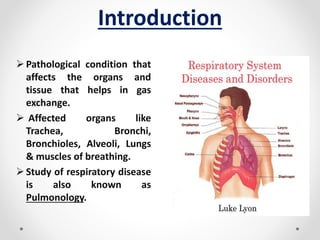
Introduction
Pathological condition that
affects the organs and
tissue that helps in gas
exchange.
 Affected organs like
Trachea, Bronchi,
Bronchioles, Alveoli, Lungs
& muscles of breathing.
Study of respiratory disease
is also known as
Pulmonology.
Classification of disease
 Infectious Diseases
o Upper respiratory tract infections
• Common cold
• Sinusitis
o Lower respiratory tract infections
• RSV(Respiratory Syncytial Virus)
• Tuberculosis(TB)
• Pneumonia
• Cough
 Obstructive Lung Diseases
o Lung Cancer
o Asthma
 Chronic Obstructive Pulmonary Disease (COPD)
o Emphysema
o Bronchitis
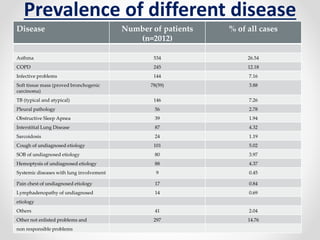
Prevalence of different disease
Disease Number of patients
(n=2012)
% of all cases
Asthma 534 26.54
COPD 245 12.18
Infective problems 144 7.16
Soft tissue mass (proved bronchogenic
carcinoma)
78(59) 3.88
TB (typical and atypical) 146 7.26
Pleural pathology 56 2.78
Obstructive Sleep Apnea 39 1.94
Interstitial Lung Disease 87 4.32
Sarcoidosis 24 1.19
Cough of undiagnosed etiology 101 5.02
SOB of undiagnosed etiology 80 3.97
Hemoptysis of undiagnosed etiology 88 4.37
Systemic diseases with lung involvement 9 0.45
Pain chest of undiagnosed etiology 17 0.84
Lymphadenopathy of undiagnosed 14 0.69
etiology
Others 41 2.04
Other not enlisted problems and 297 14.76
non responsible problems
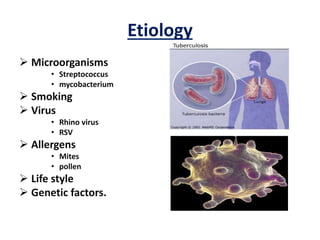
Etiology
 Microorganisms
• Streptococcus
• mycobacterium
 Smoking
 Virus
• Rhino virus
• RSV
 Allergens
• Mites
• pollen
 Life style
 Genetic factors.
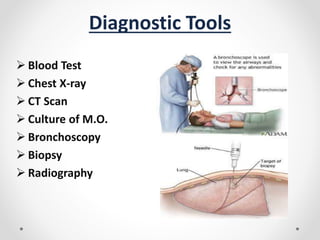
Diagnostic Tools
 Blood Test
 Chest X-ray
 CT Scan
 Culture of M.O.
 Bronchoscopy
 Biopsy
 Radiography
Manifestation
• Rapid heart
rate(tachycardia)
• High fever
• Bluish lips, nails, or
skin.
• Sneezing
• Coughing
o Irritation
o Constant, dry unproductive
vs. productive cough
• Sputum
o Mucus discharge
o Yellowish-green
o Hemoptysis
• Changes in ABG
(arterial blood gases)
o Hypoxemia  inadequate
oxygen in blood
o Hypoxia  inadequate
oxygen supply to cells
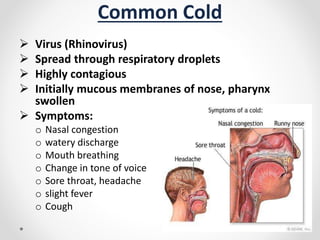
Common Cold
 Virus (Rhinovirus)
 Spread through respiratory droplets
 Highly contagious
 Initially mucous membranes of nose, pharynx
swollen
 Symptoms:
o Nasal congestion
o watery discharge
o Mouth breathing
o Change in tone of voice
o Sore throat, headache
o slight fever
o Cough
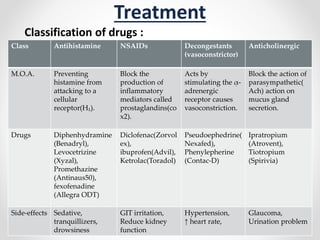
Treatment
Class Antihistamine NSAIDs Decongestants
(vasoconstrictor)
Anticholinergic
M.O.A. Preventing
histamine from
attacking to a
cellular
receptor(H₁).
Block the
production of
inflammatory
mediators called
prostaglandins(co
x2).
Acts by
stimulating the ᾳ-
adrenergic
receptor causes
vasoconstriction.
Block the action of
parasympathetic(
Ach) action on
mucus gland
secretion.
Drugs Diphenhydramine
(Benadryl),
Levocetrizine
(Xyzal),
Promethazine
(Antinaus50),
fexofenadine
(Allegra ODT)
Diclofenac(Zorvol
ex),
ibuprofen(Advil),
Ketrolac(Toradol)
Pseudoephedrine(
Nexafed),
Phenylepherine
(Contac-D)
Ipratropium
(Atrovent),
Tiotropium
(Spirivia)
Side-effects Sedative,
tranquillizers,
drowsiness
GIT irritation,
Reduce kidney
function
Hypertension,
↑ heart rate,
Glaucoma,
Urination problem
Classification of drugs :
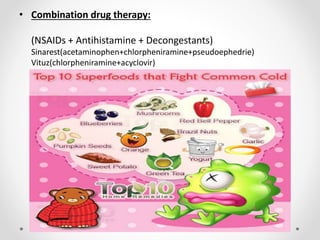
• Combination drug therapy:
(NSAIDs + Antihistamine + Decongestants)
Sinarest(acetaminophen+chlorpheniramine+pseudoephedrie)
Vituz(chlorpheniramine+acyclovir)
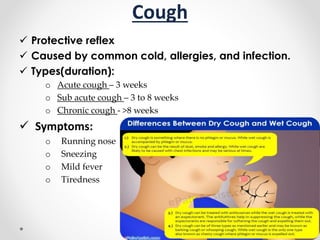
Cough
 Protective reflex
 Caused by common cold, allergies, and infection.
 Types(duration):
o Acute cough – 3 weeks
o Sub acute cough – 3 to 8 weeks
o Chronic cough - >8 weeks
 Symptoms:
o Running nose
o Sneezing
o Mild fever
o Tiredness
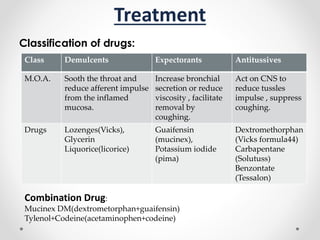
Treatment
Classification of drugs:
Class Demulcents Expectorants Antitussives
M.O.A. Sooth the throat and
reduce afferent impulse
from the inflamed
mucosa.
Increase bronchial
secretion or reduce
viscosity , facilitate
removal by
coughing.
Act on CNS to
reduce tussles
impulse , suppress
coughing.
Drugs Lozenges(Vicks),
Glycerin
Liquorice(licorice)
Guaifensin
(mucinex),
Potassium iodide
(pima)
Dextromethorphan
(Vicks formula44)
Carbapentane
(Solutuss)
Benzontate
(Tessalon)
Combination Drug:
Mucinex DM(dextrometorphan+guaifensin)
Tylenol+Codeine(acetaminophen+codeine)
Asthma
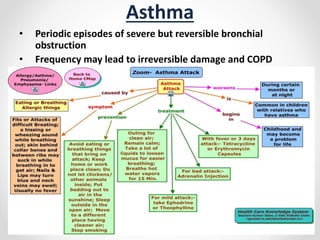
• Periodic episodes of severe but reversible bronchial
obstruction
• Frequency may lead to irreversible damage and COPD
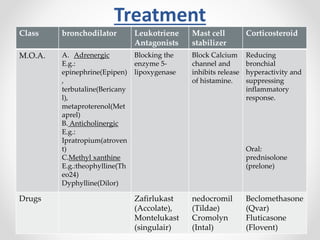
Treatment
Class bronchodilator Leukotriene
Antagonists
Mast cell
stabilizer
Corticosteroid
M.O.A. A. Adrenergic
E.g.:
epinephrine(Epipen)
,
terbutaline(Bericany
l),
metaproterenol(Met
aprel)
B. Anticholinergic
E.g.:
Ipratropium(atroven
t)
C.Methyl xanthine
E.g.:theophylline(Th
eo24)
Dyphylline(Dilor)
Blocking the
enzyme 5-
lipoxygenase
Block Calcium
channel and
inhibits release
of histamine.
Reducing
bronchial
hyperactivity and
suppressing
inflammatory
response.
Oral:
prednisolone
(prelone)
Drugs Zafirlukast
(Accolate),
Montelukast
(singulair)
nedocromil
(Tildae)
Cromolyn
(Intal)
Beclomethasone
(Qvar)
Fluticasone
(Flovent)
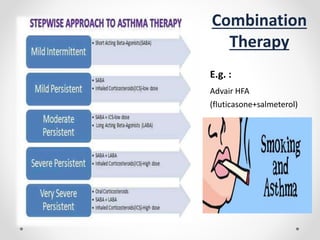
Combination
Therapy
E.g. :
Advair HFA
(fluticasone+salmeterol)
Tuberculosis
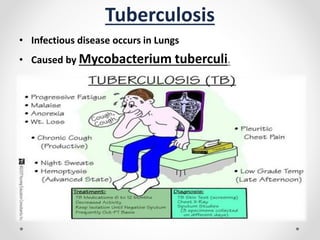
• Infectious disease occurs in Lungs
• Caused by Mycobacterium tuberculi.
Treatment
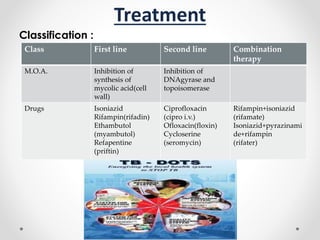
Classification :
Class First line Second line Combination
therapy
M.O.A. Inhibition of
synthesis of
mycolic acid(cell
wall)
Inhibition of
DNAgyrase and
topoisomerase
Drugs Isoniazid
Rifampin(rifadin)
Ethambutol
(myambutol)
Refapentine
(priftin)
Ciprofloxacin
(cipro i.v.)
Ofloxacin(floxin)
Cycloserine
(seromycin)
Rifampin+isoniazid
(rifamate)
Isoniazid+pyrazinami
de+rifampin
(rifater)
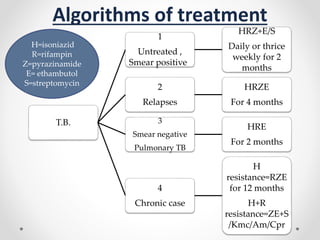
Algorithms of treatment
T.B.
1
Untreated ,
Smear positive
HRZ+E/S
Daily or thrice
weekly for 2
months
2
Relapses
HRZE
For 4 months
3
Smear negative
Pulmonary TB
HRE
For 2 months
4
Chronic case
H
resistance=RZE
for 12 months
H+R
resistance=ZE+S
/Kmc/Am/Cpr
H=isoniazid
R=rifampin
Z=pyrazinamide
E= ethambutol
S=streptomycin
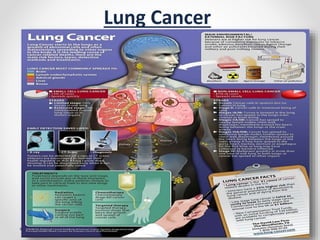
Lung Cancer
Treatment
Techniques Surgery Radiation
Therapy
Chemotherap
y
Targeted
Drug
therapy
Combination
Pneumone
ctomy ,
Segmental
resection,
lobectomy,
X-ray Paclitaxel
(taxol)
Gemcitabine
(gemzar)
Irinotecan
(camptosar)
Bevacizumab
(avastin)
Nivolumab
(opdivo)
Cisplatin+ge
mcitabine
Carpoplatin+
paclitaxel
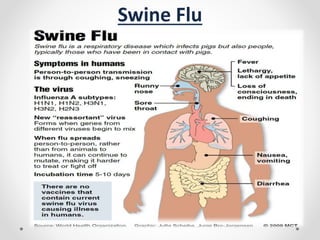
Swine Flu
Diagnostic tools:
• Nasopharyngeal swab for viral culture
• The gold standard test
• Rapid immune fluorescence test
• Viral culture
Treatment:
• Neuraminidase inhibitor antiviral medications
E.g. : Oseltamivir(Tamiflu), Zanamivir(Relenza), Peramivis(Rafivab)inj.
M.O.A. : blocking the enzyme NEURAMINIDASE, enables the virus to spread
• Immunization by vaccines
Flumist(live influenza virus)
M.O.A. : producing antibody to fight against virus.
• Possible herbal therapy
E.g. : Elderberry, Japanese wasabi leaves, Tulsi etc.
Respiratory disease and its management

Respiratory disease and its management

  • 1.
    Respiratory Disease & Management Nitesh Gunjan 1Styear M.Pharma (Pharmaceutical management) DPSRU, New Delhi
  • 2.
    Introduction Pathological condition that affectsthe organs and tissue that helps in gas exchange.  Affected organs like Trachea, Bronchi, Bronchioles, Alveoli, Lungs & muscles of breathing. Study of respiratory disease is also known as Pulmonology.
  • 3.
    Classification of disease Infectious Diseases o Upper respiratory tract infections • Common cold • Sinusitis o Lower respiratory tract infections • RSV(Respiratory Syncytial Virus) • Tuberculosis(TB) • Pneumonia • Cough  Obstructive Lung Diseases o Lung Cancer o Asthma  Chronic Obstructive Pulmonary Disease (COPD) o Emphysema o Bronchitis
  • 4.
    Prevalence of differentdisease Disease Number of patients (n=2012) % of all cases Asthma 534 26.54 COPD 245 12.18 Infective problems 144 7.16 Soft tissue mass (proved bronchogenic carcinoma) 78(59) 3.88 TB (typical and atypical) 146 7.26 Pleural pathology 56 2.78 Obstructive Sleep Apnea 39 1.94 Interstitial Lung Disease 87 4.32 Sarcoidosis 24 1.19 Cough of undiagnosed etiology 101 5.02 SOB of undiagnosed etiology 80 3.97 Hemoptysis of undiagnosed etiology 88 4.37 Systemic diseases with lung involvement 9 0.45 Pain chest of undiagnosed etiology 17 0.84 Lymphadenopathy of undiagnosed 14 0.69 etiology Others 41 2.04 Other not enlisted problems and 297 14.76 non responsible problems
  • 5.
    Etiology  Microorganisms • Streptococcus •mycobacterium  Smoking  Virus • Rhino virus • RSV  Allergens • Mites • pollen  Life style  Genetic factors.
  • 6.
    Diagnostic Tools  BloodTest  Chest X-ray  CT Scan  Culture of M.O.  Bronchoscopy  Biopsy  Radiography
  • 7.
    Manifestation • Rapid heart rate(tachycardia) •High fever • Bluish lips, nails, or skin. • Sneezing • Coughing o Irritation o Constant, dry unproductive vs. productive cough • Sputum o Mucus discharge o Yellowish-green o Hemoptysis • Changes in ABG (arterial blood gases) o Hypoxemia  inadequate oxygen in blood o Hypoxia  inadequate oxygen supply to cells
  • 8.
    Common Cold  Virus(Rhinovirus)  Spread through respiratory droplets  Highly contagious  Initially mucous membranes of nose, pharynx swollen  Symptoms: o Nasal congestion o watery discharge o Mouth breathing o Change in tone of voice o Sore throat, headache o slight fever o Cough
  • 9.
    Treatment Class Antihistamine NSAIDsDecongestants (vasoconstrictor) Anticholinergic M.O.A. Preventing histamine from attacking to a cellular receptor(H₁). Block the production of inflammatory mediators called prostaglandins(co x2). Acts by stimulating the ᾳ- adrenergic receptor causes vasoconstriction. Block the action of parasympathetic( Ach) action on mucus gland secretion. Drugs Diphenhydramine (Benadryl), Levocetrizine (Xyzal), Promethazine (Antinaus50), fexofenadine (Allegra ODT) Diclofenac(Zorvol ex), ibuprofen(Advil), Ketrolac(Toradol) Pseudoephedrine( Nexafed), Phenylepherine (Contac-D) Ipratropium (Atrovent), Tiotropium (Spirivia) Side-effects Sedative, tranquillizers, drowsiness GIT irritation, Reduce kidney function Hypertension, ↑ heart rate, Glaucoma, Urination problem Classification of drugs :
  • 10.
    • Combination drugtherapy: (NSAIDs + Antihistamine + Decongestants) Sinarest(acetaminophen+chlorpheniramine+pseudoephedrie) Vituz(chlorpheniramine+acyclovir)
  • 11.
    Cough  Protective reflex Caused by common cold, allergies, and infection.  Types(duration): o Acute cough – 3 weeks o Sub acute cough – 3 to 8 weeks o Chronic cough - >8 weeks  Symptoms: o Running nose o Sneezing o Mild fever o Tiredness
  • 12.
    Treatment Classification of drugs: ClassDemulcents Expectorants Antitussives M.O.A. Sooth the throat and reduce afferent impulse from the inflamed mucosa. Increase bronchial secretion or reduce viscosity , facilitate removal by coughing. Act on CNS to reduce tussles impulse , suppress coughing. Drugs Lozenges(Vicks), Glycerin Liquorice(licorice) Guaifensin (mucinex), Potassium iodide (pima) Dextromethorphan (Vicks formula44) Carbapentane (Solutuss) Benzontate (Tessalon) Combination Drug: Mucinex DM(dextrometorphan+guaifensin) Tylenol+Codeine(acetaminophen+codeine)
  • 13.
    Asthma • Periodic episodesof severe but reversible bronchial obstruction • Frequency may lead to irreversible damage and COPD
  • 14.
    Treatment Class bronchodilator Leukotriene Antagonists Mastcell stabilizer Corticosteroid M.O.A. A. Adrenergic E.g.: epinephrine(Epipen) , terbutaline(Bericany l), metaproterenol(Met aprel) B. Anticholinergic E.g.: Ipratropium(atroven t) C.Methyl xanthine E.g.:theophylline(Th eo24) Dyphylline(Dilor) Blocking the enzyme 5- lipoxygenase Block Calcium channel and inhibits release of histamine. Reducing bronchial hyperactivity and suppressing inflammatory response. Oral: prednisolone (prelone) Drugs Zafirlukast (Accolate), Montelukast (singulair) nedocromil (Tildae) Cromolyn (Intal) Beclomethasone (Qvar) Fluticasone (Flovent)
  • 15.
  • 16.
    Tuberculosis • Infectious diseaseoccurs in Lungs • Caused by Mycobacterium tuberculi.
  • 17.
    Treatment Classification : Class Firstline Second line Combination therapy M.O.A. Inhibition of synthesis of mycolic acid(cell wall) Inhibition of DNAgyrase and topoisomerase Drugs Isoniazid Rifampin(rifadin) Ethambutol (myambutol) Refapentine (priftin) Ciprofloxacin (cipro i.v.) Ofloxacin(floxin) Cycloserine (seromycin) Rifampin+isoniazid (rifamate) Isoniazid+pyrazinami de+rifampin (rifater)
  • 18.
    Algorithms of treatment T.B. 1 Untreated, Smear positive HRZ+E/S Daily or thrice weekly for 2 months 2 Relapses HRZE For 4 months 3 Smear negative Pulmonary TB HRE For 2 months 4 Chronic case H resistance=RZE for 12 months H+R resistance=ZE+S /Kmc/Am/Cpr H=isoniazid R=rifampin Z=pyrazinamide E= ethambutol S=streptomycin
  • 19.
  • 20.
    Treatment Techniques Surgery Radiation Therapy Chemotherap y Targeted Drug therapy Combination Pneumone ctomy, Segmental resection, lobectomy, X-ray Paclitaxel (taxol) Gemcitabine (gemzar) Irinotecan (camptosar) Bevacizumab (avastin) Nivolumab (opdivo) Cisplatin+ge mcitabine Carpoplatin+ paclitaxel
  • 21.
  • 22.
    Diagnostic tools: • Nasopharyngealswab for viral culture • The gold standard test • Rapid immune fluorescence test • Viral culture Treatment: • Neuraminidase inhibitor antiviral medications E.g. : Oseltamivir(Tamiflu), Zanamivir(Relenza), Peramivis(Rafivab)inj. M.O.A. : blocking the enzyme NEURAMINIDASE, enables the virus to spread • Immunization by vaccines Flumist(live influenza virus) M.O.A. : producing antibody to fight against virus. • Possible herbal therapy E.g. : Elderberry, Japanese wasabi leaves, Tulsi etc.