

Need for resource leveling
 Because the loading for a particular resource depends
on the amount of the resource needed by project
activities and the start and finish dates of those
activities, the loading for a particular resource tends to
vary throughout a project.
 A common resource loading pattern in a project is a
steady build-up in the amount of the resource needed,
a peak, and then a gradual decline.
 Thus, relatively little of the resource is needed early
and late in the project, but much is needed in the
middle. This is problematic for functional managers
who are responsible for a stable, uniform pool of
workers and equipment, because it results in periods
where the pool is underworked or overworked.
 Certainly better would be a relatively uniform
workload on the resource pool.
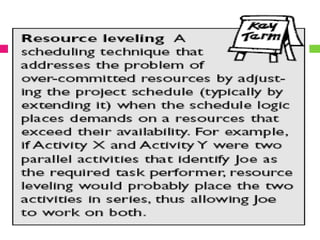
 This is the purpose of resource leveling: to
alter the schedule of individual project
activities such that the resultant amount of a
required resource is somewhat uniform
throughout the project.
 Delaying activities is one method to level
resources; others are:
 Eliminating some work segments or activities
(reduce project scope)
 Substituting resources
 Substituting less resource-consuming work
activities.
 These methods eliminate or alter work
activities to consume fewer or different
resources.
resource-constrained project
 What happens when the number of personnel,
pieces of equipment, or amount of working
capital available restricts a schedule? This is a
resource-constrained project.
 Activities in the project must be scheduled so
that the loading of a particular resource to the
activities does not exceed the available
maximum. The focus differs from time-
constrained resource leveling, because the
issue is not the resource’s loading variability
but its maximum requirement
resource-constrained project
 As each activity is to be scheduled, the sum of its
required resources plus the required resource for
activities already scheduled at the same time
must be checked against the amount available.
 The problem is more than just leveling of
resources; it involves rescheduling jobs, delaying
them until such time when resources become
available.
 Scheduling with constrained resources involves
decisions about which activities can be scheduled
immediately and receive resources, and which
should be delayed until resources are available
resource-constrained project
 The constrained-resource problem also occurs
in multi-project organizations that draw
resources from a common pool.
 To schedule activities for any one project,
managers must account for the resource
requirements of other, concurrent projects.
 The result is that schedules for some projects
are determined in part by when resources will
be freed up from other, higher priority projects.
Resource management

Resource management

  • 3.
    Need for resourceleveling  Because the loading for a particular resource depends on the amount of the resource needed by project activities and the start and finish dates of those activities, the loading for a particular resource tends to vary throughout a project.  A common resource loading pattern in a project is a steady build-up in the amount of the resource needed, a peak, and then a gradual decline.  Thus, relatively little of the resource is needed early and late in the project, but much is needed in the middle. This is problematic for functional managers who are responsible for a stable, uniform pool of workers and equipment, because it results in periods where the pool is underworked or overworked.
  • 4.
     Certainly betterwould be a relatively uniform workload on the resource pool.  This is the purpose of resource leveling: to alter the schedule of individual project activities such that the resultant amount of a required resource is somewhat uniform throughout the project.
  • 5.
     Delaying activitiesis one method to level resources; others are:  Eliminating some work segments or activities (reduce project scope)  Substituting resources  Substituting less resource-consuming work activities.  These methods eliminate or alter work activities to consume fewer or different resources.
  • 6.
    resource-constrained project  Whathappens when the number of personnel, pieces of equipment, or amount of working capital available restricts a schedule? This is a resource-constrained project.  Activities in the project must be scheduled so that the loading of a particular resource to the activities does not exceed the available maximum. The focus differs from time- constrained resource leveling, because the issue is not the resource’s loading variability but its maximum requirement
  • 7.
    resource-constrained project  Aseach activity is to be scheduled, the sum of its required resources plus the required resource for activities already scheduled at the same time must be checked against the amount available.  The problem is more than just leveling of resources; it involves rescheduling jobs, delaying them until such time when resources become available.  Scheduling with constrained resources involves decisions about which activities can be scheduled immediately and receive resources, and which should be delayed until resources are available
  • 8.
    resource-constrained project  Theconstrained-resource problem also occurs in multi-project organizations that draw resources from a common pool.  To schedule activities for any one project, managers must account for the resource requirements of other, concurrent projects.  The result is that schedules for some projects are determined in part by when resources will be freed up from other, higher priority projects.