Presenting Your Financial Statements So you can communicate your financial results  clearly and elegantly. 2009
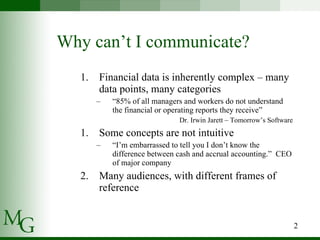
Why can’t I communicate? Financial data is inherently complex – many data points, many categories “ 85% of all managers and workers do not understand the financial or operating reports they receive” Dr. Irwin Jarett – Tomorrow’s Software Some concepts are not intuitive “ I’m embarrassed to tell you I don’t know the difference between cash and accrual accounting.”  CEO of major company  Many audiences, with different frames of reference
Topics The balance sheet Current financial reports Forecasts Dynamic models
I – The balance sheet The single most important financial report Also, the single most difficult report for communicating and persuading
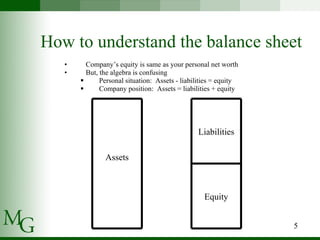
How to understand the balance sheet Company’s equity is same as your personal net worth But, the algebra is confusing Personal situation:  Assets - liabilities = equity Company position:  Assets = liabilities + equity Equity Liabilities Assets
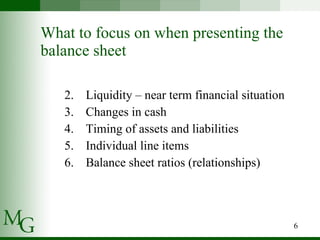
What to focus on when presenting the balance sheet Liquidity – near term financial situation Changes in cash Timing of assets and liabilities Individual line items  Balance sheet ratios (relationships)
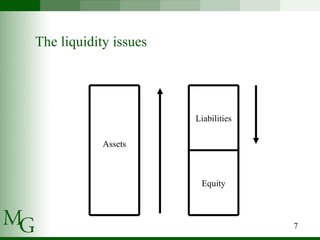
The liquidity issues Equity Liabilities Assets
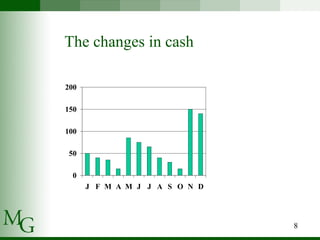
The changes in cash
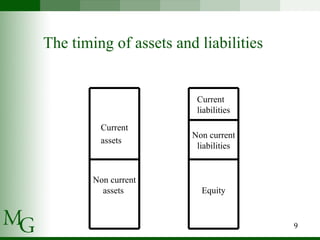
The timing of assets and liabilities   Equity Non current assets  Current liabilities Non current liabilities Current assets
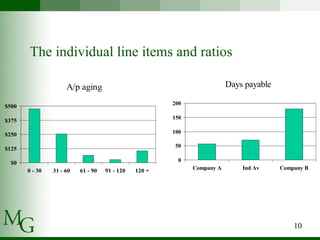
The individual line items and ratios
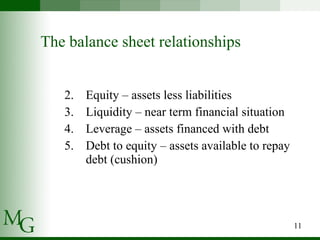
The balance sheet relationships Equity – assets less liabilities Liquidity – near term financial situation Leverage – assets financed with debt Debt to equity – assets available to repay debt (cushion)
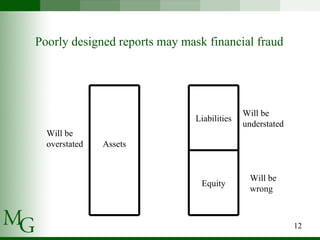
Poorly designed reports may mask financial fraud Will be overstated Equity Liabilities Will be wrong Will be understated Assets
Topics The balance sheet Current financial reports Forecasts Dynamic models
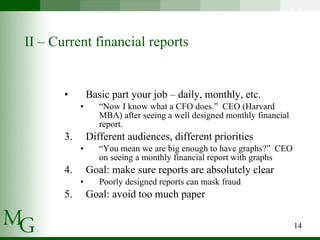
II – Current financial reports Basic part your job – daily, monthly, etc. “ Now I know what a CFO does.”  CEO (Harvard MBA) after seeing a well designed monthly financial report. Different audiences, different priorities “ You mean we are big enough to have graphs?”  CEO on seeing a monthly financial report with graphs Goal: make sure reports are absolutely clear Poorly designed reports can mask fraud Goal: avoid too much paper
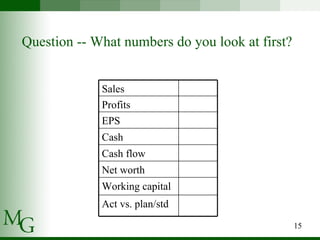
Question -- What numbers do you look at first? Net worth Cash flow Working capital Act vs. plan/std Cash EPS Profits Sales
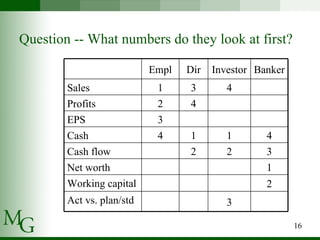
Question -- What numbers do they look at first? 2 1 3 4 Banker Net worth 2 2 Cash flow Working capital 3 Act vs. plan/std 1 1 4 Cash 3 EPS 4 2 Profits 4 3 1 Sales Investor Dir Empl
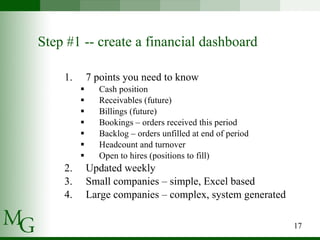
Step #1 -- create a financial dashboard 7 points you need to know  Cash position Receivables (future) Billings (future) Bookings – orders received this period Backlog – orders unfilled at end of period Headcount and turnover Open to hires (positions to fill) Updated weekly Small companies – simple, Excel based Large companies – complex, system generated
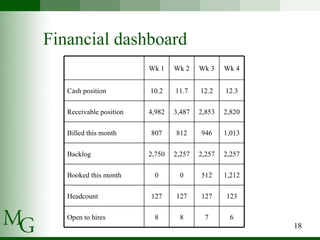
Financial dashboard 123 127 127 127 Headcount 2,820 2,853 3,487 4,982 Receivable position 2,257 2,257 2,257 2,750 Backlog 6 7 8 8 Open to hires 1,212 512 0 0 Booked this month 1,013 946 812 807 Billed this month 12.3 12.2 11.7 10.2 Cash position Wk 4 Wk 3 Wk 2 Wk 1
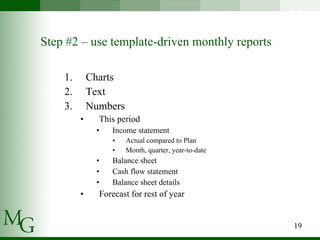
Step #2 – use template-driven monthly reports Charts Text Numbers This period Income statement Actual compared to Plan Month, quarter, year-to-date Balance sheet Cash flow statement Balance sheet details Forecast for rest of year
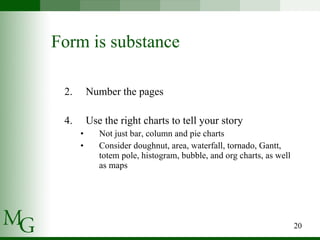
Form is substance Number the pages  Use the right charts to tell your story Not just bar, column and pie charts Consider doughnut, area, waterfall, tornado, Gantt, totem pole, histogram, bubble, and org charts, as well as maps
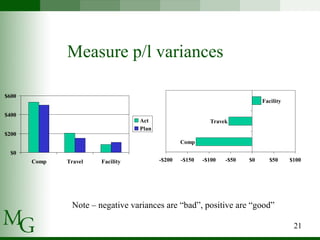
Measure p/l variances  Note – negative variances are “bad”, positive are “good”
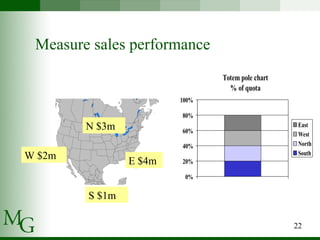
Measure sales performance N $3m E $4m S $1m W $2m
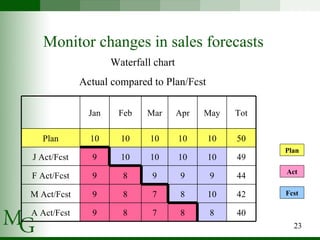
Monitor changes in sales forecasts Waterfall chart Actual compared to Plan/Fcst Plan Fcst Act 8 10 9 10 10 May 40 8 7 8 9 A Act/Fcst 42 8 7 8 9 M Act/Fcst 44 9 9 8 9 F Act/Fcst 49 10 10 10 9 J Act/Fcst 50 10 10 10 10 Plan Tot Apr Mar Feb Jan
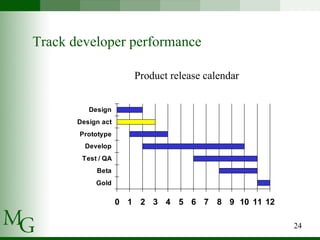
Track developer performance Product release calendar
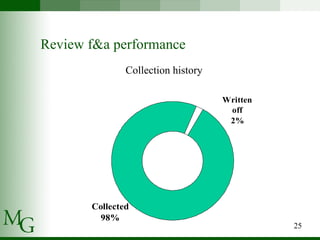
Review f&a performance Collection history
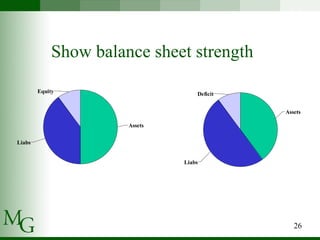
Show balance sheet strength
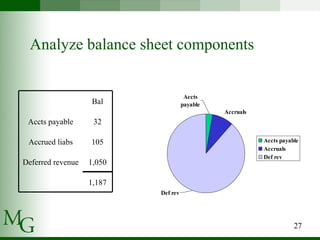
Analyze balance sheet components 1,050 Deferred revenue 1,187 105 Accrued liabs 32 Accts payable Bal
Step #3 -- Tailor the reports to your audience Banks Compliance with covenants Adequacy of collateral to ensure repayment Current investors Timing and amount of next round Management of issues that will drive next financing or liquidity event (sale, ipo, bankruptcy) Employees Operations (sales, profits) EPS Cash Will I earn my bonus/commission?
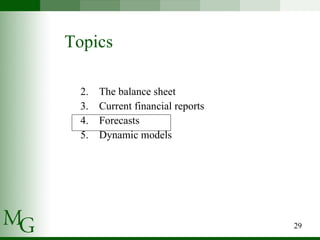
Topics The balance sheet Current financial reports Forecasts Dynamic models
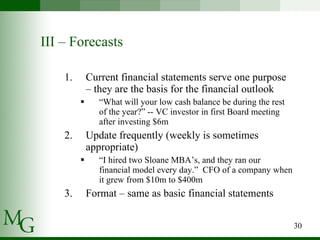
III – Forecasts Current financial statements serve one purpose – they are the basis for the financial outlook “ What will your low cash balance be during the rest of the year?” -- VC investor in first Board meeting after investing $6m Update frequently (weekly is sometimes appropriate)  “ I hired two Sloane MBA’s, and they ran our financial model every day.”  CFO of a company when it grew from $10m to $400m Format – same as basic financial statements
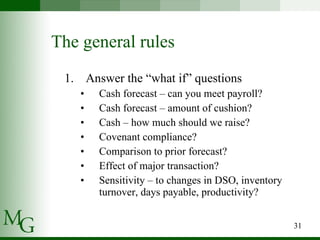
The general rules Answer the “what if” questions Cash forecast – can you meet payroll? Cash forecast – amount of cushion? Cash – how much should we raise? Covenant compliance? Comparison to prior forecast? Effect of major transaction? Sensitivity – to changes in DSO, inventory turnover, days payable, productivity?
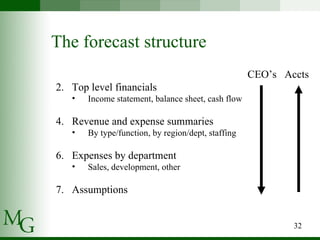
The forecast structure CEO’s  Accts Top level financials Income statement, balance sheet, cash flow Revenue and expense summaries By type/function, by region/dept, staffing Expenses by department Sales, development, other Assumptions
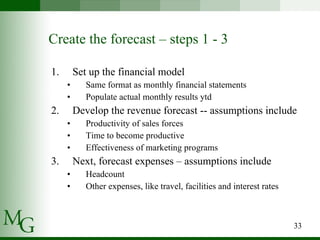
Set up the financial model Same format as monthly financial statements Populate actual monthly results ytd Develop the revenue forecast -- assumptions include Productivity of sales forces Time to become productive Effectiveness of marketing programs Next, forecast expenses – assumptions include Headcount Other expenses, like travel, facilities and interest rates Create the forecast – steps 1 - 3
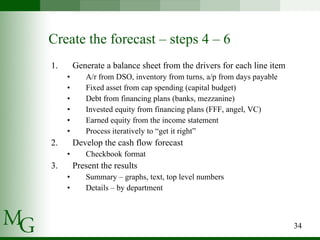
Generate a balance sheet from the drivers for each line item A/r from DSO, inventory from turns, a/p from days payable Fixed asset from cap spending (capital budget) Debt from financing plans (banks, mezzanine) Invested equity from financing plans (FFF, angel, VC) Earned equity from the income statement Process iteratively to “get it right” Develop the cash flow forecast  Checkbook format Present the results Summary – graphs, text, top level numbers Details – by department Create the forecast – steps 4 – 6
Question – what 3 charts must be in your business plan? ? ? ?
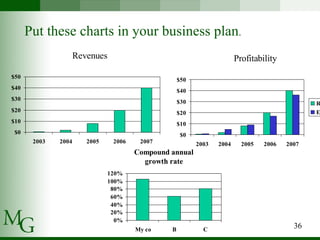
Put these charts in your business plan .
Topics The balance sheet Current financial reports Forecasts Dynamic models
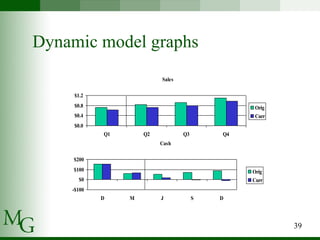
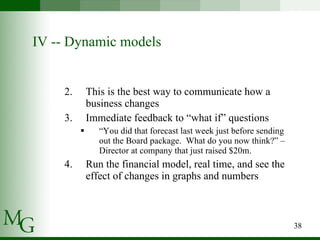
IV -- Dynamic models This is the best way to communicate how a business changes  Immediate feedback to “what if” questions “ You did that forecast last week just before sending out the Board package.  What do you now think?” – Director at company that just raised $20m. Run the financial model, real time, and see the effect of changes in graphs and numbers
Dynamic model graphs
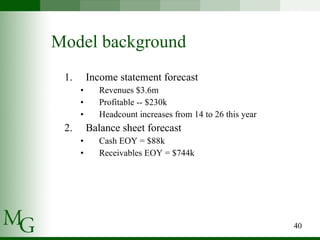
Model background Income statement forecast Revenues $3.6m Profitable -- $230k Headcount increases from 14 to 26 this year Balance sheet forecast Cash EOY = $88k Receivables EOY = $744k
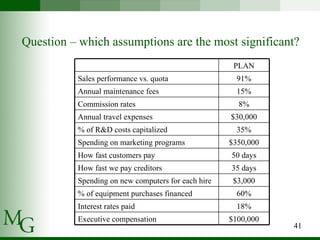
Question – which assumptions are the most significant? $100,000 18% 60% $3,000 35 days 50 days $350,000 35% $30,000 8% 15% 91% PLAN Sales performance vs. quota Executive compensation Interest rates paid % of equipment purchases financed Spending on new computers for each hire How fast we pay creditors How fast customers pay Spending on marketing programs % of R&D costs capitalized Annual travel expenses Commission rates Annual maintenance fees
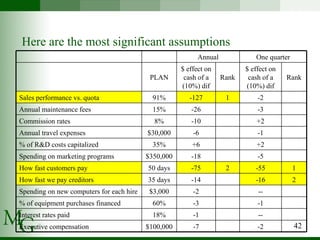
Here are the most significant assumptions -2 -- -1 -- -16 -55 -5 +2 -1 +2 -3 -2 $ effect on cash of a (10%) dif One quarter 2 1 Rank Annual -7 -1 -3 -2 -14 -75 -18 +6 -6 -10 -26 -127 $ effect on cash of a (10%) dif 2 1 Rank PLAN 91% Sales performance vs. quota $100,000 Executive compensation 18% Interest rates paid 60% % of equipment purchases financed $3,000 Spending on new computers for each hire 35 days How fast we pay creditors 50 days How fast customers pay $350,000 Spending on marketing programs 35% % of R&D costs capitalized $30,000 Annual travel expenses 8% Commission rates 15% Annual maintenance fees
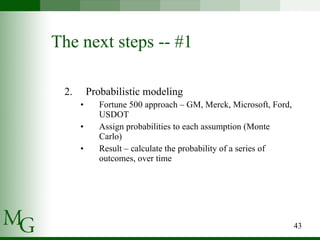
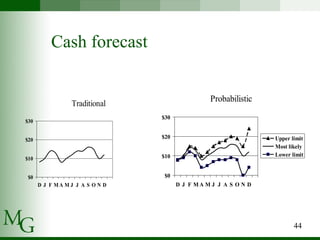
The next steps -- #1 Probabilistic modeling Fortune 500 approach – GM, Merck, Microsoft, Ford, USDOT Assign probabilities to each assumption (Monte Carlo) Result – calculate the probability of a series of outcomes, over time
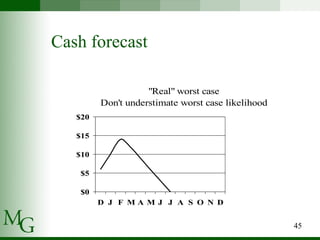
Cash forecast
Cash forecast
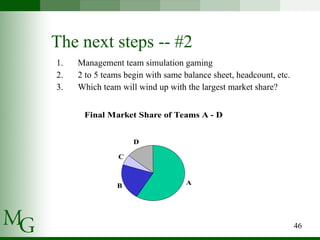
The next steps -- #2 Management team simulation gaming 2 to 5 teams begin with same balance sheet, headcount, etc. Which team will wind up with the largest market share?

Presenting Financial Statements

  • 1.
    Presenting Your FinancialStatements So you can communicate your financial results clearly and elegantly. 2009
  • 2.
    Why can’t Icommunicate? Financial data is inherently complex – many data points, many categories “ 85% of all managers and workers do not understand the financial or operating reports they receive” Dr. Irwin Jarett – Tomorrow’s Software Some concepts are not intuitive “ I’m embarrassed to tell you I don’t know the difference between cash and accrual accounting.” CEO of major company Many audiences, with different frames of reference
  • 3.
    Topics The balancesheet Current financial reports Forecasts Dynamic models
  • 4.
    I – Thebalance sheet The single most important financial report Also, the single most difficult report for communicating and persuading
  • 5.
    How to understandthe balance sheet Company’s equity is same as your personal net worth But, the algebra is confusing Personal situation: Assets - liabilities = equity Company position: Assets = liabilities + equity Equity Liabilities Assets
  • 6.
    What to focuson when presenting the balance sheet Liquidity – near term financial situation Changes in cash Timing of assets and liabilities Individual line items Balance sheet ratios (relationships)
  • 7.
    The liquidity issuesEquity Liabilities Assets
  • 8.
  • 9.
    The timing ofassets and liabilities Equity Non current assets Current liabilities Non current liabilities Current assets
  • 10.
    The individual lineitems and ratios
  • 11.
    The balance sheetrelationships Equity – assets less liabilities Liquidity – near term financial situation Leverage – assets financed with debt Debt to equity – assets available to repay debt (cushion)
  • 12.
    Poorly designed reportsmay mask financial fraud Will be overstated Equity Liabilities Will be wrong Will be understated Assets
  • 13.
    Topics The balancesheet Current financial reports Forecasts Dynamic models
  • 14.
    II – Currentfinancial reports Basic part your job – daily, monthly, etc. “ Now I know what a CFO does.” CEO (Harvard MBA) after seeing a well designed monthly financial report. Different audiences, different priorities “ You mean we are big enough to have graphs?” CEO on seeing a monthly financial report with graphs Goal: make sure reports are absolutely clear Poorly designed reports can mask fraud Goal: avoid too much paper
  • 15.
    Question -- Whatnumbers do you look at first? Net worth Cash flow Working capital Act vs. plan/std Cash EPS Profits Sales
  • 16.
    Question -- Whatnumbers do they look at first? 2 1 3 4 Banker Net worth 2 2 Cash flow Working capital 3 Act vs. plan/std 1 1 4 Cash 3 EPS 4 2 Profits 4 3 1 Sales Investor Dir Empl
  • 17.
    Step #1 --create a financial dashboard 7 points you need to know Cash position Receivables (future) Billings (future) Bookings – orders received this period Backlog – orders unfilled at end of period Headcount and turnover Open to hires (positions to fill) Updated weekly Small companies – simple, Excel based Large companies – complex, system generated
  • 18.
    Financial dashboard 123127 127 127 Headcount 2,820 2,853 3,487 4,982 Receivable position 2,257 2,257 2,257 2,750 Backlog 6 7 8 8 Open to hires 1,212 512 0 0 Booked this month 1,013 946 812 807 Billed this month 12.3 12.2 11.7 10.2 Cash position Wk 4 Wk 3 Wk 2 Wk 1
  • 19.
    Step #2 –use template-driven monthly reports Charts Text Numbers This period Income statement Actual compared to Plan Month, quarter, year-to-date Balance sheet Cash flow statement Balance sheet details Forecast for rest of year
  • 20.
    Form is substanceNumber the pages Use the right charts to tell your story Not just bar, column and pie charts Consider doughnut, area, waterfall, tornado, Gantt, totem pole, histogram, bubble, and org charts, as well as maps
  • 21.
    Measure p/l variances Note – negative variances are “bad”, positive are “good”
  • 22.
    Measure sales performanceN $3m E $4m S $1m W $2m
  • 23.
    Monitor changes insales forecasts Waterfall chart Actual compared to Plan/Fcst Plan Fcst Act 8 10 9 10 10 May 40 8 7 8 9 A Act/Fcst 42 8 7 8 9 M Act/Fcst 44 9 9 8 9 F Act/Fcst 49 10 10 10 9 J Act/Fcst 50 10 10 10 10 Plan Tot Apr Mar Feb Jan
  • 24.
    Track developer performanceProduct release calendar
  • 25.
    Review f&a performanceCollection history
  • 26.
  • 27.
    Analyze balance sheetcomponents 1,050 Deferred revenue 1,187 105 Accrued liabs 32 Accts payable Bal
  • 28.
    Step #3 --Tailor the reports to your audience Banks Compliance with covenants Adequacy of collateral to ensure repayment Current investors Timing and amount of next round Management of issues that will drive next financing or liquidity event (sale, ipo, bankruptcy) Employees Operations (sales, profits) EPS Cash Will I earn my bonus/commission?
  • 29.
    Topics The balancesheet Current financial reports Forecasts Dynamic models
  • 30.
    III – ForecastsCurrent financial statements serve one purpose – they are the basis for the financial outlook “ What will your low cash balance be during the rest of the year?” -- VC investor in first Board meeting after investing $6m Update frequently (weekly is sometimes appropriate) “ I hired two Sloane MBA’s, and they ran our financial model every day.” CFO of a company when it grew from $10m to $400m Format – same as basic financial statements
  • 31.
    The general rulesAnswer the “what if” questions Cash forecast – can you meet payroll? Cash forecast – amount of cushion? Cash – how much should we raise? Covenant compliance? Comparison to prior forecast? Effect of major transaction? Sensitivity – to changes in DSO, inventory turnover, days payable, productivity?
  • 32.
    The forecast structureCEO’s Accts Top level financials Income statement, balance sheet, cash flow Revenue and expense summaries By type/function, by region/dept, staffing Expenses by department Sales, development, other Assumptions
  • 33.
    Set up thefinancial model Same format as monthly financial statements Populate actual monthly results ytd Develop the revenue forecast -- assumptions include Productivity of sales forces Time to become productive Effectiveness of marketing programs Next, forecast expenses – assumptions include Headcount Other expenses, like travel, facilities and interest rates Create the forecast – steps 1 - 3
  • 34.
    Generate a balancesheet from the drivers for each line item A/r from DSO, inventory from turns, a/p from days payable Fixed asset from cap spending (capital budget) Debt from financing plans (banks, mezzanine) Invested equity from financing plans (FFF, angel, VC) Earned equity from the income statement Process iteratively to “get it right” Develop the cash flow forecast Checkbook format Present the results Summary – graphs, text, top level numbers Details – by department Create the forecast – steps 4 – 6
  • 35.
    Question – what3 charts must be in your business plan? ? ? ?
  • 36.
    Put these chartsin your business plan .
  • 37.
    Topics The balancesheet Current financial reports Forecasts Dynamic models
  • 38.
    IV -- Dynamicmodels This is the best way to communicate how a business changes Immediate feedback to “what if” questions “ You did that forecast last week just before sending out the Board package. What do you now think?” – Director at company that just raised $20m. Run the financial model, real time, and see the effect of changes in graphs and numbers
  • 39.
  • 40.
    Model background Incomestatement forecast Revenues $3.6m Profitable -- $230k Headcount increases from 14 to 26 this year Balance sheet forecast Cash EOY = $88k Receivables EOY = $744k
  • 41.
    Question – whichassumptions are the most significant? $100,000 18% 60% $3,000 35 days 50 days $350,000 35% $30,000 8% 15% 91% PLAN Sales performance vs. quota Executive compensation Interest rates paid % of equipment purchases financed Spending on new computers for each hire How fast we pay creditors How fast customers pay Spending on marketing programs % of R&D costs capitalized Annual travel expenses Commission rates Annual maintenance fees
  • 42.
    Here are themost significant assumptions -2 -- -1 -- -16 -55 -5 +2 -1 +2 -3 -2 $ effect on cash of a (10%) dif One quarter 2 1 Rank Annual -7 -1 -3 -2 -14 -75 -18 +6 -6 -10 -26 -127 $ effect on cash of a (10%) dif 2 1 Rank PLAN 91% Sales performance vs. quota $100,000 Executive compensation 18% Interest rates paid 60% % of equipment purchases financed $3,000 Spending on new computers for each hire 35 days How fast we pay creditors 50 days How fast customers pay $350,000 Spending on marketing programs 35% % of R&D costs capitalized $30,000 Annual travel expenses 8% Commission rates 15% Annual maintenance fees
  • 43.
    The next steps-- #1 Probabilistic modeling Fortune 500 approach – GM, Merck, Microsoft, Ford, USDOT Assign probabilities to each assumption (Monte Carlo) Result – calculate the probability of a series of outcomes, over time
  • 44.
  • 45.
  • 46.
    The next steps-- #2 Management team simulation gaming 2 to 5 teams begin with same balance sheet, headcount, etc. Which team will wind up with the largest market share?