Project Management Session 6 Scheduling Resources
Session Outcomes Following the session the delegates should have a basic understanding of the typical resource scheduling problems for time as well as resources constrained projects. In addition the delegate should be able to show how free slack can be used to effect resource leveling.
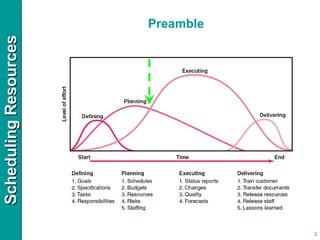
Preamble
The Resource Problem After staff and other resources have been allocated the project manager still need to answer the following questions: Will the  resources be adequate and available  when needed; Will  outside contractors  have to be used; Will unforeseen resource dependencies exist  – will there be a new critical path; How much  flexibility do we  have in using resources; Are original  deadlines realistic.
The Resource Problem Resources and Priorities: Project sequencing and scheduling deals poorly with resource availability and utilization ; Project network times are not a schedule until resources have been assigned: The implicit  assumption is that resources will be available  in the required amounts when needed; Adding new projects requires making realistic judgments of  resource availability  and project durations; Resources may be adequate but  demand can vary  – then resource leveling or smoothing is required; or  Resources  may not be adequate to meet peak resource requirements , the late start date of certain activities will have to be delayed and project duration be increased – this is referred to as resource constrained scheduling.
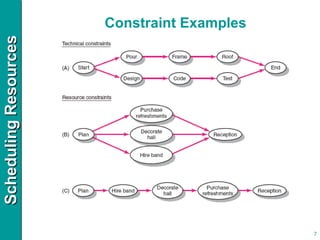
Types of Project Constraints Technical or Logic Constraints: Constraints related to the networked sequence in which project activities must occur – example, dig trenches, pour cement, then lay bricks for walls… Physical Constraints: Activities that cannot occur in parallel or are affected by contractual or environmental conditions – ship renovation, one person allowed in confined space… Resource Constraints: The absence, shortage, or unique interrelationship and interaction characteristics of resources that require a particular sequencing of project activities- example, normally you have 3 people to do three activities in parallel, but because you only have one person you have to schedule them in series – NB!! Resource dependency takes priority but cannot violate technical dependencies.
Constraint Examples
Kinds of Resource Constraints People; Materials; Equipment; Working Capital.
Classification of A Scheduling Problem Classification of Problem: Using a priority matrix will help determine if the project is time or resource constrained; Time Constrained Project: A project that must be completed by an  imposed date ; Time is fixed , resources are flexible: additional resources are required to ensure project meets schedule Resource Constrained Project: A project in which the  level of resources available cannot be exceeded: Resources are fixed , time is flexible: inadequate resources will delay the project.
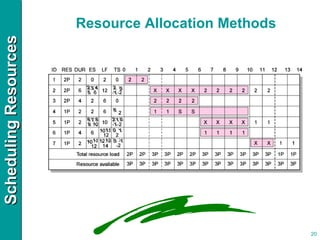
Resource Allocation Methods Resource allocation is based on the following assumptions: Splitting activities is not allowed —once an activity is start, it is carried to completion; Level of resource used for an activity cannot be changed ; Activities with the  most slack pose the least risk ; Reduction of flexibility does not increase risk ; The  nature of an activity (easy, complex) doesn’t increase risk .
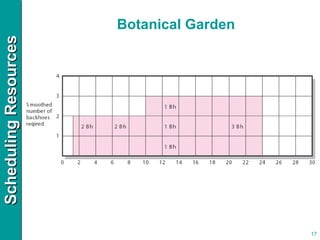
Resource Allocation Methods Time-Constrained Projects: Projects that must be completed by an imposed date;  Require the use of  leveling techniques  that focus on  balancing or smoothing resource demand  by  using positive slack (delaying noncritical activities ) to manage resource utilization over the duration of the project with the following result: Peak resource demands are reduced; Resource demand over the life of the project are reduced; Fluctuation in resource demand is minimized.
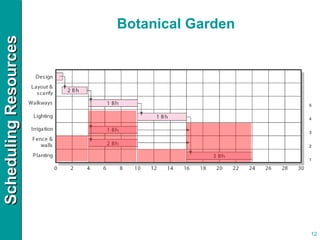
Botanical Garden 1 2 3 4 5
Botanical Garden
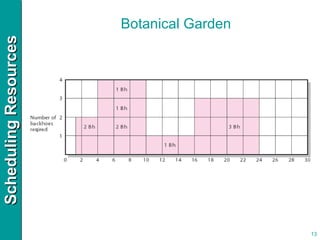
Botanical Garden 1 2 3 4 5
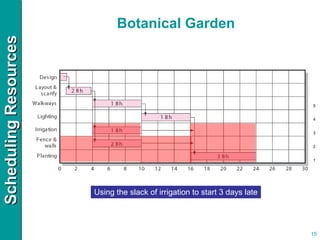
Botanical Garden Using the slack of irrigation to start 3 days late 1 2 3 4 5
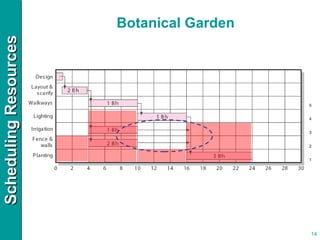
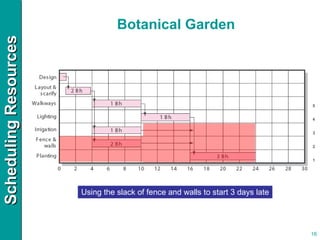
Botanical Garden Using the slack of fence and walls to start 3 days late 1 2 3 4 5
Botanical Garden
Resource Allocation Methods Resource Demand Leveling Techniques for Time-Constrained Projects: Advantages: Peak resource demands are reduced; Resources  demand  over the life of the project are reduced; Fluctuation in resource demand is minimized; Disadvantages: Loss of flexibility  that occurs from reducing slack; Increases  in the criticality  of all activities.
Resource Allocation Methods Resource-Constrained Projects: Projects that involve resources that are limited in quantity or by their availability’ Scheduling of activities requires the use of heuristics (rules-of-thumb) that focus on: Minimum slack; Smallest (least) duration; Lowest activity identification number. The parallel method is used to apply heuristics: An iterative process that starts at the first time period of the project and schedules period-by-period any activities scheduled to start using the three priority rules.
Resource Allocation Methods
The Impacts of Resource-Constrained Scheduling Reduces delay but reduces flexibility; Increases criticality of events; Increases scheduling complexity; May make traditional critical path no longer meaningful; Can break sequence of events; May cause parallel activities to become sequential and critical activities with slack to become noncritical.b
CPM includes a way of relating the project schedule to the level of physical resources allocated to the project; This allows the project manager to trade time for cost, or vice versa; In CPM, two activity times and two costs are specified, if appropriate for each activity. Resource Management
The first time/cost combination is called  normal,  and the second set is referred to as  crash ; Normal assumes time and resources in normal conditions – although there is a “technical” way to calculate it;  Crash result from an attempt to expedite the activity by the application of additional resources. Resource Management
Careful planning is critical when attempting to expedite (crash) a project; Expediting tends to create problems, and the solution to one problem often creates several more problems that require solutions. Resource Management
Another way to expedite a project is known as  “fast-tracking”; Mostly construction  but term also used on other projects; It refers to  overlapping the design and build phases  of a project; Because design is usually completed before construction starts, overlapping the two activities will result in shortening the project duration; Could however also lead to increased number of  change orders,  and therefore increased cost and loss of time – however generally feasible. Resource Management
 

PM Session 6

  • 1.
    Project Management Session6 Scheduling Resources
  • 2.
    Session Outcomes Followingthe session the delegates should have a basic understanding of the typical resource scheduling problems for time as well as resources constrained projects. In addition the delegate should be able to show how free slack can be used to effect resource leveling.
  • 3.
  • 4.
    The Resource ProblemAfter staff and other resources have been allocated the project manager still need to answer the following questions: Will the resources be adequate and available when needed; Will outside contractors have to be used; Will unforeseen resource dependencies exist – will there be a new critical path; How much flexibility do we have in using resources; Are original deadlines realistic.
  • 5.
    The Resource ProblemResources and Priorities: Project sequencing and scheduling deals poorly with resource availability and utilization ; Project network times are not a schedule until resources have been assigned: The implicit assumption is that resources will be available in the required amounts when needed; Adding new projects requires making realistic judgments of resource availability and project durations; Resources may be adequate but demand can vary – then resource leveling or smoothing is required; or Resources may not be adequate to meet peak resource requirements , the late start date of certain activities will have to be delayed and project duration be increased – this is referred to as resource constrained scheduling.
  • 6.
    Types of ProjectConstraints Technical or Logic Constraints: Constraints related to the networked sequence in which project activities must occur – example, dig trenches, pour cement, then lay bricks for walls… Physical Constraints: Activities that cannot occur in parallel or are affected by contractual or environmental conditions – ship renovation, one person allowed in confined space… Resource Constraints: The absence, shortage, or unique interrelationship and interaction characteristics of resources that require a particular sequencing of project activities- example, normally you have 3 people to do three activities in parallel, but because you only have one person you have to schedule them in series – NB!! Resource dependency takes priority but cannot violate technical dependencies.
  • 7.
  • 8.
    Kinds of ResourceConstraints People; Materials; Equipment; Working Capital.
  • 9.
    Classification of AScheduling Problem Classification of Problem: Using a priority matrix will help determine if the project is time or resource constrained; Time Constrained Project: A project that must be completed by an imposed date ; Time is fixed , resources are flexible: additional resources are required to ensure project meets schedule Resource Constrained Project: A project in which the level of resources available cannot be exceeded: Resources are fixed , time is flexible: inadequate resources will delay the project.
  • 10.
    Resource Allocation MethodsResource allocation is based on the following assumptions: Splitting activities is not allowed —once an activity is start, it is carried to completion; Level of resource used for an activity cannot be changed ; Activities with the most slack pose the least risk ; Reduction of flexibility does not increase risk ; The nature of an activity (easy, complex) doesn’t increase risk .
  • 11.
    Resource Allocation MethodsTime-Constrained Projects: Projects that must be completed by an imposed date; Require the use of leveling techniques that focus on balancing or smoothing resource demand by using positive slack (delaying noncritical activities ) to manage resource utilization over the duration of the project with the following result: Peak resource demands are reduced; Resource demand over the life of the project are reduced; Fluctuation in resource demand is minimized.
  • 12.
  • 13.
  • 14.
  • 15.
    Botanical Garden Usingthe slack of irrigation to start 3 days late 1 2 3 4 5
  • 16.
    Botanical Garden Usingthe slack of fence and walls to start 3 days late 1 2 3 4 5
  • 17.
  • 18.
    Resource Allocation MethodsResource Demand Leveling Techniques for Time-Constrained Projects: Advantages: Peak resource demands are reduced; Resources demand over the life of the project are reduced; Fluctuation in resource demand is minimized; Disadvantages: Loss of flexibility that occurs from reducing slack; Increases in the criticality of all activities.
  • 19.
    Resource Allocation MethodsResource-Constrained Projects: Projects that involve resources that are limited in quantity or by their availability’ Scheduling of activities requires the use of heuristics (rules-of-thumb) that focus on: Minimum slack; Smallest (least) duration; Lowest activity identification number. The parallel method is used to apply heuristics: An iterative process that starts at the first time period of the project and schedules period-by-period any activities scheduled to start using the three priority rules.
  • 20.
  • 21.
    The Impacts ofResource-Constrained Scheduling Reduces delay but reduces flexibility; Increases criticality of events; Increases scheduling complexity; May make traditional critical path no longer meaningful; Can break sequence of events; May cause parallel activities to become sequential and critical activities with slack to become noncritical.b
  • 22.
    CPM includes away of relating the project schedule to the level of physical resources allocated to the project; This allows the project manager to trade time for cost, or vice versa; In CPM, two activity times and two costs are specified, if appropriate for each activity. Resource Management
  • 23.
    The first time/costcombination is called normal, and the second set is referred to as crash ; Normal assumes time and resources in normal conditions – although there is a “technical” way to calculate it; Crash result from an attempt to expedite the activity by the application of additional resources. Resource Management
  • 24.
    Careful planning iscritical when attempting to expedite (crash) a project; Expediting tends to create problems, and the solution to one problem often creates several more problems that require solutions. Resource Management
  • 25.
    Another way toexpedite a project is known as “fast-tracking”; Mostly construction but term also used on other projects; It refers to overlapping the design and build phases of a project; Because design is usually completed before construction starts, overlapping the two activities will result in shortening the project duration; Could however also lead to increased number of change orders, and therefore increased cost and loss of time – however generally feasible. Resource Management
  • 26.