2–1
Agenda of the Lecture
1.Overview of the Resource Scheduling Problem
2.Types of Resource Constraints
3.Classification of a Scheduling Problem
4.Resource Allocation Methods
A. Assumptions
B. Time-Constrained Projects: Smoothing Resource Demand
C. Resource-Constrained Projects
5.Computer Demonstration of Resource-Constrained Scheduling
A. The Impacts of Resource-Constrained Scheduling
6.Splitting Activities
7.Benefits of Scheduling Resources
8.Assigning Project Work
9.Multi project Resource Schedules
10. Using the Resource Schedule to Develop a Project Cost Baseline
A. Why a Time-Phased Budget Baseline Is Needed
B. Creating a Time-Phased Budget
8–2
8–3
Overview of the Resource Scheduling Problem
• Resources and Priorities
–Project network times are not a schedule
until resources have been assigned.
• The implicit assumption is that resources will be available in
the required amounts when needed.
• Adding new projects requires making realistic judgments of
resource availability and project durations.
–Cost estimates are not a budget
until they have been time-phased.
8–4
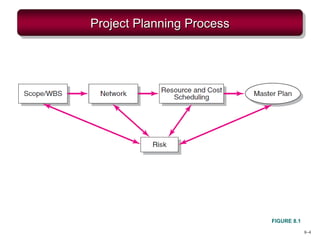
Project Planning Process
FIGURE 8.1
8–5
Overview of the Resource Scheduling Problem
.
• Resource Smoothing (or Leveling)
–Involves attempting to even out varying demands
on resources by using slack (delaying noncritical
activities) to manage resource utilization when
resources are adequate over the life of the project.
8–6
Types of Project Constraints
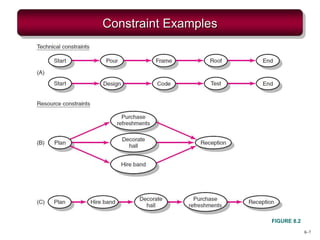
• Technical or Logic Constraints
– Constraints related to the networked sequence
in which project activities must occur.
• Physical Constraints
– Activities that cannot occur in parallel or are affected by
contractual or environmental conditions.
• Resource Constraints
– The absence, shortage, or unique interrelationship and
interaction characteristics of resources that require a particular
sequencing of project activities
• Kinds of Resource Constraints
– People, materials, equipment
8–7
Constraint Examples
FIGURE 8.2
8–8
Classification of A Scheduling Problem
• Classification of Problem
–Using a priority matrix will help determine if
the project is time or resource constrained.
1.Time-Constrained Project
–Must be completed by an imposed date.
• Time is fixed, resources are flexible: additional resources
are required to ensure project meets schedule.
2.Resource-Constrained Project
–Is one in which the level of resources available
cannot be exceeded.
• Resources are fixed, time is flexible: inadequate
resources
will delay the project.
8–9
Resource Allocation Methods
• Limiting Assumptions
–Splitting activities is not allowed—once an
activity is start, it is carried to completion.
–Level of resources used for an activity cannot
be changed.
• Risk Assumptions
–Activities with the most slack pose the least risk.
–Reduction of flexibility does not increase risk.
–The nature of an activity (easy, complex)
doesn’t increase risk.
8–10
Resource Allocation Methods (cont’d)
• Time-Constrained Projects
–Must be completed by an imposed date.
–Require use of leveling techniques that focus
on balancing or smoothing resource demands.
–Use positive slack (delaying noncritical activities)
to manage resource utilization over the duration
of the project.
1. Peak resource demands are reduced.
2. Resources over the life of the project are
reduced.
3. Fluctuation in resource demand is minimized.
8–11
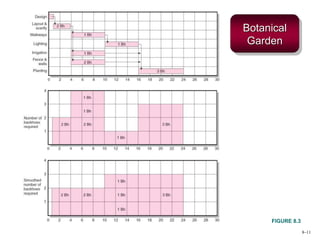
Botanical
Garden
FIGURE 8.3
8–12
Resource Allocation Methods (cont’d)
• Resource Demand Leveling Techniques
for Time-Constrained Projects
–Advantages
• Peak resource demands are reduced.
• Resources over the life of the project are reduced.
• Fluctuation in resource demand is minimized.
–Disadvantages
• Loss of flexibility that occurs from reducing slack.
• Increases in the criticality of all activities.
8–13
Resource Allocation Methods (cont’d)
• Resource-Constrained Projects
– Resources are limited in quantity or availability.
– Activities are scheduled using heuristics
(rules-of-thumb) that focus on:
1. Minimum slack
2. Smallest (least) duration
3. Lowest activity identification number
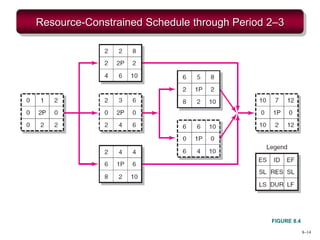
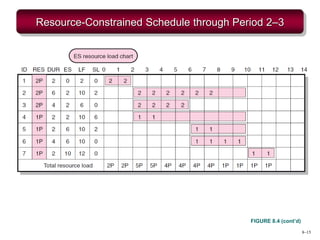
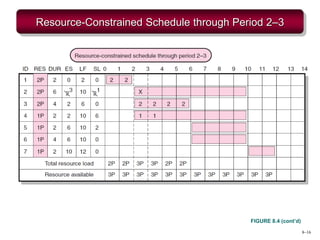
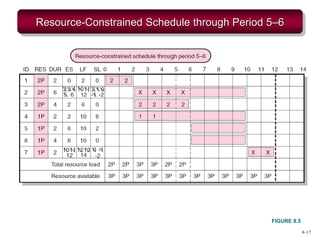
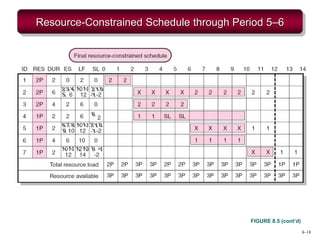
– The parallel method is used to apply heuristics
• An iterative process starting at the first time period
of the project and scheduling period-by-period the start
of any activities using the three priority rules.
8–14
Resource-Constrained Schedule through Period 2–3
FIGURE 8.4
8–15
Resource-Constrained Schedule through Period 2–3
FIGURE 8.4 (cont’d)
8–16
Resource-Constrained Schedule through Period 2–3
FIGURE 8.4 (cont’d)
8–17
Resource-Constrained Schedule through Period 5–6
FIGURE 8.5
8–18
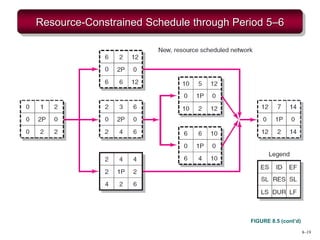
Resource-Constrained Schedule through Period 5–6
FIGURE 8.5 (cont’d)
8–19
Resource-Constrained Schedule through Period 5–6
FIGURE 8.5 (cont’d)
8–20
Computer Demonstration of Resource-
Constrained Scheduling
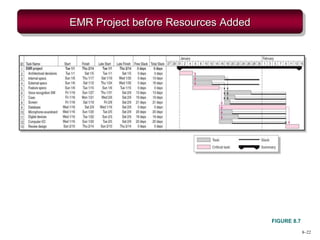
• EMR Project
–The development of a handheld Electronic Medical
Reference guide to be used by emergency medical
technicians and paramedics.
• Problem
–There are only eight design engineers who can be
assigned to the project due to a shortage of design
engineers and commitments to other projects.
8–21
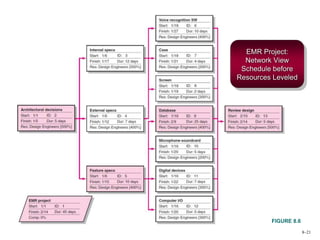
EMR Project:
Network View
Schedule before
Resources Leveled
FIGURE 8.6
8–22
EMR Project before Resources Added
FIGURE 8.7
8–23
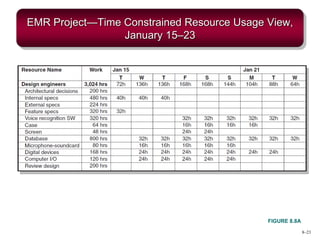
EMR Project—Time Constrained Resource Usage View,
January 15–23
FIGURE 8.8A
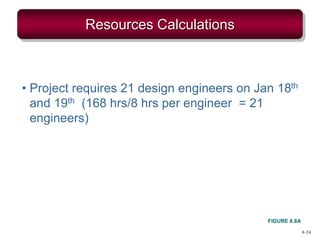
Resources Calculations
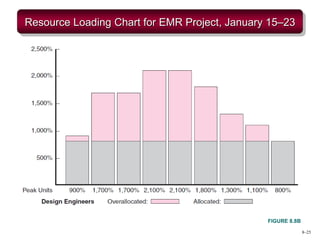
• Project requires 21 design engineers on Jan 18th
and 19th (168 hrs/8 hrs per engineer = 21
engineers)
8–24
FIGURE 8.8A
8–25
Resource Loading Chart for EMR Project, January 15–23
FIGURE 8.8B
8–26
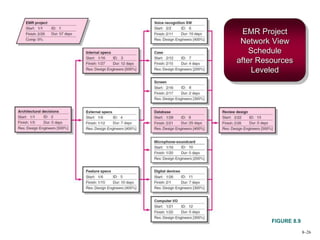
EMR Project
Network View
Schedule
after Resources
Leveled
FIGURE 8.9
8–27
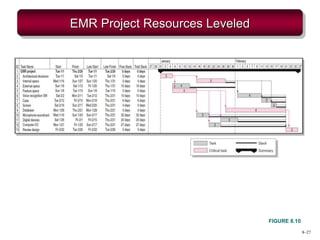
EMR Project Resources Leveled
FIGURE 8.10
8–28
The Impacts of Resource-Constrained
Scheduling
• Reduces delay but reduces flexibility.
• Increases criticality of events.
• Increases scheduling complexity.
• May make the traditional critical path
no longer meaningful.
• Can break sequence of events.
• May cause parallel activities to become
sequential and critical activities with slack
to become noncritical.
8–29
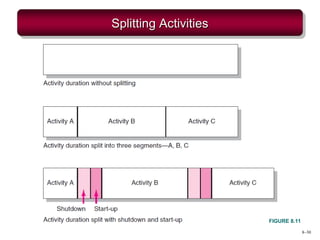
Splitting
• Splitting
– A scheduling technique use to get a better project
schedule and/or increase resource utilization.
• Involves interrupting work on an activity to
employ the resource on another activity, then
returning the resource to finish the interrupted
work.
• Is feasible when startup and shutdown costs are
low.
• Is considered the major reason why projects fail
to meet schedule.
8–30
Splitting Activities
FIGURE 8.11
8–31
Benefits of Scheduling Resources
• Leaves time for consideration
of reasonable alternatives:
–Cost-time tradeoffs
–Changes in priorities
• Provides information for time-phased
work package budgets to assess:
–Impact of unforeseen events
–Amount of flexibility in available resources
8–32
Multiproject Resource Schedules
• Multiproject Scheduling Problems
1. Overall project slippage
• Delay on one project create delays for other projects
2. Inefficient resource application
• The peaks and valleys of resource demands create
scheduling problems and delays for projects.
3. Resource bottlenecks
• Shortages of critical resources required for multiple
projects cause delays and schedule extensions.
8–33
Multiproject Resource Schedules (cont’d)
• Managing Multiproject Scheduling:
–Create project offices or departments to oversee
the scheduling of resources across projects.
–Use a project priority queuing system: first come,
first served for resources.
–Centralize project management: treat all projects
as a part of a “megaproject.”
–Outsource projects to reduce the number
of projects handled internally.
8–34
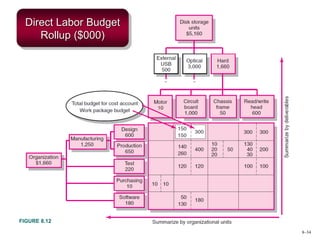
Direct Labor Budget
Rollup ($000)
FIGURE 8.12
8–35
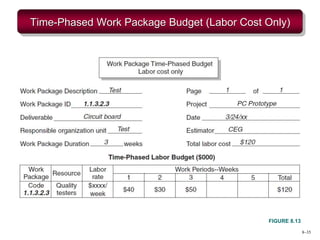
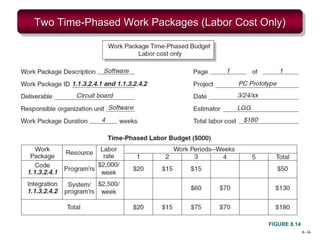
Time-Phased Work Package Budget (Labor Cost Only)
FIGURE 8.13
8–36
Two Time-Phased Work Packages (Labor Cost Only)
FIGURE 8.14
8–37
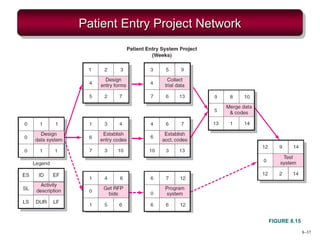
Patient Entry Project Network
FIGURE 8.15
8–38
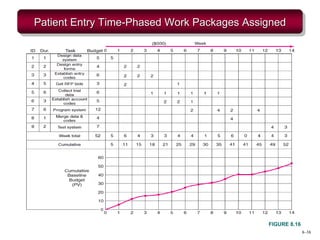
Patient Entry Time-Phased Work Packages Assigned
FIGURE 8.16
8–39
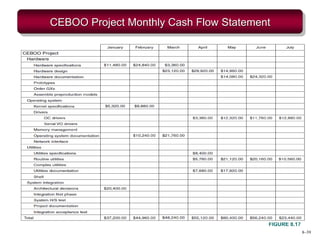
CEBOO Project Monthly Cash Flow Statement
FIGURE 8.17
8–40
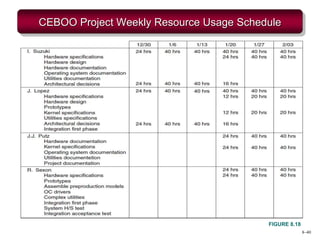
CEBOO Project Weekly Resource Usage Schedule
FIGURE 8.18
8–41
Key Terms
Heuristic
Planned value (PV)
Resource-constrained projects
Smoothing
Splitting
Time-constrained projects
Time-phased budget baseline
8–42
The End
Thanks a lot for Your Attention!
Any Comment !!!
Any Question?????

Scheduling-Resources-and-Costs.ppt

  • 1.
  • 2.
    Agenda of theLecture 1.Overview of the Resource Scheduling Problem 2.Types of Resource Constraints 3.Classification of a Scheduling Problem 4.Resource Allocation Methods A. Assumptions B. Time-Constrained Projects: Smoothing Resource Demand C. Resource-Constrained Projects 5.Computer Demonstration of Resource-Constrained Scheduling A. The Impacts of Resource-Constrained Scheduling 6.Splitting Activities 7.Benefits of Scheduling Resources 8.Assigning Project Work 9.Multi project Resource Schedules 10. Using the Resource Schedule to Develop a Project Cost Baseline A. Why a Time-Phased Budget Baseline Is Needed B. Creating a Time-Phased Budget 8–2
  • 3.
    8–3 Overview of theResource Scheduling Problem • Resources and Priorities –Project network times are not a schedule until resources have been assigned. • The implicit assumption is that resources will be available in the required amounts when needed. • Adding new projects requires making realistic judgments of resource availability and project durations. –Cost estimates are not a budget until they have been time-phased.
  • 4.
  • 5.
    8–5 Overview of theResource Scheduling Problem . • Resource Smoothing (or Leveling) –Involves attempting to even out varying demands on resources by using slack (delaying noncritical activities) to manage resource utilization when resources are adequate over the life of the project.
  • 6.
    8–6 Types of ProjectConstraints • Technical or Logic Constraints – Constraints related to the networked sequence in which project activities must occur. • Physical Constraints – Activities that cannot occur in parallel or are affected by contractual or environmental conditions. • Resource Constraints – The absence, shortage, or unique interrelationship and interaction characteristics of resources that require a particular sequencing of project activities • Kinds of Resource Constraints – People, materials, equipment
  • 7.
  • 8.
    8–8 Classification of AScheduling Problem • Classification of Problem –Using a priority matrix will help determine if the project is time or resource constrained. 1.Time-Constrained Project –Must be completed by an imposed date. • Time is fixed, resources are flexible: additional resources are required to ensure project meets schedule. 2.Resource-Constrained Project –Is one in which the level of resources available cannot be exceeded. • Resources are fixed, time is flexible: inadequate resources will delay the project.
  • 9.
    8–9 Resource Allocation Methods •Limiting Assumptions –Splitting activities is not allowed—once an activity is start, it is carried to completion. –Level of resources used for an activity cannot be changed. • Risk Assumptions –Activities with the most slack pose the least risk. –Reduction of flexibility does not increase risk. –The nature of an activity (easy, complex) doesn’t increase risk.
  • 10.
    8–10 Resource Allocation Methods(cont’d) • Time-Constrained Projects –Must be completed by an imposed date. –Require use of leveling techniques that focus on balancing or smoothing resource demands. –Use positive slack (delaying noncritical activities) to manage resource utilization over the duration of the project. 1. Peak resource demands are reduced. 2. Resources over the life of the project are reduced. 3. Fluctuation in resource demand is minimized.
  • 11.
  • 12.
    8–12 Resource Allocation Methods(cont’d) • Resource Demand Leveling Techniques for Time-Constrained Projects –Advantages • Peak resource demands are reduced. • Resources over the life of the project are reduced. • Fluctuation in resource demand is minimized. –Disadvantages • Loss of flexibility that occurs from reducing slack. • Increases in the criticality of all activities.
  • 13.
    8–13 Resource Allocation Methods(cont’d) • Resource-Constrained Projects – Resources are limited in quantity or availability. – Activities are scheduled using heuristics (rules-of-thumb) that focus on: 1. Minimum slack 2. Smallest (least) duration 3. Lowest activity identification number – The parallel method is used to apply heuristics • An iterative process starting at the first time period of the project and scheduling period-by-period the start of any activities using the three priority rules.
  • 14.
  • 15.
    8–15 Resource-Constrained Schedule throughPeriod 2–3 FIGURE 8.4 (cont’d)
  • 16.
    8–16 Resource-Constrained Schedule throughPeriod 2–3 FIGURE 8.4 (cont’d)
  • 17.
  • 18.
    8–18 Resource-Constrained Schedule throughPeriod 5–6 FIGURE 8.5 (cont’d)
  • 19.
    8–19 Resource-Constrained Schedule throughPeriod 5–6 FIGURE 8.5 (cont’d)
  • 20.
    8–20 Computer Demonstration ofResource- Constrained Scheduling • EMR Project –The development of a handheld Electronic Medical Reference guide to be used by emergency medical technicians and paramedics. • Problem –There are only eight design engineers who can be assigned to the project due to a shortage of design engineers and commitments to other projects.
  • 21.
    8–21 EMR Project: Network View Schedulebefore Resources Leveled FIGURE 8.6
  • 22.
    8–22 EMR Project beforeResources Added FIGURE 8.7
  • 23.
    8–23 EMR Project—Time ConstrainedResource Usage View, January 15–23 FIGURE 8.8A
  • 24.
    Resources Calculations • Projectrequires 21 design engineers on Jan 18th and 19th (168 hrs/8 hrs per engineer = 21 engineers) 8–24 FIGURE 8.8A
  • 25.
    8–25 Resource Loading Chartfor EMR Project, January 15–23 FIGURE 8.8B
  • 26.
  • 27.
    8–27 EMR Project ResourcesLeveled FIGURE 8.10
  • 28.
    8–28 The Impacts ofResource-Constrained Scheduling • Reduces delay but reduces flexibility. • Increases criticality of events. • Increases scheduling complexity. • May make the traditional critical path no longer meaningful. • Can break sequence of events. • May cause parallel activities to become sequential and critical activities with slack to become noncritical.
  • 29.
    8–29 Splitting • Splitting – Ascheduling technique use to get a better project schedule and/or increase resource utilization. • Involves interrupting work on an activity to employ the resource on another activity, then returning the resource to finish the interrupted work. • Is feasible when startup and shutdown costs are low. • Is considered the major reason why projects fail to meet schedule.
  • 30.
  • 31.
    8–31 Benefits of SchedulingResources • Leaves time for consideration of reasonable alternatives: –Cost-time tradeoffs –Changes in priorities • Provides information for time-phased work package budgets to assess: –Impact of unforeseen events –Amount of flexibility in available resources
  • 32.
    8–32 Multiproject Resource Schedules •Multiproject Scheduling Problems 1. Overall project slippage • Delay on one project create delays for other projects 2. Inefficient resource application • The peaks and valleys of resource demands create scheduling problems and delays for projects. 3. Resource bottlenecks • Shortages of critical resources required for multiple projects cause delays and schedule extensions.
  • 33.
    8–33 Multiproject Resource Schedules(cont’d) • Managing Multiproject Scheduling: –Create project offices or departments to oversee the scheduling of resources across projects. –Use a project priority queuing system: first come, first served for resources. –Centralize project management: treat all projects as a part of a “megaproject.” –Outsource projects to reduce the number of projects handled internally.
  • 34.
  • 35.
    8–35 Time-Phased Work PackageBudget (Labor Cost Only) FIGURE 8.13
  • 36.
    8–36 Two Time-Phased WorkPackages (Labor Cost Only) FIGURE 8.14
  • 37.
    8–37 Patient Entry ProjectNetwork FIGURE 8.15
  • 38.
    8–38 Patient Entry Time-PhasedWork Packages Assigned FIGURE 8.16
  • 39.
    8–39 CEBOO Project MonthlyCash Flow Statement FIGURE 8.17
  • 40.
    8–40 CEBOO Project WeeklyResource Usage Schedule FIGURE 8.18
  • 41.
    8–41 Key Terms Heuristic Planned value(PV) Resource-constrained projects Smoothing Splitting Time-constrained projects Time-phased budget baseline
  • 42.
    8–42 The End Thanks alot for Your Attention! Any Comment !!! Any Question?????