RESOURCE ALLOCATION
    By: Kemuel Bryan G. Luciaja
Resource


  An economic or productive factor required to
accomplish an activity, or as means to undertake
an enterprise and achieve desired outcome.
The Three Most Basic Resources
Land
Includes all natural resources (โ€œgifts of natureโ€) used in the
production process, such as arable land, forests, mineral and oil
deposits, and water resources.

Labor
Consists of the physical and mental talents of individuals used in
producing goods and services.

Capital
Refers not to money but to tools, machinery, and
other productive equipment.
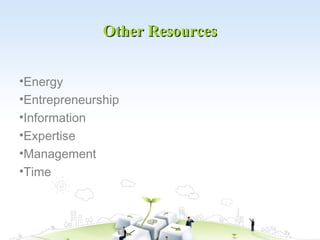
Other Resources


โ€ขEnergy
โ€ขEntrepreneurship
โ€ขInformation
โ€ขExpertise
โ€ขManagement
โ€ขTime
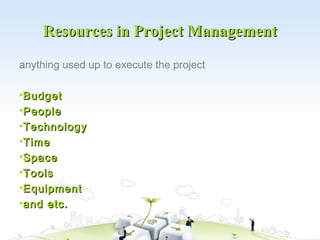
Resources in Project Management

anything used up to execute the project

โ€ขBudget
โ€ขPeople
โ€ขTechnology
โ€ขTime
โ€ขSpace
โ€ขTools
โ€ขEquipment
โ€ขand etc.
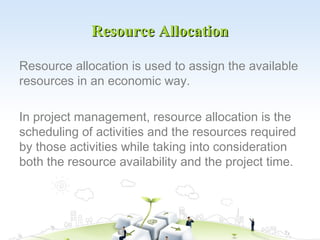
Resource Allocation

Resource allocation is used to assign the available
resources in an economic way.

In project management, resource allocation is the
scheduling of activities and the resources required
by those activities while taking into consideration
both the resource availability and the project time.
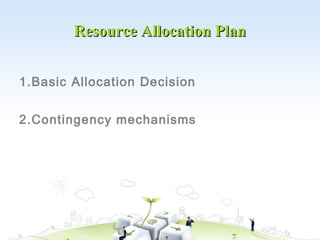
Resource Allocation Plan


1.Basic Allocation Decision


2.Contingency mechanisms
1. Basic allocation decision

โ€ข The choice of which items to fund in the plan
โ€ข What level of funding it should receive
โ€ข Which to leave unfunded
โ€ข The resources are allocated to some items, not to
others
2. Contingency mechanisms

A.There is a priority ranking of items excluded from the
plan, showing which items to fund if more resources should
become available.


B.There is a priority ranking of some items included in the
plan, showing which items should be sacrificed if total
funding must be reduced.
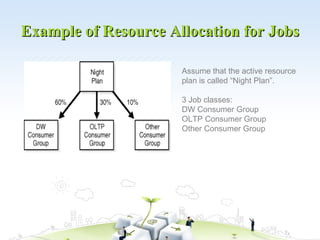
Example of Resource Allocation for Jobs

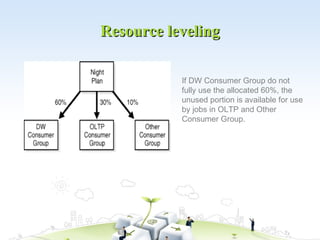
                      Assume that the active resource
                      plan is called โ€œNight Planโ€.

                      3 Job classes:
                      DW Consumer Group
                      OLTP Consumer Group
                      Other Consumer Group
Resource leveling

A project management technique used to examine
unbalanced use of resources (usually people or equipment)
over time, and for resolving over-allocations or conflicts.

Leveling resources involves redistributing an imbalance of
allocated work. It assists project team members by keeping
them from becoming overwhelmed, working overtime, or
running into project burnout.
Resource leveling

           If DW Consumer Group do not
           fully use the allocated 60%, the
           unused portion is available for use
           by jobs in OLTP and Other
           Consumer Group.
Resource leveling
The Two Key Elements of Resource Leveling:

1. As the main aim of resource leveling is to allocate resource
   efficiently, so that the project can be completed in the given time
   period. Hence, resource leveling can be broken down into two main
   areas; projects that can be completed by using up all resources
   which are available and projects that can be completed with limited
   resources.
2. Projects which use limited resources can be extended for over a
   period of time until the resources required are available. If then
   again, the number of projects that an organization undertakes
   exceeds the resources available. Then it's wiser to postpone the
   project for a later date.
Resource Over-allocation

Over-allocation of a resource is when a resource
has been assigned more work than can be
completed during normal work hours. Resource
allocation often leads to overtime and
overspending on financial resources.
Techniques for Avoiding Resource Overload

1.   Resource Leveling
2.   Prioritize Projects
3.   Linking Tasks
4.   Leaving Breathing Room
5.   Avoid the โ€œPutting out firesโ€ approach to project
     management
Techniques for Avoiding Resource Overload

1. Resource Leveling
            In this method, the project manager
   can either level resources by hand
   (complicated, but perhaps more sound) or use a
   software program such as Microsoft Project to
   level resources for you.
Techniques for Avoiding Resource Overload

2. Prioritize Projects
             By prioritizing projects, when a
   resource allocation overload is apparent or a
   task conflict exists, it can be resolved without
   piling pressure on the individual or team (or
   requiring the individual or team to put in a
   couple twelve-hour days).
Techniques for Avoiding Resource Overload

3. Linking Tasks
            Linking tasks is more of a logistical
   solution. If the resource has been assigned to
   research the markets for project A and project
   B, these tasks could be linked. In this manner,
   when it appears that a resource has been over-
   allocated, really the tasks are similar enough to
   count for two projects. By linking these tasks
   from the different projects, the problem can be
   resolved.
Techniques for Avoiding Resource Overload

4. Leaving Breathing Room
             When scheduling the project, it is vital
   to leave breathing room between tasks.
   However, it is important to not under-allocate
   resources as this could lead to a loss of budget
   monies meaning resource allocations problems
   will affect your project's health. A fine balance
   must be achieved between breathing room and
   not moving forward quickly enough.
Techniques for Avoiding Resource Overload

5. Avoid the โ€œPutting out firesโ€ approach to project
   management
              If your team is consistently putting out
   fires, it makes it difficult to focus on the project.
   Moreover, by putting out fires, the team
   becomes knee-deep in ash, while project tasks
   pile up. This is where project management
   techniques such as Scrum come in handy.
Thank you!

Resource allocation

  • 1.
    RESOURCE ALLOCATION By: Kemuel Bryan G. Luciaja
  • 2.
    Resource Aneconomic or productive factor required to accomplish an activity, or as means to undertake an enterprise and achieve desired outcome.
  • 3.
    The Three MostBasic Resources Land Includes all natural resources (โ€œgifts of natureโ€) used in the production process, such as arable land, forests, mineral and oil deposits, and water resources. Labor Consists of the physical and mental talents of individuals used in producing goods and services. Capital Refers not to money but to tools, machinery, and other productive equipment.
  • 4.
  • 5.
    Resources in ProjectManagement anything used up to execute the project โ€ขBudget โ€ขPeople โ€ขTechnology โ€ขTime โ€ขSpace โ€ขTools โ€ขEquipment โ€ขand etc.
  • 6.
    Resource Allocation Resource allocationis used to assign the available resources in an economic way. In project management, resource allocation is the scheduling of activities and the resources required by those activities while taking into consideration both the resource availability and the project time.
  • 7.
    Resource Allocation Plan 1.BasicAllocation Decision 2.Contingency mechanisms
  • 8.
    1. Basic allocationdecision โ€ข The choice of which items to fund in the plan โ€ข What level of funding it should receive โ€ข Which to leave unfunded โ€ข The resources are allocated to some items, not to others
  • 9.
    2. Contingency mechanisms A.Thereis a priority ranking of items excluded from the plan, showing which items to fund if more resources should become available. B.There is a priority ranking of some items included in the plan, showing which items should be sacrificed if total funding must be reduced.
  • 10.
    Example of ResourceAllocation for Jobs Assume that the active resource plan is called โ€œNight Planโ€. 3 Job classes: DW Consumer Group OLTP Consumer Group Other Consumer Group
  • 11.
    Resource leveling A projectmanagement technique used to examine unbalanced use of resources (usually people or equipment) over time, and for resolving over-allocations or conflicts. Leveling resources involves redistributing an imbalance of allocated work. It assists project team members by keeping them from becoming overwhelmed, working overtime, or running into project burnout.
  • 12.
    Resource leveling If DW Consumer Group do not fully use the allocated 60%, the unused portion is available for use by jobs in OLTP and Other Consumer Group.
  • 13.
    Resource leveling The TwoKey Elements of Resource Leveling: 1. As the main aim of resource leveling is to allocate resource efficiently, so that the project can be completed in the given time period. Hence, resource leveling can be broken down into two main areas; projects that can be completed by using up all resources which are available and projects that can be completed with limited resources. 2. Projects which use limited resources can be extended for over a period of time until the resources required are available. If then again, the number of projects that an organization undertakes exceeds the resources available. Then it's wiser to postpone the project for a later date.
  • 14.
    Resource Over-allocation Over-allocation ofa resource is when a resource has been assigned more work than can be completed during normal work hours. Resource allocation often leads to overtime and overspending on financial resources.
  • 15.
    Techniques for AvoidingResource Overload 1. Resource Leveling 2. Prioritize Projects 3. Linking Tasks 4. Leaving Breathing Room 5. Avoid the โ€œPutting out firesโ€ approach to project management
  • 16.
    Techniques for AvoidingResource Overload 1. Resource Leveling In this method, the project manager can either level resources by hand (complicated, but perhaps more sound) or use a software program such as Microsoft Project to level resources for you.
  • 17.
    Techniques for AvoidingResource Overload 2. Prioritize Projects By prioritizing projects, when a resource allocation overload is apparent or a task conflict exists, it can be resolved without piling pressure on the individual or team (or requiring the individual or team to put in a couple twelve-hour days).
  • 18.
    Techniques for AvoidingResource Overload 3. Linking Tasks Linking tasks is more of a logistical solution. If the resource has been assigned to research the markets for project A and project B, these tasks could be linked. In this manner, when it appears that a resource has been over- allocated, really the tasks are similar enough to count for two projects. By linking these tasks from the different projects, the problem can be resolved.
  • 19.
    Techniques for AvoidingResource Overload 4. Leaving Breathing Room When scheduling the project, it is vital to leave breathing room between tasks. However, it is important to not under-allocate resources as this could lead to a loss of budget monies meaning resource allocations problems will affect your project's health. A fine balance must be achieved between breathing room and not moving forward quickly enough.
  • 20.
    Techniques for AvoidingResource Overload 5. Avoid the โ€œPutting out firesโ€ approach to project management If your team is consistently putting out fires, it makes it difficult to focus on the project. Moreover, by putting out fires, the team becomes knee-deep in ash, while project tasks pile up. This is where project management techniques such as Scrum come in handy.
  • 21.