This document discusses educational planning and its importance. It defines planning as designing actions beforehand. Educational planning is significant as it helps ensure success of programs, saves time/money, avoids trial and error, utilizes resources efficiently, and contributes to smooth administration. The document outlines five types of educational planning: administrative, academic/curricular, co-curricular, instructional, and institutional. It also discusses grassroots planning which includes planning administration, academics, activities, community relations, discipline, development programs, and resource utilization.
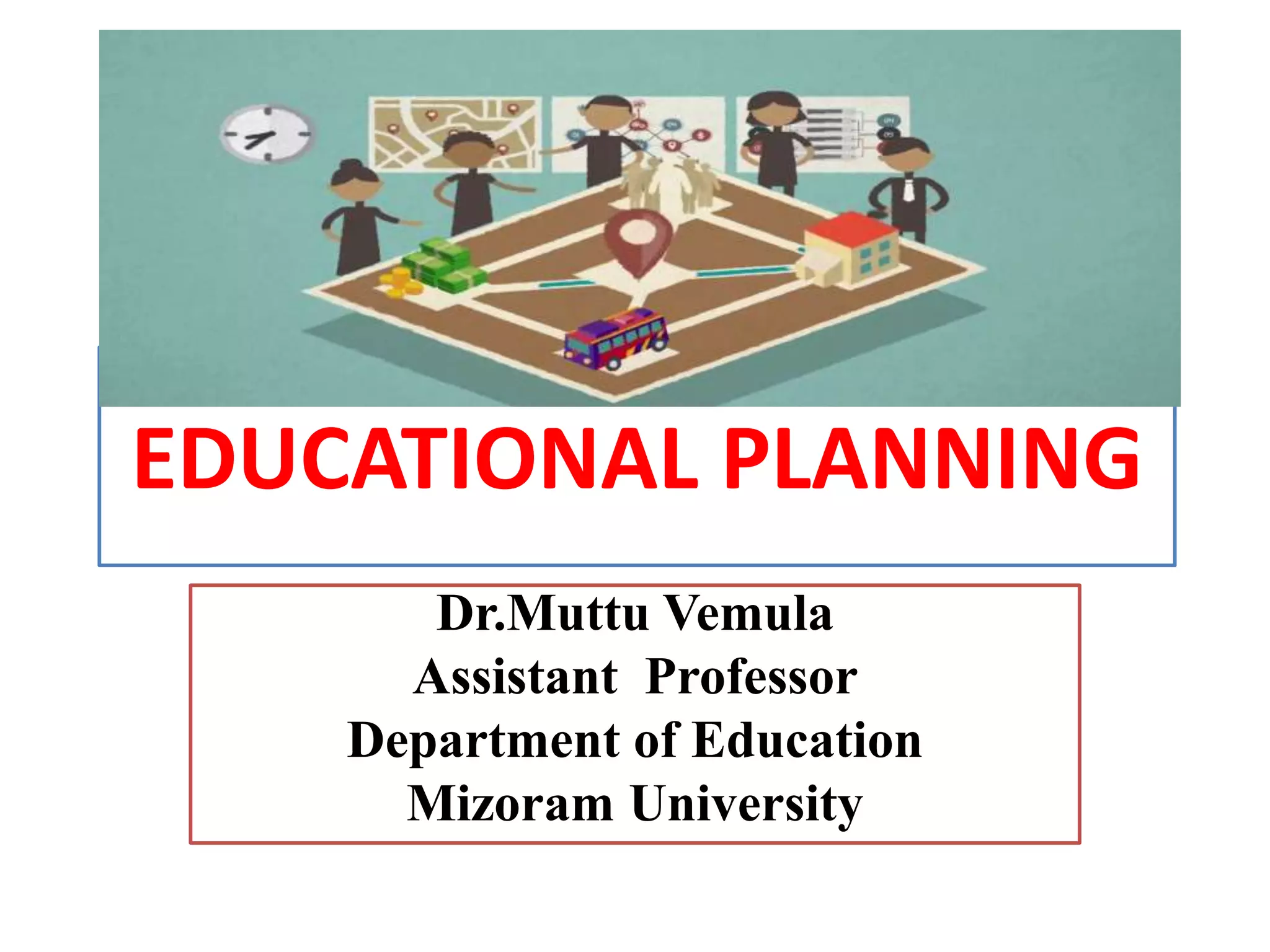
EDUCATIONAL PLANNING
• Definitions:
•“Planning is to design some action to be done
before hand.”
• —Oxford English Dictionary
• “Planning selects among alternatives explores,
routes before travel begins and identifies
possible or probable outcomes or action before
the executive and his organisation committed
to any.”
3.
Significance of Educational
Planning:
•1. To make every programme of an educational institution or
organisation grand success.
• 2. Proper educational planning saves time, effort and money as
planning in every field is a time-saving, an effort-saving and a
money-saving activity.
• 3. Educational planning is a sound method of solving
educational problems by avoiding the trial and error method of
doing things.
• 4. Educational planning is essential for the best utilization of
available resources.
• 5. Educational planning checks wastage and failure and
contributes to the smoothness, ease and efficiency of the
administrative process in the field of education.
4.
• Educational planningis highly essential for preparing a
blueprint or plan of action for every programme of an
educational institution or organisation.
• 9. Planning in education is necessary for making one’s
educational journey goal-oriented and purposeful.
• 10. It is essential to maintain, sustain and enhance the
thinking process of an individual, institution or
organisation.
• 11. Planning in education is necessary to highlight the
universal aims of education required for every nation
for its development in every respect.
• 12. To bring total development of a nation in time, in
which educational development is one among its
various aspects.
5.
Types of EducationalPlanning:
• 1. Administrative Planning:
• In the field of education, administrative planning relates to
distribution of responsibilities and powers for different levels of
education. In administrative educational planning, the administrative
responsibilities and powers are phase-wise planned in relation to the
level of different educational administrators.
• This planning of education makes a detail plan on structure and
organisation of education at different levels – primary, secondary,
higher secondary, higher – general, technical and professional. This
planning prepares planning on duration of an educational
programme, organisation and co-ordination of educational
programmes, financial allocation or budget for the programme,
engagement of educational officials in the programme, and smooth
management of the programme etc.
6.
2. Academic orCurricular Planning:
• This type of educational planning refers to planning
for smooth academic transaction of the syllabus for
any course at any level of education. It encompasses
planning on education in relation to needs and
demands of the individual and society.
• Formulation of educational goals, formation of
curriculum committee for development of curriculum
and selection of appropriate strategies and methods of
teaching, planning of content units, planning for
evaluation, planning for review of the curriculum,
planning for use of library, planning for special
provision for the gifted and remedial instruction for
slow learners etc.
7.
3. Co-curricular Planning
•This planning of education is necessary for
bringing total development of a student in one
point and total development of an educational
institution or organisation in another point.
• This planning includes planning for
• student welfare services,
• sports and games
• social activities
• cultural activities
• hobbies etc.
8.
4. Instructional Planning:
•This sort of planning in education is macro-level
in nature as its deals with planning in classroom
situation in relation to a particular topic of a
concerned subject. This planning refers to
emotional and organisational climate of the
classroom.
• It includes planning for specification or
instructional objectives, selection and
organisation of learning activities, selection of
appropriate means for presentation of learning
experiences, monitoring of the learning or
instructional progress, selection of suitable
evaluation techniques for learning outcomes etc.
9.
5. Institutional Planning
•This type of educational planning gives a
practical shape to the meaning of educational
planning. In this context educational planning
refers to the needs and requirements of every
institution to be achieved through creation and
maintenance of a planning atmosphere in the
institution.
10.
planning at grass-rootlevels
• These are:
• a. Planning for administration.
• b. Planning for academic or curricular
development.
• c. Planning for non-academic or co-curricular
activities
• d. Planning for school-community relations.
• e. Planning for discipline.
• f. Planning for developmental activities or
programmes.
• g. Planning for proper utilization of community
resources for total development of the institution.