MODULE 1
AN INTRODUCTION TO
CONFLICT RESOLUTION
What is a Conflict?
DEFINITION
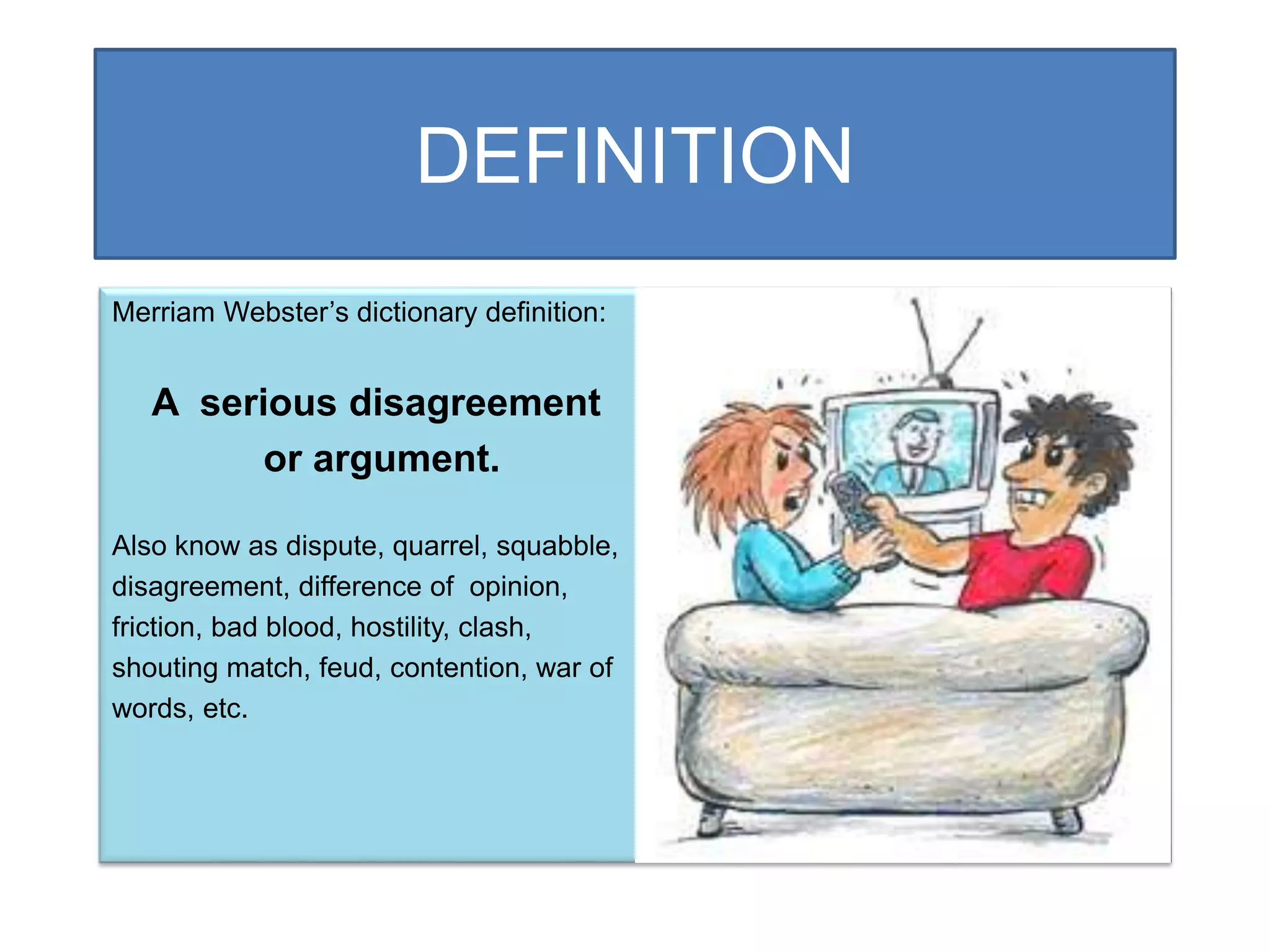
Merriam Webster’s dictionary definition:
A serious disagreement
or argument.
Also know as dispute, quarrel, squabble,
disagreement, difference of opinion,
friction, bad blood, hostility, clash,
shouting match, feud, contention, war of
words, etc.
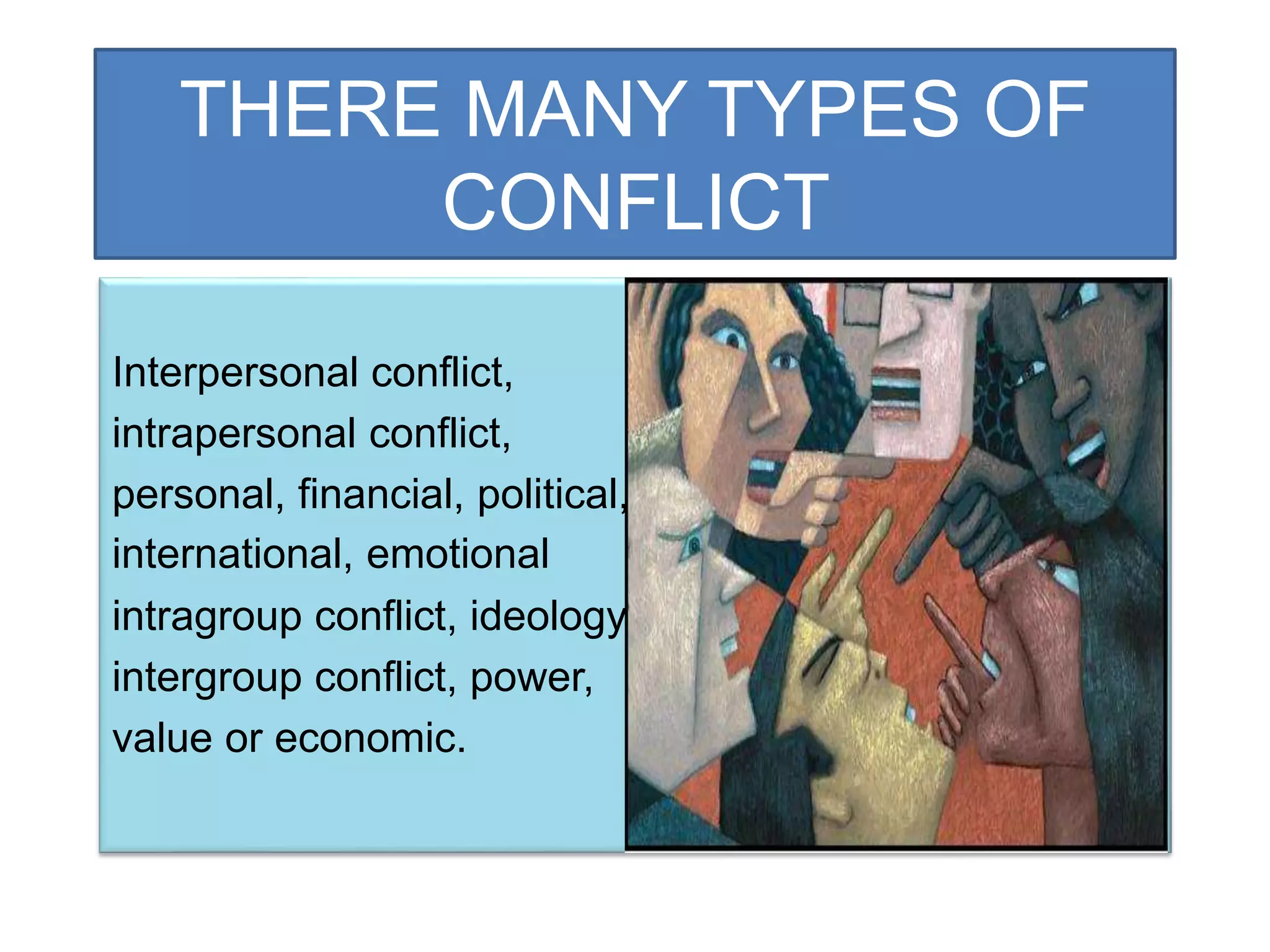
THERE MANY TYPES OF
CONFLICT
Interpersonal conflict,
intrapersonal conflict,
personal, financial, political,
international, emotional
intragroup conflict, ideology
intergroup conflict, power,
value or economic.
TYPES OF CONFLICTS
What are the types of
conflicts you have
experienced in your life?
AN INTRODUCTION TO
CONFLICT RESOLUTION
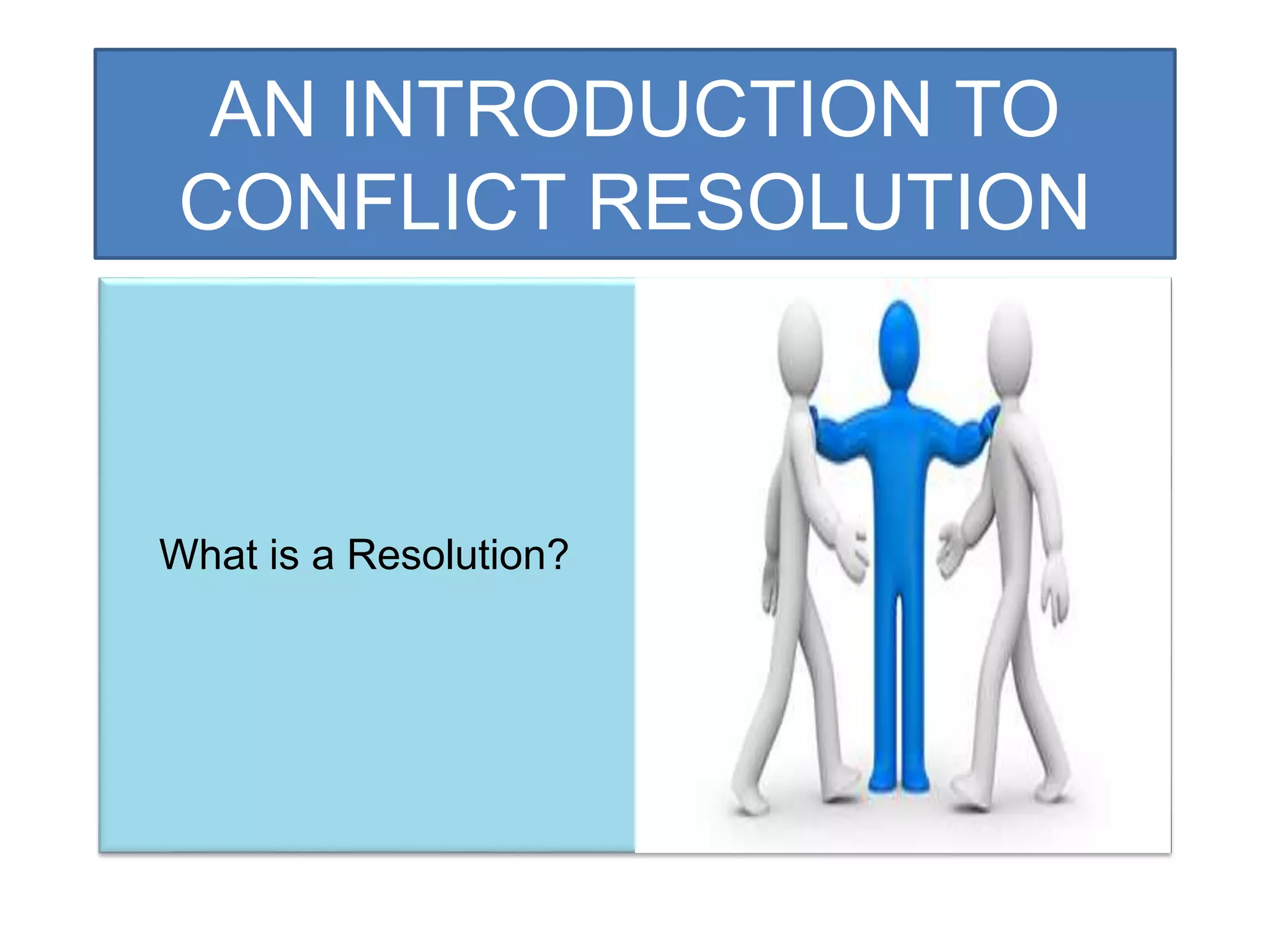
What is a Resolution?
DEFINITION
Merriam Webster’s dictionary definition:
CONFLICT RESOLUTION
is a way for two or more
parties to find a peaceful
solution to a disagreement
among them. The
disagreement may be
personal, financial, political,
or emotional.
..AND CONFLICT
RESOLUTION ..
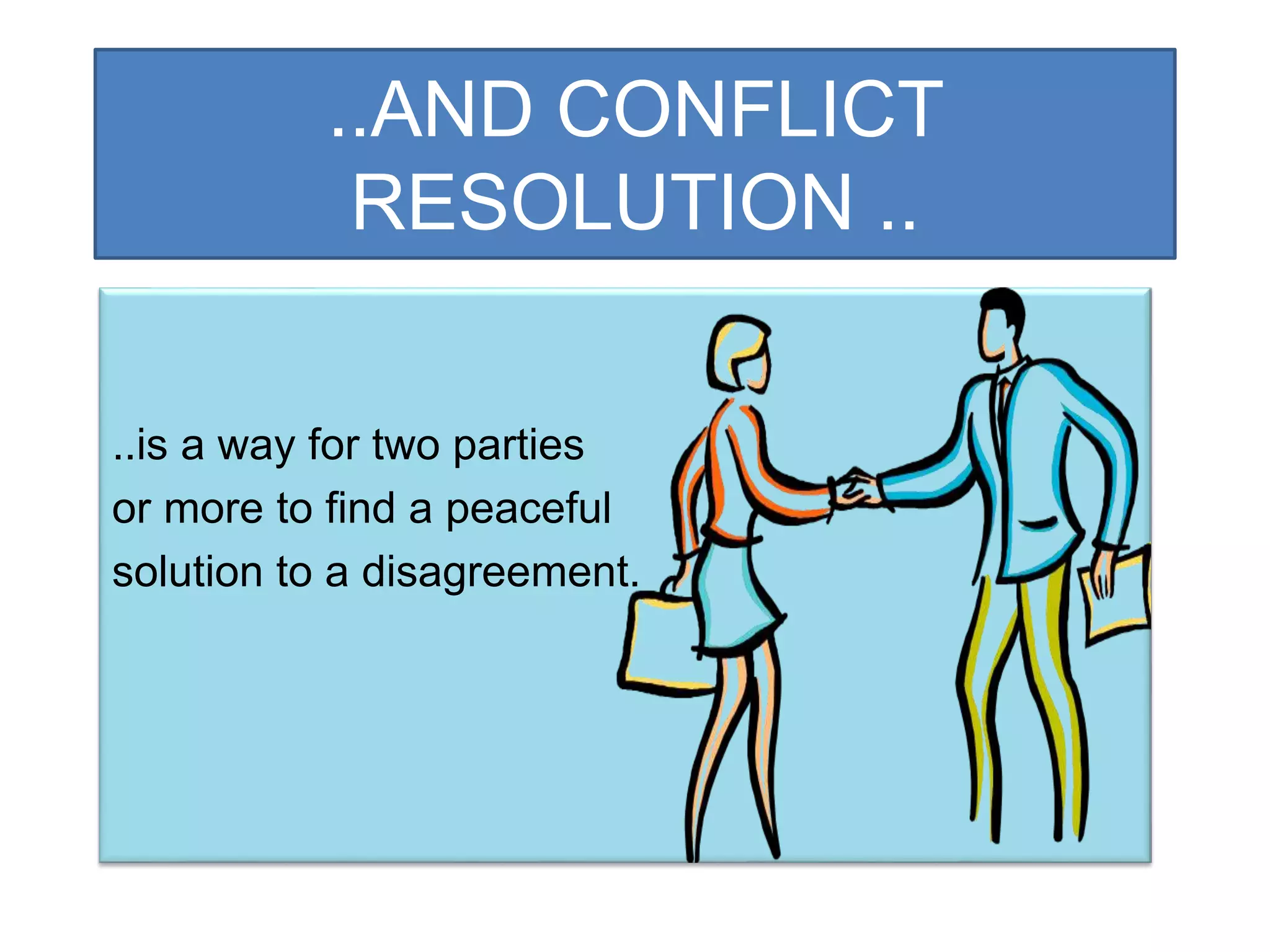
..is a way for two parties
or more to find a peaceful
solution to a disagreement.
WHAT CONFLICT HAVE YOU
BEEN IN?
Recall an office conflict
that you were involved in.
YOUR EXPERIENCE
Was the conflict resolved?
How did you resolve that
conflict?
GROUP DISCUSSION
Break into your groups.
Let us discuss our personal
experiences in Conflict and
Resolution.
THE BIG QUESTION:
Is conflict bad?
CONFLICT RESOLUTION
Effective conflict resolution
can make the difference
between positive and
negative outcomes.
BENEFITS OF CONFLICT
RESOLUTION
Increased understanding
Increased group cohesion
Improved self-knowledge
IF CONFLICT IS NOT
HANDLED EFFECTIVELY…
Can turn into personal dislike.
Teamwork breaks down.
Talent is wasted as people
Disengage from their work.
Can spiral into negativity
and recrimination
UNDERSTANDING THE CONFLICT
RESOLUTION PROCESS
What is the Conflict
Resolution process?
RESOLUTION PROCESS
1. Identify the source of
the conflict.
Set the scene.
#1
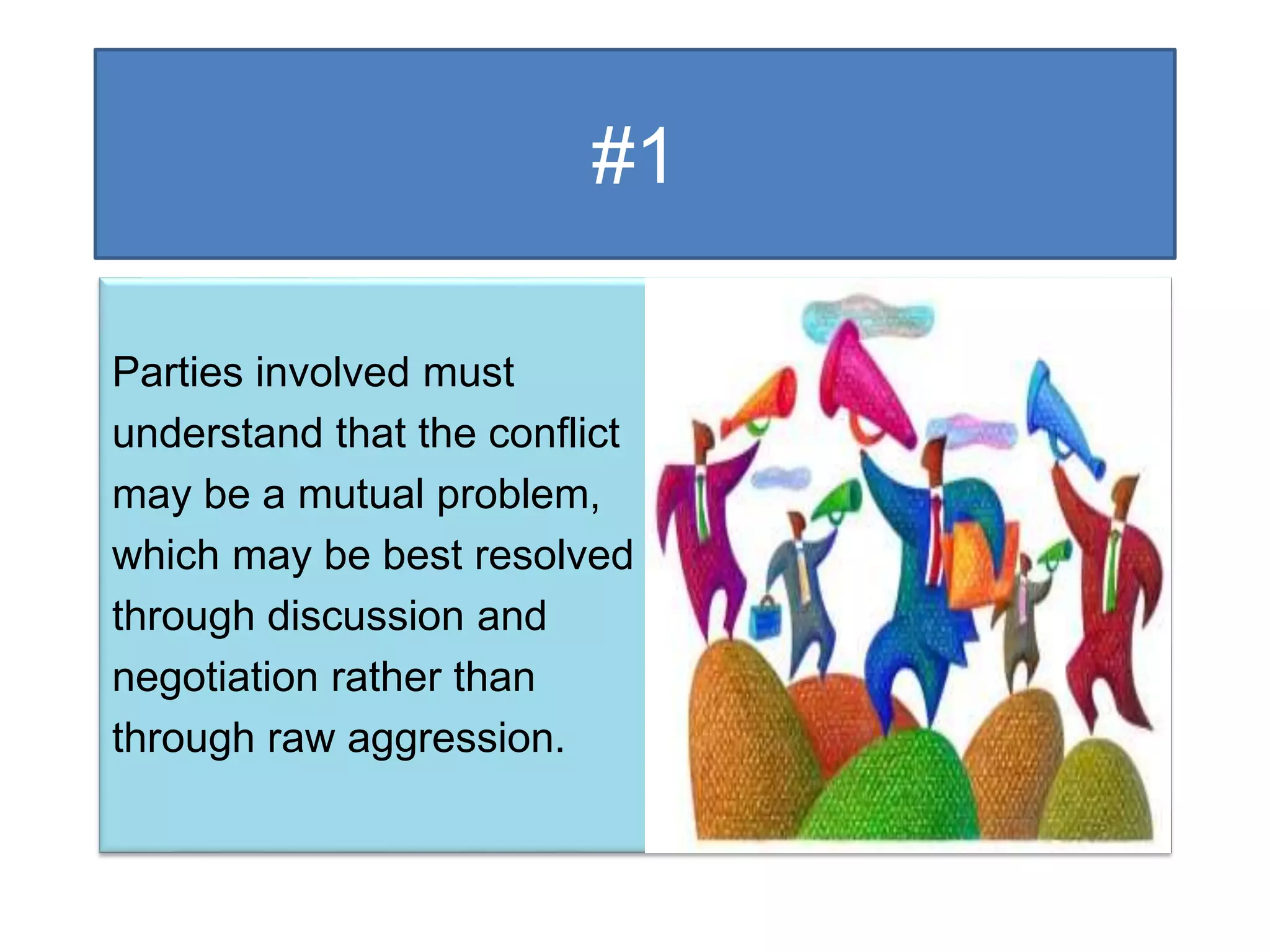
Parties involved must
understand that the conflict
may be a mutual problem,
which may be best resolved
through discussion and
negotiation rather than
through raw aggression.
RESOLUTION PROCESS
2. Look beyond the incident.
#2
Hear other person's viewpoint.
Respect his or her opinion.
Understand the conflict in
objective terms.
RESOLUTION PROCESS
3. Agree that there is
a problem
#3
Agree to the problems that
you are trying to solve,
before you find a mutually
acceptable solution.
RESOLUTION PROCESS
4. Brainstorm possible
solutions
#4
Brainstorm possible solutions,
and be open to all ideas,
including ones you never
considered before.
RESOLUTION PROCESS
5. Request solutions
#5
The other party may have
and want their solution
heard
RESOLUTION PROCESS
6. Negotiate a solution
#6
By this stage, the conflict
may be resolved. Both sides
may better understand the
position of the other, and a
mutually satisfactory solution
may be clear to all.
RESOLUTION PROCESS
7.Identify solutions both
disputants can support
#7
Make clear of the chosen
solution.
RESOLUTION PROCESS
8. Agreement
#8
Agree on the solution and
seal it in writing if
necessary.
MODULE 2
THE CONFLICT
RESOLUTION INSTRUMENT
Why do we need Conflict
Resolution Instruments?
Thomas-Kilmanns’ Conflict
Mode Instrument.
CONFLICT STYLES
Thomas and Kilmann identified
five main styles of dealing with
conflict that vary in their
degrees of cooperativeness
and assertiveness. The Thomas-
Kilmann Conflict Mode
Instrument helps to
identify which style you tend
towards when conflict arises.
INSTRUMENT #1
1. Collaborating
COLLABORATING
- try to meet the needs of all
people involved.
- highly assertive, cooperative
- acknowledge that everyone
is important.
- this style is useful when you
need to bring together a
variety of viewpoints to get
the best solution
INSTRUMENT #2
2. Competing
COMPETING
- take a firm stand, and
know what they want.
- operate from a position of
power, drawn from things
like position, rank, expertise,
or persuasive ability.
- this style can be useful when
there is an emergency and a
decision needs to be made
fast
INSTRUMENT #3
3.Compromising
COMPROMISING
- find a solution that will at
least partially satisfy everyone
- everyone is expected to give
up something
- compromise is useful when
equal strength opponents are
at a standstill and when there
is a deadline looming
INSTRUMENT #4
4. Accommodating
ACCOMODATING
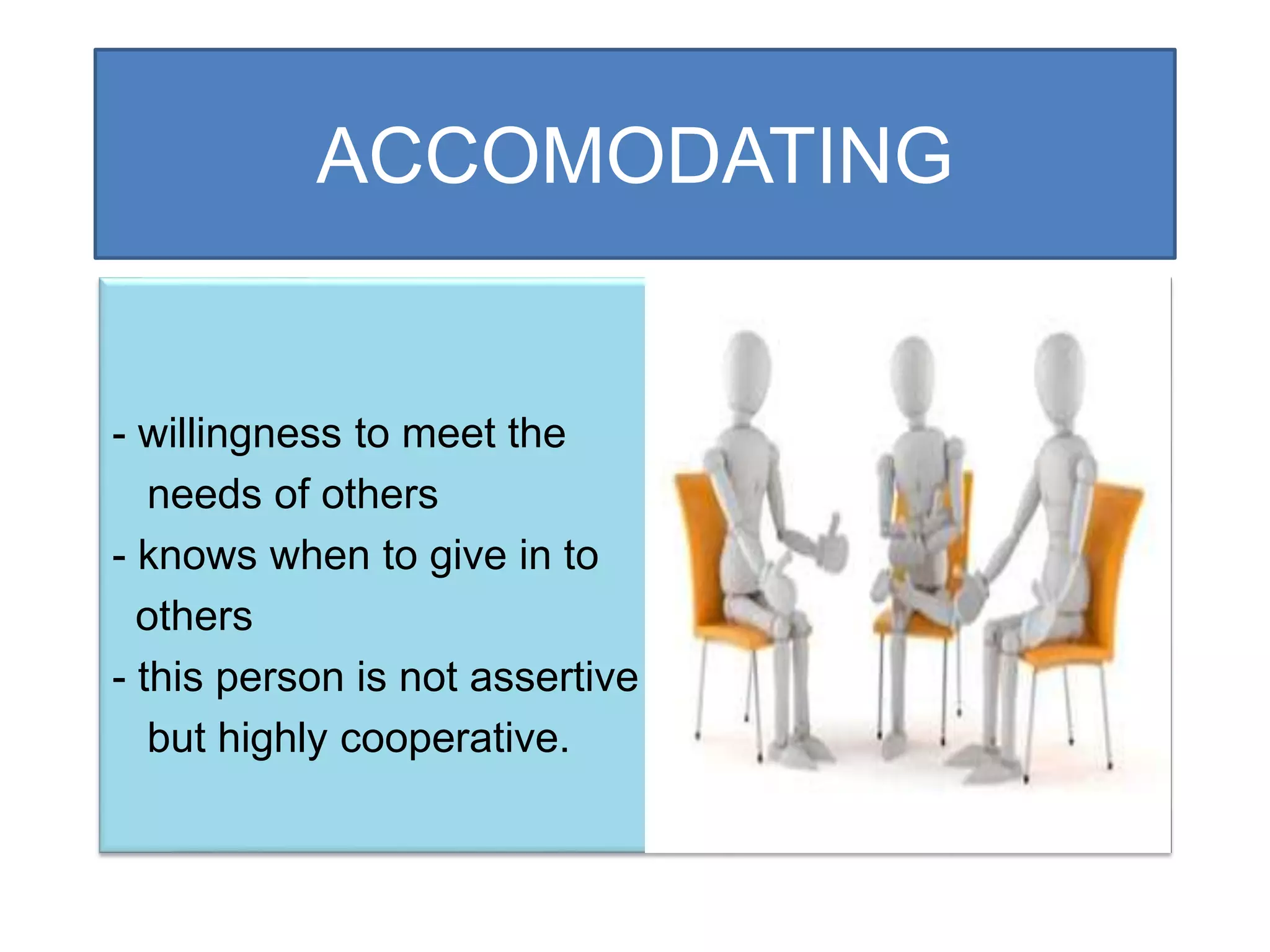
- willingness to meet the
needs of others
- knows when to give in to
others
- this person is not assertive
but highly cooperative.
INSTRUMENT #5
5. Avoiding
AVOIDING
-seek to evade the conflict
entirely
-delegating controversial
decisions
-not wanting to hurt
anyone‘s feelings
MODULE 3
CREATING MUTUAL
UNDERSTANDING
1.What Do I Want?
SO WHAT IS IT THAT YOU
WANT?
-make clear what are you
intensions
-what is it that you are
fighting for?
CREATING MUTUAL
UNDERSTANDING
2.What do they want?
SO WHAT IS IT THAT THEY
WANT?
- understand their intentions
- what is it that they are
fighting for?
CREATING MUTUAL
UNDERSTANDING
3.What do we want?
UNDERSTANDING EACH OTHER
RESULTS IN RESOLUTION
- make clear of each
parties goals
- move towards negotiating,
agreement and closure
MODULE 4
FOCUSING ON INDIVIDUAL NEEDS
Why do we need to do so?
WE MUST……..
to build on common
grounds to ensure a
strong partnership
WE MUST……..
1. Finding common
ground
WE MUST……..
It will help you understand
your adversary’s position
and better position you to
help create a win‐win
solution. This will build
goodwill.
WE MUST……..
2. Building positive energy
and goodwill
WE MUST……..
Turn negative energy into
positive energy to help build
goodwill with the person
that you are in conflict with,
resolving the conflict will be
much easier
WE MUST……..
3. Strengthening your
partnership
WE MUST……..
Build common ground to
help bridge the gap between
you and the person having
the conflict.
MODULE 5
GETTING TO THE ROOT CAUSE
Why do we need to
examine the root cause
of the conflict?
KNOWING THE ROOT CAUSE…
Is important for long‐term
resolution, rather than a
band‐aid solution.
WE MUST……..
1. Examining root causes
KNOWING THE ROOT CAUSE…
will provide greater value
and satisfaction to al
l involved.
WE MUST……..
2. Create a cause and
effect diagram
TO HELP……
make clear to the parties
involved, the main conflict
and the way forward to
resolve the issue.
WE MUST……..
3. Understand the
importance of
forgiveness
FORGIVENESS..
is a key concept in conflict
resolution and should give
the participants some
feeling of closure over the
issue
WE MUST……..
4. Identify the benefits
of resolution
BENEFITS OF …..
resolving the true conflict is
well worth the effort in the
long term. It brings closure
to the conflict and work can
move on.
MODULE 6
BUILDING A RESOLUTION..
is important for proper
implementation that will
be effective as a resolution
WHY…
do we need to build a
resolution?
RESOLUTIONS…..
can have long lasting
implication on people and
the enterprise. Do not build
it hastily.
BUILDING A SOLUTION
Stress and anger
management techniques
ANGER!!
Being well equipped with
some stress and anger
management techniques
can help you stay calm
during the conflict resolution
process.
UNDERSTAND THE AGREEMENT
The agreement frame
TO ENCOURAGE DISCUSSION..
It can be used in any situation
to explain your viewpoint in
an assertive,
non‐confrontational way,
without watering your position
down
OPEN CHANELS OF
COMMUNICATION
Asking open questions
OPEN QUESTION WILL….
encourage discussion,
self‐evaluation, and open
conversation. Use 5 wives,
1 husband approach.
THANK YOU
WINNING DOESN’T ALWAYS MEAN
BEING FIRST – WINNING MEANS YOU’RE
DOING BETTER THAN YOU’VE DONE
BEFORE
SUCCESS MEANS – KNOWING MORE
THAN THE OTHERS, WORKING MORE
THAN THE OTHERS & EXPECTING LESS
THAN THE OTHERS

Effective Conflict Resolution