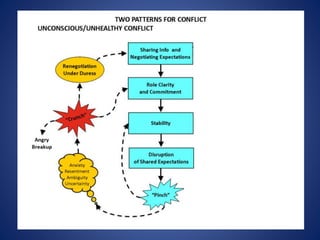
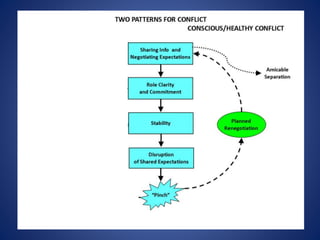
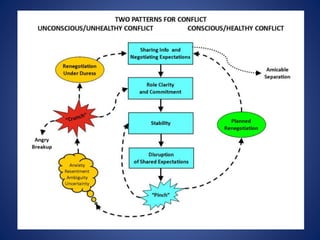
Conflict Transformation
understanding the difference
between healthy & unhealthy conflict
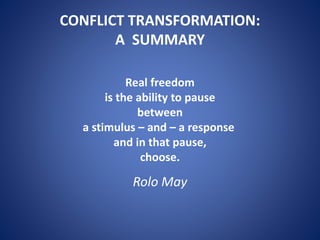
CONFLICT TRANSFORMATION:
A SUMMARY
Real freedom
is the ability to pause
between
a stimulus – and – a response
and in that pause,
choose.
Rolo May
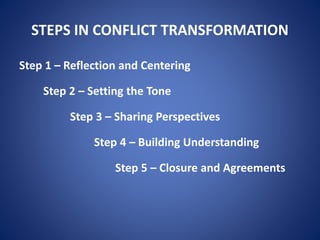
STEPS IN CONFLICT TRANSFORMATION
Step 1 – Reflection and Centering
Step 2 – Setting the Tone
Step 3 – Sharing Perspectives
Step 4 – Building Understanding
Step 5 – Closure and Agreements
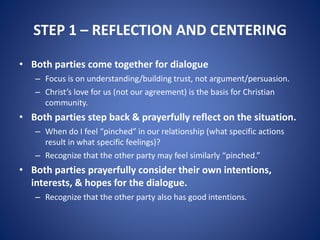
STEP 1 – REFLECTION AND CENTERING
• Both parties come together for dialogue
– Focus is on understanding/building trust, not argument/persuasion.
– Christ’s love for us (not our agreement) is the basis for Christian
community.
• Both parties step back & prayerfully reflect on the situation.
– When do I feel “pinched” in our relationship (what specific actions
result in what specific feelings)?
– Recognize that the other party may feel similarly “pinched.”
• Both parties prayerfully consider their own intentions,
interests, & hopes for the dialogue.
– Recognize that the other party also has good intentions.
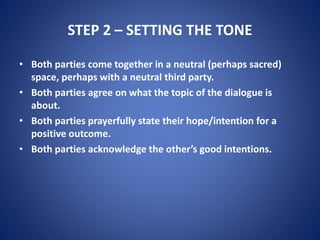
STEP 2 – SETTING THE TONE
• Both parties come together in a neutral (perhaps sacred)
space, perhaps with a neutral third party.
• Both parties agree on what the topic of the dialogue is
about.
• Both parties prayerfully state their hope/intention for a
positive outcome.
• Both parties acknowledge the other’s good intentions.
STEP 3 – SHARING PERSPECTIVES
• Each party describes the situation, using “I messages.”
– “When you _[behavior]___, I feel _[feeling]_____.”
– “The meaning I take from our disagreement is _________________.”
– “What is at the heart of this for me is _______________.”
• Before responding, each party briefly paraphrases feelings &
facts heard, & asks for clarification.
– “What I hear you saying is _[paraphrase of what you heard]____.”
– “Am I understanding that clearly, the way you meant it?”
• Both parties acknowledge responsibility for conflict &
outcome.
• Each party specifically describes perspective of the situation.
STEP 4 – BUILDING UNDERSTANDING
(Addressing Multiple Issues)
• Parties list the issues still to be addressed, writing them
down in neutral language.
• Parties discuss one issue at a time. For each issue:
– check out assumptions (intent -> [a1] -> action -> [a2] -> effect)
– explore underlying interests.
STEP 5 – CLOSURE AND AGREEMENTS
• Parties mutually generate options for each issue.
• Parties creatively develop solutions that both can agree to.
• Parties summarize and clarify agreements.
• Parties determine the agreement details.
CONFLICT TRANSFORMATION TIPS
• Accept that conflicts are a natural part of life.
• Treat conflict as an opportunity for transformation.
• Respect each other at beloved children of God.
• Understand that your assumptions about others’ intentions
may be incorrect.
• Be aware of your initial reaction, own your feelings, share.
• Actively listen: hear, reflect, seek to understand.
• Discover common interests. Positions tend to clouded them.
• Be creative, chose your approach. In Christ all possibilities are
open & you always have a choice.

Conflict Transformation: Understanding the Difference Between Healthy & Unhealthy Conflict

  • 1.
    Conflict Transformation understanding thedifference between healthy & unhealthy conflict
  • 5.
    CONFLICT TRANSFORMATION: A SUMMARY Realfreedom is the ability to pause between a stimulus – and – a response and in that pause, choose. Rolo May
  • 6.
    STEPS IN CONFLICTTRANSFORMATION Step 1 – Reflection and Centering Step 2 – Setting the Tone Step 3 – Sharing Perspectives Step 4 – Building Understanding Step 5 – Closure and Agreements
  • 7.
    STEP 1 –REFLECTION AND CENTERING • Both parties come together for dialogue – Focus is on understanding/building trust, not argument/persuasion. – Christ’s love for us (not our agreement) is the basis for Christian community. • Both parties step back & prayerfully reflect on the situation. – When do I feel “pinched” in our relationship (what specific actions result in what specific feelings)? – Recognize that the other party may feel similarly “pinched.” • Both parties prayerfully consider their own intentions, interests, & hopes for the dialogue. – Recognize that the other party also has good intentions.
  • 8.
    STEP 2 –SETTING THE TONE • Both parties come together in a neutral (perhaps sacred) space, perhaps with a neutral third party. • Both parties agree on what the topic of the dialogue is about. • Both parties prayerfully state their hope/intention for a positive outcome. • Both parties acknowledge the other’s good intentions.
  • 9.
    STEP 3 –SHARING PERSPECTIVES • Each party describes the situation, using “I messages.” – “When you _[behavior]___, I feel _[feeling]_____.” – “The meaning I take from our disagreement is _________________.” – “What is at the heart of this for me is _______________.” • Before responding, each party briefly paraphrases feelings & facts heard, & asks for clarification. – “What I hear you saying is _[paraphrase of what you heard]____.” – “Am I understanding that clearly, the way you meant it?” • Both parties acknowledge responsibility for conflict & outcome. • Each party specifically describes perspective of the situation.
  • 10.
    STEP 4 –BUILDING UNDERSTANDING (Addressing Multiple Issues) • Parties list the issues still to be addressed, writing them down in neutral language. • Parties discuss one issue at a time. For each issue: – check out assumptions (intent -> [a1] -> action -> [a2] -> effect) – explore underlying interests.
  • 11.
    STEP 5 –CLOSURE AND AGREEMENTS • Parties mutually generate options for each issue. • Parties creatively develop solutions that both can agree to. • Parties summarize and clarify agreements. • Parties determine the agreement details.
  • 12.
    CONFLICT TRANSFORMATION TIPS •Accept that conflicts are a natural part of life. • Treat conflict as an opportunity for transformation. • Respect each other at beloved children of God. • Understand that your assumptions about others’ intentions may be incorrect. • Be aware of your initial reaction, own your feelings, share. • Actively listen: hear, reflect, seek to understand. • Discover common interests. Positions tend to clouded them. • Be creative, chose your approach. In Christ all possibilities are open & you always have a choice.