Contents
Introduction
Borehole Environment
Types of Well logging
Types of Electrical Well logging
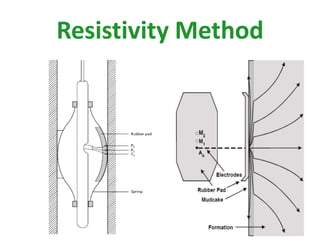
Resistivity Method
Self Potential method
Induction Logging
Conclusion
References
Introduction
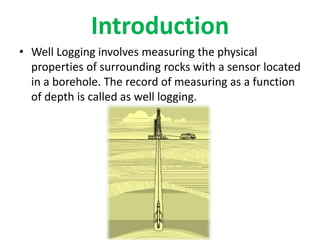
• Well Logging involves measuring the physical
properties of surrounding rocks with a sensor located
in a borehole. The record of measuring as a function
of depth is called as well logging.
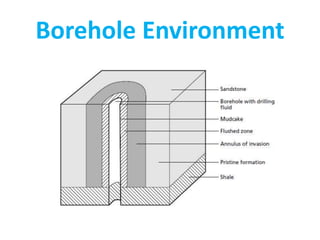
Borehole Environment
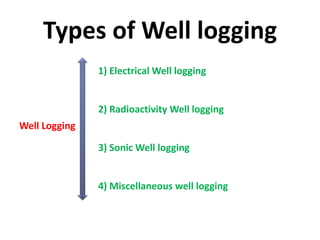
Types of Well logging
Well Logging
1) Electrical Well logging
2) Radioactivity Well logging
3) Sonic Well logging
4) Miscellaneous well logging
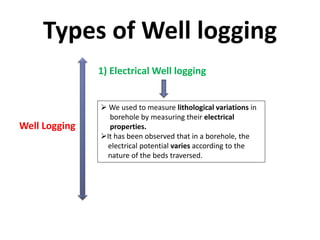
Types of Well logging
Well Logging
1) Electrical Well logging
 We used to measure lithological variations in
borehole by measuring their electrical
properties.
It has been observed that in a borehole, the
electrical potential varies according to the
nature of the beds traversed.
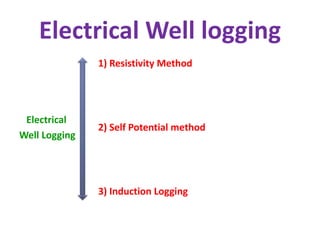
Electrical Well logging
Electrical
Well Logging
1) Resistivity Method
2) Self Potential method
3) Induction Logging
Electrical Well logging
Electrical
Well Logging
1) Resistivity Method
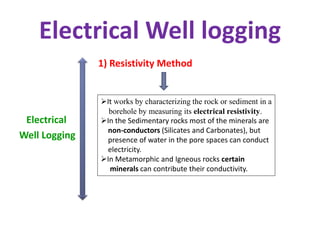
It works by characterizing the rock or sediment in a
borehole by measuring its electrical resistivity.
In the Sedimentary rocks most of the minerals are
non-conductors (Silicates and Carbonates), but
presence of water in the pore spaces can conduct
electricity.
In Metamorphic and Igneous rocks certain
minerals can contribute their conductivity.
Resistivity Method
Resistivity
Method
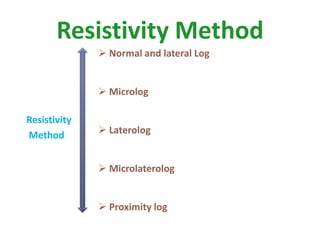
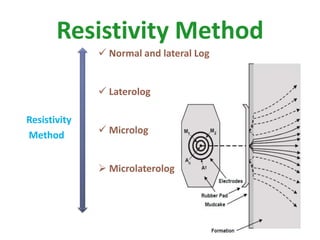
 Normal and lateral Log
 Microlog
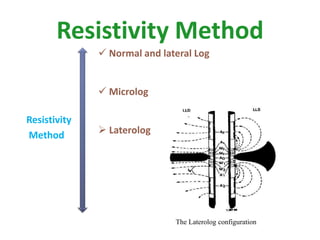
 Laterolog
 Microlaterolog
 Proximity log
Resistivity Method
Resistivity
Method
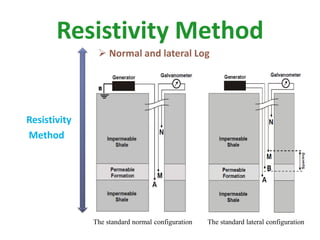
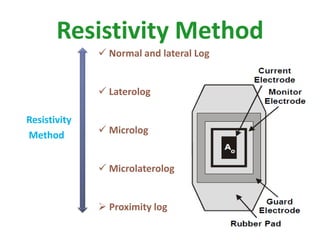
 Normal and lateral Log
2) Laterolog
3) Microlog
4) Microlaterolog
5) Proximity log
The standard normal configuration The standard lateral configuration
Resistivity Method
Resistivity
Method
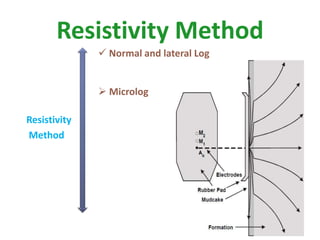
 Normal and lateral Log
 Microlog
Resistivity Method
Resistivity Method
Resistivity
Method
 Normal and lateral Log
 Microlog
 Laterolog
The Laterolog configuration
N
M
C0
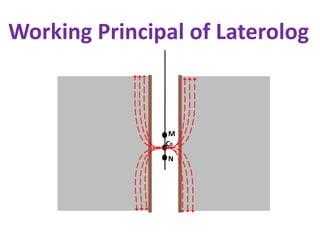
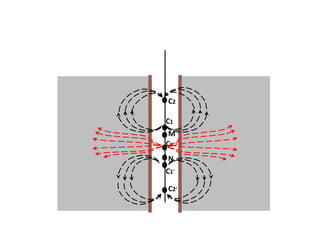
Working Principal of Laterolog
N
M
C0
C2'
C1'
C2
C1
Resistivity Method
Resistivity
Method
 Normal and lateral Log
 Laterolog
 Microlog
 Microlaterolog
Resistivity Method
Resistivity
Method
 Normal and lateral Log
 Laterolog
 Microlog
 Microlaterolog
 Proximity log
Electrical Well logging
Electrical
Well Logging
 Resistivity Method
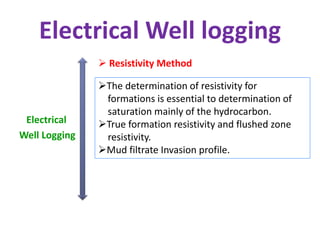
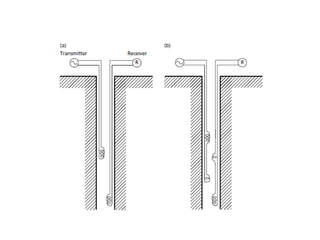
The determination of resistivity for
formations is essential to determination of
saturation mainly of the hydrocarbon.
True formation resistivity and flushed zone
resistivity.
Mud filtrate Invasion profile.
Electrical Well logging
Electrical
Well Logging
 Resistivity Method
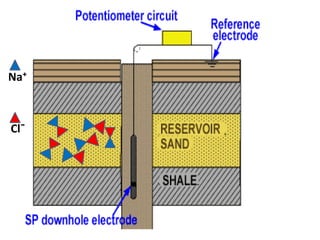
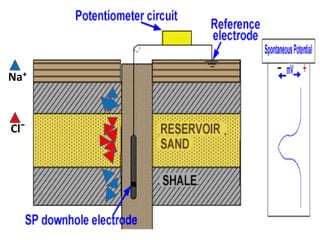
 Self Potential Method
Cl¯
Na⁺
Cl¯
Na⁺
Electrical Well logging
Electrical
Well Logging
 Resistivity Method
 Self Potential Method
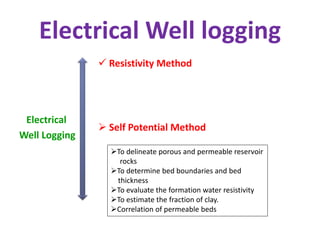
To delineate porous and permeable reservoir
rocks
To determine bed boundaries and bed
thickness
To evaluate the formation water resistivity
To estimate the fraction of clay.
Correlation of permeable beds
Electrical Well logging
Electrical
Well Logging
 Resistivity Method
 Self Potential method
 Induction Logging
Fe, Mg rich
body
Conclusion
 Well logging is the detailed survey, conducted after the location
for drilling is fixed based on the other preliminary geological
and geophysical surveys.
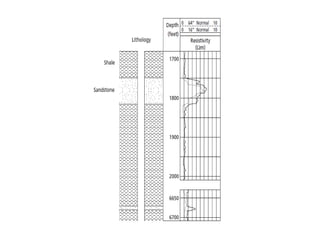
 In the normal resistivity logging method, if the thickness of the
bed is less than the separation between AM, then we will get
reverse graph.
 In the resistivity well logging method we use our own source
but in the case of SP method we use natural current.
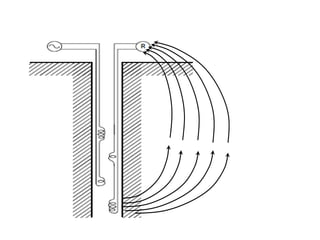
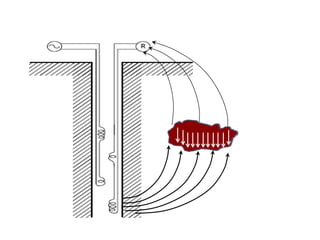
 Proximity well logging is use to determine the density of the
reserves.
Books:-
 Philip Kearey, Michael Brooks, Ian Hill (2002), An Introduction to
Geophysical Exploration, Third Edition, Blackwell Science Ltd, Pp 236-244
 W.M. Telford, L.P. Geldart, R.E. Shrriff (1990), Applied Geophysics,
Second Edition, Cambridge University Press, Pp 645-658
 Darwin V. Ellis & Julian M. Singer (2007), Well Logging for Earth
Scientists, Second Edition, Springer. Pp 41-59
Websites:-
 http://www.greatgeophysics.com/logginginfo.html
 http://en.wikipedia.org/wiki/Well_logging
 http://petrofed.winwinhosting.net/upload/IAI/17-
20mar10/WellLoggingTech.pdf
 http://petrowiki.org/Electrode_resistivity_devices
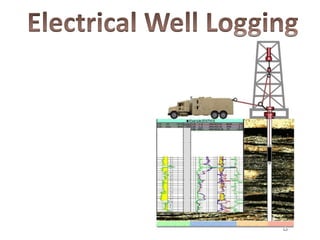
Electrical well logging

Electrical well logging

  • 2.
    Contents Introduction Borehole Environment Types ofWell logging Types of Electrical Well logging Resistivity Method Self Potential method Induction Logging Conclusion References
  • 3.
    Introduction • Well Logginginvolves measuring the physical properties of surrounding rocks with a sensor located in a borehole. The record of measuring as a function of depth is called as well logging.
  • 4.
  • 5.
    Types of Welllogging Well Logging 1) Electrical Well logging 2) Radioactivity Well logging 3) Sonic Well logging 4) Miscellaneous well logging
  • 6.
    Types of Welllogging Well Logging 1) Electrical Well logging  We used to measure lithological variations in borehole by measuring their electrical properties. It has been observed that in a borehole, the electrical potential varies according to the nature of the beds traversed.
  • 7.
    Electrical Well logging Electrical WellLogging 1) Resistivity Method 2) Self Potential method 3) Induction Logging
  • 8.
    Electrical Well logging Electrical WellLogging 1) Resistivity Method It works by characterizing the rock or sediment in a borehole by measuring its electrical resistivity. In the Sedimentary rocks most of the minerals are non-conductors (Silicates and Carbonates), but presence of water in the pore spaces can conduct electricity. In Metamorphic and Igneous rocks certain minerals can contribute their conductivity.
  • 9.
    Resistivity Method Resistivity Method  Normaland lateral Log  Microlog  Laterolog  Microlaterolog  Proximity log
  • 10.
    Resistivity Method Resistivity Method  Normaland lateral Log 2) Laterolog 3) Microlog 4) Microlaterolog 5) Proximity log The standard normal configuration The standard lateral configuration
  • 12.
  • 13.
  • 14.
    Resistivity Method Resistivity Method  Normaland lateral Log  Microlog  Laterolog The Laterolog configuration
  • 15.
  • 16.
  • 17.
    Resistivity Method Resistivity Method  Normaland lateral Log  Laterolog  Microlog  Microlaterolog
  • 18.
    Resistivity Method Resistivity Method  Normaland lateral Log  Laterolog  Microlog  Microlaterolog  Proximity log
  • 19.
    Electrical Well logging Electrical WellLogging  Resistivity Method The determination of resistivity for formations is essential to determination of saturation mainly of the hydrocarbon. True formation resistivity and flushed zone resistivity. Mud filtrate Invasion profile.
  • 20.
    Electrical Well logging Electrical WellLogging  Resistivity Method  Self Potential Method
  • 21.
  • 22.
  • 23.
    Electrical Well logging Electrical WellLogging  Resistivity Method  Self Potential Method To delineate porous and permeable reservoir rocks To determine bed boundaries and bed thickness To evaluate the formation water resistivity To estimate the fraction of clay. Correlation of permeable beds
  • 24.
    Electrical Well logging Electrical WellLogging  Resistivity Method  Self Potential method  Induction Logging
  • 27.
  • 28.
    Conclusion  Well loggingis the detailed survey, conducted after the location for drilling is fixed based on the other preliminary geological and geophysical surveys.  In the normal resistivity logging method, if the thickness of the bed is less than the separation between AM, then we will get reverse graph.  In the resistivity well logging method we use our own source but in the case of SP method we use natural current.  Proximity well logging is use to determine the density of the reserves.
  • 29.
    Books:-  Philip Kearey,Michael Brooks, Ian Hill (2002), An Introduction to Geophysical Exploration, Third Edition, Blackwell Science Ltd, Pp 236-244  W.M. Telford, L.P. Geldart, R.E. Shrriff (1990), Applied Geophysics, Second Edition, Cambridge University Press, Pp 645-658  Darwin V. Ellis & Julian M. Singer (2007), Well Logging for Earth Scientists, Second Edition, Springer. Pp 41-59 Websites:-  http://www.greatgeophysics.com/logginginfo.html  http://en.wikipedia.org/wiki/Well_logging  http://petrofed.winwinhosting.net/upload/IAI/17- 20mar10/WellLoggingTech.pdf  http://petrowiki.org/Electrode_resistivity_devices