Climate Change & Cities 
James Voogt 
Department of Geography 
Western University 
President: International Association for Urban Climate
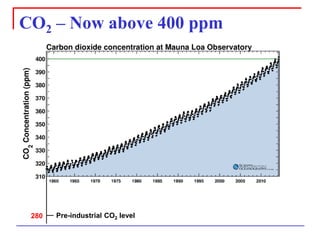
CO2–Now above 400 ppm 
280 
Pre-industrial CO2level
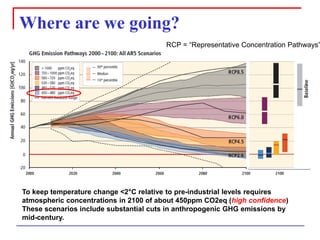
Where are we going? 
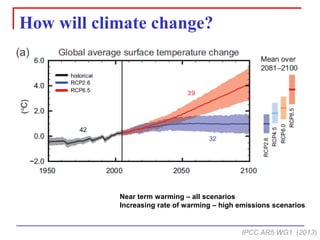
RCP = “Representative Concentration Pathways” 
To keep temperature change <2°C relative to pre-industrial levels requires atmospheric concentrations in 2100 of about 450ppm CO2eq (high confidence) 
These scenarios include substantial cuts in anthropogenic GHG emissions by mid-century.
How will climate change? 
IPCC AR5 WG1 (2013) 
Near term warming –all scenarios 
Increasing rate of warming –high emissions scenarios
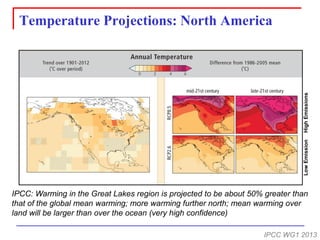
Temperature Projections: North America 
IPCC WG1 2013 
High Emissions 
Low Emission 
IPCC: Warming in the Great Lakes region is projected to be about 50% greater than that of the global mean warming; more warming further north; mean warming over land will be larger than over the ocean (very high confidence)
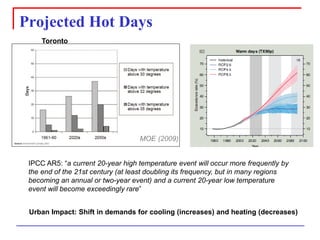
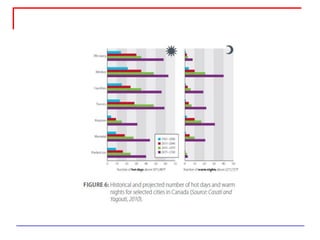
Projected Hot Days 
MOE (2009) 
IPCC AR5: “a current 20-year high temperature event will occur more frequently by the end of the 21st century (at least doubling its frequency, but in many regions becoming an annual or two-year event) and a current 20-year low temperature event will become exceedingly rare” 
Toronto 
Urban Impact: Shift in demands for cooling (increases) and heating (decreases)
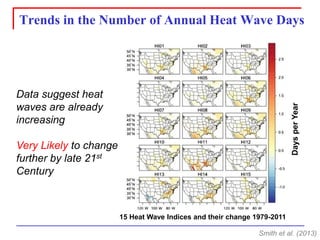
Trends in the Number of Annual Heat Wave Days 
Smith et al. (2013) 
15 Heat Wave Indices and their change 1979-2011 
Days per Year 
Data suggest heat waves are already increasing 
Very Likelyto change further by late 21stCentury
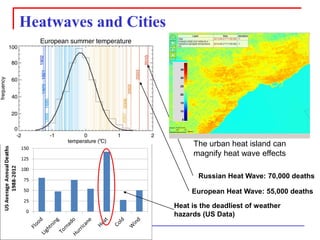
Heatwaves and Cities 
The urban heat island can magnify heat wave effects 
Toronto 
Russian Heat Wave: 70,000 deaths 
European Heat Wave: 55,000 deaths 
Heat is the deadliest of weather hazards (US Data)
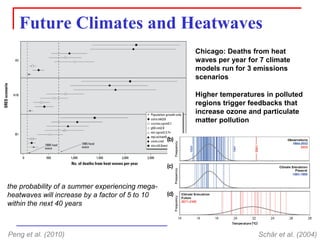
Future Climates and Heatwaves 
Schäret al. (2004) 
the probability of a summer experiencing mega- heatwaves will increase by a factor of 5 to 10 within the next 40 years 
Chicago: Deaths from heat waves per year for 7 climate models run for 3 emissions scenarios 
Peng et al. (2010) 
Higher temperatures in polluted regions trigger feedbacks that increase ozone and particulate matter pollution
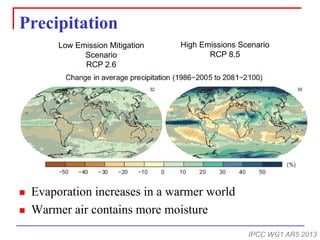
Precipitation 
Evaporation increases in a warmer world 
Warmer air contains more moisture 
IPCC WG1 AR5 2013 
High Emissions Scenario 
RCP 8.5 
Low Emission Mitigation ScenarioRCP 2.6
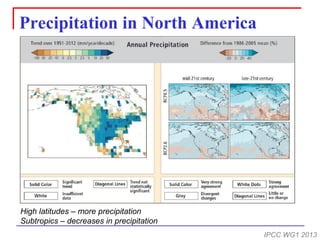
Precipitation in North America 
IPCC WG1 2013 
High latitudes –more precipitation 
Subtropics –decreases in precipitation
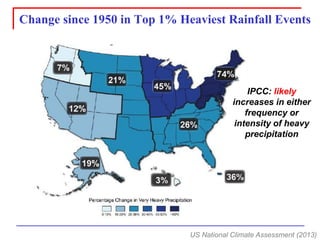
Change since 1950 in Top 1% Heaviest Rainfall Events 
US National Climate Assessment (2013) 
IPCC: likelyincreases in either frequency or intensity of heavy precipitation
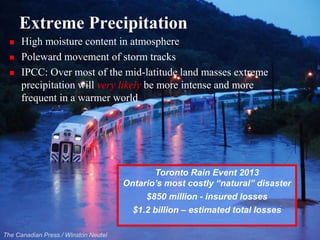
Extreme Precipitation 
High moisture content in atmosphere 
Polewardmovement of storm tracks 
IPCC: Over most of the mid-latitude land masses extreme precipitation will very likely be more intense and more frequent in a warmer world 
The Canadian Press / Winston Neutel 
Toronto Rain Event 2013 
Ontario’s most costly “natural” disaster 
$850 million -insured losses 
$1.2 billion –estimated total losses
TELLING THE WEATHER STORY | 14 
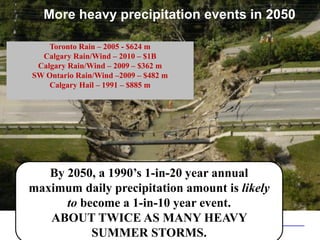
By 2050, a 1990’s 1-in-20 year annual maximum daily precipitation amount is likely to become a 1-in-10 year event. 
ABOUT TWICE AS MANY HEAVY SUMMER STORMS. 
More heavy precipitation events in 2050 
Toronto Rain –2005 -$624 m 
Calgary Rain/Wind –2010 –$1B 
Calgary Rain/Wind –2009 –$362 m 
SW Ontario Rain/Wind –2009 –$482 m 
Calgary Hail –1991 –$885 m
CBC
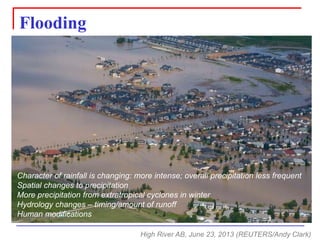
Flooding 
High River AB, June 23, 2013 (REUTERS/Andy Clark) 
Character of rainfall is changing: more intense; overall precipitation less frequent 
Spatial changes to precipitation 
More precipitation from extratropicalcyclones in winter 
Hydrology changes –timing/amount of runoff 
Human modifications
TELLING THE WEATHER STORY | 17 
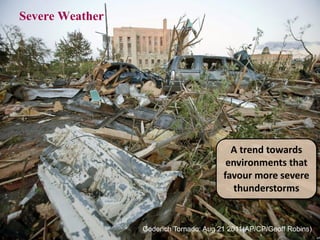
Severe Weather 
Goderich Tornado: Aug 21 2011(AP/CP/Geoff Robins) 
A trend towards environments that favour more severe thunderstorms
Fires in BC 
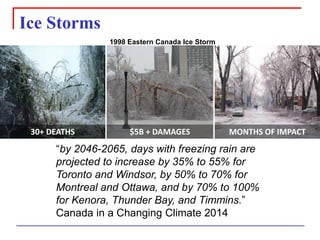
MONTHS OF IMPACT 
$5B + DAMAGES 
30+ DEATHS 
Ice Storms 
1998 Eastern Canada Ice Storm 
2013 Southern Ontario Ice Storm 
$200 million in insured losses 
Alex Urosevicfor National Post 
“by 2046-2065, days with freezing rain are projected to increase by 35% to 55% for Toronto and Windsor, by 50% to 70% for Montreal and Ottawa, and by 70% to 100% for Kenora, Thunder Bay, and Timmins.” Canada in a Changing Climate 2014
CurrentClimate 
Futurescenario 
City[D=Cityonadelta] 
Population in 2005 
Exposedpopulation 
Exposedassets 
Exposedpopulation 
Exposedassets 
Mumbai,India 
18.2 
2.8 
46 
11.4 
1598 
Guangzhou,China[D] 
8.4 
2.7 
84 
10.3 
3358 
Shanghai,China[D] 
14.5 
2.4 
73 
5.5 
1771 
Miami,USA 
5.4 
2.0 
416 
4.8 
3513 
HoChiMinhCity,Vietnam[D] 
5.1 
1.9 
27 
9.2 
653 
Kolkata,India[D] 
14.3 
1.9 
32 
14.0 
1961 
NewYork-Newark,USA 
18.7 
1.5 
320 
2.9 
2147 
Osaka-Kobe,Japan[D] 
11.3 
1.4 
216 
2.0 
969 
Alexandria,Egypt[D] 
3.8 
1.3 
28 
4.4 
563 
NewOrleans,USA[D] 
1.0 
1.1 
234 
1.4 
1013 
Tokyo,Japan[D] 
35.2 
1.1 
174 
2.5 
1207 
Tianjin,China[D] 
7.0 
1.0 
30 
3.8 
1231 
Bangkok,Thailand[D] 
6.6 
0.9 
39 
5.1 
1118 
Dhaka,Bangladesh[D] 
12.4 
0.8 
8 
11.1 
544 
Amsterdam,Netherlands[D] 
1.2 
0.8 
128 
1.4 
844 
Sea Level Rise: Top 15 world port cities ranked by population exposure under the current climate and future climate scenario. 
Population –millions; Exposed Assets: $US billions 
Nicholls et al (2008)
EFFECTIVE CLIMATE CHANGE ADAPTATION 
A MORE VIBRANT WORLD
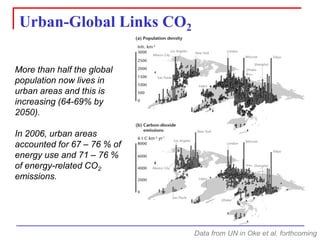
More than half the global population now lives in urban areas and this is increasing (64-69% by 2050). 
In 2006, urban areas accounted for 67 –76 % of energy use and 71 –76 % of energy-related CO2emissions. 
Urban-Global Links CO2 
Data from UN in Okeet al. forthcoming
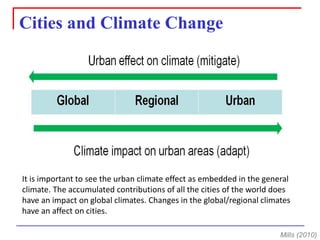
It is important to see the urban climate effect as embedded in the general climate. The accumulated contributions of all the cities of the world does have an impact on global climates. Changes in the global/regional climates have an affect on cities. 
Cities and Climate Change 
Mills (2010)
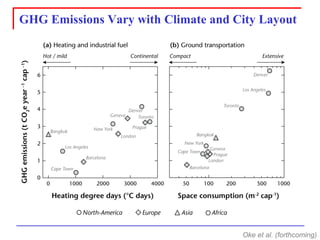
GHG Emissions Vary with Climate and City Layout 
Oke et al. (forthcoming)
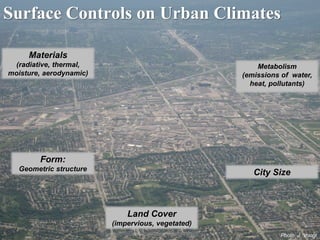
Surface Controls on Urban Climates 
Photo: J. Voogt 
Form: Geometric structure 
Land Cover(impervious, vegetated) 
Metabolism (emissions of water, heat, pollutants) 
City Size 
Materials(radiative, thermal, moisture, aerodynamic)
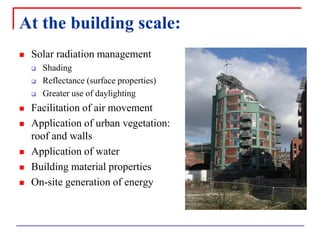
At the building scale: 
Solar radiation management 
Shading 
Reflectance (surface properties) 
Greater use of daylighting 
Facilitation of air movement 
Application of urban vegetation: roof and walls 
Application of water 
Building material properties 
On-site generation of energy
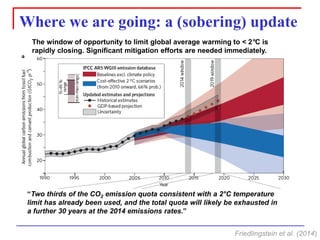
Where we are going: a (sobering) update 
Friedlingsteinet al. (2014) 
“Two thirds of the CO2emission quota consistent with a 2°C temperature limit has already been used, and the total quota will likely be exhausted in a further 30 years at the 2014 emissions rates.” 
The window of opportunity to limit global average warming to < 2°C is rapidly closing. Significant mitigation efforts are needed immediately.
Take Home Messages 
Anthropogenic climate change is occurring and effects will become more clear with time 
Cities are important sites related to both emissions of GHG (climate forcing) and receiving impacts of climate change 
Urban areas further modify climates: e.g. water balance changes and heat islands that exacerbate climate change in cities 
More compact and densely occupied cities generally generate less GHG per capita. Policies to reduce emissions in cities should consider technology and fuel-switching, but also the potential for moderating the urban contribution of GHG through more efficient urban form, transport and land-use mix.
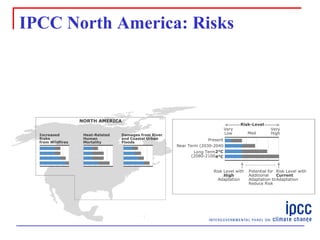
Risk Level withCurrent Adaptation 
Potential forAdditional Adaptation to Reduce Risk 
Risk Level withHigh Adaptation 
Risk-Level 
VeryLow 
Med 
VeryHigh 
4°C 
2°C 
Present 
Long Term(2080-2100 
Near Term (2030-2040 
Increased Risksfrom Wildfires 
Heat-RelatedHuman Mortality 
Damages from River and Coastal Urban Floods 
NORTH AMERICA 
IPCC North America: Risks
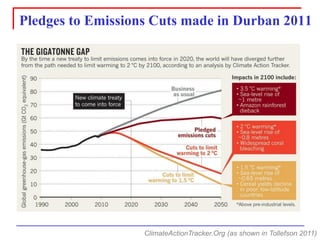
Pledges to Emissions Cuts made in Durban 2011 
ClimateActionTracker.Org(as shown in Tollefson2011)
emissions 
concentrations 
temperature 
sea level 
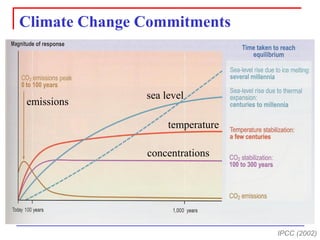
IPCC (2002) 
Climate Change Commitments
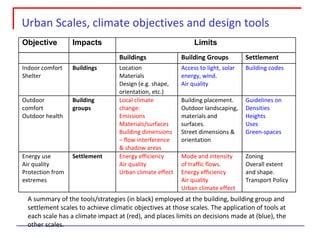
A summary of the tools/strategies (in black) employed at the building, building group and settlement scales to achieve climatic objectives at those scales. The application of tools at each scale has a climate impact at (red), and places limits on decisions made at (blue), the other scales. 
Urban Scales, climate objectives and design tools 
Objective Impacts Limits Buildings Building Groups Settlement Indoor comfort Shelter Buildings Location Materials Design (e.g. shape, orientation, etc.) Access to light, solar energy, wind. Air quality Building codes Outdoor comfort Outdoor health Building groups Local climate change: Emissions Materials/surfaces Building dimensions – flow interference & shadow areas Building placement. Outdoor landscaping, materials and surfaces. Street dimensions & orientation Guidelines on Densities Heights Uses Green-spaces Energy use Air quality Protection from extremes Settlement Energy efficiency Air quality Urban climate effect Mode and intensity of traffic flows. Energy efficiency Air quality Urban climate effect Zoning Overall extent and shape. Transport Policy

GBF2014 - James Voogt - Climate Change & Cities

  • 1.
    Climate Change &Cities James Voogt Department of Geography Western University President: International Association for Urban Climate
  • 2.
    CO2–Now above 400ppm 280 Pre-industrial CO2level
  • 3.
    Where are wegoing? RCP = “Representative Concentration Pathways” To keep temperature change <2°C relative to pre-industrial levels requires atmospheric concentrations in 2100 of about 450ppm CO2eq (high confidence) These scenarios include substantial cuts in anthropogenic GHG emissions by mid-century.
  • 4.
    How will climatechange? IPCC AR5 WG1 (2013) Near term warming –all scenarios Increasing rate of warming –high emissions scenarios
  • 5.
    Temperature Projections: NorthAmerica IPCC WG1 2013 High Emissions Low Emission IPCC: Warming in the Great Lakes region is projected to be about 50% greater than that of the global mean warming; more warming further north; mean warming over land will be larger than over the ocean (very high confidence)
  • 6.
    Projected Hot Days MOE (2009) IPCC AR5: “a current 20-year high temperature event will occur more frequently by the end of the 21st century (at least doubling its frequency, but in many regions becoming an annual or two-year event) and a current 20-year low temperature event will become exceedingly rare” Toronto Urban Impact: Shift in demands for cooling (increases) and heating (decreases)
  • 7.
    Trends in theNumber of Annual Heat Wave Days Smith et al. (2013) 15 Heat Wave Indices and their change 1979-2011 Days per Year Data suggest heat waves are already increasing Very Likelyto change further by late 21stCentury
  • 8.
    Heatwaves and Cities The urban heat island can magnify heat wave effects Toronto Russian Heat Wave: 70,000 deaths European Heat Wave: 55,000 deaths Heat is the deadliest of weather hazards (US Data)
  • 9.
    Future Climates andHeatwaves Schäret al. (2004) the probability of a summer experiencing mega- heatwaves will increase by a factor of 5 to 10 within the next 40 years Chicago: Deaths from heat waves per year for 7 climate models run for 3 emissions scenarios Peng et al. (2010) Higher temperatures in polluted regions trigger feedbacks that increase ozone and particulate matter pollution
  • 10.
    Precipitation Evaporation increasesin a warmer world Warmer air contains more moisture IPCC WG1 AR5 2013 High Emissions Scenario RCP 8.5 Low Emission Mitigation ScenarioRCP 2.6
  • 11.
    Precipitation in NorthAmerica IPCC WG1 2013 High latitudes –more precipitation Subtropics –decreases in precipitation
  • 12.
    Change since 1950in Top 1% Heaviest Rainfall Events US National Climate Assessment (2013) IPCC: likelyincreases in either frequency or intensity of heavy precipitation
  • 13.
    Extreme Precipitation Highmoisture content in atmosphere Polewardmovement of storm tracks IPCC: Over most of the mid-latitude land masses extreme precipitation will very likely be more intense and more frequent in a warmer world The Canadian Press / Winston Neutel Toronto Rain Event 2013 Ontario’s most costly “natural” disaster $850 million -insured losses $1.2 billion –estimated total losses
  • 14.
    TELLING THE WEATHERSTORY | 14 By 2050, a 1990’s 1-in-20 year annual maximum daily precipitation amount is likely to become a 1-in-10 year event. ABOUT TWICE AS MANY HEAVY SUMMER STORMS. More heavy precipitation events in 2050 Toronto Rain –2005 -$624 m Calgary Rain/Wind –2010 –$1B Calgary Rain/Wind –2009 –$362 m SW Ontario Rain/Wind –2009 –$482 m Calgary Hail –1991 –$885 m
  • 15.
  • 16.
    Flooding High RiverAB, June 23, 2013 (REUTERS/Andy Clark) Character of rainfall is changing: more intense; overall precipitation less frequent Spatial changes to precipitation More precipitation from extratropicalcyclones in winter Hydrology changes –timing/amount of runoff Human modifications
  • 17.
    TELLING THE WEATHERSTORY | 17 Severe Weather Goderich Tornado: Aug 21 2011(AP/CP/Geoff Robins) A trend towards environments that favour more severe thunderstorms
  • 18.
    Fires in BC MONTHS OF IMPACT $5B + DAMAGES 30+ DEATHS Ice Storms 1998 Eastern Canada Ice Storm 2013 Southern Ontario Ice Storm $200 million in insured losses Alex Urosevicfor National Post “by 2046-2065, days with freezing rain are projected to increase by 35% to 55% for Toronto and Windsor, by 50% to 70% for Montreal and Ottawa, and by 70% to 100% for Kenora, Thunder Bay, and Timmins.” Canada in a Changing Climate 2014
  • 19.
    CurrentClimate Futurescenario City[D=Cityonadelta] Population in 2005 Exposedpopulation Exposedassets Exposedpopulation Exposedassets Mumbai,India 18.2 2.8 46 11.4 1598 Guangzhou,China[D] 8.4 2.7 84 10.3 3358 Shanghai,China[D] 14.5 2.4 73 5.5 1771 Miami,USA 5.4 2.0 416 4.8 3513 HoChiMinhCity,Vietnam[D] 5.1 1.9 27 9.2 653 Kolkata,India[D] 14.3 1.9 32 14.0 1961 NewYork-Newark,USA 18.7 1.5 320 2.9 2147 Osaka-Kobe,Japan[D] 11.3 1.4 216 2.0 969 Alexandria,Egypt[D] 3.8 1.3 28 4.4 563 NewOrleans,USA[D] 1.0 1.1 234 1.4 1013 Tokyo,Japan[D] 35.2 1.1 174 2.5 1207 Tianjin,China[D] 7.0 1.0 30 3.8 1231 Bangkok,Thailand[D] 6.6 0.9 39 5.1 1118 Dhaka,Bangladesh[D] 12.4 0.8 8 11.1 544 Amsterdam,Netherlands[D] 1.2 0.8 128 1.4 844 Sea Level Rise: Top 15 world port cities ranked by population exposure under the current climate and future climate scenario. Population –millions; Exposed Assets: $US billions Nicholls et al (2008)
  • 20.
    EFFECTIVE CLIMATE CHANGEADAPTATION A MORE VIBRANT WORLD
  • 21.
    More than halfthe global population now lives in urban areas and this is increasing (64-69% by 2050). In 2006, urban areas accounted for 67 –76 % of energy use and 71 –76 % of energy-related CO2emissions. Urban-Global Links CO2 Data from UN in Okeet al. forthcoming
  • 22.
    It is importantto see the urban climate effect as embedded in the general climate. The accumulated contributions of all the cities of the world does have an impact on global climates. Changes in the global/regional climates have an affect on cities. Cities and Climate Change Mills (2010)
  • 23.
    GHG Emissions Varywith Climate and City Layout Oke et al. (forthcoming)
  • 24.
    Surface Controls onUrban Climates Photo: J. Voogt Form: Geometric structure Land Cover(impervious, vegetated) Metabolism (emissions of water, heat, pollutants) City Size Materials(radiative, thermal, moisture, aerodynamic)
  • 25.
    At the buildingscale: Solar radiation management Shading Reflectance (surface properties) Greater use of daylighting Facilitation of air movement Application of urban vegetation: roof and walls Application of water Building material properties On-site generation of energy
  • 26.
    Where we aregoing: a (sobering) update Friedlingsteinet al. (2014) “Two thirds of the CO2emission quota consistent with a 2°C temperature limit has already been used, and the total quota will likely be exhausted in a further 30 years at the 2014 emissions rates.” The window of opportunity to limit global average warming to < 2°C is rapidly closing. Significant mitigation efforts are needed immediately.
  • 27.
    Take Home Messages Anthropogenic climate change is occurring and effects will become more clear with time Cities are important sites related to both emissions of GHG (climate forcing) and receiving impacts of climate change Urban areas further modify climates: e.g. water balance changes and heat islands that exacerbate climate change in cities More compact and densely occupied cities generally generate less GHG per capita. Policies to reduce emissions in cities should consider technology and fuel-switching, but also the potential for moderating the urban contribution of GHG through more efficient urban form, transport and land-use mix.
  • 28.
    Risk Level withCurrentAdaptation Potential forAdditional Adaptation to Reduce Risk Risk Level withHigh Adaptation Risk-Level VeryLow Med VeryHigh 4°C 2°C Present Long Term(2080-2100 Near Term (2030-2040 Increased Risksfrom Wildfires Heat-RelatedHuman Mortality Damages from River and Coastal Urban Floods NORTH AMERICA IPCC North America: Risks
  • 29.
    Pledges to EmissionsCuts made in Durban 2011 ClimateActionTracker.Org(as shown in Tollefson2011)
  • 30.
    emissions concentrations temperature sea level IPCC (2002) Climate Change Commitments
  • 32.
    A summary ofthe tools/strategies (in black) employed at the building, building group and settlement scales to achieve climatic objectives at those scales. The application of tools at each scale has a climate impact at (red), and places limits on decisions made at (blue), the other scales. Urban Scales, climate objectives and design tools Objective Impacts Limits Buildings Building Groups Settlement Indoor comfort Shelter Buildings Location Materials Design (e.g. shape, orientation, etc.) Access to light, solar energy, wind. Air quality Building codes Outdoor comfort Outdoor health Building groups Local climate change: Emissions Materials/surfaces Building dimensions – flow interference & shadow areas Building placement. Outdoor landscaping, materials and surfaces. Street dimensions & orientation Guidelines on Densities Heights Uses Green-spaces Energy use Air quality Protection from extremes Settlement Energy efficiency Air quality Urban climate effect Mode and intensity of traffic flows. Energy efficiency Air quality Urban climate effect Zoning Overall extent and shape. Transport Policy