Presented by:
Shilpa Shivanand
III MDS
• Introduction
• History
• Terminology
• Rationale
• Normal alveolar bone morphology
• Factors in selection of technique
• Examination , Diagnosis and Treatment Planning
• Techniques
• Specific situations
• Summary
• References
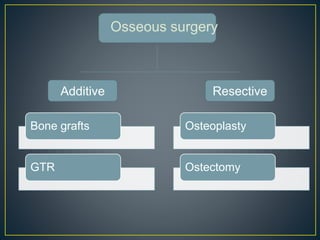
Osseous surgery
Additive Resective
Bone grafts
GTR
Osteoplasty
Ostectomy
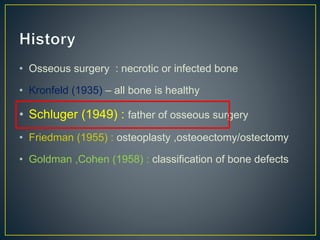
• Osseous surgery : necrotic or infected bone
• Kronfeld (1935) – all bone is healthy
• Schluger (1949) : father of osseous surgery
• Friedman (1955) : osteoplasty ,osteoectomy/ostectomy
• Goldman ,Cohen (1958) : classification of bone defects
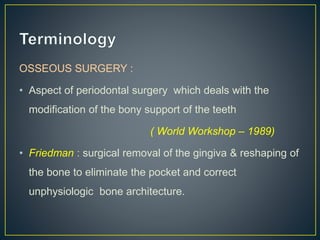
OSSEOUS SURGERY :
• Aspect of periodontal surgery which deals with the
modification of the bony support of the teeth
( World Workshop – 1989)
• Friedman : surgical removal of the gingiva & reshaping of
the bone to eliminate the pocket and correct
unphysiologic bone architecture.
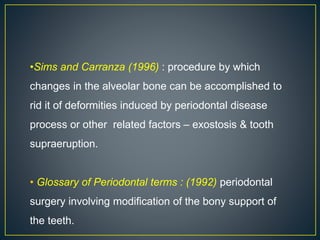
•Sims and Carranza (1996) : procedure by which
changes in the alveolar bone can be accomplished to
rid it of deformities induced by periodontal disease
process or other related factors – exostosis & tooth
supraeruption.
• Glossary of Periodontal terms : (1992) periodontal
surgery involving modification of the bony support of
the teeth.
• Osteoplasty : reshaping of the alveolar process to
achieve a more physiological form without removal of
supporting bone .
• Ostectomy : bone that is part of the attachment
apparatus
,is removed to eliminate a periodontal pocket and
establish gingival contours that will be maintained .
Friedman 1955
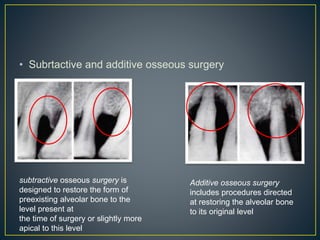
• Subrtactive and additive osseous surgery
Additive osseous surgery
includes procedures directed
at restoring the alveolar bone
to its original level
subtractive osseous surgery is
designed to restore the form of
preexisting alveolar bone to the
level present at
the time of surgery or slightly more
apical to this level
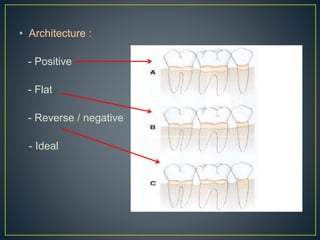
• Architecture :
- Positive
- Flat
- Reverse / negative
- Ideal
Definitive osseous
reshaping
implies that further
osseous reshaping would
not improve the overall
result
Compromise osseous
reshaping
indicates a bone pattern
that cannot be improved
without significant osseous
removal that would be
detrimental to the overall
result
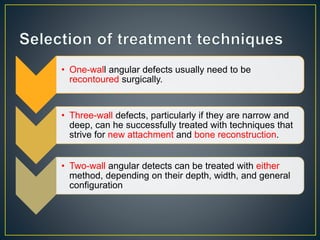
• One-wall angular defects usually need to be
recontoured surgically.
• Three-wall defects, particularly if they are narrow and
deep, can he successfully treated with techniques that
strive for new attachment and bone reconstruction.
• Two-wall angular detects can be treated with either
method, depending on their depth, width, and general
configuration
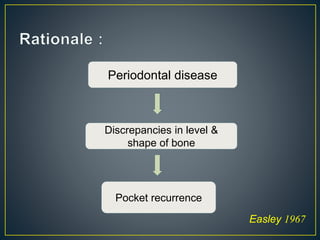
Pocket recurrence
Periodontal disease
Discrepancies in level &
shape of bone
Easley 1967
Reshape the marginal bone to resemble that of the
alveolar process undamaged by periodontal disease.
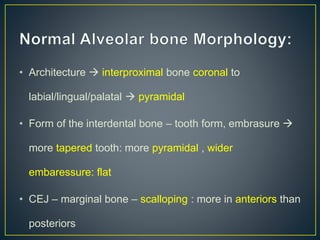
• Architecture  interproximal bone coronal to
labial/lingual/palatal  pyramidal
• Form of the interdental bone – tooth form, embrasure 
more tapered tooth: more pyramidal , wider
embaressure: flat
• CEJ – marginal bone – scalloping : more in anteriors than
posteriors
Craters and root trunk types
- Craters : shallow – 1-2mm
moderate : 3-4mm
deep : >5mm
- Amt of buccal bone removed – base of crater to root
trunk
- Root trunk : short, average & long
- Avg. 1.5 – 2mm CEJ to marginal bone (Orban, Wentz)
Ochsenbien 1986
• Maxillary molars :
• History : 1960s – buccal approach
• Disadvantages : buccal recession
- reversed architecture
- buccal radicular bone lost
- inadequate buccal interprox.space
• Palatal approach : Ochsenbein & Bohannan (1963)
• Shallow craters : 1-2mm
- Buccal to palatal slope ; concave
- Rarely flat topography
- Reduction : 10 0 to a horizontal line to base of crater
- Palatal radicular bone – apical to the interdental bone
- Buccal – radicular bone – thin
• Medium Craters – 3-4mm
- both palatal & buccal approaches
- Step 1- palatal reduction
- Step 2 – buccal reduction
• Deep craters : >5mm
- Buccal and palatal reduction
- Compromise
- Furcal involvement , recession
- Extraction?
• Maxillary Premolars :
- Bucco-lingual dimension of bone –thick
- Shallow well-like defects
- Osteoplasty
- Root concavities (Booker) – odontoplasty and early
pocket management
• Mandibular molars:
- Lingually tilted (Dempster et al 1963)- base of crater
lingual
- Root trunk length lingual > buccal
- Buccal gingiva scalloped > than lingual
- Lingual inclination to the slope
- Initial osteoplasty – ostectomy
• Short root trunks : 30-35% of teeth
- 1mm bone coronal to the furcation
- minimal bone reduction – osteoplasty
• Medium & Long root trunks :
- more favorable
• Deep craters : osteotomy + ostectomy – lingual slope
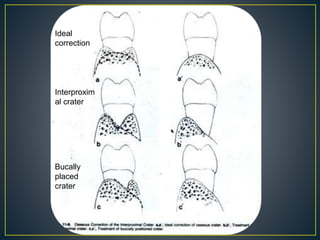
Ideal
correction
Interproxim
al crater
Bucally
placed
crater
• IDEAL
Early to moderate bone loss (2-3mm)
with moderate root trunk lengths , bony
defects – two walls
• Mandibular molars > Maxillary molars
• Loss of supporting bone
• Furcation exposure
• Reversed architecture
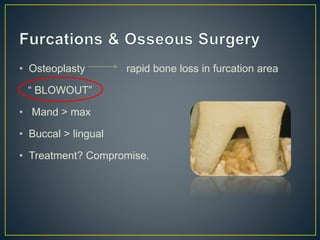
• Osteoplasty rapid bone loss in furcation area
“ BLOWOUT”
• Mand > max
• Buccal > lingual
• Treatment? Compromise.
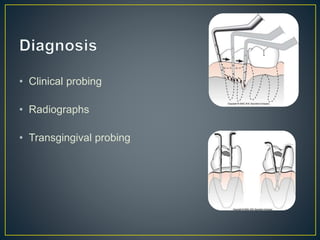
• Clinical probing
• Radiographs
• Transgingival probing
Indications
1. Pocket elimination
2. Tori
3. Intrabony defects adjacent to edentulous ridges
4. Incipient furcation involvement
5. Thick, heavy ledges &/or exostosis
6. Shallow osseous craters
7. Enhanced flap placement with improved alveolar
contours
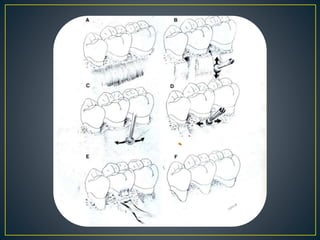
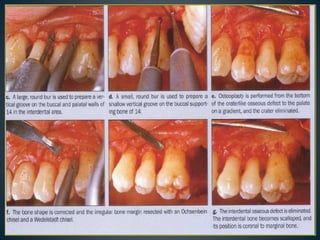
• Festooning – reduce buccal & lingual thickness of bone
interdentally
• Greater root prominence , minimum bone removal ,
smooth transition from radicular to interradicular space
• Intial step – reduce walls of small craters
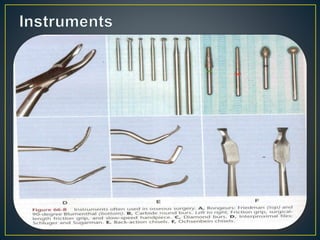
• Instrument : no. 6, 8 or 10 bur + high speed handpiece+
copious irrigation
• Indication : shallow craters, thick bony ledges
• For thicker , heavier bone after vertical grooving
• Even flowing thin radicular surface – root prominences
and valleys
• Instrument : bur no. 6,8 or 10 – high speed handpiece.
• Back & forth motion
• Scribing : Ochsenbien chisels – 1 or 2
• Indication : shallow craters, thick ledges, Cl.1 & 2 FI
Indications :
1. Sufficient bone remaining for establishing physiologic
contours without attachment compromise
2. No aesthetic or anatomic limitations
3. Elimination of interdental craters
4. Intrabony defects not amenable to regeneration
5. Horizontal bone loss with irregular marginal bone
6. Moderate to advanced furcation involvements
7. Hemisepta
• Advantages :
- predictable pocket elimination
- establishment of physiologic gingival & osseous
architecture
- favorable prosthetic environment
• Disadvantages :
- Loss of attachment
- esthetic compromise
- increased root sensitivity
• Contraindications:
- insufficient attachment or where ostectomy may
unfavorably alter the prognosis of the tooth
- anatomic limitations
- esthetic limitations
- effective alternative treatment
• Removal of small amounts of supporting bone
• One walled interproximal defects / hemisepta
• Three walled defect –coronally placed one wall edge
• Contraindicated : large hemiseptal defects
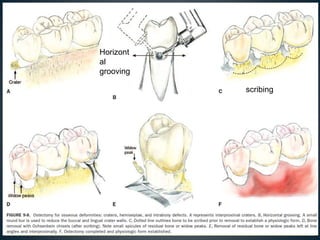
• Removal of bony discrepancies – Widow’s peaks
• Hand instruments
• Failure to remove…
Horizont
al
grooving
scribing
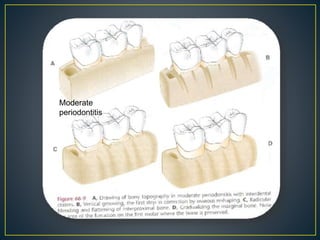
Moderate
periodontitis
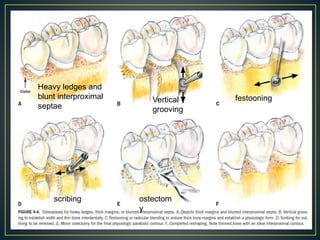
Heavy ledges and
blunt interproximal
septae
Vertical
grooving
festooning
scribing ostectom
y
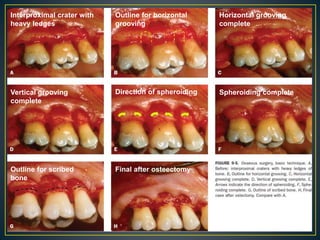
Interproximal crater with
heavy ledges
Outline for horizontal
grooving
Horizontal grooving
complete
Vertical grooving
complete
Direction of spheroiding Spheroiding complete
Outline for scribed
bone
Final after osteectomy
• Exostoses – osteoplasty followed by ostectomy
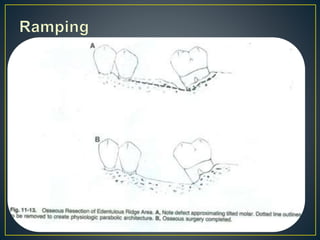
• Edentulous area- ramping
• One wall defect – osteoplasty
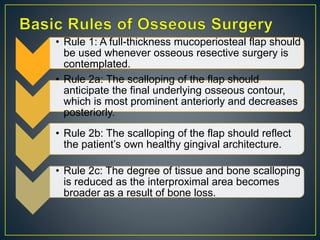
• Rule 1: A full-thickness mucoperiosteal flap should
be used whenever osseous resective surgery is
contemplated.
• Rule 2a: The scalloping of the flap should
anticipate the final underlying osseous contour,
which is most prominent anteriorly and decreases
posteriorly.
• Rule 2b: The scalloping of the flap should reflect
the patient’s own healthy gingival architecture.
• Rule 2c: The degree of tissue and bone scalloping
is reduced as the interproximal area becomes
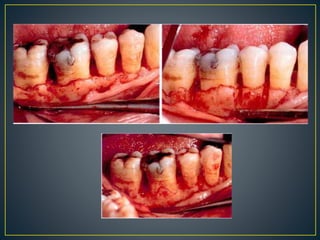
broader as a result of bone loss.
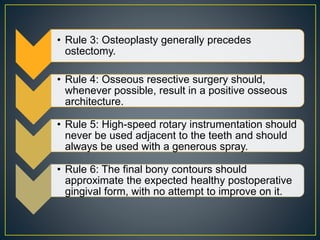
• Rule 3: Osteoplasty generally precedes
ostectomy.
• Rule 4: Osseous resective surgery should,
whenever possible, result in a positive osseous
architecture.
• Rule 5: High-speed rotary instrumentation should
never be used adjacent to the teeth and should
always be used with a generous spray.
• Rule 6: The final bony contours should
approximate the expected healthy postoperative
gingival form, with no attempt to improve on it.
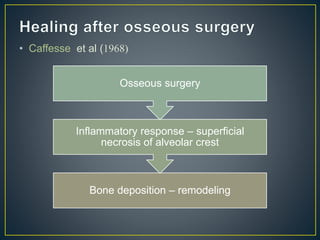
• Caffesse et al (1968)
Bone deposition – remodeling
Inflammatory response – superficial
necrosis of alveolar crest
Osseous surgery
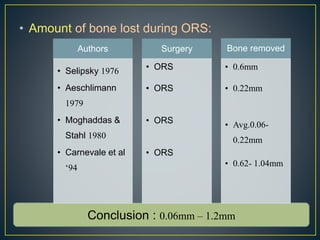
Conclusion : 0.06mm – 1.2mm
• Amount of bone lost during ORS:
Authors
• Selipsky 1976
• Aeschlimann
1979
• Moghaddas &
Stahl 1980
• Carnevale et al
‘94
Surgery
• ORS
• ORS
• ORS
• ORS
Bone removed
• 0.6mm
• 0.22mm
• Avg.0.06-
0.22mm
• 0.62- 1.04mm
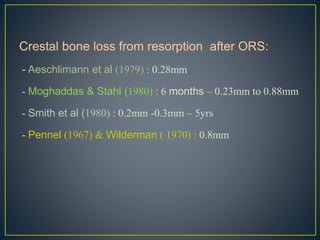
Crestal bone loss from resorption after ORS:
- Aeschlimann et al (1979) : 0.28mm
- Moghaddas & Stahl (1980) : 6 months – 0.23mm to 0.88mm
- Smith et al (1980) : 0.2mm -0.3mm – 5yrs
- Pennel (1967) & Wilderman ( 1970) : 0.8mm
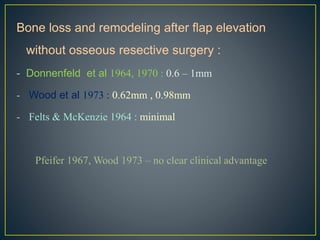
Bone loss and remodeling after flap elevation
without osseous resective surgery :
- Donnenfeld et al 1964, 1970 : 0.6 – 1mm
- Wood et al 1973 : 0.62mm , 0.98mm
- Felts & McKenzie 1964 : minimal
Pfeifer 1967, Wood 1973 – no clear clinical advantage
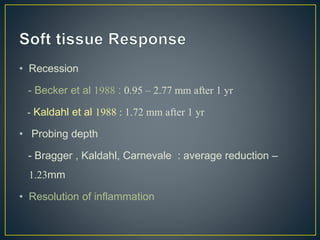
• Recession
- Becker et al 1988 : 0.95 – 2.77 mm after 1 yr
- Kaldahl et al 1988 : 1.72 mm after 1 yr
• Probing depth
- Bragger , Kaldahl, Carnevale : average reduction –
1.23mm
• Resolution of inflammation
• Knowles et al. (1979) , Ramjford et al. (1987),
Rosling et al (1983)
- Compared gingival curettage, pocket elimination tech.
with ORS & elimination by MWF
- >4-5mm – MWF > ORS
- 7 mm > ORS – gain in CAL , reduced probing depths
- 3 yrs : no difference btw the three therapies
Rosling et al 1976, 1983 , Smith et al 1980:
- Apically repositioned flap with & without ORS
- ORS – long term – less probing
Becker et al 1988 , Kaldahl et al 1990 :
- non surgical therapy & ORS : no clinically significant
difference
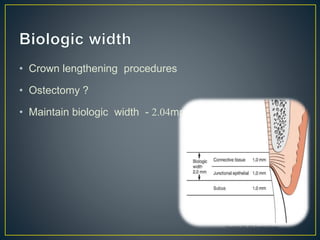
• Crown lengthening procedures
• Ostectomy ?
• Maintain biologic width - 2.04mm
Basic rules :
1. Full thickness mucoperiosteal flap
2. Scalloping – anticipated ; prominent anteriorly
3. Reflect patient’s own architecture
4. Scalloping & bone reduction reduces as interproximal
area becomes broader
5. Osteoplasty before ostectomy
6. Positive architecture when possible
7. High speed rotary instrument + copious irrigation
• Osteoplasty – enhance tissue placement
- tissue adaptation at suturing
• Ostectomy – eliminate intrabony pocket
OSSEOUS RESECTIVE SURGERY  minimal probing
depths
and gingival tissue morphology that facilitates good oral
hygiene and periodontal health.
References
• Carranza 10th ed.
• Page and Schluger 2nd ed.
• Cohen – Atlas of Cosmetic & Reconstructive
periodontal Surgery – 2nd ed.
• The role of resective periodontal surgery in the
treatment of furcation defects. Massimo Desanctis ,
Perio 2000 Vol 22, 2000
• Osseous Resective Surgery – Carnavale & Kaldahl,
Perio 2000, vol.22 ,2000
• Osseous resective surgery: Long-term case report ,
Checchi et al , IJPRD 2008.
• Osseous Resection in Periodontal Surgery, Ochsenbejn
Resective osseous surgery

Resective osseous surgery

  • 2.
  • 3.
    • Introduction • History •Terminology • Rationale • Normal alveolar bone morphology • Factors in selection of technique • Examination , Diagnosis and Treatment Planning
  • 4.
    • Techniques • Specificsituations • Summary • References
  • 6.
    Osseous surgery Additive Resective Bonegrafts GTR Osteoplasty Ostectomy
  • 7.
    • Osseous surgery: necrotic or infected bone • Kronfeld (1935) – all bone is healthy • Schluger (1949) : father of osseous surgery • Friedman (1955) : osteoplasty ,osteoectomy/ostectomy • Goldman ,Cohen (1958) : classification of bone defects
  • 8.
    OSSEOUS SURGERY : •Aspect of periodontal surgery which deals with the modification of the bony support of the teeth ( World Workshop – 1989) • Friedman : surgical removal of the gingiva & reshaping of the bone to eliminate the pocket and correct unphysiologic bone architecture.
  • 9.
    •Sims and Carranza(1996) : procedure by which changes in the alveolar bone can be accomplished to rid it of deformities induced by periodontal disease process or other related factors – exostosis & tooth supraeruption. • Glossary of Periodontal terms : (1992) periodontal surgery involving modification of the bony support of the teeth.
  • 10.
    • Osteoplasty :reshaping of the alveolar process to achieve a more physiological form without removal of supporting bone . • Ostectomy : bone that is part of the attachment apparatus ,is removed to eliminate a periodontal pocket and establish gingival contours that will be maintained . Friedman 1955
  • 11.
    • Subrtactive andadditive osseous surgery Additive osseous surgery includes procedures directed at restoring the alveolar bone to its original level subtractive osseous surgery is designed to restore the form of preexisting alveolar bone to the level present at the time of surgery or slightly more apical to this level
  • 12.
    • Architecture : -Positive - Flat - Reverse / negative - Ideal
  • 13.
    Definitive osseous reshaping implies thatfurther osseous reshaping would not improve the overall result Compromise osseous reshaping indicates a bone pattern that cannot be improved without significant osseous removal that would be detrimental to the overall result
  • 14.
    • One-wall angulardefects usually need to be recontoured surgically. • Three-wall defects, particularly if they are narrow and deep, can he successfully treated with techniques that strive for new attachment and bone reconstruction. • Two-wall angular detects can be treated with either method, depending on their depth, width, and general configuration
  • 15.
    Pocket recurrence Periodontal disease Discrepanciesin level & shape of bone Easley 1967
  • 16.
    Reshape the marginalbone to resemble that of the alveolar process undamaged by periodontal disease.
  • 17.
    • Architecture interproximal bone coronal to labial/lingual/palatal  pyramidal • Form of the interdental bone – tooth form, embrasure  more tapered tooth: more pyramidal , wider embaressure: flat • CEJ – marginal bone – scalloping : more in anteriors than posteriors
  • 18.
    Craters and roottrunk types - Craters : shallow – 1-2mm moderate : 3-4mm deep : >5mm - Amt of buccal bone removed – base of crater to root trunk - Root trunk : short, average & long - Avg. 1.5 – 2mm CEJ to marginal bone (Orban, Wentz) Ochsenbien 1986
  • 19.
    • Maxillary molars: • History : 1960s – buccal approach • Disadvantages : buccal recession - reversed architecture - buccal radicular bone lost - inadequate buccal interprox.space • Palatal approach : Ochsenbein & Bohannan (1963)
  • 20.
    • Shallow craters: 1-2mm - Buccal to palatal slope ; concave - Rarely flat topography - Reduction : 10 0 to a horizontal line to base of crater - Palatal radicular bone – apical to the interdental bone - Buccal – radicular bone – thin
  • 21.
    • Medium Craters– 3-4mm - both palatal & buccal approaches - Step 1- palatal reduction - Step 2 – buccal reduction
  • 22.
    • Deep craters: >5mm - Buccal and palatal reduction - Compromise - Furcal involvement , recession - Extraction?
  • 23.
    • Maxillary Premolars: - Bucco-lingual dimension of bone –thick - Shallow well-like defects - Osteoplasty - Root concavities (Booker) – odontoplasty and early pocket management
  • 24.
    • Mandibular molars: -Lingually tilted (Dempster et al 1963)- base of crater lingual - Root trunk length lingual > buccal - Buccal gingiva scalloped > than lingual - Lingual inclination to the slope - Initial osteoplasty – ostectomy
  • 25.
    • Short roottrunks : 30-35% of teeth - 1mm bone coronal to the furcation - minimal bone reduction – osteoplasty • Medium & Long root trunks : - more favorable • Deep craters : osteotomy + ostectomy – lingual slope
  • 26.
  • 27.
    • IDEAL Early tomoderate bone loss (2-3mm) with moderate root trunk lengths , bony defects – two walls
  • 28.
    • Mandibular molars> Maxillary molars • Loss of supporting bone • Furcation exposure • Reversed architecture
  • 29.
    • Osteoplasty rapidbone loss in furcation area “ BLOWOUT” • Mand > max • Buccal > lingual • Treatment? Compromise.
  • 30.
    • Clinical probing •Radiographs • Transgingival probing
  • 33.
    Indications 1. Pocket elimination 2.Tori 3. Intrabony defects adjacent to edentulous ridges 4. Incipient furcation involvement 5. Thick, heavy ledges &/or exostosis 6. Shallow osseous craters 7. Enhanced flap placement with improved alveolar contours
  • 34.
    • Festooning –reduce buccal & lingual thickness of bone interdentally • Greater root prominence , minimum bone removal , smooth transition from radicular to interradicular space • Intial step – reduce walls of small craters • Instrument : no. 6, 8 or 10 bur + high speed handpiece+ copious irrigation • Indication : shallow craters, thick bony ledges
  • 37.
    • For thicker, heavier bone after vertical grooving • Even flowing thin radicular surface – root prominences and valleys • Instrument : bur no. 6,8 or 10 – high speed handpiece. • Back & forth motion • Scribing : Ochsenbien chisels – 1 or 2 • Indication : shallow craters, thick ledges, Cl.1 & 2 FI
  • 38.
    Indications : 1. Sufficientbone remaining for establishing physiologic contours without attachment compromise 2. No aesthetic or anatomic limitations 3. Elimination of interdental craters 4. Intrabony defects not amenable to regeneration 5. Horizontal bone loss with irregular marginal bone 6. Moderate to advanced furcation involvements 7. Hemisepta
  • 39.
    • Advantages : -predictable pocket elimination - establishment of physiologic gingival & osseous architecture - favorable prosthetic environment • Disadvantages : - Loss of attachment - esthetic compromise - increased root sensitivity
  • 40.
    • Contraindications: - insufficientattachment or where ostectomy may unfavorably alter the prognosis of the tooth - anatomic limitations - esthetic limitations - effective alternative treatment
  • 41.
    • Removal ofsmall amounts of supporting bone • One walled interproximal defects / hemisepta • Three walled defect –coronally placed one wall edge • Contraindicated : large hemiseptal defects
  • 42.
    • Removal ofbony discrepancies – Widow’s peaks • Hand instruments • Failure to remove…
  • 43.
  • 44.
  • 45.
    Heavy ledges and bluntinterproximal septae Vertical grooving festooning scribing ostectom y
  • 47.
    Interproximal crater with heavyledges Outline for horizontal grooving Horizontal grooving complete Vertical grooving complete Direction of spheroiding Spheroiding complete Outline for scribed bone Final after osteectomy
  • 48.
    • Exostoses –osteoplasty followed by ostectomy • Edentulous area- ramping • One wall defect – osteoplasty
  • 50.
    • Rule 1:A full-thickness mucoperiosteal flap should be used whenever osseous resective surgery is contemplated. • Rule 2a: The scalloping of the flap should anticipate the final underlying osseous contour, which is most prominent anteriorly and decreases posteriorly. • Rule 2b: The scalloping of the flap should reflect the patient’s own healthy gingival architecture. • Rule 2c: The degree of tissue and bone scalloping is reduced as the interproximal area becomes broader as a result of bone loss.
  • 51.
    • Rule 3:Osteoplasty generally precedes ostectomy. • Rule 4: Osseous resective surgery should, whenever possible, result in a positive osseous architecture. • Rule 5: High-speed rotary instrumentation should never be used adjacent to the teeth and should always be used with a generous spray. • Rule 6: The final bony contours should approximate the expected healthy postoperative gingival form, with no attempt to improve on it.
  • 52.
    • Caffesse etal (1968) Bone deposition – remodeling Inflammatory response – superficial necrosis of alveolar crest Osseous surgery
  • 53.
    Conclusion : 0.06mm– 1.2mm • Amount of bone lost during ORS: Authors • Selipsky 1976 • Aeschlimann 1979 • Moghaddas & Stahl 1980 • Carnevale et al ‘94 Surgery • ORS • ORS • ORS • ORS Bone removed • 0.6mm • 0.22mm • Avg.0.06- 0.22mm • 0.62- 1.04mm
  • 54.
    Crestal bone lossfrom resorption after ORS: - Aeschlimann et al (1979) : 0.28mm - Moghaddas & Stahl (1980) : 6 months – 0.23mm to 0.88mm - Smith et al (1980) : 0.2mm -0.3mm – 5yrs - Pennel (1967) & Wilderman ( 1970) : 0.8mm
  • 55.
    Bone loss andremodeling after flap elevation without osseous resective surgery : - Donnenfeld et al 1964, 1970 : 0.6 – 1mm - Wood et al 1973 : 0.62mm , 0.98mm - Felts & McKenzie 1964 : minimal Pfeifer 1967, Wood 1973 – no clear clinical advantage
  • 56.
    • Recession - Beckeret al 1988 : 0.95 – 2.77 mm after 1 yr - Kaldahl et al 1988 : 1.72 mm after 1 yr • Probing depth - Bragger , Kaldahl, Carnevale : average reduction – 1.23mm • Resolution of inflammation
  • 57.
    • Knowles etal. (1979) , Ramjford et al. (1987), Rosling et al (1983) - Compared gingival curettage, pocket elimination tech. with ORS & elimination by MWF - >4-5mm – MWF > ORS - 7 mm > ORS – gain in CAL , reduced probing depths - 3 yrs : no difference btw the three therapies
  • 58.
    Rosling et al1976, 1983 , Smith et al 1980: - Apically repositioned flap with & without ORS - ORS – long term – less probing Becker et al 1988 , Kaldahl et al 1990 : - non surgical therapy & ORS : no clinically significant difference
  • 59.
    • Crown lengtheningprocedures • Ostectomy ? • Maintain biologic width - 2.04mm
  • 60.
    Basic rules : 1.Full thickness mucoperiosteal flap 2. Scalloping – anticipated ; prominent anteriorly 3. Reflect patient’s own architecture 4. Scalloping & bone reduction reduces as interproximal area becomes broader 5. Osteoplasty before ostectomy 6. Positive architecture when possible 7. High speed rotary instrument + copious irrigation
  • 61.
    • Osteoplasty –enhance tissue placement - tissue adaptation at suturing • Ostectomy – eliminate intrabony pocket OSSEOUS RESECTIVE SURGERY  minimal probing depths and gingival tissue morphology that facilitates good oral hygiene and periodontal health.
  • 62.
    References • Carranza 10thed. • Page and Schluger 2nd ed. • Cohen – Atlas of Cosmetic & Reconstructive periodontal Surgery – 2nd ed. • The role of resective periodontal surgery in the treatment of furcation defects. Massimo Desanctis , Perio 2000 Vol 22, 2000
  • 63.
    • Osseous ResectiveSurgery – Carnavale & Kaldahl, Perio 2000, vol.22 ,2000 • Osseous resective surgery: Long-term case report , Checchi et al , IJPRD 2008. • Osseous Resection in Periodontal Surgery, Ochsenbejn