PERIIMPLANTITIS
Shilpa Shivanand
III MDS
CONTENTS
• Introduction
• Epidemiology
• Classification of Periimplant Diseases
• Etiology
• Possible Pathogenic Mechanisms
• Genetic polymorphism & periimplantitis
• Periodontitis & Periimplantitis
• Diagnosis of Periimplantitis
• Treatment of periimplantitis
• Conclusion
• References
• Use of implants has developed significantly during the past two
decades
• Widely accepted treatment modality of high success and
predictability
• Despite the high success and survival rates of oral
implants, failures do occur and implant-supported
prosthesis may require a substantial periodontal
and prosthodontic maintenance over time
Implant failure: Traditionally described as early or late:
Early failures: Prior to implant loading
: Surgical, implant or host-related factors
Late failures: After prosthodontic rehabilitation
: Peri-implant disease or biomechanical overload
Bone loss around the implant
Loss of osseointegration
Esposito M et al 1998
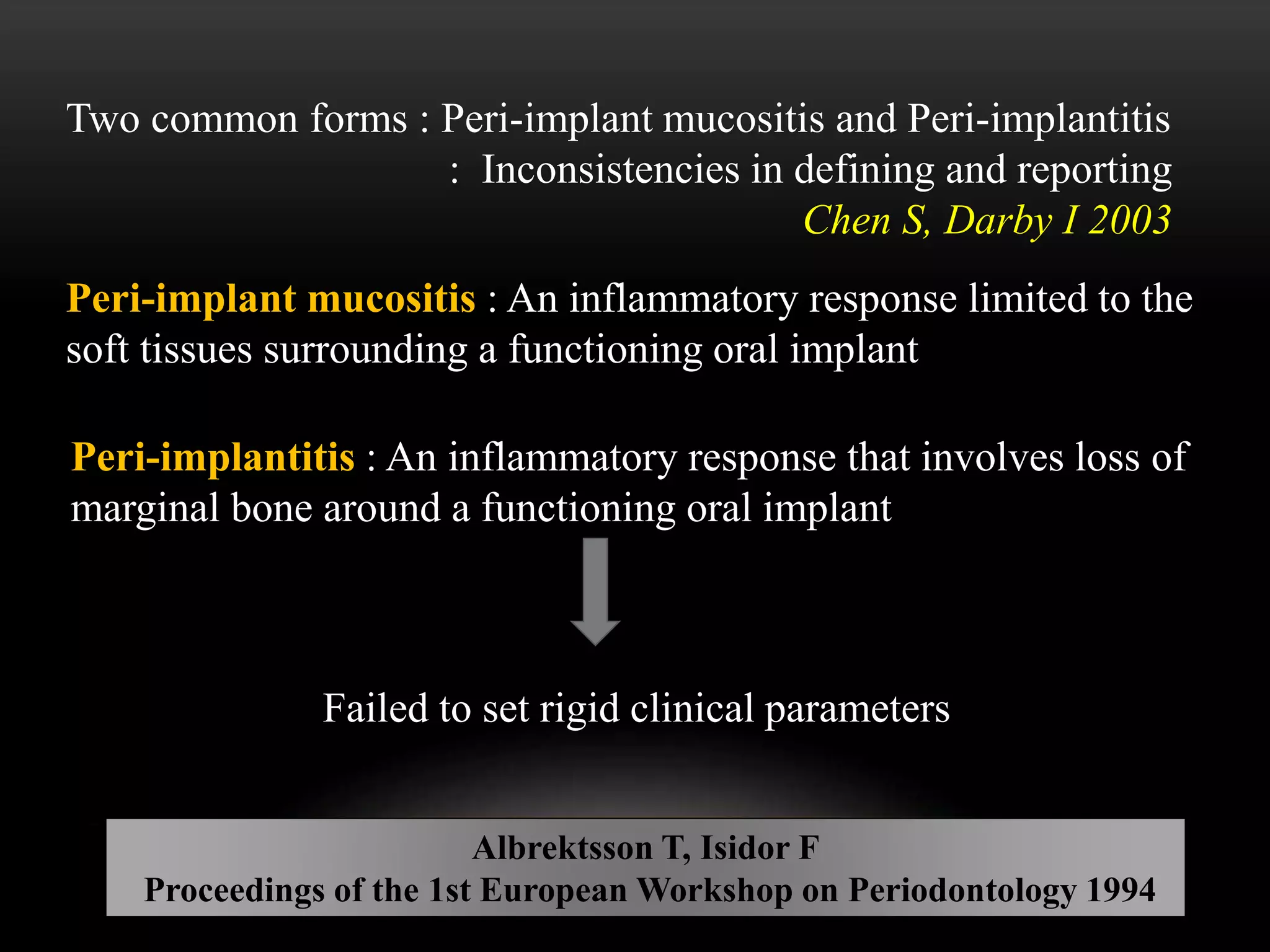
Two common forms : Peri-implant mucositis and Peri-implantitis
: Inconsistencies in defining and reporting
Chen S, Darby I 2003
Peri-implant mucositis : An inflammatory response limited to the
soft tissues surrounding a functioning oral implant
Peri-implantitis : An inflammatory response that involves loss of
marginal bone around a functioning oral implant
Failed to set rigid clinical parameters
Albrektsson T, Isidor F
Proceedings of the 1st European Workshop on Periodontology 1994
3rd International Team for Implantology (ITI) Consensus
Conference
Similar definitions, and additional diagnostic parameters for
periimplantitis
Peri-implant sulcular fluid analysis was also
included as a diagnostic aid for peri-implantitis
Plaque
Suppuration
Bleeding on probing (BOP)
Probing depth (PD) > 5 mm
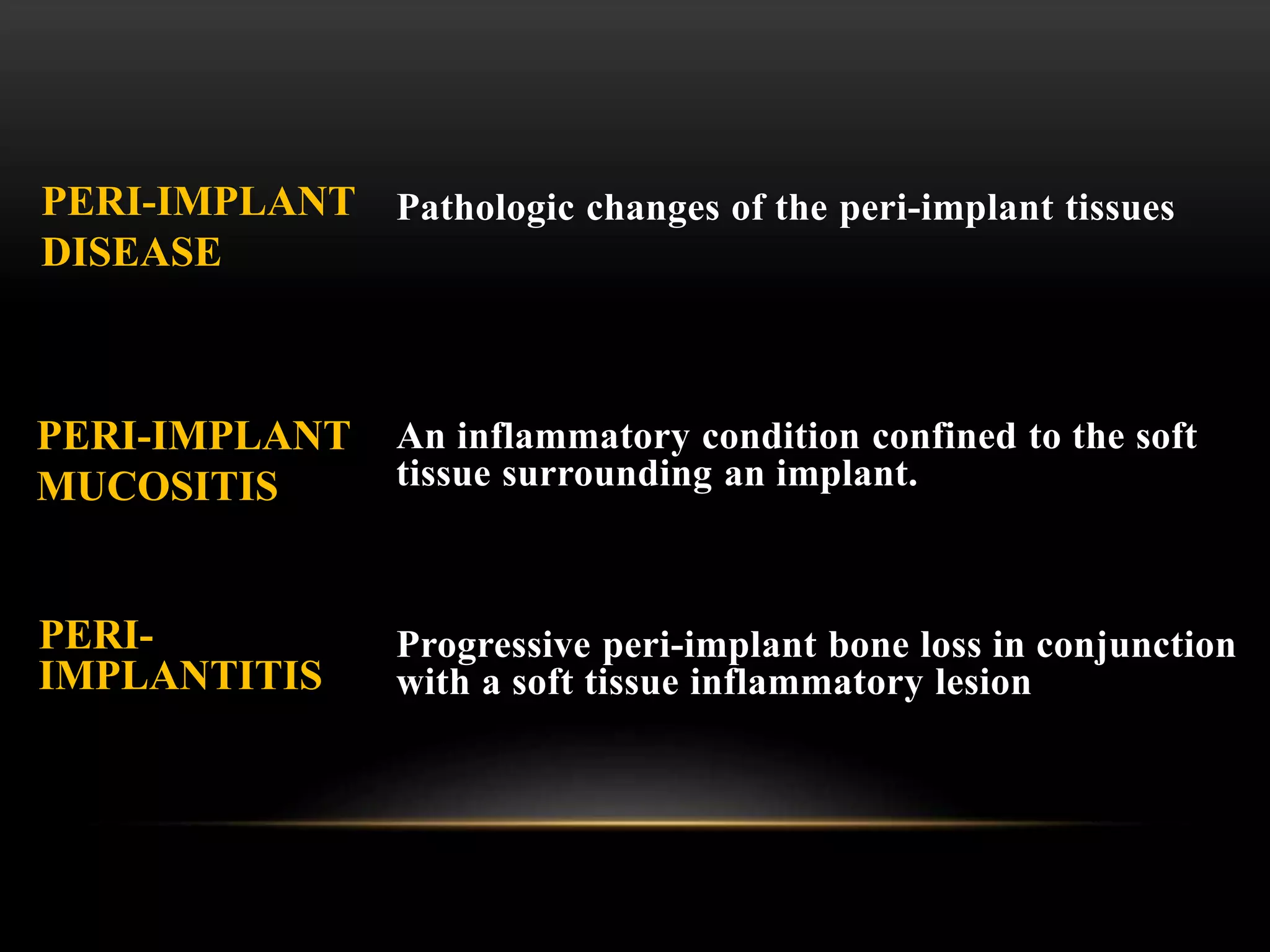
Pathologic changes of the peri-implant tissues
An inflammatory condition confined to the soft
tissue surrounding an implant.
Progressive peri-implant bone loss in conjunction
with a soft tissue inflammatory lesion
PERI-IMPLANT
DISEASE
PERI-IMPLANT
MUCOSITIS
PERI-
IMPLANTITIS
Definition:
Destructive inflammatory process affecting the soft and hard
tissues around osseointegrated implants, leading to the
formation of a peri-implant pocket and loss of supporting bone
The term peri-implantitis was introduced in the 1987
(Mombelli A,1987)
PERI- IMPLANTITIS
1st European workshop on periodontology,
Ittingen, Switzerland, 1993
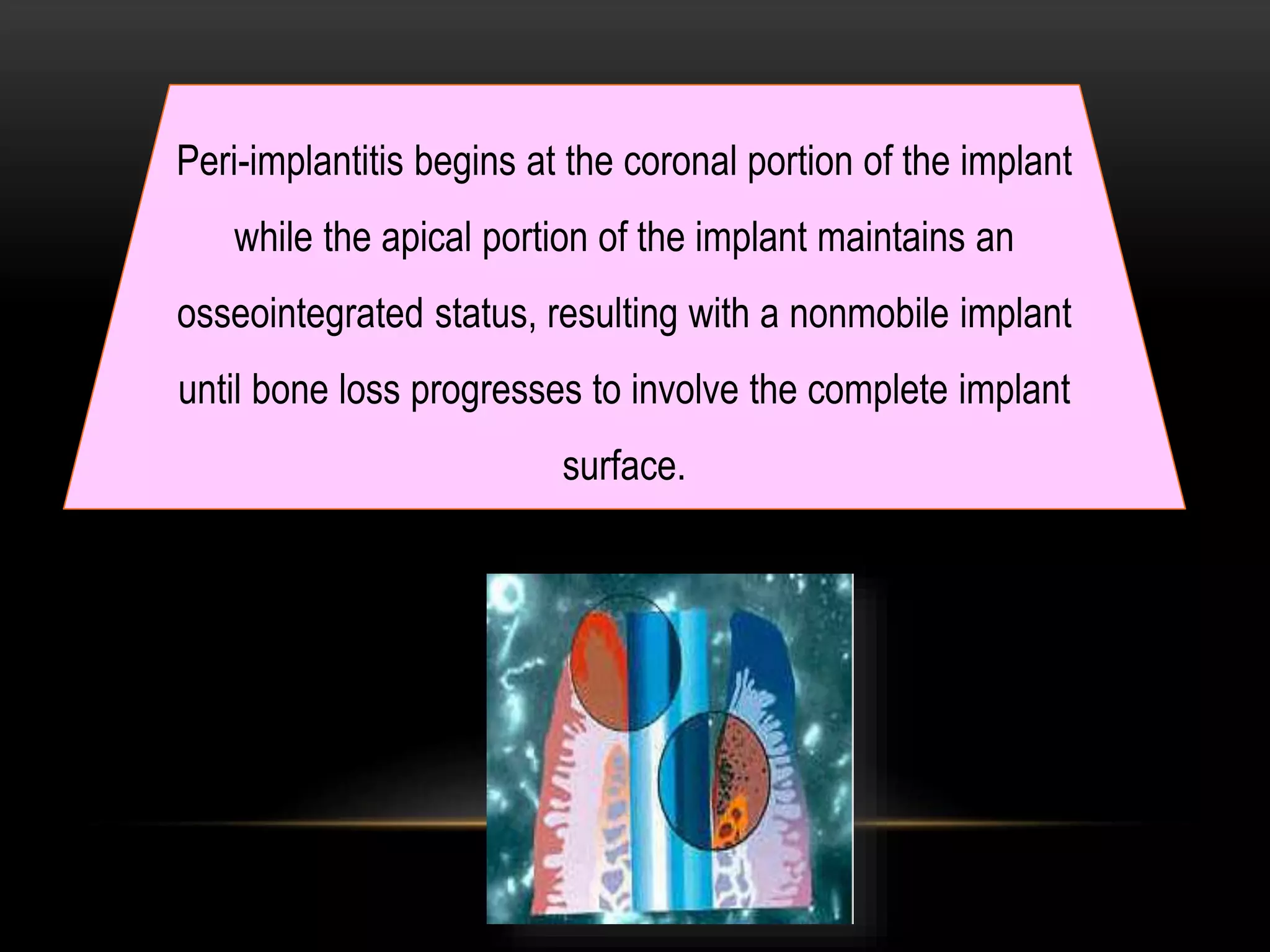
Peri-implantitis begins at the coronal portion of the implant
while the apical portion of the implant maintains an
osseointegrated status, resulting with a nonmobile implant
until bone loss progresses to involve the complete implant
surface.
• McAllister et al. in 1992 : Reported an entity separate
from peri-implantitis as retrograde peri-implantitis (RPI).
“Clinically symptomatic peri-apical lesion that develops
within the first few months after implant insertion while the
coronal portion of the implant sustains a normal bone to
implant interface.’’
EPIDEMIOLOGY
• Prevalence (5–10 year period) : 9.6%of implants
: 18.8 % of patients
• Retrograde periimplantitis: <1% to 9.9%.
• Affected by smoking, poor oral hygiene, and a history of
periodontitis
• Wide range of reported prevalence values 
Differences in the definition of peri-implantitis.
CLASSIFICATION
I. Jovanovic & Klinge 1990, Spiekermann 1991 :
On the basis of:
• Clinical status of peri-implant bone.
• Required therapy
A new approach for treating periimplantitis: reversibility of osseointegration
CLASS I
Slight horizontal bone loss with minimal peri-implant defect
CLASS II
Moderate horizontal bone loss with isolated vertical defect
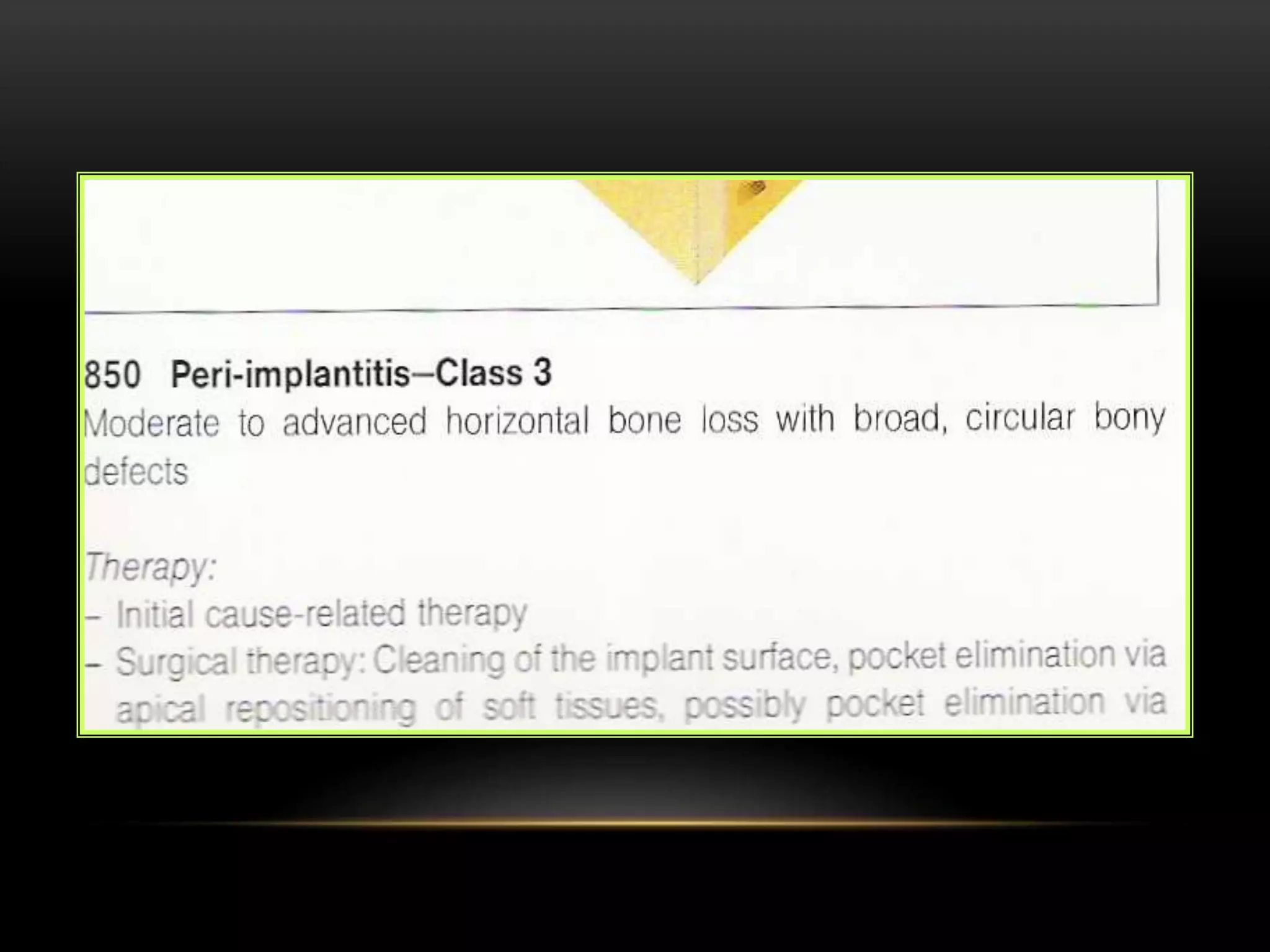
CLASS III
Moderate to advanced horizontal bone loss with broad,
circular bony defect
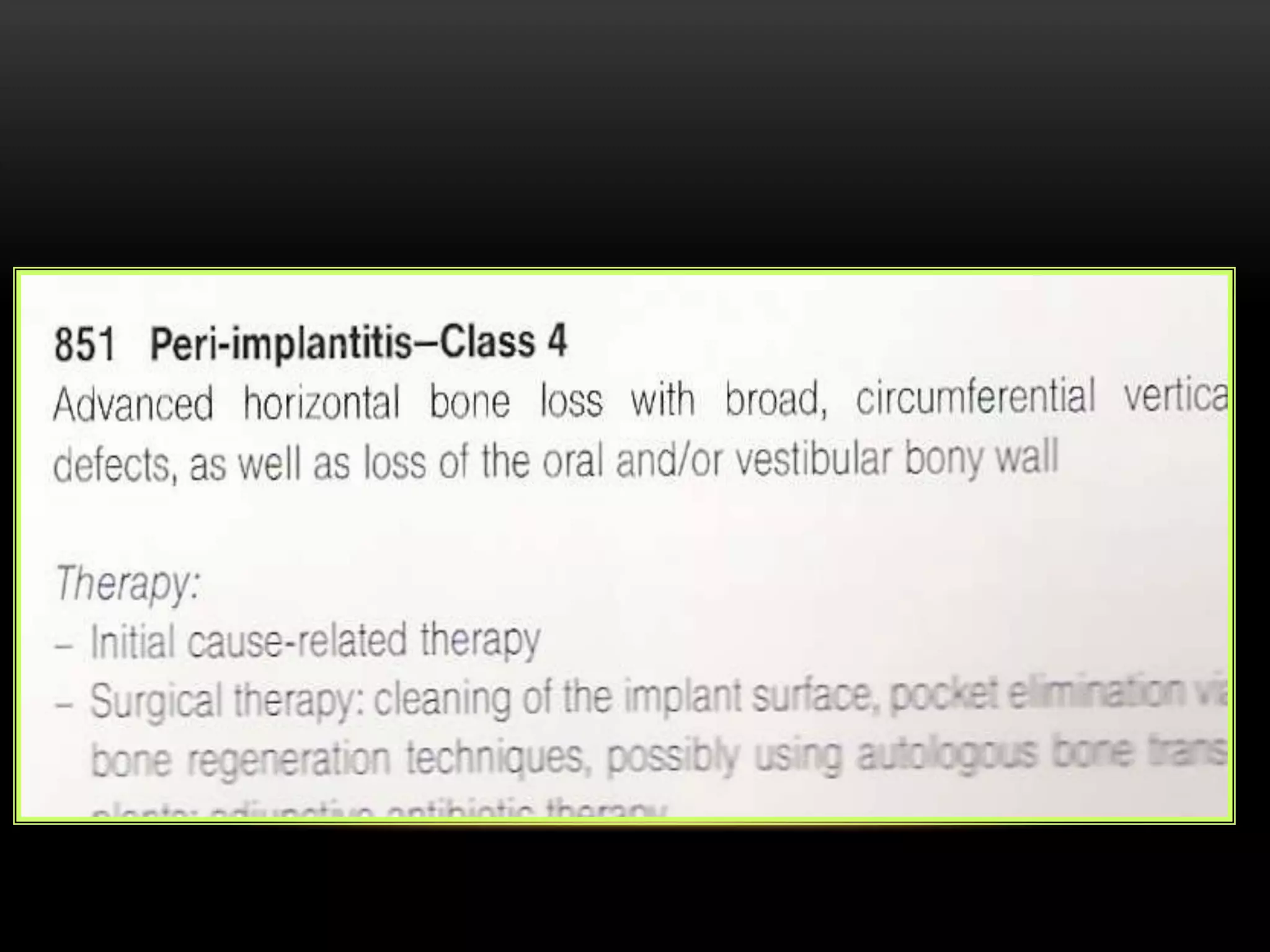
CLASS IV
Advanced horizontal bone loss with broad, circumferential
vertical defects as well as loss of the oral or vestibular bony
wall.
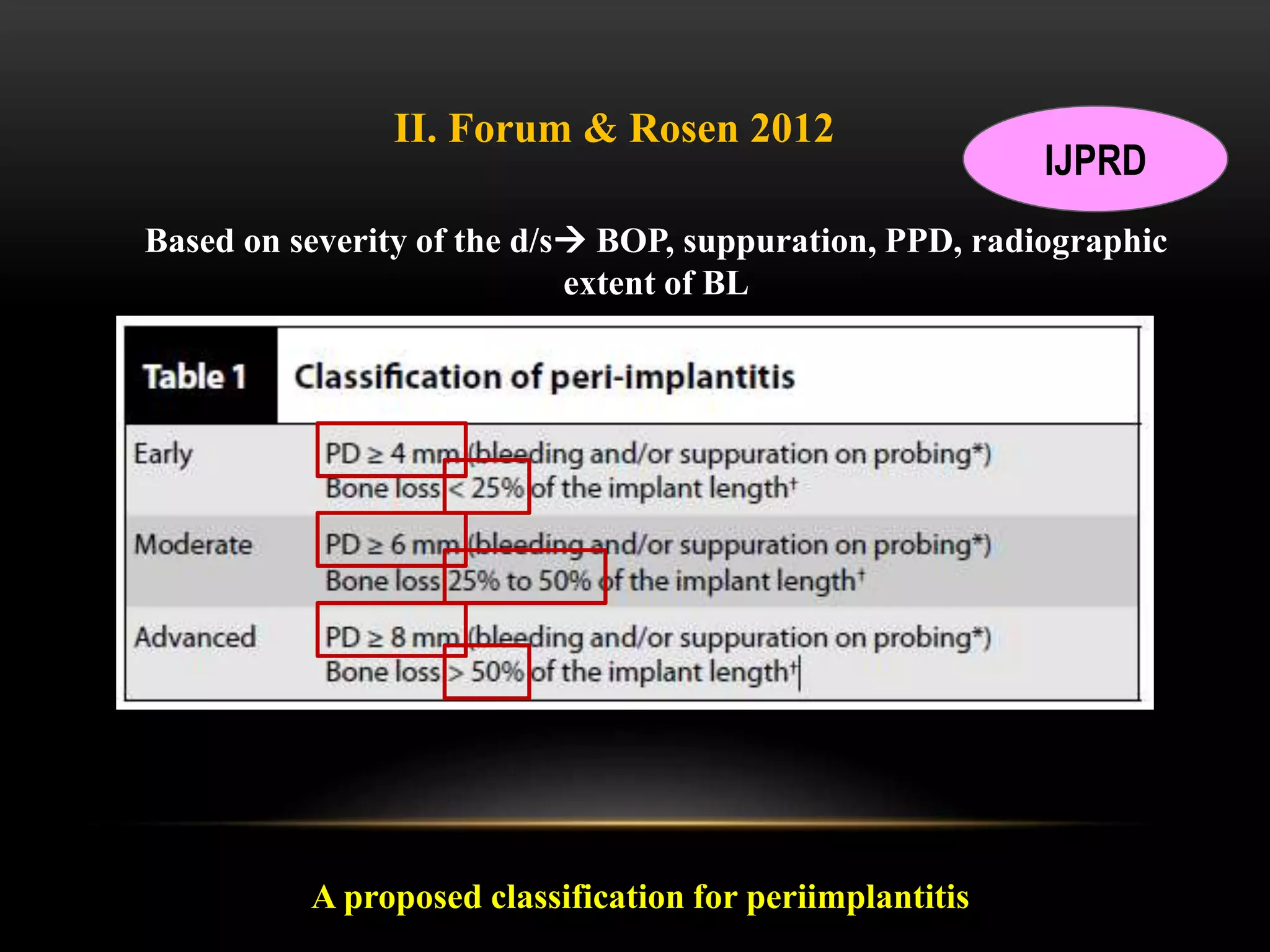
II. Forum & Rosen 2012
IJPRD
Based on severity of the d/s BOP, suppuration, PPD, radiographic
extent of BL
A proposed classification for periimplantitis
Periimplant
mucositis
periimplantitis
Renvert &
Claffey
III.
GRADE
0,I,II,III
Treatment of periimplant diseases: a review of literature & protocol proposal,
Dent Update J, 2013
According to causative factor & degree of soft &
hard tissue loss
Dr H Ryan Kazemi
2012
Periimplantitis class I
• Similar to mucositis
Periimplantitis class II
• Similar to implantitis
IV.
The painful dental implant
V. Carl E Misch & Jon B Suzuki 2014
J Korean Assoc Oral Maxillofac Surg
GROUP MANAGEMENT CLINICAL CONDITION
I. SUCCESS
(Optimum group health)
• Normal • No pain, No mobility, No exudate
• <2mm BL
• <5mm PD
II. SURVIVAL (Satisfactory health) • Reduction of stress
• More maintenance
• Yearly RGs
• OH Reinforcement
• No pain, No mobility, No exudate
• 2-4mm BL
• 5-7 mm PD (stable)
III. SURVIVAL (Compromised
health)
• Reduction of stress
• Drug therapy
• Surgical reentery
• Change in prosthesis/implants
• No pain, No mobility
• Possible exudate
• >4mm BL
• >7 mm PD
IV. FAILURE (Clinical/absolute
failure)
• Removal • Pain
• Mobility
• Uncontrolled exudate
• >50% BL
Comparison of the reproducibility of results of a new periimplant assessment
system (implant success index) with Misch classification
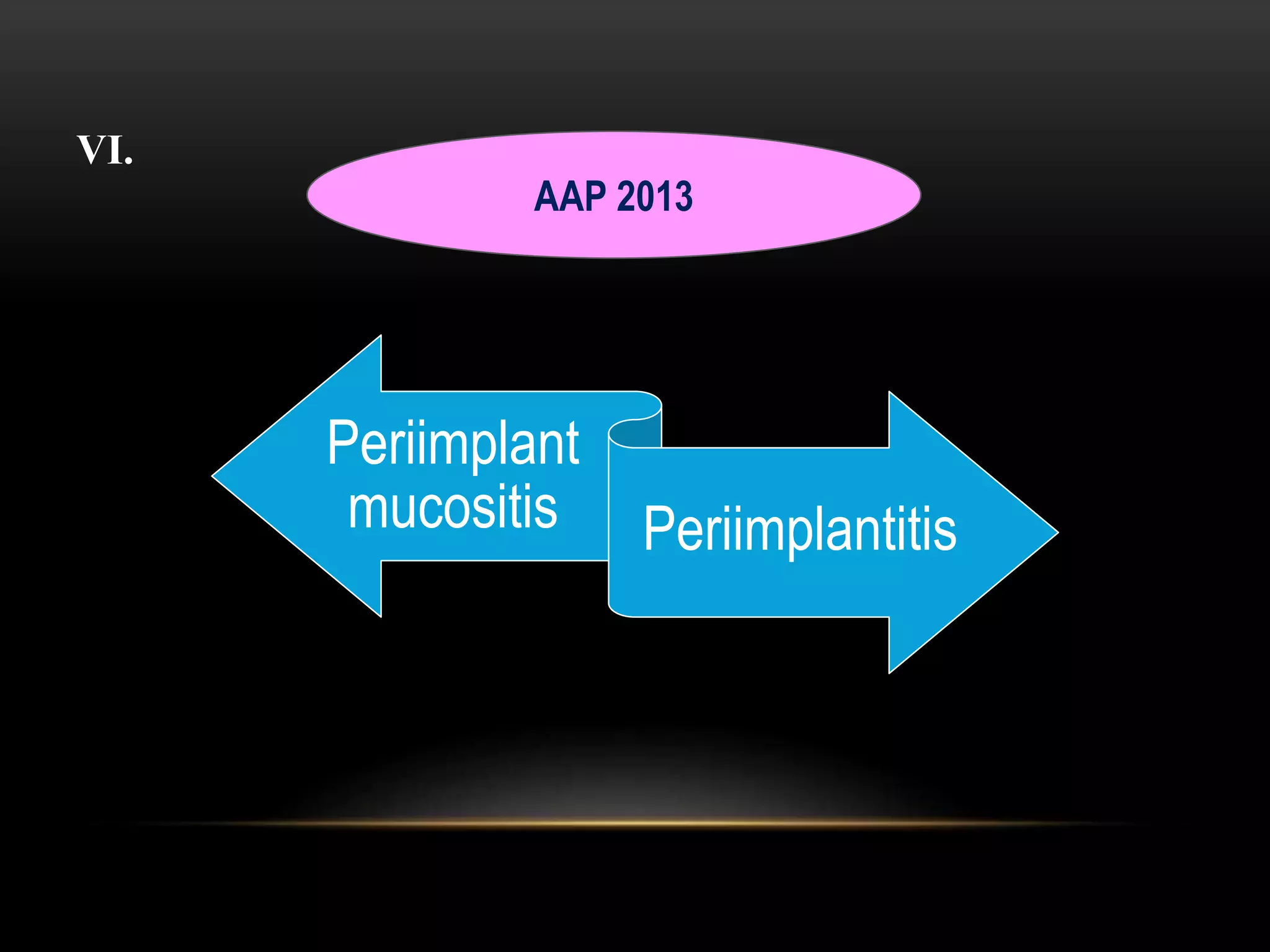
AAP 2013
Periimplant
mucositis Periimplantitis
VI.
VII.
Ata Ali et al
A classification proposed for periimplant mucositis &
periimplantitis: a critical update, The Open Dentistry J, 2015
VIII. Newman 1992:
• Subclassification of non-successful implants
• Based on severity of peri-implantitis
Compromised successful implant : Inflammation,
hyperplasia, and fistula formation occur near an otherwise
fully osseointegrated implant.
Failing implant : The implant is characterized by
progressive bone resorption, but remains functional.
Failed implant : Infection persist around an implant whose
function is compromise
RETROGRADE PERIIMPLANTITIS
IX. Reiser & Nevins (1995)
• Inactive lesions
• Infected lesions (active)
X. Sussman HI (1998)
• Type 1: Implant to tooth
• Type 2 :Tooth to implant
32
occurs during osteotomy preparation
either by direct trauma or through
indirect damage, which causes the
adjacent pulp to undergo devitalization
occurs shortly after the placement of the implant when an
adjacent tooth develops a periapical pathology, either by
operative damage to the pulp or through reactivation of a
prior apical lesion
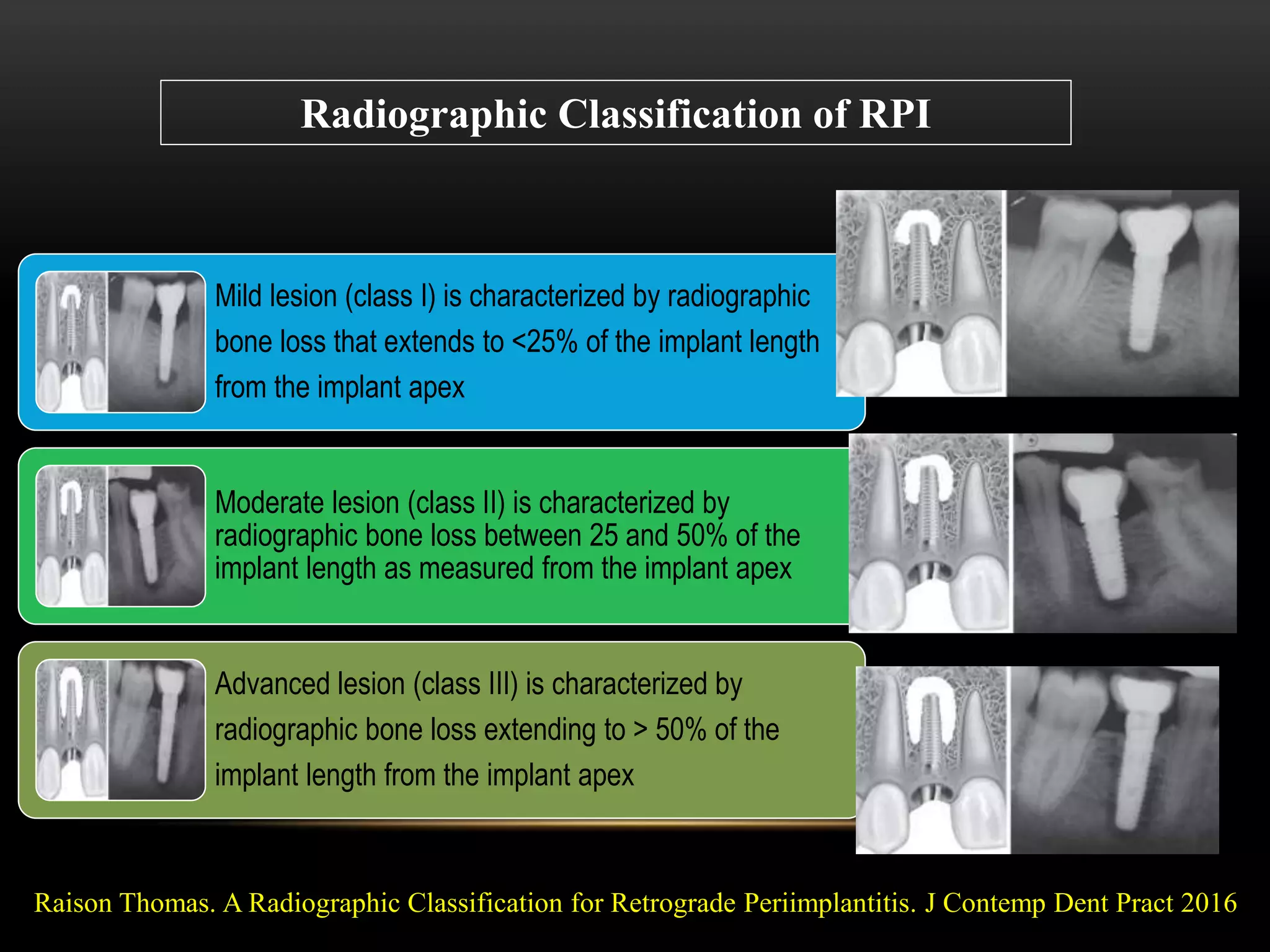
Radiographic Classification of RPI
Mild lesion (class I) is characterized by radiographic
bone loss that extends to <25% of the implant length
from the implant apex
Moderate lesion (class II) is characterized by
radiographic bone loss between 25 and 50% of the
implant length as measured from the implant apex
Advanced lesion (class III) is characterized by
radiographic bone loss extending to > 50% of the
implant length from the implant apex
Raison Thomas. A Radiographic Classification for Retrograde Periimplantitis. J Contemp Dent Pract 2016
ETIOLOGY
I. Bacterial infection ( “plaque theory”)
II. Biomechanical overload ( “loading theory”)
Newman et al 1988,1992 & Quirynen et al 1992
SUBGINGIVAL MICROBIOLOGY AND
DENTAL IMPLANTS
In good oral health, teeth and implants have similar microflora
with streptococci and nonmobile rods predominating
Apse et al 1989, Lekholm et al 1986, Mombelli et al 1987,
Mombelli and Mericske –Stern, 1990, Newman and Flemming
1985, Palmisano et al 1991, Quirynen and Listgarten 1990
The same groups of recognized periodontopathogens are involved in
periodontal diseases and in periimplantitis or infectous failure of implants
Apse et al 1989, Becker et al 1990, Mombelli et al 1987, Nakou et
al 1987, Newman and Flemming 1988, Rosenberg et al 1991
Commonly found microflora:
A. actinomycetemcomitans
P. gingivalis
T. forsythia
P. intermedia
C. rectus
Other:
P. aerugenosa
Enterobacteriaceae
C. albicans
Staphylococci sp
 Peri-implant microflora is established shortly after implant
placement.
 Successful implants experience no shifts in microbial
composition over time.
(Bower et al 1989; Mombelli et al 1990)
 Induction of peri-implantitis by placement of plaque retentive
ligatures in animals
(Lindhe et al 1992; Lang et al 1993)
 Therapy aimed at a reduction of the peri-implant microflora
improves clinical conditions
(Ericsson et al 1996; Mombelli et al 1992)
EVIDENCE FOR A BACTERIAL CAUSE OF
PERIIMPLANTITIS
II. BIOMECHANICAL OVERLOAD:
Excessive biomechanical forces may lead to high stress or
microfractures in the coronal bone-to-implant contact and thus
lead to loss of osseointegration around the neck of the implant.
Likely to increase in four clinical situations.
1. Poor quality bone.
2. Incorrect implant’s position or number
3. Patient with heavy occlusal function
(Parafunction)
4. Prosthetic superstructure does not fit the implants
precisely.
Consensus statement: Occlusal overload
Third EAO Consensus Conference 2012
• Overload > 3000 micro strain
• Response depend on peri-implant tissue health
• Healthy peri-implant tissues : No loss /gain of bone mass
• Inflamed : Increased marginal bone resorption occurs
• Non-physiological loading : Bone/implant loss.
OTHER ETIOLOGIC FACTORS
1. Patient related factors
• Systemic diseases
• Social factors
• Para functional habits
• Inadequate amount of host bone resulting in an exposed implant
surface at the time of placement
Quirynen M et al 1993
2. Iatrogenic factors
e.g. Traumatic surgical techniques
Lack of primary stability
Premature loading during the healing period
Quirynen M et al 1993
45
• Unclear (paucity of information)
• May be attribute to:
 Implant surface contamination
 Residual bacteria in the implant site
 Presence of adjacent endodontic lesions
 Residual root particles or foreign bodies
Etiology: Retrograde periimplantitis
• Violation of minimal distance from adjacent teeth
• Surgical drilling beyond the length of the implant
• Fenestration of vestibular bone
• Development of osteomyelitis
46
Genetic polymorphism & periimplantitis
• Association was checked to dental implant loss/ peri-
implantitis/peri-implant marginal bone loss
• IL-2, IL-6, TNF-ά, TGF-b1 genotype polymorphism: NO
association
• IL-1 A & IL-1B gene polymorphisms : SHOWN
ASSOCIATION.
• OPG, RANKL, IL-17 gene polymorphism: Shown
association in Iranian population
• No obvious association in terms of biological complications
Systemetic review : Dereka X et al 2011
POSSIBLE PATHOGENIC MECHANISMS IN
IMPLANT FAILURE
• Most important factor : Microbial plaque accumulation
• Disruption of the perimucosal and loss of peri-implant
bone, analogous to the destruction of soft and hard tissue
seen in periodontitis.
Decreased resistance to mechanical probing
Ericsson & Lindhe (1993),
2mm 0.7mm
Defense mechanism of the gingiva is more effective around teeth
than peri-implant mucosa in preventing further apical propagation
of the pocket microbiota.
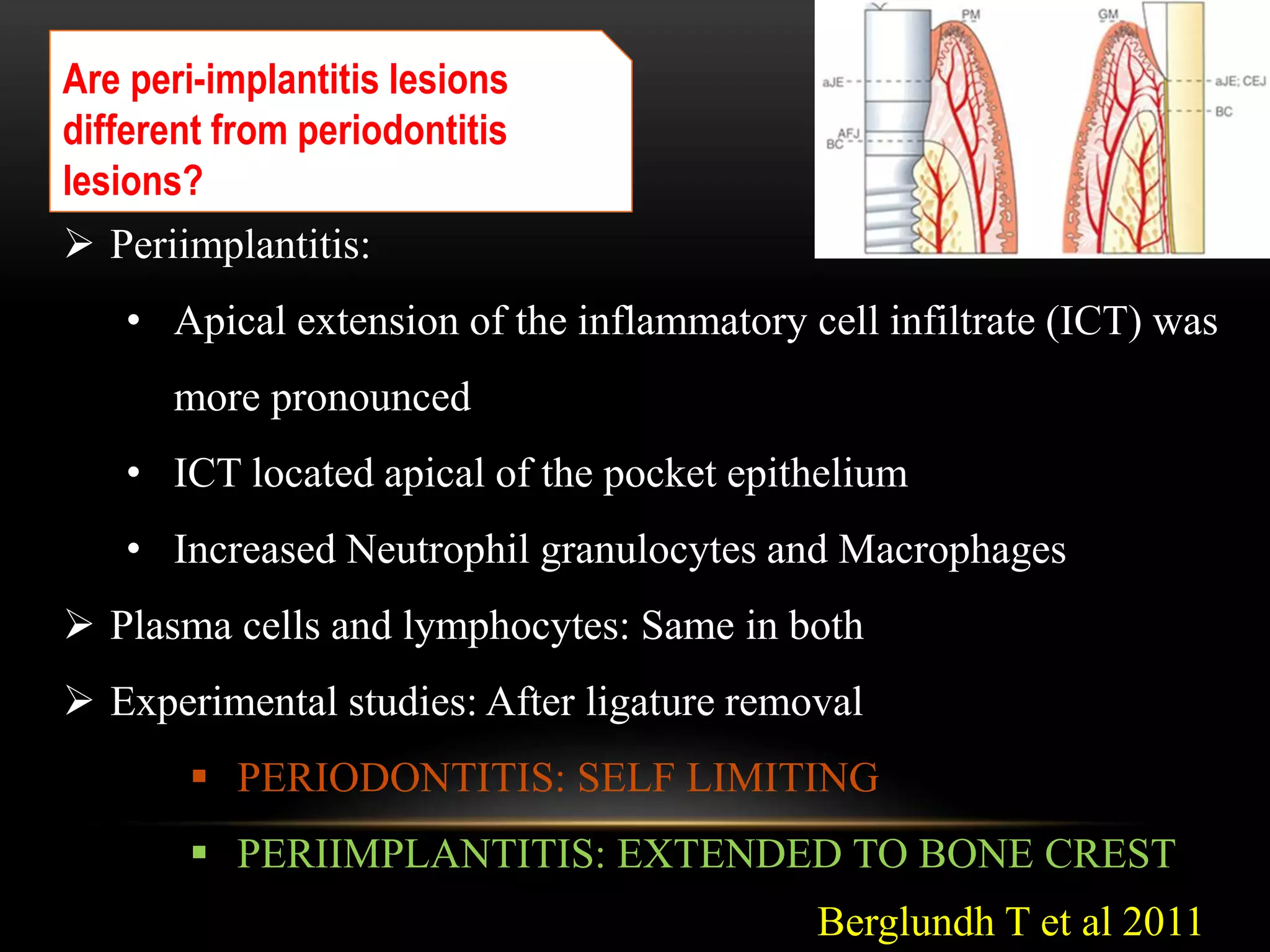
 Periimplantitis:
• Apical extension of the inflammatory cell infiltrate (ICT) was
more pronounced
• ICT located apical of the pocket epithelium
• Increased Neutrophil granulocytes and Macrophages
 Plasma cells and lymphocytes: Same in both
 Experimental studies: After ligature removal
 PERIODONTITIS: SELF LIMITING
 PERIIMPLANTITIS: EXTENDED TO BONE CREST
Are peri-implantitis lesions
different from periodontitis
lesions?
Berglundh T et al 2011
PERIIMPLANTITIS & UNTREATED PERIODONTITIS
Surviving
status
HEALTHY MODERATE SEVERE
Early
Failure
2.1% 1.3% 2%
Late
failure
0.9% 2% 3.2%
• Until 50 months: No significant effect;
• After 50 months : 8 times greater risk in severe chronic
periodontal patients.
Continuous and cumulative nature of periodontal disease
Levin L et al 2011
PERIIMPLANTITIS & TREATED PERIODONTITIS
Lisa J. A. Heitz-Mayfield 2009
3.1 to 4.7 higher risk
Survival rates > 90%
Cho-Yan Lee J et al 2012
• Better outcome in non periodontitis patient.
• Prevalence of implant with PPD ≥ 5mm+BOP
(27% vs 13%)
• Higher implant PPD : Residual pockets present
(3.18 mm vs 2.81 mm)
Karoussis I K et al 2007
• Chronic periodontitis
• No significant difference : Implant survival
• Long-term: Greater incidence, PPD, crestal bone loss
• Aggressive Periodontitis:
 Short-term prognosis : Acceptable
 Long-term prognosis: Open to question
Pjetursson B E et al 2012
Higher risk if:
• Residual pockets > 5 mm
• Reinfections occur during SPT
SUGGESTED RISK-ASSESSMENT PARAMETERS
• Responded favorably to periodontal therapy
• optimal oral hygiene
• Non-smoker
• Systemically healthy
• Low risk for periodontal disease
• Limited number of residual sites with PPD ≥ 5mm + BOP
• Oral hygiene : Not constantly optimal.
• Attempt for further pocket reduction should be considered
• Options other than dental implants
• Significant number of residual sites with with PPD ≥ 5mm
+ BOP
• Oral hygiene is suboptimal
• heavy smoker/uncontrolled type 2 diabetes.
• implant placement should be delayed
Donos N et al 2012
DIAGNOSIS
 Indices (similar to periodontal)
 Peri-implant probing
 Peri-implant probing depth (3-4mm normal)
 Bleeding after gentle probing
 Exudation & suppuration
 Mobility: Late (Insensitive)
 Pain
 Peri-implant sulcular fluid analysis
Blunt, straight plastic periodontal probe
(Automated probe or TPS probe)
 Microbial monitoring: to determine the microbial composition
of a peri-implantitis site
 Peri-implant radiography: Standardized IOPA radiographs or
OPG.
• Vertical bone loss
• Saucer shaped defect.
• Progressive bone loss : Definite indicator
IMPLANT SUCCESS CRITERIA  ALBREKTSSON 1986
Treatment: Focus: Removal of the
contaminating agent
1. Systemic antibiotics
2. Mechanical debridement
• With/without systemic antibiotic treatment
• With/without LDD & Chlorhexidine oral rinse.
• Combined with LASER decontamination
3. Surgical debridement
• With/without guided bone regeneration (GBR)
INITIAL PHASE
I. OCCLUSAL THERAPY
 When excessive forces are main etiologic factor
 Includes:
• Prosthesis design changes
• Improvement in implant number and position
• Occlusal adjustment
II. ANTI-INFECTIVE THERAPY
 Microbial etiology
 Local removal of plaque deposits (plastic instruments)
 Polishing of accessible surfaces with pumice.
 Subgingival irrigation of all peri-implant pockets
(0.2 % chlorhexidine)
 Systemic antimicrobial therapy for 10 consecutive days.
NONSURGICAL THERAPY
Indications
 Mucosal inflammation detected by clinical signs
 Radiographic bone level stable
 Phase I therapy before surgery.
Debridement / detoxification
 Plastic curettes
 Carbon fibre curettes (Calculus)
 Rubber points
 Abrasive paste
 Abrasive air
 US+ Teflon
 Titanium brush
Antiseptics
 Citric acid (40%)
 Tetracycline 5%
Antibiotics
 Metronidazole
 If GBR: Doxycycline + Ornidazole.
Disadvantage : Failed to promote the re-osseointegration of
the exposed implant sites
Schwarz F et al 2006
Other treatment modalities
• Mechanical/ultrasonic debridement with LDD
• Laser treatment with and without flap access
• Open flap debridement
• Open flap debridement with guided bone regeneration
Peri-implantitis lesions are usually well demarcated
Controlled delivery devices
Release sustained high dose of antimicrobial agents
Antimicrobial minocycline spheres
(Arestin®)
Tetracycline fibres
LOCAL DRUG DELIVERY
More improvements in probing depths compare to CHX gel
sustained for 6 months
Renvert S et al 2008
IRRADIATION WITH A SOFT LASER
Er:YAG and CO2 :
CO2 Laser:
Deppe et al 2007, Romanos & Nentwig 2008, Romanos et al 2009
Er:YAG Laser:
Schwarz et al 2011, Renvert et al 2011, Persson et al 2011
• With and without flap access
• Destruction of bacterial cells
• Plaque control measures should be adhered to reduce the effect of
plaque and associated inflammation on healing.
• Positive treatment outcomes after 6 months
• Improvements relapse after 6 months.
Nicholas Peters 2012
COMPARISON OF
ADJUNCTIVE USE OF
LDD & LASER
• Equally effective
• Complete resolution of inflammation not achieved
with either of two
Schar D et al 2013
Reduction of clinical signs of peri-implant mucosal inflammation:
Long-term RCT are needed
To assess the efficacy of non-surgical therapy on
• Progressing bone loss
• Implant survival rates
• Measures of oral health-related quality of life
Muthukuru M et al 2012
Submucosal debridement + Adjunctive local delivery of
antibiotics + Submucosal glycine powder air polishing
or Er:YAG laser treatment
Submucosal debridement using curettes +Adjunctive
irrigation with chlorhexidine.
More
effective
TREATMENT OF CHOICE:
• Smooth implant surfaces: Non-metal instruments + rubber cups.
• Rough implant surfaces: Non-metal instruments + air abrasives
• If smoothening of the surface roughness required : Metal
instruments and burs
The clinical impact of these findings requires clarification.
Systematic review: Louropoulou A et al 2011
• Peri-implant mucositis : Treated successfully.
• Peri-implantitis : Limited efficacy.
• Clinical recommendations
 Patients should be monitored regularly for
 Plaque control
 Signs of peri-implant inflammation
 A regular maintenance program for the long-term
management of peri-implantitis lesions
High
vigilance
monitoring
Consensus statement: Non-surgical intervention
Third EAO Consensus Conference 2012
SURGICAL TREATMENT OF PERI-IMPLANTITIS
PERI-IMPLANT RESECTIVE THERAPY
 Identify the type of osseous defect before deciding on the
treatment modality
 Apically displaced flap techniques and osseous resective
therapy are used to correct
• Moderate to severe Horizontal bone loss
• Moderate (<3 mm) vertical bone defects
(1and 2 wall bone defects)
• Reduce overall pocket depth.
• Implant position in unesthetic area.
SURFACE POLISHING / IMPLANTOPLASTY
(Before resection)
Objective:
• To arrest the progression of the disease.
• To achieve a maintainable site by the patient.
 Implant topography should be altered with high-speed diamond
burs and polishers to produce smooth continuous surfaces.
 Performed before any osseous resective therapy is initiated and
with profuse irrigation.
PERI-IMPLANT REGENERATIVE THERAPY
• Accomplish regeneration of lost bone tissue and re-
osseointegration
• Guided bone regeneration (GBR) and bone graft techniques
have been suggested.
Guided Bone Regeration (GBR) principle using a nonresorbable
expanded polytetrafluoroethylene membrane has been used for
healing of bone defects seen at the time of implant placement
and around failing implants.
Indications:
• Implant allows complete closure with flap
• Moderate to advanced circumferential vertical defects
• 2/3 wall bone defects
• Detoxification of implant surface possible
SUBMERGED REGENERATIVE THERAPY
Consensus statement: Surgical intervention
Third EAO Consensus Conference 2012
• Superior to non-surgical therapy: For periimplantitis
• Should include:
 Removal of the granulation tissue.
 Thorough cleaning of the contaminated surface
• Adjunctive measures : Better but variable outcomes influenced
by factors not yet fully understood.
• Regenerative or resective surgical approach: Adjunct to
mechanical instrumentation
• Regenerative : Use of a membrane does not seem to improve
the healing results
EXPLANTATION
Or
IMPLANT EXTRACTION
INDICATION
1. Suppurative exudate
2. Overt BOP
3. Severely increased peri-implant probing depth
(≥ 8mm)
5. Radiographically: Peri-implant radiolucency may be
extending far along the outline of the implant. (>half
length)
6. Mobile
7. Non surgical & surgical therapy ineffective
• Many treatment modalities available
• Implant extraction
• Peri-apical surgery (With/Without implant apex resection)
• Debridement
• Regenerative
• Local decontamination (antimicrobials/lasers)
• Antibiotics
• No conclusive evidence to advocate any specific treatment
approach
Treatment : Retrograde Periimplantitis
Nevins M et al 1996
Decision tree for management of periimplantitis
Kozue Okayasu & Hom-Lay Wang 2011
MAINTENANCE
After surgical intervention, all patients are placed on a close
recall schedule; maintenance visits every 3 months are
advised as a minimum. This allows for monitoring of
plaque, levels, soft tissue inflammation, and changes in the
level of the bone
• Train patient for self-performed plaque control with individually
designed professional supportive care program
• Professional plaque-control measures (every 3–6 month)
• Clinical examinations every 3, 6 or 12 months depending on severity
• Radiographic documentation
(Implant placement, post prosthetic, every 1 year)
• High BOP scores PPD > 5 mm : Radiographic examination
No evidence available to suggest the frequency of recall
intervals or to propose specific hygiene regimes
SUPPORTIVE PERIODONTAL THERAPY RECOMMENDATION
Donos N et al 2012
CIST PROTOCOL
• Protocol of therapeutic measures
• Depend on the clinical and the radiographic diagnosis
• Diagnosis : Key characteristic
• Cumulative in nature
Not a single procedures, rather a sequence of therapeutic
procedures with increasing antibacterial potential,
depending on the severity and extent of the lesion.
• Four steps
Lang et al 2004
CLINICAL PARAMETERS USED
• Dental plaque : ±
• Bleeding on gentle probing : ±
• Suppuration : ±
• Periimplant probing depth
• Radiographic evidence of bone loss.
CLINICALLY STABLE
(Not currently at risk for peri-implant disease)
• No evidence of plaque or calculus adjacent to healthy
peri-implant tissues
• Absence of BOP
• Absence of suppuration
• Probing depth < 3–4 mm
Revaluate Annually
Decision tree for CIST
Lang & Lindhe 2008
MECHANICAL DEBRIDEMENT
(Supportive therapy protocol A)
Instruments:
• Plaque : Polishing ( rubber cups and polishing paste)
• Calculus : Carbon-fiber curettes
• Conventional steel curettes or ultrasonic instruments with
metal tips : Avoided
• Leave marked damage on the implant surface conducive to
future plaque accumulation
Chlorhexidine digluconate:
• Daily rinse of 0.1%, 0.12%, or
0.2%
• Gel applied to the site of desired
action.
• 3–4 weeks of regular use necessary
ANTISEPTIC TREATMENT
(Supportive therapy protocol B)
ANTIBIOTIC TREATMENT
(Supportive therapy protocol C)
• To eliminate or reduce the pathogens
• Done in last 10 days of the antiseptic treatment
(Metronidazole 350 mg TID or Ornidazole 500 mg BD)
• Prophylactic procedures instituted to prevent reinfection
• Local antibiotics application:
1. Tetracycline periodontal fibers
2. Microspheres containing minocycline hyclate
REGENERATIVE OR RESECTIVE THERAPY
(Supportive Therapy protocol D)
Done to accomplish regeneration of lost bone tissue and re-
osseointegration
REOSSEOINTEGRATION : Growth of new bone in direct
contact to the previously contaminated implant surface without
an intervening band of organized connective tissue.
CONCLUSION:
• Patient should be informed in detail about the possibility of
developing inflammation and infection around implants.
• Informed consent should include need of maintenance
therapy
• Oral hygiene practices should be given along with an
organized maintenance recall care system on a regular basis
(at least once a year).
• Prophylactic measures should be intervened if mucositis
(bleeding) is noted around the implant.
• View a pocket with a probing depth of 6 mm as an
ecologic niche harboring anaerobic bacteria and should be
treated.
• CIST protocol should be followed.
• Optimal oral hygiene standards should be maintained for
peri-implantitis therapy.
REFERENCES
• Clinical Periodontology – Carranzas 10th ed
• Clinical Periodontology & Implant Dentistry, Jan Lindhe
4th ed
• Contemporary Implant Dentistry, Carl Misch
• Antibiotics in treatment of periimplantitis, Quintescence
Int 2012
• A proposed classification for periimplantitis, IJPRD 2012
• Perio 2000, vol 53, 2010
• Therapy of periimplantitis: a systematic review, Int J Oral
Maxillofac Implants 2014
• Ata-Ali et al, A Classification Proposal for Peri-Implant
Mucositis and Peri-Implantitis: A Critical Update, The
Open Dentistry Journal, 2015, 9, 393-395.
• Eduardo Anitua , A New Approach for Treating Peri-
Implantitis: Reversibility of Osseointegration.
• Raison Thomas, A Radiographic Classification for
Retrograde Peri-implantitis, J Contemp Dent Pract
2016;17(4):313-321.
Periimplantitis

Periimplantitis

  • 2.
  • 3.
    CONTENTS • Introduction • Epidemiology •Classification of Periimplant Diseases • Etiology • Possible Pathogenic Mechanisms • Genetic polymorphism & periimplantitis • Periodontitis & Periimplantitis • Diagnosis of Periimplantitis • Treatment of periimplantitis • Conclusion • References
  • 4.
    • Use ofimplants has developed significantly during the past two decades • Widely accepted treatment modality of high success and predictability
  • 5.
    • Despite thehigh success and survival rates of oral implants, failures do occur and implant-supported prosthesis may require a substantial periodontal and prosthodontic maintenance over time
  • 6.
    Implant failure: Traditionallydescribed as early or late: Early failures: Prior to implant loading : Surgical, implant or host-related factors Late failures: After prosthodontic rehabilitation : Peri-implant disease or biomechanical overload Bone loss around the implant Loss of osseointegration Esposito M et al 1998
  • 7.
    Two common forms: Peri-implant mucositis and Peri-implantitis : Inconsistencies in defining and reporting Chen S, Darby I 2003 Peri-implant mucositis : An inflammatory response limited to the soft tissues surrounding a functioning oral implant Peri-implantitis : An inflammatory response that involves loss of marginal bone around a functioning oral implant Failed to set rigid clinical parameters Albrektsson T, Isidor F Proceedings of the 1st European Workshop on Periodontology 1994
  • 8.
    3rd International Teamfor Implantology (ITI) Consensus Conference Similar definitions, and additional diagnostic parameters for periimplantitis Peri-implant sulcular fluid analysis was also included as a diagnostic aid for peri-implantitis Plaque Suppuration Bleeding on probing (BOP) Probing depth (PD) > 5 mm
  • 9.
    Pathologic changes ofthe peri-implant tissues An inflammatory condition confined to the soft tissue surrounding an implant. Progressive peri-implant bone loss in conjunction with a soft tissue inflammatory lesion PERI-IMPLANT DISEASE PERI-IMPLANT MUCOSITIS PERI- IMPLANTITIS
  • 10.
    Definition: Destructive inflammatory processaffecting the soft and hard tissues around osseointegrated implants, leading to the formation of a peri-implant pocket and loss of supporting bone The term peri-implantitis was introduced in the 1987 (Mombelli A,1987) PERI- IMPLANTITIS 1st European workshop on periodontology, Ittingen, Switzerland, 1993
  • 11.
    Peri-implantitis begins atthe coronal portion of the implant while the apical portion of the implant maintains an osseointegrated status, resulting with a nonmobile implant until bone loss progresses to involve the complete implant surface.
  • 12.
    • McAllister etal. in 1992 : Reported an entity separate from peri-implantitis as retrograde peri-implantitis (RPI). “Clinically symptomatic peri-apical lesion that develops within the first few months after implant insertion while the coronal portion of the implant sustains a normal bone to implant interface.’’
  • 13.
    EPIDEMIOLOGY • Prevalence (5–10year period) : 9.6%of implants : 18.8 % of patients • Retrograde periimplantitis: <1% to 9.9%. • Affected by smoking, poor oral hygiene, and a history of periodontitis • Wide range of reported prevalence values  Differences in the definition of peri-implantitis.
  • 14.
    CLASSIFICATION I. Jovanovic &Klinge 1990, Spiekermann 1991 : On the basis of: • Clinical status of peri-implant bone. • Required therapy A new approach for treating periimplantitis: reversibility of osseointegration
  • 15.
    CLASS I Slight horizontalbone loss with minimal peri-implant defect
  • 17.
    CLASS II Moderate horizontalbone loss with isolated vertical defect
  • 19.
    CLASS III Moderate toadvanced horizontal bone loss with broad, circular bony defect
  • 21.
    CLASS IV Advanced horizontalbone loss with broad, circumferential vertical defects as well as loss of the oral or vestibular bony wall.
  • 23.
    II. Forum &Rosen 2012 IJPRD Based on severity of the d/s BOP, suppuration, PPD, radiographic extent of BL A proposed classification for periimplantitis
  • 24.
    Periimplant mucositis periimplantitis Renvert & Claffey III. GRADE 0,I,II,III Treatment ofperiimplant diseases: a review of literature & protocol proposal, Dent Update J, 2013
  • 26.
    According to causativefactor & degree of soft & hard tissue loss Dr H Ryan Kazemi 2012 Periimplantitis class I • Similar to mucositis Periimplantitis class II • Similar to implantitis IV. The painful dental implant
  • 27.
    V. Carl EMisch & Jon B Suzuki 2014 J Korean Assoc Oral Maxillofac Surg GROUP MANAGEMENT CLINICAL CONDITION I. SUCCESS (Optimum group health) • Normal • No pain, No mobility, No exudate • <2mm BL • <5mm PD II. SURVIVAL (Satisfactory health) • Reduction of stress • More maintenance • Yearly RGs • OH Reinforcement • No pain, No mobility, No exudate • 2-4mm BL • 5-7 mm PD (stable) III. SURVIVAL (Compromised health) • Reduction of stress • Drug therapy • Surgical reentery • Change in prosthesis/implants • No pain, No mobility • Possible exudate • >4mm BL • >7 mm PD IV. FAILURE (Clinical/absolute failure) • Removal • Pain • Mobility • Uncontrolled exudate • >50% BL Comparison of the reproducibility of results of a new periimplant assessment system (implant success index) with Misch classification
  • 28.
  • 29.
    VII. Ata Ali etal A classification proposed for periimplant mucositis & periimplantitis: a critical update, The Open Dentistry J, 2015
  • 30.
    VIII. Newman 1992: •Subclassification of non-successful implants • Based on severity of peri-implantitis Compromised successful implant : Inflammation, hyperplasia, and fistula formation occur near an otherwise fully osseointegrated implant. Failing implant : The implant is characterized by progressive bone resorption, but remains functional. Failed implant : Infection persist around an implant whose function is compromise
  • 31.
    RETROGRADE PERIIMPLANTITIS IX. Reiser& Nevins (1995) • Inactive lesions • Infected lesions (active) X. Sussman HI (1998) • Type 1: Implant to tooth • Type 2 :Tooth to implant 32 occurs during osteotomy preparation either by direct trauma or through indirect damage, which causes the adjacent pulp to undergo devitalization occurs shortly after the placement of the implant when an adjacent tooth develops a periapical pathology, either by operative damage to the pulp or through reactivation of a prior apical lesion
  • 32.
    Radiographic Classification ofRPI Mild lesion (class I) is characterized by radiographic bone loss that extends to <25% of the implant length from the implant apex Moderate lesion (class II) is characterized by radiographic bone loss between 25 and 50% of the implant length as measured from the implant apex Advanced lesion (class III) is characterized by radiographic bone loss extending to > 50% of the implant length from the implant apex Raison Thomas. A Radiographic Classification for Retrograde Periimplantitis. J Contemp Dent Pract 2016
  • 33.
    ETIOLOGY I. Bacterial infection( “plaque theory”) II. Biomechanical overload ( “loading theory”) Newman et al 1988,1992 & Quirynen et al 1992
  • 34.
    SUBGINGIVAL MICROBIOLOGY AND DENTALIMPLANTS In good oral health, teeth and implants have similar microflora with streptococci and nonmobile rods predominating Apse et al 1989, Lekholm et al 1986, Mombelli et al 1987, Mombelli and Mericske –Stern, 1990, Newman and Flemming 1985, Palmisano et al 1991, Quirynen and Listgarten 1990 The same groups of recognized periodontopathogens are involved in periodontal diseases and in periimplantitis or infectous failure of implants Apse et al 1989, Becker et al 1990, Mombelli et al 1987, Nakou et al 1987, Newman and Flemming 1988, Rosenberg et al 1991
  • 35.
    Commonly found microflora: A.actinomycetemcomitans P. gingivalis T. forsythia P. intermedia C. rectus Other: P. aerugenosa Enterobacteriaceae C. albicans Staphylococci sp
  • 37.
     Peri-implant microflorais established shortly after implant placement.  Successful implants experience no shifts in microbial composition over time. (Bower et al 1989; Mombelli et al 1990)  Induction of peri-implantitis by placement of plaque retentive ligatures in animals (Lindhe et al 1992; Lang et al 1993)  Therapy aimed at a reduction of the peri-implant microflora improves clinical conditions (Ericsson et al 1996; Mombelli et al 1992) EVIDENCE FOR A BACTERIAL CAUSE OF PERIIMPLANTITIS
  • 38.
    II. BIOMECHANICAL OVERLOAD: Excessivebiomechanical forces may lead to high stress or microfractures in the coronal bone-to-implant contact and thus lead to loss of osseointegration around the neck of the implant.
  • 39.
    Likely to increasein four clinical situations. 1. Poor quality bone. 2. Incorrect implant’s position or number 3. Patient with heavy occlusal function (Parafunction) 4. Prosthetic superstructure does not fit the implants precisely.
  • 40.
    Consensus statement: Occlusaloverload Third EAO Consensus Conference 2012 • Overload > 3000 micro strain • Response depend on peri-implant tissue health • Healthy peri-implant tissues : No loss /gain of bone mass • Inflamed : Increased marginal bone resorption occurs • Non-physiological loading : Bone/implant loss.
  • 41.
    OTHER ETIOLOGIC FACTORS 1.Patient related factors • Systemic diseases • Social factors • Para functional habits • Inadequate amount of host bone resulting in an exposed implant surface at the time of placement Quirynen M et al 1993
  • 42.
    2. Iatrogenic factors e.g.Traumatic surgical techniques Lack of primary stability Premature loading during the healing period Quirynen M et al 1993
  • 43.
    45 • Unclear (paucityof information) • May be attribute to:  Implant surface contamination  Residual bacteria in the implant site  Presence of adjacent endodontic lesions  Residual root particles or foreign bodies Etiology: Retrograde periimplantitis
  • 44.
    • Violation ofminimal distance from adjacent teeth • Surgical drilling beyond the length of the implant • Fenestration of vestibular bone • Development of osteomyelitis 46
  • 45.
    Genetic polymorphism &periimplantitis • Association was checked to dental implant loss/ peri- implantitis/peri-implant marginal bone loss • IL-2, IL-6, TNF-ά, TGF-b1 genotype polymorphism: NO association • IL-1 A & IL-1B gene polymorphisms : SHOWN ASSOCIATION. • OPG, RANKL, IL-17 gene polymorphism: Shown association in Iranian population • No obvious association in terms of biological complications Systemetic review : Dereka X et al 2011
  • 46.
    POSSIBLE PATHOGENIC MECHANISMSIN IMPLANT FAILURE • Most important factor : Microbial plaque accumulation • Disruption of the perimucosal and loss of peri-implant bone, analogous to the destruction of soft and hard tissue seen in periodontitis.
  • 47.
    Decreased resistance tomechanical probing Ericsson & Lindhe (1993), 2mm 0.7mm Defense mechanism of the gingiva is more effective around teeth than peri-implant mucosa in preventing further apical propagation of the pocket microbiota.
  • 48.
     Periimplantitis: • Apicalextension of the inflammatory cell infiltrate (ICT) was more pronounced • ICT located apical of the pocket epithelium • Increased Neutrophil granulocytes and Macrophages  Plasma cells and lymphocytes: Same in both  Experimental studies: After ligature removal  PERIODONTITIS: SELF LIMITING  PERIIMPLANTITIS: EXTENDED TO BONE CREST Are peri-implantitis lesions different from periodontitis lesions? Berglundh T et al 2011
  • 50.
    PERIIMPLANTITIS & UNTREATEDPERIODONTITIS Surviving status HEALTHY MODERATE SEVERE Early Failure 2.1% 1.3% 2% Late failure 0.9% 2% 3.2% • Until 50 months: No significant effect; • After 50 months : 8 times greater risk in severe chronic periodontal patients. Continuous and cumulative nature of periodontal disease Levin L et al 2011
  • 51.
    PERIIMPLANTITIS & TREATEDPERIODONTITIS Lisa J. A. Heitz-Mayfield 2009 3.1 to 4.7 higher risk Survival rates > 90% Cho-Yan Lee J et al 2012 • Better outcome in non periodontitis patient. • Prevalence of implant with PPD ≥ 5mm+BOP (27% vs 13%) • Higher implant PPD : Residual pockets present (3.18 mm vs 2.81 mm)
  • 52.
    Karoussis I Ket al 2007 • Chronic periodontitis • No significant difference : Implant survival • Long-term: Greater incidence, PPD, crestal bone loss • Aggressive Periodontitis:  Short-term prognosis : Acceptable  Long-term prognosis: Open to question Pjetursson B E et al 2012 Higher risk if: • Residual pockets > 5 mm • Reinfections occur during SPT
  • 53.
    SUGGESTED RISK-ASSESSMENT PARAMETERS •Responded favorably to periodontal therapy • optimal oral hygiene • Non-smoker • Systemically healthy • Low risk for periodontal disease • Limited number of residual sites with PPD ≥ 5mm + BOP • Oral hygiene : Not constantly optimal. • Attempt for further pocket reduction should be considered • Options other than dental implants • Significant number of residual sites with with PPD ≥ 5mm + BOP • Oral hygiene is suboptimal • heavy smoker/uncontrolled type 2 diabetes. • implant placement should be delayed Donos N et al 2012
  • 54.
    DIAGNOSIS  Indices (similarto periodontal)  Peri-implant probing  Peri-implant probing depth (3-4mm normal)  Bleeding after gentle probing  Exudation & suppuration  Mobility: Late (Insensitive)  Pain  Peri-implant sulcular fluid analysis Blunt, straight plastic periodontal probe (Automated probe or TPS probe)
  • 55.
     Microbial monitoring:to determine the microbial composition of a peri-implantitis site  Peri-implant radiography: Standardized IOPA radiographs or OPG. • Vertical bone loss • Saucer shaped defect. • Progressive bone loss : Definite indicator
  • 56.
    IMPLANT SUCCESS CRITERIA ALBREKTSSON 1986
  • 57.
    Treatment: Focus: Removalof the contaminating agent 1. Systemic antibiotics 2. Mechanical debridement • With/without systemic antibiotic treatment • With/without LDD & Chlorhexidine oral rinse. • Combined with LASER decontamination 3. Surgical debridement • With/without guided bone regeneration (GBR)
  • 58.
    INITIAL PHASE I. OCCLUSALTHERAPY  When excessive forces are main etiologic factor  Includes: • Prosthesis design changes • Improvement in implant number and position • Occlusal adjustment
  • 59.
    II. ANTI-INFECTIVE THERAPY Microbial etiology  Local removal of plaque deposits (plastic instruments)  Polishing of accessible surfaces with pumice.  Subgingival irrigation of all peri-implant pockets (0.2 % chlorhexidine)  Systemic antimicrobial therapy for 10 consecutive days.
  • 60.
    NONSURGICAL THERAPY Indications  Mucosalinflammation detected by clinical signs  Radiographic bone level stable  Phase I therapy before surgery.
  • 61.
    Debridement / detoxification Plastic curettes  Carbon fibre curettes (Calculus)  Rubber points  Abrasive paste  Abrasive air  US+ Teflon  Titanium brush Antiseptics  Citric acid (40%)  Tetracycline 5% Antibiotics  Metronidazole  If GBR: Doxycycline + Ornidazole.
  • 62.
    Disadvantage : Failedto promote the re-osseointegration of the exposed implant sites Schwarz F et al 2006 Other treatment modalities • Mechanical/ultrasonic debridement with LDD • Laser treatment with and without flap access • Open flap debridement • Open flap debridement with guided bone regeneration
  • 63.
    Peri-implantitis lesions areusually well demarcated Controlled delivery devices Release sustained high dose of antimicrobial agents Antimicrobial minocycline spheres (Arestin®) Tetracycline fibres LOCAL DRUG DELIVERY More improvements in probing depths compare to CHX gel sustained for 6 months Renvert S et al 2008
  • 64.
    IRRADIATION WITH ASOFT LASER Er:YAG and CO2 : CO2 Laser: Deppe et al 2007, Romanos & Nentwig 2008, Romanos et al 2009 Er:YAG Laser: Schwarz et al 2011, Renvert et al 2011, Persson et al 2011 • With and without flap access • Destruction of bacterial cells • Plaque control measures should be adhered to reduce the effect of plaque and associated inflammation on healing. • Positive treatment outcomes after 6 months • Improvements relapse after 6 months. Nicholas Peters 2012
  • 65.
    COMPARISON OF ADJUNCTIVE USEOF LDD & LASER • Equally effective • Complete resolution of inflammation not achieved with either of two Schar D et al 2013
  • 66.
    Reduction of clinicalsigns of peri-implant mucosal inflammation: Long-term RCT are needed To assess the efficacy of non-surgical therapy on • Progressing bone loss • Implant survival rates • Measures of oral health-related quality of life Muthukuru M et al 2012 Submucosal debridement + Adjunctive local delivery of antibiotics + Submucosal glycine powder air polishing or Er:YAG laser treatment Submucosal debridement using curettes +Adjunctive irrigation with chlorhexidine. More effective
  • 67.
    TREATMENT OF CHOICE: •Smooth implant surfaces: Non-metal instruments + rubber cups. • Rough implant surfaces: Non-metal instruments + air abrasives • If smoothening of the surface roughness required : Metal instruments and burs The clinical impact of these findings requires clarification. Systematic review: Louropoulou A et al 2011
  • 68.
    • Peri-implant mucositis: Treated successfully. • Peri-implantitis : Limited efficacy. • Clinical recommendations  Patients should be monitored regularly for  Plaque control  Signs of peri-implant inflammation  A regular maintenance program for the long-term management of peri-implantitis lesions High vigilance monitoring Consensus statement: Non-surgical intervention Third EAO Consensus Conference 2012
  • 69.
    SURGICAL TREATMENT OFPERI-IMPLANTITIS PERI-IMPLANT RESECTIVE THERAPY  Identify the type of osseous defect before deciding on the treatment modality  Apically displaced flap techniques and osseous resective therapy are used to correct • Moderate to severe Horizontal bone loss • Moderate (<3 mm) vertical bone defects (1and 2 wall bone defects) • Reduce overall pocket depth. • Implant position in unesthetic area.
  • 70.
    SURFACE POLISHING /IMPLANTOPLASTY (Before resection) Objective: • To arrest the progression of the disease. • To achieve a maintainable site by the patient.  Implant topography should be altered with high-speed diamond burs and polishers to produce smooth continuous surfaces.  Performed before any osseous resective therapy is initiated and with profuse irrigation.
  • 71.
    PERI-IMPLANT REGENERATIVE THERAPY •Accomplish regeneration of lost bone tissue and re- osseointegration • Guided bone regeneration (GBR) and bone graft techniques have been suggested. Guided Bone Regeration (GBR) principle using a nonresorbable expanded polytetrafluoroethylene membrane has been used for healing of bone defects seen at the time of implant placement and around failing implants.
  • 72.
    Indications: • Implant allowscomplete closure with flap • Moderate to advanced circumferential vertical defects • 2/3 wall bone defects • Detoxification of implant surface possible SUBMERGED REGENERATIVE THERAPY
  • 73.
    Consensus statement: Surgicalintervention Third EAO Consensus Conference 2012 • Superior to non-surgical therapy: For periimplantitis • Should include:  Removal of the granulation tissue.  Thorough cleaning of the contaminated surface • Adjunctive measures : Better but variable outcomes influenced by factors not yet fully understood. • Regenerative or resective surgical approach: Adjunct to mechanical instrumentation • Regenerative : Use of a membrane does not seem to improve the healing results
  • 74.
    EXPLANTATION Or IMPLANT EXTRACTION INDICATION 1. Suppurativeexudate 2. Overt BOP 3. Severely increased peri-implant probing depth (≥ 8mm)
  • 75.
    5. Radiographically: Peri-implantradiolucency may be extending far along the outline of the implant. (>half length) 6. Mobile 7. Non surgical & surgical therapy ineffective
  • 76.
    • Many treatmentmodalities available • Implant extraction • Peri-apical surgery (With/Without implant apex resection) • Debridement • Regenerative • Local decontamination (antimicrobials/lasers) • Antibiotics • No conclusive evidence to advocate any specific treatment approach Treatment : Retrograde Periimplantitis Nevins M et al 1996
  • 77.
    Decision tree formanagement of periimplantitis Kozue Okayasu & Hom-Lay Wang 2011
  • 78.
    MAINTENANCE After surgical intervention,all patients are placed on a close recall schedule; maintenance visits every 3 months are advised as a minimum. This allows for monitoring of plaque, levels, soft tissue inflammation, and changes in the level of the bone
  • 79.
    • Train patientfor self-performed plaque control with individually designed professional supportive care program • Professional plaque-control measures (every 3–6 month) • Clinical examinations every 3, 6 or 12 months depending on severity • Radiographic documentation (Implant placement, post prosthetic, every 1 year) • High BOP scores PPD > 5 mm : Radiographic examination No evidence available to suggest the frequency of recall intervals or to propose specific hygiene regimes SUPPORTIVE PERIODONTAL THERAPY RECOMMENDATION Donos N et al 2012
  • 80.
    CIST PROTOCOL • Protocolof therapeutic measures • Depend on the clinical and the radiographic diagnosis • Diagnosis : Key characteristic • Cumulative in nature Not a single procedures, rather a sequence of therapeutic procedures with increasing antibacterial potential, depending on the severity and extent of the lesion. • Four steps Lang et al 2004
  • 81.
    CLINICAL PARAMETERS USED •Dental plaque : ± • Bleeding on gentle probing : ± • Suppuration : ± • Periimplant probing depth • Radiographic evidence of bone loss.
  • 82.
    CLINICALLY STABLE (Not currentlyat risk for peri-implant disease) • No evidence of plaque or calculus adjacent to healthy peri-implant tissues • Absence of BOP • Absence of suppuration • Probing depth < 3–4 mm Revaluate Annually
  • 83.
    Decision tree forCIST Lang & Lindhe 2008
  • 84.
    MECHANICAL DEBRIDEMENT (Supportive therapyprotocol A) Instruments: • Plaque : Polishing ( rubber cups and polishing paste) • Calculus : Carbon-fiber curettes • Conventional steel curettes or ultrasonic instruments with metal tips : Avoided • Leave marked damage on the implant surface conducive to future plaque accumulation
  • 85.
    Chlorhexidine digluconate: • Dailyrinse of 0.1%, 0.12%, or 0.2% • Gel applied to the site of desired action. • 3–4 weeks of regular use necessary ANTISEPTIC TREATMENT (Supportive therapy protocol B)
  • 86.
    ANTIBIOTIC TREATMENT (Supportive therapyprotocol C) • To eliminate or reduce the pathogens • Done in last 10 days of the antiseptic treatment (Metronidazole 350 mg TID or Ornidazole 500 mg BD) • Prophylactic procedures instituted to prevent reinfection • Local antibiotics application: 1. Tetracycline periodontal fibers 2. Microspheres containing minocycline hyclate
  • 87.
    REGENERATIVE OR RESECTIVETHERAPY (Supportive Therapy protocol D) Done to accomplish regeneration of lost bone tissue and re- osseointegration REOSSEOINTEGRATION : Growth of new bone in direct contact to the previously contaminated implant surface without an intervening band of organized connective tissue.
  • 88.
    CONCLUSION: • Patient shouldbe informed in detail about the possibility of developing inflammation and infection around implants. • Informed consent should include need of maintenance therapy • Oral hygiene practices should be given along with an organized maintenance recall care system on a regular basis (at least once a year).
  • 89.
    • Prophylactic measuresshould be intervened if mucositis (bleeding) is noted around the implant. • View a pocket with a probing depth of 6 mm as an ecologic niche harboring anaerobic bacteria and should be treated. • CIST protocol should be followed. • Optimal oral hygiene standards should be maintained for peri-implantitis therapy.
  • 90.
    REFERENCES • Clinical Periodontology– Carranzas 10th ed • Clinical Periodontology & Implant Dentistry, Jan Lindhe 4th ed • Contemporary Implant Dentistry, Carl Misch • Antibiotics in treatment of periimplantitis, Quintescence Int 2012 • A proposed classification for periimplantitis, IJPRD 2012 • Perio 2000, vol 53, 2010 • Therapy of periimplantitis: a systematic review, Int J Oral Maxillofac Implants 2014
  • 91.
    • Ata-Ali etal, A Classification Proposal for Peri-Implant Mucositis and Peri-Implantitis: A Critical Update, The Open Dentistry Journal, 2015, 9, 393-395. • Eduardo Anitua , A New Approach for Treating Peri- Implantitis: Reversibility of Osseointegration. • Raison Thomas, A Radiographic Classification for Retrograde Peri-implantitis, J Contemp Dent Pract 2016;17(4):313-321.

Editor's Notes

  • #47 Bone compression, poor bone quality, premature loading,
  • #58 Bacterial cultures, DNA probes, polymerase chain reaction (PCR), monoclonal antibody and enzyme assays
  • #70 Systemetic review
  • #91 FLAGYL 250,500,375 DAZOLIC,ENTAMIZOLE etc perioguard 0.12%