PLAQUE HYPOTHESIS
CONTENTS
• Introduction
• Definitions
• Non specific plaque hypothesis
• Specific plaque hypothesis
• Updated plaque hypothesis
• Ecological plaque hypothesis
• Keystone pathogen plaque hypothesis
• Conclusion
INTRODUCTION
• Plaque is the primary etiological factor of
periodontal diseases
• Also evidences support that periodontal disease
acts as contributor factor for various systemic
diseases (Diabetes, Heart Diseases, Lung
Diseases, Preterm low birth weight infants….....)
INTRODUCTION
To effectively treat and prevent these diseases, various
hypothesis are proposed to find how healthy plaque
change to pathological plaque
PLAQUE HYPOTHESIS-
• Non specific plaque hypothesis
• Specific plaque hypothesis
• Updated plaque hypothesis
• Ecological plaque hypothesis
• Keystone pathogen hypothesis
NON-SPECIFIC
PLAQUE HYPOTHESIS
Non-specific plaque hypothesis
Described in nineteenth century
when due to lack of technology,
bacteria could not be identified
Non-specific plaque hypothesis
Proposed by Miller in 1890;
Name given by Walter Loesche (1976)
States that periodontal disease results from the
noxious products released by entire plaque flora
All plaque bacteria
played a role in
periodontal
destruction rather
than any specific
bacteria.
Entire
plaque was
viewed as
bad plaque
Plaque induced gingivitis model in support of this theory
• Loe, Theilade, and Jensen in 1965- examined gingival
inflammation in healthy adults who ceased tooth brushing and
any other oral hygiene practices.
• It was observed that as the plaque accumulated, gingivitis
developed
• When plaque was removed by reinstituting adequate oral
hygiene, gingivitis started decreasing
 Day 0- Mechanical plaque control stopped, plaque
slowly started forming on the teeth.
 Day 1-6- Plaque composition changed, with a shift
to more gram-negative species and more rods,
filaments
 Day 7- Spirals and spirochetes started appearing
• Day 3- First symptoms of gingival
inflammation became visible.
• On re-establishment of proper plaque
control- plaque composition returned
to the initial situation; symptoms of
gingivitis disappeared.
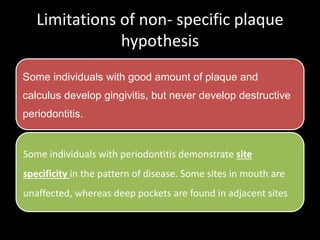
Limitations of non- specific plaque
hypothesis
Some individuals with good amount of plaque and
calculus develop gingivitis, but never develop destructive
periodontitis.
Some individuals with periodontitis demonstrate site
specificity in the pattern of disease. Some sites in mouth are
unaffected, whereas deep pockets are found in adjacent sites
SPECIFIC
PLAQUE HYPOTHESIS
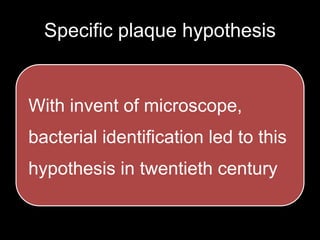
Specific plaque hypothesis
With invent of microscope,
bacterial identification led to this
hypothesis in twentieth century
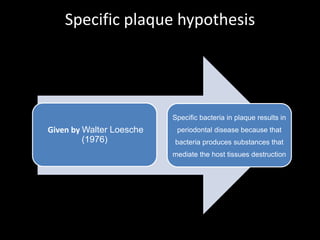
Specific plaque hypothesis
Given by Walter Loesche
(1976)
Specific bacteria in plaque results in
periodontal disease because that
bacteria produces substances that
mediate the host tissues destruction
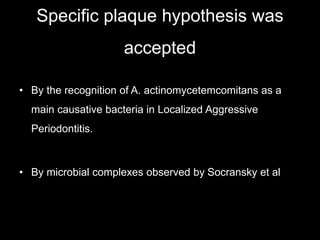
Specific plaque hypothesis was
accepted
• By the recognition of A. actinomycetemcomitans as a
main causative bacteria in Localized Aggressive
Periodontitis.
• By microbial complexes observed by Socransky et al
MICROBIAL COMPLEXES
• Socransky et al in 1998 described the
presence of specific bacterial complexes
in plaque
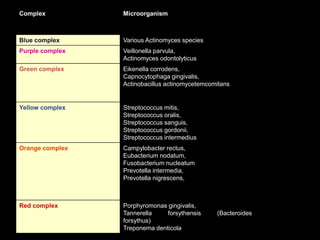
Complex Microorganism
Blue complex Various Actinomyces species
Purple complex Veillonella parvula,
Actinomyces odontolyticus
Green complex Eikenella corrodens,
Capnocytophaga gingivalis,
Actinobacillus actinomycetemcomitans
Yellow complex Streptococcus mitis,
Streptococcus oralis,
Streptococcus sanguis,
Streptococcus gordonii,
Streptococcus intermedius
Orange complex Campylobacter rectus,
Eubacterium nodatum,
Fusobacterium nucleatum
Prevotella intermedia,
Prevotella nigrescens,
Red complex Porphyromonas gingivalis,
Tannerella forsythensis (Bacteroides
forsythus)
Treponema denticola
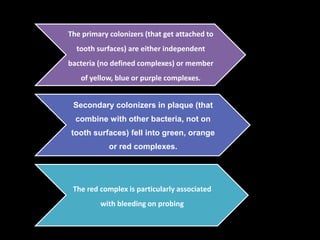
The primary colonizers (that get attached to
tooth surfaces) are either independent
bacteria (no defined complexes) or member
of yellow, blue or purple complexes.
Secondary colonizers in plaque (that
combine with other bacteria, not on
tooth surfaces) fell into green, orange
or red complexes.
The red complex is particularly associated
with bleeding on probing
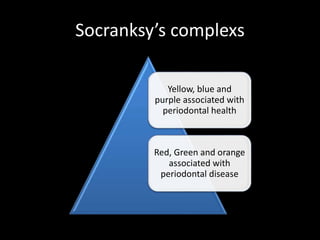
Socranksy’s complexs
Yellow, blue and
purple associated with
periodontal health
Red, Green and orange
associated with
periodontal disease
Limitations
Studies showed that periodontitis occurred even in
absence of pathogens like red/green complex
Sometime these pathogens were found to be present in
absence of disease.
UPDATED NON-SPECIFIC
PLAQUE HYPOTHESIS (UNIFIED
HYPOTHESIS)
UPDATED NON-SPECIFIC PLAOUE
HYPOTHESIS (UNIFIED HYPOTHESIS)
Described by THEILADE IN 1986
Whole plaque contribute to the pathogenic potential to a
greater or lesser extent (Gingivitis), but presence of some
specific virulent bacteria lead to disease progression
(Periodontitis)
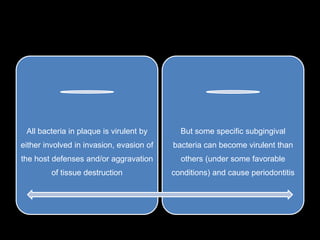
All bacteria in plaque is virulent by
either involved in invasion, evasion of
the host defenses and/or aggravation
of tissue destruction
But some specific subgingival
bacteria can become virulent than
others (under some favorable
conditions) and cause periodontitis
Thus it combines the key concepts of both
the previous hypothesis
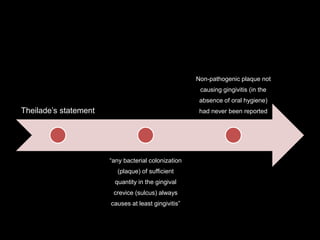
Theilade’s statement
“any bacterial colonization
(plaque) of sufficient
quantity in the gingival
crevice (sulcus) always
causes at least gingivitis”
Non-pathogenic plaque not
causing gingivitis (in the
absence of oral hygiene)
had never been reported
This hypothesis propose
Presence of plaque always lead to gingivitis
Changes occur in plaque leading to growth
of specific virulent bacteria leading to
periodontitis
LIMITATION-
CANNOT ANSWER WHY-
In some people, gingivitis
never progress to periodontitis,
whereas some people rapidly
develop periodontitis
ECOLOGICAL PLAQUE
HYPOTHESIS
ECOLOGICAL PLAQUE HYPOTHESIS
Expanded the previous hypothesis by
stating that virulence of specific
micro-organism in plaque occurs by
changes in ecological factors like
change in pH, redox potential,
presence of nutrients etc
ECOLOGICAL PLAQUE HYPOTHESIS
Given by Philip D. Marsh in 1994
Periodontitis is caused by overgrowth of
specific micro-organisms of dental plaque
when the local microenvironment changes
(ecological changes), but it is not necessarily
the same bacteria in each case
• Changes in microbial composition occurs
due to ecological factors such as change
in pH and redox potential, the presence of
nutrients
According to ecological
plaque hypothesis both the
total amount of dental plaque
and the specific microbial
composition of plaque
contribute to transition from
health to disease.
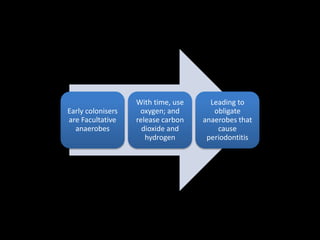
Early colonisers
are Facultative
anaerobes
With time, use
oxygen; and
release carbon
dioxide and
hydrogen
Leading to
obligate
anaerobes that
cause
periodontitis
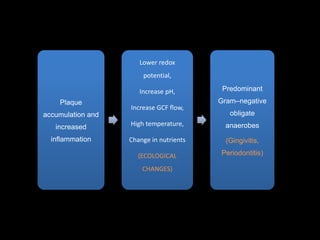
Plaque
accumulation and
increased
inflammation
Lower redox
potential,
Increase pH,
Increase GCF flow,
High temperature,
Change in nutrients
(ECOLOGICAL
CHANGES)
Predominant
Gram–negative
obligate
anaerobes
(Gingivitis,
Periodontitis)
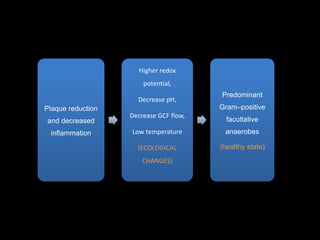
Plaque reduction
and decreased
inflammation
Higher redox
potential,
Decrease pH,
Decrease GCF flow,
Low temperature
(ECOLOGICAL
CHANGES)
Predominant
Gram–positive
facultative
anaerobes
(healthy state)
LIMITATION
Like the other hypotheses, it does not address the
role of host genetic factors that contribute to the
composition of plaque and to susceptibility of
periodontitis; as gingivitis don’t lead to periodontitis
in every case and genetic factors can be
responsible in addition to environmental factors.
KEYSTONE PATHOGEN
HYPOTHESIS
KEYSTONE PATHOGEN HYPOTHESIS
Certain low-abundant micro-organisms can cause
periodontitis by changing the composition and increasing
the quantity/number of the normal micro-organisms
Given by Hajishengallis et al., 2012
For example Porphyromonas gingivalis ( in small quantities)
has shown to cause periodontitis by manipulating the host
immune system
STUDIES
Studies in mouse models showed
Very low amount of P.gingivalis
(<0.01% of total bacteria in plaque)
altered the plaque composition,
causing periodontitis (Hajishengallis et
al.,2011)
STUDIES
But in germ-free mice models
P.gingivalis colonized but could
not cause the disease; indicating
the importance of commensal
bacteria in causing the disease
P.GINGIVALIS CAUSES three effects
1. “Local chemokine paralysis”
by blocking production of IL-8
produced by gingival epithelial
cells.
Delays the recruitment of
neutrophils, facilitating initial
microbial colonization in
periodontium
Madianos et al.,
1997;
Darveau et al;1998
P.GINGIVALIS CAUSES
2. “Manipulate toll like receptor
(TLR) response”
Decrease level of TLR4 activity,
thus facilitate survival and
multiplication of micro-organisms in
periodontium
P.GINGIVALIS CAUSES
3. “Inactivate Complement”
Gingipains release by P.Gingivalis
cleave complement factors C3 and
C5 into active C3a and C5a (active
in phagocytosis of microbes). But
these gingipains degraded C3a and
C5a, causing loss of their functions
thus increasing survival of micro-
organisms.
P.GINGIVALIS CAUSES
Increasing number of micro-
organisms increase GCF. Increased
GCF is source of more proteins
(utilized as nutrient for other micro-
organisms) and iron (utilized as
source of P.gingivalis)
Thus a vicious cycle is formed in
which P.gingivalis increases
number of other micro-organisms
and its own levels
LIMITATION
Like the other hypotheses, it does not address
the role of host genetic factors that contribute to
the composition of plaque and to susceptibility
of periodontitis
Also this hypothesis has yet to be proved in
humans
SUMMARY
• Non specific plaque hypothesis: Whole plaque
responsible for disease.
• Specific plaque hypothesis: Specific bacteria in
plaque responsible for disease.
• Updated plaque hypothesis: Whole plaque cause
gingivitis; but progression to periodontitis occurs
by growth of specific bacteria.
SUMMARY
• Ecological plaque hypothesis: Whole plaque cause
gingivitis; but progression to periodontitis occurs by
growth of specific bacteria by some ecological
changes in biofilm (like temperature, pH etc.)
• Keystone pathogen hypothesis: Low-abundant micro-
organism like P.gingivalis cause periodontitis by
changing the composition and increasing the quantity
of the normal micro-organisms.
Conclusion
It is a proven fact by all hypothesis
that accumulation of plaque always
lead to gingivitis.
But progression of disease
from gingivitis to
periodontitis—do not fit to
any hypothesis
‘In some individuals
disease never progress,
whereas in others it rapidly
progress to periodontitis’,
need to be answered
Till now, all hypothesis fail to describe actual
relationship between oral microbes and host
response that lead to maintenance of health or its
shift to the disease (periodontitis)
A hypothesis is needed, but this is only
possible when complex interaction of
bacteria with the host innate immune
response is fully explored

Plaque hypothesis ppt

  • 1.
  • 3.
    CONTENTS • Introduction • Definitions •Non specific plaque hypothesis • Specific plaque hypothesis • Updated plaque hypothesis • Ecological plaque hypothesis • Keystone pathogen plaque hypothesis • Conclusion
  • 4.
    INTRODUCTION • Plaque isthe primary etiological factor of periodontal diseases • Also evidences support that periodontal disease acts as contributor factor for various systemic diseases (Diabetes, Heart Diseases, Lung Diseases, Preterm low birth weight infants….....)
  • 5.
    INTRODUCTION To effectively treatand prevent these diseases, various hypothesis are proposed to find how healthy plaque change to pathological plaque
  • 6.
    PLAQUE HYPOTHESIS- • Nonspecific plaque hypothesis • Specific plaque hypothesis • Updated plaque hypothesis • Ecological plaque hypothesis • Keystone pathogen hypothesis
  • 7.
  • 8.
    Non-specific plaque hypothesis Describedin nineteenth century when due to lack of technology, bacteria could not be identified
  • 9.
    Non-specific plaque hypothesis Proposedby Miller in 1890; Name given by Walter Loesche (1976) States that periodontal disease results from the noxious products released by entire plaque flora
  • 10.
    All plaque bacteria playeda role in periodontal destruction rather than any specific bacteria. Entire plaque was viewed as bad plaque
  • 11.
    Plaque induced gingivitismodel in support of this theory • Loe, Theilade, and Jensen in 1965- examined gingival inflammation in healthy adults who ceased tooth brushing and any other oral hygiene practices. • It was observed that as the plaque accumulated, gingivitis developed • When plaque was removed by reinstituting adequate oral hygiene, gingivitis started decreasing
  • 12.
     Day 0-Mechanical plaque control stopped, plaque slowly started forming on the teeth.  Day 1-6- Plaque composition changed, with a shift to more gram-negative species and more rods, filaments  Day 7- Spirals and spirochetes started appearing
  • 13.
    • Day 3-First symptoms of gingival inflammation became visible. • On re-establishment of proper plaque control- plaque composition returned to the initial situation; symptoms of gingivitis disappeared.
  • 14.
    Limitations of non-specific plaque hypothesis Some individuals with good amount of plaque and calculus develop gingivitis, but never develop destructive periodontitis. Some individuals with periodontitis demonstrate site specificity in the pattern of disease. Some sites in mouth are unaffected, whereas deep pockets are found in adjacent sites
  • 15.
  • 16.
    Specific plaque hypothesis Withinvent of microscope, bacterial identification led to this hypothesis in twentieth century
  • 17.
    Specific plaque hypothesis Givenby Walter Loesche (1976) Specific bacteria in plaque results in periodontal disease because that bacteria produces substances that mediate the host tissues destruction
  • 18.
    Specific plaque hypothesiswas accepted • By the recognition of A. actinomycetemcomitans as a main causative bacteria in Localized Aggressive Periodontitis. • By microbial complexes observed by Socransky et al
  • 19.
    MICROBIAL COMPLEXES • Socranskyet al in 1998 described the presence of specific bacterial complexes in plaque
  • 20.
    Complex Microorganism Blue complexVarious Actinomyces species Purple complex Veillonella parvula, Actinomyces odontolyticus Green complex Eikenella corrodens, Capnocytophaga gingivalis, Actinobacillus actinomycetemcomitans Yellow complex Streptococcus mitis, Streptococcus oralis, Streptococcus sanguis, Streptococcus gordonii, Streptococcus intermedius Orange complex Campylobacter rectus, Eubacterium nodatum, Fusobacterium nucleatum Prevotella intermedia, Prevotella nigrescens, Red complex Porphyromonas gingivalis, Tannerella forsythensis (Bacteroides forsythus) Treponema denticola
  • 21.
    The primary colonizers(that get attached to tooth surfaces) are either independent bacteria (no defined complexes) or member of yellow, blue or purple complexes. Secondary colonizers in plaque (that combine with other bacteria, not on tooth surfaces) fell into green, orange or red complexes. The red complex is particularly associated with bleeding on probing
  • 22.
    Socranksy’s complexs Yellow, blueand purple associated with periodontal health Red, Green and orange associated with periodontal disease
  • 23.
    Limitations Studies showed thatperiodontitis occurred even in absence of pathogens like red/green complex Sometime these pathogens were found to be present in absence of disease.
  • 24.
  • 25.
    UPDATED NON-SPECIFIC PLAOUE HYPOTHESIS(UNIFIED HYPOTHESIS) Described by THEILADE IN 1986 Whole plaque contribute to the pathogenic potential to a greater or lesser extent (Gingivitis), but presence of some specific virulent bacteria lead to disease progression (Periodontitis)
  • 26.
    All bacteria inplaque is virulent by either involved in invasion, evasion of the host defenses and/or aggravation of tissue destruction But some specific subgingival bacteria can become virulent than others (under some favorable conditions) and cause periodontitis
  • 27.
    Thus it combinesthe key concepts of both the previous hypothesis
  • 28.
    Theilade’s statement “any bacterialcolonization (plaque) of sufficient quantity in the gingival crevice (sulcus) always causes at least gingivitis” Non-pathogenic plaque not causing gingivitis (in the absence of oral hygiene) had never been reported
  • 29.
    This hypothesis propose Presenceof plaque always lead to gingivitis Changes occur in plaque leading to growth of specific virulent bacteria leading to periodontitis
  • 30.
    LIMITATION- CANNOT ANSWER WHY- Insome people, gingivitis never progress to periodontitis, whereas some people rapidly develop periodontitis
  • 31.
  • 32.
    ECOLOGICAL PLAQUE HYPOTHESIS Expandedthe previous hypothesis by stating that virulence of specific micro-organism in plaque occurs by changes in ecological factors like change in pH, redox potential, presence of nutrients etc
  • 33.
    ECOLOGICAL PLAQUE HYPOTHESIS Givenby Philip D. Marsh in 1994 Periodontitis is caused by overgrowth of specific micro-organisms of dental plaque when the local microenvironment changes (ecological changes), but it is not necessarily the same bacteria in each case
  • 34.
    • Changes inmicrobial composition occurs due to ecological factors such as change in pH and redox potential, the presence of nutrients
  • 35.
    According to ecological plaquehypothesis both the total amount of dental plaque and the specific microbial composition of plaque contribute to transition from health to disease.
  • 36.
    Early colonisers are Facultative anaerobes Withtime, use oxygen; and release carbon dioxide and hydrogen Leading to obligate anaerobes that cause periodontitis
  • 37.
    Plaque accumulation and increased inflammation Lower redox potential, IncreasepH, Increase GCF flow, High temperature, Change in nutrients (ECOLOGICAL CHANGES) Predominant Gram–negative obligate anaerobes (Gingivitis, Periodontitis)
  • 38.
    Plaque reduction and decreased inflammation Higherredox potential, Decrease pH, Decrease GCF flow, Low temperature (ECOLOGICAL CHANGES) Predominant Gram–positive facultative anaerobes (healthy state)
  • 39.
    LIMITATION Like the otherhypotheses, it does not address the role of host genetic factors that contribute to the composition of plaque and to susceptibility of periodontitis; as gingivitis don’t lead to periodontitis in every case and genetic factors can be responsible in addition to environmental factors.
  • 40.
  • 41.
    KEYSTONE PATHOGEN HYPOTHESIS Certainlow-abundant micro-organisms can cause periodontitis by changing the composition and increasing the quantity/number of the normal micro-organisms Given by Hajishengallis et al., 2012 For example Porphyromonas gingivalis ( in small quantities) has shown to cause periodontitis by manipulating the host immune system
  • 42.
    STUDIES Studies in mousemodels showed Very low amount of P.gingivalis (<0.01% of total bacteria in plaque) altered the plaque composition, causing periodontitis (Hajishengallis et al.,2011)
  • 43.
    STUDIES But in germ-freemice models P.gingivalis colonized but could not cause the disease; indicating the importance of commensal bacteria in causing the disease
  • 44.
    P.GINGIVALIS CAUSES threeeffects 1. “Local chemokine paralysis” by blocking production of IL-8 produced by gingival epithelial cells. Delays the recruitment of neutrophils, facilitating initial microbial colonization in periodontium Madianos et al., 1997; Darveau et al;1998
  • 45.
    P.GINGIVALIS CAUSES 2. “Manipulatetoll like receptor (TLR) response” Decrease level of TLR4 activity, thus facilitate survival and multiplication of micro-organisms in periodontium
  • 46.
    P.GINGIVALIS CAUSES 3. “InactivateComplement” Gingipains release by P.Gingivalis cleave complement factors C3 and C5 into active C3a and C5a (active in phagocytosis of microbes). But these gingipains degraded C3a and C5a, causing loss of their functions thus increasing survival of micro- organisms.
  • 47.
    P.GINGIVALIS CAUSES Increasing numberof micro- organisms increase GCF. Increased GCF is source of more proteins (utilized as nutrient for other micro- organisms) and iron (utilized as source of P.gingivalis) Thus a vicious cycle is formed in which P.gingivalis increases number of other micro-organisms and its own levels
  • 48.
    LIMITATION Like the otherhypotheses, it does not address the role of host genetic factors that contribute to the composition of plaque and to susceptibility of periodontitis Also this hypothesis has yet to be proved in humans
  • 49.
    SUMMARY • Non specificplaque hypothesis: Whole plaque responsible for disease. • Specific plaque hypothesis: Specific bacteria in plaque responsible for disease. • Updated plaque hypothesis: Whole plaque cause gingivitis; but progression to periodontitis occurs by growth of specific bacteria.
  • 50.
    SUMMARY • Ecological plaquehypothesis: Whole plaque cause gingivitis; but progression to periodontitis occurs by growth of specific bacteria by some ecological changes in biofilm (like temperature, pH etc.) • Keystone pathogen hypothesis: Low-abundant micro- organism like P.gingivalis cause periodontitis by changing the composition and increasing the quantity of the normal micro-organisms.
  • 51.
    Conclusion It is aproven fact by all hypothesis that accumulation of plaque always lead to gingivitis.
  • 52.
    But progression ofdisease from gingivitis to periodontitis—do not fit to any hypothesis ‘In some individuals disease never progress, whereas in others it rapidly progress to periodontitis’, need to be answered
  • 53.
    Till now, allhypothesis fail to describe actual relationship between oral microbes and host response that lead to maintenance of health or its shift to the disease (periodontitis)
  • 54.
    A hypothesis isneeded, but this is only possible when complex interaction of bacteria with the host innate immune response is fully explored