BY-
J.RAHUL RAGHAVENDER
IV YEAR
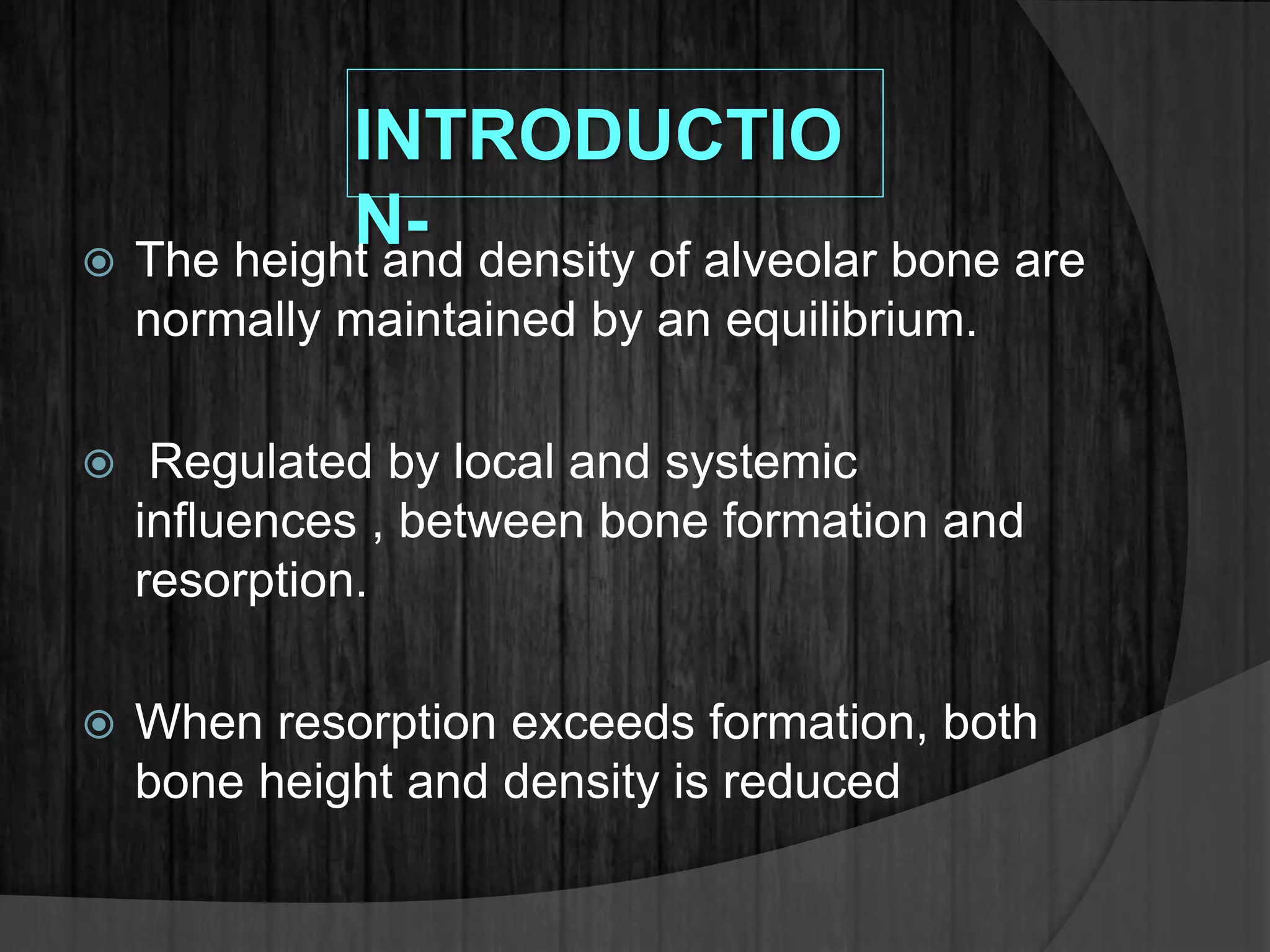
INTRODUCTIO
N- The height and density of alveolar bone are
normally maintained by an equilibrium.
 Regulated by local and systemic
influences , between bone formation and
resorption.
 When resorption exceeds formation, both
bone height and density is reduced
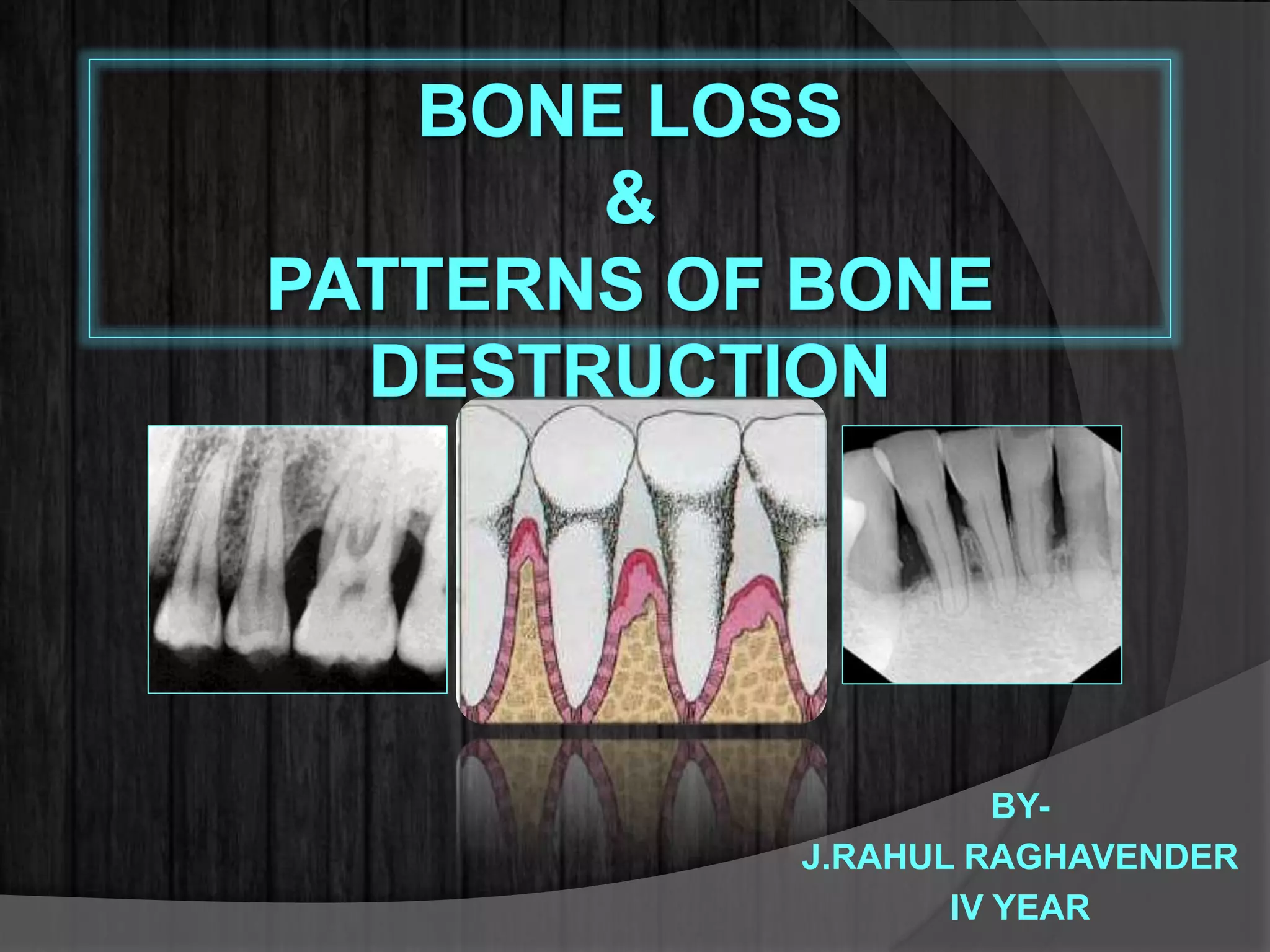
Causes of bone destruction-
(in periodontal disease)
1) Extension Of Gingival Inflammation
2) Trauma from occlusion(TFO)
3) Systemic disorders
1) Bone Destruction Caused By
Extension Of Gingival
Inflammation
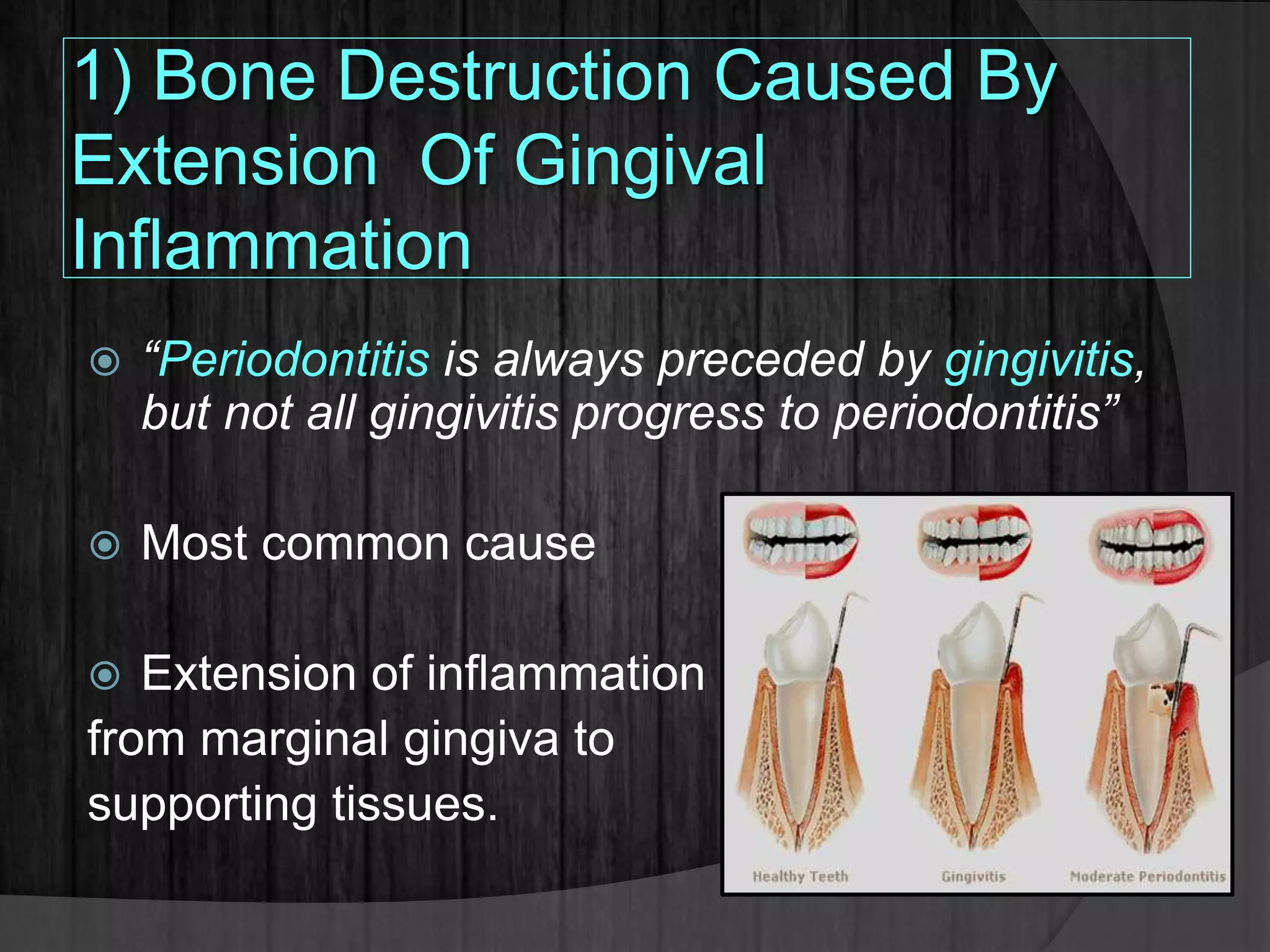
 “Periodontitis is always preceded by gingivitis,
but not all gingivitis progress to periodontitis”
 Most common cause
 Extension of inflammation
from marginal gingiva to
supporting tissues.
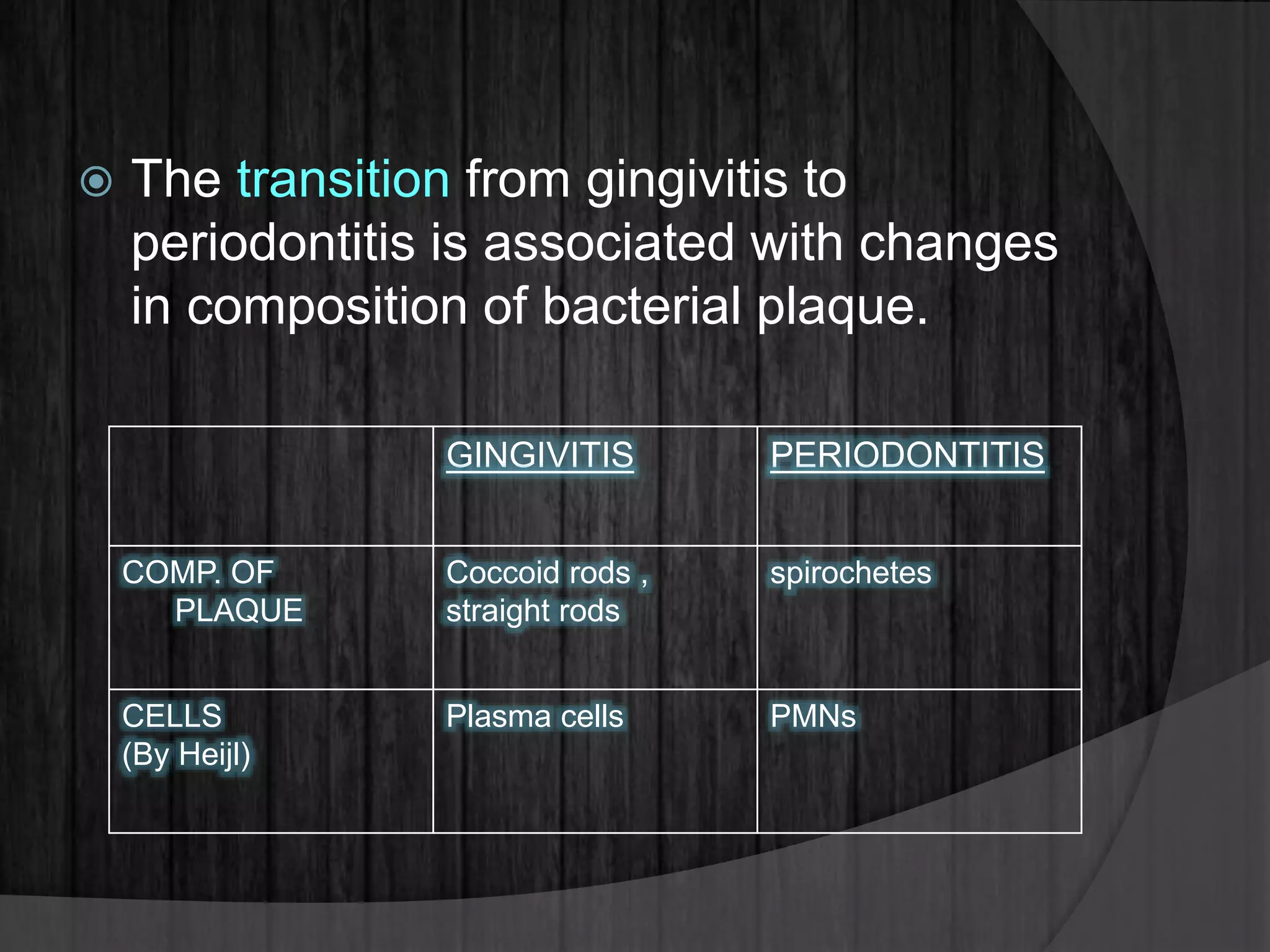
 The transition from gingivitis to
periodontitis is associated with changes
in composition of bacterial plaque.
GINGIVITIS PERIODONTITIS
COMP. OF
PLAQUE
Coccoid rods ,
straight rods
spirochetes
CELLS
(By Heijl)
Plasma cells PMNs
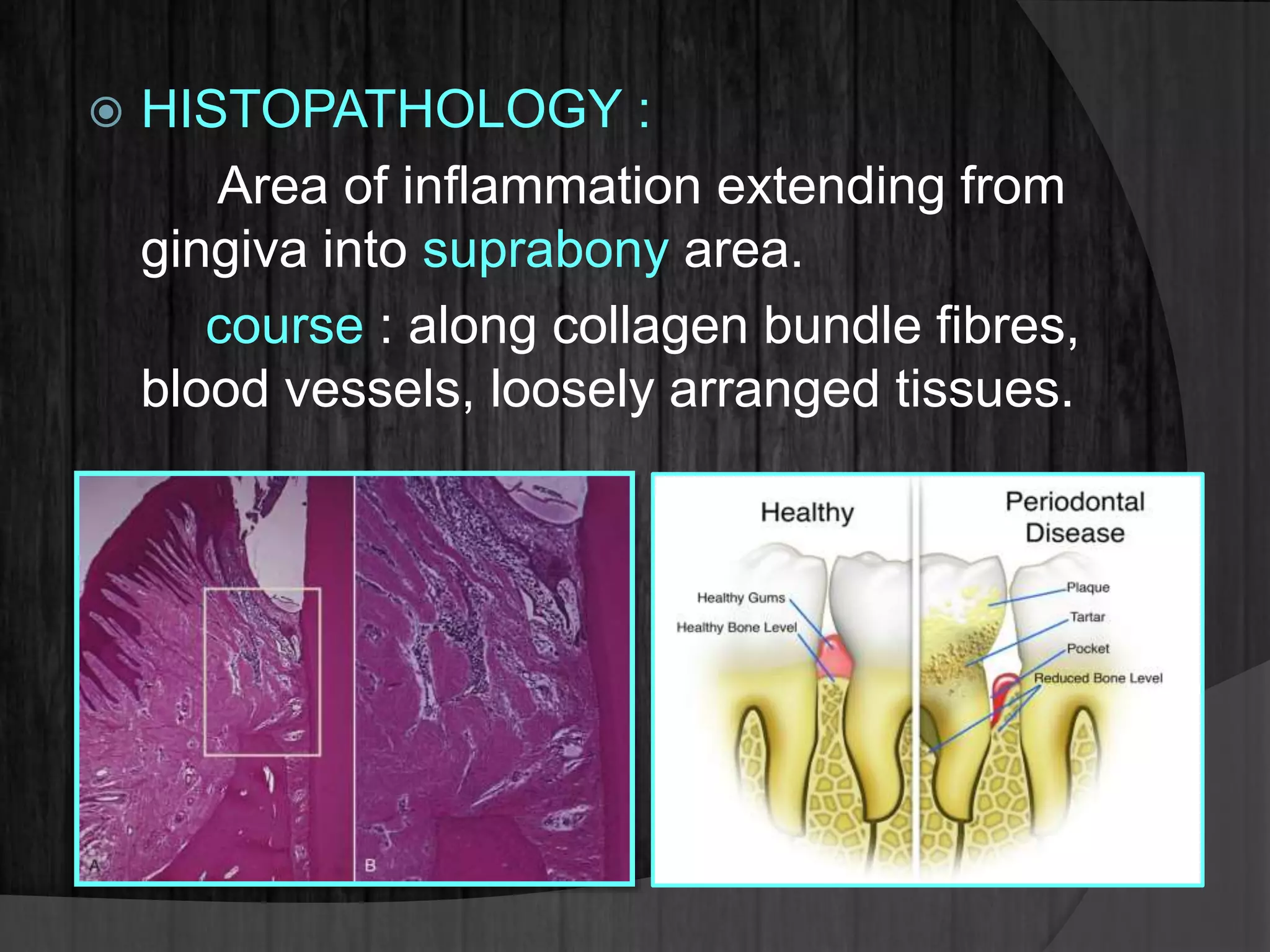
 HISTOPATHOLOGY :
Area of inflammation extending from
gingiva into suprabony area.
course : along collagen bundle fibres,
blood vessels, loosely arranged tissues.
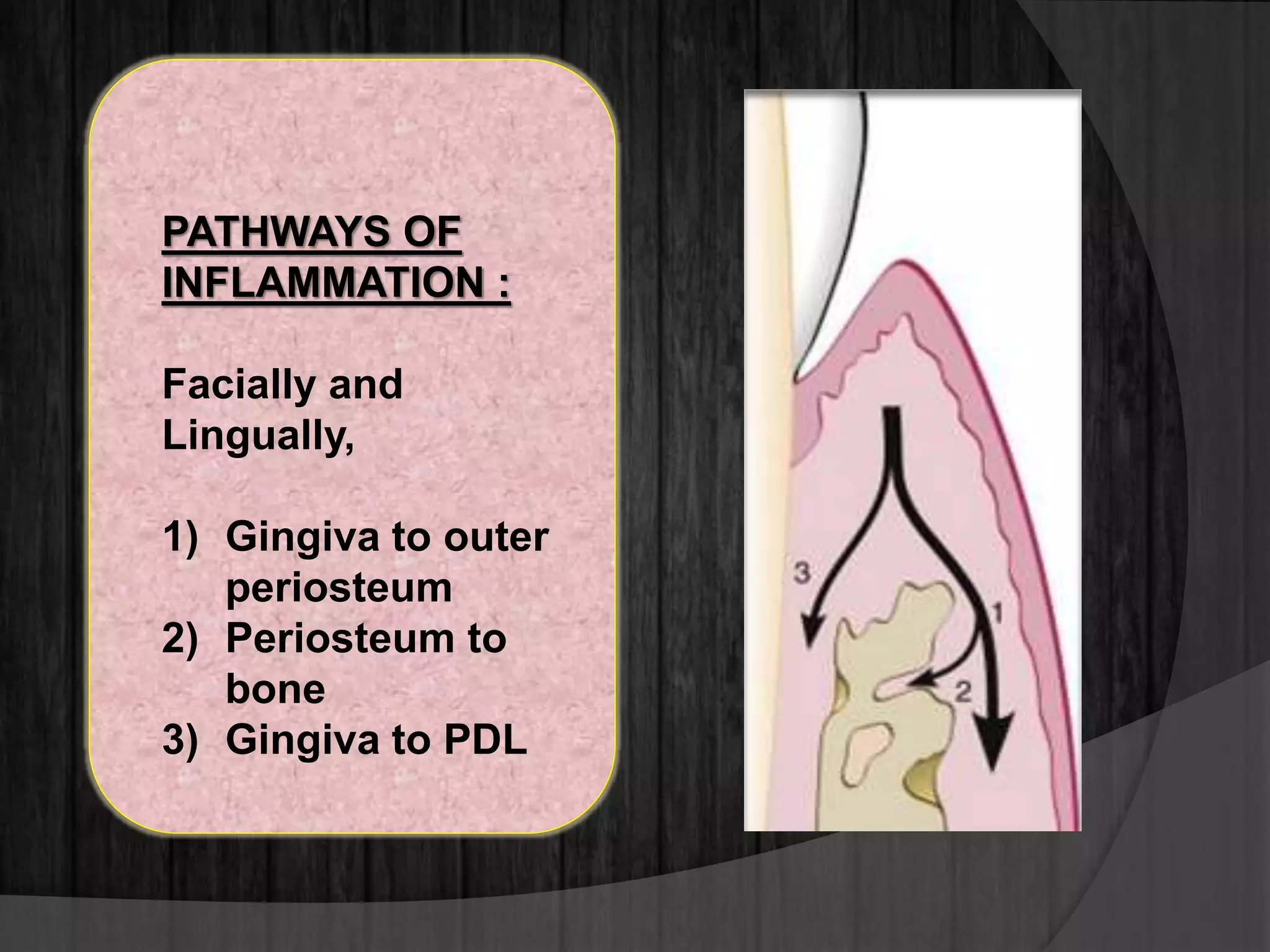
PATHWAYS OF
INFLAMMATION :
Facially and
Lingually,
1) Gingiva to outer
periosteum
2) Periosteum to
bone
3) Gingiva to PDL
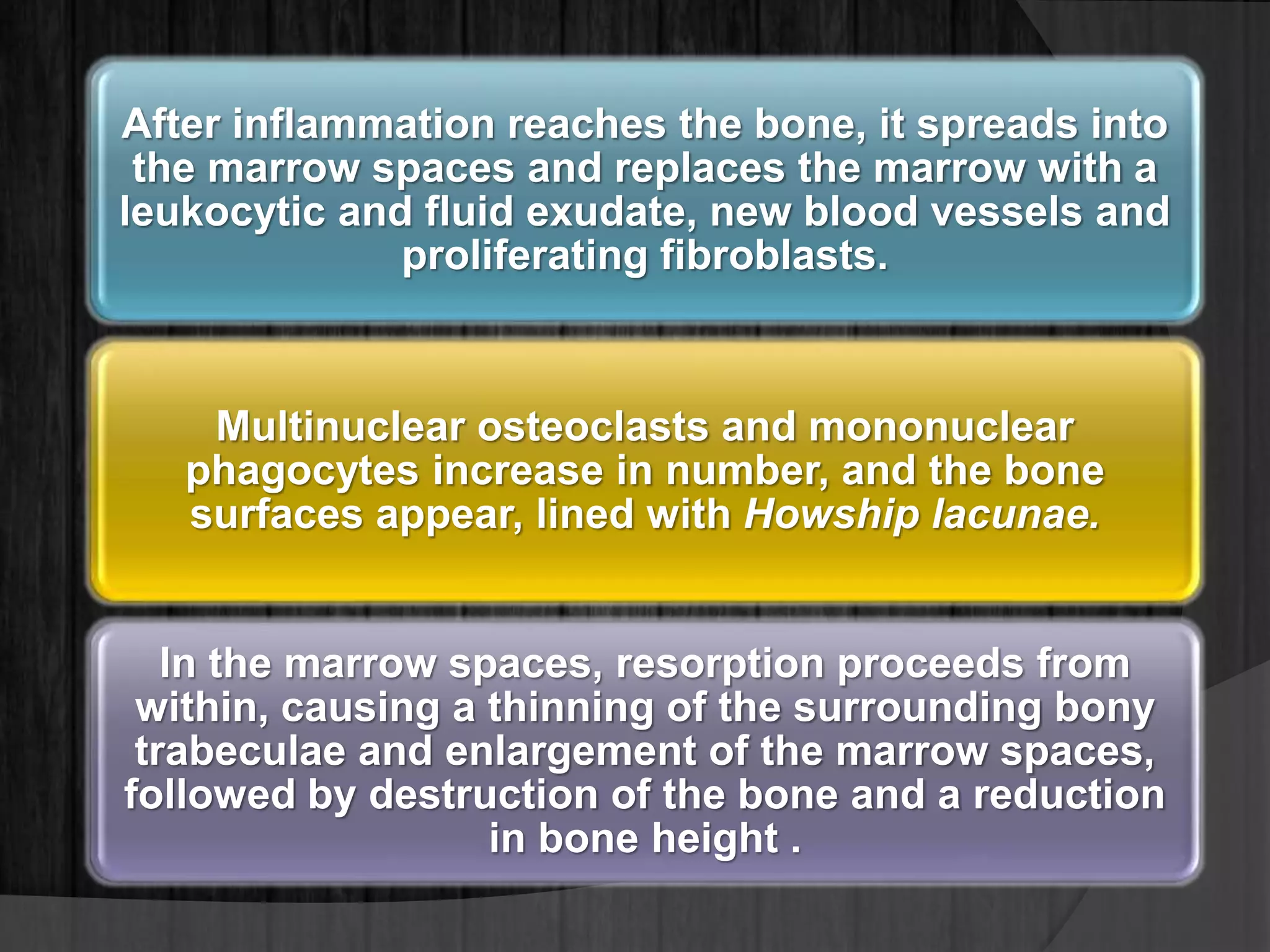
After inflammation reaches the bone, it spreads into
the marrow spaces and replaces the marrow with a
leukocytic and fluid exudate, new blood vessels and
proliferating fibroblasts.
Multinuclear osteoclasts and mononuclear
phagocytes increase in number, and the bone
surfaces appear, lined with Howship lacunae.
In the marrow spaces, resorption proceeds from
within, causing a thinning of the surrounding bony
trabeculae and enlargement of the marrow spaces,
followed by destruction of the bone and a reduction
in bone height .
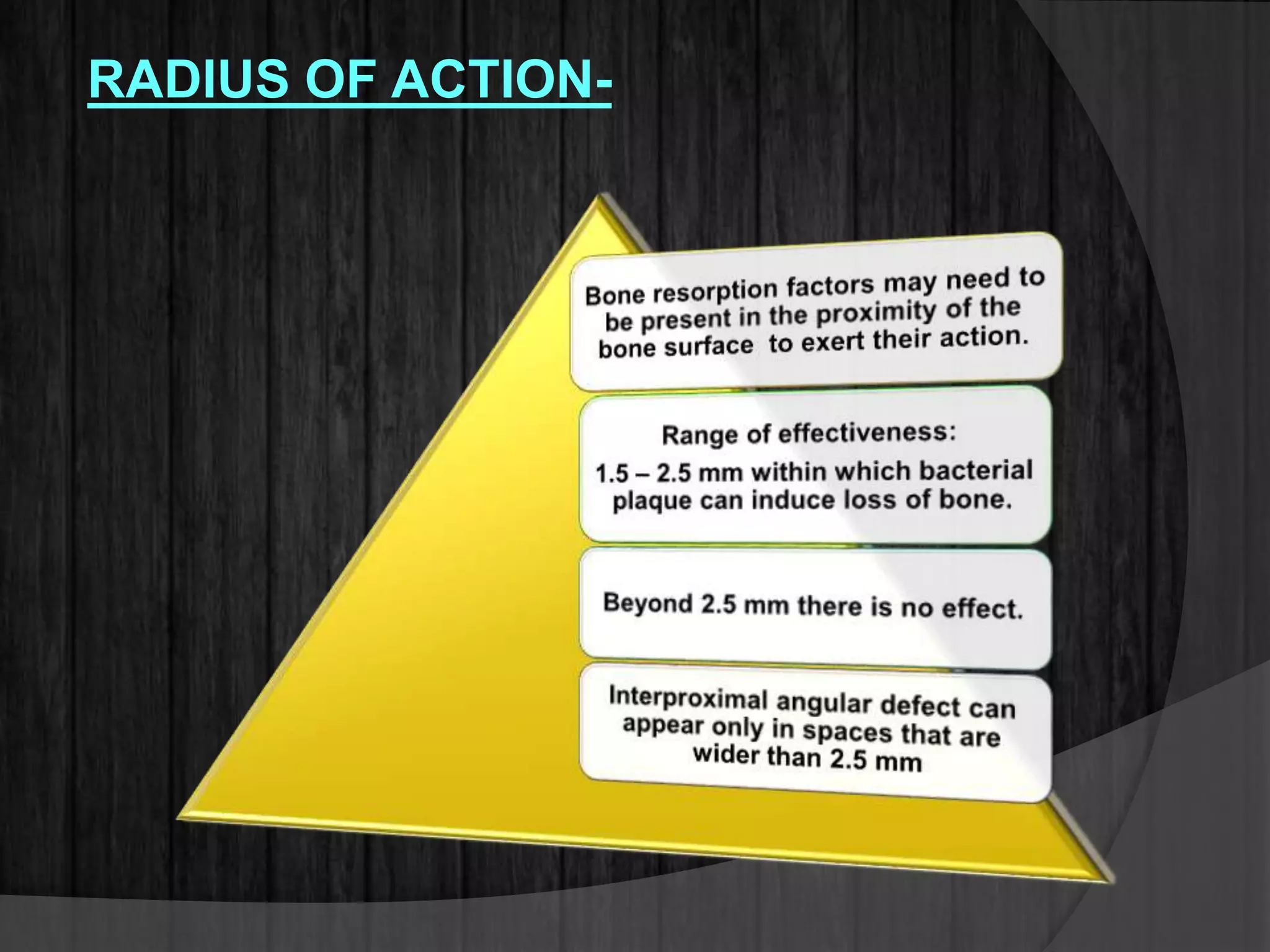
RADIUS OF ACTION-
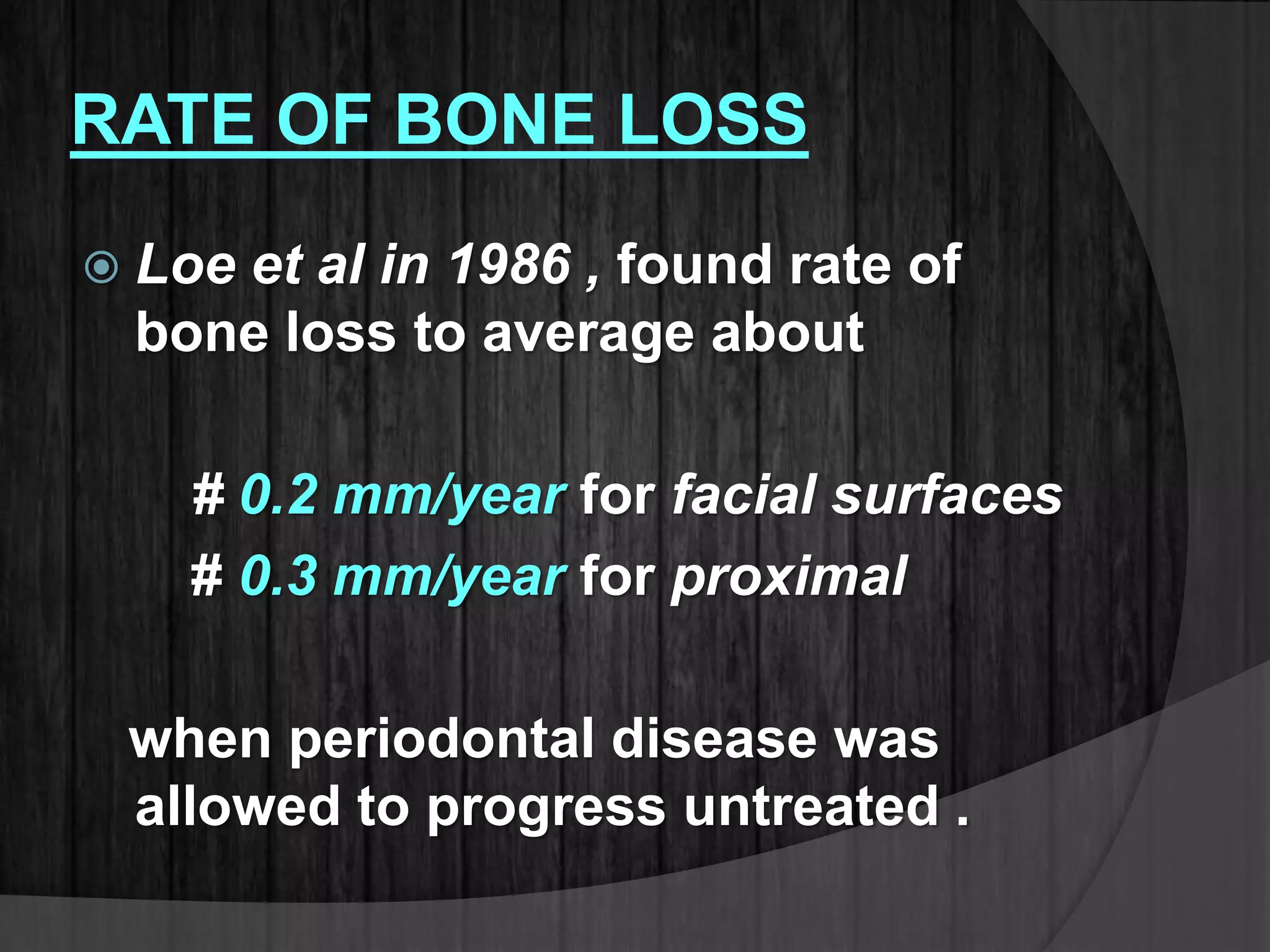
RATE OF BONE LOSS
 Loe et al in 1986 , found rate of
bone loss to average about
# 0.2 mm/year for facial surfaces
# 0.3 mm/year for proximal
when periodontal disease was
allowed to progress untreated .
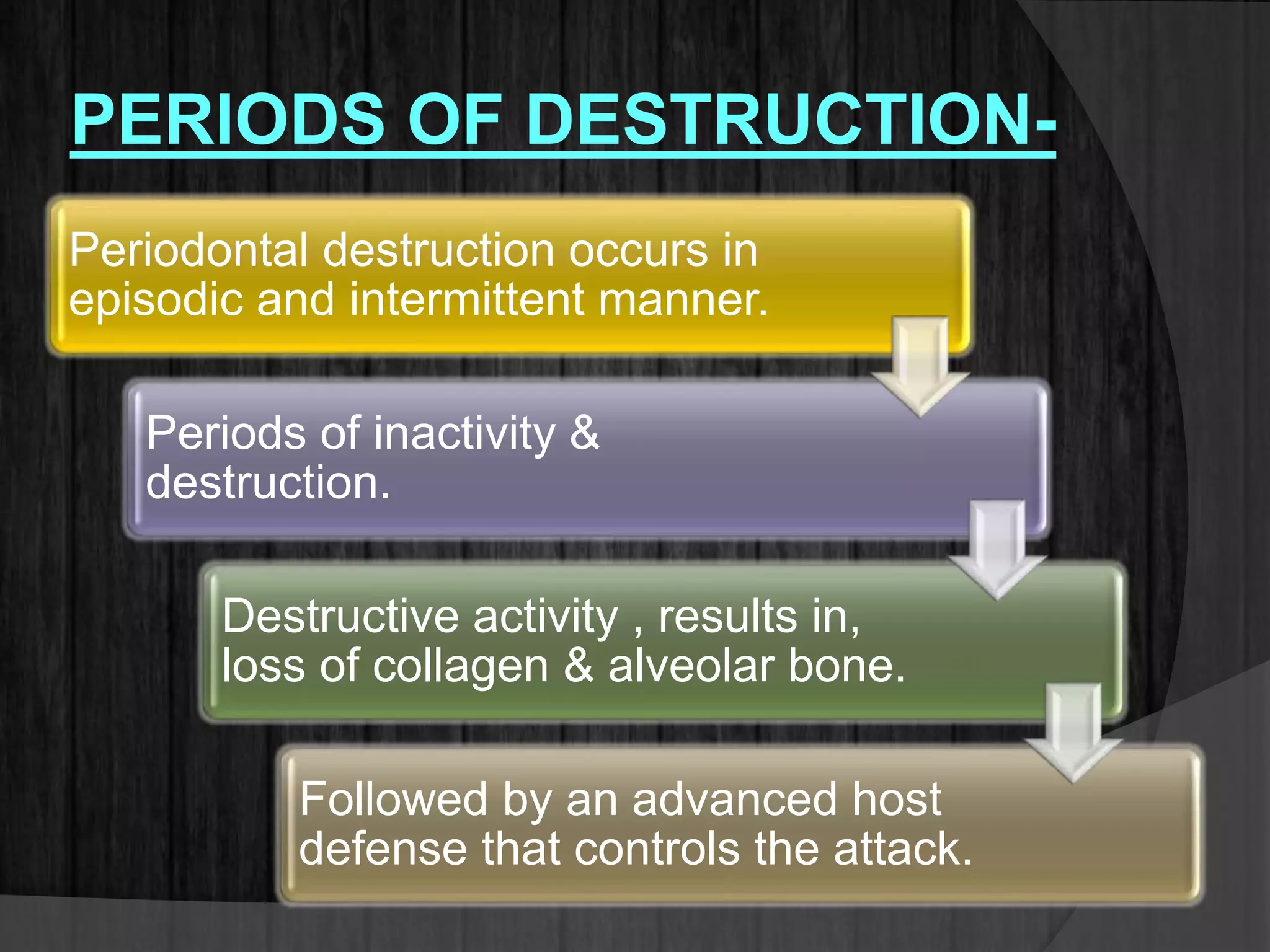
PERIODS OF DESTRUCTION-
Periodontal destruction occurs in
episodic and intermittent manner.
Periods of inactivity &
destruction.
Destructive activity , results in,
loss of collagen & alveolar bone.
Followed by an advanced host
defense that controls the attack.
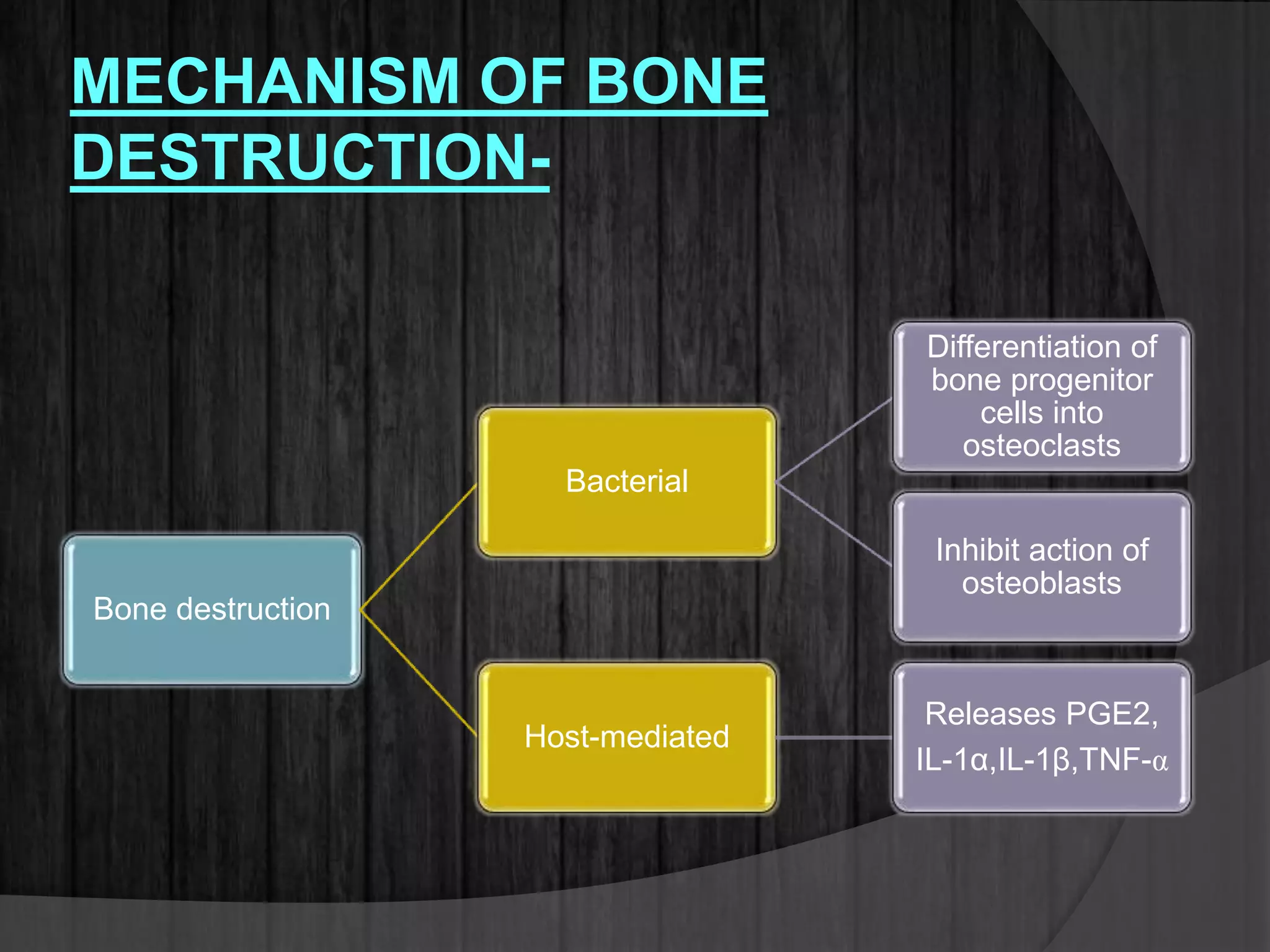
MECHANISM OF BONE
DESTRUCTION-
Bone destruction
Bacterial
Differentiation of
bone progenitor
cells into
osteoclasts
Inhibit action of
osteoblasts
Host-mediated
Releases PGE2,
IL-1α,IL-1β,TNF-α
2) BONE DESTRUCTION
CAUSED BY TRAUMA FROM
OCCLUSION -
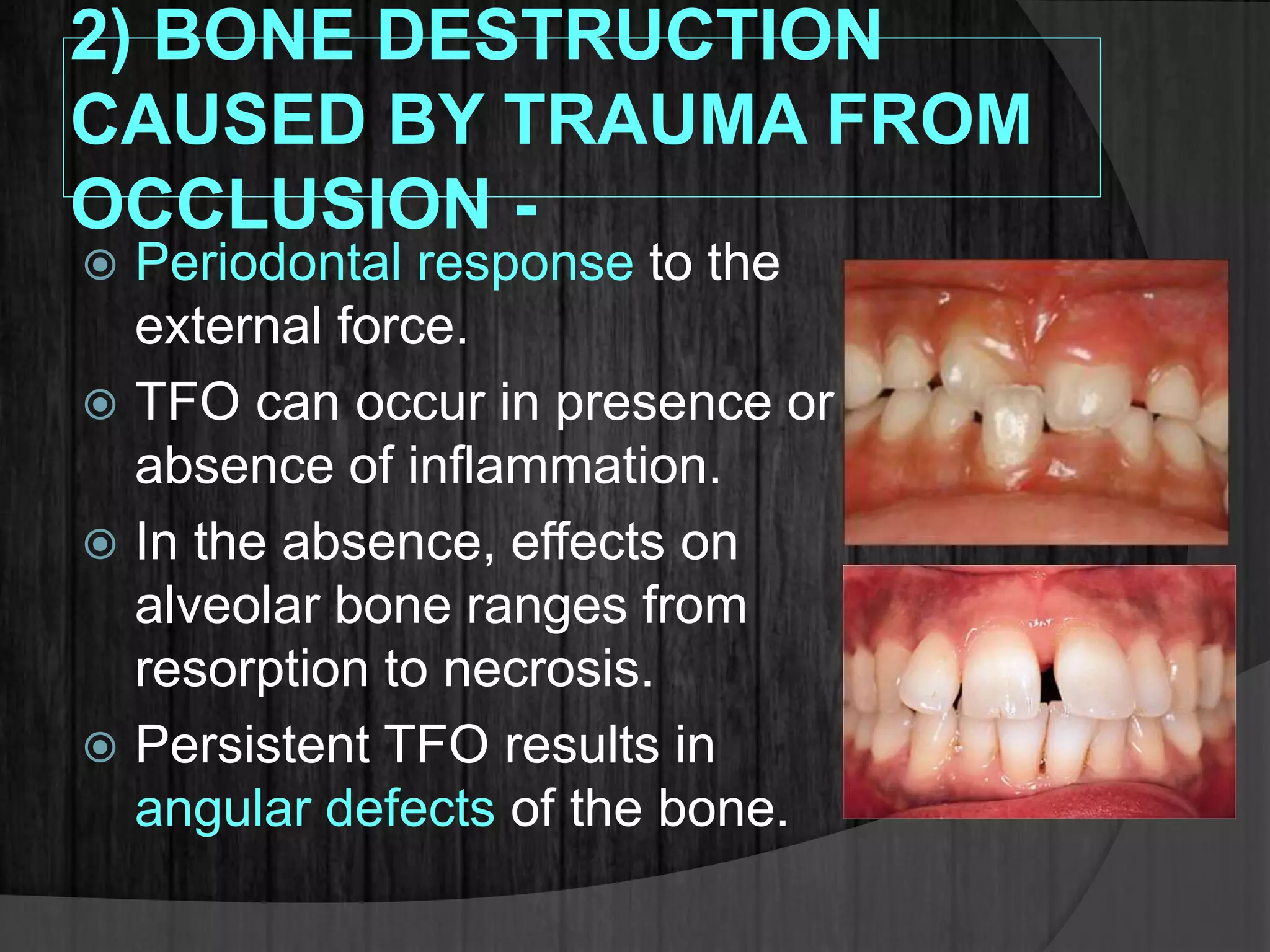
 Periodontal response to the
external force.
 TFO can occur in presence or
absence of inflammation.
 In the absence, effects on
alveolar bone ranges from
resorption to necrosis.
 Persistent TFO results in
angular defects of the bone.
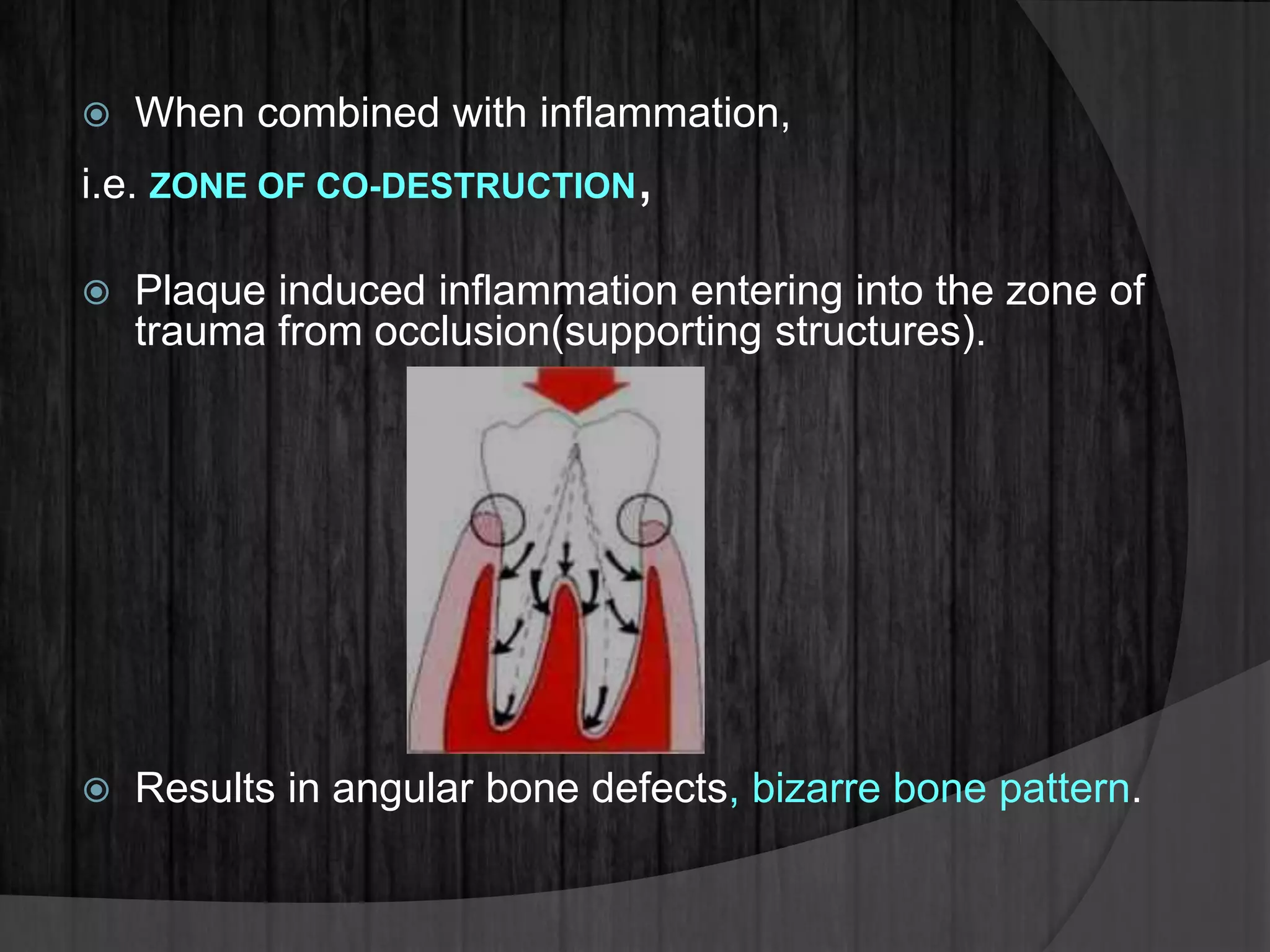
 When combined with inflammation,
i.e. ZONE OF CO-DESTRUCTION,
 Plaque induced inflammation entering into the zone of
trauma from occlusion(supporting structures).
 Results in angular bone defects, bizarre bone pattern.
3) BONE DESTRUCTION
CAUSED BY SYSTEMIC
DISORDERS -
 Possible relationship between periodontal bone
loss and systemic disorders.
 OSTEOPOROSIS : loss of bone mineral content
and structural bone changes. Risk factors-
ageing,smoking,etc
 OSTEOPENIA : tooth mobility and tooth loss
 Hyperparathyroidism, leukopenia
FACTORS DETERMINING BONE
MORPHOLOGY IN PERIODONTAL
DISEASE-
1) Normal variation of alveolar bone :
a) thickness,width,crestal angulation of
interdental septa
b) thickness of facial & lingual septa
c) presence of fenestrations &
dehiscences
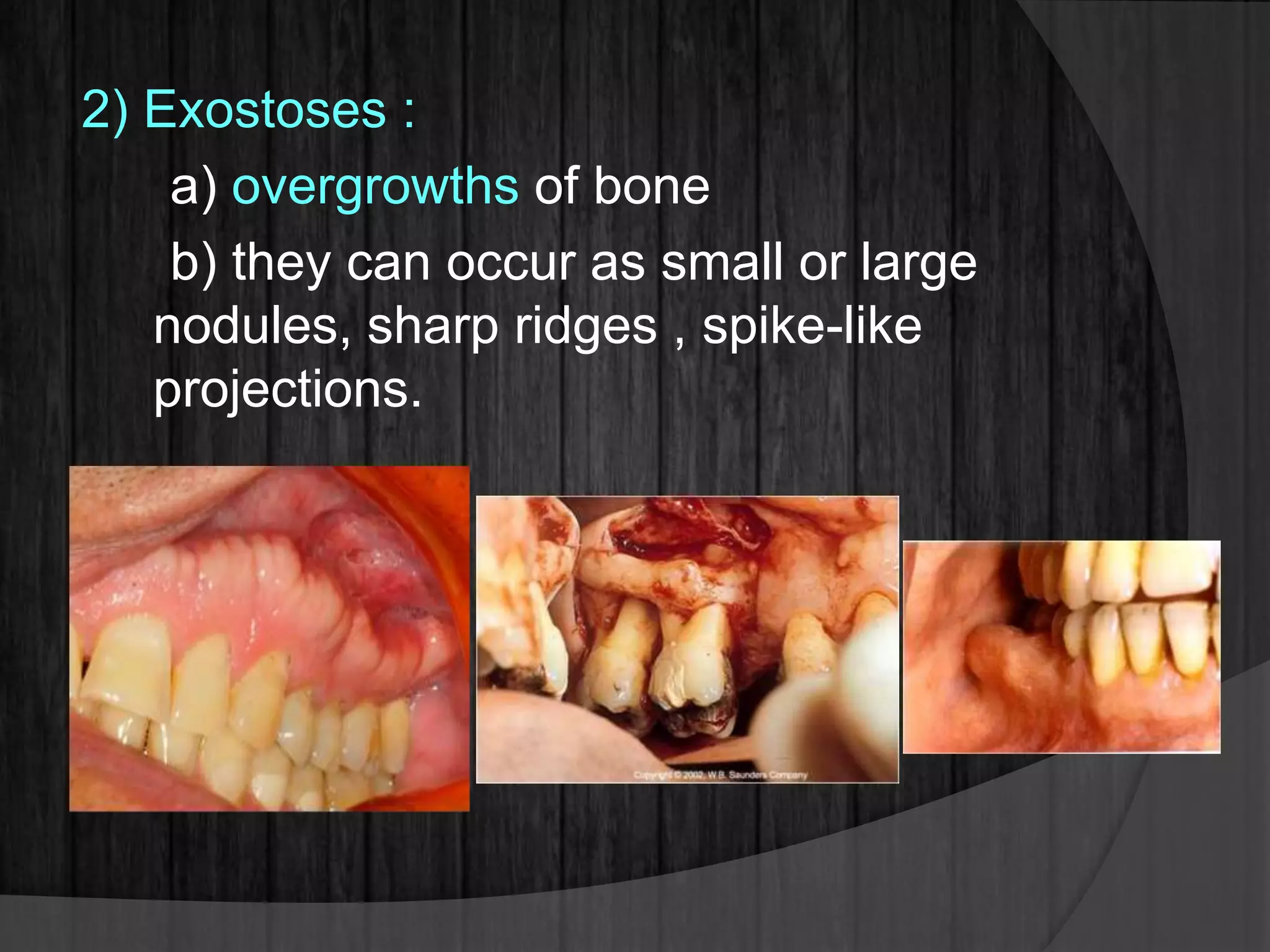
2) Exostoses :
a) overgrowths of bone
b) they can occur as small or large
nodules, sharp ridges , spike-like
projections.
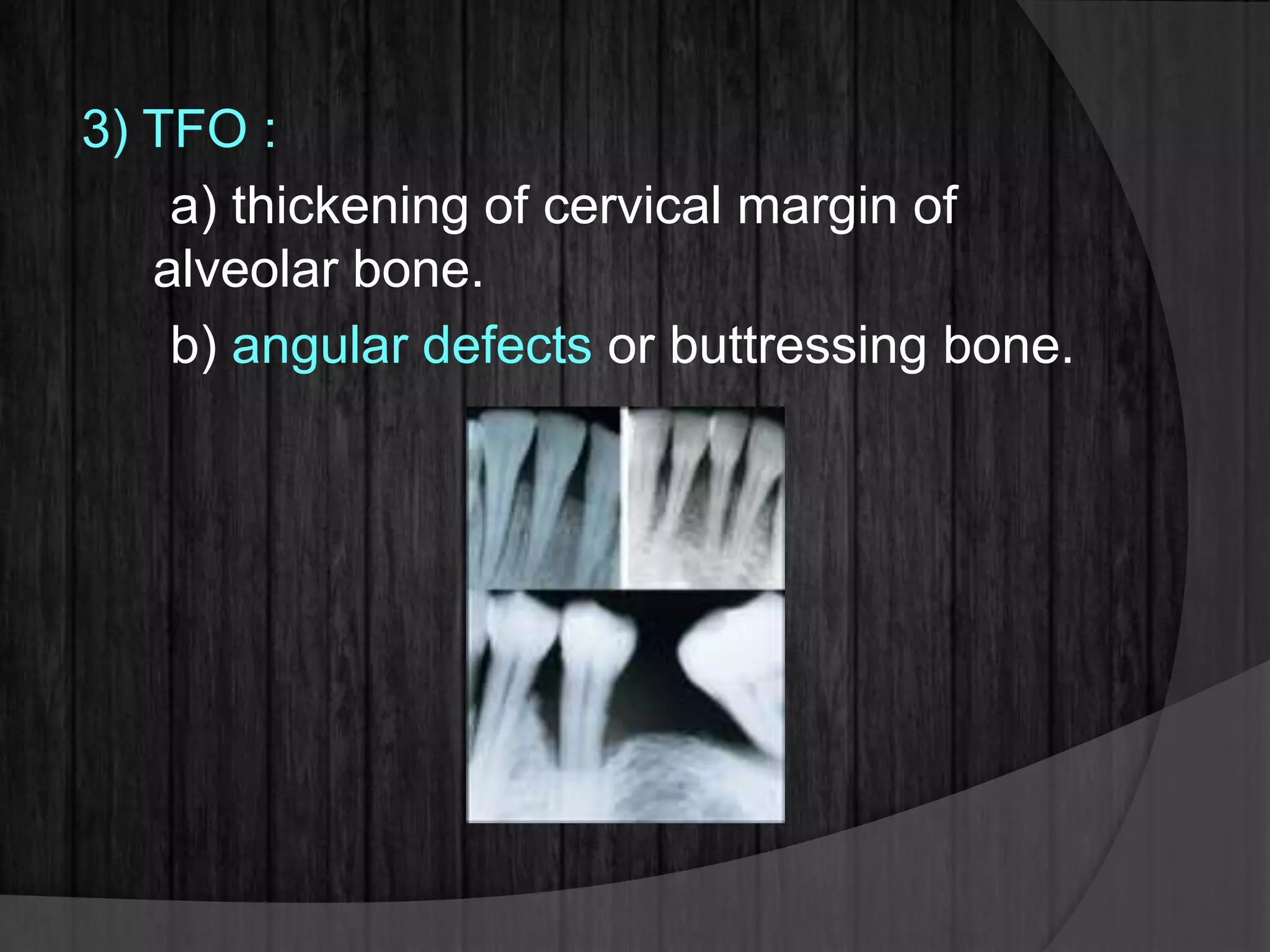
3) TFO :
a) thickening of cervical margin of
alveolar bone.
b) angular defects or buttressing bone.
c) buttressing bone formation occurs
during the repair phase of TFO
d) host reinforces thin trabeculae with
new bone
e) when it occurs within the jaw , it is
central buttressing bone formation.
f) when it occurs on external surface,
peripheral buttressing bone formation.
g) results in bulbous bone
contours(lipping) and osseous craters.
4) Food impaction :
a) interdental bone defects occur
when there is abnormal or absence of
proximal contact.
b) food impaction here , results in
inverted bone architecture.
5) Aggressive periodontitis :
a) vertical or angular bone defects.
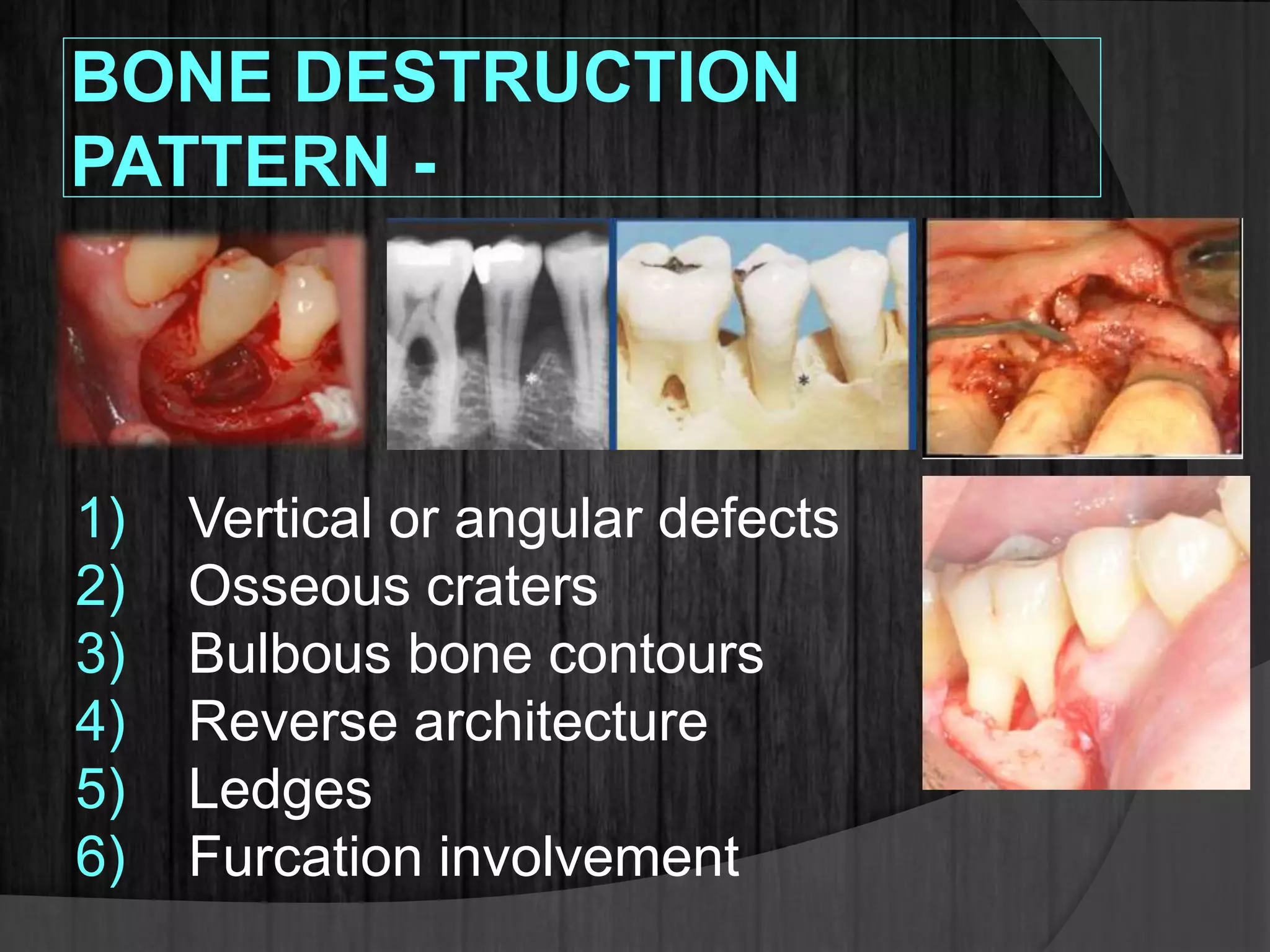
BONE DESTRUCTION
PATTERN -
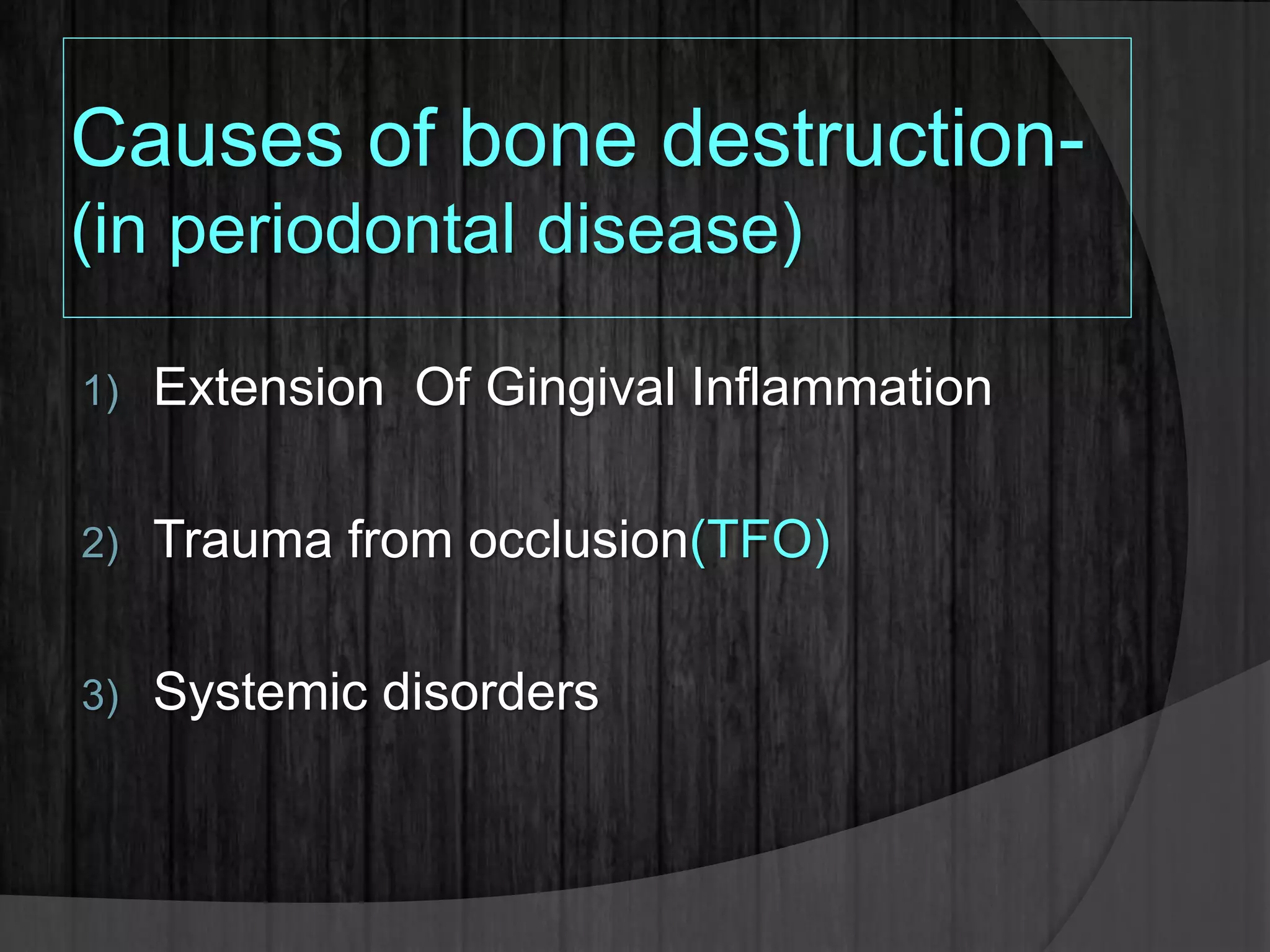
1) Vertical or angular defects
2) Osseous craters
3) Bulbous bone contours
4) Reverse architecture
5) Ledges
6) Furcation involvement
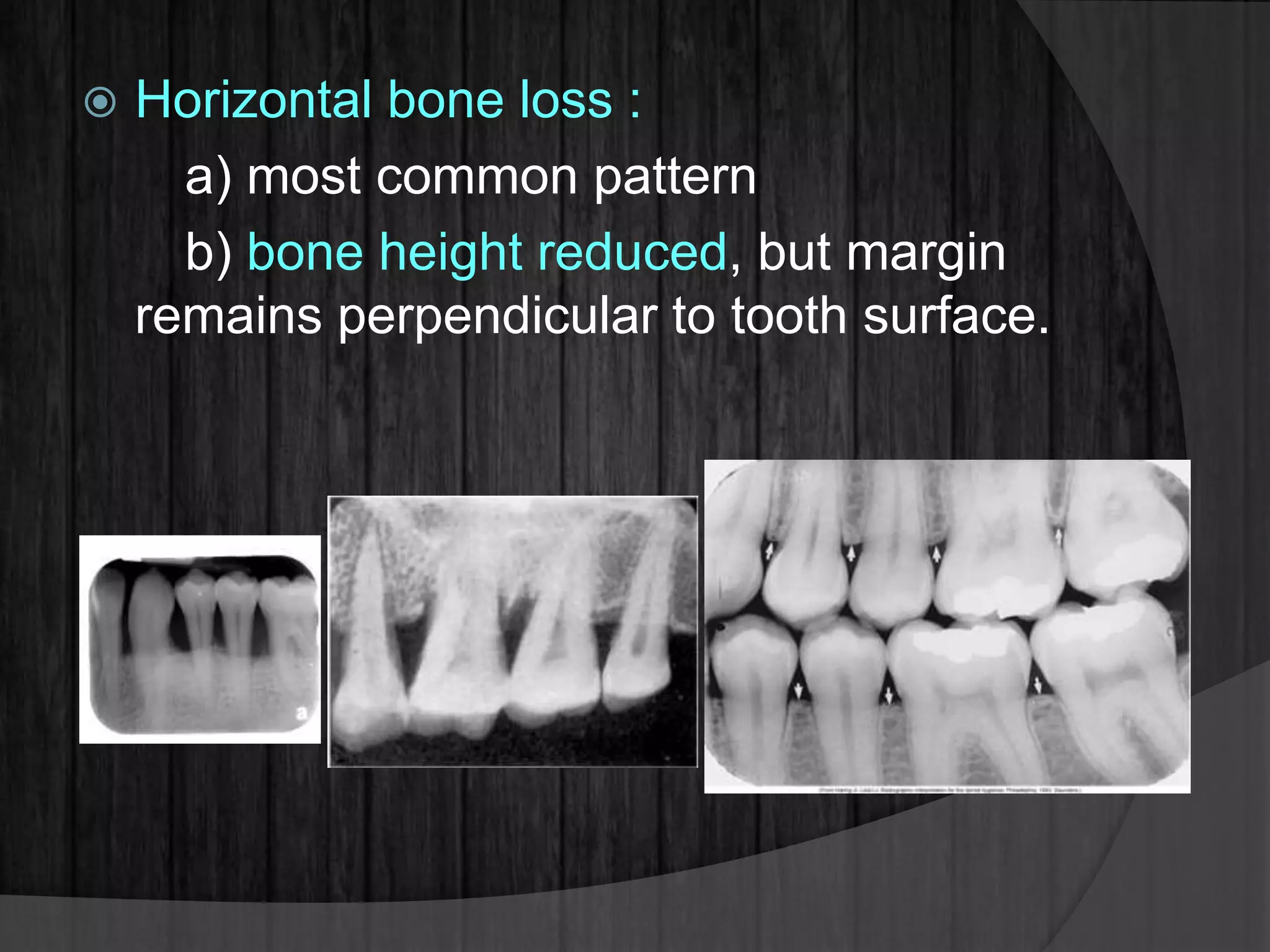
 Horizontal bone loss :
a) most common pattern
b) bone height reduced, but margin
remains perpendicular to tooth surface.
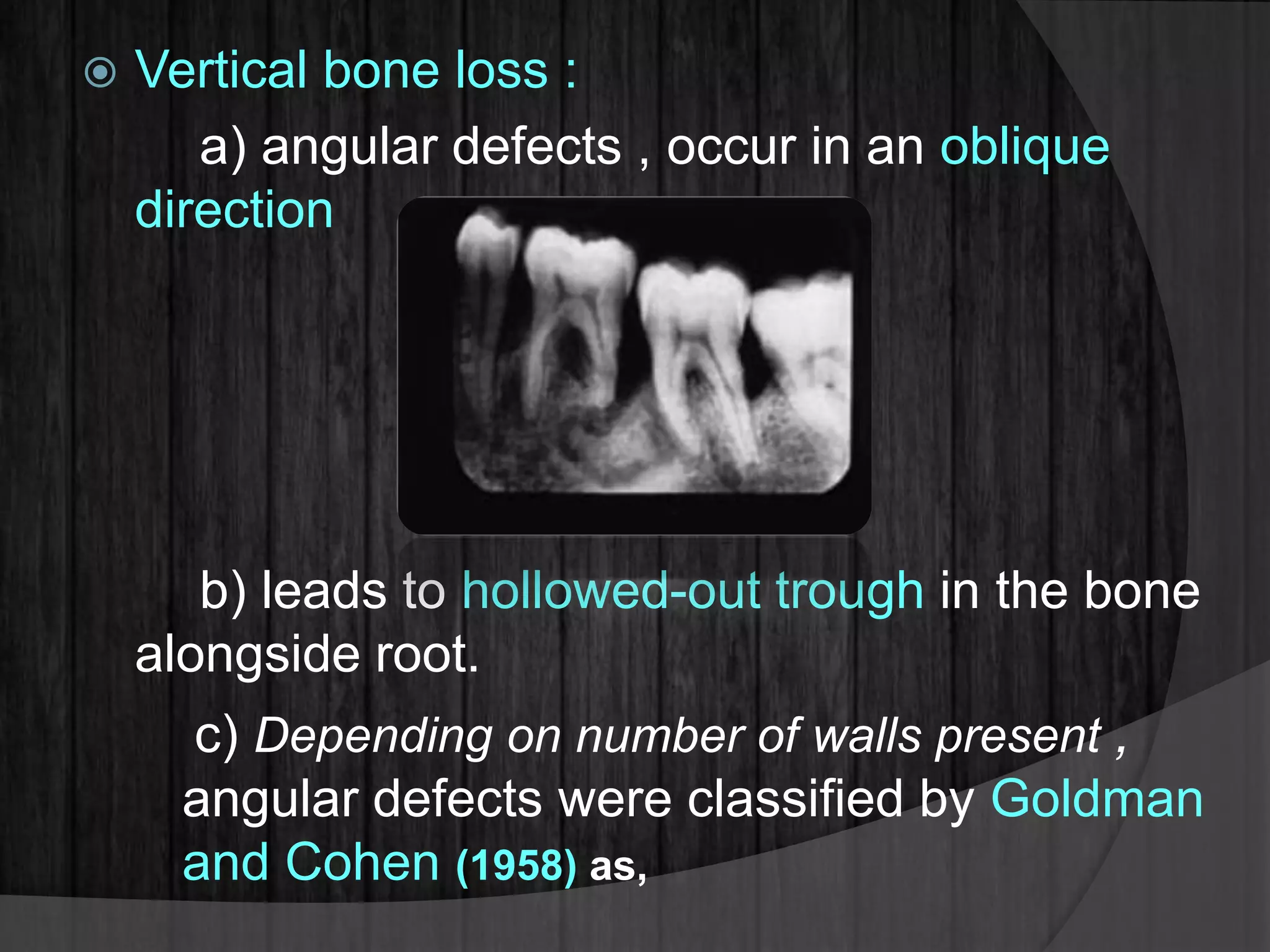
 Vertical bone loss :
a) angular defects , occur in an oblique
direction
b) leads to hollowed-out trough in the bone
alongside root.
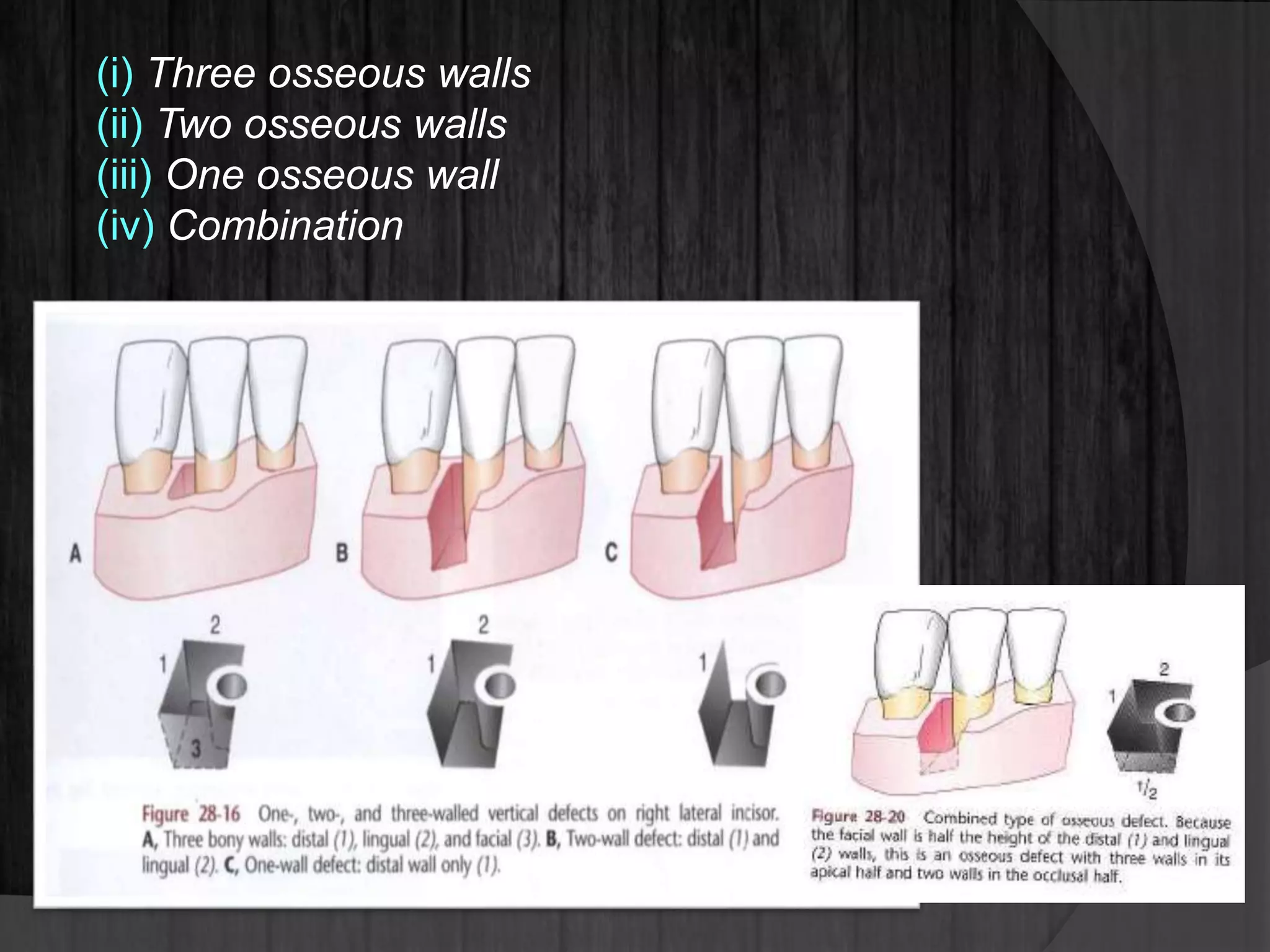
c) Depending on number of walls present ,
angular defects were classified by Goldman
and Cohen (1958) as,
(i) Three osseous walls
(ii) Two osseous walls
(iii) One osseous wall
(iv) Combination
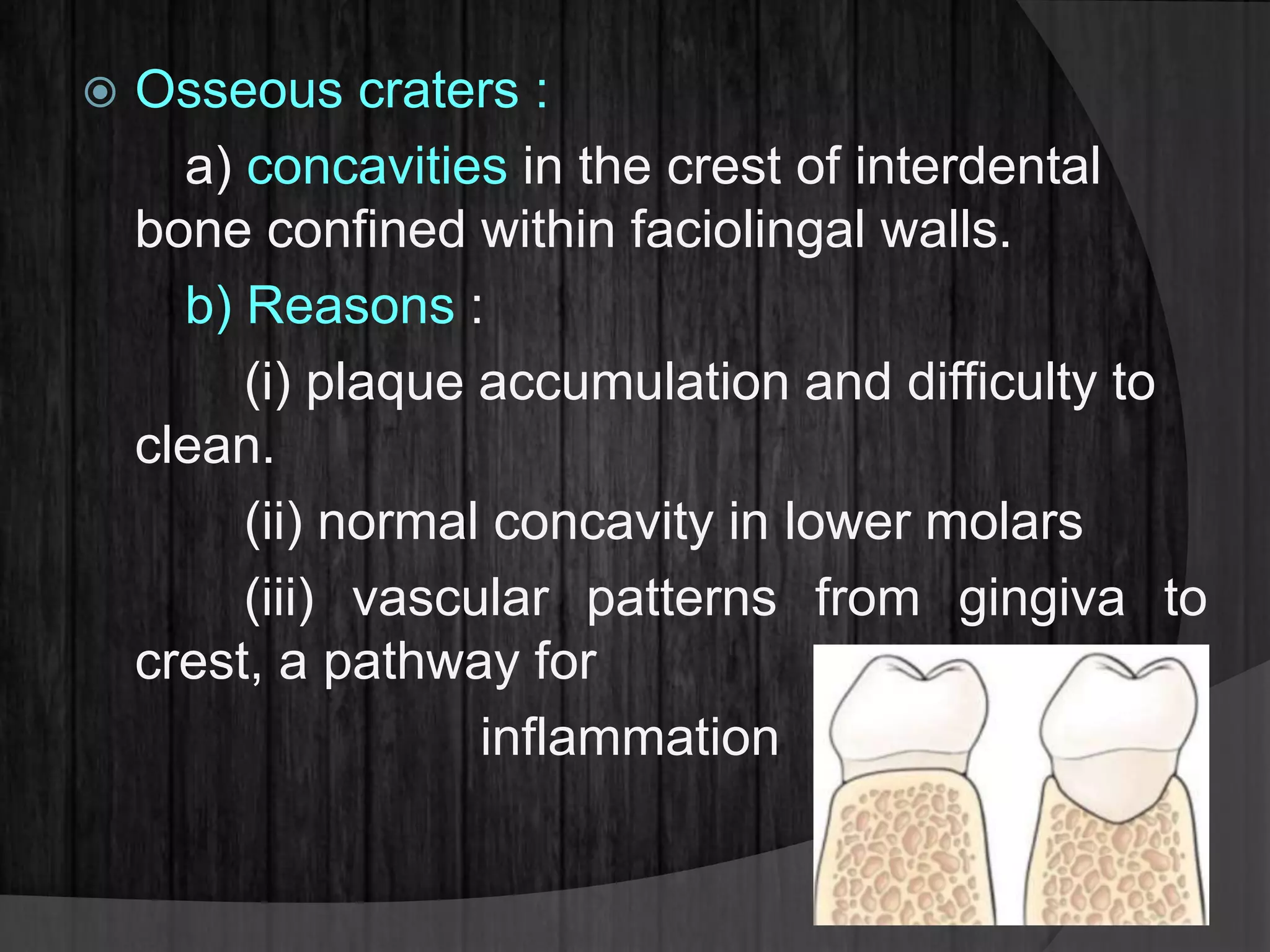
 Osseous craters :
a) concavities in the crest of interdental
bone confined within faciolingal walls.
b) Reasons :
(i) plaque accumulation and difficulty to
clean.
(ii) normal concavity in lower molars
(iii) vascular patterns from gingiva to
crest, a pathway for
inflammation
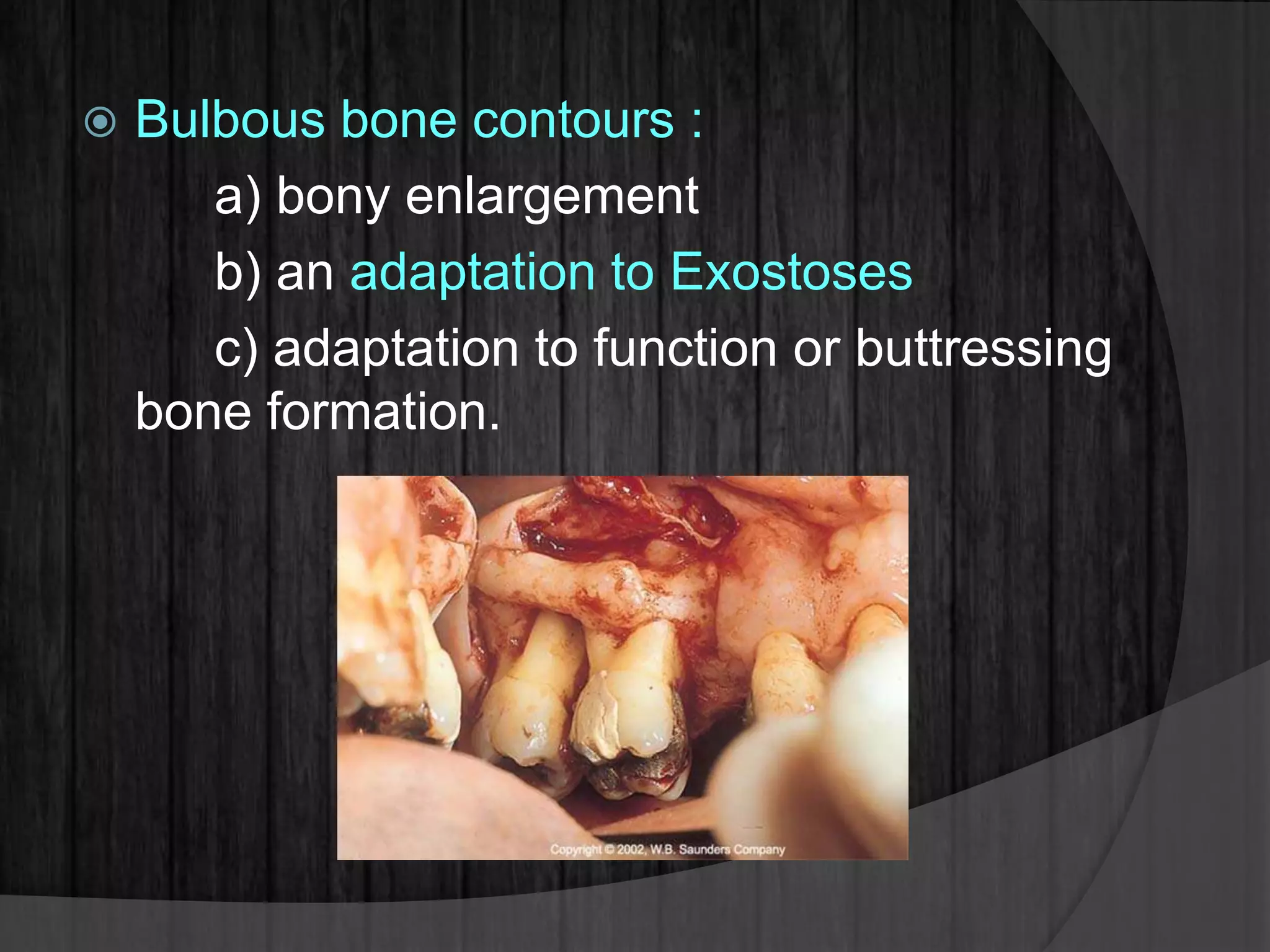
 Bulbous bone contours :
a) bony enlargement
b) an adaptation to Exostoses
c) adaptation to function or buttressing
bone formation.
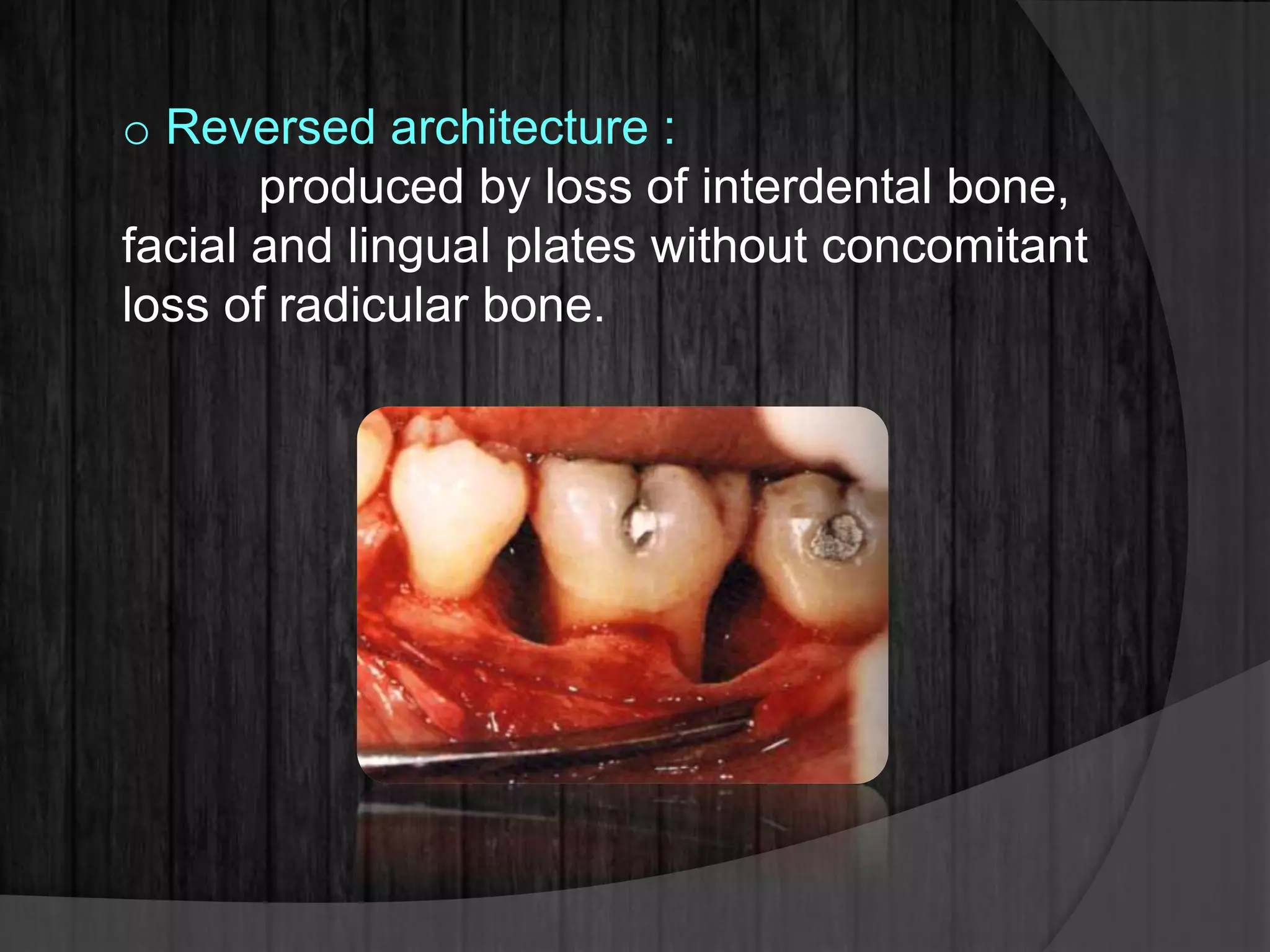
o Reversed architecture :
produced by loss of interdental bone,
facial and lingual plates without concomitant
loss of radicular bone.
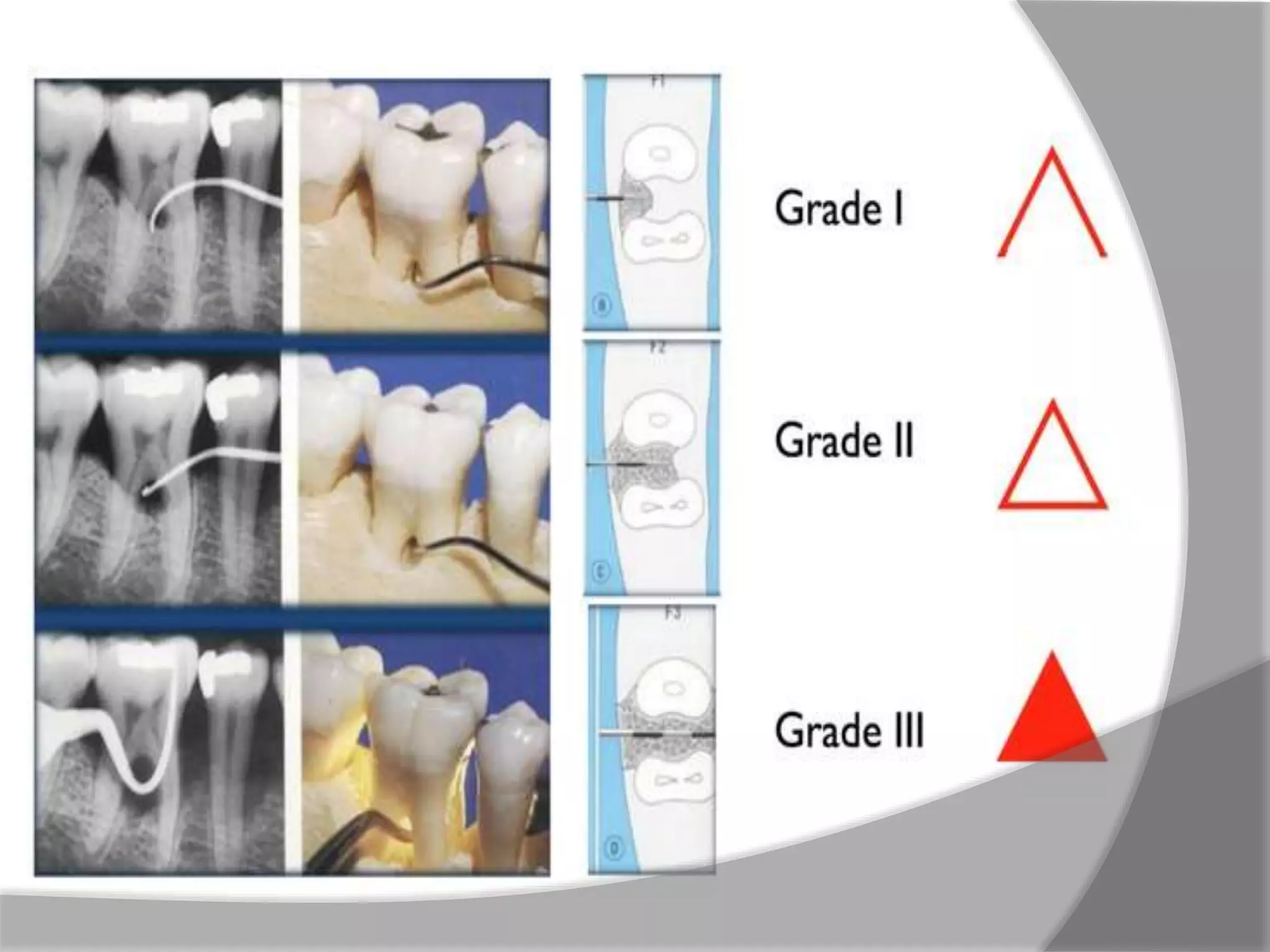
 Furcation involvement :
Invasion of bifurcation or trifurcation of
multirooted teeth by periodontal disease.
Clinical features-
(i) Grade 1 : incipient bone loss
(ii) Grade 2 : partial bone loss
(iii) Grade 3 : total bone loss with through
and through opening of furcation
(iv) Grade 4 : similar to grade 3,with gingival
recession exposing the furcation to view.
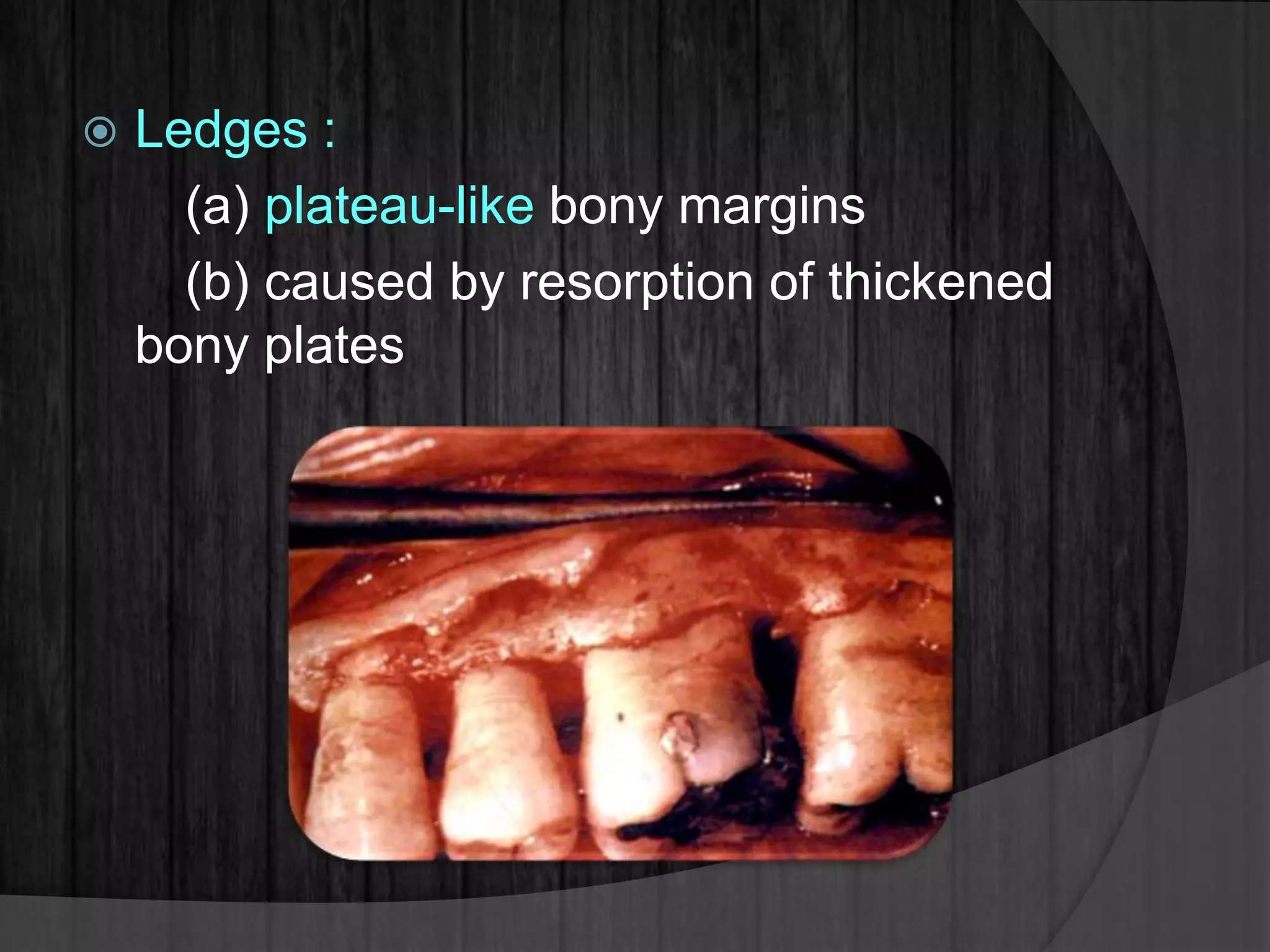
 Ledges :
(a) plateau-like bony margins
(b) caused by resorption of thickened
bony plates
CONCLUSIO
N-
 Although periodontitis is an infectious
disease of the gingival tissue , changes that
occur in bone are crucial because
destruction of bone is responsible for tooth
loss.
 Bone loss patterns associated with
periodontal disease is varied and the type of
management depends upon the type of loss.
Bone loss and patterns of bone destruction

Bone loss and patterns of bone destruction

  • 1.
  • 2.
    INTRODUCTIO N- The heightand density of alveolar bone are normally maintained by an equilibrium.  Regulated by local and systemic influences , between bone formation and resorption.  When resorption exceeds formation, both bone height and density is reduced
  • 3.
    Causes of bonedestruction- (in periodontal disease) 1) Extension Of Gingival Inflammation 2) Trauma from occlusion(TFO) 3) Systemic disorders
  • 4.
    1) Bone DestructionCaused By Extension Of Gingival Inflammation  “Periodontitis is always preceded by gingivitis, but not all gingivitis progress to periodontitis”  Most common cause  Extension of inflammation from marginal gingiva to supporting tissues.
  • 5.
     The transitionfrom gingivitis to periodontitis is associated with changes in composition of bacterial plaque. GINGIVITIS PERIODONTITIS COMP. OF PLAQUE Coccoid rods , straight rods spirochetes CELLS (By Heijl) Plasma cells PMNs
  • 6.
     HISTOPATHOLOGY : Areaof inflammation extending from gingiva into suprabony area. course : along collagen bundle fibres, blood vessels, loosely arranged tissues.
  • 7.
    PATHWAYS OF INFLAMMATION : Faciallyand Lingually, 1) Gingiva to outer periosteum 2) Periosteum to bone 3) Gingiva to PDL
  • 8.
    After inflammation reachesthe bone, it spreads into the marrow spaces and replaces the marrow with a leukocytic and fluid exudate, new blood vessels and proliferating fibroblasts. Multinuclear osteoclasts and mononuclear phagocytes increase in number, and the bone surfaces appear, lined with Howship lacunae. In the marrow spaces, resorption proceeds from within, causing a thinning of the surrounding bony trabeculae and enlargement of the marrow spaces, followed by destruction of the bone and a reduction in bone height .
  • 9.
  • 10.
    RATE OF BONELOSS  Loe et al in 1986 , found rate of bone loss to average about # 0.2 mm/year for facial surfaces # 0.3 mm/year for proximal when periodontal disease was allowed to progress untreated .
  • 11.
    PERIODS OF DESTRUCTION- Periodontaldestruction occurs in episodic and intermittent manner. Periods of inactivity & destruction. Destructive activity , results in, loss of collagen & alveolar bone. Followed by an advanced host defense that controls the attack.
  • 12.
    MECHANISM OF BONE DESTRUCTION- Bonedestruction Bacterial Differentiation of bone progenitor cells into osteoclasts Inhibit action of osteoblasts Host-mediated Releases PGE2, IL-1α,IL-1β,TNF-α
  • 13.
    2) BONE DESTRUCTION CAUSEDBY TRAUMA FROM OCCLUSION -  Periodontal response to the external force.  TFO can occur in presence or absence of inflammation.  In the absence, effects on alveolar bone ranges from resorption to necrosis.  Persistent TFO results in angular defects of the bone.
  • 14.
     When combinedwith inflammation, i.e. ZONE OF CO-DESTRUCTION,  Plaque induced inflammation entering into the zone of trauma from occlusion(supporting structures).  Results in angular bone defects, bizarre bone pattern.
  • 15.
    3) BONE DESTRUCTION CAUSEDBY SYSTEMIC DISORDERS -  Possible relationship between periodontal bone loss and systemic disorders.  OSTEOPOROSIS : loss of bone mineral content and structural bone changes. Risk factors- ageing,smoking,etc  OSTEOPENIA : tooth mobility and tooth loss  Hyperparathyroidism, leukopenia
  • 16.
    FACTORS DETERMINING BONE MORPHOLOGYIN PERIODONTAL DISEASE- 1) Normal variation of alveolar bone : a) thickness,width,crestal angulation of interdental septa b) thickness of facial & lingual septa c) presence of fenestrations & dehiscences
  • 17.
    2) Exostoses : a)overgrowths of bone b) they can occur as small or large nodules, sharp ridges , spike-like projections.
  • 18.
    3) TFO : a)thickening of cervical margin of alveolar bone. b) angular defects or buttressing bone.
  • 19.
    c) buttressing boneformation occurs during the repair phase of TFO d) host reinforces thin trabeculae with new bone e) when it occurs within the jaw , it is central buttressing bone formation. f) when it occurs on external surface, peripheral buttressing bone formation. g) results in bulbous bone contours(lipping) and osseous craters.
  • 20.
    4) Food impaction: a) interdental bone defects occur when there is abnormal or absence of proximal contact. b) food impaction here , results in inverted bone architecture. 5) Aggressive periodontitis : a) vertical or angular bone defects.
  • 21.
    BONE DESTRUCTION PATTERN - 1)Vertical or angular defects 2) Osseous craters 3) Bulbous bone contours 4) Reverse architecture 5) Ledges 6) Furcation involvement
  • 22.
     Horizontal boneloss : a) most common pattern b) bone height reduced, but margin remains perpendicular to tooth surface.
  • 23.
     Vertical boneloss : a) angular defects , occur in an oblique direction b) leads to hollowed-out trough in the bone alongside root. c) Depending on number of walls present , angular defects were classified by Goldman and Cohen (1958) as,
  • 24.
    (i) Three osseouswalls (ii) Two osseous walls (iii) One osseous wall (iv) Combination
  • 25.
     Osseous craters: a) concavities in the crest of interdental bone confined within faciolingal walls. b) Reasons : (i) plaque accumulation and difficulty to clean. (ii) normal concavity in lower molars (iii) vascular patterns from gingiva to crest, a pathway for inflammation
  • 26.
     Bulbous bonecontours : a) bony enlargement b) an adaptation to Exostoses c) adaptation to function or buttressing bone formation.
  • 27.
    o Reversed architecture: produced by loss of interdental bone, facial and lingual plates without concomitant loss of radicular bone.
  • 28.
     Furcation involvement: Invasion of bifurcation or trifurcation of multirooted teeth by periodontal disease. Clinical features- (i) Grade 1 : incipient bone loss (ii) Grade 2 : partial bone loss (iii) Grade 3 : total bone loss with through and through opening of furcation (iv) Grade 4 : similar to grade 3,with gingival recession exposing the furcation to view.
  • 30.
     Ledges : (a)plateau-like bony margins (b) caused by resorption of thickened bony plates
  • 31.
    CONCLUSIO N-  Although periodontitisis an infectious disease of the gingival tissue , changes that occur in bone are crucial because destruction of bone is responsible for tooth loss.  Bone loss patterns associated with periodontal disease is varied and the type of management depends upon the type of loss.