1
Connective tissue graft associated or not with low laser therapy to
treat gingival recession: randomized clinical trial
Fernandes-Dias SB, de Marco AC, Santamaria Junior M et al.
JCP 2015.
Presented By:
Shilpa Shivanand
II MDS
INTRODUCTION
 The presence of gingival recession may bring many negative effects,
such as dentin hypersensitivity, aesthetic complaints, and
predisposition to root caries and non-carious cervical lesions
(Toffenetti et al 1998, Goldstein et al 2002)
 The coronally positioned flap (CAF) and connective tissue graft
techniques (CTG) are the most predictable techniques, reaching up
to 100% root coverage.
3
Introduction…
 However, even the most predictable techniques demonstrate some
variability in their results among studies, with averages ranging
between 60 and 96% of root coverage.
 It may be explained by several factors: (1) different training
levels of operators; (2) local anatomic factors of recessions (such
as the height and width of the papilla, and tissue thickness); and
(3) differences in the wound healing potential of each patient.
(Santamaria et al 2010, Cortellini & Pini Prato 2012,Vignoletti et
al 2014)
4
LOW LEVEL LASER THERAPY
 Low-level laser therapy (LLLT) has been successfully used to
photobiostimulate and to accelerate wound healing in humans.
 The wound healing after surgery procedures involves several
biological events that can be improved by LLLT, such increased
motility of human keratinocytes, enhanced neovascularization of
tissue, increased fibroblast proliferation, maturation, and
attachment.
(Khadra et al 2005, Ozturan et al 2011)
5
LLLT…..
 These effects may contribute to the higher tensile strengths of
gingival flap margins, which may subsequently minimize the soft
tissue recession, increasing the results of procedures for root
coverage.
 Several studies have indicated a wavelength between 600 and 840
nm to be the most effective for biostimulation.
(Karu 1998)
6
AIM
 Thus, the aim of this study was to evaluate the 6-month outcomes
of applying low-intensity laser therapy associated with
connective tissue grafts to treat gingival recession.
7
MATERIALS AND METHODS
 This investigation was designed as a parallel, double-blind,
randomized clinical trial.
 The study protocol (ClinicalTrial.org-NCT02118155) was
approved by the Institutional Review Board of State University of
Sao Paulo (CEP-UNESP).
 Informed consent was signed by each subject after a thorough
explanation of the nature, risks, and benefits of the clinical
investigation.
8
STUDY POPULATION
9
 Forty patients from the Periodontology Clinic of UNESP – State
University of Sao Paulo (Sao Jose dos Campos, Brazil),
presenting 40 maxillary buccal gingival recessions in their
canines and premolars were included in the study.
SUBJECTS
INCLUSION CRITERIA
 Miller Class I or II gingival recession in the maxillary canines or
premolars
 Visible cemento- enamel junction (CEJ) with pulp vitality
 Patients presenting no signs of active periodontal disease and full-
mouth plaque and bleeding score ≤20%
 Patients older than 18 years
 Probing depth <3 mm in the included teeth
 Patients who agreed to participate and signed an informed consent.
 If patient presented multiple recessions, only the deepest recession
was treated.
10
SUBJECTS
EXCLUSION CRITERIA
 Patients with systemic problems that wound contraindicate the
surgical procedure
 Patients taking medications known to interfere with the wound-
healing process or that contraindicate the surgical procedure
 Smokers or pregnant women
 Patients who underwent periodontal surgery in the area of interest
 Patients with orthodontic therapy in progress.
11
CONSORT FLOW CHART OF THE STUDY
12
CLINICAL ASSESSMENTS
13
 The primary endpoint of this trial was the percentage of root
coverage at 6 months.
 After the initial therapy, the following parameters were recorded:
 (1) full-mouth plaque index
 (2) full-mouth sulcus bleeding index
 (3) presence or absence of bleeding on probing (BOP)
 (4) probing depth (PD)
 (5) relative gingival recession (RGR) measured as the distance
from the gingival margin to the incisal border of the tooth
CLINICAL ASSESSMENTS…..
14
 (5) relative clinical attachment level (CAL) as PD + RGR
 (6) gingival recession (GR), measured at the midbuccal of the
tooth (the GR and RGR were measured using a pair of dividers
and quantified by a digital caliper with 0.01-mm precision)
 (7) keratinized tissue width (KTW), distance from the gingival
margin to the mucogingival junction
 (8) keratinized tissue thickness (KTT) was measured at the
midpoint location between the gingival margin and mucogingival
junction
 (9) dentin sensitivity (DS) was assessed by an air blast from a
triple syringe. The air blast was applied to the exposed buccal
cervical area for 5 s.
CLINICAL ASSESSMENTS…..
15
 A VAS scale was used to record the DS related to the stimuli.
 The presence or absence of plaque, BOP, PD, RGR, CAL, and
DS was measured at the baseline, 3 and 6 months after surgery.
 KTW and KTT were measured at baseline and 6 months
postoperative.
SURGICAL PROCEDURE
16
 The gingival recession defects were treated by either connective
tissue graft alone (CTG: control group; n = 20) or CTG plus
application of LLLT (CTG + L: test group; n = 20).
 The exposed root surface was gently scaled and planed to remove
any possible irregularities. Afterwards, a thin and small
connective tissue graft was sutured over the root surface, in such
a way that covered the CEJ and the recession.
 Then, the flap was coronally positioned and sutured to
completely cover the graft.
LASER PROTOCOL
17
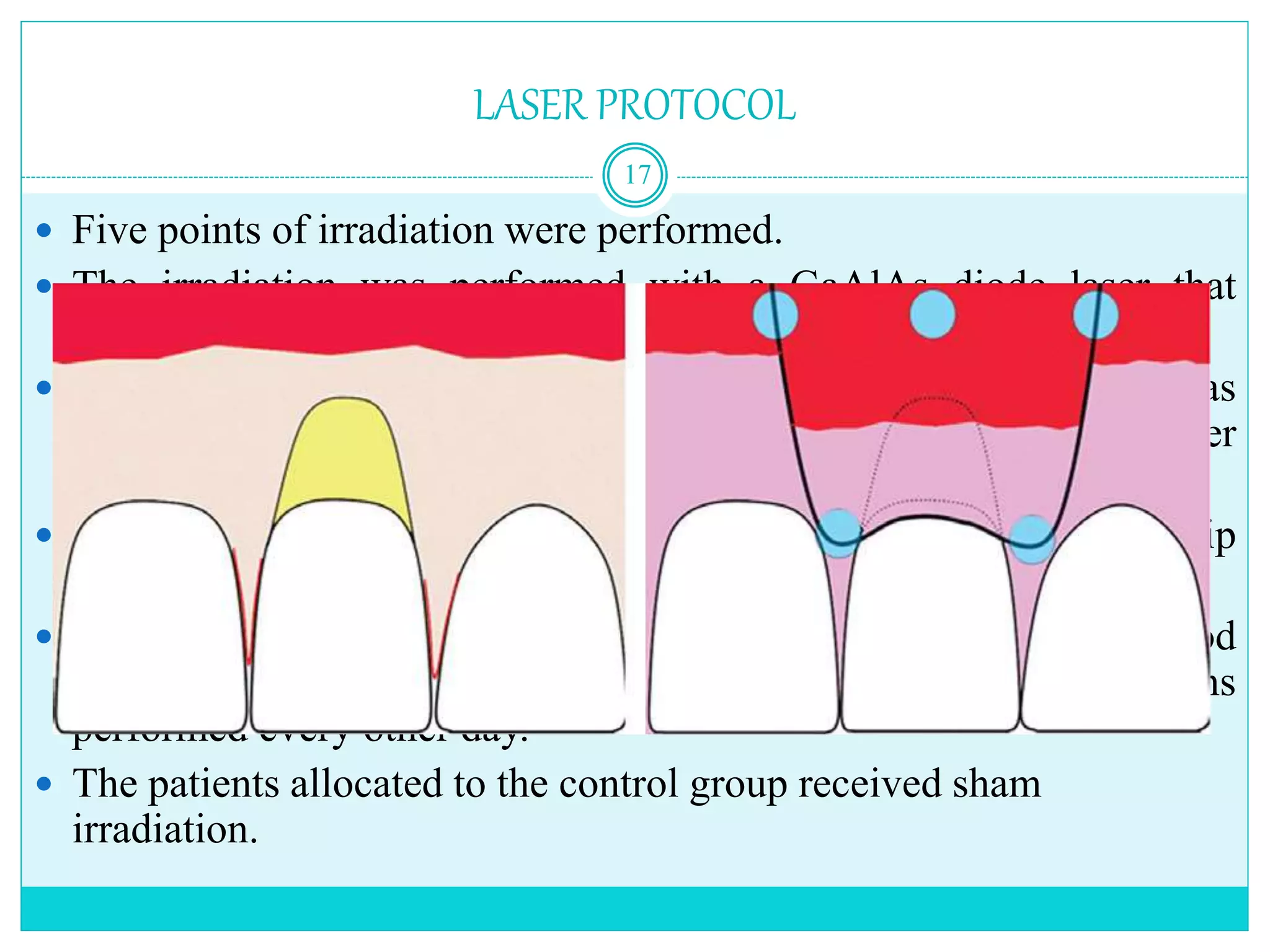
 Five points of irradiation were performed.
 The irradiation was performed with a GaAlAs diode laser that
continuously emitted a wavelength of 660 nm.
 30 mW was used for 20 s, and the total applied energy density was
15 J/cm2 (3 J/cm2 per point and an application time of 4 s per
point).
 The applications were performed using punctual contact with the tip
perpendicular to the gingival tissue.
 Laser therapy was initiated in the immediate postoperative period
(just after sutures) and was followed by seven more applications
performed every other day.
 The patients allocated to the control group received sham
irradiation.
POSTOPERATIVE CARE
18
 After the surgery, the participants were instructed to take 500 mg
of ibuprofen TID for 3 days, in case of pain, and to discontinue
tooth brushing around the surgical sites during the initial 14 days
after surgery.
 During this period, plaque control was performed using 0.12%
chlorhexidine rinse used twice a day.
 The sutures were removed after 7 days.
STATISTICAL ANALYSIS
 Descriptive statistics were expressed as mean ± standard
deviation (SD).
 The PD, RGR, CAL, KTT, KTW, and DS values were examined
by two-way repeated measures ANOVA to evaluate the
differences within and between groups, followed by a Tukey test
for multiple comparisons.
19
RESULTS
 Clinical parameters at baseline (BL), 3 and 6 months
20
RESULTS….
 Changes in clinical parameters after 6 months, the postoperative
pain, and the number of analgesic pills after 7 days
21
RESULTS….
22
 Mean values and standard deviation of aesthetic evaluation
 RES- root esthetic score (3 points were given for partial root coverage,
6 points for complete root coverage; 0 were assigned when the final
position of the gingival margin was equal or apical to the previous
recession.
 QCE-qualitative cosmetic scale (1-10cm line; 1- poor, 10- excellent)
23
CTG+L
CTG
Baseline
Baseline
6 months
6 months
DISCUSSION
 The aim of this study was to evaluate the 6-month outcomes of
CTG associated with LLLT application for the treatment of
gingival recessions.
 The present data indicate that LLLT may increase the
predictability of CTG, with significantly higher percentages of
CRC.
 The number of shallow (2.5– 3 mm) recessions allocated to the
test group was greater than in the control group (10 and 5,
respectively).
 This may have contributed to this result.
24
DISCUSSION…..
 Our findings are in accordance with a previous study that
described the positive adjunctive effect of low-laser
biostimulation associated with a coronally advanced flap for root
coverage.
 In this study, Ozturan showed that irradiation using a diode laser
with a 588 nm wavelength and 4.0 J/cm2 of power density after
the CAF procedure statistically produced more complete root
coverage than in the control group.
25
DISCUSSION…..
 Studies have shown that the use of low doses (3–6 J/cm2)
stimulates wound healing by increasing fibroblast proliferation
and collagen synthesis, and decreasing inflammation and edema.
(Medrado et al 2003, Almeida et al 2009, Costa et al 2010)
 The clinical data of the present study suggest that 15 J/cm2 of
energy density may also be suitable for periodontal root coverage
surgery.
26
DISCUSSION…..
 Most studies utilizing LLLT in tissue repair employ wavelengths
within the red visible spectrum (622–780 nm) and show significant
benefits in tissue repair within that spectrum.
 Garcia suggested that the effect of laser biostimulation on wound
healing may be due to the high absorption of 660-nm-wavelength
lasers by cytochrome oxidase (the primary photoreceptor of the
respiratory chain), resulting in increased production of ATP in
cellular metabolism and in DNA synthesis.
Garcia et al 2012
 Furthermore, there is an increase in fibroblastic proliferation and the
early formation of granulation tissue.
27
DISCUSSION….
28
 Some studies have suggested that LLLT also decreases
inflammation and edema, providing a more comfortable
postoperative experience to the patient with less edema and lower
levels of pain.
Enwemeka et al 2004, Sanz-Moliner et al 2013
 In periodontics, LLLT may be used with periodontal surgeries to
accelerate the healing process, promote analgesia, and reduce
postoperative discomfort.
DISCUSSION….
29
 Few studies have assessed DS after root coverage procedures.
 Some of these studies did not find statistically significant
differences after root coverage (Cortellini et al 2009)
 However, other authors (de Oliveira et al 2013, Santamaria et al
2009) have observed that the surgical procedures for root
coverage may reduce DS and improve patient quality of life; this
may be related to the fact that most of the exposed roots achieve
complete root coverage, thus sealing the exposed dentinal tubules
and reducing the chances of symptoms.
CONCLUSION
30
 Within the limits of this study, it can be concluded that LLLT may
have minimal additional benefits in terms of CRC when
compared to the CTG alone to treat Miller Class I and II gingival
recession.
CRITICAL EVALUATION
1. No explanation of surgical technique is elaborated.
2. No clinical photographs provided.
3. Morbidity is more  second surgical site (palate).
4. Measurements  no stent used.
5. Laser application points  represented diagrammatically, not
explained with respect to reference points.
31
CROSS REFERENCES
I. Coronally advanced flap adjunct with low intensity laser
therapy: a randomized controlled clinical pilot study.
Ozturan S et al, JCP 2011.
AIM:
 Coronally advanced flap (CAF) technique and its modifications
have been proposed in the literature. Low intensity laser therapy
(LILT) is shown to increase wound healing. The aim of this split
mouth randomized controlled pilot study was to assess the effects of
LILT with respect to root coverage after CAF procedure for the
treatment of multiple recession type defects (MRTD).
MATERIALS & METHODS:
 Ten patients with symmetrical 74 Miller I and II gingival recessions
were included in this study (37 in test, 37 in control group). A diode
laser (588 nm) was applied to test sites before and immediately after
surgery, and for 5 min. daily 7 days postoperatively. Comparisons of
the surgical sites were made with clinical measurements.
33
RESULTS:
 Statistically significant differences were observed between test and
control sites in the gingival recession depth (GRD), gingiva
recession width (GRW) and width of the keratinized tissue (WKT)
and clinical attachment level (CAL) measurements after 1 year (p =
0.014, p = 0.015, p = 0.009 and p = 0.018 respectively). The test
group presented greater complete root coverage (n = 7, 70%)
compared with the control group (n = 3, 30%) after treatment.
CONCLUSION:
 Within the limitations of this study, the results indicated that LILT
may improve the predictability of CAF in multiple recessions.
34
II. Utilization of low intensity laser during healing of free gingival
grafts. Almeida AL et al, Photomed Laser Surg 2009
AIM:
 This study evaluates the action of a low intensity diode laser with
gallium aluminum arsenide (GaAlAs) active medium on the healing
process and analgesia in individuals undergoing free gingival grafts.
 MATERIALS & METHODS:
 Ten individuals needing bilateral gingival graft in the mandibular
arch were enrolled in a double blind study. Each individual had a
30d interval between the two surgeries. The side receiving
application of laser was defined as test side and was established
upon surgery; laser application was simulated on the control side.
The laser was applied in the immediate postoperative period and
after 48 h, and patients rated pain on a scale of 0 to 10, representing
minimal and maximal pain, respectively. Photographs were obtained
at 7, 15, 30, and 60 d postop and evaluated.
35
RESULTS:
 No statistically significant difference was found at any
postoperative period between control and test sides, even though
greater clinical improvement associated with treatment was
observed at 15 d postoperative. At 30 and 60 d, some examiners
observed the same or greater clinical improvement for the
control. Only one individual reported mild to moderate pain on
the first postoperative day.
CONCLUSION:
 Low intensity laser therapy did not improve the healing of
gingival grafts and did not influence analgesia.
36
37

Journal club on Connective tissue graft associated or not with low laser therapy to treat gingival recession: randomized clinical trial

  • 1.
  • 2.
    Connective tissue graftassociated or not with low laser therapy to treat gingival recession: randomized clinical trial Fernandes-Dias SB, de Marco AC, Santamaria Junior M et al. JCP 2015. Presented By: Shilpa Shivanand II MDS
  • 3.
    INTRODUCTION  The presenceof gingival recession may bring many negative effects, such as dentin hypersensitivity, aesthetic complaints, and predisposition to root caries and non-carious cervical lesions (Toffenetti et al 1998, Goldstein et al 2002)  The coronally positioned flap (CAF) and connective tissue graft techniques (CTG) are the most predictable techniques, reaching up to 100% root coverage. 3
  • 4.
    Introduction…  However, eventhe most predictable techniques demonstrate some variability in their results among studies, with averages ranging between 60 and 96% of root coverage.  It may be explained by several factors: (1) different training levels of operators; (2) local anatomic factors of recessions (such as the height and width of the papilla, and tissue thickness); and (3) differences in the wound healing potential of each patient. (Santamaria et al 2010, Cortellini & Pini Prato 2012,Vignoletti et al 2014) 4
  • 5.
    LOW LEVEL LASERTHERAPY  Low-level laser therapy (LLLT) has been successfully used to photobiostimulate and to accelerate wound healing in humans.  The wound healing after surgery procedures involves several biological events that can be improved by LLLT, such increased motility of human keratinocytes, enhanced neovascularization of tissue, increased fibroblast proliferation, maturation, and attachment. (Khadra et al 2005, Ozturan et al 2011) 5
  • 6.
    LLLT…..  These effectsmay contribute to the higher tensile strengths of gingival flap margins, which may subsequently minimize the soft tissue recession, increasing the results of procedures for root coverage.  Several studies have indicated a wavelength between 600 and 840 nm to be the most effective for biostimulation. (Karu 1998) 6
  • 7.
    AIM  Thus, theaim of this study was to evaluate the 6-month outcomes of applying low-intensity laser therapy associated with connective tissue grafts to treat gingival recession. 7
  • 8.
    MATERIALS AND METHODS This investigation was designed as a parallel, double-blind, randomized clinical trial.  The study protocol (ClinicalTrial.org-NCT02118155) was approved by the Institutional Review Board of State University of Sao Paulo (CEP-UNESP).  Informed consent was signed by each subject after a thorough explanation of the nature, risks, and benefits of the clinical investigation. 8
  • 9.
    STUDY POPULATION 9  Fortypatients from the Periodontology Clinic of UNESP – State University of Sao Paulo (Sao Jose dos Campos, Brazil), presenting 40 maxillary buccal gingival recessions in their canines and premolars were included in the study.
  • 10.
    SUBJECTS INCLUSION CRITERIA  MillerClass I or II gingival recession in the maxillary canines or premolars  Visible cemento- enamel junction (CEJ) with pulp vitality  Patients presenting no signs of active periodontal disease and full- mouth plaque and bleeding score ≤20%  Patients older than 18 years  Probing depth <3 mm in the included teeth  Patients who agreed to participate and signed an informed consent.  If patient presented multiple recessions, only the deepest recession was treated. 10
  • 11.
    SUBJECTS EXCLUSION CRITERIA  Patientswith systemic problems that wound contraindicate the surgical procedure  Patients taking medications known to interfere with the wound- healing process or that contraindicate the surgical procedure  Smokers or pregnant women  Patients who underwent periodontal surgery in the area of interest  Patients with orthodontic therapy in progress. 11
  • 12.
    CONSORT FLOW CHARTOF THE STUDY 12
  • 13.
    CLINICAL ASSESSMENTS 13  Theprimary endpoint of this trial was the percentage of root coverage at 6 months.  After the initial therapy, the following parameters were recorded:  (1) full-mouth plaque index  (2) full-mouth sulcus bleeding index  (3) presence or absence of bleeding on probing (BOP)  (4) probing depth (PD)  (5) relative gingival recession (RGR) measured as the distance from the gingival margin to the incisal border of the tooth
  • 14.
    CLINICAL ASSESSMENTS….. 14  (5)relative clinical attachment level (CAL) as PD + RGR  (6) gingival recession (GR), measured at the midbuccal of the tooth (the GR and RGR were measured using a pair of dividers and quantified by a digital caliper with 0.01-mm precision)  (7) keratinized tissue width (KTW), distance from the gingival margin to the mucogingival junction  (8) keratinized tissue thickness (KTT) was measured at the midpoint location between the gingival margin and mucogingival junction  (9) dentin sensitivity (DS) was assessed by an air blast from a triple syringe. The air blast was applied to the exposed buccal cervical area for 5 s.
  • 15.
    CLINICAL ASSESSMENTS….. 15  AVAS scale was used to record the DS related to the stimuli.  The presence or absence of plaque, BOP, PD, RGR, CAL, and DS was measured at the baseline, 3 and 6 months after surgery.  KTW and KTT were measured at baseline and 6 months postoperative.
  • 16.
    SURGICAL PROCEDURE 16  Thegingival recession defects were treated by either connective tissue graft alone (CTG: control group; n = 20) or CTG plus application of LLLT (CTG + L: test group; n = 20).  The exposed root surface was gently scaled and planed to remove any possible irregularities. Afterwards, a thin and small connective tissue graft was sutured over the root surface, in such a way that covered the CEJ and the recession.  Then, the flap was coronally positioned and sutured to completely cover the graft.
  • 17.
    LASER PROTOCOL 17  Fivepoints of irradiation were performed.  The irradiation was performed with a GaAlAs diode laser that continuously emitted a wavelength of 660 nm.  30 mW was used for 20 s, and the total applied energy density was 15 J/cm2 (3 J/cm2 per point and an application time of 4 s per point).  The applications were performed using punctual contact with the tip perpendicular to the gingival tissue.  Laser therapy was initiated in the immediate postoperative period (just after sutures) and was followed by seven more applications performed every other day.  The patients allocated to the control group received sham irradiation.
  • 18.
    POSTOPERATIVE CARE 18  Afterthe surgery, the participants were instructed to take 500 mg of ibuprofen TID for 3 days, in case of pain, and to discontinue tooth brushing around the surgical sites during the initial 14 days after surgery.  During this period, plaque control was performed using 0.12% chlorhexidine rinse used twice a day.  The sutures were removed after 7 days.
  • 19.
    STATISTICAL ANALYSIS  Descriptivestatistics were expressed as mean ± standard deviation (SD).  The PD, RGR, CAL, KTT, KTW, and DS values were examined by two-way repeated measures ANOVA to evaluate the differences within and between groups, followed by a Tukey test for multiple comparisons. 19
  • 20.
    RESULTS  Clinical parametersat baseline (BL), 3 and 6 months 20
  • 21.
    RESULTS….  Changes inclinical parameters after 6 months, the postoperative pain, and the number of analgesic pills after 7 days 21
  • 22.
    RESULTS…. 22  Mean valuesand standard deviation of aesthetic evaluation  RES- root esthetic score (3 points were given for partial root coverage, 6 points for complete root coverage; 0 were assigned when the final position of the gingival margin was equal or apical to the previous recession.  QCE-qualitative cosmetic scale (1-10cm line; 1- poor, 10- excellent)
  • 23.
  • 24.
    DISCUSSION  The aimof this study was to evaluate the 6-month outcomes of CTG associated with LLLT application for the treatment of gingival recessions.  The present data indicate that LLLT may increase the predictability of CTG, with significantly higher percentages of CRC.  The number of shallow (2.5– 3 mm) recessions allocated to the test group was greater than in the control group (10 and 5, respectively).  This may have contributed to this result. 24
  • 25.
    DISCUSSION…..  Our findingsare in accordance with a previous study that described the positive adjunctive effect of low-laser biostimulation associated with a coronally advanced flap for root coverage.  In this study, Ozturan showed that irradiation using a diode laser with a 588 nm wavelength and 4.0 J/cm2 of power density after the CAF procedure statistically produced more complete root coverage than in the control group. 25
  • 26.
    DISCUSSION…..  Studies haveshown that the use of low doses (3–6 J/cm2) stimulates wound healing by increasing fibroblast proliferation and collagen synthesis, and decreasing inflammation and edema. (Medrado et al 2003, Almeida et al 2009, Costa et al 2010)  The clinical data of the present study suggest that 15 J/cm2 of energy density may also be suitable for periodontal root coverage surgery. 26
  • 27.
    DISCUSSION…..  Most studiesutilizing LLLT in tissue repair employ wavelengths within the red visible spectrum (622–780 nm) and show significant benefits in tissue repair within that spectrum.  Garcia suggested that the effect of laser biostimulation on wound healing may be due to the high absorption of 660-nm-wavelength lasers by cytochrome oxidase (the primary photoreceptor of the respiratory chain), resulting in increased production of ATP in cellular metabolism and in DNA synthesis. Garcia et al 2012  Furthermore, there is an increase in fibroblastic proliferation and the early formation of granulation tissue. 27
  • 28.
    DISCUSSION…. 28  Some studieshave suggested that LLLT also decreases inflammation and edema, providing a more comfortable postoperative experience to the patient with less edema and lower levels of pain. Enwemeka et al 2004, Sanz-Moliner et al 2013  In periodontics, LLLT may be used with periodontal surgeries to accelerate the healing process, promote analgesia, and reduce postoperative discomfort.
  • 29.
    DISCUSSION…. 29  Few studieshave assessed DS after root coverage procedures.  Some of these studies did not find statistically significant differences after root coverage (Cortellini et al 2009)  However, other authors (de Oliveira et al 2013, Santamaria et al 2009) have observed that the surgical procedures for root coverage may reduce DS and improve patient quality of life; this may be related to the fact that most of the exposed roots achieve complete root coverage, thus sealing the exposed dentinal tubules and reducing the chances of symptoms.
  • 30.
    CONCLUSION 30  Within thelimits of this study, it can be concluded that LLLT may have minimal additional benefits in terms of CRC when compared to the CTG alone to treat Miller Class I and II gingival recession.
  • 31.
    CRITICAL EVALUATION 1. Noexplanation of surgical technique is elaborated. 2. No clinical photographs provided. 3. Morbidity is more  second surgical site (palate). 4. Measurements  no stent used. 5. Laser application points  represented diagrammatically, not explained with respect to reference points. 31
  • 32.
  • 33.
    I. Coronally advancedflap adjunct with low intensity laser therapy: a randomized controlled clinical pilot study. Ozturan S et al, JCP 2011. AIM:  Coronally advanced flap (CAF) technique and its modifications have been proposed in the literature. Low intensity laser therapy (LILT) is shown to increase wound healing. The aim of this split mouth randomized controlled pilot study was to assess the effects of LILT with respect to root coverage after CAF procedure for the treatment of multiple recession type defects (MRTD). MATERIALS & METHODS:  Ten patients with symmetrical 74 Miller I and II gingival recessions were included in this study (37 in test, 37 in control group). A diode laser (588 nm) was applied to test sites before and immediately after surgery, and for 5 min. daily 7 days postoperatively. Comparisons of the surgical sites were made with clinical measurements. 33
  • 34.
    RESULTS:  Statistically significantdifferences were observed between test and control sites in the gingival recession depth (GRD), gingiva recession width (GRW) and width of the keratinized tissue (WKT) and clinical attachment level (CAL) measurements after 1 year (p = 0.014, p = 0.015, p = 0.009 and p = 0.018 respectively). The test group presented greater complete root coverage (n = 7, 70%) compared with the control group (n = 3, 30%) after treatment. CONCLUSION:  Within the limitations of this study, the results indicated that LILT may improve the predictability of CAF in multiple recessions. 34
  • 35.
    II. Utilization oflow intensity laser during healing of free gingival grafts. Almeida AL et al, Photomed Laser Surg 2009 AIM:  This study evaluates the action of a low intensity diode laser with gallium aluminum arsenide (GaAlAs) active medium on the healing process and analgesia in individuals undergoing free gingival grafts.  MATERIALS & METHODS:  Ten individuals needing bilateral gingival graft in the mandibular arch were enrolled in a double blind study. Each individual had a 30d interval between the two surgeries. The side receiving application of laser was defined as test side and was established upon surgery; laser application was simulated on the control side. The laser was applied in the immediate postoperative period and after 48 h, and patients rated pain on a scale of 0 to 10, representing minimal and maximal pain, respectively. Photographs were obtained at 7, 15, 30, and 60 d postop and evaluated. 35
  • 36.
    RESULTS:  No statisticallysignificant difference was found at any postoperative period between control and test sides, even though greater clinical improvement associated with treatment was observed at 15 d postoperative. At 30 and 60 d, some examiners observed the same or greater clinical improvement for the control. Only one individual reported mild to moderate pain on the first postoperative day. CONCLUSION:  Low intensity laser therapy did not improve the healing of gingival grafts and did not influence analgesia. 36
  • 37.

Editor's Notes

  • #23 RES This score evaluates five variables: level of the gingival margin, marginal tissue contour, soft tissue texture, mucogingival junction alignment, and gingival color. Because complete root coverage was the primary treatment goal, and the other variables were considered secondary, the value assigned for root coverage was 60% of the total score, whereas 40% was assigned to the other four variables. With regard to assessment of the final position of the gingival margin, 3 points were given for partial root coverage, and 6 points were given for complete root coverage; 0 points were assigned when the final position of the gingival margin was equal or apical to the previous recession. One point was assigned for each of the other four variables. Thus, 10 points was a perfect score.