RESEARCH & RESEARCH
PROCESS
Ms.K.Lavanya
MSc (N)- CHN
Associate Professor
Sources of Knowledge:
 Ideas generated in many ways.
 For nursing research point of view, the approaches to generating knowledge is divided into 2
groups as follows:
1. Unstructured- traditions, authority, experience, trial-error, intuition.
2. Structured- Logical reasoning-induction, deduction, nursing process, Research
Scientific Method:
 Scientific methods are defined as controlled, systematic investigations
that are rooted in objective reality and that aim to develop general
knowledge about natural phenomena.
Characteristics of scientific methods:
 They are orderly and systematic processes.
 Scientists attempt to control external factors that are not under direct
investigation.
 Their findings are based on empirical evidences, assumptions or
hypotheses.
 Findings of scientific method can be generalized.
 They are basically conducted to develop or test theories.
Scientific Method:
 The basic purpose of scientific methods are description,
exploration, explanation, prediction, control, prescription and
identification of relationship of the facts.
 Steps of Scientific method: Based on the type of the study
 Limitations:
1. Moral or ethical problem
2. Human complexity
3. Measurement of problems
4. External variable control problems
Problem solving method:
 Problem solving is a systematic approach to the solution or
alleviation of simple, complex, immediate, long term problems,
characterized by sequential execution of the following observation
through the action processes.
Steps Include:
 Identification and definition of the elements composing the problem
and interrelationships among elements.
 Specification of crux of the problem along with theorizing about
relevance of background facts and theories.
 Determination and systematic collection of facts
Contd…..
 Analysis and interpretation and synthesis of collected
facts along with previously known facts.
 Proposal and strategic course of action
 Action
 Observation and evaluation of outcome of action
Process differences in research and
problem solving
Research
 All elements of scientific inquiry must
be explicitly and precisely described.
 Data is quantitative or quantifiable and
are analyzed with appropriate statistical
procedures.
 Findings are generalizable
 Entails a plan written in sufficient detail
and explicitness that the study may be
replicated and the findings verified.
Problem solving
 The same explicitness and
preciseness, though they may be
utilized are not demanded of
problem solving.
 Detailed statistical analyses are
seldom done.
 Not generalized
 Entails no such requirements
Research:
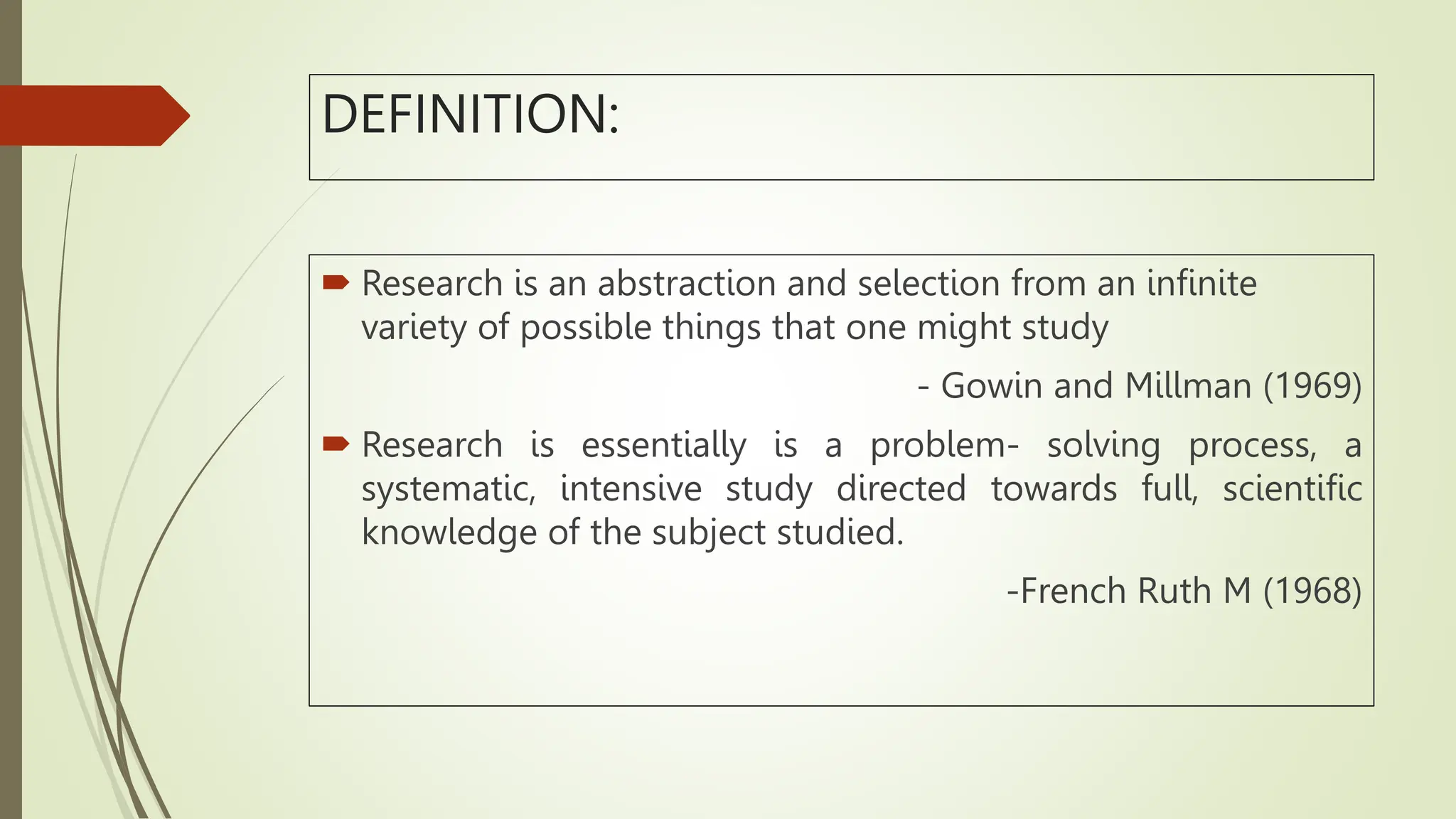
DEFINITION:
 Research is an abstraction and selection from an infinite
variety of possible things that one might study
- Gowin and Millman (1969)
 Research is essentially is a problem- solving process, a
systematic, intensive study directed towards full, scientific
knowledge of the subject studied.
-French Ruth M (1968)
DEFINITION:
• Research may be defined as the systematic and objective
analysis and recording of controlled observation that may
lead to the development of generalisations, principles,
theories, resulting in prediction and possible ultimate control
of events.
-JW Best
Nursing research means
What does research do?
Why do nurses do research?
Need and purpose of nursing research
Develop, refine, and extend the scientific base of
knowledge, which is required for quality nursing care,
education, and administration.
Enhance the body of professional knowledge in nursing
Provide foundation for EBN practices
Help in expansion of knowledge, which is essential
component of any profession.
Define the parameters of nursing, which will help nurses
to identify boundaries of nursing profession.
Need and purpose of nursing research
Refine and eliminate old knowledge so that it helps in
elimination of nursing actions that have no effect on the
achievement of desired client outcomes.
Identify nursing care practices that make a difference in health
care status of individuals and are cost effective.
Enhance accuracy of different nursing educational and
administrative techniques.
Develop and refine nursing theories and principles.
Solve the problems or answer the questions related to nursing
practices, nursing education, and nursing administration.
Importance and significance of nursing
Research
 Nursing research promotes evidence based practice, ensures credibility of
nursing profession, provides accountability for nursing practices, and
enables availability of cost effective care.
Some of the facts that prove the importance or significance of nursing
research are as follows:
 The development and utilization of nursing knowledge is essential for
continued development in patient care; nurses can develop or refine this
knowledge by the help of nursing research.
 Nurses are increasingly expected to adopt a research based or EBP, using
research findings to guide their decisions, actions, and interactions with
patients, patients family and community. Research is the only way that can
provide nurses first hand experiences on which they can build their EBN
practices.
Contd…..
 With a fast developing world, nurses are realizing the need to base specific nursing
actions and decisions on evidences indicating that the actions are clinically appropriate,
cost effective, and result in positive patient outcome. This can be achieved through
research conducted in the nursing discipline.
 Rapid advancement in medical science and technology; to keep pace with this
advancement, nurses must conduct research to learn about efficacy of particular
technology in reference to positive outcome.
 To understand the varied dimensions of their profession.
 To study characteristics of particular nursing situation about which little is known,
explain the phenomena that must be considered in planning nursing care, predict the
probable outcome, and initiate activities to promote desired patient behavior.
Contd….
 Cost of care is increasing day by day. Therefore, they must find solution for
cost effective care through research.
 Research also helps nurses to eliminate nursing actions that do not achieve
desired outcome for patients. Furthermore, nursing research findings may
help nurses to identify the practices that improve health care outcome of
patients and remain cost effective.
 In a nutshell, research helps to:
Build and expand the body of nursing knowledge
Validate and refine the existing nursing practice
Make health care efficient and cost effective
Historical landmarks in nursing research
Characteristics of Good Research
Orderly and systemic process
Based on current professional issues
Begin with clearly defined purposes
Emphasize to develop, refine and expand
professional knowledge
Contd…..
Directed towards development or testing
theories
Finding solution of a problem
Dedicated to develop empirical evidence
Strive to collect first hand information/data
Contd…..
An objective and logical process
Generate findings to refine and improve
professional practices
Use of appropriate methodology
Conducted on representative sample
Contd…..
Conducted through appropriate use of methods and
tools of data collection
Use of valid and reliable data collection tools
Carefully recorded and reported
Adequately and appropriately analyzed research
Patiently carried out activity
Researchers expertise, interest, motivation, and courage
Adequately communicated
Qualities of a good researcher
R- Research oriented
E- Efficient
S- Scientific
E- Effective
A- Analytical
R- Resourceful
C- Creative
H- Honest
E- Economical
R- Religious
Types of Research
Comparison of Quantitative & Qualitative Research
Parameters Quantitative Research Qualitative Research
General Nature Objective approach to seek precise
measurement in numerical form.
Subjective approach to seek in
depth description in narrative
form
Knowledge of study
Variables
Variables are clearly understood and
defined in advance by the researcher
Have only rough idea about
variables in advance.
Aims To identify and count the variables to test
or refine the theories and hypothesis
To collect complete detailed
description to develop theories
and assumptions.
Research problem Problem is deductively reasoned and does
not change over the course of the study.
Problem is inductively reasoned
and is constantly reformulated
during the study
Planning All aspects of the study are carefully
designed before data is collected
The design emerges as the study
unfolds
Research Design Experimental, quasi experimental and non
experimental
Phenomenology, grounded
theory, ethnography, case study
and historical research
Sample
Quantitative studies are conducted on large
representative samples to generalize the
research findings
Qualitative research studies are in-depth
studies and therefore have small size
samples.
Data
It is easier to collect facilitates the testing of
Hypotheses, but may miss contextual details.
It is richer, time consuming, and less
generalizable.
Tools
Structured or semi structured tools to collect
numerical data, such as questionnaires,
opinion polls etc.,
Less formally structured instruments like
participative observation, indepth
interviews focus group discussions.
Methods
Researcher tends to remain objectively
separated from the subject matter
Researcher tends to become subjectively
immersed in the subject matter
Analysis
Analysis of numerical data through descriptive
and/ or inferential statistics
Analysis of data, such as words, pictures, or
objects, through descriptive coding,
indexing, narrations, integrative diagrams,
thematic analysis, etc.,
Quantitative Research Process
 Quantitative research is a formal, objective, and systematic process for generating information
about the world.
 Quantitative research is conducted to describe new situations, events, or concepts.
 In quantitative research study, variables are preselected and defined by the investigator, the data is
collected and quantified (i.e. translated in numbers), and then statistically analyzed often with the
view to establish cause-and-effect relationship among, the variables. This process is an orderly way
of dealing with a research problem, where variables are generally studied in numerical (quantitative)
form.
Steps of Quantitative research process
Formulation of
research problem
Determining
study objectives
Review of
Literature
Developing
conceptual
framework
Formulating
hypothesis/
Assumptions
Selecting
research
approach/design
Specifying the
population
Developing
tool(s) for data
collection
Establishing
ethical
Considerations
Conducting pilot
study/ tryout of
tool
Sample Selection
Data collection
Preparing data
for analysis
Analysis and
interpretation of
Data
Disseminating
the research
findings
Qualitative Research Process
 Qualitative Research is a systematic and subjective approach to describe events or life experiences,
and to give them intended meanings.
 Qualitative Research is an interdisciplinary, Transdisciplinary, and sometimes counter disciplinary field.
 It not only helps to unearth hidden facts, but also to exploring attitude, emotions, beliefs, sensitive
issues, opinions, concepts processes, and relationships of people.
 The process of qualitative research is relatively less formally planned, where planning and execution of
research moves hand in hand.
Steps of Qualitative research Process
Identifying
Research
Problem Area
Formulating
broad study
objectives
Review of
literature
Entry in the
research
setting
Selecting
research
approach/
design
Select a small
sample
Establishing
ethical
considerations
Planning tools
for data
collection
Collecting Data
Organizing
data for
analysis
Analysis and
interpretation
of data
Disseminating
the Research
Findings
Overview of the research process
 The phases and steps in the research project gives an overview of the research process.
Actually there were 5 basic phases involved in conducting research that is assessment
diagnosis planning implementation And evaluation.
 In assessment Phase, the investigators select the topic and identifies a research
problems, formulates the proposal for research project, reviews the literature,
concerning the project and defines the concepts and variable to be studied.
 In diagnosis phase, the investigator states the hypothesis, examines the possible
ethical implications of the research proposal, and reviews pertinent literature and also
identifies the theory, assumptions and limitations of the proposal.
 In planning Phase, the researcher describes the research design and methods of
research including sampling, data collection, instruments to be used and method of
data analysis, obtains informed consent from subjects to be studied in the pilot study,
conducts the study, and revises proposals in the light of findings, and plans how to
communicate findings.
 In implementing phase, the researcher collects data from the subjects.
 In evaluation phase, the investigator performs analyses and interpretation of the data
collected from the target population and communicates the following as per plan made
in the planning phase.
In assessment Phase
 Identifying a researchable problem in nursing:
Good research depends to a great degree on good questions, topics
for research are generated in a variety ways.
In many cases a problem which needs solving will present an
immediate topic for the study. In other cases, reading an area of
interest will give rise to yet unanswered questions, other researchers
are having with their own experiences.
Good research reports state the general importance of the study
early in the report and follow this immediately with statement of the
specific problems that was studied.
The topic converted into problem statement which in turn is refined
in several times before a satisfactory working tool is obtained.
 Formulating the research proposal:
The research proposal is a written summary of steps stating what
the investigator intends to do, how or she plans to do it, who or
what comprises the study sample, when and where the study is to
be done, and the time schedule for the study.
The proposal is often written for the approval of the guide or
committee.
The proposal begins with the identification of the problem and
moves step by step through all elements of the planning phase.
It may be rewritten many times for its refinement.
The final writing is usually done after pilot study, when chances may
be incorporated in the light of weaknesses and strengths identified
at that time.
 Defining the concepts and variables:
An investigator or researcher must define each concept or
variables early in the studies not only to understand what is to be
examined but to communicate this information to others
operational definitions of concepts or variables requiring careful
work, as the describe how the variable under study is to be
observed and measured.
Definitions found in the literature that have already been
developed and tested in research should be used whenever
possible.
At this juncture, researchers should clarify in their own minds,
what the independent and dependent variables are actually in the
study.
Diagnosis phase:
 Stating objectives or Hypothesis:
Objectives are what the investigator proposes to accomplish in research, i.e., the
specific short term measurable goals to be met.
These objectives should be stated clearly because, at the conclusion of the study, both
the reader and the researcher can determine whether the objectives of the study were
met.
Hypothesis are statements formulated to predict a relationship between two or more
variables.
It is a statement of expectations of a researcher concerning relationships between
variables under investigation.
A problem statement represents the initial effort to give a research project direction,
hypothesis represents a more formulated focus for the collection and interpretation of
data.
The hypothesis must be testable and verifiable.
 Examining the ethical implications:
It is wise and advisable to examine the ethical implications of the research.
An ethical study is one of that does not harm the study subjects. All subjects
are carefully informed concerning the following:
i. The purpose of the study
ii. Their part in it
iii. Any possible discomfort
iv. How privacy is guarded?
v. Their right to refuse to participate or to stop participating with out penalty
and
vi. The manner in which data will be used.
 Reviewing of the literature:
Review of literature provides familiarity with existing studies, and information is often
indispensable an helping researcher to focus on a particular problem and to formulate
suitable research questions and helps in formulating and delineating the problem.
 Identifying theory, Assumptions and limitations
A theory is a generalized abstract explanation about the interrelationships among
phenomena, with the primary purpose of explaining and predicting those phenomena.
The goal of research is to provide scientific explanations for what is observed and to predict
what will be observed, under given circumstances.
Research articles usually specify the theory or assumptions upon which the study is based.
Limitations are aspects of the research that were not studied.
The investigator may summarise the use of theory, assumptions and limitations as he or she
examines the research literature.
It is good to have conceptual framework or theoretical framework for the study.
Planning phase:
 Describing research design:
The research design is the overall plan for how to obtain answers to the question being
studied and how to handle some of the difficulties encountered during the research
process.
Research design will include the experiment, the survey and the documentary (historical)
design.
1. An experiment often examines how a treatment or stimulus (the independent
variable) affects the subject exposed to the treatment (the dependent variable). The
experimental designed describes step by step how the research are selected and how
controls are used.
2. A survey is a research design that uses questionnaires, and interviews. Important
elements of the survey include not only how the subjects are selected but also their
willingness to the ability of the respondents to answer the questions determine the
extent to which the design is successful. The proper development of the tool and
schedule the crucial.
3. The documentary design uses material already in existence,
such as public or private records. Getting access to the
material, finding records that are complete and legible, and
discovering whether or not the writers recorded material
accurately important.
4. In field studies the research investigates the phenomenon in
its natural settings i.e., community, hospital or health clinic.
 Describing research methods:
Research methods will include the methods of sampling data
collection, and analysis and interpretation.
1. Sampling is the selection of the study subjects from the target
population under study. Appropriate methods must be used to able
to apply research findings from a small sample to the population
from which it was drawn.
2. Methods of data collections include observing, questioning and
measuring or a combination of these. Observation is a basic
method of collecting data. When the phenomenon under study
cannot be observed, the researcher asks questions, either interview
or by using questionnaires.
3. For analysis and interpretation of data usually by using description
and inferential statistics.
 Obtaining informed consent from subjects for pilot study
Informed consent is obtained from the subject to be used in the pilot study prior to conducting the
study.
Informed consent is the voluntary consent given by the study subjects, after they are fully informed
of every detail of the proposed research, including the right to participate or not, and to withdraw
from the study at any time without penalty.
Informed consent must be obtained from subject in both pilot study and the real study.
 Conducting the pilot study:
The pilot study is a small scale dress rehearsal that proceeds as if it were the actual study, except for
the fact, that subjects who will participate in the actual study are not used.
The primary objective of the pilot study is the test as many elements of the research proposal as
possible in order to correct any part that does not work properly.
Planning for communicating the findings of research:
In planning phase itself, it is better to plan how to communicate the research findings.
The written report and oral presentation may be first step in reaching a border audience.
Implementation Phase:
 Collecting the data:
First step in implementation is to select the sample according to plan.
Second step is to contact the subjects, as well as any agencies involved to explain the study and
obtain their informed consent.
The sampling process is a crucial element of the research design.
It determines from whom or what the data are to be collected, which in turn influences the method
of data analysis that could be used.
The method by which data are collected, which in turn influences the method of data analysis that
could be used.
The method by which data are collected varies by research design.
Once the data collections are completed or stopped for practical reasons, next phase begins.
Evaluation phase:
 An evaluation phase involves analysis and interpretation of the data and communicating findings.
Analysing and interpreting the data:
In this step is to examine raw data for completeness and accuracy.
An incomplete or inaccurately completed questionnaire must be discarded.
Next the raw data must be transferred to a general tally table or worksheet in order to bring
categories of data together.
Tally marks are then counted, and the counts are summarized.
In addition, special purpose tables help to summarise the data.
Rates, ratios, and percentages are used to summarise data such as age, sex, occupation, marital
status or type of illness.
For quantitative data, summary measures mean, median and mode that are used.
These are descriptive summaries and may be used to compare and interpret data from descriptive or
exploratory studies.
Once data summaries and estimates are concluded, the
investigator can analyse these in the light of research proposal
including objectives.
Next, the investigator may make recommendations that are
relevant to practice, administration or education, or he/she may
suggest further research.
Communicating the findings
The final step of the research process is the
communication of findings of the research project.
The research report, either written or oral must
communicate all the steps involved in research project.
It is usually wise to complete tables and graphs, since
these help in the process of communication.
The report should be well organized and in enough detail
to inform, but at the same time, it should be succinct.
Research & Research proces Unit-1 in nursing research

Research & Research proces Unit-1 in nursing research

  • 1.
  • 2.
    Sources of Knowledge: Ideas generated in many ways.  For nursing research point of view, the approaches to generating knowledge is divided into 2 groups as follows: 1. Unstructured- traditions, authority, experience, trial-error, intuition. 2. Structured- Logical reasoning-induction, deduction, nursing process, Research
  • 3.
    Scientific Method:  Scientificmethods are defined as controlled, systematic investigations that are rooted in objective reality and that aim to develop general knowledge about natural phenomena. Characteristics of scientific methods:  They are orderly and systematic processes.  Scientists attempt to control external factors that are not under direct investigation.  Their findings are based on empirical evidences, assumptions or hypotheses.  Findings of scientific method can be generalized.  They are basically conducted to develop or test theories.
  • 4.
    Scientific Method:  Thebasic purpose of scientific methods are description, exploration, explanation, prediction, control, prescription and identification of relationship of the facts.  Steps of Scientific method: Based on the type of the study  Limitations: 1. Moral or ethical problem 2. Human complexity 3. Measurement of problems 4. External variable control problems
  • 5.
    Problem solving method: Problem solving is a systematic approach to the solution or alleviation of simple, complex, immediate, long term problems, characterized by sequential execution of the following observation through the action processes. Steps Include:  Identification and definition of the elements composing the problem and interrelationships among elements.  Specification of crux of the problem along with theorizing about relevance of background facts and theories.  Determination and systematic collection of facts
  • 6.
    Contd…..  Analysis andinterpretation and synthesis of collected facts along with previously known facts.  Proposal and strategic course of action  Action  Observation and evaluation of outcome of action
  • 7.
    Process differences inresearch and problem solving Research  All elements of scientific inquiry must be explicitly and precisely described.  Data is quantitative or quantifiable and are analyzed with appropriate statistical procedures.  Findings are generalizable  Entails a plan written in sufficient detail and explicitness that the study may be replicated and the findings verified. Problem solving  The same explicitness and preciseness, though they may be utilized are not demanded of problem solving.  Detailed statistical analyses are seldom done.  Not generalized  Entails no such requirements
  • 8.
  • 9.
    DEFINITION:  Research isan abstraction and selection from an infinite variety of possible things that one might study - Gowin and Millman (1969)  Research is essentially is a problem- solving process, a systematic, intensive study directed towards full, scientific knowledge of the subject studied. -French Ruth M (1968)
  • 10.
    DEFINITION: • Research maybe defined as the systematic and objective analysis and recording of controlled observation that may lead to the development of generalisations, principles, theories, resulting in prediction and possible ultimate control of events. -JW Best
  • 11.
  • 12.
  • 13.
  • 14.
    Why do nursesdo research?
  • 15.
    Need and purposeof nursing research Develop, refine, and extend the scientific base of knowledge, which is required for quality nursing care, education, and administration. Enhance the body of professional knowledge in nursing Provide foundation for EBN practices Help in expansion of knowledge, which is essential component of any profession. Define the parameters of nursing, which will help nurses to identify boundaries of nursing profession.
  • 16.
    Need and purposeof nursing research Refine and eliminate old knowledge so that it helps in elimination of nursing actions that have no effect on the achievement of desired client outcomes. Identify nursing care practices that make a difference in health care status of individuals and are cost effective. Enhance accuracy of different nursing educational and administrative techniques. Develop and refine nursing theories and principles. Solve the problems or answer the questions related to nursing practices, nursing education, and nursing administration.
  • 17.
    Importance and significanceof nursing Research  Nursing research promotes evidence based practice, ensures credibility of nursing profession, provides accountability for nursing practices, and enables availability of cost effective care. Some of the facts that prove the importance or significance of nursing research are as follows:  The development and utilization of nursing knowledge is essential for continued development in patient care; nurses can develop or refine this knowledge by the help of nursing research.  Nurses are increasingly expected to adopt a research based or EBP, using research findings to guide their decisions, actions, and interactions with patients, patients family and community. Research is the only way that can provide nurses first hand experiences on which they can build their EBN practices.
  • 18.
    Contd…..  With afast developing world, nurses are realizing the need to base specific nursing actions and decisions on evidences indicating that the actions are clinically appropriate, cost effective, and result in positive patient outcome. This can be achieved through research conducted in the nursing discipline.  Rapid advancement in medical science and technology; to keep pace with this advancement, nurses must conduct research to learn about efficacy of particular technology in reference to positive outcome.  To understand the varied dimensions of their profession.  To study characteristics of particular nursing situation about which little is known, explain the phenomena that must be considered in planning nursing care, predict the probable outcome, and initiate activities to promote desired patient behavior.
  • 19.
    Contd….  Cost ofcare is increasing day by day. Therefore, they must find solution for cost effective care through research.  Research also helps nurses to eliminate nursing actions that do not achieve desired outcome for patients. Furthermore, nursing research findings may help nurses to identify the practices that improve health care outcome of patients and remain cost effective.  In a nutshell, research helps to: Build and expand the body of nursing knowledge Validate and refine the existing nursing practice Make health care efficient and cost effective
  • 20.
    Historical landmarks innursing research
  • 21.
    Characteristics of GoodResearch Orderly and systemic process Based on current professional issues Begin with clearly defined purposes Emphasize to develop, refine and expand professional knowledge
  • 22.
    Contd….. Directed towards developmentor testing theories Finding solution of a problem Dedicated to develop empirical evidence Strive to collect first hand information/data
  • 23.
    Contd….. An objective andlogical process Generate findings to refine and improve professional practices Use of appropriate methodology Conducted on representative sample
  • 24.
    Contd….. Conducted through appropriateuse of methods and tools of data collection Use of valid and reliable data collection tools Carefully recorded and reported Adequately and appropriately analyzed research Patiently carried out activity Researchers expertise, interest, motivation, and courage Adequately communicated
  • 25.
    Qualities of agood researcher R- Research oriented E- Efficient S- Scientific E- Effective A- Analytical R- Resourceful C- Creative H- Honest E- Economical R- Religious
  • 26.
  • 27.
    Comparison of Quantitative& Qualitative Research Parameters Quantitative Research Qualitative Research General Nature Objective approach to seek precise measurement in numerical form. Subjective approach to seek in depth description in narrative form Knowledge of study Variables Variables are clearly understood and defined in advance by the researcher Have only rough idea about variables in advance. Aims To identify and count the variables to test or refine the theories and hypothesis To collect complete detailed description to develop theories and assumptions. Research problem Problem is deductively reasoned and does not change over the course of the study. Problem is inductively reasoned and is constantly reformulated during the study Planning All aspects of the study are carefully designed before data is collected The design emerges as the study unfolds Research Design Experimental, quasi experimental and non experimental Phenomenology, grounded theory, ethnography, case study and historical research
  • 28.
    Sample Quantitative studies areconducted on large representative samples to generalize the research findings Qualitative research studies are in-depth studies and therefore have small size samples. Data It is easier to collect facilitates the testing of Hypotheses, but may miss contextual details. It is richer, time consuming, and less generalizable. Tools Structured or semi structured tools to collect numerical data, such as questionnaires, opinion polls etc., Less formally structured instruments like participative observation, indepth interviews focus group discussions. Methods Researcher tends to remain objectively separated from the subject matter Researcher tends to become subjectively immersed in the subject matter Analysis Analysis of numerical data through descriptive and/ or inferential statistics Analysis of data, such as words, pictures, or objects, through descriptive coding, indexing, narrations, integrative diagrams, thematic analysis, etc.,
  • 29.
    Quantitative Research Process Quantitative research is a formal, objective, and systematic process for generating information about the world.  Quantitative research is conducted to describe new situations, events, or concepts.  In quantitative research study, variables are preselected and defined by the investigator, the data is collected and quantified (i.e. translated in numbers), and then statistically analyzed often with the view to establish cause-and-effect relationship among, the variables. This process is an orderly way of dealing with a research problem, where variables are generally studied in numerical (quantitative) form.
  • 30.
    Steps of Quantitativeresearch process Formulation of research problem Determining study objectives Review of Literature Developing conceptual framework Formulating hypothesis/ Assumptions Selecting research approach/design Specifying the population Developing tool(s) for data collection Establishing ethical Considerations Conducting pilot study/ tryout of tool Sample Selection Data collection Preparing data for analysis Analysis and interpretation of Data Disseminating the research findings
  • 31.
    Qualitative Research Process Qualitative Research is a systematic and subjective approach to describe events or life experiences, and to give them intended meanings.  Qualitative Research is an interdisciplinary, Transdisciplinary, and sometimes counter disciplinary field.  It not only helps to unearth hidden facts, but also to exploring attitude, emotions, beliefs, sensitive issues, opinions, concepts processes, and relationships of people.  The process of qualitative research is relatively less formally planned, where planning and execution of research moves hand in hand.
  • 32.
    Steps of Qualitativeresearch Process Identifying Research Problem Area Formulating broad study objectives Review of literature Entry in the research setting Selecting research approach/ design Select a small sample Establishing ethical considerations Planning tools for data collection Collecting Data Organizing data for analysis Analysis and interpretation of data Disseminating the Research Findings
  • 33.
    Overview of theresearch process  The phases and steps in the research project gives an overview of the research process. Actually there were 5 basic phases involved in conducting research that is assessment diagnosis planning implementation And evaluation.  In assessment Phase, the investigators select the topic and identifies a research problems, formulates the proposal for research project, reviews the literature, concerning the project and defines the concepts and variable to be studied.  In diagnosis phase, the investigator states the hypothesis, examines the possible ethical implications of the research proposal, and reviews pertinent literature and also identifies the theory, assumptions and limitations of the proposal.  In planning Phase, the researcher describes the research design and methods of research including sampling, data collection, instruments to be used and method of data analysis, obtains informed consent from subjects to be studied in the pilot study, conducts the study, and revises proposals in the light of findings, and plans how to communicate findings.  In implementing phase, the researcher collects data from the subjects.  In evaluation phase, the investigator performs analyses and interpretation of the data collected from the target population and communicates the following as per plan made in the planning phase.
  • 34.
    In assessment Phase Identifying a researchable problem in nursing: Good research depends to a great degree on good questions, topics for research are generated in a variety ways. In many cases a problem which needs solving will present an immediate topic for the study. In other cases, reading an area of interest will give rise to yet unanswered questions, other researchers are having with their own experiences. Good research reports state the general importance of the study early in the report and follow this immediately with statement of the specific problems that was studied. The topic converted into problem statement which in turn is refined in several times before a satisfactory working tool is obtained.
  • 35.
     Formulating theresearch proposal: The research proposal is a written summary of steps stating what the investigator intends to do, how or she plans to do it, who or what comprises the study sample, when and where the study is to be done, and the time schedule for the study. The proposal is often written for the approval of the guide or committee. The proposal begins with the identification of the problem and moves step by step through all elements of the planning phase. It may be rewritten many times for its refinement. The final writing is usually done after pilot study, when chances may be incorporated in the light of weaknesses and strengths identified at that time.
  • 36.
     Defining theconcepts and variables: An investigator or researcher must define each concept or variables early in the studies not only to understand what is to be examined but to communicate this information to others operational definitions of concepts or variables requiring careful work, as the describe how the variable under study is to be observed and measured. Definitions found in the literature that have already been developed and tested in research should be used whenever possible. At this juncture, researchers should clarify in their own minds, what the independent and dependent variables are actually in the study.
  • 37.
    Diagnosis phase:  Statingobjectives or Hypothesis: Objectives are what the investigator proposes to accomplish in research, i.e., the specific short term measurable goals to be met. These objectives should be stated clearly because, at the conclusion of the study, both the reader and the researcher can determine whether the objectives of the study were met. Hypothesis are statements formulated to predict a relationship between two or more variables. It is a statement of expectations of a researcher concerning relationships between variables under investigation. A problem statement represents the initial effort to give a research project direction, hypothesis represents a more formulated focus for the collection and interpretation of data. The hypothesis must be testable and verifiable.
  • 38.
     Examining theethical implications: It is wise and advisable to examine the ethical implications of the research. An ethical study is one of that does not harm the study subjects. All subjects are carefully informed concerning the following: i. The purpose of the study ii. Their part in it iii. Any possible discomfort iv. How privacy is guarded? v. Their right to refuse to participate or to stop participating with out penalty and vi. The manner in which data will be used.
  • 39.
     Reviewing ofthe literature: Review of literature provides familiarity with existing studies, and information is often indispensable an helping researcher to focus on a particular problem and to formulate suitable research questions and helps in formulating and delineating the problem.  Identifying theory, Assumptions and limitations A theory is a generalized abstract explanation about the interrelationships among phenomena, with the primary purpose of explaining and predicting those phenomena. The goal of research is to provide scientific explanations for what is observed and to predict what will be observed, under given circumstances. Research articles usually specify the theory or assumptions upon which the study is based. Limitations are aspects of the research that were not studied. The investigator may summarise the use of theory, assumptions and limitations as he or she examines the research literature. It is good to have conceptual framework or theoretical framework for the study.
  • 40.
    Planning phase:  Describingresearch design: The research design is the overall plan for how to obtain answers to the question being studied and how to handle some of the difficulties encountered during the research process. Research design will include the experiment, the survey and the documentary (historical) design. 1. An experiment often examines how a treatment or stimulus (the independent variable) affects the subject exposed to the treatment (the dependent variable). The experimental designed describes step by step how the research are selected and how controls are used. 2. A survey is a research design that uses questionnaires, and interviews. Important elements of the survey include not only how the subjects are selected but also their willingness to the ability of the respondents to answer the questions determine the extent to which the design is successful. The proper development of the tool and schedule the crucial.
  • 41.
    3. The documentarydesign uses material already in existence, such as public or private records. Getting access to the material, finding records that are complete and legible, and discovering whether or not the writers recorded material accurately important. 4. In field studies the research investigates the phenomenon in its natural settings i.e., community, hospital or health clinic.
  • 42.
     Describing researchmethods: Research methods will include the methods of sampling data collection, and analysis and interpretation. 1. Sampling is the selection of the study subjects from the target population under study. Appropriate methods must be used to able to apply research findings from a small sample to the population from which it was drawn. 2. Methods of data collections include observing, questioning and measuring or a combination of these. Observation is a basic method of collecting data. When the phenomenon under study cannot be observed, the researcher asks questions, either interview or by using questionnaires. 3. For analysis and interpretation of data usually by using description and inferential statistics.
  • 43.
     Obtaining informedconsent from subjects for pilot study Informed consent is obtained from the subject to be used in the pilot study prior to conducting the study. Informed consent is the voluntary consent given by the study subjects, after they are fully informed of every detail of the proposed research, including the right to participate or not, and to withdraw from the study at any time without penalty. Informed consent must be obtained from subject in both pilot study and the real study.
  • 44.
     Conducting thepilot study: The pilot study is a small scale dress rehearsal that proceeds as if it were the actual study, except for the fact, that subjects who will participate in the actual study are not used. The primary objective of the pilot study is the test as many elements of the research proposal as possible in order to correct any part that does not work properly. Planning for communicating the findings of research: In planning phase itself, it is better to plan how to communicate the research findings. The written report and oral presentation may be first step in reaching a border audience.
  • 45.
    Implementation Phase:  Collectingthe data: First step in implementation is to select the sample according to plan. Second step is to contact the subjects, as well as any agencies involved to explain the study and obtain their informed consent. The sampling process is a crucial element of the research design. It determines from whom or what the data are to be collected, which in turn influences the method of data analysis that could be used. The method by which data are collected, which in turn influences the method of data analysis that could be used. The method by which data are collected varies by research design. Once the data collections are completed or stopped for practical reasons, next phase begins.
  • 46.
    Evaluation phase:  Anevaluation phase involves analysis and interpretation of the data and communicating findings. Analysing and interpreting the data: In this step is to examine raw data for completeness and accuracy. An incomplete or inaccurately completed questionnaire must be discarded. Next the raw data must be transferred to a general tally table or worksheet in order to bring categories of data together. Tally marks are then counted, and the counts are summarized. In addition, special purpose tables help to summarise the data. Rates, ratios, and percentages are used to summarise data such as age, sex, occupation, marital status or type of illness. For quantitative data, summary measures mean, median and mode that are used. These are descriptive summaries and may be used to compare and interpret data from descriptive or exploratory studies.
  • 47.
    Once data summariesand estimates are concluded, the investigator can analyse these in the light of research proposal including objectives. Next, the investigator may make recommendations that are relevant to practice, administration or education, or he/she may suggest further research.
  • 48.
    Communicating the findings Thefinal step of the research process is the communication of findings of the research project. The research report, either written or oral must communicate all the steps involved in research project. It is usually wise to complete tables and graphs, since these help in the process of communication. The report should be well organized and in enough detail to inform, but at the same time, it should be succinct.