Nursing Research
 The word research means “to search again” or “to
examine carefully
 Research is a diligent, systematic inquiry or study that
validates and refines existing knowledge and develops
new knowledge
Cont…..
 Practicing nurses should know,
 How to read research reports
 Identify effective intervention for practice
 Nursing Research generates
 Evidence-based guidelines, standards, protocols, and
policies
 knowledge about nursing education, nursing
administration, health care services and nursing roles
Ways of Acquiring
Knowledge in Nursing
 Traditions
 Authority
 Borrowing
 Trial and error
 Personal experience
 Role modeling
 Intuition
 Reasoning
Research important in
generating an EBP for Nurses
 Essential for development of empirical knowledge that
enables nurses to provide EB nursing care
 EBP is the conscientious integration of best research
evidence with clinical expertise, patient’s values,
needs, in the delivery of high quality, cost effective
care
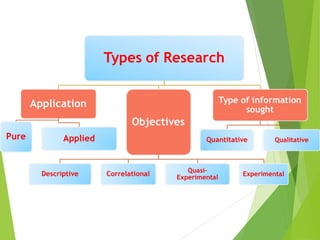
Types
 Qualitative, quantitative and outcome research are
essential to generate research evidences
1. Promoting an understanding of patients and
families experiences with health and illness (a
common focus of qualitative research)
2. Implementing effective nursing interventions to
promote patients health (a common focus of
quantitative research)
3. Providing high quality, cost effective care within
health care system (a common focus of outcome
research)
Quantitative research
 Quantitative research is a formal, objective, systematic process in which
numerical data are used to obtain information about the world.
(Burns and Grove,1997)
Quantitative
Types/Approaches
 Descriptive
 Co- rrelational
 Quasi-experimental
 Experiemtal
Qualitative research
 Qualitative research is a systematic, subjective, approach to describe life
experiences and give meaning to them.
(Munhall Oiler,1993)
Qualitative Types/Approaches
 Phenomenological approach
 Grounded theory approach
 Ethnographic approach
 Historical approach
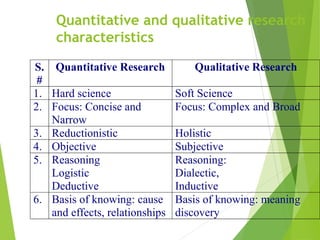
Quantitative and qualitative research
characteristics
S.
#
Quantitative Research Qualitative Research
1. Hard science Soft Science
2. Focus: Concise and
Narrow
Focus: Complex and Broad
3. Reductionistic Holistic
4. Objective Subjective
5. Reasoning
Logistic
Deductive
Reasoning:
Dialectic,
Inductive
6. Basis of knowing: cause
and effects, relationships
Basis of knowing: meaning
discovery
Quantitative and qualitative research
characteristics
Quantitative Research Qualitative Research
Tests theory Develops theory
Control Shared interpretation
Basic elements of
analysis: numbers
Basic elements of analysis:
words
Statistical analysis Individual interpretation.

Generalization Uniqueness
Outcome Research
 A new paradigm of research
 Focuses on the end-result of patient care
 An evaluation of treatment out comes
 It has multidisciplinary perspectives
 The concepts are derived from the evaluative methods,
epidemiology and economics
(Hinshaw, 1992)
Quantitative research
Quantitative research is a formal, objective, systematic
process in which numerical data are used to obtain
information about the world.
(Burns
and Grove,1997)
Steps of Quantitative Research Process
1. Research problems and purpose
2. Literature Review
3. Study Framework
4. Research objective, question and hypothesis
5. Study variables
6. Assumptions
7. Limitations
8. Research design
9. Population and samples
10. Methods of measurement
11. Data collection
12. Data analysis
13. Research outcome
 Research problems and
purpose
 Literature Review
 Study Framework
 Research objective,
question and hypothesis
 Study variables
 Research design
 Population and samples
 Data collection
 Data analysis
 Research outcome
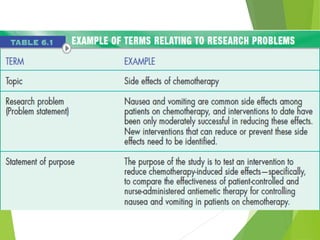
Research Problem
 A situation in need of a solution or improvement;
 A discrepancy between the way things are and
the way they ought to be
Research problem
“An area of concern in which there is a gap in knowledge
base needed for nursing practice. Research is conducted to
generate essential knowledge to address the practice
concern, with the ultimate goal of providing evidence-
based practice”
Research problem
 Identifies an area of concern for a particular population
that require investigation
 Indicates the significance of problem
 Provide a background for the problem
 Outlines the need for additional study in a problem
statement
 Not all published studies includes a clearly expressed
problems
 Can be identified in the first or second paragraph of the
article
 Provides a base to studies
Developing and refining a research
problems
 Define a specific problem area
 Reviewed the relevant scientific literature
 Examined the problem’s potential significance to
nursing
 Pragmatically examined the feasibility of studying the
research problem
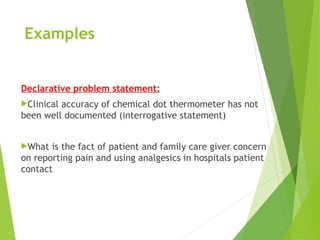
Examples
Declarative problem statement:
Clinical accuracy of chemical dot thermometer has not
been well documented (interrogative statement)
What is the fact of patient and family care giver concern
on reporting pain and using analgesics in hospitals patient
contact
Significance
It should meet the following criteria :
Patient nurses, the medical community in general and society will
potentially benefit from the knowledge derived from the study
Result will be applicable for nursing practice, education or
administration
The result will be theoretically relevant
The finding will lend spot to untested theoretical assumptions,
extend or challenge on existing theory or clarify a conflict in the
literature.
The finding will potentially formulate or alter nursing practices or
policies
Feasibility
1. Time
2. Availability of subjects
3. Facilities
4. Equipment
5. Money
6. Experience of researcher
7. Ethical consideration
Final problem statement
May be written or declarative or in interrogative form
A good problem statement exhibit the following three
characteristics:
1.It clearly identifies the variables under consideration
2.It specifies population studied
3.It implies the possibility of empirical testing
Examples of Problem
statements
Experimental:
what is the difference in the incidence of contractures in
comatose patients in relation to frequency of repositioning ?
Non- Experimental:
Is there a relationship between a physical symptoms of
pregnancy and maternal fetal attachment in prim gravidas?
Purpose
“ Research purpose is, concise, clear statement of specific
goal or aim of the study. The purpose is generated from
problem”
Research Purpose
A concise, clear statement of the specific aim or
goal of the study
The research purpose usually reflects the type of
study (descriptive, correlational, quasi-
experimental, experimental, phenomenological,
grounded theory, ethnographical & Historical)
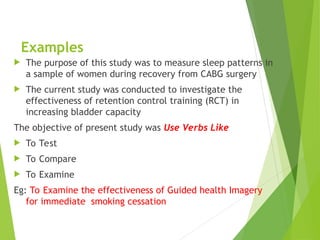
Examples
 The purpose of this study was to measure sleep patterns in
a sample of women during recovery from CABG surgery
 The current study was conducted to investigate the
effectiveness of retention control training (RCT) in
increasing bladder capacity
The objective of present study was Use Verbs Like
 To Test
 To Compare
 To Examine
Eg: To Examine the effectiveness of Guided health Imagery
for immediate smoking cessation
Characteristics of Purpose
Generated from problem
Identifies specific goals or aim of study
The goal of the study might be:-
 To identify
 To describe
 To Explain a situation
 To predict a solution to situation
 To control a situation to produce positive
outcomes in practice
Characteristics of Purpose
 Capture the essence of study in a single sentence
 Essential for directing the remaining steps of research
process
 Often presented after the problem or literature review
 Frequently reflected in the title of study
 Ist line of study Abstract
 The purpose was clearly stated and indicated the type
of study conducted
 Included the study variables and population
Determining the significance
You need to determine whether the knowledge generated
in the study:
 Influences nursing practice
 Builds on previous research
 Promotes theory testing/developing
 Addresses current concerns/priorities in nursing
Examining the feasibility
1. Researcher Expertise
2. Money commitment
3. Availability of subjects, Facilities and
Equipment
4. Ethical consideration
Researcher Expertise
 Identify the Education of researcher and their
Current position, which indicate their expertise
to conduct a study
 Examine the reference list to determine if the
researchers have conducted additional studies in
this area
Money commitment
 The problem and purpose studied are influenced
by the amount of money available to the
researcher
 The cost of the research project range from Few
Dollars ( student level/simple) to hundreds of
thousands of dollars (Complex projects)
 In critiquing a study, one of the points that are
analyzed is whether the researcher’s financial
resources were adequate to complete a quality
study.
 Sources of funding usually identified in the article
Availability of subjects, Facilities
and Equipment
 Researchers need to have adequate sample
size, facilities and equipment to implement
their study
 Sample size and settings indicated in the
“Methods” section of the study
Ethical consideration
 The purpose selected for investigation must be
ethical, which means that the subjects' rights
and rights of others in the setting are protected
 An ethical study must confers more benefits then
the risks in its conduct and will generate useful
knowledge for practice

Nursing Research tips for novice students.ppt

  • 1.
    Nursing Research  Theword research means “to search again” or “to examine carefully  Research is a diligent, systematic inquiry or study that validates and refines existing knowledge and develops new knowledge
  • 2.
    Cont…..  Practicing nursesshould know,  How to read research reports  Identify effective intervention for practice  Nursing Research generates  Evidence-based guidelines, standards, protocols, and policies  knowledge about nursing education, nursing administration, health care services and nursing roles
  • 3.
    Ways of Acquiring Knowledgein Nursing  Traditions  Authority  Borrowing  Trial and error  Personal experience  Role modeling  Intuition  Reasoning
  • 4.
    Research important in generatingan EBP for Nurses  Essential for development of empirical knowledge that enables nurses to provide EB nursing care  EBP is the conscientious integration of best research evidence with clinical expertise, patient’s values, needs, in the delivery of high quality, cost effective care
  • 5.
    Types  Qualitative, quantitativeand outcome research are essential to generate research evidences 1. Promoting an understanding of patients and families experiences with health and illness (a common focus of qualitative research) 2. Implementing effective nursing interventions to promote patients health (a common focus of quantitative research) 3. Providing high quality, cost effective care within health care system (a common focus of outcome research)
  • 6.
    Quantitative research  Quantitativeresearch is a formal, objective, systematic process in which numerical data are used to obtain information about the world. (Burns and Grove,1997)
  • 7.
    Quantitative Types/Approaches  Descriptive  Co-rrelational  Quasi-experimental  Experiemtal
  • 8.
    Qualitative research  Qualitativeresearch is a systematic, subjective, approach to describe life experiences and give meaning to them. (Munhall Oiler,1993)
  • 9.
    Qualitative Types/Approaches  Phenomenologicalapproach  Grounded theory approach  Ethnographic approach  Historical approach
  • 10.
    Quantitative and qualitativeresearch characteristics S. # Quantitative Research Qualitative Research 1. Hard science Soft Science 2. Focus: Concise and Narrow Focus: Complex and Broad 3. Reductionistic Holistic 4. Objective Subjective 5. Reasoning Logistic Deductive Reasoning: Dialectic, Inductive 6. Basis of knowing: cause and effects, relationships Basis of knowing: meaning discovery
  • 11.
    Quantitative and qualitativeresearch characteristics Quantitative Research Qualitative Research Tests theory Develops theory Control Shared interpretation Basic elements of analysis: numbers Basic elements of analysis: words Statistical analysis Individual interpretation. Generalization Uniqueness

  • 12.
    Outcome Research  Anew paradigm of research  Focuses on the end-result of patient care  An evaluation of treatment out comes  It has multidisciplinary perspectives  The concepts are derived from the evaluative methods, epidemiology and economics (Hinshaw, 1992)
  • 14.
    Quantitative research Quantitative researchis a formal, objective, systematic process in which numerical data are used to obtain information about the world. (Burns and Grove,1997)
  • 15.
    Steps of QuantitativeResearch Process 1. Research problems and purpose 2. Literature Review 3. Study Framework 4. Research objective, question and hypothesis 5. Study variables 6. Assumptions 7. Limitations 8. Research design 9. Population and samples 10. Methods of measurement 11. Data collection 12. Data analysis 13. Research outcome
  • 16.
     Research problemsand purpose  Literature Review  Study Framework  Research objective, question and hypothesis  Study variables  Research design  Population and samples  Data collection  Data analysis  Research outcome
  • 17.
    Research Problem  Asituation in need of a solution or improvement;  A discrepancy between the way things are and the way they ought to be
  • 18.
    Research problem “An areaof concern in which there is a gap in knowledge base needed for nursing practice. Research is conducted to generate essential knowledge to address the practice concern, with the ultimate goal of providing evidence- based practice”
  • 19.
    Research problem  Identifiesan area of concern for a particular population that require investigation  Indicates the significance of problem  Provide a background for the problem  Outlines the need for additional study in a problem statement  Not all published studies includes a clearly expressed problems  Can be identified in the first or second paragraph of the article  Provides a base to studies
  • 20.
    Developing and refininga research problems  Define a specific problem area  Reviewed the relevant scientific literature  Examined the problem’s potential significance to nursing  Pragmatically examined the feasibility of studying the research problem
  • 21.
    Examples Declarative problem statement: Clinicalaccuracy of chemical dot thermometer has not been well documented (interrogative statement) What is the fact of patient and family care giver concern on reporting pain and using analgesics in hospitals patient contact
  • 22.
    Significance It should meetthe following criteria : Patient nurses, the medical community in general and society will potentially benefit from the knowledge derived from the study Result will be applicable for nursing practice, education or administration The result will be theoretically relevant The finding will lend spot to untested theoretical assumptions, extend or challenge on existing theory or clarify a conflict in the literature. The finding will potentially formulate or alter nursing practices or policies
  • 23.
    Feasibility 1. Time 2. Availabilityof subjects 3. Facilities 4. Equipment 5. Money 6. Experience of researcher 7. Ethical consideration
  • 24.
    Final problem statement Maybe written or declarative or in interrogative form A good problem statement exhibit the following three characteristics: 1.It clearly identifies the variables under consideration 2.It specifies population studied 3.It implies the possibility of empirical testing
  • 25.
    Examples of Problem statements Experimental: whatis the difference in the incidence of contractures in comatose patients in relation to frequency of repositioning ? Non- Experimental: Is there a relationship between a physical symptoms of pregnancy and maternal fetal attachment in prim gravidas?
  • 26.
    Purpose “ Research purposeis, concise, clear statement of specific goal or aim of the study. The purpose is generated from problem”
  • 27.
    Research Purpose A concise,clear statement of the specific aim or goal of the study The research purpose usually reflects the type of study (descriptive, correlational, quasi- experimental, experimental, phenomenological, grounded theory, ethnographical & Historical)
  • 28.
    Examples  The purposeof this study was to measure sleep patterns in a sample of women during recovery from CABG surgery  The current study was conducted to investigate the effectiveness of retention control training (RCT) in increasing bladder capacity The objective of present study was Use Verbs Like  To Test  To Compare  To Examine Eg: To Examine the effectiveness of Guided health Imagery for immediate smoking cessation
  • 30.
    Characteristics of Purpose Generatedfrom problem Identifies specific goals or aim of study The goal of the study might be:-  To identify  To describe  To Explain a situation  To predict a solution to situation  To control a situation to produce positive outcomes in practice
  • 31.
    Characteristics of Purpose Capture the essence of study in a single sentence  Essential for directing the remaining steps of research process  Often presented after the problem or literature review  Frequently reflected in the title of study  Ist line of study Abstract  The purpose was clearly stated and indicated the type of study conducted  Included the study variables and population
  • 32.
    Determining the significance Youneed to determine whether the knowledge generated in the study:  Influences nursing practice  Builds on previous research  Promotes theory testing/developing  Addresses current concerns/priorities in nursing
  • 33.
    Examining the feasibility 1.Researcher Expertise 2. Money commitment 3. Availability of subjects, Facilities and Equipment 4. Ethical consideration
  • 34.
    Researcher Expertise  Identifythe Education of researcher and their Current position, which indicate their expertise to conduct a study  Examine the reference list to determine if the researchers have conducted additional studies in this area
  • 35.
    Money commitment  Theproblem and purpose studied are influenced by the amount of money available to the researcher  The cost of the research project range from Few Dollars ( student level/simple) to hundreds of thousands of dollars (Complex projects)  In critiquing a study, one of the points that are analyzed is whether the researcher’s financial resources were adequate to complete a quality study.  Sources of funding usually identified in the article
  • 36.
    Availability of subjects,Facilities and Equipment  Researchers need to have adequate sample size, facilities and equipment to implement their study  Sample size and settings indicated in the “Methods” section of the study
  • 37.
    Ethical consideration  Thepurpose selected for investigation must be ethical, which means that the subjects' rights and rights of others in the setting are protected  An ethical study must confers more benefits then the risks in its conduct and will generate useful knowledge for practice