MS.SASIKALA.N
MSC (N),OBSTETRICS AND GYNECOLOGICAL NURSING
LECTURER
GANGA COLLEGE OF NURSING
COIMBATORE
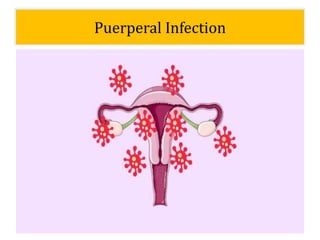
Puerperal Infection
Objectives
• Define Puerperal Infection
• Enumerate the causes and
predisposing factors
• List out the Mode of Infection
• Describe the Pathophysiology
• Discuss the Clinical features
• Explain the Management of Puerperal Infection
Introduction
• Puerperal infection is an infection developing in
the birth structure after delivery.
• Puerperal infection is a major cause of Maternal
Morbidity and Mortality.
Definition – Puerperal Infection
• A puerperal infection occurs when bacteria infect
the uterus and surrounding areas after a women
gives birth.
• It is also known as Postpartum Infection.
Puerperal Fever-define
• A rise of Temperature reaching
100.4 ̊ F(38 ̊C) or more (measured
orally) on 2 separate occasions at
24 hours apart(excluding first 24 hours)within first
10 days following delivery.
Also known as Childbed Fever/Puerperal Fever.
Puerperal sepsis
Define
• According to WHO, Puerperal Sepsis is defined as
the Infection of the Genital tract occurring at
labour or within 42days of the Postpartum period.
• Dc Dutta, an Infection of the Genital tract which
occurs as a complication of Delivery or
Miscarriage is termed as Puerperal Sepsis.
• It is also known as Childbed Fever/Childbirth
Fever.
Difference between
Puerperal sepsis
• An infection of the
genital tract which
occurs as a
complication of
delivery or
miscarriage within 6
weeks is termed as
puerperal sepsis.
Reproductive tract
infection
• Infection of external
and /or internal
Reproductive organs.
Causes
• Endometritis
• Endomyometritis
• Endoparameritis
• Or combination of all
these(pelvic cellulitis)
Predisposing Factors
Malnutrition Preterm Labour
Premature ROM
Prolonged ROM
Intrapartum
APH/PPH
Retained bits of
placenta
Traumatic operative delivery Repeated PV
Causative Micro Organism
• Streptococcus
Haemolytic group
A(GAS)
• Streptococcus
Haemolyticus group
B(GBS)
• Staphylococcus
Pyogens
• E.coli
• Streptococcus
• Peptococcus
• Bacteriodes
Mode of infection
Exogenous organism
The causative organism are,
• Streptococcus Fecalis that lives in the anus and in the
Perineum. Anaerobic Streptococci and Clostridium
Welchi which are found in the vagina.
• These are responsible for the Infection.
Endogenous organism
• This comes from sources outside the body and are
transmitted by another person
• The source of infection can be Midwife,Doctor and
other patient or visitors.
• Air and dust also cause infection to the patient.
Pathophysiology
Primary site of infection – Perineum, Vagina,Cervix &
Uterus.
Endometrium (placental infection site),Lacerated wound of the
Perineum, Vagina & cervix are favourable sites for bacterial growth
&multiplication (group A or group B Streptococci, Clostridia)
Devitalised tissue, Blood clots, Foreign body(Retained cotton
swab) & Surgical trauma(C.S) Favour microbial growth,
Proliferation & Spread of infection
Spread to distant site i.e
uterus(placental
implantation site)
Endometritis, parametritis
& cellulitis)
Localised infection,
laceration of the
perineum, vagina &
cervix.
or
Spread of infection
Pelvic cellulitis
• Infection of the pelvic peritoneum and levator ani
muscles.
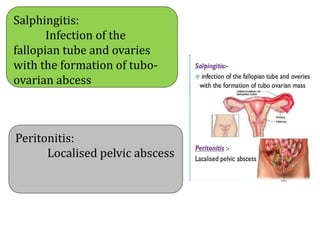
Salphingitis:
Infection of the
fallopian tube and ovaries
with the formation of tubo-
ovarian abcess
Peritonitis:
Localised pelvic abscess
Cont..
Pelvic cellulitis
Pelvic thrombophlebitis
Septicaemia and septic shock
Clinical features
Local infection :
• Slight rise of temperature
• Generalised malaise or headache
• Wound becomes red & swollen
• Pus formation
• If becomes severe temperature with chills & rigor.
• Sero purulent discharge
Cont…
Uterine Infection :
• Mild – Rise in Temperature(>100 degree)
• Rise in Pulse rate >90b/min
• Lochia becomes Offensive and Copious.
• Subinvolution and tender (may be due to
Lochiastasis and Lochiometra)
Cont…
Severe :
• High rise of temperature
• Chills and Rigor
• Rapid Pulse Rate
• Breathlessness
• Abdominal pain
• Dysuria
• Lochorrhea – green in colour and foul smelling
• Uterus may be Subinvoluted and tender
Cont..
Extra Uterine spread
• Presence of pelvic tenderness(pelvic peritonitis)
• Tenderness on the fornix(parametritis)bulging
fluctuant mass in the pouch of Douglas(pelvic
abscess).
Diagnostic Evaluation
Clean catch mid
stream urine –
culture sensitivity
High vaginal &
Endocervical swab-
Culture & sensitivity
Thick blood film –
Malarial parasite
Pelvic USG –
Placental bits
History - h/o any
high risk factor for
Infection like
anemia,PROM or
Prolonged labour
Blood culture
Blood test – DC,TC &
Hb
Clinical Examination-
Abdomen & Pelvic
examination to check
involution & examine
leg for
thrombophlebitis
Colour Doppler-
Venous thrombosis
CT & MRI – Lung
Pathology, T.BBlood urea and
Electolytes
Diagnosis
Prevention
Antenatal period
• Diagnosis and treatment of UTI, Anaemia and
Malnutrition & Diabetes Mellitus
• Assessment of risk factors for Feto pelvic
disproportion.
• Diagnosis and treatment of pre existing sexually
transmitted infections e.g. Gonorrhoea, Chlamydia
etc. and other infections
• Identification and appropriate management of
prolonged rupture of membranes(>12hours)
Cont..
Intranatal period
• Full surgical asepsis during delivery.
• Screening for group B streptococcus in high risk
cases
• Prophylactic Antibiotics in C.S
• Postnatal period
• Aseptic precaution
• Restrict visitors
Treatment
General care
• Isolate infected baby & mother when the culture
shows Haemolytic streptococci infection
• Adequate Fluid Calorie through IV
• Urinary catheterisation for urine retention
• Maintain chart-TPR, IO chart & Lochia discharge
Cont..
It depends on c/s
• Gentamicin(2mg/kg IV loading dose following
1.5mg/kg every 8 hours)
• Ampicillin (1gm IV every 6 hours)
• Clindamycin(900mg IV every 8 hours)
• Cefotoxime 1gm, every 8 hours
• Metronidazole 0.5mg IV every 8 hours.
• It should be continued for about 7 – 10 days
Surgical treatment
• Removal of perineal sutures for easy drainage. clean
wound with sitz bath & do dressing with antiseptic
ointment. secondary suture after wound infection
controlled
• Remove retained uterine products
• Drain pelvic abscess by Colpotomy
• Clean wound dehiscence of episiotomy & C.S remove
necrotic tissue & restore it.
• Hysterectomy in case of rupture or
Perforation,gangereneous uterus or multiple
abscess.
Puerperal Infection

Puerperal Infection

  • 1.
    MS.SASIKALA.N MSC (N),OBSTETRICS ANDGYNECOLOGICAL NURSING LECTURER GANGA COLLEGE OF NURSING COIMBATORE
  • 2.
  • 3.
    Objectives • Define PuerperalInfection • Enumerate the causes and predisposing factors • List out the Mode of Infection • Describe the Pathophysiology • Discuss the Clinical features • Explain the Management of Puerperal Infection
  • 4.
    Introduction • Puerperal infectionis an infection developing in the birth structure after delivery. • Puerperal infection is a major cause of Maternal Morbidity and Mortality.
  • 5.
    Definition – PuerperalInfection • A puerperal infection occurs when bacteria infect the uterus and surrounding areas after a women gives birth. • It is also known as Postpartum Infection.
  • 6.
    Puerperal Fever-define • Arise of Temperature reaching 100.4 ̊ F(38 ̊C) or more (measured orally) on 2 separate occasions at 24 hours apart(excluding first 24 hours)within first 10 days following delivery. Also known as Childbed Fever/Puerperal Fever.
  • 7.
  • 8.
    Define • According toWHO, Puerperal Sepsis is defined as the Infection of the Genital tract occurring at labour or within 42days of the Postpartum period. • Dc Dutta, an Infection of the Genital tract which occurs as a complication of Delivery or Miscarriage is termed as Puerperal Sepsis. • It is also known as Childbed Fever/Childbirth Fever.
  • 9.
    Difference between Puerperal sepsis •An infection of the genital tract which occurs as a complication of delivery or miscarriage within 6 weeks is termed as puerperal sepsis. Reproductive tract infection • Infection of external and /or internal Reproductive organs.
  • 10.
    Causes • Endometritis • Endomyometritis •Endoparameritis • Or combination of all these(pelvic cellulitis)
  • 11.
    Predisposing Factors Malnutrition PretermLabour Premature ROM Prolonged ROM
  • 12.
  • 13.
    Causative Micro Organism •Streptococcus Haemolytic group A(GAS) • Streptococcus Haemolyticus group B(GBS) • Staphylococcus Pyogens • E.coli • Streptococcus • Peptococcus • Bacteriodes
  • 14.
    Mode of infection Exogenousorganism The causative organism are, • Streptococcus Fecalis that lives in the anus and in the Perineum. Anaerobic Streptococci and Clostridium Welchi which are found in the vagina. • These are responsible for the Infection. Endogenous organism • This comes from sources outside the body and are transmitted by another person • The source of infection can be Midwife,Doctor and other patient or visitors. • Air and dust also cause infection to the patient.
  • 15.
    Pathophysiology Primary site ofinfection – Perineum, Vagina,Cervix & Uterus. Endometrium (placental infection site),Lacerated wound of the Perineum, Vagina & cervix are favourable sites for bacterial growth &multiplication (group A or group B Streptococci, Clostridia) Devitalised tissue, Blood clots, Foreign body(Retained cotton swab) & Surgical trauma(C.S) Favour microbial growth, Proliferation & Spread of infection Spread to distant site i.e uterus(placental implantation site) Endometritis, parametritis & cellulitis) Localised infection, laceration of the perineum, vagina & cervix. or
  • 17.
    Spread of infection Pelviccellulitis • Infection of the pelvic peritoneum and levator ani muscles.
  • 18.
    Salphingitis: Infection of the fallopiantube and ovaries with the formation of tubo- ovarian abcess Peritonitis: Localised pelvic abscess
  • 19.
  • 20.
    Clinical features Local infection: • Slight rise of temperature • Generalised malaise or headache • Wound becomes red & swollen • Pus formation • If becomes severe temperature with chills & rigor. • Sero purulent discharge
  • 21.
    Cont… Uterine Infection : •Mild – Rise in Temperature(>100 degree) • Rise in Pulse rate >90b/min • Lochia becomes Offensive and Copious. • Subinvolution and tender (may be due to Lochiastasis and Lochiometra)
  • 22.
    Cont… Severe : • Highrise of temperature • Chills and Rigor • Rapid Pulse Rate • Breathlessness • Abdominal pain • Dysuria • Lochorrhea – green in colour and foul smelling • Uterus may be Subinvoluted and tender
  • 23.
    Cont.. Extra Uterine spread •Presence of pelvic tenderness(pelvic peritonitis) • Tenderness on the fornix(parametritis)bulging fluctuant mass in the pouch of Douglas(pelvic abscess).
  • 24.
  • 25.
    Clean catch mid streamurine – culture sensitivity High vaginal & Endocervical swab- Culture & sensitivity Thick blood film – Malarial parasite Pelvic USG – Placental bits History - h/o any high risk factor for Infection like anemia,PROM or Prolonged labour Blood culture Blood test – DC,TC & Hb Clinical Examination- Abdomen & Pelvic examination to check involution & examine leg for thrombophlebitis Colour Doppler- Venous thrombosis CT & MRI – Lung Pathology, T.BBlood urea and Electolytes Diagnosis
  • 26.
    Prevention Antenatal period • Diagnosisand treatment of UTI, Anaemia and Malnutrition & Diabetes Mellitus • Assessment of risk factors for Feto pelvic disproportion. • Diagnosis and treatment of pre existing sexually transmitted infections e.g. Gonorrhoea, Chlamydia etc. and other infections • Identification and appropriate management of prolonged rupture of membranes(>12hours)
  • 27.
    Cont.. Intranatal period • Fullsurgical asepsis during delivery. • Screening for group B streptococcus in high risk cases • Prophylactic Antibiotics in C.S • Postnatal period • Aseptic precaution • Restrict visitors
  • 28.
    Treatment General care • Isolateinfected baby & mother when the culture shows Haemolytic streptococci infection • Adequate Fluid Calorie through IV • Urinary catheterisation for urine retention • Maintain chart-TPR, IO chart & Lochia discharge
  • 29.
    Cont.. It depends onc/s • Gentamicin(2mg/kg IV loading dose following 1.5mg/kg every 8 hours) • Ampicillin (1gm IV every 6 hours) • Clindamycin(900mg IV every 8 hours) • Cefotoxime 1gm, every 8 hours • Metronidazole 0.5mg IV every 8 hours. • It should be continued for about 7 – 10 days
  • 30.
    Surgical treatment • Removalof perineal sutures for easy drainage. clean wound with sitz bath & do dressing with antiseptic ointment. secondary suture after wound infection controlled • Remove retained uterine products • Drain pelvic abscess by Colpotomy • Clean wound dehiscence of episiotomy & C.S remove necrotic tissue & restore it. • Hysterectomy in case of rupture or Perforation,gangereneous uterus or multiple abscess.