Hemophilia
Ms. K. Lavanya
MSc(N)-CHN
Associate Professor
Definition:
• Hemophilia is an inherited bleeding disorder due to deficiency of plasma
coagulation factors. It is primarily found in males but transmitted by female
carriers. – Parul datta
• Hemophilia is a congenital bleeding disorder caused by the genetic lack of at
least one coagulation factor. – Dorothy R Marlow
Definition:
• The term hemophilia refers to a group of bleeding disorders in
which there is a deficiency of one of the factors necessary for
coagulation of the blood.
Wong’s
• Hemophilia is due to congenital deficiency of plasma coagulation
factor VIII & factor IX.
O.P.Ghai
Incidence:
Prevalence:
 Occur 1 in 5000 males
 No racial prediction, found in all ethnic groups.
Etiology:
 Hereditary (approximately 80% of patients)
 Transmitted by asymptomatic in females
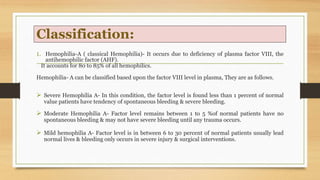
Classification:
1. Hemophilia-A ( classical Hemophilia)- It occurs due to deficiency of plasma factor VIII, the
antihemophilic factor (AHF).
It accounts for 80 to 85% of all hemophilics.
Hemophilia- A can be classified based upon the factor VIII level in plasma, They are as follows.
 Severe Hemophilia A- In this condition, the factor level is found less than 1 percent of normal
value patients have tendency of spontaneous bleeding & severe bleeding.
 Moderate Hemophilia A- Factor level remains between 1 to 5 %of normal patients have no
spontaneous bleeding & may not have severe bleeding until any trauma occurs.
 Mild hemophilia A- Factor level is in between 6 to 30 percent of normal patients usually lead
normal lives & bleeding only occurs in severe injury & surgical interventions.
2. Hemophilia-B (Christmas disease)- It results from deficiency of plasma factor IX,
the plasma thromboplastin componenet (PTC). It accounts for about 15-20% of
cases.
3. Hemophilia-C: It results from deficiency of factor XI, plasma thromboplastin
antecedent (PTA). It accounts for fewcases only.
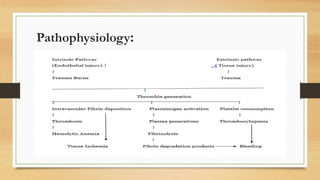
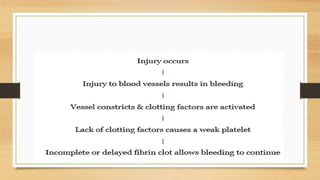
Pathophysiology:
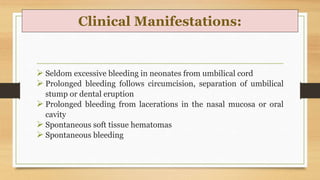
Clinical Manifestations:
 Seldom excessive bleeding in neonates from umbilical cord
 Prolonged bleeding follows circumcision, separation of umbilical
stump or dental eruption
 Prolonged bleeding from lacerations in the nasal mucosa or oral
cavity
 Spontaneous soft tissue hematomas
 Spontaneous bleeding
Contd….
 Hemorrhages into the joints (Hemarthrosis) especially in elbows,
knees & ankles causing pain, swelling & limitation of movement of
the involved joint.
 Spontaneous hematuria
 GI bleeding
 Bleeding from any site of the body
 Intracranial hemorrhage
Complications:
 Airway obstruction
 Intestinal obstruction
 Compartment syndrome due to compression of nerves by bleeding
into deep tissues
 Degenerative joint disease, osteoporosis & muscle atrophy due to
repeated Hemorrhage.
 Chronic hepatitis & cirrhosis due to contaminated cryoprecipitate
 Transfusion related infections
Diagnostic Evaluation:
1. Blood examination shows the following findings
o Prolonged clotting time & partial thromboplastin time.
o Reduced prothrombin consumption
o Increased thromboplastin level
o Bleeding time & prothrombin time are normal.
o Assays of specific clotting factors indicates deficient level
2. X-ray if the affected joints help to detect the severity & complications of Hemarthrosis
3. Gene analysis for antenatal diagnosis of hemophilia
4. DNA studies for detection of carrier of hemophilia.
Management:
• Objective:
The main objective of treatment is to ensure nearly to lead normal life for the child.
• Must replace missing coagulation factor through the administration of type specific
coagulation concentrates during bleeding episodes
• The specific management include the followings:
 Replacement of missing coagulation factors is the important aspect of management
o Factor-VIII made from cryoprecipitate
o Factor VIII concentrate is transfused in hemophilia A
o Factor Ix made from fresh frozen plasma is administered for hemophilia B
o Fresh frozen plasma is given to supply factor XI.
Management:
 Mild to moderate factor VIII deficient hemophiliacs may respond to
desmopressin which causes release of factor VIII from the endothelial
stores.
 Fresh whole blood transfusion can be given if the commercially prepared
coagulation factors are not readily available.
 Antifibrinolytics such as aminocaproic acid & tranexamic acid are given for
mucosal bleeding to prevent clot breakdown by salivary proteins & to
promote hemostasis.
Management:
 Supportive management in case of Hemarthrosis should include rest,
immobilization of joint, application of local cold & pressure bandage with
local application of thrombin powder or foam.
o Pain can be relieved by analgesic like paracetmol or NSAIDS.
o Aspirin, indomethacin & batezolidone are not used as they inhibit
platelet function & promote bleeding.
o Ambulation & exercise can be allowed after the acute phase is over. Later
local heat & physiotherapy should be given to prevent ankyloses of joint.
Management:
Synovectomy can be recommended to remove damage synovium
in chronically involved joints.
Orthotics can be used to prevent injury to affected joint & help to
resolve hemorrhages.
Prophylactic measures to be taken to prevent complications
Genetic counselling & antenatal diagnosis should be arranged
especially with positive family history of hemophilia
Nursing Diagnosis:
 Risk for fluid volume deficit related to hemorrhage
 Pain related to bleeding joints
 Potential for bleeding related to deficiency of clotting factors
 Impaired physical mobility related to Hemarthrosis
 Ineffective family coping related to life threatening illness.
Prognosis:
 Death may occur due to serious hemorrhage & obstructions due to
bleeding.
 Cripple patients may need rehabilitative services.
Hemophilia.pptx

Hemophilia.pptx

  • 1.
  • 2.
    Definition: • Hemophilia isan inherited bleeding disorder due to deficiency of plasma coagulation factors. It is primarily found in males but transmitted by female carriers. – Parul datta • Hemophilia is a congenital bleeding disorder caused by the genetic lack of at least one coagulation factor. – Dorothy R Marlow
  • 3.
    Definition: • The termhemophilia refers to a group of bleeding disorders in which there is a deficiency of one of the factors necessary for coagulation of the blood. Wong’s • Hemophilia is due to congenital deficiency of plasma coagulation factor VIII & factor IX. O.P.Ghai
  • 4.
    Incidence: Prevalence:  Occur 1in 5000 males  No racial prediction, found in all ethnic groups. Etiology:  Hereditary (approximately 80% of patients)  Transmitted by asymptomatic in females
  • 5.
    Classification: 1. Hemophilia-A (classical Hemophilia)- It occurs due to deficiency of plasma factor VIII, the antihemophilic factor (AHF). It accounts for 80 to 85% of all hemophilics. Hemophilia- A can be classified based upon the factor VIII level in plasma, They are as follows.  Severe Hemophilia A- In this condition, the factor level is found less than 1 percent of normal value patients have tendency of spontaneous bleeding & severe bleeding.  Moderate Hemophilia A- Factor level remains between 1 to 5 %of normal patients have no spontaneous bleeding & may not have severe bleeding until any trauma occurs.  Mild hemophilia A- Factor level is in between 6 to 30 percent of normal patients usually lead normal lives & bleeding only occurs in severe injury & surgical interventions.
  • 6.
    2. Hemophilia-B (Christmasdisease)- It results from deficiency of plasma factor IX, the plasma thromboplastin componenet (PTC). It accounts for about 15-20% of cases. 3. Hemophilia-C: It results from deficiency of factor XI, plasma thromboplastin antecedent (PTA). It accounts for fewcases only.
  • 7.
  • 9.
    Clinical Manifestations:  Seldomexcessive bleeding in neonates from umbilical cord  Prolonged bleeding follows circumcision, separation of umbilical stump or dental eruption  Prolonged bleeding from lacerations in the nasal mucosa or oral cavity  Spontaneous soft tissue hematomas  Spontaneous bleeding
  • 10.
    Contd….  Hemorrhages intothe joints (Hemarthrosis) especially in elbows, knees & ankles causing pain, swelling & limitation of movement of the involved joint.  Spontaneous hematuria  GI bleeding  Bleeding from any site of the body  Intracranial hemorrhage
  • 11.
    Complications:  Airway obstruction Intestinal obstruction  Compartment syndrome due to compression of nerves by bleeding into deep tissues  Degenerative joint disease, osteoporosis & muscle atrophy due to repeated Hemorrhage.  Chronic hepatitis & cirrhosis due to contaminated cryoprecipitate  Transfusion related infections
  • 12.
    Diagnostic Evaluation: 1. Bloodexamination shows the following findings o Prolonged clotting time & partial thromboplastin time. o Reduced prothrombin consumption o Increased thromboplastin level o Bleeding time & prothrombin time are normal. o Assays of specific clotting factors indicates deficient level 2. X-ray if the affected joints help to detect the severity & complications of Hemarthrosis 3. Gene analysis for antenatal diagnosis of hemophilia 4. DNA studies for detection of carrier of hemophilia.
  • 13.
    Management: • Objective: The mainobjective of treatment is to ensure nearly to lead normal life for the child. • Must replace missing coagulation factor through the administration of type specific coagulation concentrates during bleeding episodes • The specific management include the followings:  Replacement of missing coagulation factors is the important aspect of management o Factor-VIII made from cryoprecipitate o Factor VIII concentrate is transfused in hemophilia A o Factor Ix made from fresh frozen plasma is administered for hemophilia B o Fresh frozen plasma is given to supply factor XI.
  • 14.
    Management:  Mild tomoderate factor VIII deficient hemophiliacs may respond to desmopressin which causes release of factor VIII from the endothelial stores.  Fresh whole blood transfusion can be given if the commercially prepared coagulation factors are not readily available.  Antifibrinolytics such as aminocaproic acid & tranexamic acid are given for mucosal bleeding to prevent clot breakdown by salivary proteins & to promote hemostasis.
  • 15.
    Management:  Supportive managementin case of Hemarthrosis should include rest, immobilization of joint, application of local cold & pressure bandage with local application of thrombin powder or foam. o Pain can be relieved by analgesic like paracetmol or NSAIDS. o Aspirin, indomethacin & batezolidone are not used as they inhibit platelet function & promote bleeding. o Ambulation & exercise can be allowed after the acute phase is over. Later local heat & physiotherapy should be given to prevent ankyloses of joint.
  • 16.
    Management: Synovectomy can berecommended to remove damage synovium in chronically involved joints. Orthotics can be used to prevent injury to affected joint & help to resolve hemorrhages. Prophylactic measures to be taken to prevent complications Genetic counselling & antenatal diagnosis should be arranged especially with positive family history of hemophilia
  • 17.
    Nursing Diagnosis:  Riskfor fluid volume deficit related to hemorrhage  Pain related to bleeding joints  Potential for bleeding related to deficiency of clotting factors  Impaired physical mobility related to Hemarthrosis  Ineffective family coping related to life threatening illness.
  • 18.
    Prognosis:  Death mayoccur due to serious hemorrhage & obstructions due to bleeding.  Cripple patients may need rehabilitative services.