Web 2.0 Applications Tutorial
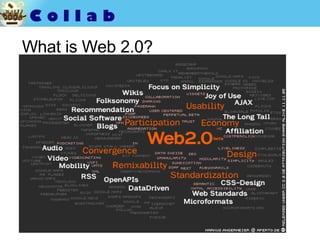
What is Web 2.0?
Web 2.0: the term Coined by T. O’Reilly  Used as a title for a series of conferences since 2004  Misleading No new designed version of the Web Impressive A simple ajax-based application now is called a Web 2.0 application
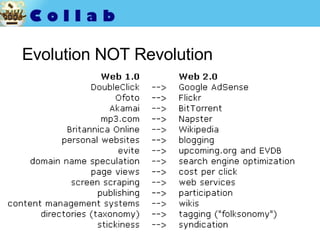
Evolution NOT Revolution
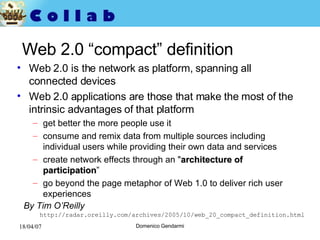
Web 2.0 “compact” definition Web 2.0 is the network as platform, spanning all connected devices Web 2.0 applications are those that make the most of the intrinsic advantages of that platform get better the more people use it consume and remix data from multiple sources including individual users while providing their own data and services  create network effects through an " architecture of participation ” go beyond the page metaphor of Web 1.0 to deliver rich user experiences  By Tim O’Reilly http://radar.oreilly.com/archives/2005/10/web_20_compact_definition.html
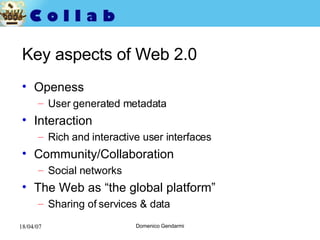
Key aspects of Web 2.0 Openess User generated metadata Interaction Rich and interactive user interfaces Community/Collaboration Social networks The Web as “the global platform” Sharing of services & data
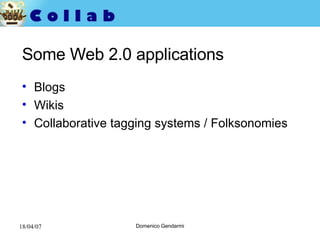
Some Web 2.0 applications Blogs Wikis Collaborative tagging systems / Folksonomies
Blogs
Blog Definition Weblog  = Web + Log A diary available on the Web that is frequently updated and intended for general public consumption
Blog Features Classical Background subject Content organized in posts presented in inverse chronological order Multilple roles: author, commentator, reader Asynchronous & asymmetric communication Extra Permalink  RSS feed Trackback / Pingback
Wikis
Wiki as a collaborative tool Web pages editing through the browser Replace HTML with an easier syntax or a editor WYSWYG Foster the creation of “au pair” online communities Users are at the same time authors and readers of the wiki pages
Principles :  a wiki is… Open Everybody can contribute Dynamic Automatic generation of links Incremental Each page can be always improved Simple HTML not mandatory Monitorable Previous versions are stored Uniform No distinction between author and reader
Basic functionalities :  a wiki provides… Editing and preview of pages Recent changes list History of versions  Comparison of versions and  Rollback Pages Index Search Easy links ( WikiWord e Link Pattern) Backlinks
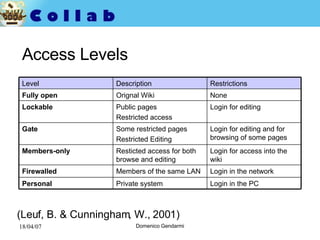
Access Levels (Leuf, B. & Cunningham, W., 2001) Restrictions Description Level Login in the PC Private system Personal   Login in the network Members of the same LAN Firewalled   Login for access into the wiki Resticted access for both browse and editing Members-only   Login for editing and for browsing of some pages Some restricted pages Restricted Editing Gate   Login for editing Public pages Restricted access Lockable   None Orignal Wiki Fully open
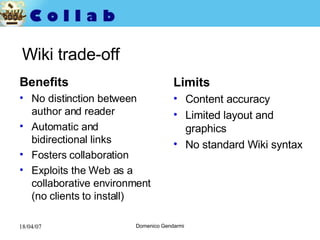
Wiki trade-off Benefits No distinction between author and reader Automatic and bidirectional links Fosters collaboration Exploits the Web as a collaborative environment (no clients to install)  Limits Content accuracy Limited layout and graphics No standard Wiki syntax
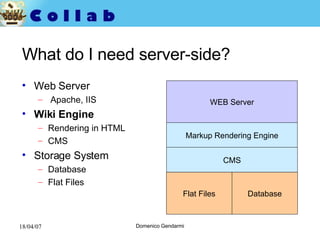
What do I need server-side? Web Server Apache, IIS Wiki Engine Rendering in HTML CMS Storage System Database Flat Files WEB Server Markup Rendering Engine CMS Flat Files Database
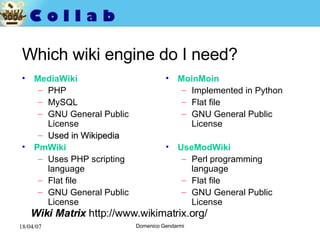
Which wiki engine do I need? MediaWiki PHP  MySQL  GNU General Public License Used in Wikipedia PmWiki   Uses PHP scripting language Flat file GNU General Public License MoinMoin Implemented in Python Flat file  GNU General Public License UseModWiki Perl programming language  Flat file GNU General Public License Wiki Matrix  http://www.wikimatrix.org/
Collaborative Tagging
Folksonomy or Collaborative Tagging? Folksonomy Folk ” + “ Taxonomy ” (taxonomy of the people) Broad or Narrow  Collaborative Tagging Each user tag items individually that aggregate at at a higher level via a  collaborative action The creation of metadata is shifted from an individual professional activity to a collective endeavor
Features Bottom-up (Created by Users) No structure No fixed vocabulary No explicit relationships   between terms No authority Distribution Collaboration
What’s new? Collaboration You can tag items owned by others Instant feedback  All items with the same tag All tags for the same item Communication through shared metadata Tight feedback loop Negotiation about the meaning of the terms You could adapt your tags to the group norm Never forced
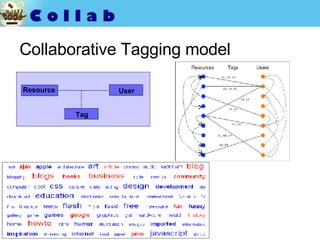
Collaborative Tagging model User Resource Tag
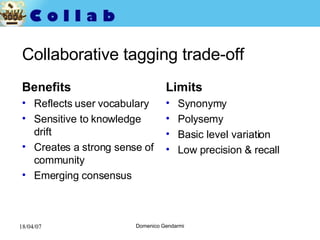
Collaborative tagging trade-off Benefits Reflects user vocabulary Sensitive to knowledge drift Creates a strong sense of community Emerging consensus Limits Synonymy Polysemy Basic level variation Low precision & recall
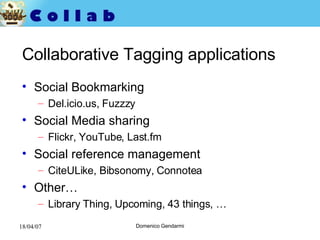
Collaborative Tagging applications Social Bookmarking Del.icio.us, Fuzzzy Social Media sharing Flickr, YouTube, Last.fm Social reference management CiteULike, Bibsonomy, Connotea Other… Library Thing, Upcoming, 43 things, …
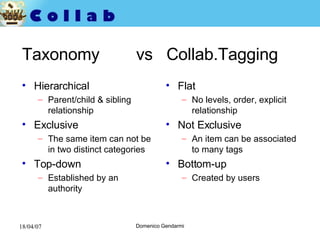
Taxonomy  vs  Collab.Tagging Hierarchical Parent/child & sibling relationship Exclusive The same item can not be in two distinct categories Top-down Established by an authority Flat No levels, order, explicit relationship Not Exclusive An item can be associated to many tags Bottom-up Created by users
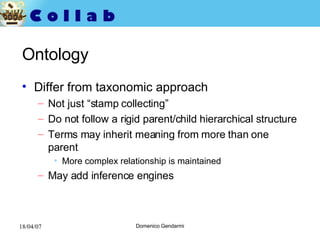
Ontology Differ from taxonomic approach Not just “stamp collecting”  Do not follow a rigid parent/child hierarchical structure Terms may inherit meaning from more than one parent More complex relationship is maintained May add inference engines
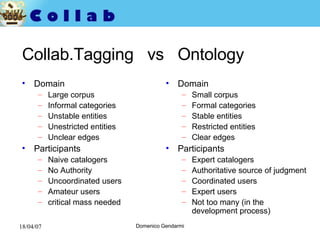
Collab.Tagging  vs  Ontology Domain Large corpus Informal categories Unstable entities Unestricted entities Unclear edges Participants Naive catalogers No Authority Uncoordinated users Amateur users critical mass needed Domain Small corpus Formal categories Stable entities Restricted entities Clear edges Participants Expert catalogers Authoritative source of judgment Coordinated users Expert users Not too many (in the development process)
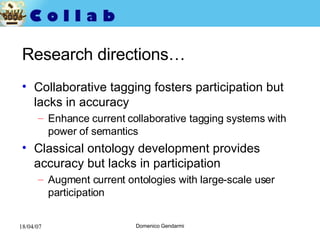
Research directions… Collaborative tagging fosters participation but lacks in accuracy Enhance current collaborative tagging systems with power of semantics Classical ontology development provides accuracy but lacks in participation Augment current ontologies with large-scale user participation
Selected references O'Reilly, T.:  What is Web 2.0 . (2005)   Leuf, B. & Cunningham, W.:  The Wiki way: Quick collaboration on the Web.  Upper Saddle River, NJ, USA: Addison Wesley. (2001) Speller, E.:  Collaborative tagging, folksonomies, distributed classification or ethnoclassification: a literature review . Library Student Journal. (2007) Golder, S. A., Huberman, B. A.,  The Structure of Collaborative Tagging Systems . ( 2005) Gendarmi,D., Abbattista,F. and Lanubile,F.:  Fostering knowledge evolution through community-based participation . Workshop on Social and Collaborative Construction of Structured Knowledge at WWW’07, (2007) Gendarmi,D. and Lanubile,F.:  Community-Driven Ontology Evolution Based on Folksonomies . Community Informatics Workshop at OTM’06, (2006)

Web2.0 Applications

  • 1.
  • 2.
  • 3.
    Web 2.0: theterm Coined by T. O’Reilly Used as a title for a series of conferences since 2004 Misleading No new designed version of the Web Impressive A simple ajax-based application now is called a Web 2.0 application
  • 4.
  • 5.
    Web 2.0 “compact”definition Web 2.0 is the network as platform, spanning all connected devices Web 2.0 applications are those that make the most of the intrinsic advantages of that platform get better the more people use it consume and remix data from multiple sources including individual users while providing their own data and services create network effects through an " architecture of participation ” go beyond the page metaphor of Web 1.0 to deliver rich user experiences By Tim O’Reilly http://radar.oreilly.com/archives/2005/10/web_20_compact_definition.html
  • 6.
    Key aspects ofWeb 2.0 Openess User generated metadata Interaction Rich and interactive user interfaces Community/Collaboration Social networks The Web as “the global platform” Sharing of services & data
  • 7.
    Some Web 2.0applications Blogs Wikis Collaborative tagging systems / Folksonomies
  • 8.
  • 9.
    Blog Definition Weblog = Web + Log A diary available on the Web that is frequently updated and intended for general public consumption
  • 10.
    Blog Features ClassicalBackground subject Content organized in posts presented in inverse chronological order Multilple roles: author, commentator, reader Asynchronous & asymmetric communication Extra Permalink RSS feed Trackback / Pingback
  • 11.
  • 12.
    Wiki as acollaborative tool Web pages editing through the browser Replace HTML with an easier syntax or a editor WYSWYG Foster the creation of “au pair” online communities Users are at the same time authors and readers of the wiki pages
  • 13.
    Principles : a wiki is… Open Everybody can contribute Dynamic Automatic generation of links Incremental Each page can be always improved Simple HTML not mandatory Monitorable Previous versions are stored Uniform No distinction between author and reader
  • 14.
    Basic functionalities : a wiki provides… Editing and preview of pages Recent changes list History of versions Comparison of versions and Rollback Pages Index Search Easy links ( WikiWord e Link Pattern) Backlinks
  • 15.
    Access Levels (Leuf,B. & Cunningham, W., 2001) Restrictions Description Level Login in the PC Private system Personal Login in the network Members of the same LAN Firewalled Login for access into the wiki Resticted access for both browse and editing Members-only Login for editing and for browsing of some pages Some restricted pages Restricted Editing Gate Login for editing Public pages Restricted access Lockable None Orignal Wiki Fully open
  • 16.
    Wiki trade-off BenefitsNo distinction between author and reader Automatic and bidirectional links Fosters collaboration Exploits the Web as a collaborative environment (no clients to install) Limits Content accuracy Limited layout and graphics No standard Wiki syntax
  • 17.
    What do Ineed server-side? Web Server Apache, IIS Wiki Engine Rendering in HTML CMS Storage System Database Flat Files WEB Server Markup Rendering Engine CMS Flat Files Database
  • 18.
    Which wiki enginedo I need? MediaWiki PHP MySQL GNU General Public License Used in Wikipedia PmWiki Uses PHP scripting language Flat file GNU General Public License MoinMoin Implemented in Python Flat file GNU General Public License UseModWiki Perl programming language Flat file GNU General Public License Wiki Matrix http://www.wikimatrix.org/
  • 19.
  • 20.
    Folksonomy or CollaborativeTagging? Folksonomy Folk ” + “ Taxonomy ” (taxonomy of the people) Broad or Narrow Collaborative Tagging Each user tag items individually that aggregate at at a higher level via a collaborative action The creation of metadata is shifted from an individual professional activity to a collective endeavor
  • 21.
    Features Bottom-up (Createdby Users) No structure No fixed vocabulary No explicit relationships between terms No authority Distribution Collaboration
  • 22.
    What’s new? CollaborationYou can tag items owned by others Instant feedback All items with the same tag All tags for the same item Communication through shared metadata Tight feedback loop Negotiation about the meaning of the terms You could adapt your tags to the group norm Never forced
  • 23.
    Collaborative Tagging modelUser Resource Tag
  • 24.
    Collaborative tagging trade-offBenefits Reflects user vocabulary Sensitive to knowledge drift Creates a strong sense of community Emerging consensus Limits Synonymy Polysemy Basic level variation Low precision & recall
  • 25.
    Collaborative Tagging applicationsSocial Bookmarking Del.icio.us, Fuzzzy Social Media sharing Flickr, YouTube, Last.fm Social reference management CiteULike, Bibsonomy, Connotea Other… Library Thing, Upcoming, 43 things, …
  • 26.
    Taxonomy vs Collab.Tagging Hierarchical Parent/child & sibling relationship Exclusive The same item can not be in two distinct categories Top-down Established by an authority Flat No levels, order, explicit relationship Not Exclusive An item can be associated to many tags Bottom-up Created by users
  • 27.
    Ontology Differ fromtaxonomic approach Not just “stamp collecting” Do not follow a rigid parent/child hierarchical structure Terms may inherit meaning from more than one parent More complex relationship is maintained May add inference engines
  • 28.
    Collab.Tagging vs Ontology Domain Large corpus Informal categories Unstable entities Unestricted entities Unclear edges Participants Naive catalogers No Authority Uncoordinated users Amateur users critical mass needed Domain Small corpus Formal categories Stable entities Restricted entities Clear edges Participants Expert catalogers Authoritative source of judgment Coordinated users Expert users Not too many (in the development process)
  • 29.
    Research directions… Collaborativetagging fosters participation but lacks in accuracy Enhance current collaborative tagging systems with power of semantics Classical ontology development provides accuracy but lacks in participation Augment current ontologies with large-scale user participation
  • 30.
    Selected references O'Reilly,T.: What is Web 2.0 . (2005) Leuf, B. & Cunningham, W.: The Wiki way: Quick collaboration on the Web. Upper Saddle River, NJ, USA: Addison Wesley. (2001) Speller, E.: Collaborative tagging, folksonomies, distributed classification or ethnoclassification: a literature review . Library Student Journal. (2007) Golder, S. A., Huberman, B. A., The Structure of Collaborative Tagging Systems . ( 2005) Gendarmi,D., Abbattista,F. and Lanubile,F.: Fostering knowledge evolution through community-based participation . Workshop on Social and Collaborative Construction of Structured Knowledge at WWW’07, (2007) Gendarmi,D. and Lanubile,F.: Community-Driven Ontology Evolution Based on Folksonomies . Community Informatics Workshop at OTM’06, (2006)