Notes on Spectral Clustering
             Politecnico di Milano, 28/05/2012


                        Davide Eynard
    Institute of Computational Sciences - Faculty of Informatics
                  Università della Svizzera Italiana
                      davide.eynard@usi.ch
Talk outline

    Spectral Clustering
            Distances and similarity graphs
            Graph Laplacians and their properties
            Spectral clustering algorithms
            SC under the hood


24/04/2011                  Notes on Spectral Clustering and Joint Diagonalization   2/15
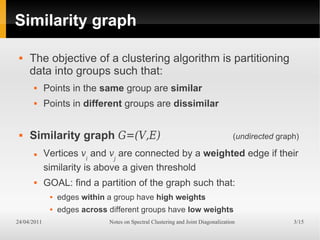
Similarity graph

    The objective of a clustering algorithm is partitioning
     data into groups such that:
            Points in the same group are similar
            Points in different groups are dissimilar


    Similarity graph G=(V,E)                                                       (undirected graph)

            Vertices vi and vj are connected by a weighted edge if their
             similarity is above a given threshold
            GOAL: find a partition of the graph such that:
                 edges within a group have high weights
                 edges across different groups have low weights
24/04/2011                     Notes on Spectral Clustering and Joint Diagonalization               3/15
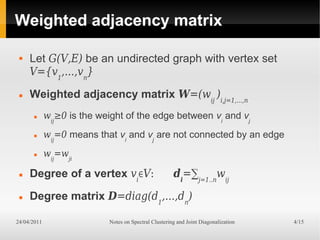
Weighted adjacency matrix

    Let G(V,E) be an undirected graph with vertex set
     V={v1,...,vn}
    Weighted adjacency matrix W=(wij )i,j=1,...,n
            wij≥0 is the weight of the edge between vi and vj
            wij=0 means that vi and vj are not connected by an edge
            wij=wji

    Degree of a vertex vi∈V:                          di=∑j=1..nwij
    Degree matrix D=diag(d1,...,dn)

24/04/2011                  Notes on Spectral Clustering and Joint Diagonalization   4/15
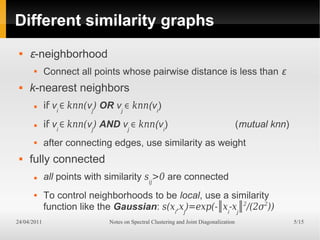
Different similarity graphs
 
     ε-neighborhood
            Connect all points whose pairwise distance is less than ε
    k-nearest neighbors
            if vi ∈ knn(vj) OR vj ∈ knn(vi)
            if vi ∈ knn(vj) AND vj ∈ knn(vi)                                          (mutual knn)
            after connecting edges, use similarity as weight
    fully connected
            all points with similarity sij>0 are connected
            To control neighborhoods to be local, use a similarity
             function like the Gaussian: s(xi,xj)=exp(-║xi-xj║2/(2σ2))
24/04/2011                    Notes on Spectral Clustering and Joint Diagonalization                  5/15
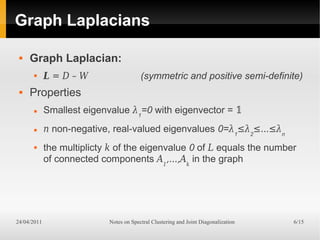
Graph Laplacians

    Graph Laplacian:
            L=D–W                       (symmetric and positive semi-definite)
    Properties
            Smallest eigenvalue λ1=0 with eigenvector = �
            n non-negative, real-valued eigenvalues 0=λ1≤λ2≤...≤λn
            the multiplicty k of the eigenvalue 0 of L equals the number
             of connected components A1,...,Ak in the graph


24/04/2011                  Notes on Spectral Clustering and Joint Diagonalization   6/15
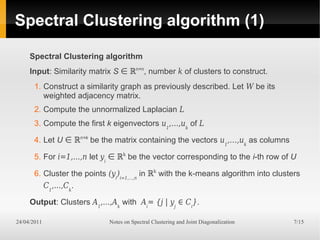
Spectral Clustering algorithm (1)

     Spectral Clustering algorithm
     Input: Similarity matrix S ∈ ℝn×n, number k of clusters to construct.
       1. Construct a similarity graph as previously described. Let W be its
          weighted adjacency matrix.
       2. Compute the unnormalized Laplacian L
       3. Compute the first k eigenvectors u1,…,uk of L

       4. Let U ∈ ℝn×k be the matrix containing the vectors u1,…,uk as columns

       5. For i=1,...,n let yi ∈ ℝk be the vector corresponding to the i-th row of U

       6. Cluster the points (yi)i=1,...,n in ℝk with the k-means algorithm into clusters
          C1,...,Ck.

     Output: Clusters A1,...,Ak with Ai= {j | yj ∈ Ci}.

24/04/2011                    Notes on Spectral Clustering and Joint Diagonalization   7/15
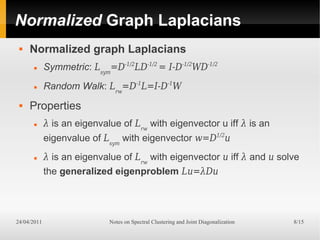
Normalized Graph Laplacians
    Normalized graph Laplacians
            Symmetric: Lsym=D-1/2LD-1/2 = I-D-1/2WD-1/2
            Random Walk: Lrw=D-1L=I-D-1W
    Properties
            λ is an eigenvalue of Lrw with eigenvector u iff λ is an
             eigenvalue of Lsym with eigenvector w=D1/2u
            λ is an eigenvalue of Lrw with eigenvector u iff λ and u solve
             the generalized eigenproblem Lu=λDu


24/04/2011                   Notes on Spectral Clustering and Joint Diagonalization   8/15
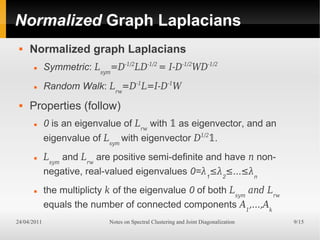
Normalized Graph Laplacians
    Normalized graph Laplacians
            Symmetric: Lsym=D-1/2LD-1/2 = I-D-1/2WD-1/2
            Random Walk: Lrw=D-1L=I-D-1W
    Properties (follow)
            0 is an eigenvalue of Lrw with � as eigenvector, and an
             eigenvalue of Lsym with eigenvector D1/2�.
            Lsym and Lrw are positive semi-definite and have n non-
             negative, real-valued eigenvalues 0=λ1≤λ2≤...≤λn
            the multiplicty k of the eigenvalue 0 of both Lsym and Lrw
             equals the number of connected components A1,...,Ak
24/04/2011                   Notes on Spectral Clustering and Joint Diagonalization   9/15
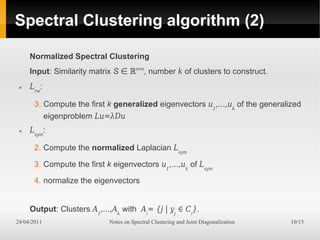
Spectral Clustering algorithm (2)

     Normalized Spectral Clustering
     Input: Similarity matrix S ∈ ℝn×n, number k of clusters to construct.
    Lrw:

       3. Compute the first k generalized eigenvectors u1,…,uk of the generalized
          eigenproblem Lu=λDu
    Lsym:

       2. Compute the normalized Laplacian Lsym

       3. Compute the first k eigenvectors u1,…,uk of Lsym

       4. normalize the eigenvectors


     Output: Clusters A1,...,Ak with Ai= {j | yj ∈ Ci}.
24/04/2011                  Notes on Spectral Clustering and Joint Diagonalization   10/15
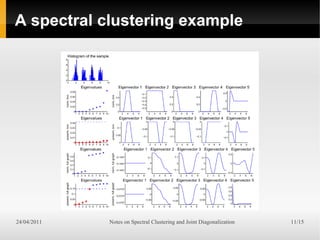
A spectral clustering example


24/04/2011   Notes on Spectral Clustering and Joint Diagonalization   11/15
Under the hood

    0-eigenvalues in the ideal case
    parameters are crucial:
            k in k nearest neighbors
       
             σ in Gaussian kernel
            k (another one!) in k-means


24/04/2011                  Notes on Spectral Clustering and Joint Diagonalization   12/15
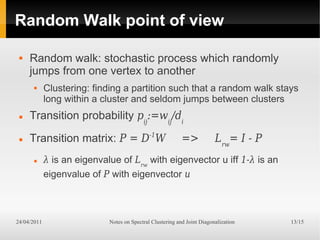
Random Walk point of view

    Random walk: stochastic process which randomly
     jumps from one vertex to another
            Clustering: finding a partition such that a random walk stays
             long within a cluster and seldom jumps between clusters
    Transition probability pij:=wij/di
    Transition matrix: P = D-1W                            =>            Lrw= I - P
            λ is an eigenvalue of Lrw with eigenvector u iff 1-λ is an
             eigenvalue of P with eigenvector u


24/04/2011                   Notes on Spectral Clustering and Joint Diagonalization    13/15
References

    Von Luxburg, U. (2007). A tutorial on spectral clustering.
     Statistics and Computing, 17(4), 395-416. Springer.


24/04/2011              Notes on Spectral Clustering and Joint Diagonalization   14/15
Thank you!


             Thanks for your attention!

                        Questions?


24/04/2011       Notes on Spectral Clustering and Joint Diagonalization   15/15

Notes on Spectral Clustering

  • 1.
    Notes on SpectralClustering Politecnico di Milano, 28/05/2012 Davide Eynard Institute of Computational Sciences - Faculty of Informatics Università della Svizzera Italiana davide.eynard@usi.ch
  • 2.
    Talk outline  Spectral Clustering  Distances and similarity graphs  Graph Laplacians and their properties  Spectral clustering algorithms  SC under the hood 24/04/2011 Notes on Spectral Clustering and Joint Diagonalization 2/15
  • 3.
    Similarity graph  The objective of a clustering algorithm is partitioning data into groups such that:  Points in the same group are similar  Points in different groups are dissimilar  Similarity graph G=(V,E) (undirected graph)  Vertices vi and vj are connected by a weighted edge if their similarity is above a given threshold  GOAL: find a partition of the graph such that:  edges within a group have high weights  edges across different groups have low weights 24/04/2011 Notes on Spectral Clustering and Joint Diagonalization 3/15
  • 4.
    Weighted adjacency matrix  Let G(V,E) be an undirected graph with vertex set V={v1,...,vn}  Weighted adjacency matrix W=(wij )i,j=1,...,n  wij≥0 is the weight of the edge between vi and vj  wij=0 means that vi and vj are not connected by an edge  wij=wji  Degree of a vertex vi∈V: di=∑j=1..nwij  Degree matrix D=diag(d1,...,dn) 24/04/2011 Notes on Spectral Clustering and Joint Diagonalization 4/15
  • 5.
    Different similarity graphs  ε-neighborhood  Connect all points whose pairwise distance is less than ε  k-nearest neighbors  if vi ∈ knn(vj) OR vj ∈ knn(vi)  if vi ∈ knn(vj) AND vj ∈ knn(vi) (mutual knn)  after connecting edges, use similarity as weight  fully connected  all points with similarity sij>0 are connected  To control neighborhoods to be local, use a similarity function like the Gaussian: s(xi,xj)=exp(-║xi-xj║2/(2σ2)) 24/04/2011 Notes on Spectral Clustering and Joint Diagonalization 5/15
  • 6.
    Graph Laplacians  Graph Laplacian:  L=D–W (symmetric and positive semi-definite)  Properties  Smallest eigenvalue λ1=0 with eigenvector = �  n non-negative, real-valued eigenvalues 0=λ1≤λ2≤...≤λn  the multiplicty k of the eigenvalue 0 of L equals the number of connected components A1,...,Ak in the graph 24/04/2011 Notes on Spectral Clustering and Joint Diagonalization 6/15
  • 7.
    Spectral Clustering algorithm(1) Spectral Clustering algorithm Input: Similarity matrix S ∈ ℝn×n, number k of clusters to construct. 1. Construct a similarity graph as previously described. Let W be its weighted adjacency matrix. 2. Compute the unnormalized Laplacian L 3. Compute the first k eigenvectors u1,…,uk of L 4. Let U ∈ ℝn×k be the matrix containing the vectors u1,…,uk as columns 5. For i=1,...,n let yi ∈ ℝk be the vector corresponding to the i-th row of U 6. Cluster the points (yi)i=1,...,n in ℝk with the k-means algorithm into clusters C1,...,Ck. Output: Clusters A1,...,Ak with Ai= {j | yj ∈ Ci}. 24/04/2011 Notes on Spectral Clustering and Joint Diagonalization 7/15
  • 8.
    Normalized Graph Laplacians  Normalized graph Laplacians  Symmetric: Lsym=D-1/2LD-1/2 = I-D-1/2WD-1/2  Random Walk: Lrw=D-1L=I-D-1W  Properties  λ is an eigenvalue of Lrw with eigenvector u iff λ is an eigenvalue of Lsym with eigenvector w=D1/2u  λ is an eigenvalue of Lrw with eigenvector u iff λ and u solve the generalized eigenproblem Lu=λDu 24/04/2011 Notes on Spectral Clustering and Joint Diagonalization 8/15
  • 9.
    Normalized Graph Laplacians  Normalized graph Laplacians  Symmetric: Lsym=D-1/2LD-1/2 = I-D-1/2WD-1/2  Random Walk: Lrw=D-1L=I-D-1W  Properties (follow)  0 is an eigenvalue of Lrw with � as eigenvector, and an eigenvalue of Lsym with eigenvector D1/2�.  Lsym and Lrw are positive semi-definite and have n non- negative, real-valued eigenvalues 0=λ1≤λ2≤...≤λn  the multiplicty k of the eigenvalue 0 of both Lsym and Lrw equals the number of connected components A1,...,Ak 24/04/2011 Notes on Spectral Clustering and Joint Diagonalization 9/15
  • 10.
    Spectral Clustering algorithm(2) Normalized Spectral Clustering Input: Similarity matrix S ∈ ℝn×n, number k of clusters to construct.  Lrw: 3. Compute the first k generalized eigenvectors u1,…,uk of the generalized eigenproblem Lu=λDu  Lsym: 2. Compute the normalized Laplacian Lsym 3. Compute the first k eigenvectors u1,…,uk of Lsym 4. normalize the eigenvectors Output: Clusters A1,...,Ak with Ai= {j | yj ∈ Ci}. 24/04/2011 Notes on Spectral Clustering and Joint Diagonalization 10/15
  • 11.
    A spectral clusteringexample 24/04/2011 Notes on Spectral Clustering and Joint Diagonalization 11/15
  • 12.
    Under the hood  0-eigenvalues in the ideal case  parameters are crucial:  k in k nearest neighbors  σ in Gaussian kernel  k (another one!) in k-means 24/04/2011 Notes on Spectral Clustering and Joint Diagonalization 12/15
  • 13.
    Random Walk pointof view  Random walk: stochastic process which randomly jumps from one vertex to another  Clustering: finding a partition such that a random walk stays long within a cluster and seldom jumps between clusters  Transition probability pij:=wij/di  Transition matrix: P = D-1W => Lrw= I - P  λ is an eigenvalue of Lrw with eigenvector u iff 1-λ is an eigenvalue of P with eigenvector u 24/04/2011 Notes on Spectral Clustering and Joint Diagonalization 13/15
  • 14.
    References  Von Luxburg, U. (2007). A tutorial on spectral clustering. Statistics and Computing, 17(4), 395-416. Springer. 24/04/2011 Notes on Spectral Clustering and Joint Diagonalization 14/15
  • 15.
    Thank you! Thanks for your attention! Questions? 24/04/2011 Notes on Spectral Clustering and Joint Diagonalization 15/15